Overview
Divisibility is one of the most fundamental and frequently tested concepts in GMAT Quantitative Reasoning. At its core, divisibility concerns whether one integer can be divided by another integer without leaving a remainder. While this may sound elementary, GMAT divisibility questions often layer multiple concepts together, testing not just computational ability but also logical reasoning and pattern recognition. Questions involving divisibility appear across problem-solving and data sufficiency formats, often disguised within word problems about remainders, factors, multiples, prime factorization, and number properties.
Understanding divisibility is essential because it serves as the foundation for numerous other arithmetic and algebra concepts tested on the GMAT. Mastery of divisibility rules enables rapid mental calculation, allowing test-takers to eliminate answer choices efficiently and solve complex problems involving least common multiples (LCM), greatest common divisors (GCD), prime numbers, and modular arithmetic. The GMAT frequently combines divisibility with other topics such as sequences, ratios, and even geometry problems involving integer constraints.
The strategic importance of divisibility cannot be overstated. Questions testing this concept appear in approximately 15-20% of GMAT Quantitative sections, and they often serve as building blocks for more complex multi-step problems. Students who develop fluency with divisibility rules and their applications gain a significant time advantage on test day, as they can quickly identify patterns, test cases systematically, and recognize when numbers must satisfy specific divisibility constraints. This topic bridges pure arithmetic with algebraic reasoning, making it indispensable for achieving a competitive Quantitative score.
Learning Objectives
- [ ] Identify divisibility relationships between integers
- [ ] Explain divisibility rules for common divisors (2, 3, 4, 5, 6, 8, 9, 10, 11)
- [ ] Apply divisibility concepts to solve GMAT problem-solving questions
- [ ] Determine divisibility in data sufficiency questions with incomplete information
- [ ] Combine multiple divisibility rules to solve complex multi-constraint problems
- [ ] Recognize divisibility patterns in algebraic expressions and variables
- [ ] Use divisibility to eliminate incorrect answer choices efficiently
Prerequisites
- Basic integer operations: Understanding addition, subtraction, multiplication, and division is essential for recognizing when one number divides evenly into another
- Factors and multiples: Knowledge of what constitutes a factor or multiple provides the conceptual foundation for divisibility relationships
- Remainders: Familiarity with division remainders helps distinguish between divisible and non-divisible cases
- Prime numbers: Understanding primes is necessary for applying prime factorization methods in divisibility problems
- Place value: Recognizing the value of digits in different positions enables application of digit-based divisibility rules
Why This Topic Matters
Divisibility extends far beyond academic mathematics into practical real-world applications. Scheduling problems, resource allocation, packaging optimization, and financial calculations all rely on divisibility principles. When determining whether items can be evenly distributed, whether time intervals align, or whether quantities can be grouped without remainder, divisibility provides the analytical framework.
On the GMAT specifically, divisibility appears in approximately 15-20% of Quantitative questions, making it one of the highest-yield topics for focused study. Questions may directly test divisibility rules, or they may embed divisibility within problems about consecutive integers, digit problems, remainder problems, or algebraic expressions with integer constraints. Data sufficiency questions particularly favor divisibility concepts because they test whether given information is sufficient to determine divisibility relationships without requiring actual calculation.
Common GMAT question formats include: determining whether a number with specific digit properties is divisible by another number; finding how many integers in a range satisfy certain divisibility conditions; identifying the remainder when complex expressions are divided by small integers; and determining whether algebraic expressions must be divisible by specific values. The GMAT also frequently tests divisibility in "must be true" questions, where understanding divisibility rules allows rapid elimination of incorrect choices. Mastering this topic provides both direct point-scoring opportunities and time-saving shortcuts that create capacity for tackling more challenging problems.
Core Concepts
Fundamental Definition of Divisibility
An integer a is divisible by a non-zero integer b if there exists an integer q such that a = b × q. In simpler terms, a is divisible by b when b divides into a evenly, leaving no remainder. We express this relationship using the notation b|a (read as "b divides a"). For example, 15 is divisible by 3 because 15 = 3 × 5, where 5 is an integer. Conversely, 17 is not divisible by 3 because 17 ÷ 3 = 5 remainder 2, and no integer multiplied by 3 equals 17.
The concept of divisibility is intimately connected to factors and multiples. If a is divisible by b, then b is a factor of a, and a is a multiple of b. This reciprocal relationship appears frequently in GMAT questions that ask about factor counts, multiple identification, or relationships between numbers.
Divisibility Rules for Common Divisors
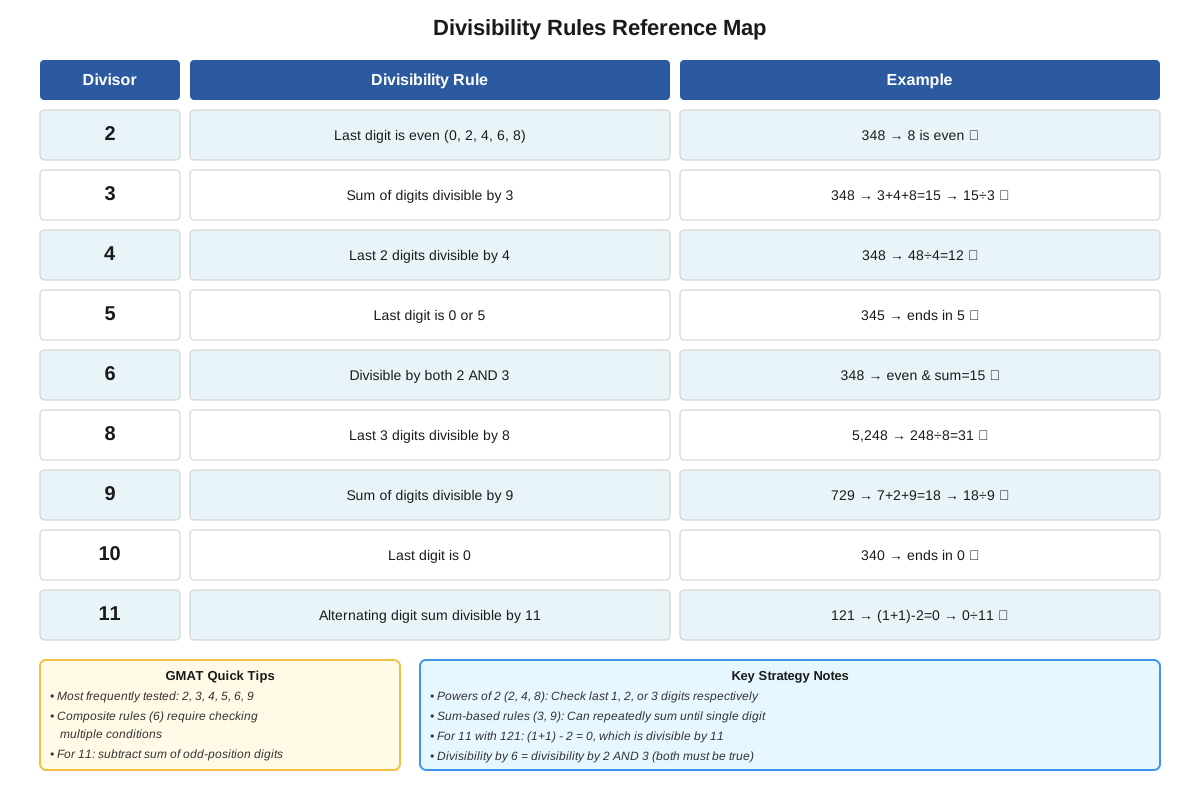
The GMAT heavily tests knowledge of divisibility rules—shortcuts that allow determination of divisibility without performing full division. These rules are based on digit patterns and place value properties:
Divisibility by 2: A number is divisible by 2 if and only if its last digit (units digit) is even (0, 2, 4, 6, or 8). This rule works because 10, 100, 1000, and all higher powers of 10 are divisible by 2, so only the units digit matters.
Divisibility by 3: A number is divisible by 3 if and only if the sum of its digits is divisible by 3. For example, 2,547 has digit sum 2+5+4+7 = 18, and since 18 is divisible by 3, so is 2,547. This rule derives from the fact that 10 ≡ 1 (mod 3), making each digit's contribution to divisibility equal to its face value.
Divisibility by 4: A number is divisible by 4 if and only if its last two digits form a number divisible by 4. Since 100 is divisible by 4, only the last two digits affect divisibility by 4. For example, 3,728 is divisible by 4 because 28 is divisible by 4.
Divisibility by 5: A number is divisible by 5 if and only if its last digit is 0 or 5. This follows from the fact that 10 is divisible by 5.
Divisibility by 6: A number is divisible by 6 if and only if it is divisible by both 2 and 3. Since 6 = 2 × 3 and 2 and 3 are coprime (share no common factors), a number must satisfy both conditions.
Divisibility by 8: A number is divisible by 8 if and only if its last three digits form a number divisible by 8. Since 1,000 is divisible by 8, only the last three digits matter.
Divisibility by 9: A number is divisible by 9 if and only if the sum of its digits is divisible by 9. This rule parallels the divisibility rule for 3 but requires the stricter condition that the digit sum be divisible by 9.
Divisibility by 10: A number is divisible by 10 if and only if its last digit is 0.
Divisibility by 11: A number is divisible by 11 if and only if the alternating sum of its digits is divisible by 11. For a number with digits d₁d₂d₃d₄..., calculate (d₁ - d₂ + d₃ - d₄ + ...). For example, 2,728 has alternating sum 2 - 7 + 2 - 8 = -11, which is divisible by 11, so 2,728 is divisible by 11.
Divisibility with Prime Factorization
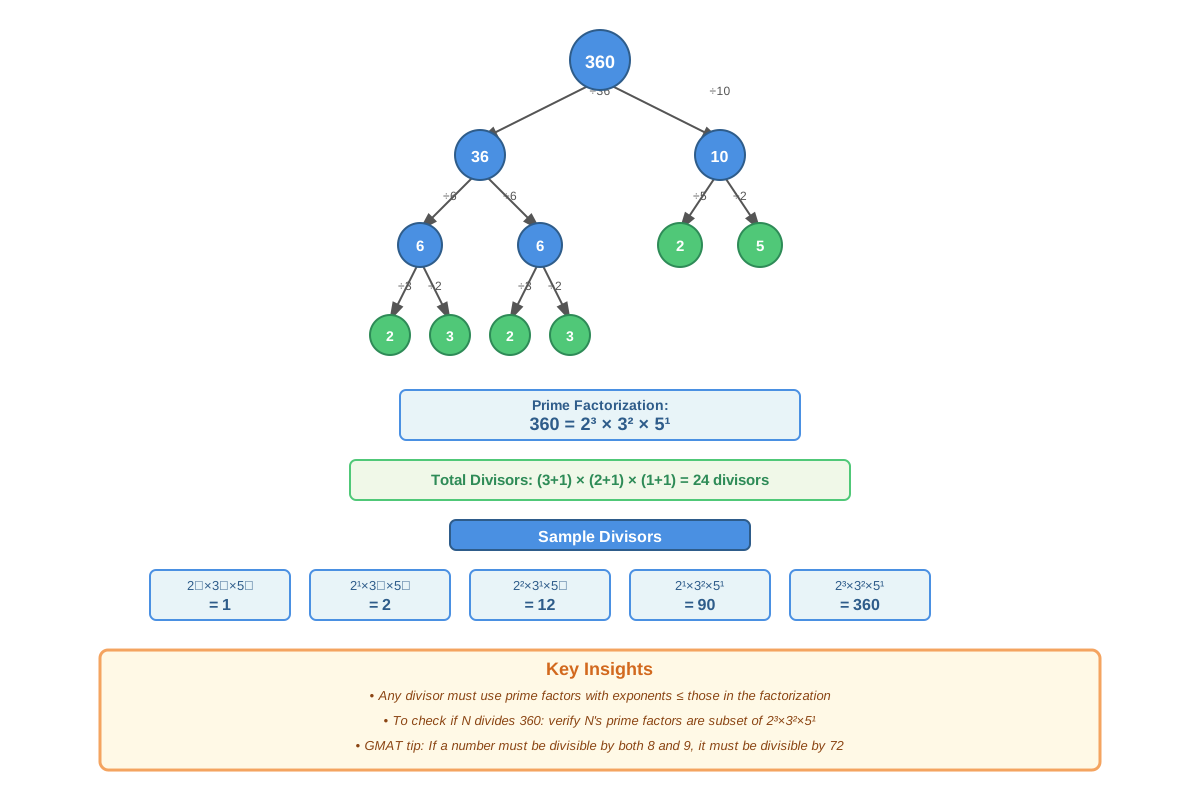
Prime factorization provides a powerful method for determining divisibility. Any integer greater than 1 can be expressed uniquely as a product of prime numbers. For one number to be divisible by another, the first number's prime factorization must contain all the prime factors of the second number, with at least the same exponents.
For example, consider whether 360 is divisible by 24. First, find prime factorizations:
- 360 = 2³ × 3² × 5
- 24 = 2³ × 3
Since 360's factorization contains 2³ (matching 24's requirement) and 3² (exceeding 24's requirement of 3¹), and the extra factor of 5 doesn't prevent divisibility, 360 is divisible by 24.
This method is particularly useful for GMAT questions involving variables or when determining divisibility by composite numbers without obvious digit rules.
Divisibility Properties and Theorems
Several key properties govern divisibility relationships:
Transitivity: If a|b and b|c, then a|c. For example, if 3|12 and 12|36, then 3|36.
Linear Combination: If a|b and a|c, then a|(bx + cy) for any integers x and y. This means if a number divides two quantities, it also divides any linear combination of those quantities.
Product Rule: If a|b, then a|(b × c) for any integer c. If a number divides another, it also divides any multiple of that number.
GCD Property: If d = gcd(a,b), then any common divisor of a and b must also divide d.
These properties enable sophisticated reasoning in GMAT problems, particularly in data sufficiency questions where establishing divisibility relationships without calculation is crucial.
Divisibility in Algebraic Expressions
The GMAT frequently tests divisibility with algebraic expressions involving variables. Key patterns include:
Consecutive integers: The product of n consecutive integers is always divisible by n!. For example, the product of any 3 consecutive integers is divisible by 6 (since 3! = 6).
Even and odd patterns: The sum or difference of two even numbers is even; the sum or difference of two odd numbers is even; the sum or difference of an even and odd number is odd. The product of any even number with any integer is even.
Difference of powers: x^n - y^n is always divisible by (x - y). For example, a³ - b³ is divisible by (a - b).
Sum of odd powers: x^n + y^n is divisible by (x + y) when n is odd.
Understanding these patterns allows rapid evaluation of "must be true" questions without testing specific values.
Concept Relationships
Divisibility serves as the foundational concept connecting multiple arithmetic topics. The relationship flow begins with basic division → which defines divisibility → which determines factors and multiples → which enables prime factorization → which facilitates GCD and LCM calculations → which support fraction simplification and ratio problems.
Within divisibility itself, the concepts interconnect hierarchically. Basic divisibility definition establishes the framework, while divisibility rules provide computational shortcuts. Prime factorization offers a systematic method that works universally, and divisibility properties enable logical deduction without calculation. Algebraic divisibility extends these principles to variable expressions, bridging arithmetic and algebra.
Divisibility also connects forward to more advanced GMAT topics. Understanding divisibility is prerequisite for remainder problems (which test non-divisibility cases), modular arithmetic (which generalizes remainder patterns), number theory problems (which often involve divisibility constraints), and combinatorics (where divisibility determines valid groupings). Even geometry problems occasionally require divisibility reasoning when dealing with integer side lengths or area constraints.
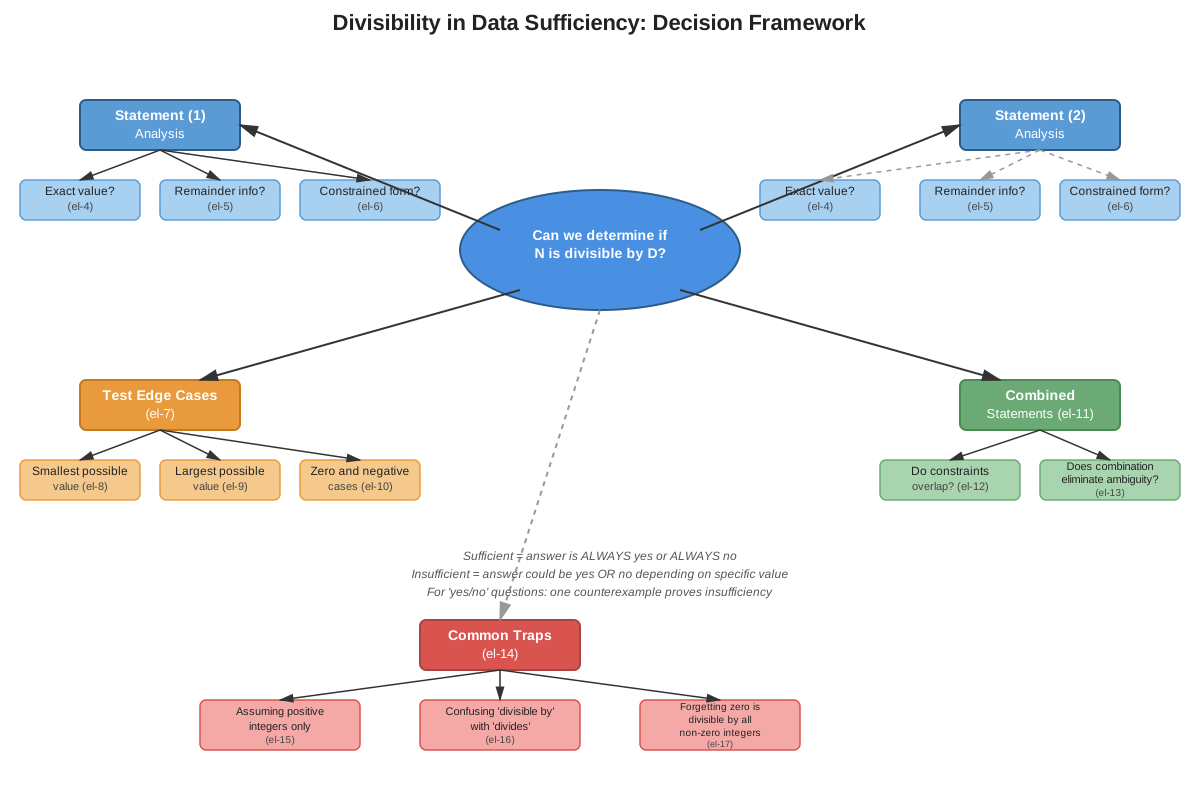
The relationship between divisibility and data sufficiency deserves special attention. Many data sufficiency questions test whether given information is sufficient to determine divisibility without requiring actual division. This requires understanding which properties and combinations of properties guarantee divisibility—a meta-level application of divisibility concepts.
Quick check — test yourself on Divisibility so far.
Try Flashcards →High-Yield Facts
⭐ A number is divisible by 3 if and only if the sum of its digits is divisible by 3
⭐ A number is divisible by 9 if and only if the sum of its digits is divisible by 9
⭐ For a number to be divisible by a composite number, it must be divisible by all prime factors with sufficient exponents
⭐ The product of n consecutive integers is always divisible by n!
⭐ If a number is divisible by both m and n, and gcd(m,n) = 1, then the number is divisible by m×n
- A number is divisible by 4 if its last two digits form a number divisible by 4
- A number is divisible by 8 if its last three digits form a number divisible by 8
- A number is divisible by 6 if and only if it is divisible by both 2 and 3
- The alternating sum of digits determines divisibility by 11
- If a|b and b|c, then a|c (transitivity of divisibility)
- x^n - y^n is always divisible by (x - y) for any positive integer n
- The sum of any two consecutive integers is always odd (never divisible by 2)
- Any integer ending in 0 is divisible by both 2 and 5
- If a number is divisible by 12, it must be divisible by 2, 3, 4, and 6
- Zero is divisible by every non-zero integer
Common Misconceptions
Misconception: If a number is divisible by 6 and by 4, it must be divisible by 24.
Correction: This is false because 12 is divisible by both 6 and 4 but not by 24. For divisibility by a product, the factors must be coprime (share no common factors). Since gcd(6,4) = 2 ≠ 1, divisibility by both doesn't guarantee divisibility by their product. The number must be divisible by lcm(6,4) = 12, not necessarily by 6×4 = 24.
Misconception: If the sum of a number's digits is divisible by 6, the number is divisible by 6.
Correction: Digit sum divisibility rules work only for 3 and 9, not for 6. A number is divisible by 6 only if it satisfies both divisibility by 2 (even last digit) AND divisibility by 3 (digit sum divisible by 3). For example, 123 has digit sum 6 (divisible by 6), but 123 is odd and therefore not divisible by 6.
Misconception: All numbers divisible by 3 are also divisible by 9.
Correction: Divisibility by 9 is more restrictive than divisibility by 3. While every number divisible by 9 is divisible by 3 (since 9 = 3²), the reverse is not true. For example, 12 is divisible by 3 but not by 9. The digit sum must be divisible by 9 specifically, not just by 3.
Misconception: If a number ends in 5, it's divisible by 10.
Correction: Numbers ending in 5 are divisible by 5, not 10. Divisibility by 10 requires the last digit to be 0. This confusion arises from conflating the divisibility rules for 5 and 10. For example, 25 is divisible by 5 but not by 10.
Misconception: Testing one specific value proves divisibility for all cases in algebraic expressions.
Correction: Testing specific values can disprove divisibility (finding one counterexample is sufficient) but cannot prove divisibility for all cases. For example, if asked whether n² + n is always even, testing n = 2 gives 6 (even), but this doesn't prove the statement for all n. Algebraic proof is required: n² + n = n(n+1), which is always the product of consecutive integers, hence always even.
Misconception: If a|b and c|d, then ac|bd.
Correction: This is actually TRUE and is a valid divisibility property, but students often doubt it or misapply it. If 3|12 and 5|20, then 15|240. This property follows from the definition of divisibility: if b = 3k and d = 5m, then bd = 15km, so 15|bd.
Misconception: Divisibility by 11 can be tested by checking if the last two digits form a number divisible by 11.
Correction: The last-two-digits rule works for 4, but not for 11. Divisibility by 11 requires the alternating sum of ALL digits to be divisible by 11. For example, 121 has last two digits 21 (not divisible by 11), but 121 is divisible by 11 because the alternating sum is 1-2+1 = 0, which is divisible by 11.
Worked Examples
Example 1: Multi-Rule Divisibility Problem
Question: If n is a positive integer, how many integers between 100 and 300 (inclusive) are divisible by both 6 and 8?
Solution:
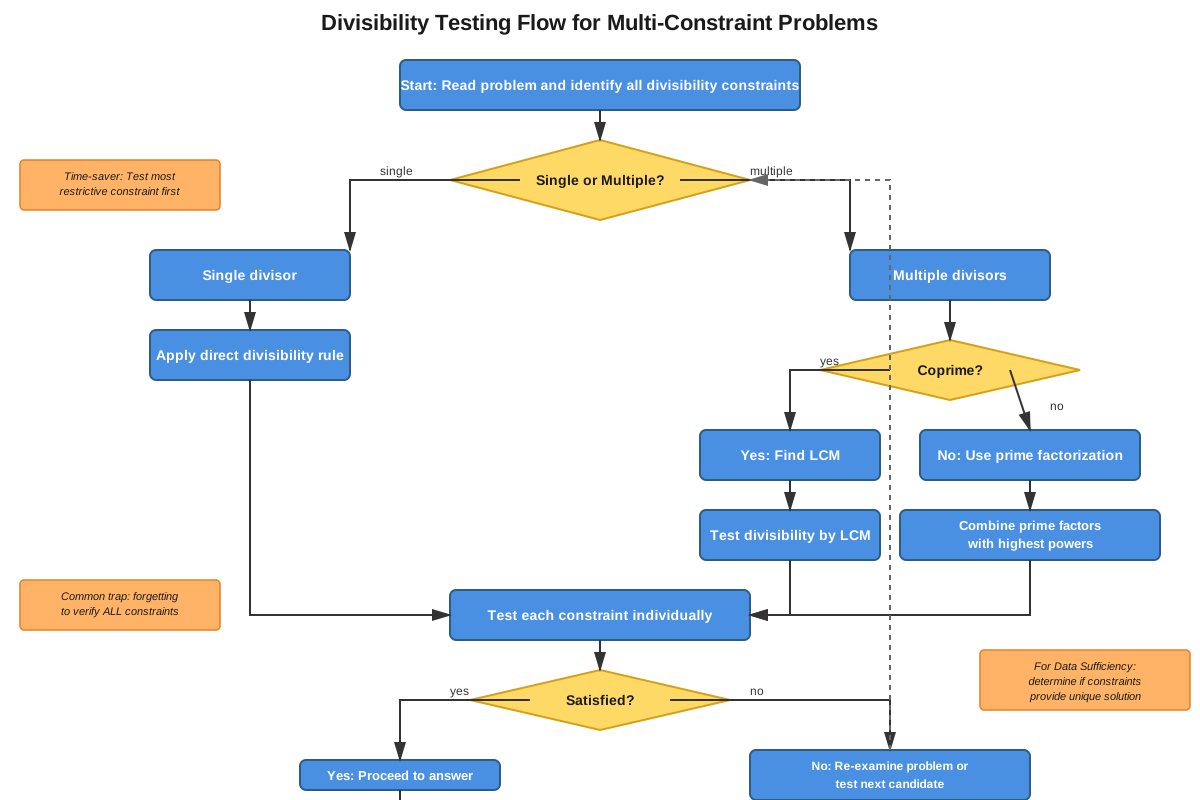
Step 1: Recognize that for a number to be divisible by both 6 and 8, we need to find the least common multiple (LCM) of 6 and 8.
Step 2: Find prime factorizations:
- 6 = 2 × 3
- 8 = 2³
Step 3: Calculate LCM by taking the highest power of each prime factor:
- LCM(6, 8) = 2³ × 3 = 24
Step 4: The question reduces to: How many multiples of 24 are between 100 and 300 inclusive?
Step 5: Find the smallest multiple of 24 ≥ 100:
- 100 ÷ 24 = 4.166...
- Round up to 5
- 24 × 5 = 120 (first multiple)
Step 6: Find the largest multiple of 24 ≤ 300:
- 300 ÷ 24 = 12.5
- Round down to 12
- 24 × 12 = 288 (last multiple)
Step 7: Count multiples from 24×5 to 24×12:
- Number of multiples = 12 - 5 + 1 = 8
Answer: 8 integers between 100 and 300 are divisible by both 6 and 8.
Connection to Learning Objectives: This problem applies divisibility rules (objective 3) by recognizing that divisibility by two numbers requires divisibility by their LCM, and combines multiple divisibility concepts to solve a complex problem (objective 5).
Example 2: Data Sufficiency with Algebraic Divisibility
Question: Is the positive integer n divisible by 12?
(1) n is divisible by 4 and by 6
(2) n = 24k for some positive integer k
Solution:
Analyzing Statement (1):
Step 1: Recognize that 12 = 2² × 3, so n must have at least 2² and 3 in its prime factorization to be divisible by 12.
Step 2: Given n is divisible by 4 = 2², n has at least 2² in its factorization.
Step 3: Given n is divisible by 6 = 2 × 3, n has at least 2¹ and 3¹ in its factorization.
Step 4: Combining these conditions: n has at least 2² (from divisibility by 4) and at least 3¹ (from divisibility by 6).
Step 5: Therefore, n must be divisible by 2² × 3 = 12.
Statement (1) is SUFFICIENT.
Analyzing Statement (2):
Step 1: If n = 24k, then n is a multiple of 24.
Step 2: Since 24 = 12 × 2, any multiple of 24 is also a multiple of 12.
Step 3: Therefore, n is definitely divisible by 12.
Statement (2) is SUFFICIENT.
Answer: D (Each statement alone is sufficient)
Connection to Learning Objectives: This problem demonstrates determining divisibility in data sufficiency questions (objective 4), applying prime factorization reasoning (objective 6), and using divisibility properties to reach conclusions without calculation (objective 2).
Exam Strategy
When approaching GMAT divisibility questions, begin by identifying what type of divisibility relationship the question asks about. Look for trigger phrases such as "divisible by," "evenly divided," "no remainder," "multiple of," "factor of," or "integer result." These phrases signal that divisibility concepts are central to the solution.
For problem-solving questions, determine whether the question requires:
- Direct application of divisibility rules (use memorized rules for 2, 3, 4, 5, 6, 8, 9, 10, 11)
- Prime factorization approach (best for composite numbers without simple rules)
- LCM/GCD calculation (when dealing with multiple divisibility conditions)
- Algebraic reasoning (for variable expressions or "must be true" questions)
For data sufficiency questions, focus on whether the given information establishes divisibility relationships rather than calculating actual values. Often, recognizing that certain combinations of conditions guarantee divisibility is sufficient. Remember that proving divisibility requires showing it works for ALL cases, while disproving requires only ONE counterexample.
Time-saving techniques:
- Memorize divisibility rules cold—hesitation costs precious seconds
- For divisibility by composite numbers, immediately think about prime factorization or LCM
- When testing divisibility by 3 or 9, add digits mentally as you read the number
- For divisibility by 4 or 8, ignore all but the last 2 or 3 digits respectively
- In "must be true" questions, test the simplest values first (0, 1, 2) to quickly eliminate wrong answers
Process of elimination strategies:
- If a question asks what a number "must be divisible by," eliminate any answer choice that doesn't divide at least one example you construct
- For "could be divisible by" questions, eliminate choices that create contradictions with given constraints
- When multiple conditions are given, eliminate answer choices that satisfy only some conditions
Red flags to watch for:
- Questions mixing divisibility with remainders (these test whether you understand the complement relationship)
- Algebraic expressions with multiple variables (require systematic case analysis)
- "Except" questions that reverse the usual logic
- Data sufficiency statements that seem to provide the same information in different forms (often one is insufficient while the other is sufficient)
Allocate approximately 2 minutes for straightforward divisibility problems and up to 2.5 minutes for complex multi-step problems. If a problem requires testing many cases, consider whether there's a pattern or algebraic approach that would be faster.
Memory Techniques
Divisibility Rules Mnemonic - "The TENS System":
- Two: Tail must be even (last digit)
- Eight: End three digits divisible by 8
- Nine: Nine needs digit sum divisible by 9
- Six: Satisfy both 2 and 3
For remembering 3 and 9: "Sum-thing special about 3 and 9" (digit sum determines divisibility)
For remembering 4 and 8: "Last but not least" - 4 uses last 2 digits, 8 uses last 3 digits (increasing pattern: 4→2, 8→3)
For remembering 11: "Alternate reality" - use alternating sum of digits
Visualization for consecutive integers: Picture a number line with consecutive integers highlighted. Remember that their product "collects" all factors up to n!, like gathering items in sequence.
Prime factorization memory aid: "Prime time for factors" - when dealing with composite divisors, it's always prime time to break them into factors.
LCM vs GCD distinction:
- LCM = Largest that works for both (think "Large")
- GCD = Greatest that divides both (think "Goes into")
For coprime condition: "Co-prime means completely separate" - no shared prime factors
Summary
Divisibility is a cornerstone concept in GMAT Quantitative Reasoning that tests whether one integer divides another without remainder. Mastery requires fluency with divisibility rules for common divisors (2, 3, 4, 5, 6, 8, 9, 10, 11), understanding of prime factorization methods, and ability to apply divisibility properties to algebraic expressions. The GMAT tests divisibility both directly and embedded within complex problems involving factors, multiples, remainders, and integer constraints. Success requires memorizing key divisibility rules, recognizing when to apply prime factorization versus digit-based rules, understanding that divisibility by composite numbers requires divisibility by all constituent prime factors with appropriate exponents, and knowing special patterns like consecutive integer products and difference of powers. Data sufficiency questions particularly reward understanding of what information sufficiently establishes divisibility relationships without requiring calculation. Strategic application of these concepts, combined with efficient testing methods and pattern recognition, enables rapid problem-solving and high accuracy on this high-yield GMAT topic.
Key Takeaways
- Divisibility means one integer divides another evenly with zero remainder, forming the basis for factors, multiples, and prime factorization
- Memorize divisibility rules for 2, 3, 4, 5, 6, 8, 9, 10, and 11—these enable rapid mental calculation and answer elimination
- For divisibility by composite numbers, use prime factorization or recognize that divisibility by coprime factors guarantees divisibility by their product
- The product of n consecutive integers is always divisible by n!, a pattern frequently tested in "must be true" questions
- In data sufficiency questions, focus on whether given information establishes divisibility relationships rather than calculating specific values
- Digit sum rules work only for 3 and 9; other divisibility rules require different approaches
- Algebraic divisibility problems often involve recognizing patterns in expressions like x^n - y^n or products of consecutive terms
Related Topics
Prime Factorization and Prime Numbers: Understanding how to break numbers into prime components provides the systematic foundation for all divisibility analysis and enables solving complex problems involving multiple divisibility constraints.
Least Common Multiple (LCM) and Greatest Common Divisor (GCD): These concepts directly extend divisibility principles to find the smallest common multiple or largest common divisor of multiple numbers, essential for fraction operations and ratio problems.
Remainders and Modular Arithmetic: The complement to divisibility, remainder problems test what happens when division is not exact, requiring understanding of division algorithm and cyclical patterns.
Factors and Multiples: Deep exploration of factor counting, factor pairs, and multiple patterns builds on divisibility to solve problems about number properties and relationships.
Integer Properties and Number Theory: Advanced applications including perfect squares, perfect cubes, units digits, and cyclicity patterns all rely on divisibility as a foundational concept.
Practice CTA
Now that you've mastered the core concepts of divisibility, it's time to cement your understanding through active practice. Attempt the practice questions to apply divisibility rules in various GMAT-style scenarios, and use the flashcards to reinforce quick recall of key rules and patterns. Remember, divisibility questions reward both conceptual understanding and computational speed—practice will build both. Each problem you solve strengthens your pattern recognition and strategic thinking, bringing you closer to your target GMAT score. You've built a solid foundation; now make it automatic through deliberate practice!
Sign up free to keep reading
Create a free AnvayaPrep account to finish this GMAT guide on Divisibility — plus flashcards and practice questions.