Overview
Proportions are one of the most fundamental and frequently tested concepts in GMAT Quantitative Reasoning. A proportion represents an equation stating that two ratios are equal, expressed in the form a/b = c/d or a:b = c:d. This seemingly simple concept underlies countless GMAT problems, from straightforward ratio questions to complex word problems involving rates, mixtures, scale models, and data sufficiency scenarios. Mastering proportions is not merely about memorizing a formula—it requires understanding the relationship between quantities and developing the ability to set up equations that accurately model real-world situations.
The importance of GMAT proportions cannot be overstated. These questions appear across multiple problem types and difficulty levels, often disguised within word problems about work rates, distance-speed-time relationships, mixture problems, and geometric similarity. A strong command of proportions enables test-takers to solve problems more efficiently, recognize patterns quickly, and avoid common algebraic pitfalls. Furthermore, proportional reasoning forms the foundation for understanding percentages, ratios, rates, and probability—all high-frequency GMAT topics.
Within the broader Quantitative Reasoning framework, proportions serve as a bridge between basic arithmetic operations and more complex algebraic problem-solving. They connect directly to ratio concepts, provide the mathematical foundation for percentage calculations, and enable the solution of linear equations in practical contexts. Students who master proportions gain a powerful tool that simplifies seemingly complex problems by revealing the underlying relationships between quantities. This topic represents a critical skill set that distinguishes high-scoring test-takers from those who struggle with word problems and applied mathematics.
Learning Objectives
- [ ] Identify proportions in various problem formats and contexts
- [ ] Explain proportions using mathematical notation and verbal descriptions
- [ ] Apply proportions to GMAT questions across multiple problem types
- [ ] Set up proportion equations from word problems with 95%+ accuracy
- [ ] Solve proportion problems using cross-multiplication and alternative methods
- [ ] Recognize when proportional relationships exist versus when they do not
- [ ] Convert between different representations of proportional relationships (fractions, ratios, percentages)
Prerequisites
- Basic fraction operations: Essential for manipulating and simplifying proportional equations, as proportions are fundamentally equations involving fractions
- Ratio concepts: Proportions are equations stating that two ratios are equal, so understanding what ratios represent is foundational
- Basic algebraic manipulation: Solving proportions requires isolating variables, cross-multiplying, and simplifying expressions
- Linear equations: Proportions are a specific type of linear equation, and solving them uses similar algebraic techniques
Why This Topic Matters
Proportions appear in approximately 15-20% of GMAT Quantitative Reasoning questions, either directly or as an underlying concept within more complex problems. This high frequency makes proportions one of the most valuable topics to master for score improvement. In real-world applications, proportional reasoning is essential for business analytics, financial projections, resource allocation, and scaling operations—all relevant to the business school context the GMAT serves.
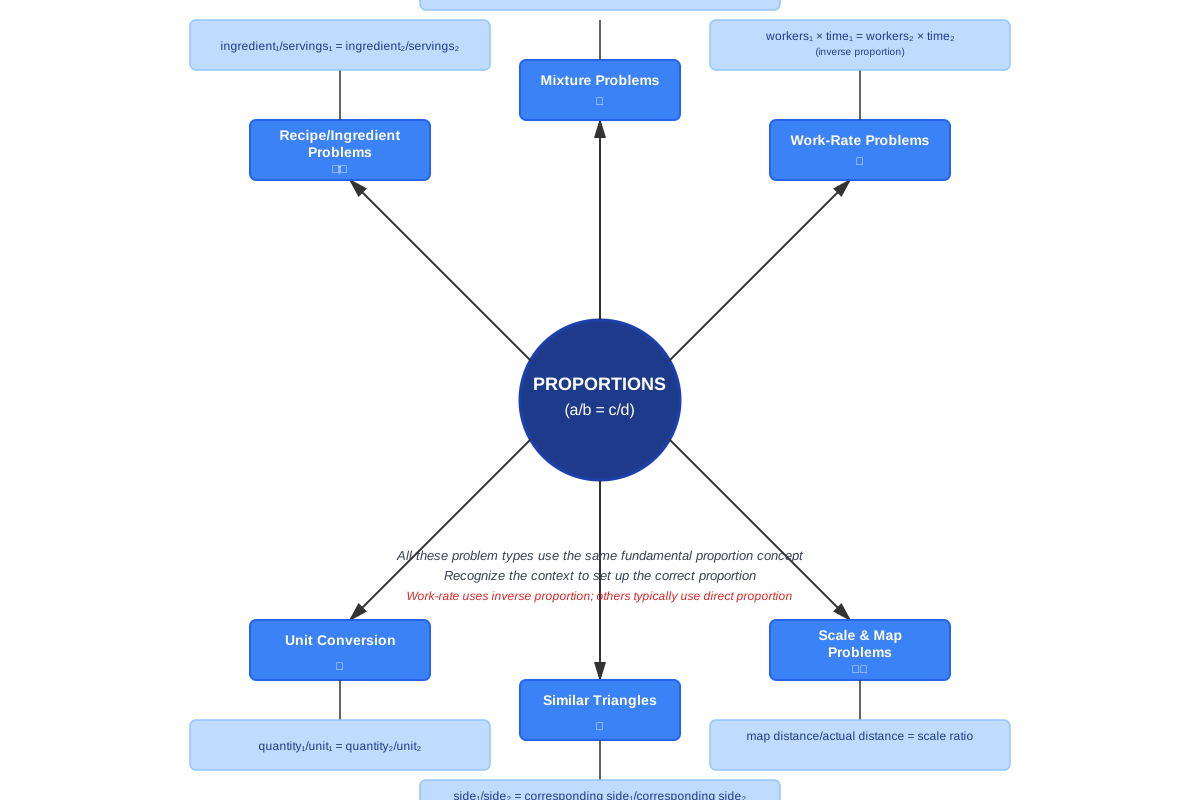
On the GMAT, proportion questions manifest in several distinct formats: direct proportion word problems, inverse proportion scenarios, mixture problems, work-rate questions, scale and map problems, geometric similarity questions, and data sufficiency problems testing whether sufficient information exists to establish a proportional relationship. The test-makers frequently embed proportions within multi-step problems, requiring students to first recognize the proportional relationship before applying the appropriate solution method.
Business school admissions committees value proportional reasoning because it demonstrates quantitative literacy essential for case analysis, financial modeling, and data-driven decision-making. Students who can quickly identify and solve proportion problems show the analytical flexibility needed for MBA coursework. Furthermore, proportion problems on the GMAT often test not just mathematical ability but also reading comprehension and logical reasoning—the ability to translate verbal descriptions into mathematical relationships is a key differentiator among test-takers.
Core Concepts
Definition and Structure of Proportions
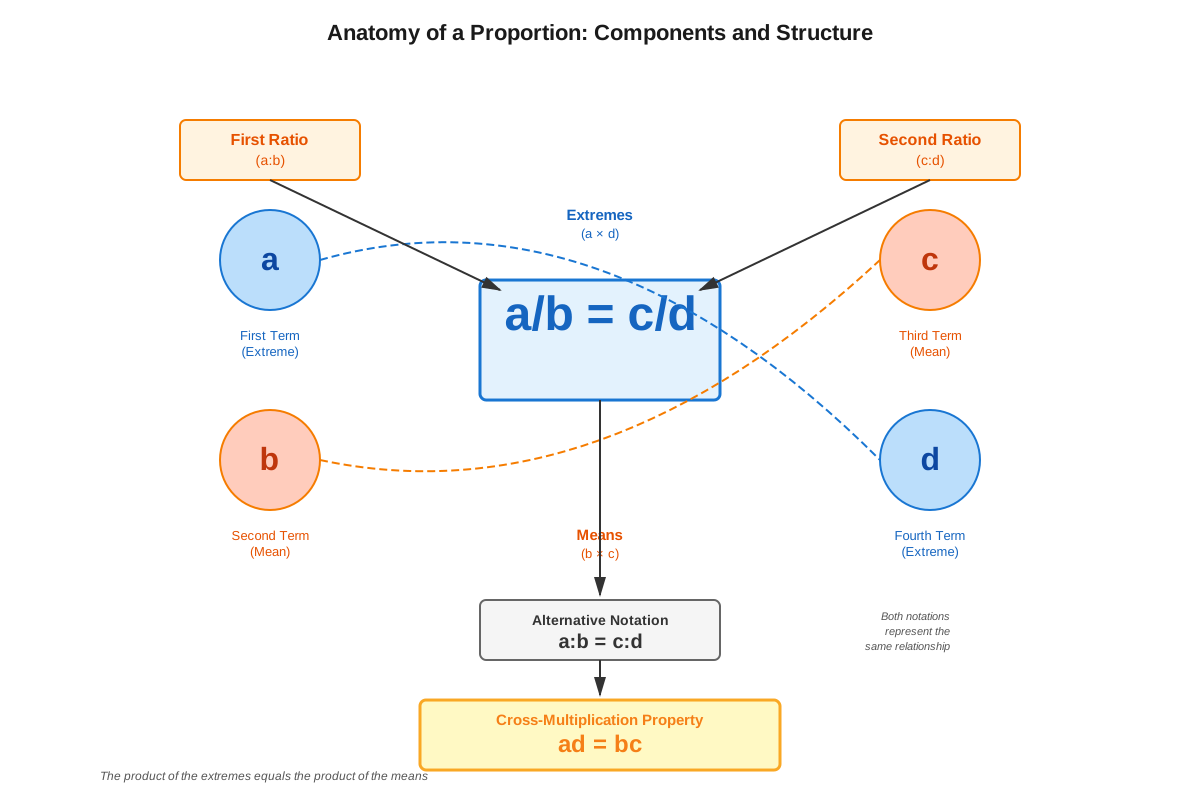
A proportion is an equation that states two ratios are equal. The standard form is a/b = c/d, which can also be written as a:b = c:d or a:b :: c:d. In this equation, the four values are called the terms of the proportion. Specifically, 'a' and 'd' are the extremes (outer terms), while 'b' and 'c' are the means (inner terms). A fundamental property of proportions is that the product of the means equals the product of the extremes: b × c = a × d. This property, known as cross-multiplication, provides the primary method for solving proportion problems.
For a proportion to be valid, the ratios must represent the same relationship between quantities. For example, if 3 apples cost $6, then 9 apples cost $18, because 3/6 = 9/18 (both simplify to 1/2). The key insight is that the relationship between the numerators must be the same as the relationship between the denominators. In this case, multiplying both the numerator and denominator by 3 maintains the proportional relationship.
Direct Proportions
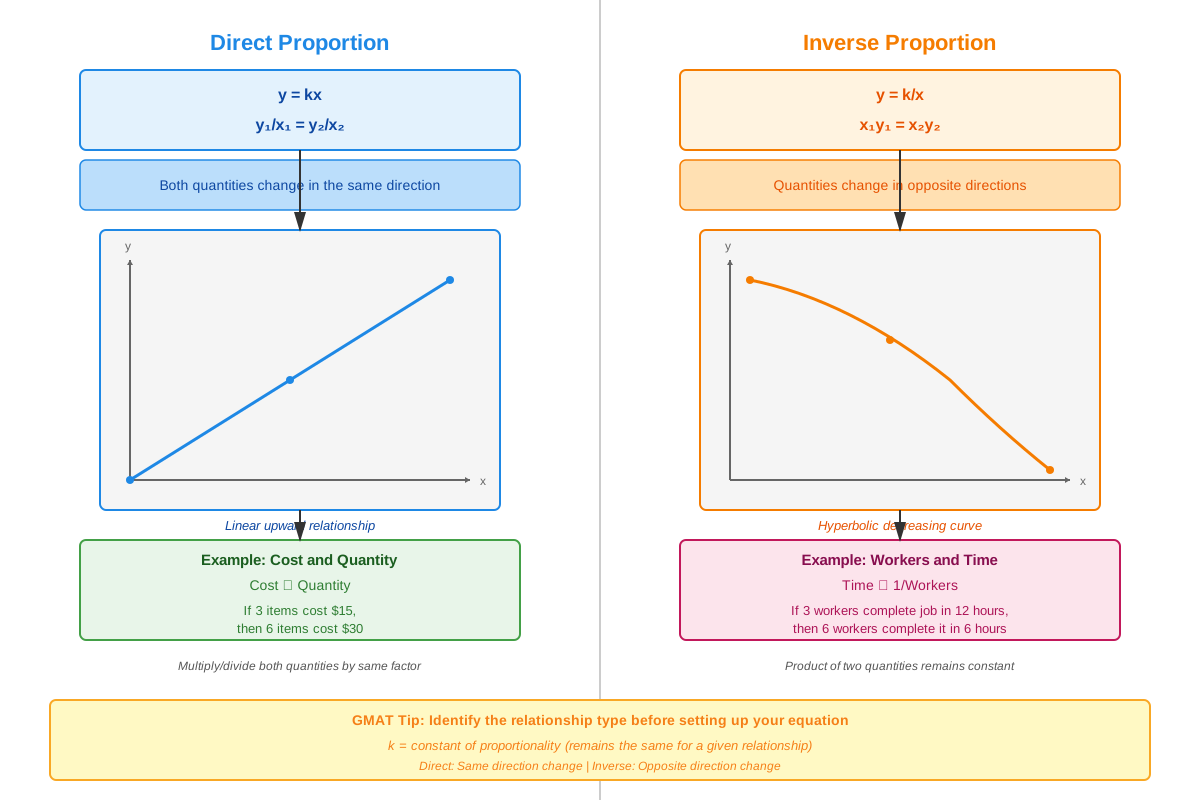
Direct proportions describe relationships where two quantities increase or decrease together at a constant rate. When one quantity doubles, the other doubles; when one triples, the other triples. Mathematically, if y is directly proportional to x, we write y = kx, where k is the constant of proportionality. This can be rearranged as y/x = k, showing that the ratio remains constant.
Common GMAT scenarios involving direct proportions include:
- Cost and quantity (more items cost more money)
- Distance and time at constant speed (longer time means greater distance)
- Work completed and number of workers (more workers complete more work in the same time)
- Recipe scaling (doubling ingredients doubles the yield)
To solve direct proportion problems, set up the equation: (quantity₁/quantity₂) = (corresponding₁/corresponding₂), then cross-multiply and solve for the unknown variable.
Inverse Proportions
Inverse proportions (or indirect proportions) describe relationships where one quantity increases as the other decreases, maintaining a constant product. When one quantity doubles, the other is halved. Mathematically, if y is inversely proportional to x, we write y = k/x or xy = k, where k is constant.
Common GMAT scenarios involving inverse proportions include:
- Speed and time for a fixed distance (faster speed means less time)
- Number of workers and time to complete a job (more workers means less time)
- Gear ratios (larger gear rotates fewer times)
- Concentration problems when adding dilutant
The critical distinction between direct and inverse proportions is whether the product or the ratio remains constant. For inverse proportions, set up the equation: (quantity₁)(corresponding₁) = (quantity₂)(corresponding₂).
Setting Up Proportions from Word Problems
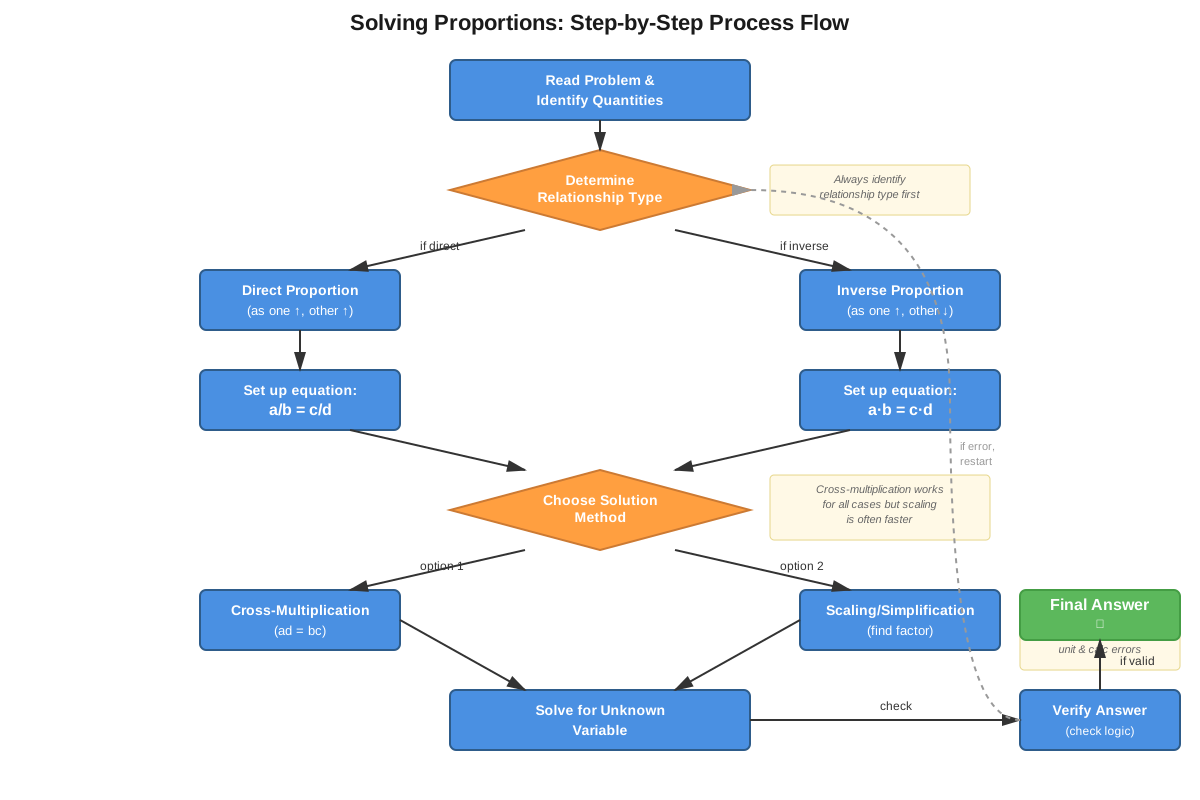
The most challenging aspect of proportion problems on the GMAT is translating verbal descriptions into mathematical equations. A systematic approach involves:
- Identify the quantities: Determine what is being compared
- Establish the relationship: Is it direct or inverse?
- Maintain consistent units: Ensure numerators compare to numerators and denominators to denominators
- Set up the equation: Place known values and the unknown in the correct positions
- Solve using cross-multiplication: Multiply extremes and means, then isolate the variable
A critical rule: keep the same type of quantity in the same position in both ratios. If the first ratio has "miles in the numerator and hours in the denominator," the second ratio must maintain this structure. Mixing positions is the most common error in setting up proportions.
Cross-Multiplication Method
Cross-multiplication is the standard technique for solving proportions. Given a/b = c/d, multiply both sides by bd to eliminate fractions: ad = bc. This transforms the proportion into a simple linear equation. The method works because multiplying both sides of an equation by the same value maintains equality.
Example: Solve 5/8 = x/24
- Cross-multiply: 5 × 24 = 8 × x
- Simplify: 120 = 8x
- Divide both sides by 8: x = 15
This method is efficient and reduces calculation errors compared to other approaches. However, students should verify that the setup is correct before cross-multiplying, as errors in the initial equation will propagate through the solution.
Scaling and Unit Conversion
Proportions are essential for scaling problems, where quantities must be adjusted while maintaining relationships. Map scales, architectural models, recipe adjustments, and currency conversions all rely on proportional reasoning. The key is identifying the conversion factor (constant of proportionality) and applying it consistently.
For unit conversions, set up proportions with the conversion factor as one ratio and the quantities to convert as the other. For example, to convert 5 kilometers to miles (given 1 km = 0.621 miles): 1/0.621 = 5/x, solving gives x ≈ 3.105 miles.
Compound Proportions
Compound proportions involve three or more related quantities changing simultaneously. These problems require setting up multiple proportional relationships or using the unitary method (finding the value for one unit, then scaling to the desired quantity).
Example: If 6 workers complete a project in 8 days working 5 hours per day, how many days will 4 workers need working 6 hours per day?
Approach: Total work = 6 workers × 8 days × 5 hours = 240 worker-hours
For 4 workers at 6 hours per day: 240 = 4 × d × 6, so d = 10 days
Concept Relationships
Proportions serve as the mathematical foundation connecting several key Quantitative Reasoning concepts. Ratios → lead to → Proportions (proportions are equations of equal ratios). Proportions → enable → Percentage calculations (percentages are proportions with a denominator of 100). Proportions → underlie → Rate problems (rates are ratios that can be set equal in proportion equations). Proportions → solve → Similarity problems (similar geometric figures have proportional corresponding sides).
The relationship between direct and inverse proportions represents a fundamental dichotomy in quantitative relationships. Recognizing which type applies to a given situation determines the correct equation setup. Both types connect to the broader concept of functional relationships, where one variable depends on another according to a specific rule.
Within proportion problems themselves, the concepts build hierarchically: understanding basic proportion structure enables cross-multiplication, which enables solving for unknowns, which enables application to word problems, which enables solving compound proportion problems involving multiple variables. Each level requires mastery of the previous concepts.
Proportions also connect forward to more advanced topics: linear equations (proportions are a special case), systems of equations (multiple proportions can create systems), functions (proportional relationships are linear functions), and coordinate geometry (proportional relationships graph as straight lines through the origin for direct proportions).
Quick check — test yourself on Proportions so far.
Try Flashcards →High-Yield Facts
⭐ A proportion is an equation stating that two ratios are equal: a/b = c/d
⭐ Cross-multiplication is the primary solving method: If a/b = c/d, then ad = bc
⭐ In direct proportions, the ratio remains constant: y/x = k (constant)
⭐ In inverse proportions, the product remains constant: xy = k (constant)
⭐ Keep the same type of quantity in the same position when setting up proportions (miles/hours = miles/hours, not miles/hours = hours/miles)
- The product of the means equals the product of the extremes in any valid proportion
- Proportions can be written in multiple equivalent forms: a/b = c/d, a:b = c:d, or a:b :: c:d
- If a/b = c/d, then b/a = d/c (reciprocals of equal ratios are equal)
- If a/b = c/d, then (a+b)/b = (c+d)/d (componendo property)
- If a/b = c/d, then (a-b)/b = (c-d)/d (dividendo property)
- Proportions are preserved under multiplication or division of both terms in a ratio by the same non-zero number
- Direct proportion problems often use the phrase "varies directly with" or "is proportional to"
- Inverse proportion problems often use phrases like "inversely proportional" or "varies inversely with"
- When three quantities are given and one is unknown, a proportion can be set up and solved
- Proportion problems frequently appear in data sufficiency format, testing whether enough information exists to establish the proportional relationship
Common Misconceptions
Misconception: All relationships between quantities are proportional → Correction: Many relationships are non-proportional. For example, the relationship between the side length and area of a square is quadratic (A = s²), not proportional. Always verify that the ratio or product remains constant before assuming proportionality.
Misconception: In inverse proportions, set up the equation the same way as direct proportions → Correction: Inverse proportions require setting products equal (x₁y₁ = x₂y₂) or inverting one ratio (x₁/x₂ = y₂/y₁). Using the direct proportion setup (x₁/x₂ = y₁/y₂) for inverse relationships produces incorrect answers.
Misconception: Cross-multiplication can be used on any equation with fractions → Correction: Cross-multiplication specifically applies to equations with a single fraction on each side (a/b = c/d). For equations like a/b + c/d = e/f, cross-multiplication doesn't directly apply; find a common denominator instead.
Misconception: The order of terms in a proportion doesn't matter → Correction: The order is critical. The ratio a/b = c/d is not the same as a/c = b/d unless the proportions happen to be equal. Consistent positioning (same type of quantity in the same position) is essential for correct setup.
Misconception: Proportions only involve two quantities → Correction: Compound proportions involve three or more related quantities. For example, work problems often involve workers, days, and hours per day—all three must be considered simultaneously using the unitary method or combined proportions.
Misconception: If two quantities increase together, they must be directly proportional → Correction: Direct proportionality requires a constant ratio, not just simultaneous increase. For example, as a square's side length increases, its area increases, but not proportionally (the relationship is quadratic). Always check if the ratio remains constant.
Worked Examples
Example 1: Direct Proportion Word Problem
Problem: A recipe for 8 servings requires 3 cups of flour. How many cups of flour are needed for 20 servings?
Solution:
Step 1: Identify the relationship. This is a direct proportion—more servings require more flour at a constant rate.
Step 2: Set up the proportion. Keep the same type of quantity in the same position:
servings/flour = servings/flour
8/3 = 20/x
Alternatively (and equivalently):
flour/servings = flour/servings
3/8 = x/20
Step 3: Cross-multiply using the second setup:
3 × 20 = 8 × x
60 = 8x
Step 4: Solve for x:
x = 60/8 = 7.5Answer: 7.5 cups of flour are needed for 20 servings.
Connection to Learning Objectives: This problem demonstrates identifying a proportional relationship (direct proportion), setting up the equation correctly with consistent positioning, and applying cross-multiplication to solve. The key insight is recognizing that the flour-to-servings ratio remains constant.
Example 2: Inverse Proportion with Multiple Steps
Problem: Six machines can complete a production run in 10 hours. How long would it take 15 machines to complete the same production run, assuming all machines work at the same rate?
Solution:
Step 1: Identify the relationship. This is an inverse proportion—more machines complete the work in less time. The total work (machine-hours) remains constant.
Step 2: Calculate the total work in machine-hours:
Total work = 6 machines × 10 hours = 60 machine-hoursStep 3: Set up the inverse proportion equation. The product of machines and time remains constant:
(machines₁)(time₁) = (machines₂)(time₂)
6 × 10 = 15 × t
Step 4: Solve for t:
60 = 15t
t = 60/15 = 4Answer: It would take 15 machines 4 hours to complete the production run.
Alternative approach using inverse proportion setup:
machines₁/machines₂ = time₂/time₁ (note the inversion)
6/15 = t/10
Cross-multiply:
6 × 10 = 15 × t
60 = 15t
t = 4
Connection to Learning Objectives: This problem requires recognizing an inverse proportional relationship (more machines means less time), understanding that the product remains constant, and applying the correct equation setup. The alternative approach shows how inverse proportions can be set up with inverted ratios, demonstrating flexibility in problem-solving methods.
Exam Strategy
When approaching GMAT proportions questions, begin by carefully reading the problem to identify what quantities are being compared and what relationship exists between them. Look for trigger phrases that signal proportional relationships: "varies directly with," "is proportional to," "at the same rate," "at this rate," "per," "for every," and "if...then" constructions comparing quantities.
The first critical decision is determining whether the relationship is direct or inverse. Ask: "If one quantity increases, does the other increase (direct) or decrease (inverse)?" This determines the equation setup. For direct proportions, ratios are equal; for inverse proportions, products are equal or ratios are inverted.
Time allocation strategy: Simple proportion problems should take 1.5-2 minutes. If you find yourself spending more time, you may be overcomplicating the setup. Step back and verify your equation structure. For data sufficiency questions involving proportions, quickly assess whether the given information provides enough values to establish the constant of proportionality—typically, you need at least one complete pair of corresponding values.
Process of elimination tips: In multiple-choice problems, you can often eliminate answers by checking reasonableness. For direct proportions, if the input increases, the output must increase; eliminate any answers showing the opposite. For inverse proportions, check that the product of the answer with its corresponding value matches the product of the given values. Use estimation: if doubling one quantity should roughly double another (direct proportion), eliminate answers that don't reflect this relationship.
Common traps to avoid: Watch for problems that mix direct and inverse proportions or that include irrelevant information. The GMAT often provides extra numbers that don't factor into the proportional relationship—identify what's actually being compared. Be cautious with problems involving rates; ensure you're comparing the same units (miles per hour to miles per hour, not miles per hour to hours per mile).
Setup verification: Before cross-multiplying, verify your proportion setup by checking units. If you set up "miles/hours = miles/hours," the units cancel correctly. If you accidentally set up "miles/hours = hours/miles," the units don't match, signaling an error. This quick check prevents the most common proportion mistakes.
Memory Techniques
Mnemonic for proportion setup: "SAME SAME" - Keep the SAME type of quantity in the SAME position in both ratios. If apples are in the numerator on the left, apples must be in the numerator on the right.
Visualization for direct vs. inverse proportions: Picture a seesaw for inverse proportions—when one side goes up, the other goes down. Picture parallel arrows pointing the same direction for direct proportions—both quantities move together.
Acronym for solving proportions: CROSS - Check the relationship type, Rearrange into standard form, Organize with consistent positioning, Set up the equation, Solve using cross-multiplication.
Memory aid for cross-multiplication: Visualize drawing an X through the proportion a/b = c/d. The X connects the terms you multiply: a connects to d, and b connects to c, giving ad = bc.
Phrase for inverse proportions: "More means less, less means more" - more workers means less time, more speed means less time, etc. If you can apply this phrase, it's an inverse proportion.
Rhyme for proportion properties: "Flip them both, they're still the same; swap the means, it's still the game" - reminds you that reciprocals of equal ratios are equal (a/b = c/d means b/a = d/c) and that swapping the means preserves the proportion (a/b = c/d means a/c = b/d).
Summary
Proportions represent equations stating that two ratios are equal, forming a cornerstone of GMAT Quantitative Reasoning. Mastery requires understanding both direct proportions (where ratios remain constant) and inverse proportions (where products remain constant), along with the ability to translate word problems into correct mathematical setups. The cross-multiplication method provides an efficient solving technique, but success depends on proper equation setup with consistent positioning of like quantities. Proportions appear frequently on the GMAT in various contexts including rate problems, mixture problems, scaling scenarios, and geometric similarity. The key to excellence is recognizing proportional relationships quickly, distinguishing between direct and inverse types, setting up equations with the same type of quantity in the same position, and applying cross-multiplication accurately. Students must also recognize when relationships are not proportional, avoiding the trap of assuming all related quantities maintain proportional relationships. With systematic practice in identifying, setting up, and solving proportion problems, test-takers can efficiently handle this high-yield topic and significantly improve their Quantitative Reasoning scores.
Key Takeaways
- Proportions are equations stating that two ratios are equal (a/b = c/d), solved primarily through cross-multiplication (ad = bc)
- Direct proportions maintain constant ratios (y/x = k), while inverse proportions maintain constant products (xy = k)
- Proper setup requires keeping the same type of quantity in the same position in both ratios—this is the most critical step
- Proportions appear in 15-20% of GMAT Quantitative questions across multiple problem types including rates, mixtures, scaling, and similarity
- Trigger phrases like "varies directly with," "at this rate," and "inversely proportional" signal proportional relationships
- Not all relationships between quantities are proportional—verify that ratios or products remain constant before applying proportion methods
- Compound proportions involving three or more quantities require the unitary method or careful setup of multiple relationships
Related Topics
Ratios: The foundation of proportions, ratios compare two quantities and can be manipulated using proportion techniques. Mastering proportions enables solving complex ratio problems involving multiple quantities and part-to-whole relationships.
Percentages: Percentages are proportions with a denominator of 100, making proportion skills directly applicable to percentage increase/decrease, percentage of a quantity, and compound percentage problems.
Rate Problems: Distance-speed-time problems, work-rate problems, and other rate scenarios rely on proportional relationships. Strong proportion skills enable efficient solution of these high-frequency GMAT problem types.
Mixture Problems: Combining substances with different concentrations or prices uses proportional reasoning to determine final mixtures. This advanced application builds directly on proportion fundamentals.
Similar Triangles and Geometric Scaling: Geometric similarity problems involve proportional corresponding sides and areas. Understanding proportions is essential for solving these geometry questions efficiently.
Practice CTA
Now that you've mastered the fundamentals of proportions, it's time to solidify your understanding through practice. Attempt the practice questions to apply these concepts to GMAT-style problems, and use the flashcards to reinforce key facts and formulas. Remember, proportions appear in numerous contexts on the GMAT—the more you practice identifying and solving them, the more automatic and efficient your approach will become. Each practice problem you solve builds the pattern recognition and problem-solving speed that distinguishes top scorers. You've built a strong foundation; now transform that knowledge into test-day performance through deliberate practice!
Sign up free to keep reading
Create a free AnvayaPrep account to finish this GMAT guide on Proportions — plus flashcards and practice questions.