Overview
Ratios are one of the most fundamental and frequently tested concepts in GMAT Quantitative Reasoning. A ratio expresses the relationship between two or more quantities, showing how many times one value contains or is contained within another. On the GMAT, GMAT ratios appear in approximately 10-15% of all quantitative questions, making them a high-yield topic that demands thorough understanding and fluent application.
Mastering ratios is essential because they form the foundation for numerous other quantitative concepts tested on the GMAT, including proportions, rates, percentages, and probability. Ratio problems on the GMAT range from straightforward identification questions to complex multi-step word problems involving combined ratios, changing ratios, and ratio-to-actual-value conversions. The ability to translate verbal descriptions into mathematical ratio expressions and manipulate these expressions efficiently separates high scorers from average performers.
Understanding ratios connects directly to broader Quantitative Reasoning skills, particularly algebraic thinking and problem-solving strategies. Ratios bridge arithmetic and algebra, requiring students to work comfortably with both concrete numbers and abstract relationships. This topic also reinforces proportional reasoning, a critical skill that appears across Data Sufficiency and Problem Solving questions. Students who develop strong ratio skills find themselves better equipped to tackle complex word problems, geometry questions involving similar figures, and data interpretation questions that require comparative analysis.
Learning Objectives
- [ ] Identify ratios in various formats and contexts
- [ ] Explain ratios and their mathematical relationships
- [ ] Apply ratios to GMAT questions across different question types
- [ ] Convert between ratio notation and fractional/decimal representations
- [ ] Solve problems involving combined ratios and ratio changes
- [ ] Determine actual quantities from given ratios and additional constraints
- [ ] Manipulate ratios algebraically to solve multi-variable problems
Prerequisites
- Basic arithmetic operations: Essential for calculating and simplifying ratios through multiplication, division, and finding common factors
- Fractions and simplification: Ratios are fundamentally related to fractions, requiring comfort with reducing fractions to lowest terms
- Basic algebra: Necessary for setting up equations when converting ratios to actual values and solving for unknowns
- Greatest Common Divisor (GCD): Used to simplify ratios to their most reduced form
- Linear equations: Required for solving problems where ratios create relationships between multiple variables
Why This Topic Matters
Ratios appear throughout real-world applications, from business contexts (profit-to-revenue ratios, employee-to-manager ratios) to scientific measurements (concentration ratios, scale models) to financial analysis (debt-to-equity ratios, price-earnings ratios). The GMAT tests ratios because they represent a fundamental way professionals analyze relationships and make comparisons in business settings. Understanding ratios enables decision-makers to compare disparate quantities meaningfully and scale solutions appropriately.
On the GMAT specifically, ratio questions appear in both Problem Solving and Data Sufficiency formats, accounting for a significant portion of arithmetic-based questions. According to GMAT question analysis, ratios appear in approximately 12-15% of Quantitative Reasoning questions, with difficulty levels ranging from 500-level (medium) to 700+ level (very difficult). The topic frequently combines with other concepts such as percentages, work rates, mixture problems, and geometry (similar triangles, scale factors).
Common question formats include: direct ratio problems asking for simplification or comparison; word problems requiring translation of verbal descriptions into ratio notation; combined ratio problems involving three or more quantities; ratio change problems where one or more quantities change; and inverse proportion problems. Data Sufficiency questions often test whether students understand what information is sufficient to determine actual values from ratios, making conceptual understanding crucial beyond mere computational ability.
Core Concepts
Definition and Notation
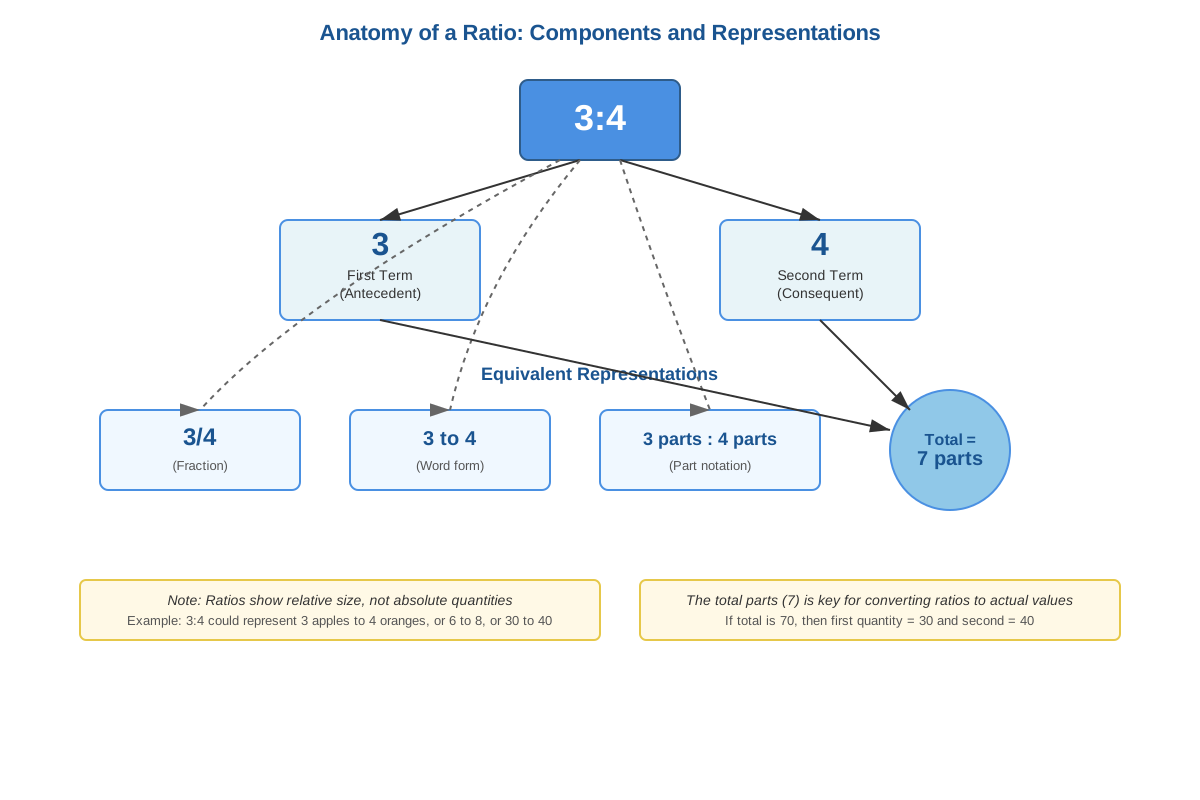
A ratio is a comparison of two or more quantities measured in the same units, expressing how many times one quantity contains another or how the quantities relate proportionally. Ratios can be expressed in several equivalent forms:
- Colon notation: 3:4 (read as "3 to 4")
- Fraction notation: 3/4
- Word form: "3 to 4" or "the ratio of 3 to 4"
- Part-to-whole notation: 3 out of 7 total parts
The order in a ratio is critical. The ratio of A to B (A:B) is fundamentally different from the ratio of B to A (B:A). When a problem states "the ratio of men to women is 3:5," this means for every 3 men, there are 5 women, not the reverse.
Part-to-Part vs. Part-to-Whole Ratios
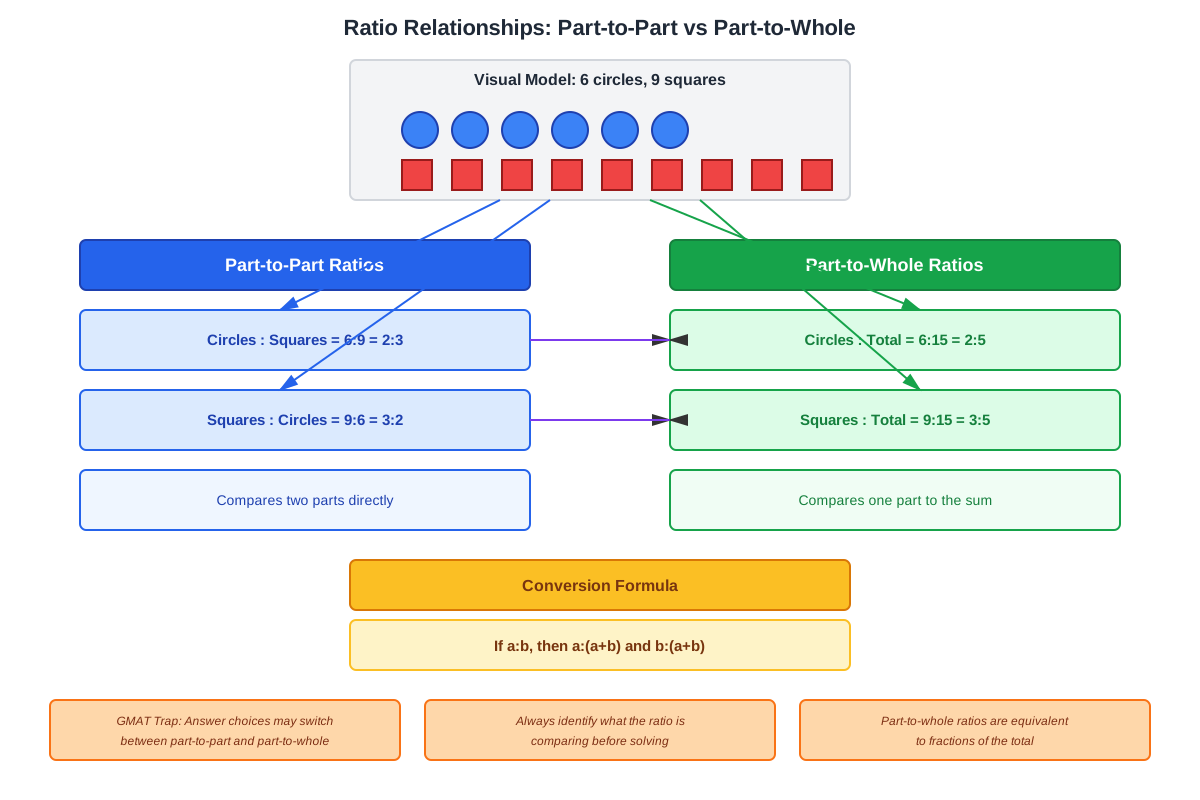
Understanding the distinction between part-to-part and part-to-whole ratios is essential for GMAT success:
| Ratio Type | Description | Example | Interpretation |
|---|---|---|---|
| Part-to-Part | Compares one component to another component | Men to women = 3:5 | For every 3 men, there are 5 women |
| Part-to-Whole | Compares one component to the total | Men to total people = 3:8 | Men represent 3 out of every 8 people |
If the ratio of men to women is 3:5, then:
- Part-to-part ratio (men to women) = 3:5
- Part-to-whole ratio (men to total) = 3:8
- Part-to-whole ratio (women to total) = 5:8
- Total parts = 3 + 5 = 8
Simplifying Ratios
Ratios should be expressed in their simplest form by dividing all terms by their greatest common divisor (GCD). The ratio 12:18 simplifies to 2:3 by dividing both terms by 6. Simplified ratios make comparisons clearer and calculations easier.
For ratios with more than two terms, find the GCD of all terms. The ratio 15:25:35 simplifies to 3:5:7 by dividing all terms by 5.
When ratios involve fractions or decimals, multiply all terms by the least common multiple (LCM) of denominators to create whole number ratios. The ratio 1/2 : 2/3 : 3/4 becomes 6:8:9 by multiplying all terms by 12.
Converting Ratios to Actual Values
One of the most important GMAT skills is converting from ratio relationships to actual quantities. This requires additional information beyond the ratio itself—typically either:
- The actual value of one quantity
- The total of all quantities
- The difference between quantities
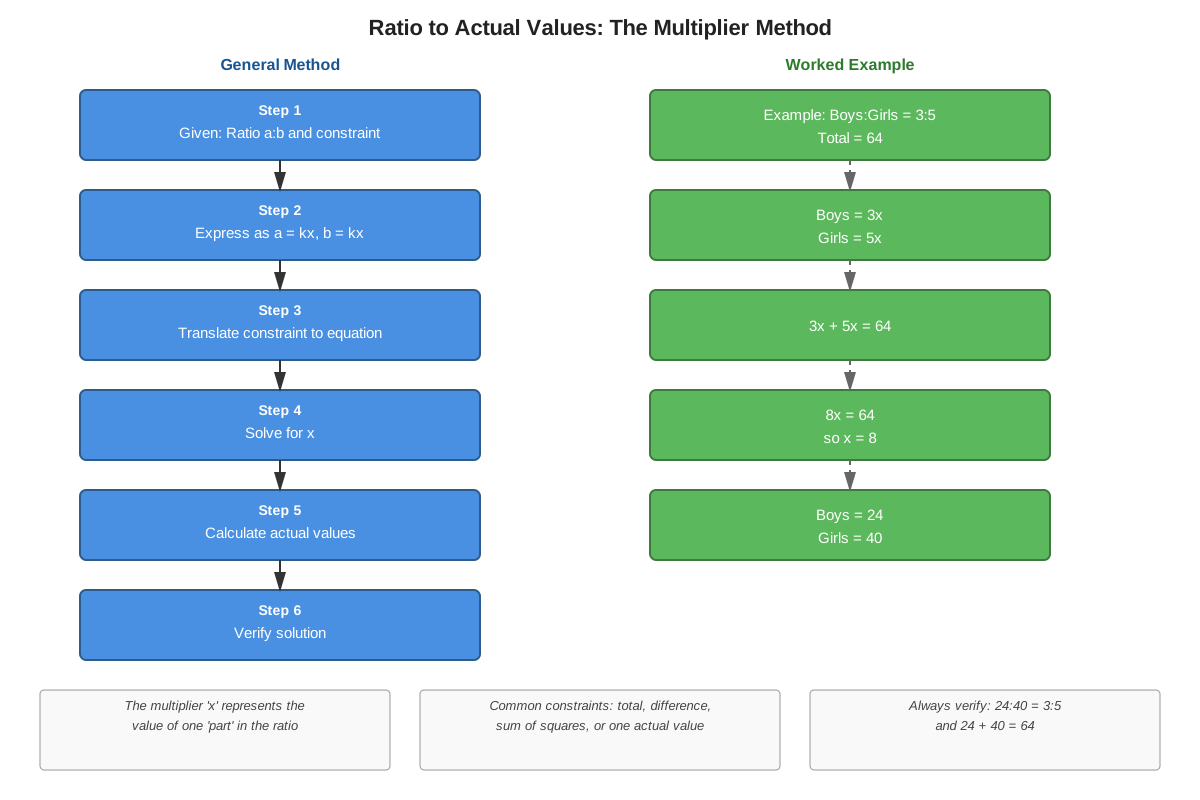
The Multiplier Method: If the ratio of A to B is m:n, then A = mx and B = nx for some multiplier x. This multiplier represents the "value of one part."
Example: If the ratio of boys to girls is 3:4 and there are 21 boys, find the number of girls.
- Boys = 3x = 21, therefore x = 7
- Girls = 4x = 4(7) = 28
Combined Ratios
Combined ratio problems involve three or more quantities where you know some pairwise ratios and must find the overall relationship. The key is finding a common term to link the ratios.
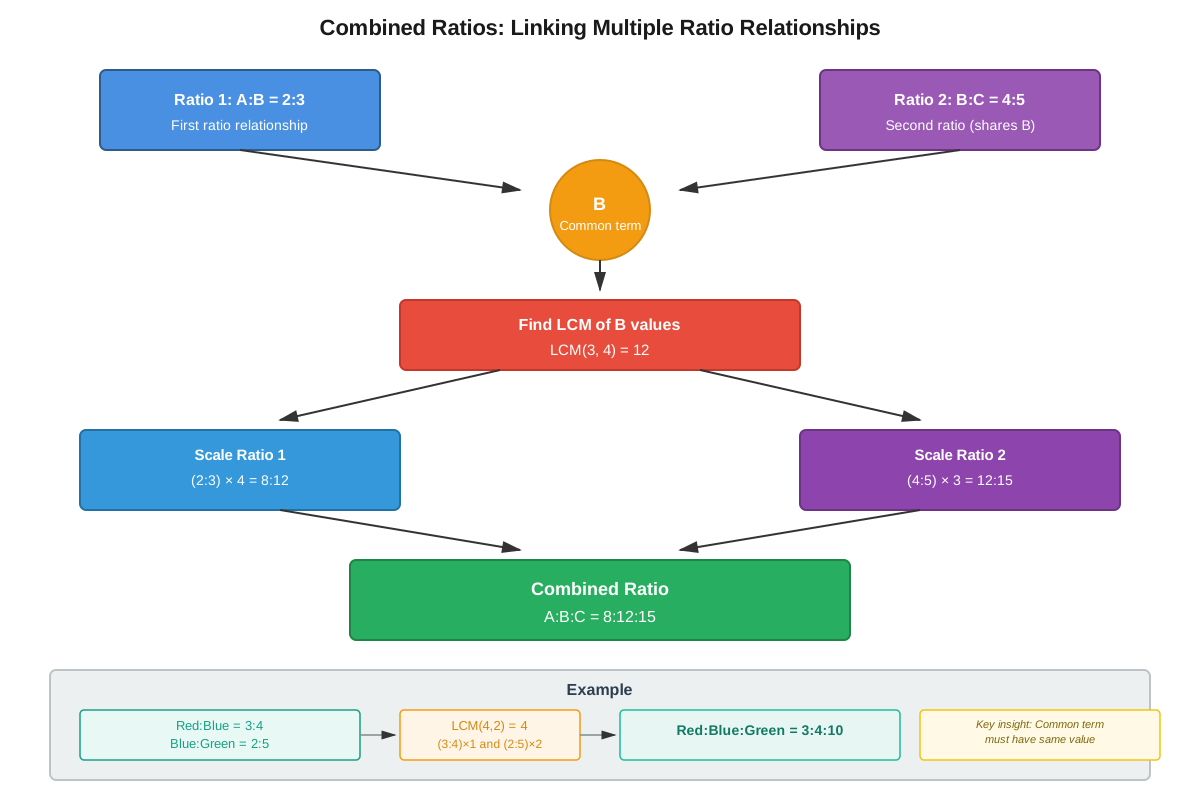
Example: If A:B = 2:3 and B:C = 4:5, find A:B:C.
- Make the B terms equal by finding a common multiple
- A:B = 2:3 = 8:12 (multiply by 4)
- B:C = 4:5 = 12:15 (multiply by 3)
- Combined: A:B:C = 8:12:15
Ratio Changes
Problems involving changing ratios require careful tracking of what changes and what remains constant. The general approach:
- Express initial quantities using the initial ratio and a multiplier
- Apply the described change to the appropriate quantity
- Set up the new ratio with the changed values
- Solve for the multiplier
Example: The ratio of red to blue marbles is 5:3. After adding 10 red marbles, the ratio becomes 3:1. How many blue marbles are there?
- Initial: Red = 5x, Blue = 3x
- After change: Red = 5x + 10, Blue = 3x (unchanged)
- New ratio: (5x + 10)/3x = 3/1
- Solving: 5x + 10 = 9x, therefore x = 2.5
- Blue marbles = 3(2.5) = 7.5 (if the problem requires whole numbers, check for errors or constraints)
Equivalent Ratios and Proportions
Two ratios are equivalent if they represent the same relationship. The ratios 2:3 and 8:12 are equivalent because 8/12 simplifies to 2/3. This concept connects ratios to proportions, which are equations stating that two ratios are equal: a/b = c/d.
Cross-multiplication is the primary tool for solving proportions: if a/b = c/d, then ad = bc. This technique is invaluable for GMAT ratio problems requiring you to find unknown values.
Inverse Ratios and Reciprocals
The inverse of a ratio A:B is B:A. If the ratio of completion times for two workers is 3:4, the ratio of their work rates is 4:3 (faster completion time means higher work rate). Understanding when to use inverse ratios is crucial for rate and work problems.
Concept Relationships
The concepts within ratios build hierarchically and interconnect extensively. Basic ratio definition and notation → serves as the foundation for → simplifying ratios → which enables → converting ratios to actual values using the multiplier method. Understanding part-to-part versus part-to-whole ratios → is essential for → correctly interpreting word problems and avoiding the most common errors.
Combined ratios represent an advanced application that requires mastery of simplifying ratios and finding common terms. Similarly, ratio change problems build upon converting ratios to actual values by adding the complexity of tracking which quantities change and which remain constant.
The connection to prerequisite topics is direct: fractions relate to ratios as another way to express the same relationship (every ratio can be written as a fraction); GCD and simplification from basic arithmetic enable ratio simplification; algebraic equation-solving provides the tools for the multiplier method and ratio change problems.
Ratios connect forward to numerous advanced GMAT topics: proportions are equations of equivalent ratios; percentages are special ratios comparing to 100; rates are ratios involving time; probability often involves part-to-whole ratios; similar figures in geometry have proportional sides (equal ratios); mixture problems use ratios to track concentrations; work problems involve ratios of rates or times.
Quick check — test yourself on Ratios so far.
Try Flashcards →High-Yield Facts
⭐ A ratio compares quantities in the same units and can be expressed as a:b, a/b, or "a to b"
⭐ If the ratio of A to B is m:n, then A = mx and B = nx for some multiplier x
⭐ Part-to-part ratio of a:b means part-to-whole ratios are a:(a+b) and b:(a+b)
⭐ To combine ratios A:B and B:C, make the B terms equal by finding a common multiple
⭐ Ratios remain unchanged when all terms are multiplied or divided by the same non-zero number
- The order of terms in a ratio matters: A:B ≠ B:A unless A = B
- Ratios with fractions or decimals should be converted to whole numbers by multiplying by the LCM
- In ratio change problems, identify which quantities change and which remain constant
- Equivalent ratios form proportions that can be solved using cross-multiplication
- The sum of ratio parts multiplied by the multiplier equals the total quantity
- Inverse ratios (reciprocals) apply when comparing rates or speeds to times
- A ratio of 1:1 means the quantities are equal, not that each equals 1
- Ratios can involve more than two terms (e.g., A:B:C = 2:3:5)
- When given actual values and asked for a ratio, always simplify to lowest terms
- Data Sufficiency ratio problems often test whether you can determine actual values from ratio information alone
Common Misconceptions
Misconception: A ratio of 3:4 means there are exactly 3 of one item and 4 of another.
Correction: A ratio of 3:4 means the quantities are in that proportion, but actual values could be 3 and 4, or 6 and 8, or 30 and 40, or any multiple of 3 and 4. The ratio describes the relationship, not necessarily the actual quantities.
Misconception: If the ratio of A to B is 2:3, then A/B = 3/2.
Correction: If the ratio of A to B is 2:3, then A/B = 2/3. The order in ratio notation matches the order in fraction notation. The first term in the ratio becomes the numerator.
Misconception: You can add or subtract ratios directly (e.g., if A:B = 2:3 and C:D = 1:4, then A+C:B+D = 3:7).
Correction: Ratios cannot be added or subtracted directly unless they share a common base. Each ratio represents a different proportional relationship, and combining them requires converting to actual values first or finding a common multiplier.
Misconception: In a ratio problem, if you know the ratio and one actual value, you can always find all other values.
Correction: This is true only if you know which term of the ratio corresponds to the given actual value. Ambiguity about which quantity matches which ratio term makes the problem unsolvable without additional information.
Misconception: Doubling one term in a ratio doubles the ratio.
Correction: Doubling one term in a ratio changes the ratio to a different relationship entirely. If A:B = 2:3 and you double A, the new ratio is 4:3, not 4:6. To maintain the same ratio, all terms must be multiplied by the same factor.
Misconception: The ratio 3:5 means 3/5 of the total.
Correction: The ratio 3:5 is a part-to-part ratio. The first term represents 3/(3+5) = 3/8 of the total, not 3/5. This confusion between part-to-part and part-to-whole ratios is extremely common and frequently tested.
Worked Examples
Example 1: Converting Ratios to Actual Values with Total Given
Problem: In a classroom, the ratio of boys to girls is 5:7. If there are 36 students total, how many boys are in the classroom?
Solution:
Step 1: Identify the ratio and what it represents.
- Boys:Girls = 5:7 (part-to-part ratio)
Step 2: Determine total parts in the ratio.
- Total parts = 5 + 7 = 12
Step 3: Apply the multiplier method.
- Let boys = 5x and girls = 7x
- Total students = 5x + 7x = 12x
Step 4: Use the given total to find the multiplier.
- 12x = 36
- x = 3
Step 5: Calculate the actual number of boys.
- Boys = 5x = 5(3) = 15
Answer: There are 15 boys in the classroom.
Connection to Learning Objectives: This problem demonstrates identifying ratios (recognizing the 5:7 relationship), explaining ratios (understanding part-to-part vs. part-to-whole), and applying ratios (using the multiplier method to convert to actual values).
Example 2: Combined Ratios with Three Quantities
Problem: In a mixture, the ratio of chemical A to chemical B is 2:5, and the ratio of chemical B to chemical C is 3:4. What is the ratio of A to B to C?
Solution:
Step 1: Write out the given ratios.
- A:B = 2:5
- B:C = 3:4
Step 2: Identify the common term (B) that appears in both ratios.
- In the first ratio, B = 5 parts
- In the second ratio, B = 3 parts
Step 3: Find a common value for B by finding the LCM of 5 and 3.
- LCM(5, 3) = 15
Step 4: Scale each ratio so B equals 15 in both.
- A:B = 2:5 → multiply by 3 → A:B = 6:15
- B:C = 3:4 → multiply by 5 → B:C = 15:20
Step 5: Combine the ratios using the common B term.
- A:B:C = 6:15:20
Answer: The ratio of A to B to C is 6:15:20.
Verification: Check that the original ratios are preserved:
- A:B = 6:15 simplifies to 2:5 ✓
- B:C = 15:20 simplifies to 3:4 ✓
Connection to Learning Objectives: This problem requires identifying multiple ratios, explaining how they relate through a common term, and applying algebraic manipulation to combine them—demonstrating advanced ratio application skills essential for high-level GMAT questions.
Exam Strategy
When approaching GMAT ratio questions, begin by carefully reading the problem to distinguish between part-to-part and part-to-whole ratios. This distinction is the source of most errors. Underline or note which type you're working with before setting up any equations.
Trigger words and phrases to watch for include:
- "The ratio of A to B" → part-to-part ratio A:B
- "A is to B as..." → proportion statement
- "For every A, there are B..." → ratio relationship
- "A represents X fraction of the total" → part-to-whole relationship
- "Combined," "mixture," "together" → may require adding quantities or combining ratios
- "After adding/removing" → ratio change problem
Process-of-elimination strategies:
- Eliminate answers that don't maintain the correct ratio relationship when simplified
- For Data Sufficiency, recognize that ratios alone never provide actual values—you need additional information
- Check whether answer choices are in simplified form; GMAT typically expects simplified ratios
- Verify that your answer makes logical sense (e.g., if the ratio suggests more girls than boys, your answer should reflect this)
Time allocation: Simple ratio problems should take 1-1.5 minutes. Combined ratio or ratio change problems may require 2-2.5 minutes. If you find yourself spending more than 3 minutes, consider whether you've misidentified the problem type or missed a simpler approach.
Systematic approach:
- Identify what type of ratio problem (basic, combined, changing, or proportion)
- Define variables using the multiplier method (A = mx, B = nx)
- Write equations based on given information
- Solve for the multiplier x
- Calculate the requested quantity
- Verify your answer makes sense in context
For Data Sufficiency ratio questions, remember that a ratio alone is never sufficient to determine actual values. You need either a total, one actual value, a difference, or a sum to convert ratios to actual quantities.
Memory Techniques
Mnemonic for ratio problem types: "SCCP" - Simple, Combined, Changing, Proportion
- Simple: Direct ratio to actual value conversion
- Combined: Multiple ratios sharing a common term
- Changing: One or more quantities change, affecting the ratio
- Proportion: Two ratios set equal to solve for unknowns
Visualization for part-to-part vs. part-to-whole: Picture a pie chart. If the ratio of A to B is 3:5, imagine the pie divided into 8 slices (3+5). A gets 3 slices, B gets 5 slices. This visual reinforces that A is 3/8 of the total, not 3/5.
Acronym for the multiplier method: "RAM" - Ratio, Assign multiplier, Math
- Ratio: Write the ratio
- Assign: Let each term equal the ratio value times x
- Math: Set up and solve equations
Memory phrase for combining ratios: "Make the middle match" - when combining A:B and B:C, make the B terms equal.
Rhyme for ratio order: "First to first, second to second - that's the ratio rule to be reckoned." This reminds you that in "ratio of A to B," A comes first in both the phrase and the notation (A:B).
Summary
Ratios are fundamental relationships expressing how quantities compare proportionally, appearing in 12-15% of GMAT Quantitative Reasoning questions across various difficulty levels. Mastery requires understanding multiple representations (colon, fraction, word form), distinguishing part-to-part from part-to-whole ratios, and fluently converting between ratio relationships and actual values using the multiplier method. The core principle is that if A:B = m:n, then A = mx and B = nx for some multiplier x, which can be determined when given additional information such as totals, differences, or one actual value. Advanced applications include combining ratios through common terms, solving ratio change problems by tracking which quantities change, and recognizing when ratios connect to proportions, percentages, rates, and geometric similarity. Success on GMAT ratio questions demands careful reading to identify problem type, systematic variable assignment, algebraic manipulation skills, and awareness of common traps like confusing part-to-part with part-to-whole ratios or assuming ratios provide actual values without additional constraints.
Key Takeaways
- Ratios express proportional relationships and can be written as a:b, a/b, or "a to b," with order being critical to meaning
- The multiplier method (A = mx, B = nx) is the most powerful technique for converting ratios to actual values
- Part-to-part ratio a:b means the part-to-whole ratios are a:(a+b) and b:(a+b)—this distinction is heavily tested
- Combined ratios require making common terms equal by finding appropriate multipliers for each ratio
- Ratio change problems demand identifying which quantities change and which remain constant, then setting up equations with the new relationship
- Ratios alone never determine actual values on Data Sufficiency questions; additional information (total, one value, difference, or sum) is always required
- Always simplify ratios to lowest terms and verify answers maintain the correct proportional relationships
Related Topics
Proportions: Direct extensions of ratios where two ratios are set equal (a/b = c/d), enabling cross-multiplication techniques for solving unknowns. Mastering ratios provides the foundation for all proportion work.
Percentages: Special ratios comparing quantities to 100, frequently combined with ratio concepts in GMAT problems involving percent increase/decrease or converting between ratios and percentages.
Rates and Work Problems: Applications of ratios involving time, where rate ratios, time ratios, and work ratios interconnect through inverse relationships.
Mixture Problems: Advanced applications requiring ratio concepts to track concentrations, weighted averages, and combined quantities.
Similar Figures and Scale Factors: Geometric applications where corresponding sides of similar triangles or other figures maintain constant ratios, connecting ratio skills to geometry.
Probability: Part-to-whole ratios form the basis of probability calculations, making ratio fluency essential for probability problems.
Practice CTA
Now that you've mastered the core concepts, strategies, and common pitfalls of GMAT ratios, it's time to solidify your understanding through active practice. Attempt the practice questions to apply these techniques under exam-like conditions, and use the flashcards to reinforce high-yield facts and formulas. Remember, ratio problems reward systematic approaches and careful reading—skills that improve dramatically with deliberate practice. Each problem you solve strengthens your pattern recognition and builds the confidence needed to tackle even the most complex ratio questions efficiently on test day. Your investment in mastering this high-yield topic will pay dividends across multiple question types throughout the Quantitative Reasoning section.
Sign up free to keep reading
Create a free AnvayaPrep account to finish this GMAT guide on Ratios — plus flashcards and practice questions.