Overview
Similar triangles represent one of the most powerful and frequently tested concepts in GMAT Quantitative Reasoning. These geometric figures share the same shape but differ in size, maintaining identical angle measures while their corresponding sides exist in constant proportion. Understanding similar triangles unlocks efficient problem-solving pathways across numerous GMAT question types, from pure geometry problems to complex word problems involving indirect measurement, shadows, maps, and architectural designs.
The concept of GMAT similar triangles appears with remarkable consistency on the exam, often embedded within multi-step problems that test spatial reasoning, proportional thinking, and algebraic manipulation simultaneously. Questions may present similar triangles explicitly or require test-takers to identify them within complex diagrams containing parallel lines, nested triangles, or overlapping figures. Mastery of this topic directly impacts performance on approximately 15-20% of geometry questions and frequently appears in Data Sufficiency questions where recognizing similarity relationships determines whether given information is sufficient.
Within the broader Quantitative Reasoning framework, similar triangles serve as a bridge between pure geometry and algebraic reasoning. They connect foundational concepts like angle relationships and the Pythagorean theorem with advanced topics including coordinate geometry, area ratios, and volume scaling. The proportional relationships inherent in similar triangles also reinforce ratio and proportion skills that extend beyond geometry into work-rate problems, mixture problems, and statistical reasoning. For GMAT test-takers, developing fluency with similar triangles means building a versatile analytical tool applicable across multiple question formats and difficulty levels.
Learning Objectives
- [ ] Identify similar triangles in various geometric configurations and diagrams
- [ ] Explain the conditions that establish triangle similarity and the properties that result
- [ ] Apply similar triangles to GMAT questions involving proportions, missing measurements, and geometric proofs
- [ ] Calculate unknown side lengths using similarity ratios and proportional relationships
- [ ] Determine area and perimeter ratios between similar triangles
- [ ] Recognize similar triangles created by parallel lines, angle bisectors, and altitude constructions
- [ ] Solve multi-step problems combining similarity with other geometric principles
Prerequisites
- Basic triangle properties: Understanding of angle sum (180°), triangle inequality, and classification by angles and sides provides the foundation for recognizing when triangles share structural characteristics
- Ratio and proportion: Facility with setting up and solving proportions is essential since similarity relationships fundamentally express constant ratios between corresponding parts
- Angle relationships: Knowledge of vertical angles, corresponding angles with parallel lines, and complementary/supplementary angles enables identification of equal angles that establish similarity
- Basic algebraic manipulation: Solving equations with variables in numerators and denominators is required for working with proportional relationships in similarity problems
Why This Topic Matters
Similar triangles extend far beyond abstract geometry into practical applications that appear throughout engineering, architecture, navigation, and surveying. Architects use similarity principles to create scale models; cartographers rely on them for accurate map representations; and engineers apply them to calculate inaccessible distances. These real-world connections make similar triangles a favorite topic for GMAT test writers seeking to assess practical quantitative reasoning.
On the GMAT specifically, similar triangles appear in approximately 3-5 questions per exam administration, representing roughly 10-15% of all geometry questions. They manifest across multiple question formats: Problem Solving questions requiring calculation of specific measurements, Data Sufficiency questions testing whether given information establishes similarity or suffices to determine unknown values, and integrated reasoning questions combining geometric and algebraic reasoning. The topic frequently appears at medium to high difficulty levels (600-750 score range), making it particularly important for test-takers targeting competitive scores.
Common GMAT presentations include: triangles formed by parallel lines cutting through two intersecting lines (creating automatically similar triangles); nested triangles sharing a common angle; triangles in coordinate geometry where slope relationships reveal parallel sides; shadow problems requiring indirect measurement; and complex figures where identifying hidden similar triangles provides the key insight. Questions often combine similarity with other concepts like the Pythagorean theorem, special right triangles (30-60-90 and 45-45-90), or area calculations, testing the ability to synthesize multiple geometric principles efficiently.
Core Concepts
Definition and Fundamental Properties
Similar triangles are triangles that have the same shape but not necessarily the same size. Formally, two triangles are similar if and only if their corresponding angles are congruent (equal in measure) and their corresponding sides are proportional. The symbol ~ denotes similarity; if triangle ABC is similar to triangle DEF, we write △ABC ~ △DEF.
The defining characteristics of similar triangles include:
- All three pairs of corresponding angles are equal
- All three pairs of corresponding sides are in the same ratio (called the scale factor or ratio of similarity)
- Corresponding sides are those opposite equal angles
- The ratio of any two corresponding linear measurements (sides, altitudes, medians, perimeters) equals the scale factor
Conditions for Establishing Similarity
Three primary methods establish that triangles are similar, analogous to triangle congruence conditions but requiring less restrictive criteria:
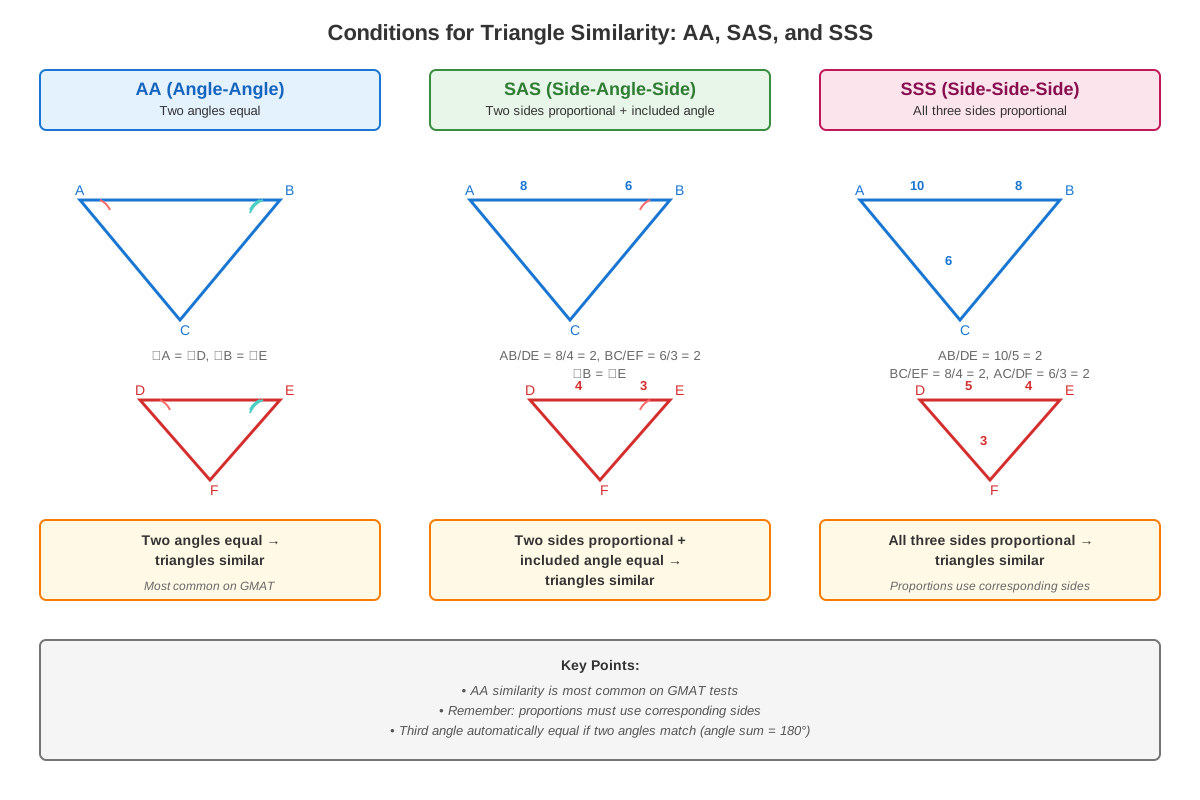
Angle-Angle (AA) Similarity: If two angles of one triangle are congruent to two angles of another triangle, the triangles are similar. Since the sum of angles in any triangle equals 180°, establishing two equal angle pairs automatically ensures the third pair is also equal. This is the most commonly used similarity criterion on the GMAT because it requires the least information.
Side-Side-Side (SSS) Similarity: If the three sides of one triangle are proportional to the three sides of another triangle, the triangles are similar. Specifically, if △ABC and △DEF satisfy AB/DE = BC/EF = AC/DF, then △ABC ~ △DEF.
Side-Angle-Side (SAS) Similarity: If two sides of one triangle are proportional to two sides of another triangle, and the included angles (the angles between those sides) are congruent, the triangles are similar. For example, if AB/DE = AC/DF and ∠A = ∠D, then △ABC ~ △DEF.
Proportional Relationships in Similar Triangles
When △ABC ~ △DEF with scale factor k, meaning each side of △ABC is k times the corresponding side of △DEF, several proportional relationships follow:
AB/DE = BC/EF = AC/DF = kThis constant ratio extends beyond sides to other linear measurements:
- The ratio of corresponding altitudes equals k
- The ratio of corresponding medians equals k
- The ratio of corresponding angle bisectors equals k
- The ratio of perimeters equals k
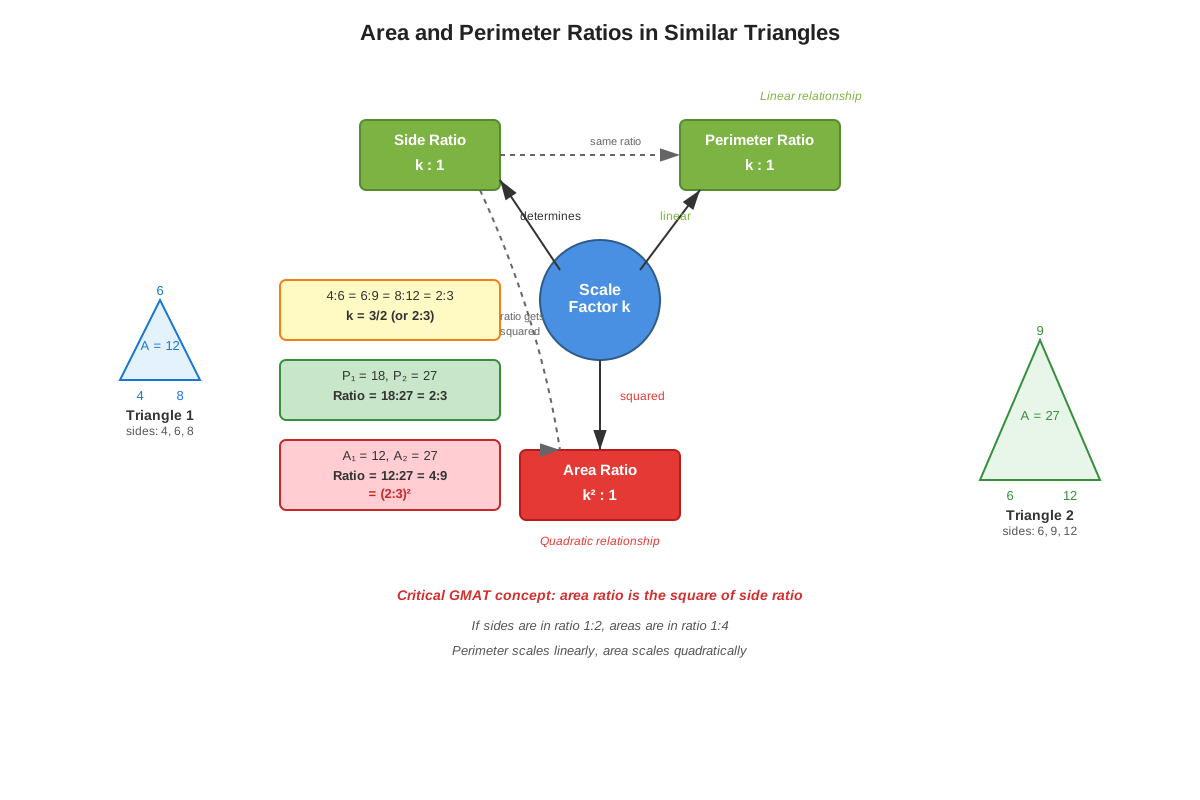
However, area relationships follow different rules. Since area is a two-dimensional measurement, the ratio of areas equals the square of the scale factor:
Area(△ABC)/Area(△DEF) = k²This distinction between linear and area ratios is frequently tested on the GMAT, particularly in Data Sufficiency questions where test-takers must recognize that knowing the side ratio allows calculation of the area ratio, but not vice versa without additional information.
Common GMAT Configurations
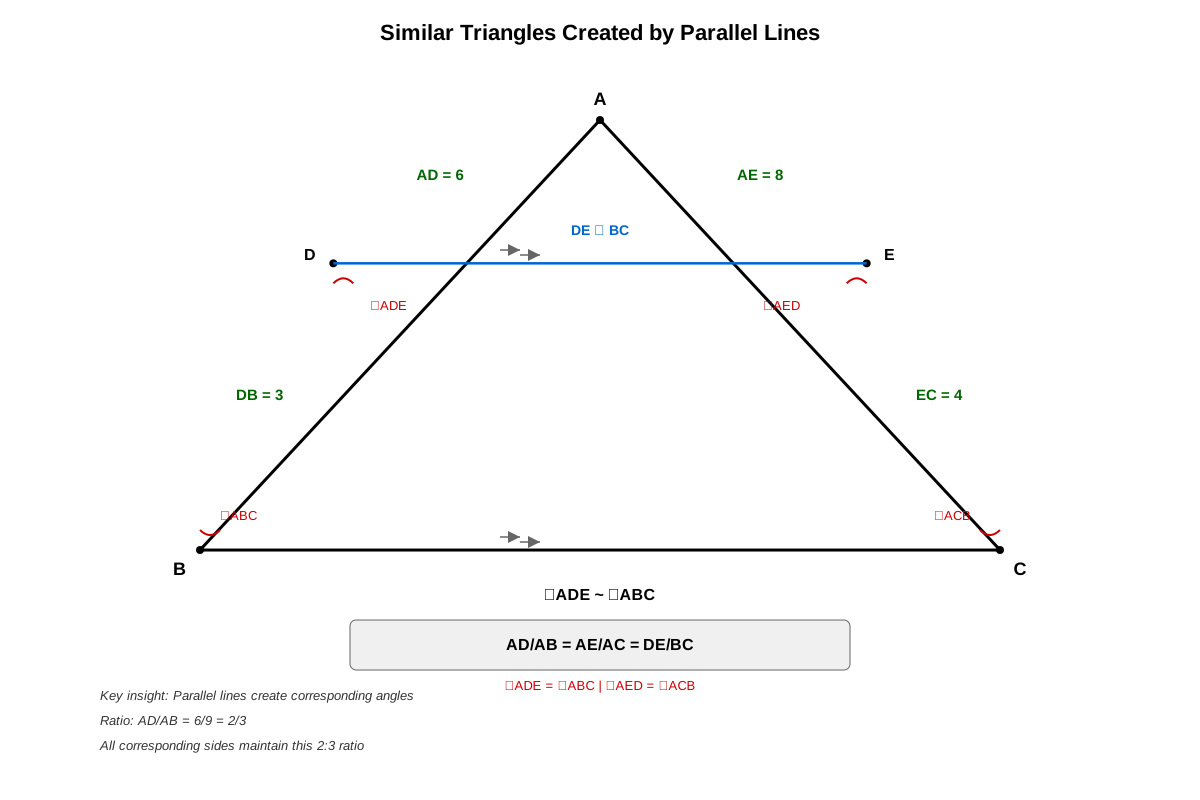
Parallel Lines Creating Similar Triangles: When a line parallel to one side of a triangle intersects the other two sides, it creates a smaller triangle similar to the original. This configuration appears frequently because it combines similarity with parallel line angle relationships. If line DE is parallel to side BC in △ABC, then △ADE ~ △ABC.
Nested Triangles with Shared Angles: When two triangles share a common angle and have another pair of equal angles, they are similar by AA. These often appear in problems involving overlapping triangles or triangles sharing a vertex.
Triangles Formed by Altitudes: When an altitude is drawn from the right angle to the hypotenuse in a right triangle, it creates three similar triangles: the two smaller triangles formed are each similar to the original triangle and to each other. This configuration connects similarity with the Pythagorean theorem and special right triangles.
Calculating with Similar Triangles
The standard approach to solving similar triangle problems involves:
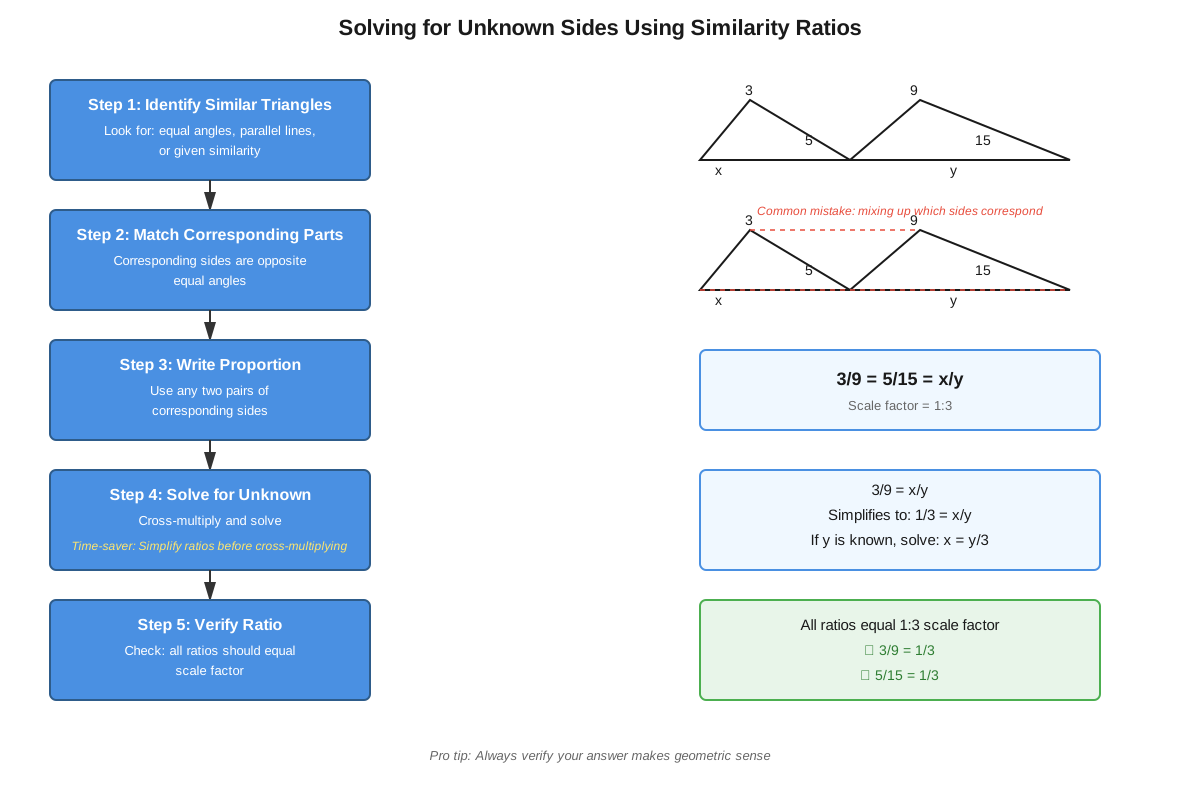
- Identify the similar triangles: Look for equal angles, parallel lines, or given similarity statements
- Establish correspondence: Determine which vertices correspond (match angles to angles)
- Set up proportions: Write ratios of corresponding sides equal to each other
- Solve algebraically: Cross-multiply and solve for unknown values
- Verify reasonableness: Check that calculated values make geometric sense
For example, if △ABC ~ △DEF with AB = 6, BC = 8, AC = 10, and DE = 9, finding EF requires:
- Identifying corresponding sides: AB corresponds to DE, BC corresponds to EF
- Setting up the proportion: AB/DE = BC/EF
- Substituting: 6/9 = 8/EF
- Cross-multiplying: 6(EF) = 72
- Solving: EF = 12
Scale Factor Applications
The scale factor k represents how many times larger (or smaller) one triangle is compared to another. Understanding scale factor enables quick calculations:
| Given Information | Scale Factor | Linear Ratio | Area Ratio | Volume Ratio (3D) |
|---|---|---|---|---|
| Sides in ratio 2:3 | k = 3/2 | 3:2 | 9:4 | 27:8 |
| Areas in ratio 4:9 | k = 3/2 | 3:2 | 9:4 | 27:8 |
| One side doubled | k = 2 | 2:1 | 4:1 | 8:1 |
This table illustrates the critical relationship between linear, area, and volume scaling—a concept that extends similarity principles into three-dimensional geometry.
Concept Relationships
The internal logic of similar triangles flows from angle equality to proportional sides to derived measurements. Angle congruence (established through AA, or implied by SSS/SAS) → side proportionality (the defining characteristic) → proportional linear measurements (altitudes, medians, perimeters) → squared ratio for areas (two-dimensional scaling).
Similar triangles connect backward to prerequisite topics: angle relationships with parallel lines provide the mechanism for identifying equal angles in many configurations; ratio and proportion supply the algebraic tools for working with side relationships; basic triangle properties ensure understanding of what measurements exist and how they relate. The topic connects forward to coordinate geometry (where slope relationships reveal parallel sides and thus similarity), trigonometry (where similar right triangles define trigonometric ratios), and three-dimensional geometry (where similarity principles extend to similar solids with volume ratios equal to the cube of the scale factor).
Within GMAT Quantitative Reasoning more broadly, similar triangles exemplify the integration of geometric visualization with algebraic manipulation. They frequently appear alongside the Pythagorean theorem (especially in right triangle configurations), special right triangles (where angle measures immediately establish similarity), and area calculations (where similarity ratios provide efficient solution pathways). The proportional reasoning developed through similarity work transfers directly to percent problems, rate problems, and data interpretation questions involving scaling.
Quick check — test yourself on Similar triangles so far.
Try Flashcards →High-Yield Facts
⭐ Two triangles are similar if they have two pairs of equal angles (AA similarity) — this is the most efficient method for establishing similarity on the GMAT
⭐ When a line is parallel to one side of a triangle and intersects the other two sides, it creates a similar triangle — this configuration appears in approximately 40% of GMAT similar triangle questions
⭐ The ratio of corresponding sides in similar triangles equals the scale factor k, while the ratio of areas equals k² — confusing linear and area ratios is a common trap
⭐ All corresponding linear measurements (sides, altitudes, medians, perimeters) share the same ratio in similar triangles — this allows calculation of any linear measurement from the scale factor
⭐ In a right triangle, the altitude to the hypotenuse creates three mutually similar triangles — this creates powerful relationships for solving complex right triangle problems
- Similar triangles have congruent corresponding angles and proportional corresponding sides
- The symbol ~ denotes similarity (△ABC ~ △DEF means triangle ABC is similar to triangle DEF)
- Corresponding sides are those opposite equal angles in similar triangles
- If the scale factor between similar triangles is k, then the ratio of their perimeters is k and the ratio of their areas is k²
- SSS similarity requires all three side ratios to be equal; SAS similarity requires two side ratios equal with the included angle congruent
- Triangles with the same shape but different sizes are always similar; congruent triangles are a special case of similar triangles where k = 1
- In coordinate geometry, triangles with sides having the same slopes (or perpendicular slopes) may be similar
- The ratio of corresponding altitudes, medians, and angle bisectors in similar triangles equals the ratio of corresponding sides
- Similar triangles preserve angle measures but scale all linear dimensions by the same factor
- When solving proportions from similar triangles, corresponding sides must be in the same position in each ratio
Common Misconceptions
Misconception: If two triangles have one pair of equal angles, they are similar.
Correction: One pair of equal angles is insufficient. AA similarity requires two pairs of equal angles. A single equal angle only guarantees similarity if additional information (like proportional sides) is provided.
Misconception: The ratio of areas of similar triangles equals the ratio of their sides.
Correction: The ratio of areas equals the square of the ratio of corresponding sides. If sides are in ratio 2:3, areas are in ratio 4:9, not 2:3. This is because area is a two-dimensional measurement.
Misconception: Any two right triangles are similar because they both have a 90° angle.
Correction: Having one equal angle (even a right angle) is insufficient for similarity. Two right triangles are similar only if they have another pair of equal angles, making them similar by AA.
Misconception: When setting up proportions, any sides can be compared as long as they're from similar triangles.
Correction: Only corresponding sides can be compared. Corresponding sides are those opposite equal angles. Mixing non-corresponding sides produces incorrect proportions and wrong answers.
Misconception: If two triangles have proportional sides, they must be congruent.
Correction: Proportional sides indicate similarity, not necessarily congruence. Congruence requires the scale factor k = 1 (sides are equal, not just proportional). Similar triangles can have very different sizes.
Misconception: The altitude of a triangle always creates similar triangles.
Correction: Only the altitude to the hypotenuse in a right triangle creates similar triangles. Altitudes in acute or obtuse triangles do not generally create similar triangles unless special conditions exist.
Misconception: If corresponding angles are equal, corresponding sides must also be equal.
Correction: Equal corresponding angles guarantee that sides are proportional (similar triangles), not equal. Equal sides would make the triangles congruent, which is a special case of similarity.
Worked Examples
Example 1: Parallel Line Configuration
Problem: In triangle ABC, point D lies on side AB and point E lies on side AC such that DE is parallel to BC. If AD = 4, DB = 6, and BC = 15, find the length of DE.
Solution:
Step 1: Identify the similar triangles
Since DE || BC, we know that △ADE ~ △ABC by AA similarity. The parallel lines create corresponding angles: ∠ADE = ∠ABC (corresponding angles) and ∠AED = ∠ACB (corresponding angles). With ∠A common to both triangles, we have two pairs of equal angles.
Step 2: Determine the scale factor
First, find the length of AB: AB = AD + DB = 4 + 6 = 10
The scale factor from △ADE to △ABC is:
k = AB/AD = 10/4 = 5/2
Alternatively, we can express the scale factor from △ADE to △ABC as AD:AB = 4:10 = 2:5
Step 3: Set up the proportion
Since corresponding sides are proportional:
DE/BC = AD/AB
Step 4: Substitute and solve
DE/15 = 4/10
DE/15 = 2/5
5(DE) = 30
DE = 6
Step 5: Verify
The ratio DE:BC = 6:15 = 2:5, which matches AD:AB = 4:10 = 2:5 ✓
Answer: DE = 6
Connection to Learning Objectives: This problem demonstrates identifying similar triangles created by parallel lines (a high-yield GMAT configuration) and applying proportional relationships to find unknown measurements.
Example 2: Multi-Step Problem with Area
Problem: Triangle PQR is similar to triangle XYZ. The sides of triangle PQR are 6, 8, and 10. The shortest side of triangle XYZ is 9. What is the area of triangle XYZ?
Solution:
Step 1: Identify corresponding sides
The shortest side of △PQR is 6, which corresponds to the shortest side of △XYZ, which is 9.
Step 2: Determine the scale factor
Scale factor k = (side of △XYZ)/(corresponding side of △PQR) = 9/6 = 3/2
This means each side of △XYZ is 3/2 times the corresponding side of △PQR.
Step 3: Find all sides of △XYZ
- Shortest side: 9 (given)
- Medium side: 8 × (3/2) = 12
- Longest side: 10 × (3/2) = 15
Step 4: Recognize the right triangle
△PQR has sides 6, 8, 10, which is a multiple of the 3-4-5 Pythagorean triple (specifically, 2 × 3-4-5). Therefore, △PQR is a right triangle with legs 6 and 8.
Similarly, △XYZ has sides 9, 12, 15, which is 3 × 3-4-5, making it a right triangle with legs 9 and 12.
Step 5: Calculate the area of △XYZ
Area = (1/2) × base × height = (1/2) × 9 × 12 = 54
Alternative approach using area ratio:
Area of △PQR = (1/2) × 6 × 8 = 24
Since the scale factor is k = 3/2, the area ratio is k² = (3/2)² = 9/4
Area of △XYZ = 24 × (9/4) = 216/4 = 54 ✓
Answer: The area of triangle XYZ is 54 square units.
Connection to Learning Objectives: This problem integrates multiple concepts: identifying corresponding sides, calculating scale factors, recognizing special right triangles, and applying the critical principle that area ratios equal the square of the scale factor. It demonstrates the type of multi-step reasoning common in higher-difficulty GMAT questions.
Exam Strategy
When approaching GMAT similar triangles questions, begin by scanning the diagram for parallel lines, shared angles, or explicit similarity statements. These visual cues immediately suggest similarity relationships. If no diagram is provided, sketch one quickly, marking equal angles with the same symbol (single arc, double arc, etc.) to track correspondence.
Trigger words and phrases that signal similar triangle problems include:
- "Parallel to"
- "Corresponding sides"
- "In the same ratio"
- "Scale model" or "scale drawing"
- "Shadow" problems (real object and shadow form similar triangles)
- "Proportional to"
- Questions asking about ratios of areas or perimeters
For Data Sufficiency questions, remember that establishing similarity requires proving either AA, SSS, or SAS conditions. Statement (1) or (2) is sufficient if it provides:
- Two angle measures (AA)
- All three side lengths for both triangles (SSS)
- Two side lengths and the included angle for both triangles (SAS)
Be cautious: knowing that triangles are similar is often insufficient to find specific measurements without additional information about at least one actual length.
Process-of-elimination strategies:
- Eliminate answers that confuse linear and area ratios (if sides are in ratio 2:3, eliminate answers suggesting areas are in ratio 2:3)
- Eliminate answers that don't respect the triangle inequality (the sum of any two sides must exceed the third)
- In Data Sufficiency, if a statement provides only one angle or one side length without establishing similarity, it's typically insufficient
- Watch for answer choices that use the reciprocal of the correct ratio (if the scale factor is 2/3, eliminate answers using 3/2 unless the question asks for the inverse relationship)
Time allocation: Most similar triangle problems should take 1.5-2.5 minutes. If you find yourself spending more than 3 minutes, you may be missing a key insight—often that a parallel line creates similar triangles or that recognizing a special right triangle simplifies calculations. Set up proportions systematically rather than trying to "see" the answer, as this reduces errors under time pressure.
Memory Techniques
AA-SSS-SAS Mnemonic: "All Angles Same Shape, Sides Scale Similarly, Some Angles Suffice" — reminds you of the three similarity conditions and that angles determine shape while sides determine size.
Linear vs. Area Ratio: Visualize "Linear = Length (power of 1), Area = Area (power of 2)" — the number of dimensions determines the exponent on the scale factor. For 3D volumes, it would be power of 3.
Parallel Lines Create Similar Triangles: Picture a ladder leaning against a wall. Any rung parallel to the ground creates a smaller similar triangle with the wall and the portion of the ladder above it. This visual reinforces that parallel lines cutting through triangle sides create similarity.
Correspondence Acronym - COAST: Corresponding sides are Opposite Angles that are Same (equal), Therefore proportional. This reminds you how to identify which sides correspond in similar triangles.
Scale Factor Direction: Remember "Big over Small = Bigger than 1" — if you're finding the scale factor from a smaller triangle to a larger one, the ratio should exceed 1. If your calculation gives a fraction less than 1, you've inverted the ratio.
Summary
Similar triangles represent a cornerstone concept in GMAT geometry, combining angle relationships with proportional reasoning to solve problems involving indirect measurement and scaling. Two triangles are similar when their corresponding angles are equal and their corresponding sides are proportional, established through AA (two angle pairs equal), SSS (three side ratios equal), or SAS (two side ratios equal with included angles equal) conditions. The most efficient method on the GMAT is AA similarity, particularly when parallel lines create corresponding angles. The scale factor k describes how many times larger one triangle is than another, with all linear measurements (sides, altitudes, medians, perimeters) sharing this ratio while areas scale by k². Common GMAT configurations include parallel lines intersecting triangle sides, nested triangles sharing angles, and right triangles where the altitude to the hypotenuse creates three mutually similar triangles. Success requires systematic identification of similar triangles, careful establishment of correspondence between vertices, accurate setup of proportions, and awareness of the distinction between linear and area ratios. Mastering similar triangles provides a powerful analytical tool applicable across numerous GMAT question types and difficulty levels.
Key Takeaways
- Similar triangles have equal corresponding angles and proportional corresponding sides, established through AA, SSS, or SAS similarity conditions
- AA similarity (two pairs of equal angles) is the most commonly tested and efficient method for proving triangles are similar on the GMAT
- Parallel lines cutting through a triangle create smaller similar triangles, a configuration appearing in approximately 40% of GMAT similar triangle questions
- The ratio of corresponding sides equals the scale factor k, while the ratio of areas equals k²—never confuse linear and area ratios
- All linear measurements (sides, altitudes, medians, perimeters) share the same ratio in similar triangles, enabling calculation of any measurement from the scale factor
- Corresponding sides are those opposite equal angles—establishing correct correspondence is essential for setting up accurate proportions
- In right triangles, the altitude to the hypotenuse creates three mutually similar triangles, connecting similarity with Pythagorean relationships and special right triangles
Related Topics
Congruent Triangles: While similar triangles have the same shape, congruent triangles have both the same shape and size (scale factor k = 1). Understanding the distinction and the conditions for congruence (SSS, SAS, ASA, AAS) complements similarity knowledge.
Pythagorean Theorem and Special Right Triangles: Similar triangles frequently involve right triangles, where the Pythagorean theorem and 30-60-90 or 45-45-90 relationships provide additional tools for finding side lengths and establishing similarity.
Coordinate Geometry: Similar triangles appear in coordinate plane problems where slope relationships reveal parallel sides or where distance formulas determine side lengths for establishing SSS similarity.
Ratios, Proportions, and Scaling: The proportional reasoning developed through similar triangles extends to mixture problems, rate problems, and data interpretation questions involving scaling, making this a foundational skill across Quantitative Reasoning.
Three-Dimensional Geometry: Similarity principles extend to similar solids, where linear dimensions scale by k, surface areas by k², and volumes by k³, building on two-dimensional similarity concepts.
Practice CTA
Now that you've mastered the core concepts of similar triangles, it's time to solidify your understanding through active practice. Attempt the practice questions to apply these principles across various GMAT question formats and difficulty levels. Use the flashcards to reinforce key facts, formulas, and common configurations until recognition becomes automatic. Remember: similar triangles appear in 10-15% of GMAT geometry questions, making this topic a high-yield investment of your study time. Each practice problem you solve builds the pattern recognition and proportional reasoning skills that translate directly to points on test day. You've built the foundation—now strengthen it through deliberate practice!
Sign up free to keep reading
Create a free AnvayaPrep account to finish this GMAT guide on Similar triangles — plus flashcards and practice questions.