Overview
Work problems are a fundamental category of arithmetic questions that appear consistently on the GMAT Quantitative Reasoning section. These problems involve scenarios where one or more workers, machines, or processes complete a task over time, and test-takers must calculate rates, times, or combined efforts. The essential principle underlying all work problems is the relationship between rate, time, and work completed, typically expressed as: Work = Rate × Time.
Understanding GMAT work problems is crucial because they represent a high-yield question type that combines multiple mathematical concepts including fractions, ratios, rates, and algebraic reasoning. These problems test not only computational skills but also logical thinking and the ability to set up equations from word problems. Work problems frequently appear in both Problem Solving and Data Sufficiency formats, making them essential for achieving competitive scores.
Work problems connect to broader Quantitative Reasoning concepts including rate problems (distance = rate × time), proportional reasoning, and systems of equations. Mastering work problems builds foundational skills that transfer to other GMAT topics such as mixture problems, distance-rate-time questions, and percentage applications. The analytical framework developed through work problems—identifying rates, establishing relationships, and solving for unknowns—represents a critical thinking pattern that appears throughout the GMAT.
Learning Objectives
- [ ] Identify Work problems in various GMAT question formats
- [ ] Explain Work problems using the fundamental work formula and rate concepts
- [ ] Apply Work problems to GMAT questions efficiently and accurately
- [ ] Convert between different representations of work rates (time to complete vs. rate per unit time)
- [ ] Solve combined work problems involving multiple workers or machines
- [ ] Analyze work problems with varying conditions (workers joining or leaving mid-task)
- [ ] Recognize and avoid common traps in GMAT work problem answer choices
Prerequisites
- Basic algebra and equation solving: Essential for setting up and manipulating work equations with variables
- Fraction operations: Required for adding rates and working with partial completion scenarios
- Ratio and proportion concepts: Necessary for understanding relationships between different workers' rates
- Rate concepts: Foundational understanding that rate = quantity/time applies to work contexts
- Unit conversion: Needed to ensure consistent time units (hours, minutes, days) throughout calculations
Why This Topic Matters
Work problems reflect real-world scenarios involving productivity, efficiency, and resource allocation—concepts fundamental to business and operations management. Understanding how to calculate combined efforts, optimize task completion, and analyze productivity rates has direct applications in project management, manufacturing, and workforce planning. These practical connections make work problems particularly relevant for MBA candidates.
On the GMAT, work problems appear in approximately 10-15% of Quantitative Reasoning questions, making them a high-frequency topic that significantly impacts overall scores. They appear in both Problem Solving questions (requiring calculation of specific values) and Data Sufficiency questions (testing whether given information is sufficient to solve). The GMAT particularly favors work problems because they efficiently test multiple skills simultaneously: reading comprehension, algebraic setup, fractional reasoning, and logical analysis.
Common GMAT presentations include: individual workers completing tasks at different rates, machines working together or in sequence, workers joining or leaving projects mid-completion, and comparative efficiency scenarios. Data Sufficiency questions often test whether knowing individual rates versus combined rates provides sufficient information. The versatility of work problem formats makes them ideal for discriminating between test-takers at different skill levels, with harder versions incorporating multiple variables, changing conditions, or requiring multi-step reasoning.
Core Concepts
The Fundamental Work Formula
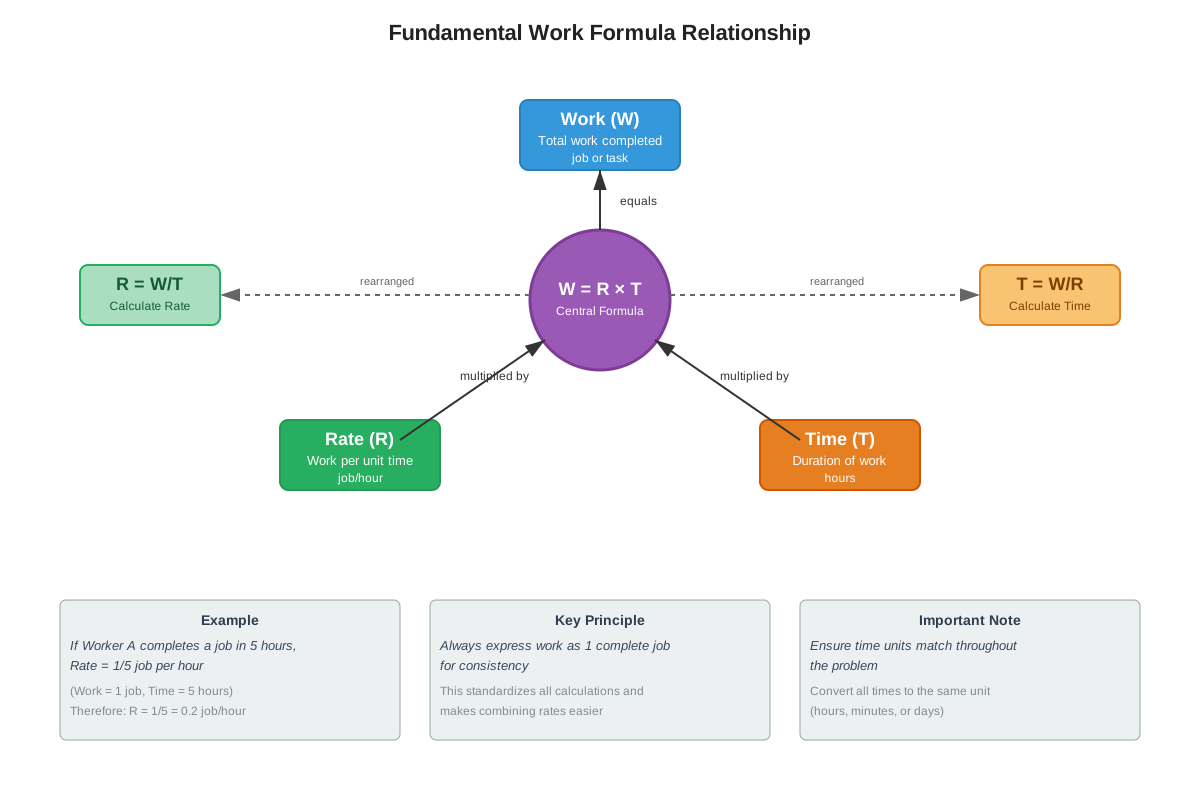
The foundation of all work problems is the relationship: Work = Rate × Time. In this formula, "Work" represents the task to be completed (often normalized to 1 complete job), "Rate" represents the portion of work completed per unit time, and "Time" represents the duration of work. This formula can be rearranged to solve for any variable: Rate = Work/Time or Time = Work/Rate.
When a problem states "John can complete a job in 6 hours," this means John's rate is 1/6 of the job per hour. This conversion—from "time to complete" to "rate per unit time"—is the critical first step in solving work problems. The reciprocal relationship between completion time and rate is fundamental: if completion time is T, then rate is 1/T.
Individual Work Rates
Each worker or machine has an individual work rate representing their productivity. If Worker A completes a task in 4 hours, Worker A's rate is 1/4 job per hour. If Machine B completes a task in 10 hours, Machine B's rate is 1/10 job per hour. These rates remain constant unless the problem explicitly states otherwise.
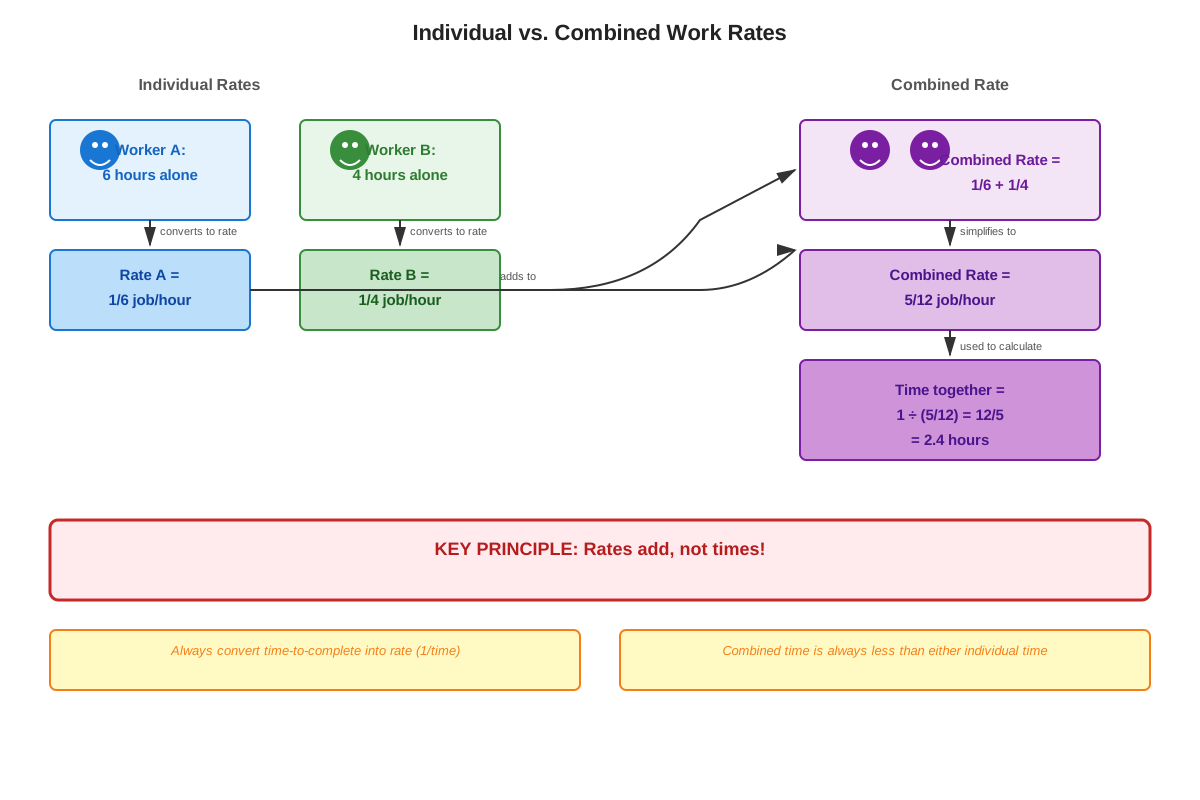
The key principle is that rates are additive when workers collaborate. If Worker A works at rate R_A and Worker B works at rate R_B, their combined rate when working together is R_A + R_B. This additivity principle applies regardless of how many workers are involved: Combined Rate = R₁ + R₂ + R₃ + ... + Rₙ.
Combined Work Problems
When multiple workers or machines work together simultaneously, their rates combine. The standard approach involves three steps:
- Convert individual completion times to rates: If A completes the job in 3 hours and B in 6 hours, then R_A = 1/3 and R_B = 1/6
- Add the rates to find combined rate: R_combined = 1/3 + 1/6 = 2/6 + 1/6 = 3/6 = 1/2
- Calculate time using combined rate: Time = Work/Rate = 1/(1/2) = 2 hours
This framework applies universally to combined work scenarios. The combined rate represents how much of the job all workers complete together in one unit of time.
Partial Work and Sequential Work
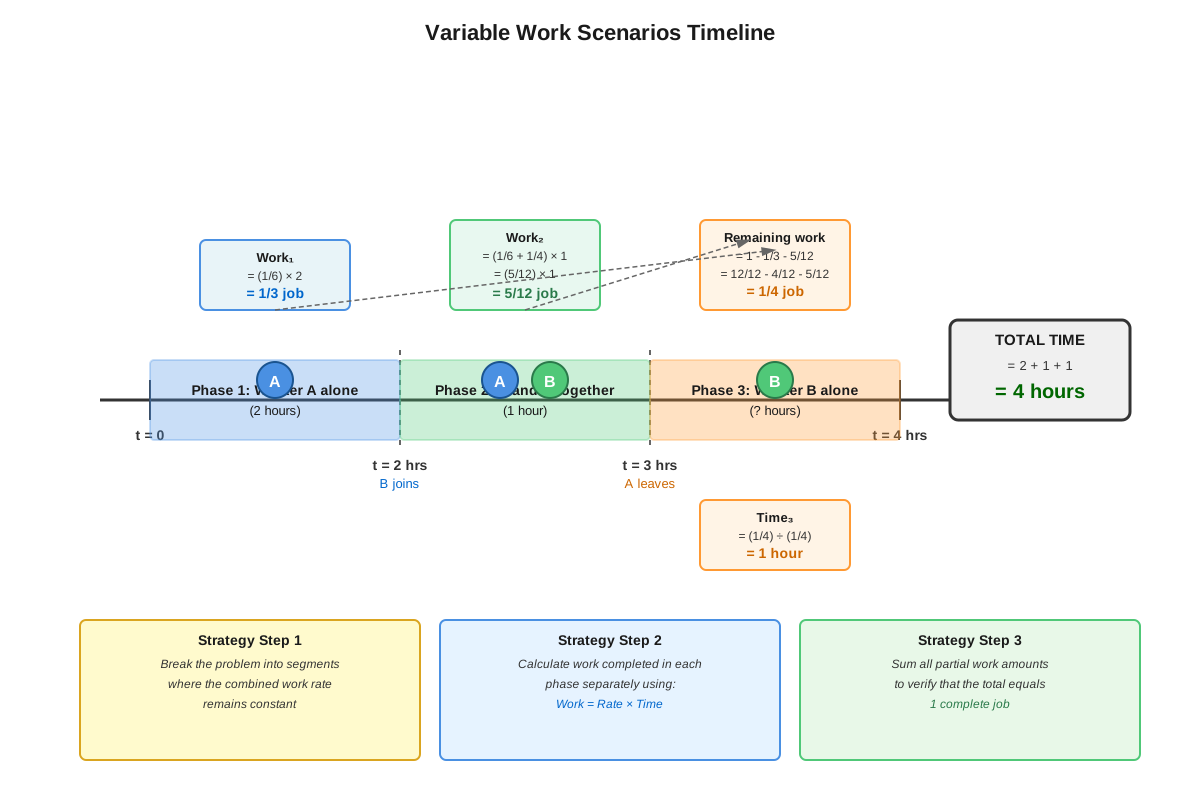
Many GMAT work problems involve workers completing portions of a task before others join or leave. The approach requires tracking work completed in each phase:
- Phase 1: Worker A works alone for time t₁, completing work W₁ = R_A × t₁
- Phase 2: Workers A and B work together for time t₂, completing work W₂ = (R_A + R_B) × t₂
- Total work: W₁ + W₂ = 1 (complete job)
For sequential work where workers alternate or work in stages, calculate each stage's contribution separately and sum to find total work or remaining work.
Negative Rates and Opposing Work
Some problems involve processes that undo work (like a drain emptying a tank being filled). In these scenarios, one rate is positive (constructive) and another is negative (destructive). If a pipe fills a pool at rate 1/4 pool per hour and a drain empties at rate 1/6 pool per hour, the net rate is 1/4 - 1/6 = 3/12 - 2/12 = 1/12 pool per hour.
The principle remains: Net Rate = Positive Rate - Negative Rate. Time to complete = Work/Net Rate.
Efficiency and Rate Comparisons
GMAT problems often compare worker efficiencies using ratios. If Worker A is "twice as fast" as Worker B, then R_A = 2 × R_B. If A completes a job in time T_A and B in time T_B, and R_A = 2 × R_B, then T_A = T_B/2 (the faster worker takes half the time).
Key relationships:
- If rates are in ratio m:n, then times are in ratio n:m (inverse relationship)
- If A is x% faster than B, then R_A = R_B × (1 + x/100)
- If A takes x% less time than B, then T_A = T_B × (1 - x/100)
Variable Rates and Changing Conditions
Advanced work problems involve rates that change during the task. For example, a worker might work at one rate for part of the day and another rate afterward, or additional workers might join mid-project. The solution approach divides the problem into segments with constant rates:
Total Work = (Rate₁ × Time₁) + (Rate₂ × Time₂) + ... + (Rateₙ × Timeₙ)Each segment is calculated separately, then summed to determine total work completed or time required.
Concept Relationships
The core concepts in work problems build hierarchically. The Fundamental Work Formula (Work = Rate × Time) serves as the foundation for all other concepts. From this base, Individual Work Rates emerge by recognizing that rate = 1/time for a complete job.
Individual Work Rates → combine through addition → Combined Work Problems, where multiple workers' rates sum to create a joint rate. This combined rate concept extends to Partial Work and Sequential Work, where different rate combinations apply during different time periods.
Efficiency and Rate Comparisons represent a parallel application of individual rates, focusing on relative rather than absolute values. These comparisons often feed into combined work scenarios where workers of different efficiencies collaborate.
Negative Rates and Opposing Work modify the combination principle by introducing subtraction rather than addition of rates, representing destructive or counterproductive processes. Variable Rates and Changing Conditions integrate all previous concepts, requiring segmented analysis where different rate combinations apply to different time periods.
Connections to prerequisite topics: Work problems apply rate concepts (from distance-rate-time) to a new context, use fraction operations when adding rates, employ algebraic reasoning to set up equations, and leverage ratio concepts when comparing efficiencies. These connections make work problems an integrative topic that reinforces multiple mathematical skills simultaneously.
High-Yield Facts
⭐ The fundamental work formula is Work = Rate × Time, where rate = 1/(time to complete) for a single complete job
⭐ When workers collaborate simultaneously, their rates add: Combined Rate = R₁ + R₂ + R₃ + ...
⭐ If a worker completes a job in T hours, their rate is 1/T jobs per hour
⭐ Time to complete together = 1/(sum of individual rates) when rates are expressed as jobs per unit time
⭐ If Worker A is twice as fast as Worker B, then R_A = 2R_B and T_A = T_B/2
- For partial work problems, calculate work completed in each phase separately, then sum: Total = (Rate₁ × Time₁) + (Rate₂ × Time₂)
- When a process undoes work (like a drain), use negative rates: Net Rate = Positive Rate - Negative Rate
- Rates and times have an inverse relationship: if rates are in ratio m:n, times are in ratio n:m
- In Data Sufficiency, knowing the combined rate alone is usually insufficient to determine individual rates without additional constraints
- Always ensure time units are consistent throughout the problem (all hours, all minutes, etc.)
- The work completed is always expressed as a fraction of the total job: 1 = complete job, 1/2 = half the job, etc.
- When workers join or leave mid-task, divide the problem into time segments with constant rate combinations
- If n identical workers complete a job in T hours, one worker completes it in nT hours
- The reciprocal of combined rate gives time to complete: if combined rate is 3/10 jobs/hour, time is 10/3 hours
- For three workers with times T₁, T₂, T₃, combined time = 1/(1/T₁ + 1/T₂ + 1/T₃)
Quick check — test yourself on Work problems so far.
Try Flashcards →Common Misconceptions
Misconception: When two workers complete a job together, the time required is the average of their individual times.
Correction: Time is determined by the sum of rates, not the average of times. If A takes 2 hours and B takes 4 hours, together they take 1/(1/2 + 1/4) = 1/(3/4) = 4/3 hours, not (2+4)/2 = 3 hours. Rates add, times do not.
Misconception: If Worker A is twice as fast as Worker B, then A takes twice as long to complete the job.
Correction: Faster rate means less time. If A is twice as fast (R_A = 2R_B), then A takes half the time (T_A = T_B/2). Rate and time have an inverse relationship.
Misconception: The combined rate of two workers is always greater than each individual rate.
Correction: While true for positive rates (constructive work), when one rate is negative (destructive work like a drain), the net rate can be less than the positive rate. Net rate = 1/4 - 1/6 = 1/12, which is less than 1/4.
Misconception: In partial work problems, if Worker A works for half the time, they complete half the work.
Correction: Work completed depends on both rate and time: Work = Rate × Time. If A works at rate 1/3 for 2 hours, they complete (1/3) × 2 = 2/3 of the job, not necessarily half. The fraction of time worked doesn't equal the fraction of work completed unless the rate is exactly 1 job per unit time.
Misconception: Knowing the combined time for two workers is sufficient to determine their individual times.
Correction: Multiple combinations of individual rates can produce the same combined rate. If combined time is 2 hours (rate = 1/2), this could result from rates 1/3 + 1/6, or 1/4 + 1/4, or infinitely many other combinations. Additional information is needed to determine individual rates uniquely.
Misconception: When a worker leaves mid-task, their rate is subtracted from the combined rate for the remaining time.
Correction: Correct approach, but students often forget to account for work already completed before the worker left. The remaining work (not the total work) must be divided by the new rate to find additional time needed.
Misconception: If three workers together complete a job in 6 hours, each worker individually takes 18 hours.
Correction: This is only true if all workers have identical rates. If rates differ, individual times will differ. The relationship 1/T₁ + 1/T₂ + 1/T₃ = 1/6 has infinitely many solutions unless workers are specified as identical.
Worked Examples
Example 1: Combined Work with Different Rates
Problem: Machine A can complete a manufacturing job in 6 hours. Machine B can complete the same job in 9 hours. If both machines work together, how long will it take them to complete the job?
Solution:
Step 1: Identify individual rates
- Machine A completes the job in 6 hours, so R_A = 1/6 job per hour
- Machine B completes the job in 9 hours, so R_B = 1/9 job per hour
Step 2: Calculate combined rate
- Combined rate = R_A + R_B = 1/6 + 1/9
- Find common denominator: 1/6 = 3/18 and 1/9 = 2/18
- Combined rate = 3/18 + 2/18 = 5/18 job per hour
Step 3: Calculate time to complete
- Time = Work/Rate = 1 job ÷ (5/18 job per hour)
- Time = 1 × 18/5 = 18/5 = 3.6 hours or 3 hours 36 minutes
Answer: 3.6 hours
Connection to Learning Objectives: This example demonstrates identifying a work problem (two machines completing a task), explaining the solution using rate addition, and applying the fundamental formula to reach the answer.
Example 2: Partial Work with Worker Joining Mid-Task
Problem: Painter A can paint a house in 12 hours. Painter A works alone for 4 hours, then Painter B joins, and together they finish the job in 3 more hours. How long would it take Painter B to paint the house alone?
Solution:
Step 1: Determine Painter A's rate and work completed alone
- R_A = 1/12 house per hour
- Work completed by A alone = Rate × Time = (1/12) × 4 = 4/12 = 1/3 of the house
- Remaining work = 1 - 1/3 = 2/3 of the house
Step 2: Set up equation for combined work phase
- Let R_B = Painter B's rate (unknown)
- Combined rate = R_A + R_B = 1/12 + R_B
- Work completed together = (Combined rate) × Time
- 2/3 = (1/12 + R_B) × 3
Step 3: Solve for R_B
- 2/3 = 3/12 + 3R_B
- 2/3 = 1/4 + 3R_B
- 2/3 - 1/4 = 3R_B
- 8/12 - 3/12 = 3R_B
- 5/12 = 3R_B
- R_B = 5/36 house per hour
Step 4: Calculate Painter B's individual time
- Time = 1/Rate = 1 ÷ (5/36) = 36/5 = 7.2 hours
Answer: Painter B would take 7.2 hours (or 7 hours 12 minutes) to paint the house alone.
Connection to Learning Objectives: This problem requires identifying a partial work scenario, explaining the multi-phase approach, and applying algebraic techniques to solve for an unknown rate—demonstrating advanced application of work problem concepts.
Exam Strategy
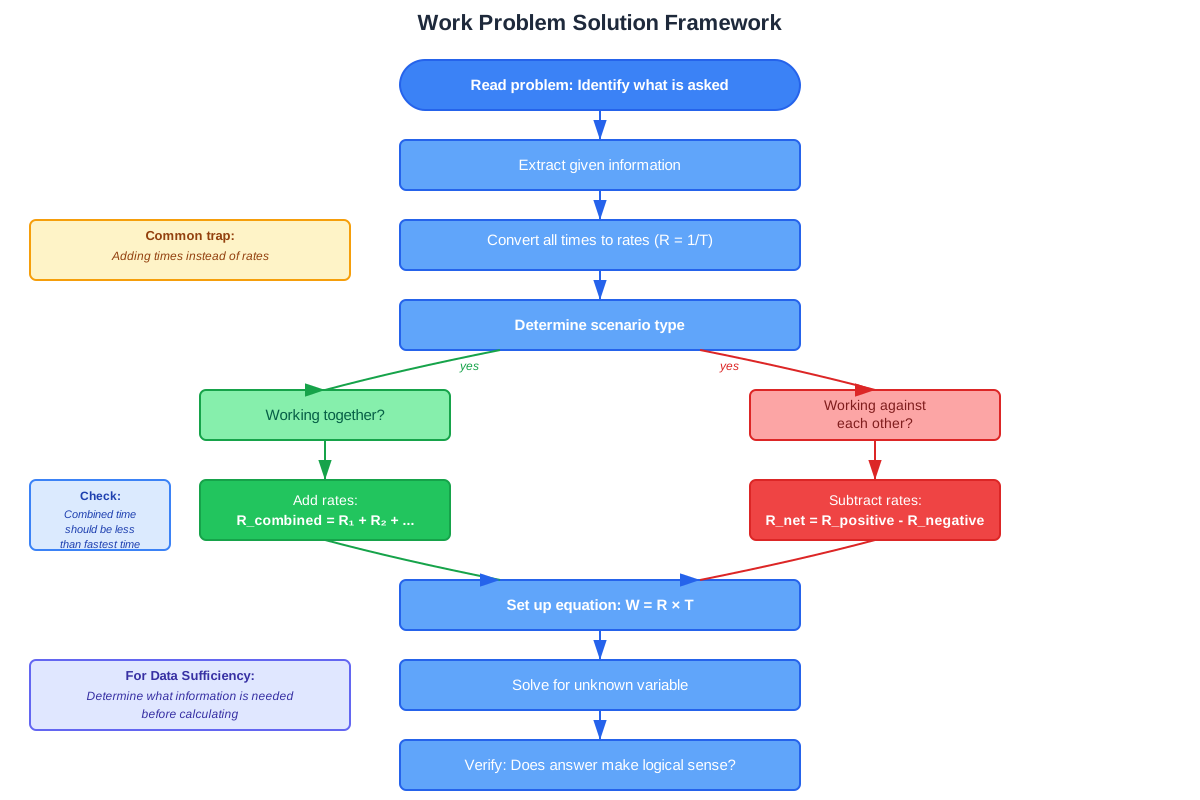
Approach Framework: When encountering GMAT work problems, follow this systematic process:
- Identify the problem type: Look for keywords like "complete," "finish," "working together," "rate," or time-based completion statements
- Extract and convert information: Convert all "time to complete" statements into rates (rate = 1/time)
- Determine what's being asked: Time, rate, work completed, or sufficiency of information
- Set up the equation: Use Work = Rate × Time, adjusting for combined rates or multiple phases
- Solve systematically: Work through algebra carefully, maintaining consistent units
Trigger Words and Phrases:
- "Working together" → signals combined rate calculation
- "Can complete in X hours" → convert to rate of 1/X per hour
- "Joins after" or "leaves before" → indicates partial work problem with phases
- "Twice as fast" or "half the time" → signals efficiency comparison
- "At the same rate" → indicates identical rates that can be combined
- "How much work remains" → calculate work completed, subtract from 1
Process of Elimination Tips:
- Eliminate answers that exceed the time of the slowest individual worker (combined work is always faster)
- Eliminate answers less than the time of the fastest individual worker divided by the number of workers
- For Data Sufficiency, remember that combined rate alone rarely determines individual rates uniquely
- Check if answer choices are in expected range: combined time for two workers is always between T_faster and (T_faster + T_slower)/2
- Verify units match the question (hours vs. minutes, jobs vs. partial completion)
Time Allocation:
- Standard work problems: 1.5-2 minutes for Problem Solving, 1-1.5 minutes for Data Sufficiency
- Complex multi-phase problems: 2-2.5 minutes
- If setup takes more than 30 seconds, reconsider your approach—there's likely a simpler method
Exam Tip: Always convert to rates first, never try to work directly with times. The formula "combined time = (T₁ × T₂)/(T₁ + T₂)" for two workers is a shortcut but can lead to errors in complex problems. Stick with the rate-based approach for consistency.
Memory Techniques
The "WRT" Mnemonic: Remember Work = Rate × Time as "We Race Together" to recall the fundamental formula and the principle that rates combine when working together.
The Reciprocal Rule: "Time to Rate, flip the plate" — to convert time to rate, take the reciprocal (flip the fraction). If time is 5 hours, rate is 1/5; if time is 3/4 hour, rate is 4/3.
The Addition Principle: "Rates add, times don't" — remember that when workers collaborate, you add their rates, never their times. Visualize rates as streams flowing together into a larger combined stream.
The Inverse Relationship: "Fast rate, short wait" — faster rates mean shorter times. If one worker is twice as fast (2× rate), they take half the time (1/2× time). The relationship is inverse.
Phase-by-Phase Visualization: For partial work problems, visualize a progress bar filling up in segments. Each phase fills a portion: Phase 1 fills 1/3, Phase 2 fills 2/3, total reaches 1 (complete).
The "1 Job" Standard: Always normalize work to 1 complete job. Visualize a single complete task as your unit, making all calculations fractions of that whole. This prevents confusion about what "the work" represents.
Summary
Work problems on the GMAT test the fundamental relationship between work, rate, and time through scenarios involving workers, machines, or processes completing tasks. The essential principle—Work = Rate × Time—serves as the foundation for all problem types. Success requires converting completion times to rates (rate = 1/time), understanding that rates add when workers collaborate (Combined Rate = R₁ + R₂ + ...), and systematically analyzing multi-phase problems where conditions change. The inverse relationship between rate and time is critical: faster workers have higher rates but take less time. For partial work scenarios, calculate each phase separately using the appropriate rate combination, then sum the work completed. GMAT work problems frequently test whether students can set up correct equations from word problems, combine rates properly, and avoid common traps like averaging times or confusing rate relationships. Mastery requires recognizing problem patterns, converting information systematically, and applying the work formula with precision across varying scenarios including combined work, sequential work, and changing conditions.
Key Takeaways
- The fundamental formula Work = Rate × Time applies universally; rate = 1/(time to complete) for a single job
- When workers collaborate simultaneously, add their rates: Combined Rate = R₁ + R₂ + R₃ + ...
- Rate and time have an inverse relationship: doubling the rate halves the time
- For partial work problems, divide into phases with constant rates, calculate each phase separately, then sum
- Always convert "time to complete" statements into rates before performing calculations
- Rates add (or subtract for opposing work), but times never add directly
- Ensure consistent units throughout (all hours or all minutes) and normalize work to 1 complete job
Related Topics
Distance-Rate-Time Problems: These problems use the identical formula structure (Distance = Rate × Time) and share the same analytical framework as work problems. Mastering work problems builds skills directly transferable to motion problems.
Mixture Problems: Like work problems, mixture problems involve combining quantities with different properties and require tracking contributions from multiple sources. The rate-based thinking developed in work problems applies to concentration and mixture scenarios.
Ratio and Proportion: Work problems frequently involve comparing worker efficiencies using ratios. Deeper study of proportional reasoning enhances the ability to solve comparative efficiency problems and scale rates appropriately.
Systems of Equations: Complex work problems with multiple unknowns require setting up and solving systems of equations. Advanced work problems serve as practical applications of algebraic techniques.
Optimization Problems: Understanding work rates enables analysis of optimal resource allocation, scheduling, and efficiency maximization—topics that appear in advanced GMAT questions and real-world business scenarios.
Practice CTA
Now that you've mastered the core concepts, formulas, and strategies for GMAT work problems, it's time to solidify your understanding through practice. Attempt the practice questions to apply these concepts in realistic GMAT scenarios, testing both your computational skills and strategic thinking. Use the flashcards to reinforce key formulas, relationships, and common traps until they become automatic. Remember: work problems are high-yield on the GMAT, and consistent practice transforms these initially challenging questions into reliable score-boosters. Every problem you solve strengthens your pattern recognition and builds the confidence needed for test day success!
Sign up free to keep reading
Create a free AnvayaPrep account to finish this GMAT guide on Work problems — plus flashcards and practice questions.