Overview
The Pythagorean theorem stands as one of the most fundamental and frequently tested concepts in GMAT Quantitative Reasoning. This ancient mathematical principle, discovered by the Greek mathematician Pythagoras around 500 BCE, establishes the relationship between the sides of a right triangle. On the GMAT, the Pythagorean theorem appears not only in straightforward geometry problems but also in coordinate geometry, three-dimensional figures, word problems involving distances, and data sufficiency questions. Mastering this theorem is non-negotiable for achieving a competitive quantitative score.
The theorem's versatility makes it a high-yield topic that connects multiple areas of GMAT mathematics. Test-makers frequently embed Pythagorean relationships within complex problem scenarios, requiring students to recognize when and how to apply the theorem even when triangles aren't explicitly drawn. Understanding the GMAT Pythagorean theorem applications extends beyond simple triangle calculations to include diagonal measurements in rectangles, heights in isosceles triangles, distances between coordinate points, and spatial reasoning in three-dimensional geometry.
Within the broader Quantitative Reasoning framework, the Pythagorean theorem serves as a bridge between algebra and geometry. It requires algebraic manipulation skills while solving geometric problems, making it an integrative concept that tests multiple competencies simultaneously. The theorem also forms the foundation for understanding special right triangles (45-45-90 and 30-60-90), distance formulas, and circle problems involving tangent lines and radii. Students who develop fluency with Pythagorean applications gain a significant strategic advantage across numerous GMAT question types.
Learning Objectives
- [ ] Identify the Pythagorean theorem and recognize when it applies to a given problem
- [ ] Explain the Pythagorean theorem and its mathematical foundation
- [ ] Apply the Pythagorean theorem to GMAT questions across various contexts
- [ ] Recognize and utilize Pythagorean triples to solve problems efficiently
- [ ] Determine missing side lengths in right triangles using the theorem
- [ ] Apply the Pythagorean theorem in three-dimensional geometry problems
- [ ] Solve coordinate geometry problems using Pythagorean relationships
Prerequisites
- Basic algebra skills: Ability to solve equations with one variable and manipulate square roots is essential for working with the Pythagorean formula
- Understanding of right angles: Recognition of 90-degree angles and right triangles is necessary to identify when the theorem applies
- Square and square root operations: Facility with squaring numbers and extracting square roots enables efficient calculation and problem-solving
- Triangle properties: Knowledge of basic triangle terminology (hypotenuse, legs, vertices) provides the vocabulary framework for applying the theorem
- Coordinate plane basics: Familiarity with plotting points and understanding x-y coordinates supports distance calculation applications
Why This Topic Matters
The Pythagorean theorem appears in approximately 15-20% of GMAT Quantitative Reasoning questions, making it one of the most frequently tested geometric concepts. Its applications span multiple question formats including problem-solving, data sufficiency, and integrated reasoning scenarios. Test-makers favor this topic because it efficiently assesses both geometric intuition and algebraic manipulation skills within a single problem.
In real-world contexts, the Pythagorean theorem underlies countless practical applications from construction and architecture to navigation and computer graphics. Engineers use it to calculate structural supports, surveyors employ it for distance measurements, and programmers apply it in game development and animation. Understanding this theorem develops spatial reasoning skills that extend far beyond standardized testing.
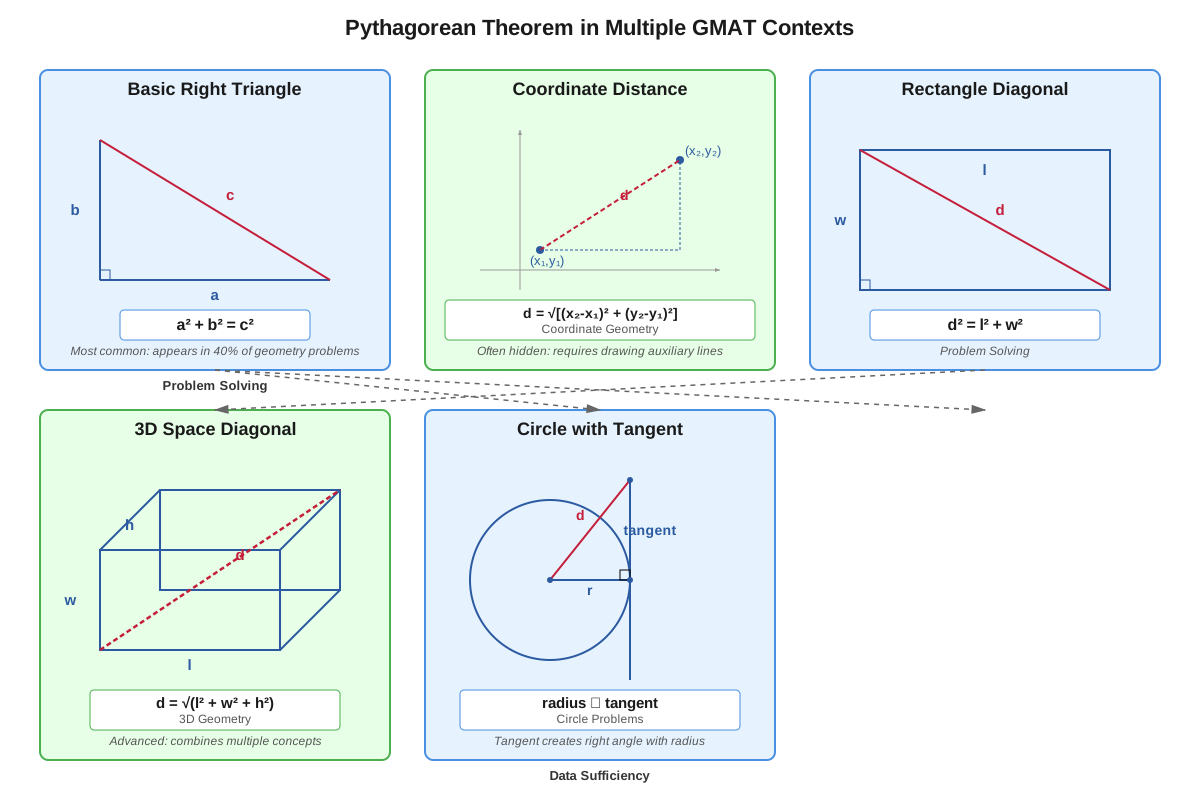
On the GMAT specifically, Pythagorean theorem questions commonly appear as: (1) direct right triangle problems asking for missing side lengths, (2) rectangle and square diagonal calculations, (3) coordinate geometry distance problems, (4) three-dimensional box diagonal questions, (5) circle problems involving radii and tangent lines, (6) word problems about ladders, shadows, or distances, and (7) data sufficiency questions testing whether given information allows determination of specific measurements. The theorem often appears embedded within more complex multi-step problems rather than as isolated calculations, requiring students to recognize its applicability without explicit prompting.
Core Concepts
The Fundamental Theorem
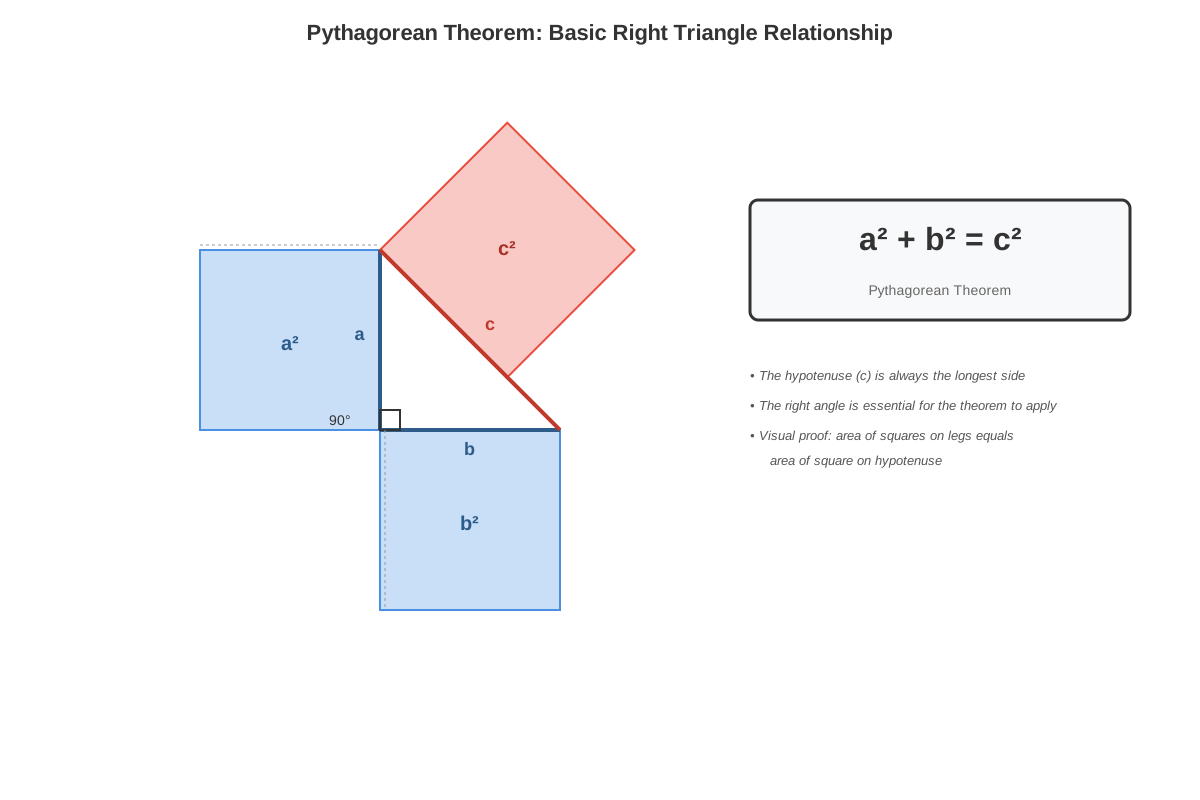
The Pythagorean theorem states that in any right triangle, the square of the length of the hypotenuse (the side opposite the right angle) equals the sum of the squares of the lengths of the other two sides (called legs). Mathematically, this relationship is expressed as:
a² + b² = c²Where:
- a and b represent the lengths of the two legs (the sides that form the right angle)
- c represents the length of the hypotenuse (the longest side, opposite the right angle)
This formula works exclusively for right triangles—triangles containing exactly one 90-degree angle. The theorem provides a powerful tool for finding any unknown side length when the other two sides are known. The hypotenuse is always the longest side of a right triangle and always lies opposite the right angle.
Applying the Theorem to Find Missing Sides
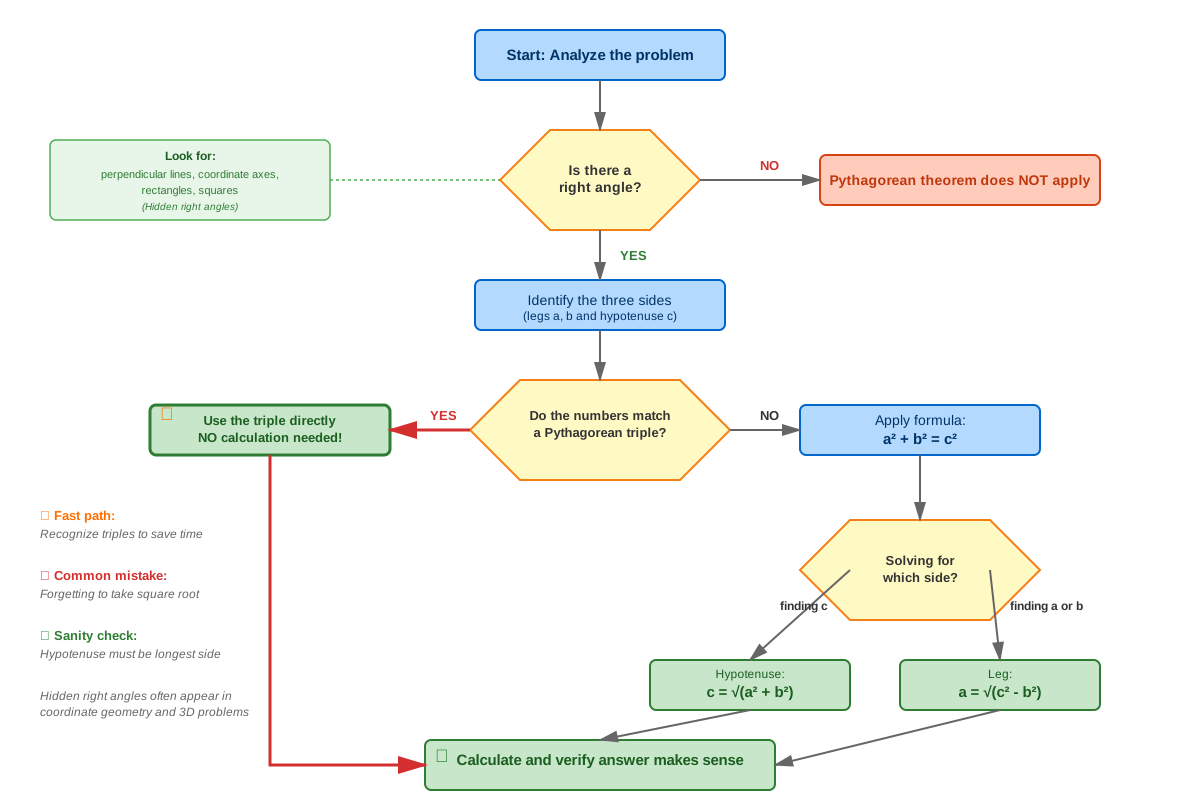
When solving for an unknown side, the approach depends on which side is missing:
Finding the hypotenuse (c):
- Square both known leg lengths
- Add these squared values together
- Take the square root of the sum
Example: If a = 3 and b = 4, then c² = 3² + 4² = 9 + 16 = 25, so c = 5
Finding a leg (a or b):
- Square the hypotenuse
- Square the known leg
- Subtract the squared leg from the squared hypotenuse
- Take the square root of the difference
Example: If c = 13 and b = 5, then a² = 13² - 5² = 169 - 25 = 144, so a = 12
Pythagorean Triples
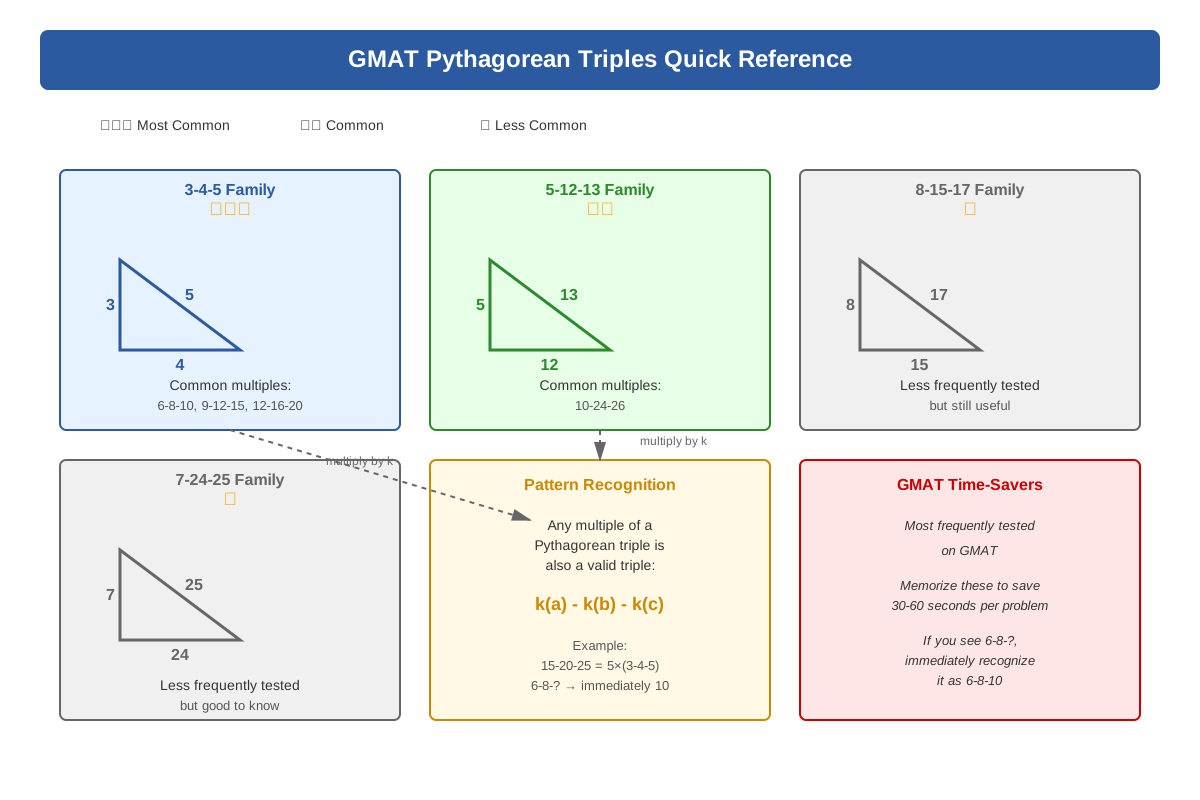
Pythagorean triples are sets of three positive integers that satisfy the Pythagorean theorem. Recognizing these common patterns dramatically increases solving speed on the GMAT, as they eliminate the need for calculation. The most frequently appearing triples include:
| Basic Triple | Common Multiples | Pattern |
|---|---|---|
| 3-4-5 | 6-8-10, 9-12-15, 12-16-20, 15-20-25 | Multiply each term by same integer |
| 5-12-13 | 10-24-26, 15-36-39 | Less common but appears regularly |
| 8-15-17 | 16-30-34 | Occasionally tested |
| 7-24-25 | 14-48-50 | Rare but valuable to recognize |
When a problem presents side lengths that match or are multiples of these triples, students can immediately identify the missing side without calculation. For instance, if a triangle has legs of 9 and 12, recognizing this as 3(3-4-5) immediately reveals the hypotenuse is 15.
Three-Dimensional Applications
The Pythagorean theorem extends to three-dimensional geometry, particularly for finding space diagonals in rectangular solids (boxes). For a rectangular box with dimensions length (l), width (w), and height (h), the space diagonal (d) connecting opposite corners is found using:
d² = l² + w² + h²This formula derives from applying the Pythagorean theorem twice: first to find the diagonal of the base, then using that diagonal with the height to find the space diagonal. GMAT problems frequently test this concept with questions about the longest rod that can fit inside a box or the distance between opposite corners of a room.
Coordinate Geometry Applications
In the coordinate plane, the distance between any two points (x₁, y₁) and (x₂, y₂) can be calculated using the distance formula, which is a direct application of the Pythagorean theorem:
distance = √[(x₂ - x₁)² + (y₂ - y₁)²]This formula treats the horizontal distance (x₂ - x₁) and vertical distance (y₂ - y₁) as the two legs of a right triangle, with the straight-line distance between the points as the hypotenuse. GMAT coordinate geometry problems often require calculating distances between points, determining if points form right triangles, or finding points at specific distances from given locations.
Special Right Triangles Connection
The Pythagorean theorem validates the side ratios in special right triangles. In a 45-45-90 triangle, if each leg has length x, the theorem confirms the hypotenuse is x√2. In a 30-60-90 triangle with shortest side x, the theorem verifies the sides are x, x√3, and 2x. Understanding these relationships allows rapid problem-solving when special triangles appear.
Converse of the Pythagorean Theorem
The converse states that if three sides of a triangle satisfy a² + b² = c² (where c is the longest side), then the triangle must be a right triangle. This principle helps determine whether a triangle is right-angled when only side lengths are provided. GMAT data sufficiency questions sometimes test whether given information is sufficient to determine if a triangle is a right triangle.
Concept Relationships
The Pythagorean theorem serves as a central hub connecting multiple geometric concepts. At its foundation, the theorem relies on algebraic manipulation skills, particularly solving equations and working with square roots. This algebraic-geometric intersection makes it a powerful integrative concept.
The theorem directly enables understanding of special right triangles (45-45-90 and 30-60-90 triangles), as these triangles' side ratios can be derived and verified using Pythagorean relationships. Conversely, recognizing special triangles often eliminates the need for Pythagorean calculations, creating a bidirectional relationship where each concept reinforces the other.
In coordinate geometry, the Pythagorean theorem transforms into the distance formula, connecting pure geometry to the coordinate plane. This relationship flows as: Pythagorean theorem → distance formula → circle equations → coordinate geometry problems. Understanding this progression reveals how a single geometric principle underlies multiple question types.
For three-dimensional geometry, the theorem extends through repeated application: base diagonal calculation → space diagonal calculation. This hierarchical relationship demonstrates how two-dimensional principles scale to three-dimensional problems.
The theorem also connects to triangle properties more broadly. It helps determine triangle types (acute, right, or obtuse) through comparison: if a² + b² = c², the triangle is right; if a² + b² > c², it's acute; if a² + b² < c², it's obtuse. This relationship links the Pythagorean theorem to triangle classification.
Additionally, the theorem interfaces with circle geometry when problems involve tangent lines (which form right angles with radii), chords, and inscribed shapes. The relationship flows: circle properties → right angle formation → Pythagorean application → solution.
High-Yield Facts
⭐ The Pythagorean theorem applies only to right triangles: a² + b² = c², where c is the hypotenuse opposite the right angle
⭐ The 3-4-5 triangle and its multiples (6-8-10, 9-12-15, etc.) are the most commonly tested Pythagorean triples on the GMAT
⭐ The hypotenuse is always the longest side of a right triangle and always lies opposite the 90-degree angle
⭐ In coordinate geometry, the distance between points (x₁, y₁) and (x₂, y₂) equals √[(x₂ - x₁)² + (y₂ - y₁)²]
⭐ The diagonal of a rectangle with sides a and b equals √(a² + b²), creating two congruent right triangles
- The 5-12-13 and 8-15-17 triples appear frequently enough to memorize for time-saving on test day
- The space diagonal of a rectangular box with dimensions l, w, and h equals √(l² + w² + h²)
- If a² + b² = c² where c is the longest side, the triangle must be a right triangle (converse theorem)
- The diagonal of a square with side length s equals s√2, derived from the 45-45-90 triangle relationship
- In isosceles right triangles, the two legs are equal, and the hypotenuse equals leg × √2
- When a right triangle is inscribed in a semicircle, the diameter is always the hypotenuse
- The altitude to the hypotenuse of a right triangle creates two smaller right triangles similar to the original
- Pythagorean theorem problems often appear disguised as word problems about ladders, shadows, or distances
Quick check — test yourself on Pythagorean theorem so far.
Try Flashcards →Common Misconceptions
Misconception: The Pythagorean theorem works for all triangles, not just right triangles.
Correction: The theorem applies exclusively to right triangles containing exactly one 90-degree angle. Using it on acute or obtuse triangles produces incorrect results. Always verify the presence of a right angle before applying the theorem.
Misconception: The hypotenuse can be any side of the triangle.
Correction: The hypotenuse is specifically the side opposite the right angle and is always the longest side. The two legs form the right angle. Misidentifying which side is the hypotenuse leads to incorrect equation setup and wrong answers.
Misconception: When solving for a leg, students add the squares instead of subtracting (using a² = b² + c² instead of a² = c² - b²).
Correction: When finding a leg, subtract the known leg squared from the hypotenuse squared. The formula a² + b² = c² must be rearranged correctly: a² = c² - b² or b² = c² - a².
Misconception: Forgetting to take the square root after adding or subtracting squared values.
Correction: The Pythagorean theorem involves squared lengths (a², b², c²), but the final answer requires taking the square root to find the actual side length. If a² = 25, then a = 5, not 25.
Misconception: Assuming that if two sides of a triangle are 3 and 4, the third side must be 5.
Correction: The third side is 5 only if the 3 and 4 are the two legs (forming the right angle). If 4 is the hypotenuse and 3 is a leg, the other leg would be √7. Always identify which sides are legs and which is the hypotenuse.
Misconception: Pythagorean triples only work with the exact numbers (3-4-5) and don't scale.
Correction: Pythagorean triples can be multiplied by any positive integer to create new valid triples. The triple 3-4-5 generates 6-8-10, 9-12-15, 30-40-50, and infinitely many others. Recognizing these multiples saves significant calculation time.
Misconception: In three-dimensional problems, applying the Pythagorean theorem once is sufficient.
Correction: Finding a space diagonal in a rectangular box requires applying the theorem twice: first to find the base diagonal, then using that diagonal with the height to find the space diagonal. Alternatively, use the three-dimensional formula d² = l² + w² + h² directly.
Worked Examples
Example 1: Classic Right Triangle Problem
Problem: A ladder leans against a wall, reaching 24 feet up the wall. The base of the ladder is 7 feet from the wall. How long is the ladder?
Solution:
Step 1: Identify the right triangle components
- The wall, ground, and ladder form a right triangle
- The wall height (24 feet) is one leg
- The ground distance (7 feet) is the other leg
- The ladder length is the hypotenuse (what we're solving for)
Step 2: Set up the Pythagorean theorem
a² + b² = c²
7² + 24² = c²
Step 3: Calculate
49 + 576 = c²
625 = c²
c = √625 = 25
Step 4: Verify using Pythagorean triple recognition
The numbers 7, 24, and 25 form a Pythagorean triple. Recognizing this pattern immediately gives the answer without calculation.
Answer: The ladder is 25 feet long.
Connection to learning objectives: This problem demonstrates applying the Pythagorean theorem to a real-world GMAT scenario, identifying which sides are legs versus hypotenuse, and recognizing Pythagorean triples for efficiency.
Example 2: Coordinate Geometry Application
Problem: Point A is located at coordinates (2, 3) and point B is at (14, 8). What is the distance between points A and B?
Solution:
Step 1: Recognize this as a Pythagorean theorem application
The distance between two points forms the hypotenuse of a right triangle where the legs are the horizontal and vertical distances.
Step 2: Calculate the horizontal distance (change in x)
Δx = 14 - 2 = 12Step 3: Calculate the vertical distance (change in y)
Δy = 8 - 3 = 5Step 4: Apply the Pythagorean theorem (distance formula)
distance² = (Δx)² + (Δy)²
distance² = 12² + 5²
distance² = 144 + 25
distance² = 169
distance = 13
Step 5: Recognize the Pythagorean triple
The values 5, 12, and 13 form a Pythagorean triple, confirming our answer.
Answer: The distance between points A and B is 13 units.
Connection to learning objectives: This example shows how the Pythagorean theorem extends to coordinate geometry through the distance formula, demonstrating the theorem's versatility across different GMAT question formats.
Example 3: Three-Dimensional Problem
Problem: A rectangular box has dimensions 6 inches by 8 inches by 24 inches. What is the length of the longest straight rod that can fit completely inside the box?
Solution:
Step 1: Recognize that the longest rod is the space diagonal
The space diagonal connects two opposite corners of the box.
Step 2: Apply the three-dimensional Pythagorean formula
d² = l² + w² + h²
d² = 6² + 8² + 24²
Step 3: Calculate
d² = 36 + 64 + 576
d² = 676
d = √676 = 26
Step 4: Alternative approach using two applications
First, find the base diagonal: √(6² + 8²) = √(36 + 64) = √100 = 10
Then use this with height: √(10² + 24²) = √(100 + 576) = √676 = 26
Step 5: Recognize the pattern
The base dimensions 6-8 are a multiple of 3-4 (giving diagonal 10), and 10-24-26 is a multiple of 5-12-13.
Answer: The longest rod that can fit is 26 inches.
Connection to learning objectives: This problem demonstrates applying the Pythagorean theorem in three dimensions, showing how the theorem extends beyond two-dimensional triangles to spatial reasoning problems common on the GMAT.
Exam Strategy
When approaching GMAT questions involving the Pythagorean theorem, begin by identifying whether a right triangle exists or can be constructed. Look for explicit right angle symbols, perpendicular lines, rectangles (which contain right angles), or coordinate geometry setups. Many GMAT problems don't draw the triangle explicitly, requiring students to visualize the geometric relationship.
Trigger words and phrases that signal Pythagorean theorem applications include: "right triangle," "perpendicular," "diagonal," "distance between points," "ladder against a wall," "rectangular," "box dimensions," "shortest/longest distance," and "straight-line path." In data sufficiency questions, watch for information about two sides of a right triangle, which is always sufficient to determine the third side.
Time-saving strategies center on recognizing Pythagorean triples. Before calculating, check if the given numbers match or are multiples of common triples (3-4-5, 5-12-13, 8-15-17, 7-24-25). This recognition can reduce a 60-second calculation to a 5-second identification. For coordinate geometry, memorize the distance formula as an automatic application rather than deriving it each time.
Process of elimination works effectively when answer choices are provided. If you know the hypotenuse must be longer than either leg, eliminate any choices that violate this rule. If calculating a leg, eliminate choices larger than the hypotenuse. For problems involving Pythagorean triples, eliminate answers that don't fit the pattern.
Time allocation for Pythagorean theorem problems should average 1.5-2 minutes. Straightforward applications should take under 90 seconds, while multi-step problems involving three dimensions or embedded within complex scenarios may require the full 2 minutes. If a problem requires more time, mark it for review and move forward to maintain pacing.
For data sufficiency questions, remember that knowing any two sides of a right triangle is sufficient to determine the third. However, knowing only one side or knowing two sides without confirmation of a right angle is insufficient. Be cautious of problems that provide triangle side lengths without specifying whether the triangle is right-angled.
Memory Techniques
Mnemonic for the theorem: "A squared plus B squared equals C squared" can be remembered as "Always Be Calculating" to recall the formula structure, where C is always the hypotenuse.
Pythagorean triple memory palace: Visualize a house with address 345 (3-4-5 triple), a room number 51213 (5-12-13), and a phone extension 81517 (8-15-17). This spatial memory technique helps recall the most common triples.
Acronym for application steps: FISH
- Find the right angle
- Identify legs and hypotenuse
- Set up the equation (a² + b² = c²)
- Hypotenuse or leg? (determine what you're solving for)
Visualization strategy: Always sketch the triangle, even if not provided in the problem. Label the right angle with a small square, mark the hypotenuse with a different color or double line, and label all known values. This visual representation prevents misidentification errors.
Rhyme for the converse: "If the squares of two add to one more, then ninety degrees you can be sure" helps remember that when a² + b² = c², the triangle must contain a right angle.
Finger counting for 3-4-5 multiples: Use fingers to count multiples: one finger = 3-4-5, two fingers = 6-8-10, three fingers = 9-12-15, etc. This kinesthetic technique reinforces the scaling pattern.
Summary
The Pythagorean theorem represents one of the most essential and frequently tested concepts in GMAT Quantitative Reasoning, establishing that in any right triangle, the square of the hypotenuse equals the sum of the squares of the two legs (a² + b² = c²). Mastery requires not only understanding the basic formula but also recognizing its applications across diverse problem types including coordinate geometry distance calculations, three-dimensional space diagonals, and embedded word problems. Efficient GMAT performance demands immediate recognition of common Pythagorean triples (particularly 3-4-5, 5-12-13, and their multiples) to eliminate time-consuming calculations. The theorem's versatility extends from straightforward right triangle problems to complex multi-step scenarios involving rectangles, boxes, coordinate planes, and special triangles. Success requires identifying when right triangles exist even when not explicitly drawn, correctly distinguishing legs from hypotenuse, and applying appropriate algebraic manipulation to solve for unknown sides. Students must also understand the theorem's three-dimensional extension and its relationship to the distance formula in coordinate geometry.
Key Takeaways
- The Pythagorean theorem (a² + b² = c²) applies exclusively to right triangles, where c represents the hypotenuse opposite the right angle
- Memorizing common Pythagorean triples (3-4-5, 5-12-13, 8-15-17) and recognizing their multiples dramatically increases solving speed
- The theorem extends to coordinate geometry through the distance formula and to three-dimensional geometry through space diagonal calculations
- Always identify which side is the hypotenuse (longest side, opposite the right angle) before setting up the equation
- When solving for a leg, subtract the known leg squared from the hypotenuse squared; when solving for the hypotenuse, add both legs squared
- Many GMAT problems require recognizing hidden right triangles in rectangles, coordinate planes, or word problem scenarios
- The converse theorem confirms that if a² + b² = c² (where c is the longest side), the triangle must be right-angled
Related Topics
Special Right Triangles (45-45-90 and 30-60-90): These triangles have fixed side ratios that can be derived using the Pythagorean theorem. Mastering the Pythagorean theorem provides the foundation for understanding why these ratios work and enables verification of special triangle properties.
Coordinate Geometry: The distance formula, midpoint calculations, and determining whether points form right triangles all rely on Pythagorean relationships. Strong command of the theorem enables efficient navigation of coordinate plane problems.
Three-Dimensional Geometry: Calculating surface diagonals, space diagonals, and distances in rectangular solids requires extending Pythagorean thinking to three dimensions. This progression builds naturally from two-dimensional mastery.
Circle Geometry: Problems involving tangent lines (which form right angles with radii), chords, and inscribed triangles frequently incorporate Pythagorean relationships. Understanding the theorem unlocks a significant subset of circle problems.
Triangle Properties and Classification: The Pythagorean theorem helps determine whether triangles are acute, right, or obtuse, and connects to broader triangle inequality and similarity concepts.
Practice CTA
Now that you've mastered the theoretical foundations of the Pythagorean theorem, it's time to cement your understanding through active practice. Attempt the practice questions associated with this topic, focusing on recognizing Pythagorean triples quickly and identifying hidden right triangles in complex scenarios. Use the flashcards to drill the common triples and key formulas until they become automatic. Remember, GMAT success comes not just from understanding concepts but from rapid, accurate application under time pressure. Each practice problem you solve builds the pattern recognition and confidence needed to excel on test day. Challenge yourself to solve problems both with and without a calculator to develop true numerical fluency. Your investment in deliberate practice now will pay dividends in your quantitative score!
Sign up free to keep reading
Create a free AnvayaPrep account to finish this GMAT guide on Pythagorean theorem — plus flashcards and practice questions.