Overview
Coordinate geometry is one of the most frequently tested topics in the GMAT Quantitative Reasoning section, appearing in approximately 10-15% of all quant questions. This branch of mathematics merges algebra and geometry by representing geometric figures and relationships using algebraic equations on a coordinate plane. The beauty of GMAT coordinate geometry lies in its dual nature: problems can often be solved using either pure geometric reasoning or algebraic manipulation, giving test-takers strategic flexibility.
Mastering coordinate geometry is essential for GMAT success because it serves as a bridge between multiple mathematical domains. Questions may require calculating distances between points, determining slopes of lines, finding equations of circles, or analyzing the properties of polygons plotted on the xy-plane. The GMAT frequently embeds coordinate geometry within Data Sufficiency questions, where understanding the geometric implications of algebraic constraints becomes crucial for determining sufficiency.
Within the broader Quantitative Reasoning framework, coordinate geometry connects foundational algebra concepts (linear equations, quadratic functions) with spatial reasoning skills (area, perimeter, symmetry). It also frequently appears in combination with other geometry topics such as triangles, circles, and polygons. Strong proficiency in coordinate geometry enables test-takers to visualize algebraic relationships spatially and translate geometric problems into solvable equations—skills that distinguish high scorers from average performers.
Learning Objectives
- [ ] Identify coordinate geometry concepts and structures on the GMAT
- [ ] Explain coordinate geometry principles including distance, midpoint, and slope formulas
- [ ] Apply coordinate geometry to GMAT questions involving lines, circles, and polygons
- [ ] Calculate areas and perimeters of geometric figures using coordinate methods
- [ ] Determine equations of lines given various conditions (two points, point-slope, intercepts)
- [ ] Analyze the relationship between algebraic equations and their geometric representations
- [ ] Solve Data Sufficiency questions requiring coordinate geometry reasoning
Prerequisites
- Basic algebra: Solving linear and quadratic equations is fundamental to finding intersection points and working with line equations
- Properties of geometric shapes: Understanding triangles, rectangles, and circles helps recognize patterns when these figures appear on the coordinate plane
- Number properties: Positive/negative number relationships determine quadrant locations and direction of slopes
- Exponents and radicals: The distance formula involves square roots, requiring comfort with radical simplification
- Function notation: Understanding y = f(x) notation helps interpret line equations and transformations
Why This Topic Matters
Coordinate geometry represents a critical intersection of algebraic and spatial reasoning that appears throughout higher mathematics, engineering, computer graphics, data science, and economics. In business analytics, coordinate systems model relationships between variables; in logistics, they optimize routing and distance calculations; in finance, they visualize trends and correlations. The skills developed through coordinate geometry—translating between symbolic and visual representations—are fundamental to quantitative problem-solving across disciplines.
On the GMAT specifically, coordinate geometry appears in 3-5 questions per exam, distributed across both Problem Solving and Data Sufficiency formats. These questions typically fall into the 600-750 difficulty range, making them crucial for test-takers targeting competitive scores. The GMAT tests coordinate geometry through several recurring question types: finding distances or midpoints between points, determining slopes or equations of lines, calculating areas of polygons with vertices at given coordinates, analyzing properties of circles centered at specific points, and determining whether points satisfy certain geometric conditions.
The topic's high yield stems from its versatility—a single question might combine coordinate geometry with algebra, number properties, and geometric reasoning. Data Sufficiency questions particularly favor coordinate geometry because the relationship between algebraic information and geometric sufficiency creates nuanced testing opportunities. Understanding that two points determine a unique line, or that three non-collinear points determine a unique circle, becomes essential for evaluating statement sufficiency.
Core Concepts
The Coordinate Plane and Quadrants
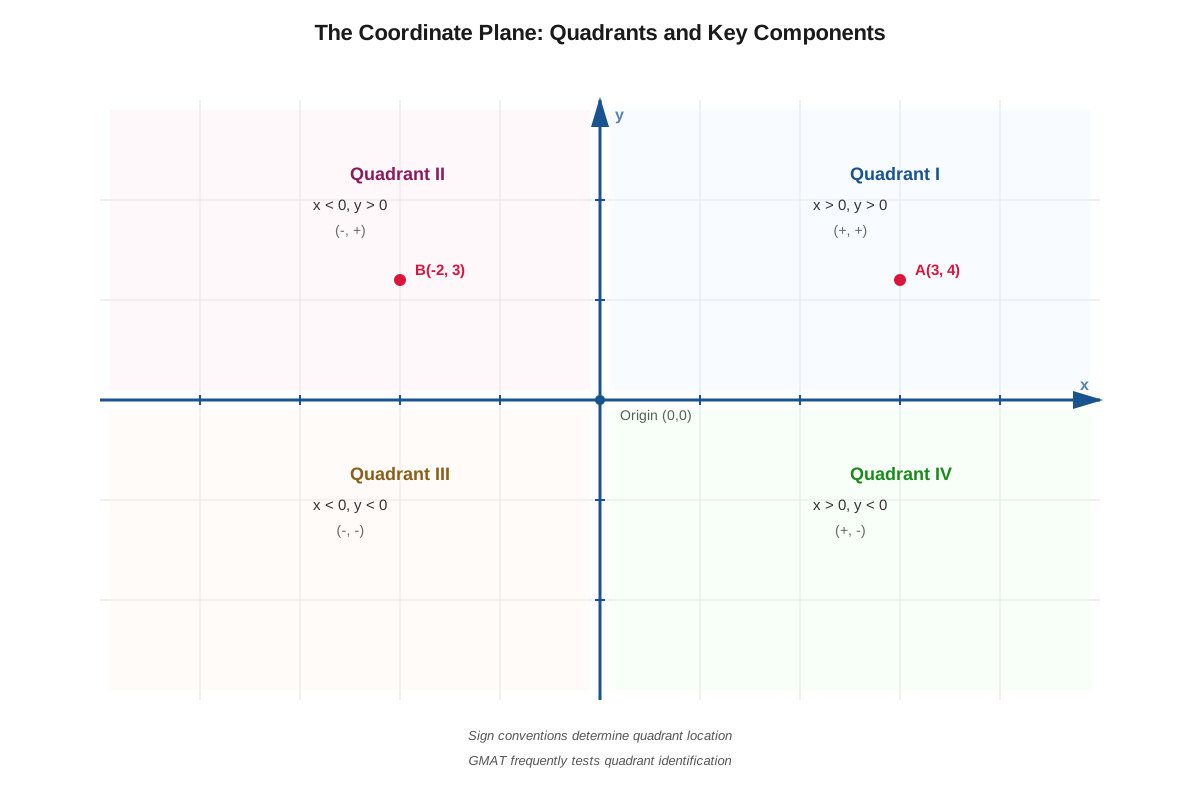
The coordinate plane consists of two perpendicular number lines: the horizontal x-axis and vertical y-axis, intersecting at the origin (0, 0). Every point in the plane is uniquely identified by an ordered pair (x, y), where x represents the horizontal displacement from the origin and y represents the vertical displacement. The axes divide the plane into four quadrants, numbered counterclockwise from the upper right:
- Quadrant I: x > 0, y > 0 (both coordinates positive)
- Quadrant II: x < 0, y > 0 (x negative, y positive)
- Quadrant III: x < 0, y < 0 (both coordinates negative)
- Quadrant IV: x > 0, y < 0 (x positive, y negative)
Points on the axes themselves don't belong to any quadrant. Understanding quadrant properties helps quickly eliminate answer choices and verify solution reasonableness.
Distance Formula
The distance formula calculates the straight-line distance between any two points (x₁, y₁) and (x₂, y₂):
d = √[(x₂ - x₁)² + (y₂ - y₁)²]This formula derives directly from the Pythagorean theorem, treating the horizontal and vertical distances as legs of a right triangle. The distance formula is essential for:
- Finding lengths of line segments
- Determining whether points are equidistant from a reference point
- Calculating perimeters of polygons
- Verifying circle equations (all points equidistant from center)
Example: The distance between points (2, 3) and (6, 6) is √[(6-2)² + (6-3)²] = √[16 + 9] = √25 = 5.
Midpoint Formula
The midpoint formula finds the point exactly halfway between two points (x₁, y₁) and (x₂, y₂):
M = ((x₁ + x₂)/2, (y₁ + y₂)/2)The midpoint coordinates are simply the averages of the respective coordinates. This formula appears frequently in GMAT questions involving:
- Bisectors of line segments
- Centers of rectangles or parallelograms (intersection of diagonals)
- Symmetric points across a reference point
Example: The midpoint between (-3, 4) and (5, -2) is ((-3+5)/2, (4-2)/2) = (1, 1).
Slope of a Line
The slope measures the steepness and direction of a line, calculated as the ratio of vertical change to horizontal change between any two points (x₁, y₁) and (x₂, y₂):
m = (y₂ - y₁)/(x₂ - x₁)Key slope properties:
| Slope Value | Line Characteristic | Example |
|---|---|---|
| m > 0 | Rising from left to right | y = 2x + 1 |
| m < 0 | Falling from left to right | y = -3x + 5 |
| m = 0 | Horizontal line | y = 4 |
| Undefined | Vertical line | x = 3 |
| m = 1 | 45° angle upward | y = x |
| m = -1 | 45° angle downward | y = -x |
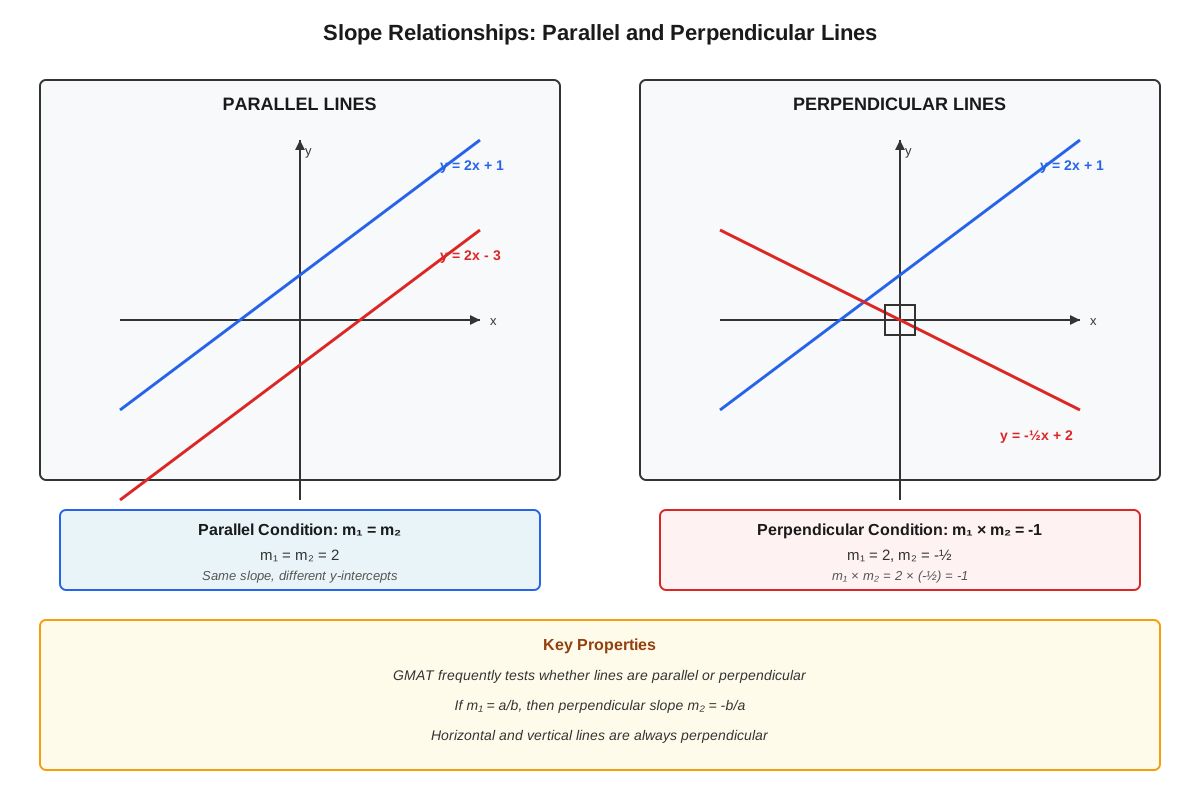
Parallel lines have equal slopes (m₁ = m₂), while perpendicular lines have slopes that are negative reciprocals (m₁ × m₂ = -1). These relationships are heavily tested on the GMAT.
Equations of Lines
Lines can be expressed in several forms, each useful for different purposes:
Slope-intercept form: y = mx + b
- m is the slope
- b is the y-intercept (where the line crosses the y-axis)
- Most useful for quickly identifying slope and y-intercept
Point-slope form: y - y₁ = m(x - x₁)
- Uses a known point (x₁, y₁) and slope m
- Most useful when given a point and slope
Standard form: Ax + By = C
- A, B, and C are integers
- Useful for finding intercepts quickly
- x-intercept: set y = 0, solve for x
- y-intercept: set x = 0, solve for y
Two-intercept form: x/a + y/b = 1
- a is the x-intercept, b is the y-intercept
- Quickly shows where line crosses both axes
Circles in the Coordinate Plane
The standard equation of a circle with center (h, k) and radius r is:
(x - h)² + (y - k)² = r²This equation states that every point (x, y) on the circle is exactly distance r from the center (h, k). Special cases:
- Circle centered at origin: x² + y² = r²
- To find the center and radius from an equation, complete the square if necessary
GMAT questions often ask whether a point lies inside, on, or outside a circle:
- Inside: distance from center < r
- On the circle: distance from center = r
- Outside: distance from center > r
Area Calculations Using Coordinates
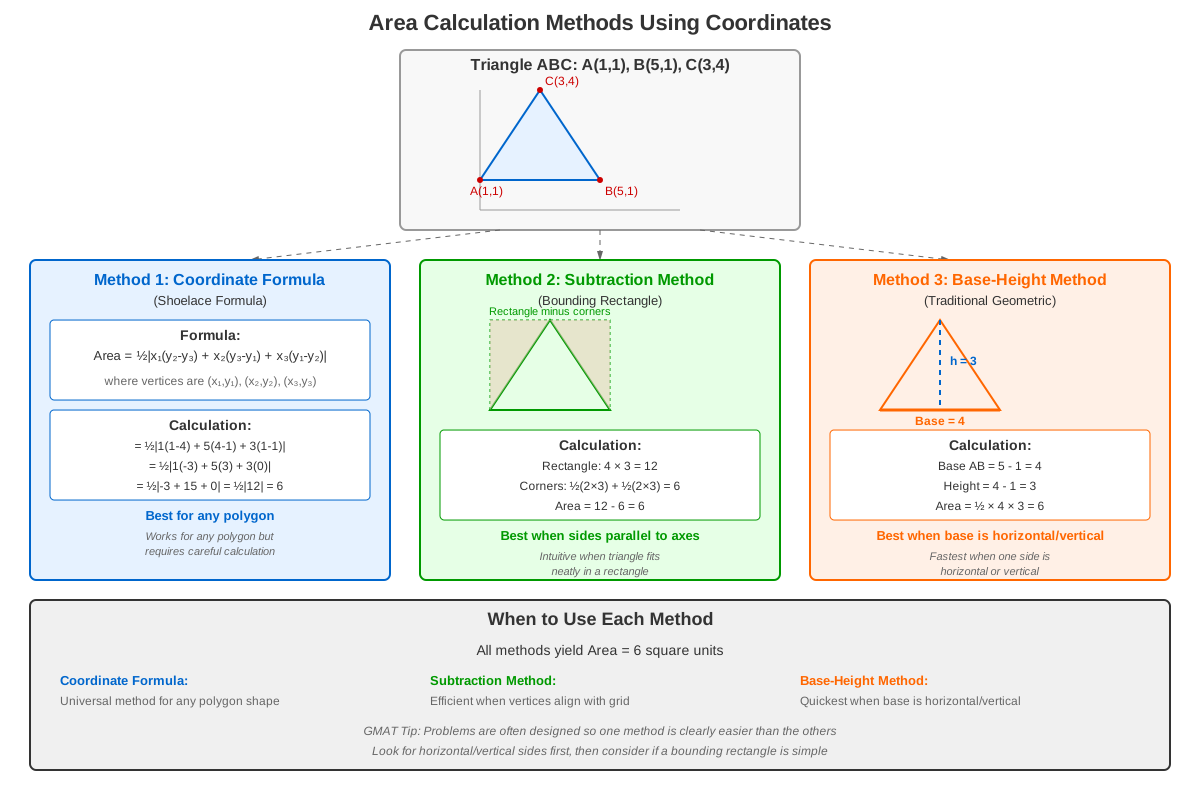
When vertices of polygons are given as coordinates, areas can be calculated using:
Triangles: For a triangle with vertices (x₁, y₁), (x₂, y₂), (x₃, y₃):
Area = ½|x₁(y₂ - y₃) + x₂(y₃ - y₁) + x₃(y₁ - y₂)|Alternatively, use the base-height method by:
- Identifying a convenient base (often horizontal or vertical)
- Calculating the perpendicular height
- Applying Area = ½ × base × height
Rectangles and squares: When sides are parallel to axes, simply multiply the differences in coordinates:
- Width = |x₂ - x₁|
- Height = |y₂ - y₁|
- Area = width × height
Polygons: Break complex polygons into triangles or rectangles, calculate individual areas, and sum them.
Collinearity and Geometric Relationships
Three points are collinear (lie on the same line) if:
- The slope between points A and B equals the slope between points B and C
- The area of the triangle formed by the three points equals zero
This concept frequently appears in Data Sufficiency questions testing whether three points form a triangle or lie on a line.
Concept Relationships
The coordinate geometry concepts form an interconnected hierarchy. The coordinate plane serves as the foundation, establishing the framework for locating all points. From this base, the distance formula emerges as an application of the Pythagorean theorem, enabling measurement of separation between points. The midpoint formula represents a special case of weighted averages applied to coordinates.
Slope connects to distance through the concept of direction—while distance measures "how far," slope measures "in what direction and how steeply." Slope then becomes the defining characteristic of line equations, which can be expressed in multiple equivalent forms depending on what information is known or needed. The relationship flows: points → slope → line equation.
Circles represent the set of all points equidistant from a center, directly applying the distance formula as a constraint. This connects circles back to the fundamental distance concept while introducing the idea of geometric loci (sets of points satisfying conditions).
Area calculations synthesize multiple concepts: they require identifying vertex coordinates, potentially calculating distances for side lengths, and applying geometric formulas. Complex area problems often decompose into simpler shapes, connecting coordinate geometry to general geometric reasoning.
The broader connection to prerequisite topics: algebra provides the equation-manipulation skills needed for line equations and circle equations; basic geometry supplies the formulas and properties that coordinate geometry quantifies; number properties determine sign relationships that indicate quadrant locations and slope directions.
Coordinate geometry enables progression to more advanced topics like optimization problems (finding maximum/minimum distances), transformations (translations, reflections, rotations), and analytic approaches to geometric proofs.
Quick check — test yourself on Coordinate geometry so far.
Try Flashcards →High-Yield Facts
⭐ The distance between points (x₁, y₁) and (x₂, y₂) is √[(x₂ - x₁)² + (y₂ - y₁)²]
⭐ The slope of a line through (x₁, y₁) and (x₂, y₂) is m = (y₂ - y₁)/(x₂ - x₁)
⭐ Parallel lines have equal slopes; perpendicular lines have slopes that multiply to -1
⭐ The equation of a circle with center (h, k) and radius r is (x - h)² + (y - k)² = r²
⭐ The midpoint between (x₁, y₁) and (x₂, y₂) is ((x₁ + x₂)/2, (y₁ + y₂)/2)
- A horizontal line has slope 0 and equation y = k; a vertical line has undefined slope and equation x = h
- The x-intercept is found by setting y = 0; the y-intercept is found by setting x = 0
- In slope-intercept form y = mx + b, m is the slope and b is the y-intercept
- The area of a triangle with base b and height h is ½bh, regardless of orientation
- Two points determine a unique line; three non-collinear points determine a unique circle
- Points in Quadrant I have both coordinates positive; Quadrant II has negative x, positive y; Quadrant III has both negative; Quadrant IV has positive x, negative y
- The distance from a point to the origin (0, 0) is √(x² + y²)
- If a point (x, y) satisfies a line equation, it lies on that line
- The diagonals of a rectangle bisect each other at their midpoint
- For perpendicular lines with slopes m₁ and m₂: m₁ = -1/m₂
Common Misconceptions
Misconception: The distance formula can be simplified by taking absolute values instead of squaring.
Correction: The formula requires squaring the differences because distance is always positive and squaring handles both positive and negative differences correctly. Taking absolute values would fail when applying the Pythagorean theorem structure.
Misconception: Slope is calculated as (x₂ - x₁)/(y₂ - y₁).
Correction: Slope is "rise over run," meaning vertical change over horizontal change: (y₂ - y₁)/(x₂ - x₁). Reversing this produces the reciprocal of the actual slope.
Misconception: A line with negative slope always has a negative y-intercept.
Correction: Slope and y-intercept are independent. A line can have negative slope but positive y-intercept (e.g., y = -2x + 5), negative slope and negative y-intercept (y = -2x - 3), or any combination.
Misconception: Perpendicular lines always have slopes that sum to zero.
Correction: Perpendicular lines have slopes that are negative reciprocals, meaning they multiply to -1, not sum to zero. For example, slopes 2 and -1/2 are perpendicular (2 × -1/2 = -1), but they sum to 3/2, not zero.
Misconception: The midpoint formula requires taking the distance between points first.
Correction: The midpoint formula independently averages the x-coordinates and y-coordinates. It doesn't require calculating distance at all—it's simply ((x₁ + x₂)/2, (y₁ + y₂)/2).
Misconception: In the circle equation (x - h)² + (y - k)² = r², the center is at (-h, -k).
Correction: The center is at (h, k). The equation subtracts h and k, so if the equation shows (x - 3)², the center's x-coordinate is +3, not -3. This sign confusion is extremely common.
Misconception: All points with the same x-coordinate lie on a horizontal line.
Correction: Points with the same x-coordinate lie on a vertical line (x = constant). Points with the same y-coordinate lie on a horizontal line (y = constant).
Misconception: The area of a triangle always requires using the special coordinate formula.
Correction: Often the simplest approach is identifying a convenient base (especially if horizontal or vertical) and calculating the perpendicular height, then using Area = ½bh. The coordinate formula is useful but not always the most efficient method.
Worked Examples
Example 1: Line Equations and Perpendicularity
Question: Line L passes through points (2, 5) and (6, 13). Line M is perpendicular to Line L and passes through the origin. What is the equation of Line M in slope-intercept form?
Solution:
Step 1: Find the slope of Line L
Using the slope formula with points (2, 5) and (6, 13):
m_L = (13 - 5)/(6 - 2) = 8/4 = 2Step 2: Determine the slope of Line M
Since Line M is perpendicular to Line L, its slope is the negative reciprocal:
m_M = -1/m_L = -1/2Step 3: Write the equation of Line M
Line M passes through the origin (0, 0) with slope -1/2. Using point-slope form:
y - 0 = -1/2(x - 0)
y = -1/2 x
In slope-intercept form: y = -1/2 x + 0 or simply y = -1/2 x
Connection to Learning Objectives: This problem applies coordinate geometry by calculating slope from two points, using the perpendicularity relationship between slopes, and constructing a line equation from a point and slope—all core GMAT skills.
Example 2: Circle and Distance (Data Sufficiency)
Question: Point P has coordinates (x, y). Is point P inside the circle with center (3, 4) and radius 5?
Statement (1): x = 6 and y = 8
Statement (2): The distance from P to the origin is 10
Solution:
For P to be inside the circle, the distance from P to center (3, 4) must be less than radius 5.
Analyzing Statement (1):
Given P = (6, 8), calculate distance to center (3, 4):
d = √[(6-3)² + (8-4)²] = √[9 + 16] = √25 = 5The distance equals exactly 5, meaning P is on the circle, not inside it. Statement (1) is SUFFICIENT to answer "No."
Analyzing Statement (2):
Given that distance from P to origin (0, 0) is 10:
√(x² + y²) = 10
x² + y² = 100
This means P lies on a circle of radius 10 centered at the origin. However, this doesn't tell us P's specific location or its distance to (3, 4). Point P could be at (10, 0), which has distance √[(10-3)² + (0-4)²] = √[49 + 16] = √65 ≈ 8.06 from (3, 4)—outside the circle. Or P could be at (6, 8), which we know is on the circle. Statement (2) is INSUFFICIENT.
Answer: A (Statement 1 alone is sufficient)
Connection to Learning Objectives: This Data Sufficiency problem requires understanding the distance formula, circle definitions, and the relationship between algebraic constraints and geometric positions—demonstrating how coordinate geometry appears in complex GMAT questions.
Exam Strategy
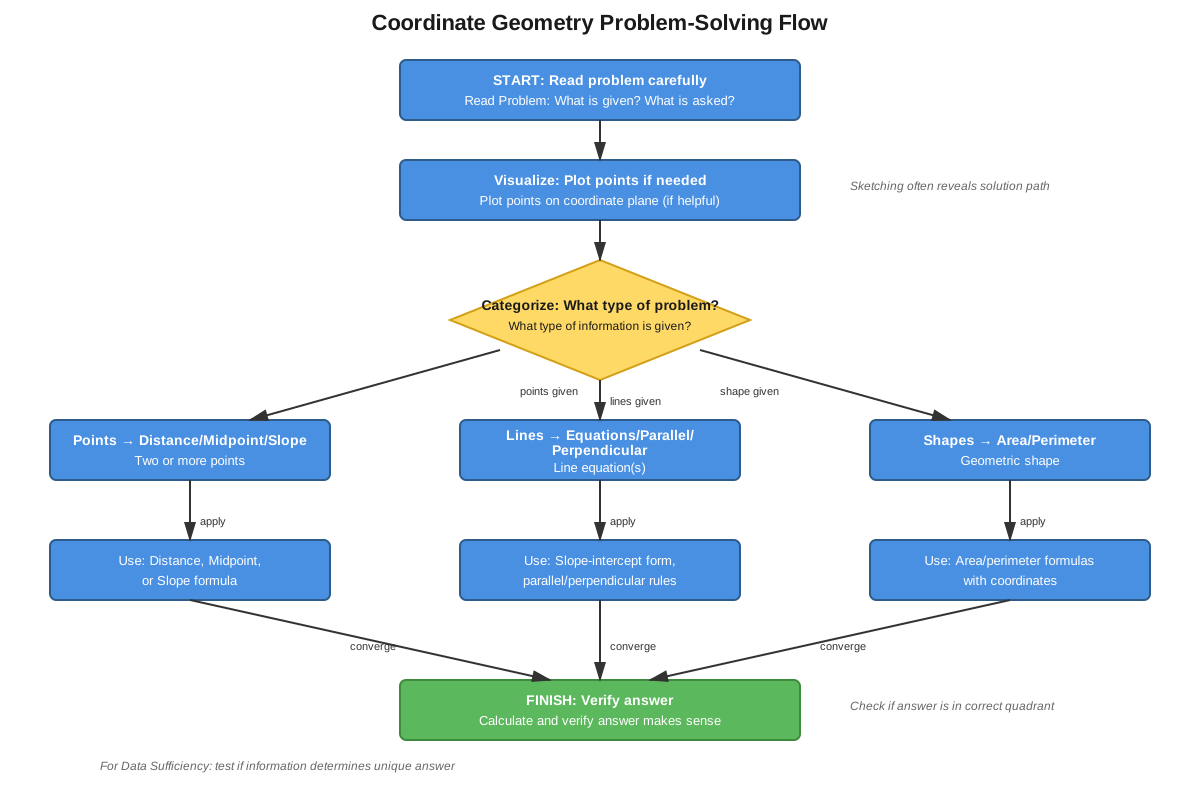
When approaching GMAT coordinate geometry questions, begin by sketching a quick diagram even if one isn't provided. Visual representation helps identify relationships that might not be obvious from coordinates alone. Plot key points, draw lines or circles, and mark known information directly on your sketch.
Trigger words and phrases that signal coordinate geometry:
- "Points with coordinates..."
- "Line passing through..."
- "Distance between..."
- "Midpoint of..."
- "Slope of..."
- "Circle with center..."
- "Perpendicular/parallel to..."
- "Lies on the line/circle..."
- "Quadrant"
- "x-intercept/y-intercept"
For Data Sufficiency questions, recognize that coordinate geometry often creates situations where:
- Two points always determine a unique line (sufficient)
- One point and a slope determine a unique line (sufficient)
- Three non-collinear points determine a unique circle (sufficient)
- Knowing a point is equidistant from two other points means it lies on the perpendicular bisector
Process of elimination strategies:
- Eliminate answers with wrong signs (check quadrants)
- Eliminate slopes that would make lines parallel when they should be perpendicular, or vice versa
- For distance problems, eliminate answers that violate the triangle inequality
- Check extreme cases: what if x = 0? What if y = 0?
Time allocation: Straightforward coordinate geometry problems (finding slope, midpoint, or distance) should take 1.5-2 minutes. Complex problems involving multiple steps (finding line equations then intersection points) may require 2.5-3 minutes. If a problem requires extensive calculation, look for a geometric shortcut or algebraic simplification before computing.
Common shortcuts:
- For perpendicular lines, flip the slope and change the sign rather than using the formula
- For midpoints, average the coordinates mentally without writing intermediate steps
- For distances along horizontal or vertical lines, simply subtract coordinates (no formula needed)
- When checking if a point is on a line, substitute coordinates into the equation rather than deriving the equation from scratch
Memory Techniques
Distance Formula Mnemonic: "Difference Squared Summed Rooted" (DSSR)
- Difference: subtract coordinates
- Squared: square each difference
- Summed: add the squared differences
- Rooted: take the square root
Slope Memory: "Rise over Run" or visualize climbing stairs—vertical change (rise) divided by horizontal change (run). Remember: "Y goes high" (y in numerator).
Perpendicular Slopes: "Flip and Nip"
- Flip: take the reciprocal (flip the fraction)
- Nip: negate it (change the sign)
Quadrant Signs: Moving counterclockwise from Quadrant I, use "All Students Take Calculus"
- All (Quadrant I): All positive
- Students (Quadrant II): Sine positive (y positive, x negative)
- Take (Quadrant III): Tangent positive (both negative)
- Calculus (Quadrant IV): Cosine positive (x positive, y negative)
Circle Equation: "Center Opposite"—in (x - h)² + (y - k)² = r², the center coordinates have the opposite sign from what appears in the equation.
Midpoint Visualization: Imagine the midpoint as the "average location"—you're literally averaging the x's and averaging the y's to find the middle.
Summary
Coordinate geometry unifies algebra and geometry by representing geometric objects and relationships using coordinates and equations on the xy-plane. Mastery requires fluency with core formulas: the distance formula √[(x₂ - x₁)² + (y₂ - y₁)²] for measuring separation between points, the slope formula (y₂ - y₁)/(x₂ - x₁) for determining line steepness and direction, and the midpoint formula ((x₁ + x₂)/2, (y₁ + y₂)/2) for finding centers. Lines can be expressed in multiple forms (slope-intercept, point-slope, standard), each useful for different purposes, while circles follow the equation (x - h)² + (y - k)² = r² with center (h, k) and radius r. Critical relationships include parallel lines having equal slopes and perpendicular lines having slopes that multiply to -1. GMAT questions test these concepts through direct calculation problems and sophisticated Data Sufficiency scenarios requiring geometric reasoning about algebraic constraints. Success demands both computational accuracy and conceptual understanding of how algebraic information translates to geometric properties.
Key Takeaways
- The distance formula, slope formula, and midpoint formula are the three foundational calculations that enable all coordinate geometry problem-solving
- Parallel lines have equal slopes (m₁ = m₂); perpendicular lines have slopes that are negative reciprocals (m₁ × m₂ = -1)
- The circle equation (x - h)² + (y - k)² = r² has center (h, k)—note the sign reversal from the equation
- Always sketch a diagram for coordinate geometry problems to visualize relationships and catch errors
- In Data Sufficiency, recognize that two points determine a unique line, while one point alone or one slope alone is insufficient
- Multiple approaches often exist: pure geometric reasoning, algebraic manipulation, or hybrid methods—choose based on the given information
- Quadrant locations determine coordinate signs: I (+,+), II (-,+), III (-,-), IV (+,-)
Related Topics
Linear Inequalities and Regions: Building on line equations, this topic explores shaded regions representing solution sets of inequalities, testing understanding of which side of a line satisfies an inequality.
Quadratic Functions and Parabolas: Extends coordinate geometry to curved graphs, requiring analysis of vertex form, axis of symmetry, and intersection points—essential for advanced GMAT problems.
Geometric Transformations: Translations, reflections, and rotations on the coordinate plane apply coordinate geometry to analyze how figures change position while preserving properties.
Optimization Problems: Uses coordinate geometry to find maximum or minimum distances, areas, or other quantities subject to constraints—combining geometry with algebraic reasoning.
Three-Dimensional Coordinate Systems: Though rare on the GMAT, understanding 3D coordinates (x, y, z) extends planar concepts to space, appearing occasionally in advanced questions.
Mastering coordinate geometry provides the foundation for these advanced topics while strengthening the algebraic and spatial reasoning skills that distinguish top GMAT performers.
Practice CTA
Now that you've thoroughly reviewed coordinate geometry concepts, formulas, and strategies, it's time to solidify your understanding through active practice. Attempt the practice questions associated with this topic, focusing on applying the distance, slope, and midpoint formulas efficiently. Work through both Problem Solving and Data Sufficiency questions to build versatility. Use the flashcards to drill the high-yield facts until they become automatic—speed and accuracy on foundational calculations free up mental energy for complex reasoning. Remember: coordinate geometry mastery comes from recognizing patterns across many problems, so embrace the practice as your path to confidence and higher scores. You've got this!
Sign up free to keep reading
Create a free AnvayaPrep account to finish this GMAT guide on Coordinate geometry — plus flashcards and practice questions.