Overview
Right triangles are among the most frequently tested geometric concepts on the GMAT Quantitative Reasoning section. A right triangle is a triangle containing one 90-degree angle, and this single defining characteristic unlocks a wealth of mathematical relationships that the GMAT exploits extensively. Understanding right triangles is not merely about memorizing the Pythagorean theorem—it requires mastery of special triangle ratios, area calculations, coordinate geometry applications, and the ability to recognize disguised right triangles within complex figures.
The importance of GMAT right triangles cannot be overstated. These triangles appear in approximately 15-20% of all Geometry questions and frequently serve as building blocks for more complex problems involving circles, rectangles, coordinate planes, and three-dimensional figures. The GMAT tests right triangles both directly (asking students to find missing sides or angles) and indirectly (embedding them within word problems, data sufficiency questions, or multi-step geometry scenarios). Students who master right triangles gain a significant strategic advantage, as these concepts often provide the fastest path to solving seemingly complicated problems.
Right triangles connect fundamentally to broader Quantitative Reasoning concepts including algebraic manipulation, ratio reasoning, and spatial visualization. They serve as the foundation for trigonometry (though advanced trigonometry is not tested on the GMAT), coordinate geometry, and distance calculations. Moreover, the problem-solving strategies developed through right triangle mastery—pattern recognition, systematic application of formulas, and strategic diagram drawing—transfer directly to other high-yield GMAT topics.
Learning Objectives
- [ ] Identify right triangles in various geometric configurations and word problems
- [ ] Explain the properties and relationships that define right triangles, including the Pythagorean theorem and special triangle ratios
- [ ] Apply right triangle concepts to solve GMAT questions efficiently and accurately
- [ ] Recognize and utilize the 3-4-5, 5-12-13, and 8-15-17 Pythagorean triples to save calculation time
- [ ] Determine when a triangle is a right triangle given side lengths or coordinate points
- [ ] Calculate areas, perimeters, and missing dimensions of right triangles in multi-step problems
Prerequisites
- Basic triangle properties: Understanding that triangles have three sides, three angles, and that interior angles sum to 180 degrees is essential for recognizing when one angle must be 90 degrees
- Algebraic equation solving: Right triangle problems frequently require solving for unknown variables using the Pythagorean theorem and other formulas
- Square roots and exponents: Computing side lengths involves squaring numbers and taking square roots, operations that appear in virtually every right triangle calculation
- Ratio and proportion: Special right triangles are defined by fixed ratios between their sides, requiring comfort with proportional reasoning
Why This Topic Matters
Right triangles appear throughout mathematics, engineering, architecture, navigation, and computer graphics. In real-world applications, they enable distance calculations, structural design, slope determination, and spatial problem-solving. The Pythagorean theorem, discovered over 2,500 years ago, remains one of the most practical mathematical tools in everyday use, from construction to GPS technology.
On the GMAT specifically, right triangle questions appear in approximately 3-5 questions per exam, making them one of the highest-yield geometry topics. These questions manifest in multiple formats: Problem Solving questions asking for specific measurements, Data Sufficiency questions testing whether given information determines a triangle's dimensions, and integrated problems where right triangles are embedded within coordinate geometry, word problems, or complex figures. The GMAT particularly favors questions that combine right triangles with other concepts—such as finding the distance between two points on a coordinate plane, determining the diagonal of a rectangle, or calculating the height of a three-dimensional figure.
Common question patterns include: identifying whether sufficient information exists to determine a side length, recognizing special right triangles to avoid lengthy calculations, finding areas when given limited information, and working with right triangles in coordinate geometry contexts. The exam writers frequently disguise right triangles within other shapes or present them in non-standard orientations to test true conceptual understanding rather than formula memorization.
Core Concepts
Definition and Properties of Right Triangles
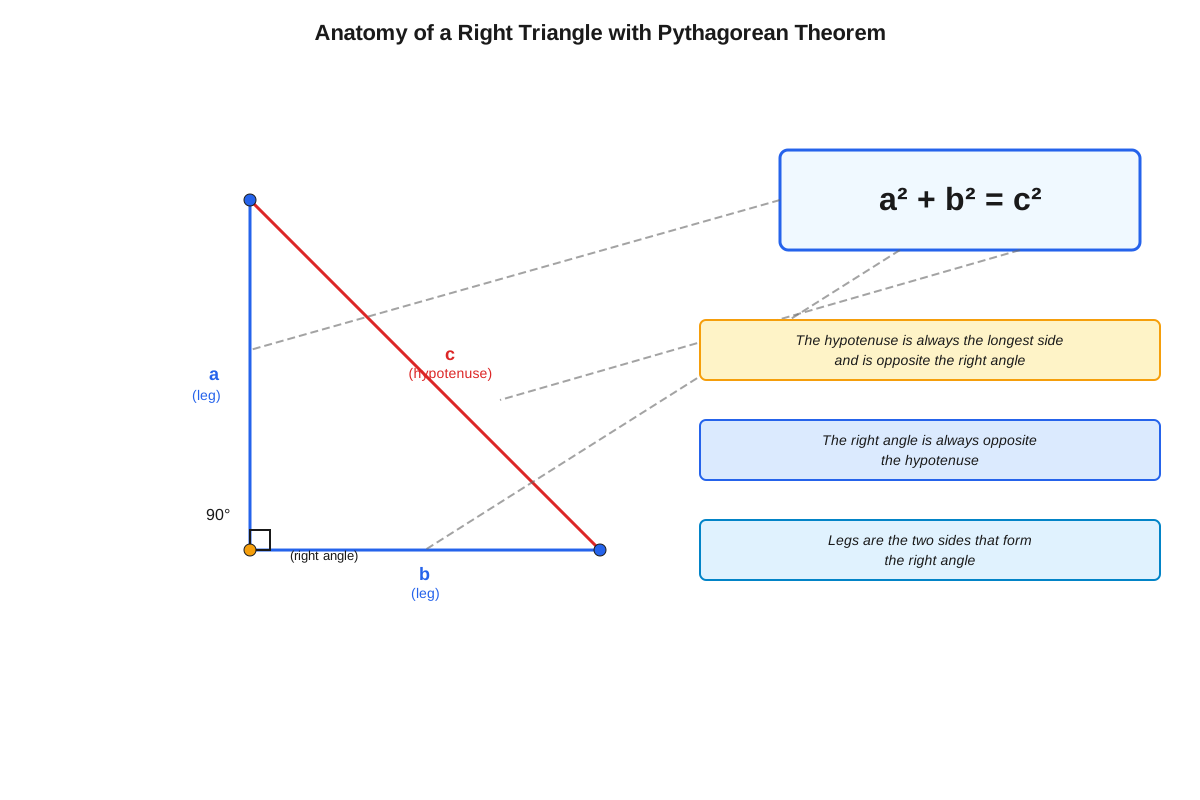
A right triangle is a triangle containing exactly one right angle (an angle measuring 90 degrees). The side opposite the right angle is called the hypotenuse and is always the longest side of the triangle. The two sides that form the right angle are called legs or catheti. This fundamental structure creates predictable mathematical relationships that the GMAT tests extensively.
The right angle is typically denoted in diagrams by a small square at the vertex. When identifying right triangles, look for this symbol, explicit statements that an angle measures 90 degrees, or contextual clues such as "perpendicular lines" or "vertical and horizontal sides." In coordinate geometry, right triangles often form naturally when connecting points with horizontal and vertical line segments.
The Pythagorean Theorem
The Pythagorean theorem is the cornerstone relationship for right triangles, stating that in any right triangle, the square of the hypotenuse equals the sum of the squares of the two legs. Mathematically:
a² + b² = c²where a and b represent the legs and c represents the hypotenuse. This formula works in both directions: given two sides, you can find the third, and given three sides, you can verify whether a triangle is a right triangle.
Application process:
- Identify which side is the hypotenuse (opposite the right angle, longest side)
- Label the known and unknown sides
- Substitute known values into the formula
- Solve for the unknown using algebraic manipulation
- Simplify radicals or calculate decimal values as needed
For example, if a right triangle has legs of length 6 and 8, the hypotenuse is found by: 6² + 8² = c², which gives 36 + 64 = c², so c² = 100, and therefore c = 10.
Pythagorean Triples
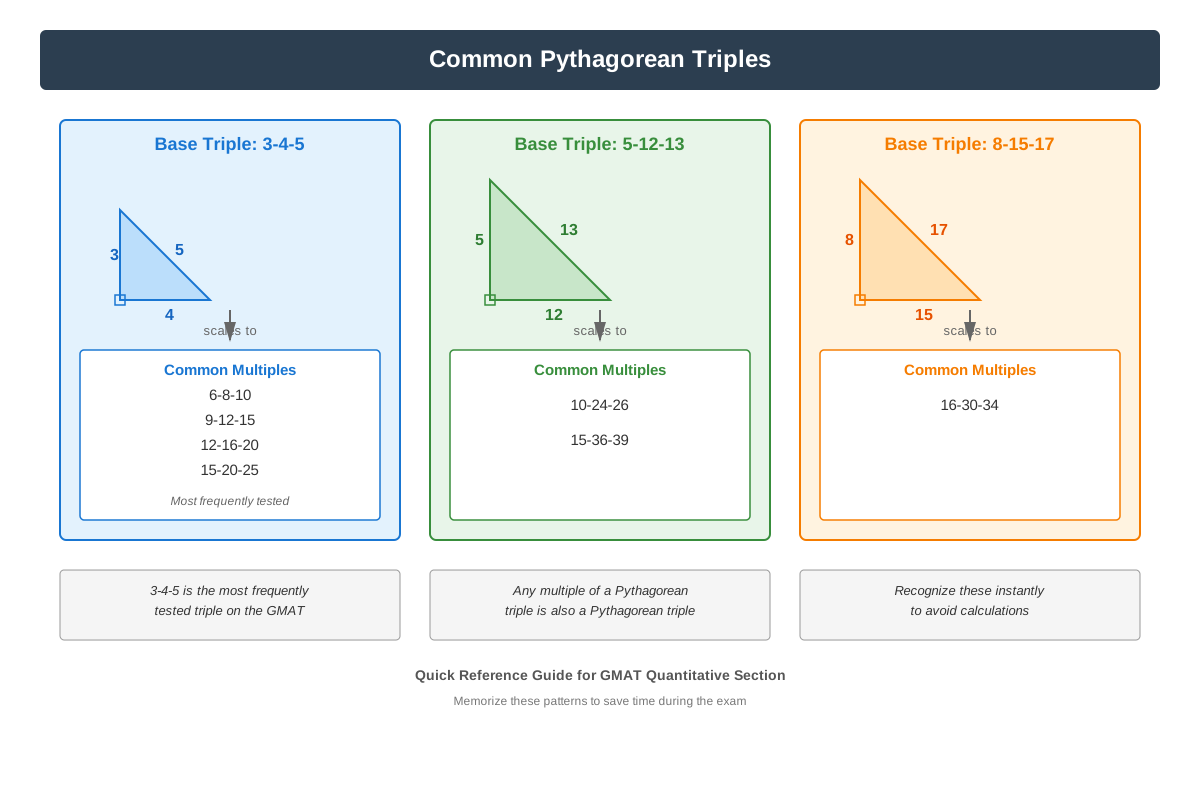
Pythagorean triples are sets of three positive integers that satisfy the Pythagorean theorem. Recognizing these patterns allows for instant calculation without using the formula. The most common triples tested on the GMAT include:
| Basic Triple | Common Multiples | Example Application |
|---|---|---|
| 3-4-5 | 6-8-10, 9-12-15, 12-16-20, 15-20-25 | If legs are 9 and 12, hypotenuse is 15 |
| 5-12-13 | 10-24-26, 15-36-39 | If legs are 5 and 12, hypotenuse is 13 |
| 8-15-17 | 16-30-34 | If legs are 8 and 15, hypotenuse is 17 |
| 7-24-25 | 14-48-50 | Less common but appears occasionally |
When you see side lengths that match or are multiples of these patterns, you can immediately determine the third side without calculation. This time-saving technique is crucial for GMAT efficiency. For instance, if a problem states that a right triangle has a hypotenuse of 20 and one leg of 12, recognizing the 3-4-5 pattern (multiplied by 4) immediately reveals the other leg is 16.
Special Right Triangles: 45-45-90
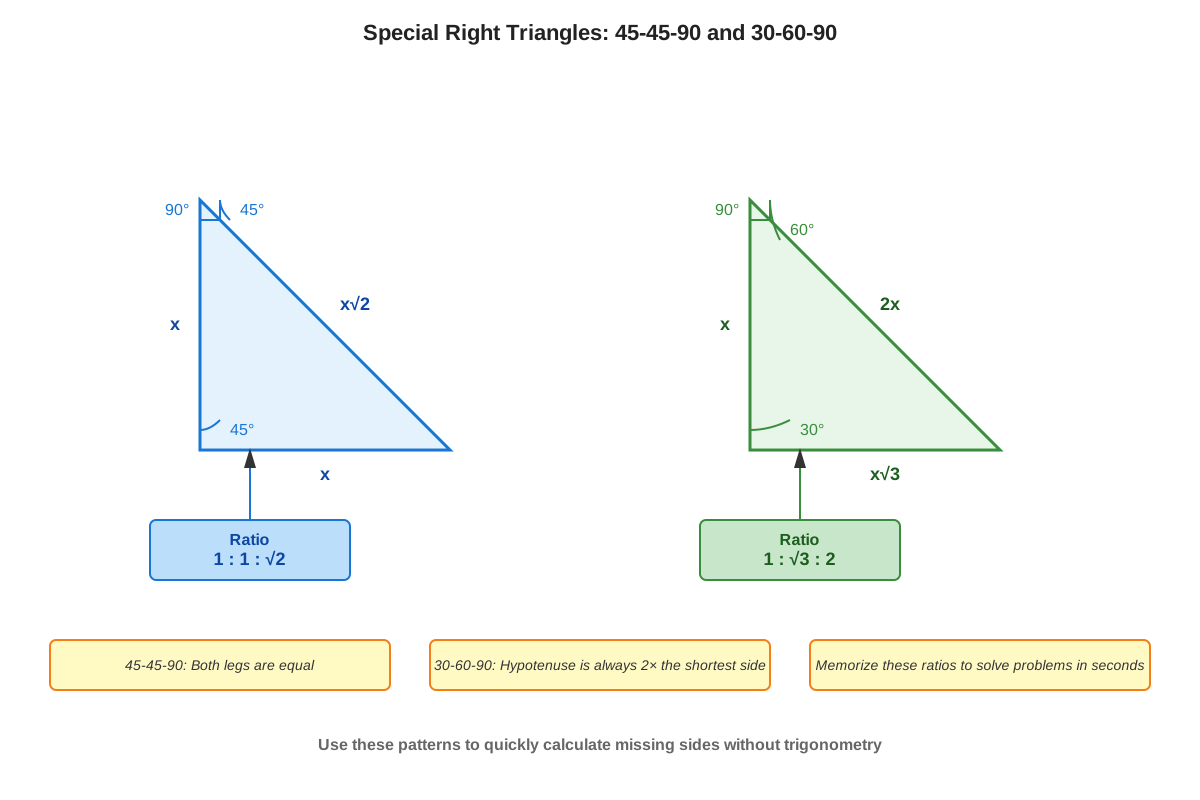
The 45-45-90 triangle is an isosceles right triangle with two 45-degree angles and one 90-degree angle. Because two angles are equal, the two legs are also equal in length. The relationship between the sides follows a fixed ratio:
legs : hypotenuse = 1 : 1 : √2If each leg has length x, the hypotenuse has length x√2. Conversely, if the hypotenuse has length h, each leg has length h/√2 or h√2/2 (after rationalizing the denominator).
Key applications:
- Diagonals of squares create 45-45-90 triangles
- If a square has side length 5, its diagonal is 5√2
- These triangles appear frequently in coordinate geometry when points form isosceles right triangles
Special Right Triangles: 30-60-90
The 30-60-90 triangle has angles measuring 30 degrees, 60 degrees, and 90 degrees. This triangle has a fixed side ratio that must be memorized:
short leg : long leg : hypotenuse = 1 : √3 : 2The short leg is opposite the 30-degree angle, the long leg is opposite the 60-degree angle, and the hypotenuse is opposite the 90-degree angle. If the short leg has length x, then the long leg has length x√3 and the hypotenuse has length 2x.
Key applications:
- Equilateral triangles split in half create 30-60-90 triangles
- If an equilateral triangle has side length 6, its height is 3√3
- These triangles appear in problems involving hexagons and equilateral triangles
Area of Right Triangles
The area of a right triangle is calculated using the formula:
Area = (1/2) × base × heightFor right triangles specifically, the two legs serve as the base and height (since they're perpendicular), making the calculation straightforward:
Area = (1/2) × leg₁ × leg₂This differs from the general triangle area formula, which requires finding the perpendicular height. In right triangles, the perpendicular relationship is built into the structure. For example, a right triangle with legs 6 and 8 has area = (1/2) × 6 × 8 = 24.
Altitude to the Hypotenuse
When an altitude is drawn from the right angle to the hypotenuse, it creates several important relationships. This altitude divides the original right triangle into two smaller right triangles, all three of which are similar to each other. If the altitude has length h and divides the hypotenuse into segments of length p and q, then:
h² = p × qThis relationship, while less commonly tested than the Pythagorean theorem, occasionally appears in advanced GMAT problems involving similar triangles or geometric means.
Concept Relationships
The Pythagorean theorem serves as the central hub connecting all right triangle concepts. From this fundamental relationship, special right triangles emerge as specific cases with predetermined ratios (45-45-90 and 30-60-90 triangles). These special triangles, in turn, connect to other geometric figures: 45-45-90 triangles relate to squares and their diagonals, while 30-60-90 triangles connect to equilateral triangles and regular hexagons.
Relationship map:
- Pythagorean Theorem → enables calculation of any missing side
- Pythagorean Theorem → generates Pythagorean Triples (integer solutions)
- Special angle measures → determine Special Right Triangles (45-45-90 and 30-60-90)
- Special Right Triangles → provide ratio-based shortcuts
- Right Triangle Properties → enable Area Calculations
- Right Triangles in Coordinate Plane → connect to Distance Formula
- Right Triangles → form building blocks of Rectangles, Squares, and 3D figures
Right triangles also connect backward to prerequisite topics: algebraic manipulation is required to solve Pythagorean theorem equations, ratio reasoning enables work with special triangles, and square root operations are essential for finding side lengths. Forward connections include coordinate geometry (where the distance formula is derived from the Pythagorean theorem), three-dimensional geometry (where right triangles help find space diagonals), and trigonometry (though advanced trigonometry exceeds GMAT scope).
Quick check — test yourself on Right triangles so far.
Try Flashcards →High-Yield Facts
⭐ The Pythagorean theorem (a² + b² = c²) applies only to right triangles, where c is always the hypotenuse
⭐ The 3-4-5 triangle and its multiples (6-8-10, 9-12-15, etc.) are the most frequently tested Pythagorean triples
⭐ In a 45-45-90 triangle, if each leg is x, the hypotenuse is x√2
⭐ In a 30-60-90 triangle, the sides are in the ratio 1 : √3 : 2 (short leg : long leg : hypotenuse)
⭐ The area of a right triangle equals (1/2) × leg₁ × leg₂, using the two legs as base and height
- The 5-12-13 and 8-15-17 triples appear less frequently but save significant calculation time when recognized
- The hypotenuse is always the longest side of a right triangle and is always opposite the 90-degree angle
- To verify if three side lengths form a right triangle, check if a² + b² = c² where c is the longest side
- The diagonal of a rectangle with sides a and b equals √(a² + b²), forming the hypotenuse of a right triangle
- In coordinate geometry, the distance between points (x₁, y₁) and (x₂, y₂) uses the Pythagorean theorem: d = √[(x₂-x₁)² + (y₂-y₁)²]
- When an altitude is drawn to the hypotenuse, it creates two smaller right triangles similar to the original and to each other
- The sum of the two acute angles in any right triangle always equals 90 degrees (complementary angles)
Common Misconceptions
Misconception: The Pythagorean theorem can be applied to any triangle.
Correction: The Pythagorean theorem applies exclusively to right triangles. For non-right triangles, different formulas (like the Law of Cosines) are required, though these are beyond GMAT scope.
Misconception: The hypotenuse can be any side of a right triangle.
Correction: The hypotenuse is specifically the side opposite the right angle and is always the longest side. The two legs form the right angle and are always shorter than the hypotenuse.
Misconception: In the formula a² + b² = c², the variables a and b must be assigned to specific legs.
Correction: The variables a and b can represent either leg interchangeably, but c must always represent the hypotenuse. The order of the legs doesn't matter due to the commutative property of addition.
Misconception: A 45-45-90 triangle has sides in the ratio 1 : 1 : 1.
Correction: A 45-45-90 triangle has sides in the ratio 1 : 1 : √2, where the two legs are equal (ratio 1:1) but the hypotenuse is √2 times the length of each leg, not equal to them.
Misconception: If you know one side of a right triangle, you can determine the other two sides.
Correction: You need at least two pieces of information about a right triangle to determine all three sides. This could be two sides, one side and one acute angle (if you recognize special triangles), or one side and the ratio between sides.
Misconception: The area formula for right triangles requires finding the perpendicular height from the hypotenuse.
Correction: For right triangles, the two legs are already perpendicular to each other, so you can use them directly as base and height: Area = (1/2) × leg₁ × leg₂. No additional height calculation is needed.
Misconception: Pythagorean triples only work with the exact numbers given (like 3-4-5).
Correction: Any multiple of a Pythagorean triple is also a Pythagorean triple. If 3-4-5 works, then so do 6-8-10, 9-12-15, 30-40-50, and any other multiple of these numbers.
Worked Examples
Example 1: Multi-Step Problem with Pythagorean Triple Recognition
Problem: A rectangular garden has a length of 40 feet and a width of 30 feet. A straight path is built from one corner to the opposite corner. What is the length of this path?
Solution:
Step 1: Visualize and identify the right triangle
The path forms the diagonal of the rectangle, which creates a right triangle with the length and width as the two legs.
Step 2: Identify known values
- Leg 1 (length) = 40 feet
- Leg 2 (width) = 30 feet
- Hypotenuse (path) = unknown
Step 3: Recognize the Pythagorean triple
Notice that 30 and 40 are both multiples of 10. Dividing by 10 gives us 3 and 4, which is part of the 3-4-5 Pythagorean triple. Therefore, the hypotenuse must be 5 × 10 = 50 feet.
Step 4: Verify using the Pythagorean theorem (optional but recommended)
30² + 40² = 900 + 1600 = 2500 = 50² ✓
Answer: The path is 50 feet long.
Connection to learning objectives: This problem demonstrates the ability to identify a right triangle within a geometric figure (the rectangle's diagonal), recognize a Pythagorean triple to save time, and apply the concept efficiently to solve a practical GMAT-style question.
Example 2: Special Right Triangle Application
Problem: An equilateral triangle has a side length of 12. What is the area of the triangle?
Solution:
Step 1: Recognize the need for a 30-60-90 triangle
To find the area of an equilateral triangle, we need the height. Drawing an altitude from any vertex to the opposite side creates two congruent 30-60-90 triangles.
Step 2: Identify the 30-60-90 triangle components
When the altitude is drawn:
- The base of the equilateral triangle (12) is split into two segments of 6 each
- This segment of 6 becomes the short leg of the 30-60-90 triangle
- The altitude we're seeking is the long leg
Step 3: Apply the 30-60-90 ratio
In a 30-60-90 triangle, if the short leg is x, the long leg is x√3.
- Short leg = 6
- Long leg (height) = 6√3
Step 4: Calculate the area
Area = (1/2) × base × height
Area = (1/2) × 12 × 6√3
Area = 6 × 6√3
Area = 36√3
Answer: The area is 36√3 square units.
Connection to learning objectives: This problem shows how right triangles appear within other geometric figures, demonstrates the application of special right triangle ratios (30-60-90), and illustrates the connection between right triangle properties and area calculations—all critical skills for GMAT success.
Exam Strategy
When approaching GMAT right triangles questions, begin by drawing or redrawing the diagram clearly, marking the right angle explicitly with a square symbol. Label all known information directly on the diagram, including side lengths and angle measures. This visual organization prevents errors and often reveals solution paths.
Trigger words and phrases to watch for:
- "Perpendicular" or "forms a right angle" → indicates a right triangle
- "Diagonal of a rectangle/square" → creates right triangles
- "Distance between two points" → coordinate geometry with right triangles
- "Isosceles right triangle" → signals a 45-45-90 triangle
- "Equilateral triangle height/altitude" → creates 30-60-90 triangles
- "Vertical and horizontal" → suggests perpendicular lines forming right angles
Strategic approach sequence:
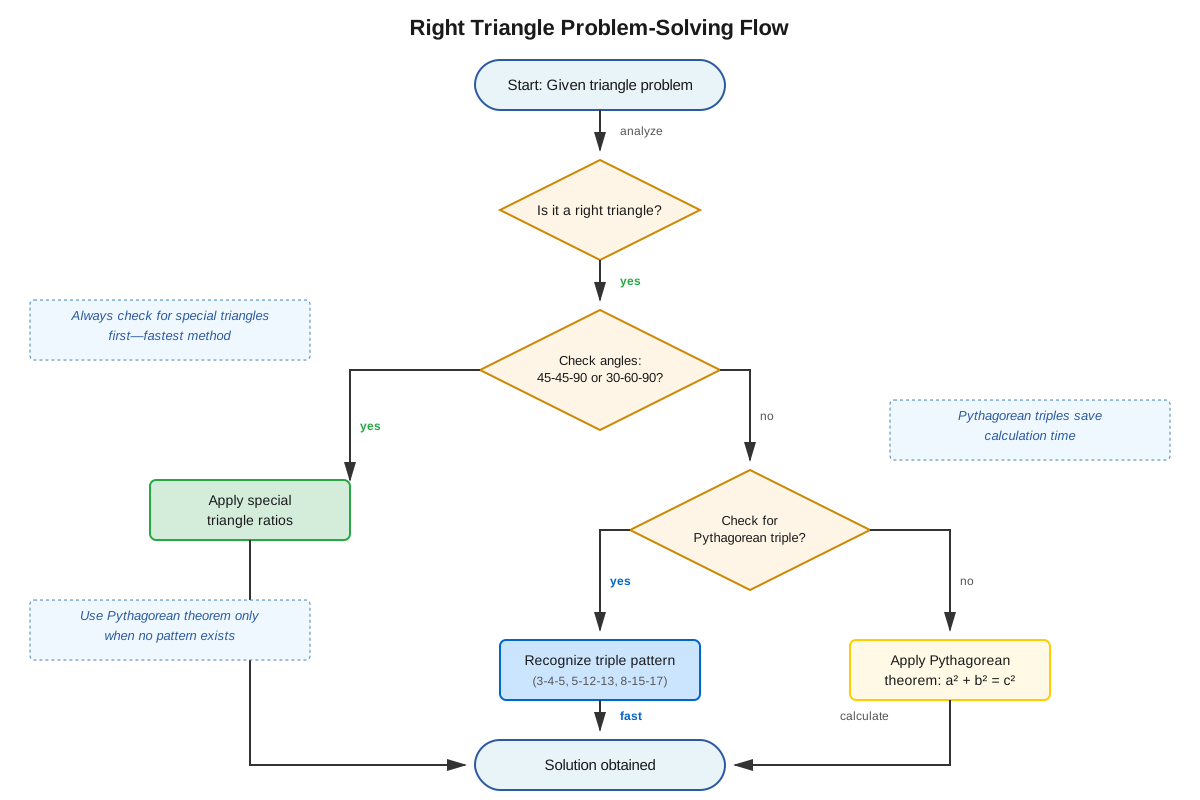
- Identify: Confirm you're dealing with a right triangle (look for the right angle marker or perpendicular indicators)
- Recognize patterns: Check if the given sides match Pythagorean triples or special triangle ratios before calculating
- Label systematically: Mark the hypotenuse (longest side, opposite the right angle) and distinguish it from the legs
- Choose your method: Use Pythagorean triples for speed, special triangle ratios when angles are given, or the Pythagorean theorem for general cases
- Verify reasonableness: The hypotenuse must be longer than either leg; if your answer violates this, recalculate
Data Sufficiency specific tips:
For Data Sufficiency questions involving right triangles, remember that you need two pieces of independent information to determine all sides. One side alone is insufficient. Two sides are sufficient. One side plus an angle (that identifies a special triangle) is sufficient. Be alert for statements that provide the same information in different forms—these are not independent.
Time allocation:
Standard right triangle problems should take 1.5-2 minutes. If you're spending more time, you may be missing a Pythagorean triple or special triangle pattern. Complex problems embedding right triangles within other concepts may warrant 2.5 minutes, but beyond that, consider making an educated guess and moving forward.
Memory Techniques
Pythagorean Theorem Mnemonic: "A squared plus B squared equals C squared, where C is the Champion (longest side)"—remembering that C represents the hypotenuse, the "champion" or longest side.
Pythagorean Triples Mnemonic: "3-4-5 is alive, 5-12-13 is keen, 8-15-17 is heaven"—a rhyming sequence to recall the three most common triples.
45-45-90 Visualization: Picture a square cut diagonally. The two sides of the square are equal (the two legs, both 1), and the diagonal (hypotenuse) is √2. This visual reinforces the 1:1:√2 ratio.
30-60-90 Visualization: Picture an equilateral triangle with all sides equal to 2, then cut it in half vertically. The base of each half is 1 (short leg), the height is √3 (long leg), and the original side is 2 (hypotenuse). This creates the 1:√3:2 ratio.
"SOH-CAH-TOA" Adaptation: While full trigonometry isn't tested, remembering "Short leg Opposite 30, Long leg Opposite 60" helps recall which leg is which in 30-60-90 triangles.
Hypotenuse Location: "The hypotenuse hides opposite the right angle"—the word "hides" sounds like "hyp" and reminds you where to find it.
Summary
Right triangles represent one of the highest-yield topics in GMAT Quantitative Reasoning, appearing in 15-20% of geometry questions and serving as foundational elements in coordinate geometry, area calculations, and complex multi-step problems. Mastery requires understanding the Pythagorean theorem (a² + b² = c²), recognizing and applying Pythagorean triples (especially 3-4-5, 5-12-13, and 8-15-17 with their multiples), and knowing the fixed ratios of special right triangles (45-45-90 with ratio 1:1:√2 and 30-60-90 with ratio 1:√3:2). Success on GMAT right triangle questions depends on pattern recognition—identifying when triangles are embedded in other figures, spotting Pythagorean triples to avoid lengthy calculations, and recognizing special triangles from angle measures or contextual clues. The ability to quickly determine missing sides, calculate areas using the two legs as base and height, and verify whether given information is sufficient to solve a problem distinguishes high scorers from average performers.
Key Takeaways
- The Pythagorean theorem (a² + b² = c²) is the fundamental relationship for right triangles, where c always represents the hypotenuse (longest side, opposite the right angle)
- Recognizing Pythagorean triples (3-4-5, 5-12-13, 8-15-17 and their multiples) enables instant calculation without using the formula, saving crucial time on the GMAT
- Special right triangles have fixed ratios: 45-45-90 triangles follow 1:1:√2, and 30-60-90 triangles follow 1:√3:2 (short leg : long leg : hypotenuse)
- Right triangles appear frequently in disguised forms—as diagonals of rectangles, in coordinate geometry distance problems, and within equilateral triangles and squares
- The area of a right triangle is calculated simply as (1/2) × leg₁ × leg₂, using the two perpendicular legs directly
- Always draw or redraw diagrams, label the right angle clearly, and identify the hypotenuse before attempting calculations
- For Data Sufficiency questions, remember that two pieces of independent information (typically two sides, or one side plus identifying information about angles) are needed to determine all dimensions of a right triangle
Related Topics
Coordinate Geometry: The distance formula between two points is derived directly from the Pythagorean theorem, treating horizontal and vertical distances as legs of a right triangle. Mastering right triangles makes coordinate geometry problems significantly more intuitive.
Triangles (General): Understanding right triangles provides a foundation for studying all triangle types, including isosceles, equilateral, and scalene triangles, as well as concepts like similarity and congruence.
Quadrilaterals: Rectangles, squares, and other quadrilaterals frequently involve right triangles when diagonals are drawn or when problems require finding distances between non-adjacent vertices.
Three-Dimensional Geometry: Finding space diagonals in rectangular solids, calculating surface distances, and determining heights of pyramids all rely heavily on right triangle relationships, often requiring multiple applications of the Pythagorean theorem.
Circles: Problems involving chords, tangent lines, and radii often create right triangles, particularly when a radius meets a tangent line (forming a 90-degree angle) or when finding distances from the center to chords.
Practice CTA
Now that you've mastered the core concepts of right triangles, it's time to solidify your understanding through active practice. Attempt the practice questions associated with this topic, focusing on recognizing patterns quickly and applying the strategies outlined above. Work through the flashcards to reinforce Pythagorean triples and special triangle ratios until they become automatic. Remember, the difference between knowing these concepts and scoring points on test day lies in repeated, deliberate practice. Each problem you solve builds the pattern recognition and speed that will serve you throughout the Quantitative Reasoning section. You've built a strong foundation—now put it to work!
Sign up free to keep reading
Create a free AnvayaPrep account to finish this GMAT guide on Right triangles — plus flashcards and practice questions.