Overview
The sector area is a fundamental geometric concept that appears regularly on the GMAT Quantitative Reasoning section. A sector is a "slice" of a circle, bounded by two radii and the arc connecting them—imagine a piece of pie cut from a circular pie. Understanding how to calculate the area of this slice is essential for solving a variety of circle-related problems that test spatial reasoning and proportional thinking.
On the GMAT, GMAT sector area questions often appear as standalone geometry problems or as components of more complex multi-step questions involving circles, angles, and proportions. These questions test not only computational ability but also conceptual understanding of how parts relate to wholes. Mastering sector area calculations enables students to tackle problems involving arc lengths, central angles, and composite geometric figures with confidence.
This topic sits at the intersection of several key Quantitative Reasoning concepts: circle geometry, proportional reasoning, angle measurement, and area calculations. A strong grasp of sector area provides the foundation for understanding more advanced geometric relationships and serves as a building block for data sufficiency questions where determining whether sufficient information exists to calculate a sector's area becomes the primary challenge.
Learning Objectives
- [ ] Identify sector area in geometric figures and word problems
- [ ] Explain the relationship between sector area, circle area, and central angles
- [ ] Apply sector area formulas to GMAT questions efficiently
- [ ] Calculate sector area when given radius and central angle in various units
- [ ] Determine missing variables (radius, angle, or total circle area) when sector area is known
- [ ] Solve multi-step problems combining sector area with other geometric concepts
- [ ] Recognize when sector area concepts apply in data sufficiency questions
Prerequisites
- Circle area formula (A = πr²): Essential because sector area is calculated as a fraction of the total circle area
- Angle measurement in degrees and radians: Required to understand and work with central angles that define sectors
- Proportional reasoning: Necessary because sector area represents a proportional part of the whole circle
- Basic fraction operations: Needed to calculate the fractional portion of a circle that a sector represents
- Circumference formula (C = 2πr): Helpful for understanding the relationship between arc length and sector area
Why This Topic Matters
Sector area calculations have practical applications in fields ranging from engineering and architecture to data visualization and resource allocation. Pie charts, which represent data as sectors of a circle, rely directly on sector area principles. Urban planners use sector calculations when designing circular parks or traffic roundabouts, and engineers apply these concepts when working with gears, circular motion, and rotational systems.
On the GMAT, sector area questions appear with moderate to high frequency, typically showing up in 2-4 questions per exam across both problem-solving and data sufficiency formats. According to GMAT question analysis, approximately 15-20% of geometry questions involve circles, and sector area represents a significant subset of these problems. The GMAT particularly favors questions that combine sector area with other concepts such as coordinate geometry, inscribed figures, or optimization problems.
Common question formats include: calculating the area of a shaded region where sectors overlap or are removed from other shapes; determining the central angle when given sector and circle areas; finding the radius when sector area and angle are provided; and data sufficiency questions asking whether enough information exists to determine a sector's area. The exam also frequently presents sector problems within real-world contexts such as pizza slices, clock faces, or circular gardens, requiring students to translate verbal descriptions into geometric calculations.
Core Concepts
Definition of a Sector
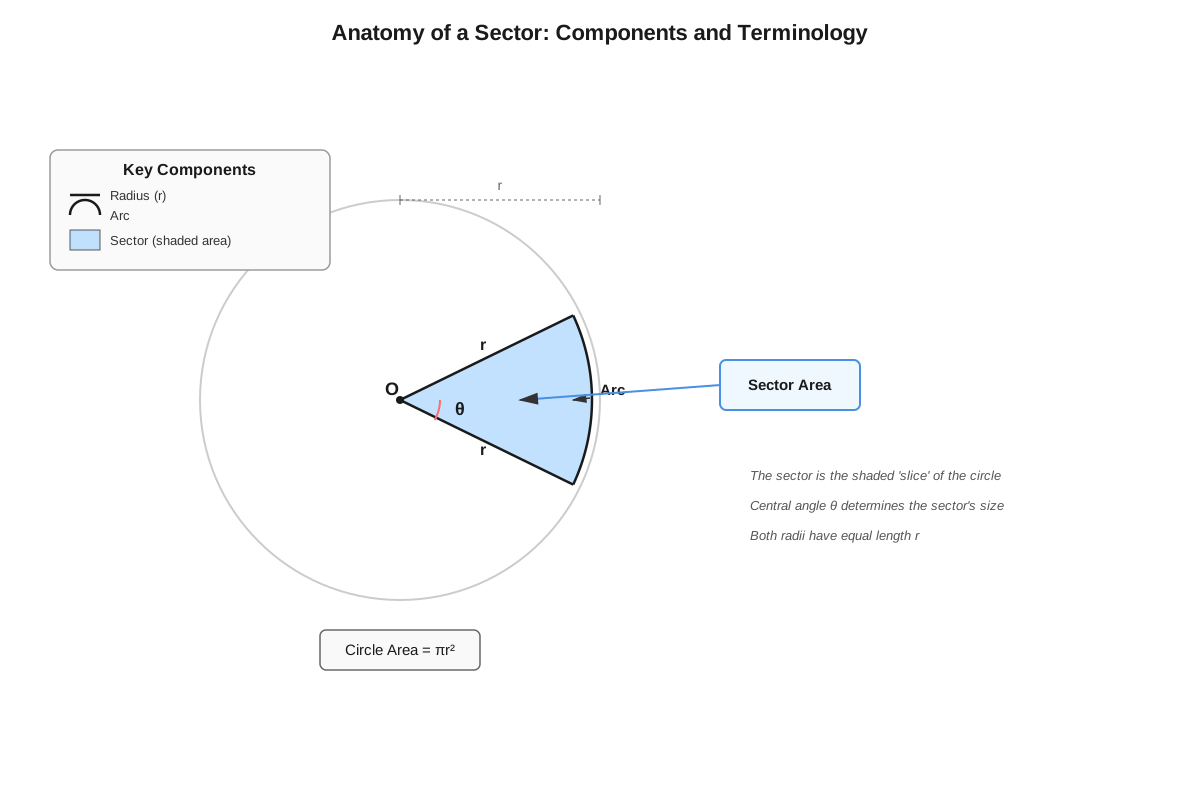
A sector is a region of a circle enclosed by two radii and the arc connecting their endpoints. Think of it as a wedge-shaped portion of a circle. Every sector has three defining elements: the radius (r) of the circle, the central angle (θ) formed by the two radii at the circle's center, and the arc that forms the curved boundary of the sector. Sectors come in two types: minor sectors (central angle less than 180°) and major sectors (central angle greater than 180°), though GMAT questions typically focus on minor sectors unless otherwise specified.
The Fundamental Sector Area Formula
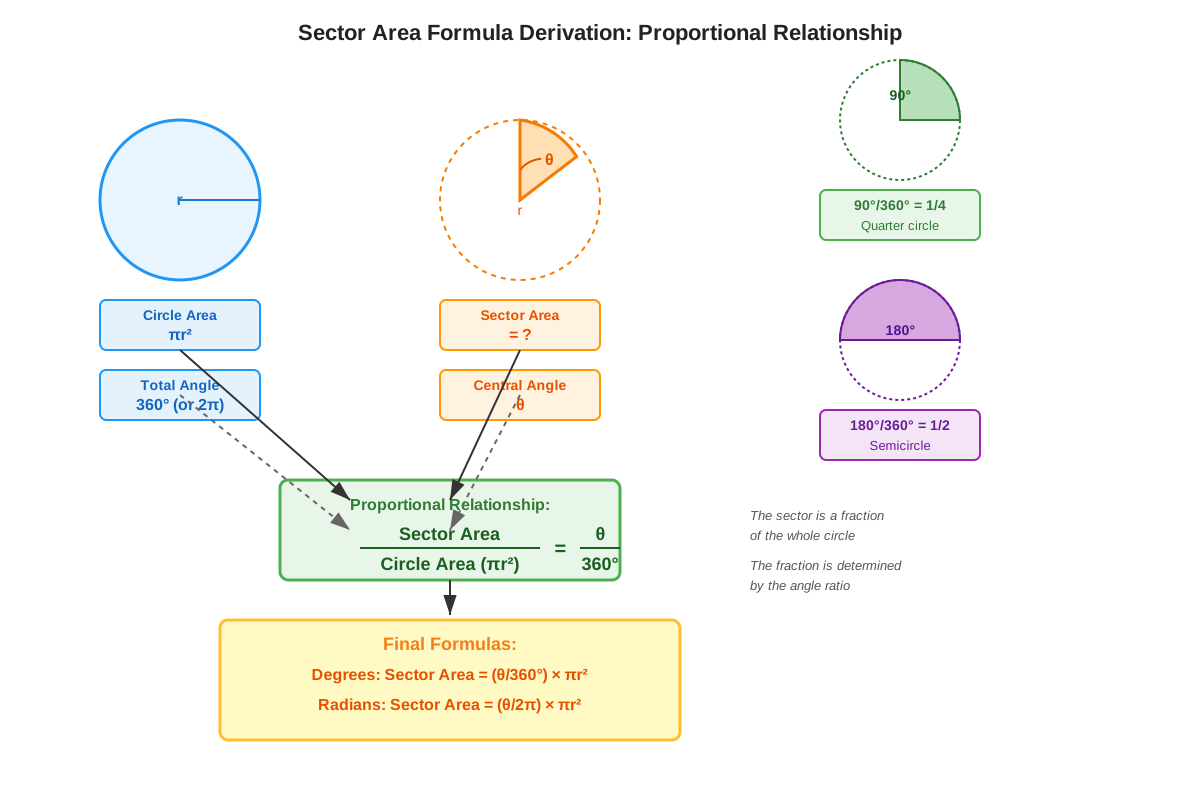
The sector area formula derives from the principle that a sector represents a fractional part of the entire circle. Since the area of a complete circle is πr², and a complete circle contains 360° (or 2π radians), a sector with central angle θ represents θ/360 of the circle when θ is measured in degrees.
The primary formula for sector area when the angle is in degrees:
Sector Area = (θ/360°) × πr²Where:
- θ = central angle in degrees
- r = radius of the circle
- π ≈ 3.14159 (or use the exact value π)
When the central angle is given in radians, the formula becomes:
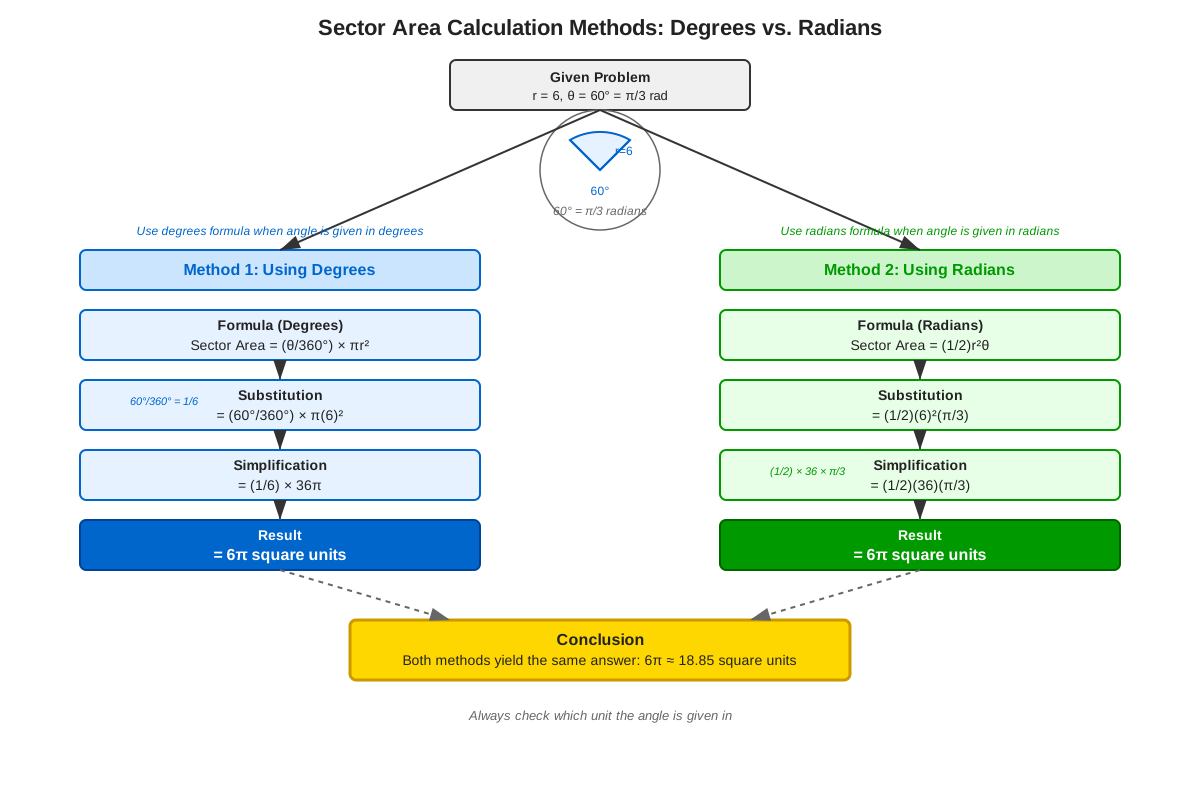
Sector Area = (θ/2π) × πr² = (1/2)r²θThis radian formula simplifies beautifully because the π terms partially cancel, making calculations more elegant when working in radians.
Understanding the Proportional Relationship
The key insight for mastering sector area is recognizing the proportional relationship between angles and areas. If a sector's central angle is 90° (one-quarter of 360°), then its area is exactly one-quarter of the circle's total area. This proportional thinking allows for quick mental calculations and provides a powerful checking mechanism for more complex problems.
| Central Angle | Fraction of Circle | Sector Area |
|---|---|---|
| 90° | 1/4 | (1/4)πr² |
| 60° | 1/6 | (1/6)πr² |
| 120° | 1/3 | (1/3)πr² |
| 180° | 1/2 | (1/2)πr² |
| 45° | 1/8 | (1/8)πr² |
Alternative Forms and Rearrangements
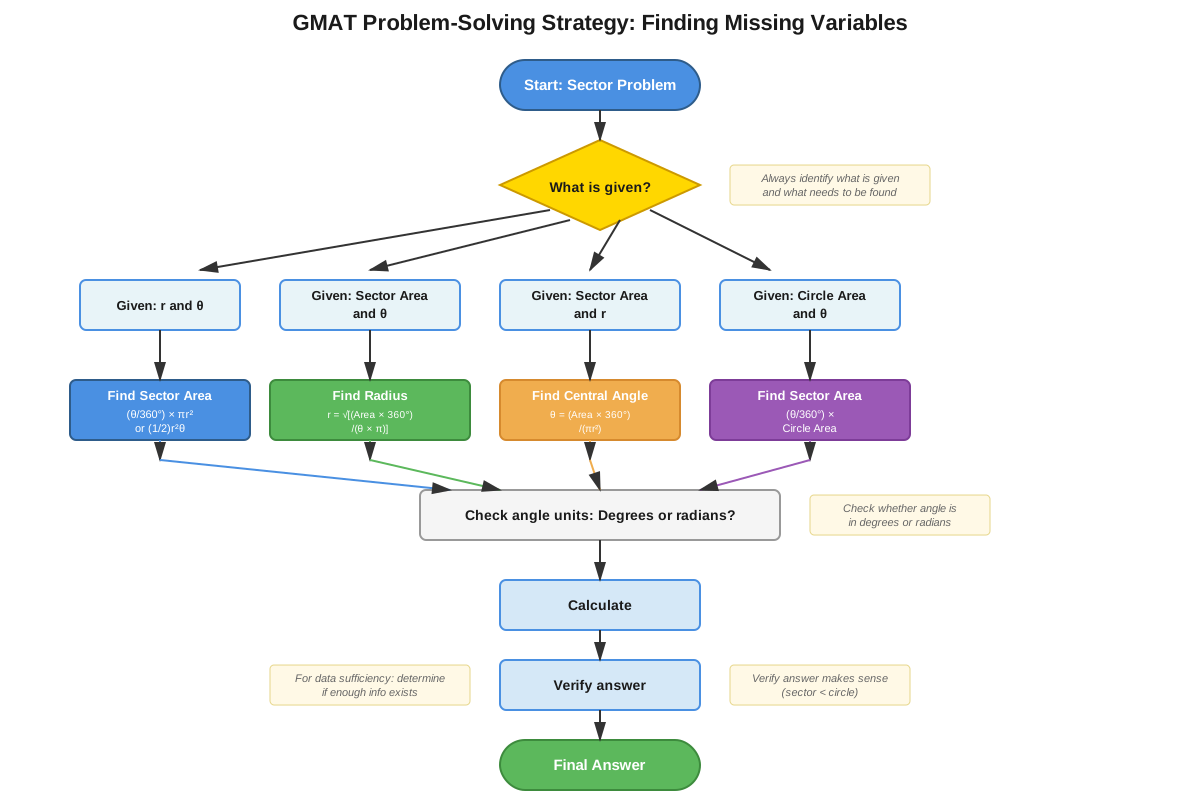
GMAT questions often require solving for variables other than sector area. Understanding how to rearrange the sector area formula is crucial:
To find the radius when sector area and angle are known:
r = √[(Sector Area × 360°)/(θ × π)]To find the central angle when sector area and radius are known:
θ = (Sector Area × 360°)/(πr²)To find the total circle area when sector area and angle are known:
Circle Area = (Sector Area × 360°)/θSector Area with Arc Length
Sometimes GMAT questions provide the arc length instead of the central angle. The relationship between arc length (s), radius (r), and central angle (θ in radians) is:
s = rθWhen arc length is known, sector area can be calculated as:
Sector Area = (1/2) × r × sThis formula is particularly useful because it resembles the triangle area formula (1/2 × base × height), making it easier to remember.
Composite Figures Involving Sectors
GMAT questions frequently combine sectors with other geometric shapes. Common scenarios include:
- Sectors within squares or rectangles: Finding shaded regions by subtracting sector area from rectangular area
- Overlapping sectors: Adding or subtracting sector areas to find regions of overlap
- Sectors with inscribed or circumscribed figures: Combining sector calculations with triangle or polygon area formulas
- Multiple sectors from the same circle: Ensuring that the sum of central angles equals 360° or less
Working with Degrees vs. Radians
The GMAT may present angles in either degrees or radians, and recognizing which unit is being used is critical. Key conversions to remember:
- 180° = π radians
- 90° = π/2 radians
- 60° = π/3 radians
- 45° = π/4 radians
- 30° = π/6 radians
When an angle is given as a fraction of π (such as π/3 or 2π/5), it's in radians. When given as a whole number or decimal without π, it's typically in degrees unless otherwise specified.
Concept Relationships
The sector area concept builds directly upon the fundamental circle area formula (A = πr²), which serves as the foundation for all sector calculations. The relationship flows as follows: Circle Area → Proportional Reasoning → Sector Area. Understanding that a sector is simply a fractional part of a circle makes the formula intuitive rather than something to memorize mechanically.
Sector area connects intimately with central angles and arc length. These three concepts form a triangle of relationships where knowing any two allows calculation of the third. The relationship map: Central Angle ↔ Sector Area ↔ Arc Length ↔ Central Angle. This circular dependency means that GMAT questions can approach sector problems from multiple entry points.
The concept also links to proportional reasoning more broadly, as sector problems are fundamentally about part-to-whole relationships. This connects sector area to percentage problems, ratio questions, and fraction operations—all high-yield GMAT topics. Additionally, sector area frequently appears alongside coordinate geometry when circles are placed on the xy-plane, requiring integration of algebraic and geometric thinking.
Finally, sector area serves as a gateway to understanding three-dimensional geometry, particularly when calculating the surface area of cones (which involves sectors of circles) or analyzing circular cross-sections of cylinders and spheres. Mastering sector area in two dimensions provides essential preparation for these more advanced spatial reasoning challenges.
High-Yield Facts
- ⭐ The sector area formula is: Sector Area = (θ/360°) × πr² when θ is in degrees
- ⭐ A sector with a 90° central angle has an area equal to exactly one-quarter of the circle's total area
- ⭐ When the central angle is in radians, the sector area formula simplifies to: (1/2)r²θ
- The ratio of sector area to circle area equals the ratio of central angle to 360° (or 2π radians)
- ⭐ Sector area can be calculated using arc length: Sector Area = (1/2) × r × s, where s is arc length
- A semicircle is a special sector with θ = 180° and area = (1/2)πr²
- ⭐ To find the central angle from sector and circle areas: θ = (Sector Area/Circle Area) × 360°
- The perimeter of a sector includes two radii plus the arc length: P = 2r + s
- When multiple sectors share the same circle, their central angles must sum to 360° or less
- ⭐ Converting between degrees and radians: multiply degrees by π/180 to get radians
- A sector with central angle θ° occupies θ/360 of the circle's circumference as its arc
- The area of a sector is always less than the area of the circle (unless θ = 360°, making it the full circle)
Quick check — test yourself on Sector area so far.
Try Flashcards →Common Misconceptions
Misconception: The sector area formula is (θ/180°) × πr² → Correction: The denominator should be 360°, not 180°, because a complete circle contains 360 degrees. The confusion arises from mixing up the degree-to-radian conversion factor (180° = π radians) with the full circle measurement.
Misconception: When the angle doubles, the sector area doubles, so when the radius doubles, the sector area also doubles → Correction: When the radius doubles, the sector area quadruples because area depends on r², not r. If r becomes 2r, then r² becomes 4r², making the sector area four times larger.
Misconception: Arc length and sector area are the same thing → Correction: Arc length is a one-dimensional measurement (a distance along the circle's edge), while sector area is a two-dimensional measurement (the space enclosed by the sector). They're related but measure different quantities with different units.
Misconception: A sector with a 60° angle in a circle of radius 6 has the same area as a sector with a 30° angle in a circle of radius 12 → Correction: The first sector has area (60/360) × π(6²) = 6π, while the second has area (30/360) × π(12²) = 12π. The second sector is twice as large because the radius effect (squared) outweighs the angle reduction.
Misconception: The sector area formula only works for minor sectors (angles less than 180°) → Correction: The formula works for any central angle from 0° to 360°. For major sectors (angles greater than 180°), simply use the actual angle measurement in the formula; the mathematics handles it correctly.
Misconception: When given an angle in radians, convert it to degrees before using the sector area formula → Correction: While you can convert to degrees, it's more efficient to use the radian formula directly: Sector Area = (1/2)r²θ. Converting adds an unnecessary step and increases the chance of calculation errors.
Worked Examples
Example 1: Basic Sector Area Calculation
Problem: A circular pizza with radius 10 inches is cut into 8 equal slices. What is the area of one slice?
Solution:
Step 1: Identify what we know and what we need to find.
- Radius (r) = 10 inches
- The pizza is cut into 8 equal slices, so each slice has a central angle of 360°/8 = 45°
- We need to find the sector area of one slice
Step 2: Apply the sector area formula.
Sector Area = (θ/360°) × πr²
Sector Area = (45°/360°) × π(10)²
Sector Area = (1/8) × 100π
Sector Area = 12.5π square inches
Step 3: Verify using proportional reasoning.
Since each slice is 1/8 of the pizza, its area should be 1/8 of the total pizza area.
Total pizza area = πr² = π(10)² = 100π
One slice = (1/8) × 100π = 12.5π ✓
Answer: 12.5π square inches (or approximately 39.27 square inches)
Connection to Learning Objectives: This example demonstrates identifying a sector (the pizza slice), explaining the relationship between the central angle and sector area, and applying the formula to solve a practical GMAT-style problem.
Example 2: Finding Radius from Sector Area
Problem: A sector with a central angle of 120° has an area of 24π square centimeters. What is the radius of the circle?
Solution:
Step 1: Write down the known information.
- Central angle (θ) = 120°
- Sector Area = 24π cm²
- Radius (r) = unknown
Step 2: Set up the sector area formula and solve for r.
Sector Area = (θ/360°) × πr²
24π = (120°/360°) × πr²
24π = (1/3) × πr²
Step 3: Simplify by dividing both sides by π.
24 = (1/3) × r²Step 4: Multiply both sides by 3.
72 = r²Step 5: Take the square root of both sides.
r = √72 = √(36 × 2) = 6√2 cmStep 6: Verify the answer.
Check: (120/360) × π(6√2)² = (1/3) × π(72) = 24π ✓Answer: The radius is 6√2 centimeters (or approximately 8.49 cm)
Connection to Learning Objectives: This example shows how to determine missing variables when sector area is known, demonstrating the flexibility required for GMAT data sufficiency questions and multi-step problem solving.
Example 3: Composite Figure with Sectors
Problem: A square with side length 8 has a quarter-circle (sector with 90° angle) removed from each corner, where each quarter-circle has a radius of 2. What is the area of the remaining figure?
Solution:
Step 1: Calculate the area of the square.
Square Area = 8² = 64 square unitsStep 2: Calculate the area of one quarter-circle sector.
One Sector Area = (90°/360°) × π(2)²
One Sector Area = (1/4) × 4π = π square units
Step 3: Calculate the total area removed (4 corners).
Total Removed = 4 × π = 4π square unitsStep 4: Subtract the removed area from the square area.
Remaining Area = 64 - 4π square unitsStep 5: Calculate the numerical approximation if needed.
Remaining Area ≈ 64 - 4(3.14159) ≈ 64 - 12.566 ≈ 51.43 square unitsAnswer: (64 - 4π) square units, or approximately 51.43 square units
Connection to Learning Objectives: This problem demonstrates applying sector area concepts to complex, multi-step GMAT questions involving composite figures—a common high-difficulty question type.
Exam Strategy
When approaching GMAT sector area questions, begin by quickly sketching the figure if one isn't provided. Visual representation helps identify the radius, central angle, and what portion of the circle the sector represents. Look for these trigger phrases: "slice," "wedge," "portion of a circle," "central angle," "arc," or any mention of degrees or radians in the context of circles.
For problem-solving questions, immediately identify which variables are given and which must be found. The three key variables—radius, central angle, and sector area—form a system where knowing any two allows calculation of the third. If the problem seems complex, check whether it can be simplified using proportional reasoning: "This sector is 1/6 of the circle, so its area is 1/6 of πr²."
In data sufficiency questions, remember that to calculate sector area, you need exactly two pieces of information: the radius (or diameter, or circle area) AND the central angle (or arc length). Statement analysis should focus on whether each statement provides or allows calculation of these two essential elements. Be alert for statements that seem to provide information but actually give redundant or insufficient data.
Time management is crucial: straightforward sector area calculations should take 60-90 seconds, while complex composite figures may require 2-2.5 minutes. If a problem involves both sector area and another geometric concept (like coordinate geometry or triangle area), budget an additional 30-60 seconds. When stuck, use estimation: a 90° sector is 1/4 of the circle, a 60° sector is 1/6, and a 45° sector is 1/8—these benchmarks help eliminate unreasonable answer choices quickly.
Process-of-elimination strategies work particularly well with sector problems. If the central angle is less than 90°, the sector area must be less than one-quarter of the circle's area—eliminate any answer choices that violate this constraint. Similarly, if you know the radius, calculate the full circle area and eliminate any sector area answers that exceed it.
Memory Techniques
The "Pizza Fraction" Mnemonic: Remember that sector area is just "angle-fraction times pizza-area." The angle-fraction is θ/360 (or θ/2π for radians), and the pizza-area is πr². This casual phrasing helps recall the formula structure under test pressure.
The "Half-R-Squared-Theta" Radian Rhyme: For the radian formula, remember "half-r-squared-theta" as a rhythmic phrase: (1/2)r²θ. The rhythm helps distinguish it from other area formulas.
The "Two Radii Plus Arc" Perimeter Rule: While not directly about area, remembering that sector perimeter includes "two radii plus the arc" helps avoid confusion between perimeter and area calculations, which sometimes appear in the same problem.
The "Quarter-Circle Benchmark" Visualization: Mentally visualize a quarter-circle (90° sector) as your reference point. Any sector can be compared to this benchmark: "Is it bigger or smaller than a quarter-circle?" This provides instant reasonableness checks for calculations.
The "Degree-Radian Conversion Clock": Picture a clock face where 12 o'clock to 3 o'clock (90°) equals π/2 radians, 12 to 6 (180°) equals π radians, and the full circle (360°) equals 2π radians. This visual anchor helps with quick conversions.
The "Arc-Area Connection" Formula: Remember that sector area equals "half-radius-times-arc": (1/2) × r × s. This resembles the triangle area formula (1/2 × base × height), creating a mental link to familiar territory.
Summary
Sector area represents one of the most testable geometric concepts on the GMAT, appearing in approximately 15-20% of circle-related questions. A sector is a wedge-shaped portion of a circle defined by two radii and the connecting arc, with its area calculated as a proportional fraction of the total circle area. The fundamental formula—Sector Area = (θ/360°) × πr² for degrees or (1/2)r²θ for radians—derives from the principle that a sector with central angle θ occupies θ/360 of the complete circle. Mastery requires understanding not just the formula but the proportional relationships that allow quick mental calculations and effective answer elimination. GMAT questions test this concept through direct calculations, reverse-solving for radius or angle, composite figures where sectors combine with other shapes, and data sufficiency scenarios requiring identification of necessary and sufficient information. Success depends on recognizing sector problems quickly, choosing the most efficient solution path, and maintaining accuracy with angle units and algebraic manipulations.
Key Takeaways
- The sector area formula is (θ/360°) × πr² for degrees and (1/2)r²θ for radians—know both forms cold
- Sector area problems are fundamentally about proportional reasoning: the sector is to the circle as the central angle is to 360°
- Always verify which unit (degrees or radians) is being used for angles before applying formulas
- Quick benchmark: 90° sectors are 1/4 of the circle, 60° sectors are 1/6, 45° sectors are 1/8
- For data sufficiency, you need exactly two pieces of information: something about the circle's size (radius, diameter, or area) and something about the angle (central angle or arc length)
- Composite figures involving sectors typically require subtracting sector area from another shape's area or combining multiple sectors
- The alternative formula using arc length—Sector Area = (1/2) × r × s—can be more efficient when arc length is given directly
Related Topics
Arc Length: Understanding how to calculate the curved distance along a sector's edge complements sector area calculations and frequently appears in the same GMAT questions. Mastering sector area provides the foundation for arc length problems since both depend on the same proportional relationships.
Circle Geometry Comprehensive: Sector area is one component of broader circle geometry, which includes tangent lines, inscribed angles, and chord properties. Building expertise in sector area strengthens overall circle problem-solving ability.
Coordinate Geometry with Circles: When circles are placed on the xy-plane, sector area calculations combine with coordinate geometry concepts like distance formula and equation of a circle, creating higher-difficulty integrated problems.
Three-Dimensional Geometry: Sector area concepts extend to surface area calculations for cones and spherical segments, making this topic essential preparation for advanced 3D geometry questions.
Proportional Reasoning: Since sector problems are fundamentally about part-to-whole relationships, mastering sector area reinforces proportional thinking skills applicable across the entire Quantitative Reasoning section.
Practice CTA
Now that you've mastered the core concepts of sector area, it's time to cement your understanding through active practice. Attempt the practice questions to test your ability to recognize sector problems, apply formulas efficiently, and navigate the tricky variations the GMAT presents. Use the flashcards to drill the essential formulas and relationships until they become automatic—speed and accuracy on test day come from this kind of deliberate practice. Remember, sector area questions are high-yield: investing 20 minutes now in focused practice can directly translate to correct answers and higher scores on exam day. You've built the foundation; now build the confidence through repetition!
Sign up free to keep reading
Create a free AnvayaPrep account to finish this GMAT guide on Sector area — plus flashcards and practice questions.