Overview
Arc length is a fundamental concept in GMAT geometry that measures the distance along a curved portion of a circle's circumference. Understanding arc length is essential for success on the GMAT Quantitative Reasoning section, as it appears frequently in both problem-solving and data-sufficiency questions. The concept bridges basic circle properties with more complex geometric relationships, making it a high-yield topic that often combines with other geometric principles such as central angles, sector areas, and coordinate geometry.
The GMAT tests arc length in various contexts, from straightforward calculations requiring direct formula application to multi-step problems involving proportional reasoning and angle relationships. Questions may present circles in coordinate planes, ask students to find missing measurements when given partial information, or embed arc length within word problems involving real-world scenarios like circular tracks, clock hands, or rotating objects. Mastery of gmat arc length problems requires not only memorizing the formula but also understanding the proportional relationship between arc length, central angle, and full circumference.
Arc length connects deeply to other Quantitative Reasoning concepts including ratios and proportions, angle measurement (both degrees and radians), area calculations for sectors, and perimeter problems. The topic serves as a gateway to understanding more complex circular geometry and demonstrates the GMAT's emphasis on proportional reasoning—a skill that appears across multiple question types. Students who master arc length develop stronger intuition for circular motion, rotational symmetry, and the relationship between linear and angular measurements, all of which contribute to higher performance on geometry questions.
Learning Objectives
- [ ] Identify arc length in geometric diagrams and word problems
- [ ] Explain the relationship between arc length, radius, and central angle
- [ ] Apply arc length formulas to solve GMAT questions efficiently
- [ ] Calculate arc length using both degree and radian measures
- [ ] Determine missing circle measurements when given arc length information
- [ ] Solve multi-step problems combining arc length with other geometric concepts
- [ ] Recognize proportional relationships between arcs and full circumferences
Prerequisites
- Circle basics (radius, diameter, circumference): Arc length calculations depend on understanding that circumference equals 2πr or πd, as arcs represent portions of the full circumference
- Angle measurement in degrees: Central angles determine what fraction of the circle an arc represents, requiring comfort with degree measures from 0° to 360°
- Ratio and proportion concepts: Arc length problems fundamentally involve proportional reasoning, comparing the arc to the full circle
- Basic algebra and equation solving: Finding unknown values requires setting up and solving equations involving arc length formulas
- Pi (π) as a mathematical constant: Arc length formulas always involve π, requiring understanding of when to use 3.14, leave π in symbolic form, or use calculator approximations
Why This Topic Matters
Arc length appears in approximately 5-8% of GMAT Quantitative Reasoning questions, making it a medium-to-high frequency topic that students cannot afford to skip. The concept appears in both problem-solving questions (where students calculate specific values) and data-sufficiency questions (where students determine whether given information is adequate to find arc length). Understanding arc length is particularly valuable because it often combines with other high-yield topics like coordinate geometry, triangles inscribed in circles, and optimization problems.
In real-world applications, arc length calculations are essential for engineering, architecture, navigation, and physics. Architects use arc length to design curved structures and calculate materials needed for rounded features. Engineers apply the concept when designing gears, pulleys, and rotating machinery. GPS systems and navigation tools rely on arc length calculations to determine distances along curved paths on Earth's surface. Even in everyday contexts, understanding arc length helps calculate distances traveled along circular tracks, the length of curved roads, or the distance a clock hand travels.
On the GMAT, arc length questions typically appear as standalone geometry problems, as part of coordinate geometry questions involving circles, or embedded within word problems about circular motion. Common question formats include: finding arc length given radius and central angle; determining the central angle or radius when given arc length; calculating the ratio of two arcs on the same circle; and solving for multiple unknowns using arc length relationships. The GMAT particularly favors questions that test proportional reasoning, requiring students to recognize that arc length relates to circumference in the same ratio as central angle relates to 360°.
Core Concepts
Definition of Arc Length
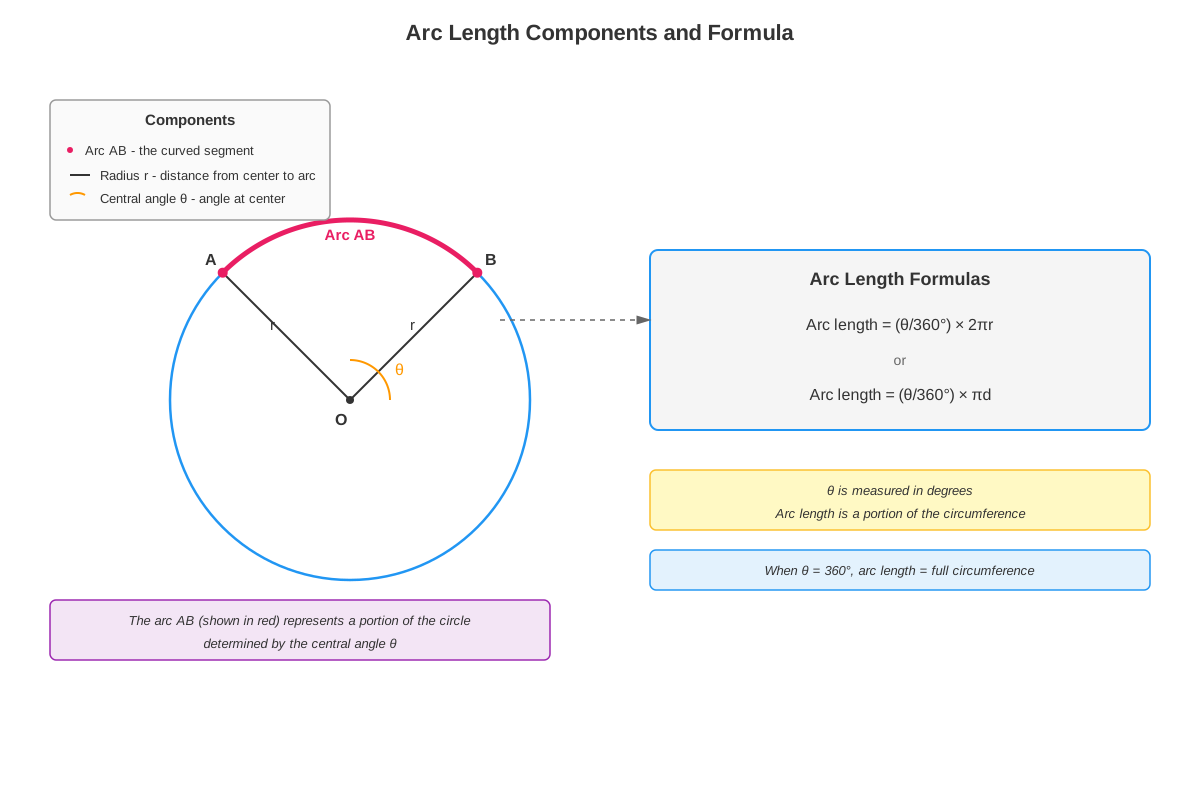
Arc length is the distance measured along the curved line that forms part of a circle's circumference. Unlike a straight-line chord connecting two points on a circle, an arc follows the circle's curve. Every arc is defined by two endpoints on the circle and the central angle that subtends (creates) the arc. The central angle is formed by two radii extending from the circle's center to the arc's endpoints.
Arcs are classified by their size relative to the circle: a minor arc measures less than 180° (less than half the circle), a major arc measures more than 180° (more than half the circle), and a semicircular arc measures exactly 180° (exactly half the circle). The GMAT most commonly tests minor arcs, though understanding all three types helps avoid confusion when interpreting diagrams.
The Arc Length Formula
The fundamental formula for arc length derives from the proportional relationship between the arc and the full circle. Since an arc represents a fraction of the complete circumference, the arc length equals that same fraction of the total circumference.
For angles measured in degrees:
Arc Length = (θ/360°) × 2πrWhere:
- θ (theta) = central angle in degrees
- r = radius of the circle
- 2πr = circumference of the full circle
This formula can also be written as:
Arc Length = (θ/360°) × πdWhere d = diameter of the circle.
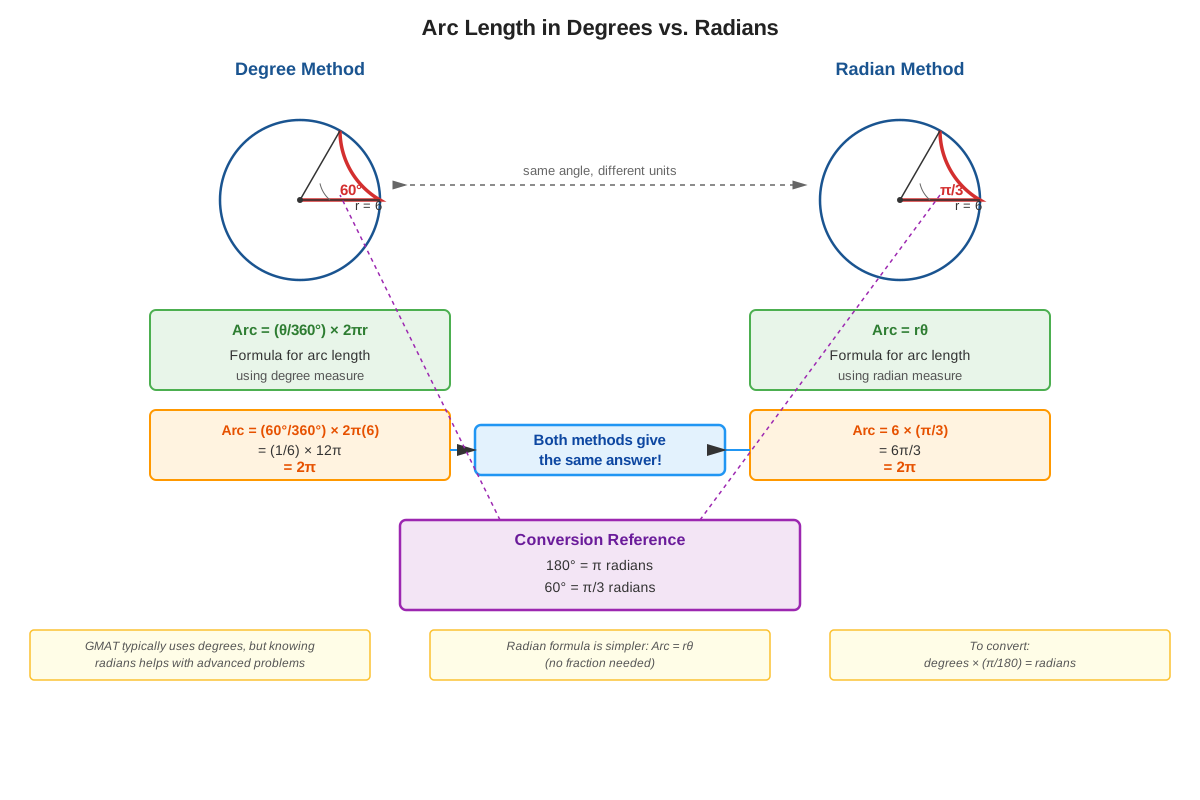
For angles measured in radians:
Arc Length = θrWhere θ is measured in radians. This simpler formula reflects the definition of a radian: the angle subtended when the arc length equals the radius.
Understanding the Proportional Relationship
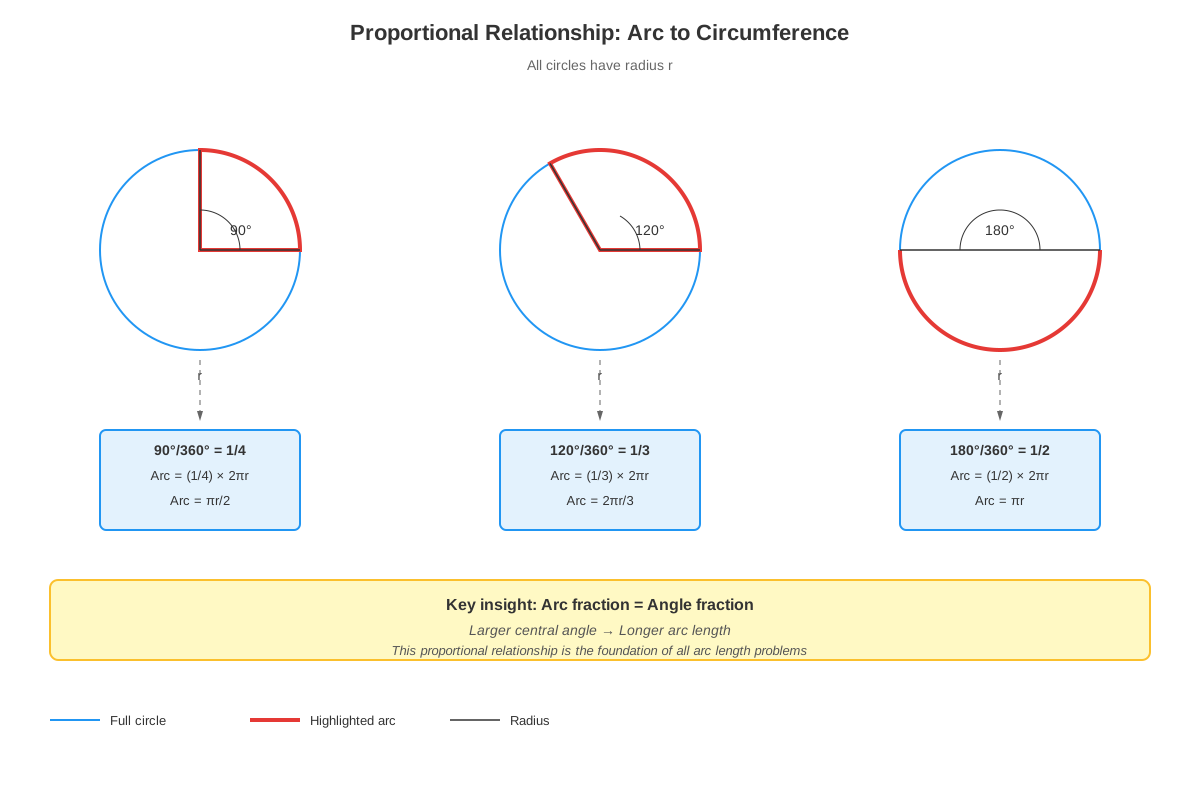
The key insight for GMAT success is recognizing that arc length problems are fundamentally about proportions. The ratio of arc length to circumference equals the ratio of central angle to 360°:
(Arc Length)/(Circumference) = (Central Angle)/(360°)This proportion can be rearranged to solve for any unknown variable. For example:
Arc Length = Circumference × (Central Angle/360°)Understanding this proportional relationship allows students to solve problems even when they momentarily forget the specific formula, as they can reason through the relationship logically.
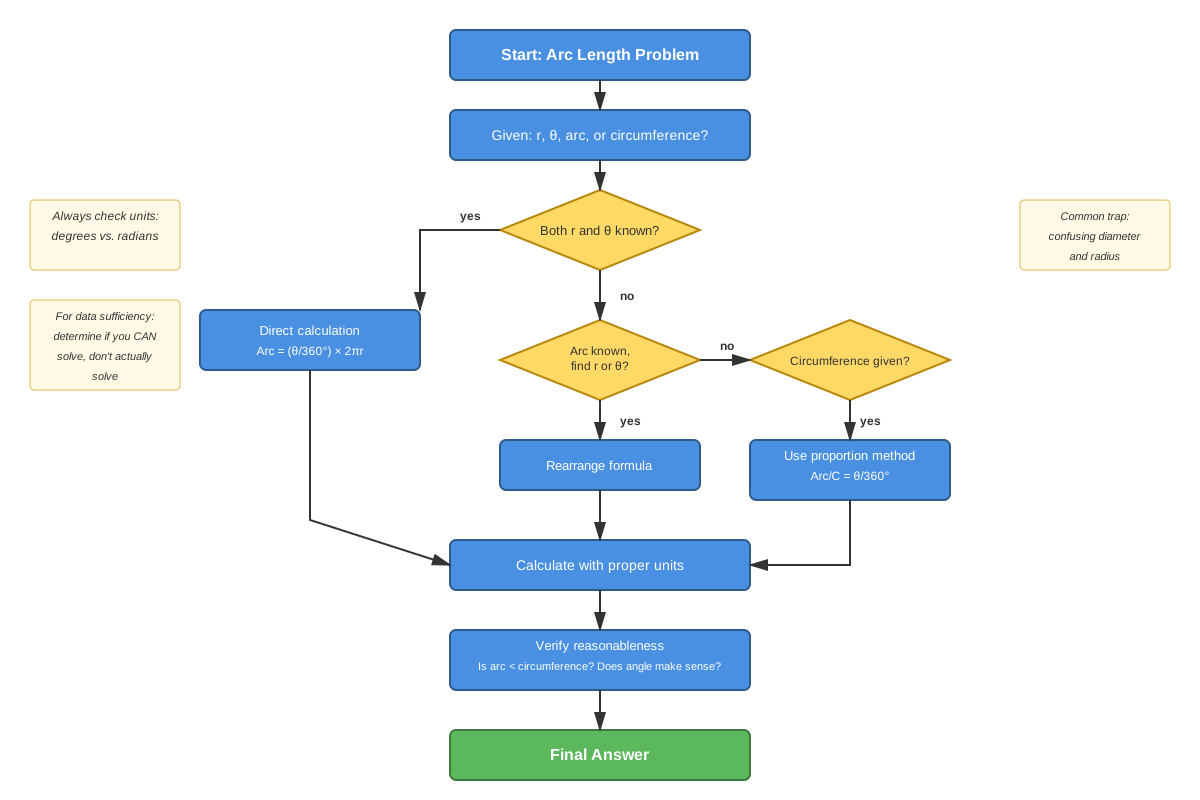
Calculating Arc Length: Step-by-Step Process
- Identify the given information: Determine what values are provided (radius, diameter, central angle, or other measurements)
- Convert units if necessary: Ensure the radius and diameter are in the same units; verify whether angles are in degrees or radians
- Select the appropriate formula: Use the degree formula for degree measures, the radian formula for radian measures
- Substitute values: Plug known values into the formula
- Simplify: Perform calculations, leaving π in symbolic form unless instructed otherwise or unless a numerical approximation is needed
- Check reasonableness: Verify that the arc length is less than the full circumference (unless dealing with multiple rotations)
Arc Length in Context: Sectors and Segments
Arc length frequently appears alongside related concepts. A sector is the pie-slice-shaped region bounded by two radii and an arc. The sector's perimeter includes the arc length plus two radii:
Sector Perimeter = Arc Length + 2rThe sector's area uses a similar proportional relationship:
Sector Area = (θ/360°) × πr²Understanding these relationships helps solve complex problems where multiple measurements must be found.
Special Cases and Common Angles
Certain central angles appear frequently on the GMAT because they create convenient fractions:
| Central Angle | Fraction of Circle | Arc Length (radius r) |
|---|---|---|
| 30° | 1/12 | πr/6 |
| 45° | 1/8 | πr/4 |
| 60° | 1/6 | πr/3 |
| 90° | 1/4 | πr/2 |
| 120° | 1/3 | 2πr/3 |
| 180° | 1/2 | πr |
Memorizing these common relationships speeds up problem-solving and helps verify answers quickly.
Concept Relationships
Arc length serves as a central hub connecting multiple geometric concepts. The relationship map flows as follows:
Circle Properties → Arc Length: Understanding radius, diameter, and circumference provides the foundation for calculating arc length, as arcs are portions of the circumference.
Central Angles → Arc Length: The central angle determines what fraction of the circle the arc represents, creating a direct proportional relationship.
Arc Length → Sector Area: Both arc length and sector area use the same proportional reasoning with the central angle, making them parallel concepts.
Arc Length ↔ Ratio and Proportion: Arc length problems are fundamentally proportion problems, and mastering proportional reasoning strengthens arc length skills.
Arc Length → Perimeter Calculations: When finding perimeters of complex shapes involving circular portions, arc length combines with straight-line segments.
Coordinate Geometry → Arc Length: Circles in the coordinate plane may require finding arc lengths after determining radius and angle measures from coordinates.
Trigonometry → Arc Length: In advanced problems, trigonometric relationships help find central angles, which then enable arc length calculations.
The bidirectional relationship between arc length and other circle measurements means that arc length can be either the unknown to solve for or the given information used to find other values like radius, central angle, or sector area. This flexibility makes arc length a versatile tool in multi-step GMAT problems.
High-Yield Facts
⭐ The arc length formula for degrees is: Arc Length = (θ/360°) × 2πr, where θ is the central angle in degrees
⭐ Arc length is directly proportional to both the radius and the central angle
⭐ The ratio of arc length to circumference equals the ratio of central angle to 360°
⭐ For a semicircle (180°), the arc length is exactly πr
⭐ When the central angle is given in radians, arc length = θr (the simplest formula)
- An arc measuring 60° on a circle with radius r has length πr/3
- Doubling the radius doubles the arc length (if the angle stays constant)
- Doubling the central angle doubles the arc length (if the radius stays constant)
- The arc length of a full circle (360°) equals the circumference: 2πr
- Arc length is always measured in linear units (inches, centimeters, meters), never in degrees
- Two arcs on the same circle are proportional to their central angles
- The minor arc and major arc connecting the same two points sum to the full circumference
- In data sufficiency questions, knowing any two of {arc length, radius, central angle} is sufficient to find the third
- Arc length problems often leave π in the answer rather than using decimal approximations
- The sector perimeter equals arc length plus two radii: P = s + 2r, where s is arc length
Quick check — test yourself on Arc length so far.
Try Flashcards →Common Misconceptions
Misconception: Arc length is the same as the chord length connecting the arc's endpoints → Correction: Arc length measures the curved distance along the circle, which is always longer than the straight-line chord distance (except when the arc is infinitesimally small). For example, a semicircular arc has length πr, while the chord (diameter) has length 2r, and πr > 2r.
Misconception: The arc length formula is Arc Length = θ × r for all angle measurements → Correction: This formula only works when θ is measured in radians. When θ is in degrees, the formula must include the conversion factor: Arc Length = (θ/360°) × 2πr. Forgetting this conversion factor is one of the most common errors on GMAT arc length questions.
Misconception: A larger central angle always means a larger arc length → Correction: While this is true for arcs on the same circle, comparing arcs on different circles requires considering both angle and radius. A 30° arc on a circle with radius 10 has length 5π/3 ≈ 5.24, which is longer than a 90° arc on a circle with radius 1, which has length π/2 ≈ 1.57.
Misconception: Arc length can be measured in degrees → Correction: Arc length is a linear distance measurement (like circumference) and must be expressed in linear units such as centimeters, inches, or meters. Degrees measure angles, not distances. The central angle is measured in degrees, but the resulting arc length is always in linear units.
Misconception: The arc length formula requires knowing the diameter → Correction: While the formula can be written using diameter (Arc Length = (θ/360°) × πd), it's more commonly expressed using radius. Either form works, but students should be comfortable converting between radius and diameter (d = 2r) to use whichever is given in the problem.
Misconception: In data sufficiency questions, knowing only the arc length is sufficient to determine the radius → Correction: Arc length alone is insufficient because infinitely many combinations of radius and central angle can produce the same arc length. For example, an arc length of π could result from r = 1 and θ = 180°, or r = 2 and θ = 90°, or many other combinations. Both the central angle and arc length (or radius and arc length) are needed.
Worked Examples
Example 1: Direct Arc Length Calculation
Problem: A circle has a radius of 12 cm. What is the length of an arc subtended by a central angle of 150°?
Solution:
Step 1: Identify the given information
- Radius (r) = 12 cm
- Central angle (θ) = 150°
- Need to find: Arc length
Step 2: Select the appropriate formula
Since the angle is given in degrees, use:
Arc Length = (θ/360°) × 2πr
Step 3: Substitute the values
Arc Length = (150°/360°) × 2π(12)
Step 4: Simplify
Arc Length = (150/360) × 24π
Arc Length = (5/12) × 24π
Arc Length = 10π cm
Step 5: Verify reasonableness
The full circumference would be 2π(12) = 24π cm. Since 150° is less than half of 360° (which would be 180°), the arc length should be less than half the circumference (12π). Our answer of 10π is indeed less than 12π, confirming the answer is reasonable.
Answer: 10π cm (or approximately 31.4 cm if a decimal approximation is needed)
Connection to Learning Objectives: This example demonstrates direct application of the arc length formula, addressing the objective to "apply arc length to GMAT questions."
Example 2: Finding Radius from Arc Length
Problem: An arc of length 5π meters is subtended by a central angle of 45° on a circle. What is the radius of the circle?
Solution:
Step 1: Identify the given information
- Arc length = 5π meters
- Central angle (θ) = 45°
- Need to find: Radius (r)
Step 2: Set up the arc length formula
Arc Length = (θ/360°) × 2πr
5π = (45°/360°) × 2πr
Step 3: Simplify the angle fraction
5π = (1/8) × 2πr
5π = (2πr)/8
5π = πr/4
Step 4: Solve for r
Multiply both sides by 4:
20π = πr
Divide both sides by π:
20 = r
Step 5: Verify the answer
Check: If r = 20 and θ = 45°, then Arc Length = (45/360) × 2π(20) = (1/8) × 40π = 5π ✓
Answer: The radius is 20 meters.
Connection to Learning Objectives: This example demonstrates working backward from arc length to find other circle measurements, addressing the objective to "determine missing circle measurements when given arc length information."
Example 3: Multi-Step Problem with Proportional Reasoning
Problem: Two concentric circles (circles with the same center) have radii of 6 cm and 10 cm. A central angle of 72° is drawn from the center. What is the difference between the arc lengths on the two circles?
Solution:
Step 1: Understand the setup
Both arcs share the same central angle (72°) but have different radii. We need to find each arc length, then calculate the difference.
Step 2: Calculate the arc length on the smaller circle (r = 6 cm)
Arc Length₁ = (72°/360°) × 2π(6)
Arc Length₁ = (1/5) × 12π
Arc Length₁ = 12π/5 cm
Step 3: Calculate the arc length on the larger circle (r = 10 cm)
Arc Length₂ = (72°/360°) × 2π(10)
Arc Length₂ = (1/5) × 20π
Arc Length₂ = 20π/5 = 4π cm
Step 4: Find the difference
Difference = Arc Length₂ - Arc Length₁
Difference = 4π - 12π/5
Difference = 20π/5 - 12π/5
Difference = 8π/5 cm
Step 5: Alternative approach using proportional reasoning
The difference in arc lengths equals the same fraction (1/5) of the difference in circumferences:
Difference in circumferences = 2π(10) - 2π(6) = 20π - 12π = 8π
Difference in arc lengths = (1/5) × 8π = 8π/5 cm ✓
Answer: 8π/5 cm (or 1.6π cm, or approximately 5.03 cm)
Connection to Learning Objectives: This problem combines arc length calculations with proportional reasoning and demonstrates how arc length appears in more complex geometric configurations, addressing multiple learning objectives including application to GMAT questions and solving multi-step problems.
Exam Strategy
When approaching gmat arc length questions, begin by quickly sketching the circle and marking the given information directly on the diagram. Label the radius, central angle, and arc clearly. This visual representation helps prevent confusion between different measurements and makes the proportional relationships more apparent.
Trigger words and phrases that signal arc length problems include: "distance along the curve," "length of the arc," "subtended by," "central angle," "portion of the circumference," and "sector perimeter." When a problem mentions a "slice" or "wedge" of a circle, it's likely involving both arc length and sector area. Questions about "circular tracks," "rotating objects," or "clock hands" often require arc length calculations to find distances traveled.
For data sufficiency questions, remember that determining arc length requires exactly two pieces of information from the set {arc length, radius/diameter, central angle}. If the question provides any two of these, the information is sufficient. Watch for disguised information: the circumference can give you the radius, and angle relationships (like "the arc is one-sixth of the circle") provide the central angle. Common trap answers provide only one piece of information or give redundant information that doesn't add new constraints.
Process-of-elimination strategies specific to arc length:
- Eliminate answers where arc length exceeds the circumference (unless the problem involves multiple rotations)
- For angles less than 180°, eliminate answers where arc length exceeds half the circumference
- If the central angle is a simple fraction of 360° (like 90° = 1/4), the arc length should be that same fraction of 2πr
- Answers that don't include π (when the problem gives exact values) are usually incorrect unless the question specifically asks for a decimal approximation
- In ratio problems, eliminate answers that don't maintain the proportional relationship between angles and arc lengths
Time allocation: Simple arc length calculations should take 60-90 seconds. Multi-step problems involving arc length combined with other concepts may require 2-2.5 minutes. If a problem seems to require more time, look for a proportional reasoning shortcut rather than calculating every value explicitly. For data sufficiency, spend 30-45 seconds per statement, focusing on whether the information provides two independent constraints on the arc length relationship.
Common shortcuts: When the central angle is 60°, 90°, 120°, or 180°, recognize these as 1/6, 1/4, 1/3, and 1/2 of the circle respectively, and calculate arc length as that fraction of 2πr. When comparing two arcs on the same circle, their lengths are in the same ratio as their central angles—no need to calculate both explicitly. If a problem asks for a ratio or proportion, often you can solve without finding absolute values.
Memory Techniques
Mnemonic for the arc length formula: "Angle Over Total Times Circumference" (AOTTC)
- Angle (θ) Over Total (360°) Times Circumference (2πr)
- This gives: (θ/360°) × 2πr
Visualization strategy: Picture a pizza. The arc length is the crusty edge of one slice. The central angle determines how big the slice is. A bigger angle means a longer crust (arc). A bigger pizza (larger radius) also means longer crust. This everyday analogy helps remember that arc length increases with both angle and radius.
Acronym for problem-solving steps: ICSVC
- Identify given information
- Choose the appropriate formula
- Substitute values
- Verify units and reasonableness
- Calculate and simplify
Memory aid for common angles: Remember "3-4-6-9-12" for the denominators when expressing common arc lengths as fractions of 2πr:
- 60° → 1/6 of circle → arc = 2πr/6 = πr/3
- 90° → 1/4 of circle → arc = 2πr/4 = πr/2
- 120° → 1/3 of circle → arc = 2πr/3
- 180° → 1/2 of circle → arc = 2πr/2 = πr
- 30° → 1/12 of circle → arc = 2πr/12 = πr/6
Radian formula memory trick: "Radians Are Really Easy" (RARE)
- When using Radians, the formula is just θR (angle times radius)
- No 360° or 2π needed—it's Easy!
Summary
Arc length represents the curved distance along a portion of a circle's circumference, determined by the circle's radius and the central angle subtending the arc. The fundamental formula—Arc Length = (θ/360°) × 2πr for degree measures—derives from the proportional relationship between the arc and the full circle. Mastering arc length requires understanding this proportional reasoning: the arc length relates to the circumference in the same ratio as the central angle relates to 360°. GMAT questions test arc length through direct calculations, reverse problems finding radius or angle from arc length, and multi-step problems combining arc length with sectors, perimeters, and coordinate geometry. Success requires memorizing the core formula, recognizing common angle-to-arc relationships, and applying proportional reasoning to solve efficiently. Students must distinguish between arc length (a linear distance) and central angle (measured in degrees or radians), avoid confusing arc length with chord length, and remember that arc length depends on both the angle and radius. The topic connects deeply to other circle properties, ratio problems, and geometric reasoning, making it a high-yield area for GMAT preparation.
Key Takeaways
- Arc length measures the curved distance along a circle and equals (θ/360°) × 2πr when θ is in degrees, or simply θr when θ is in radians
- The proportional relationship—arc length to circumference equals central angle to 360°—is the key to solving all arc length problems efficiently
- Arc length increases linearly with both radius and central angle; doubling either doubles the arc length
- Common angles (30°, 45°, 60°, 90°, 120°, 180°) create convenient fractions of the circumference that should be memorized for quick calculations
- In data sufficiency questions, any two of {arc length, radius, central angle} are sufficient to determine the third
- Arc length is always expressed in linear units (cm, m, inches), never in degrees, and typically includes π in exact answers
- Multi-step problems often combine arc length with sector area, perimeter calculations, or coordinate geometry, requiring integrated geometric reasoning
Related Topics
Sector Area: After mastering arc length, students should study sector area, which uses the same proportional reasoning but calculates the two-dimensional region rather than the one-dimensional boundary. The formula (θ/360°) × πr² parallels the arc length formula, making the transition natural.
Radians and Angle Conversion: Understanding radian measure deepens arc length mastery and is essential for advanced problems. The radian system defines angles based on arc length, making the relationship explicit: one radian is the angle where arc length equals radius.
Circle Theorems and Inscribed Angles: Arc length connects to inscribed angle theorems, where angles formed by chords relate to the arcs they intercept. These theorems often appear in complex GMAT geometry problems.
Coordinate Geometry with Circles: Applying arc length to circles in the coordinate plane requires finding radius and angles from coordinate information, integrating algebraic and geometric reasoning.
Circular Motion and Related Rates: Advanced applications involve objects moving along circular paths, where arc length represents distance traveled and connects to velocity and angular speed.
Practice CTA
Now that you've mastered the core concepts of arc length, it's time to solidify your understanding through practice. Attempt the practice questions to test your ability to apply these formulas under timed conditions, and use the flashcards to reinforce the key formulas and relationships until they become automatic. Remember, arc length appears frequently on the GMAT, and the time you invest in mastering this topic will pay dividends across multiple question types. Each practice problem you solve strengthens your proportional reasoning skills and builds the pattern recognition that separates good scores from great scores. You've got this—start practicing!
Sign up free to keep reading
Create a free AnvayaPrep account to finish this GMAT guide on Arc length — plus flashcards and practice questions.