Overview
Transformations in the context of GMAT Quantitative Reasoning refer to systematic changes applied to geometric figures, algebraic expressions, or coordinate systems that alter their position, size, orientation, or form while often preserving certain fundamental properties. On the GMAT, gmat transformations encompass a range of operations including translations (shifts), reflections (flips), rotations (turns), and dilations (scaling), as well as algebraic transformations of equations and functions. Understanding transformations is crucial because they appear across multiple question types—from pure geometry problems involving coordinate planes to data sufficiency questions requiring recognition of equivalent forms.
The GMAT tests transformations both explicitly and implicitly. Explicit questions might ask about the coordinates of a point after a specific transformation or the effect of reflecting a geometric figure across an axis. Implicit applications are even more common: recognizing that two algebraic expressions represent the same relationship after transformation, understanding how changing variables affects equations, or identifying congruent or similar figures that result from transformations. These concepts bridge multiple areas of quantitative reasoning, connecting coordinate geometry, algebra, and spatial reasoning.
Mastery of transformations provides a powerful analytical framework for the GMAT. When students recognize that a complex problem involves a transformation, they can often simplify the solution by understanding what properties remain invariant (unchanged) and what properties change predictably. This topic integrates foundational geometry concepts with algebraic manipulation skills, making it a high-yield area that appears in approximately 10-15% of GMAT Quantitative questions, particularly in Problem Solving and Data Sufficiency formats involving coordinate geometry and function behavior.
Learning Objectives
- [ ] Identify Transformations in geometric figures, coordinate systems, and algebraic expressions
- [ ] Explain Transformations and their effects on properties such as distance, angle measure, orientation, and shape
- [ ] Apply Transformations to GMAT questions involving coordinate geometry and spatial reasoning
- [ ] Determine the coordinates of points after single or multiple transformations
- [ ] Recognize invariant properties under specific transformations
- [ ] Distinguish between rigid transformations (isometries) and non-rigid transformations
- [ ] Solve problems involving composite transformations and transformation sequences
Prerequisites
- Coordinate Geometry Fundamentals: Understanding the Cartesian plane, plotting points, and calculating distances is essential because most GMAT transformation questions involve coordinate systems
- Basic Geometric Properties: Knowledge of angles, triangles, quadrilaterals, and circles provides the foundation for recognizing what changes and what remains constant during transformations
- Algebraic Manipulation: Facility with equations and expressions enables recognition of algebraic transformations and equivalent forms
- Function Notation: Familiarity with f(x) notation helps when dealing with transformations of graphs and functional relationships
Why This Topic Matters
Transformations represent a fundamental concept in mathematics with extensive real-world applications. In computer graphics, transformations enable image manipulation, animation, and 3D modeling. In physics and engineering, coordinate transformations simplify complex problems by changing reference frames. In data analysis, transformations of variables can reveal patterns and relationships that aren't apparent in raw data. Understanding transformations develops spatial reasoning and abstract thinking skills valuable far beyond standardized testing.
On the GMAT specifically, transformation questions appear with notable frequency. Approximately 10-15% of Quantitative Reasoning questions involve transformations either directly or as a component of the solution strategy. These questions typically appear as medium to high difficulty problems, making them important differentiators for competitive scores. The most common question formats include:
- Coordinate Geometry Problems: Finding new coordinates after reflections, rotations, or translations
- Data Sufficiency Questions: Determining whether transformation information is sufficient to establish relationships
- Graph Interpretation: Understanding how transformations affect function graphs
- Geometric Properties: Identifying congruent or similar figures resulting from transformations
- Optimization Problems: Using transformations to simplify distance or area calculations
The GMAT favors questions that test conceptual understanding over mechanical computation. Rather than asking for tedious calculations, questions typically require recognizing which transformation occurred, understanding what properties are preserved, or applying transformation concepts to solve problems efficiently.
Core Concepts
Types of Geometric Transformations
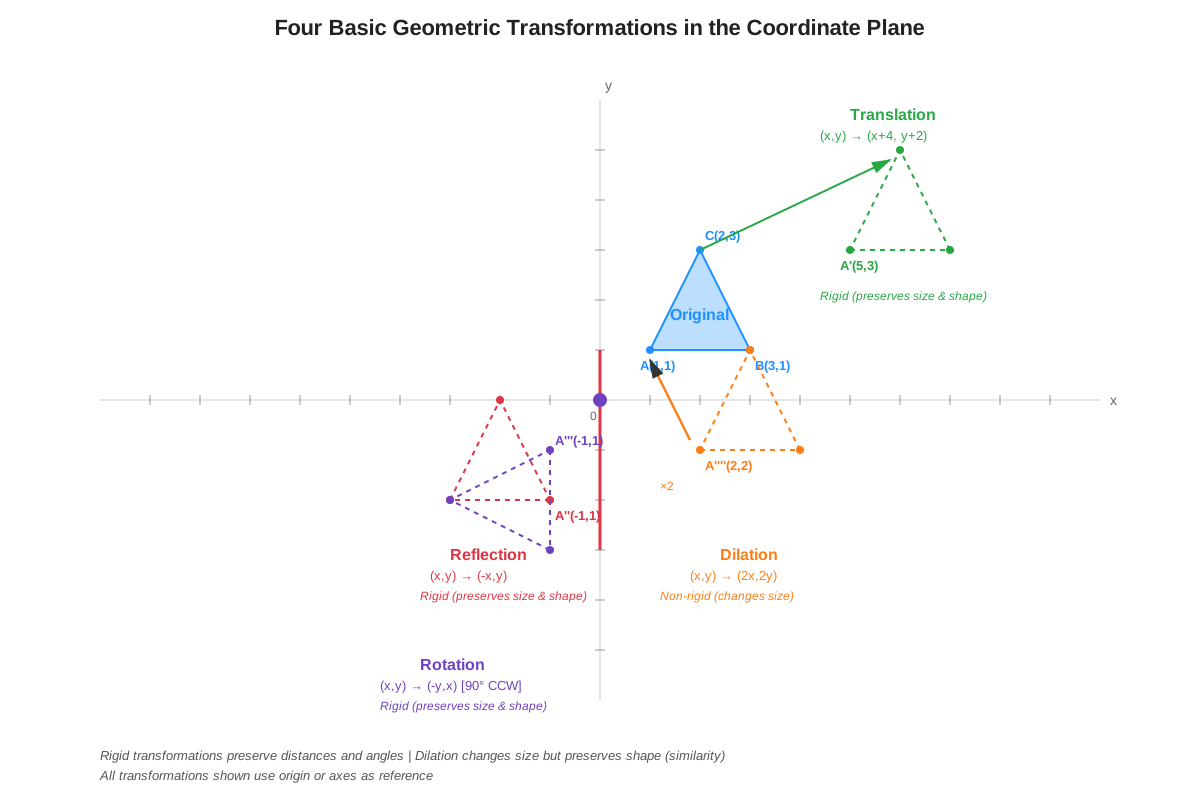
Transformations can be classified into two major categories: rigid transformations (isometries) and non-rigid transformations. This distinction is fundamental to understanding what properties are preserved.
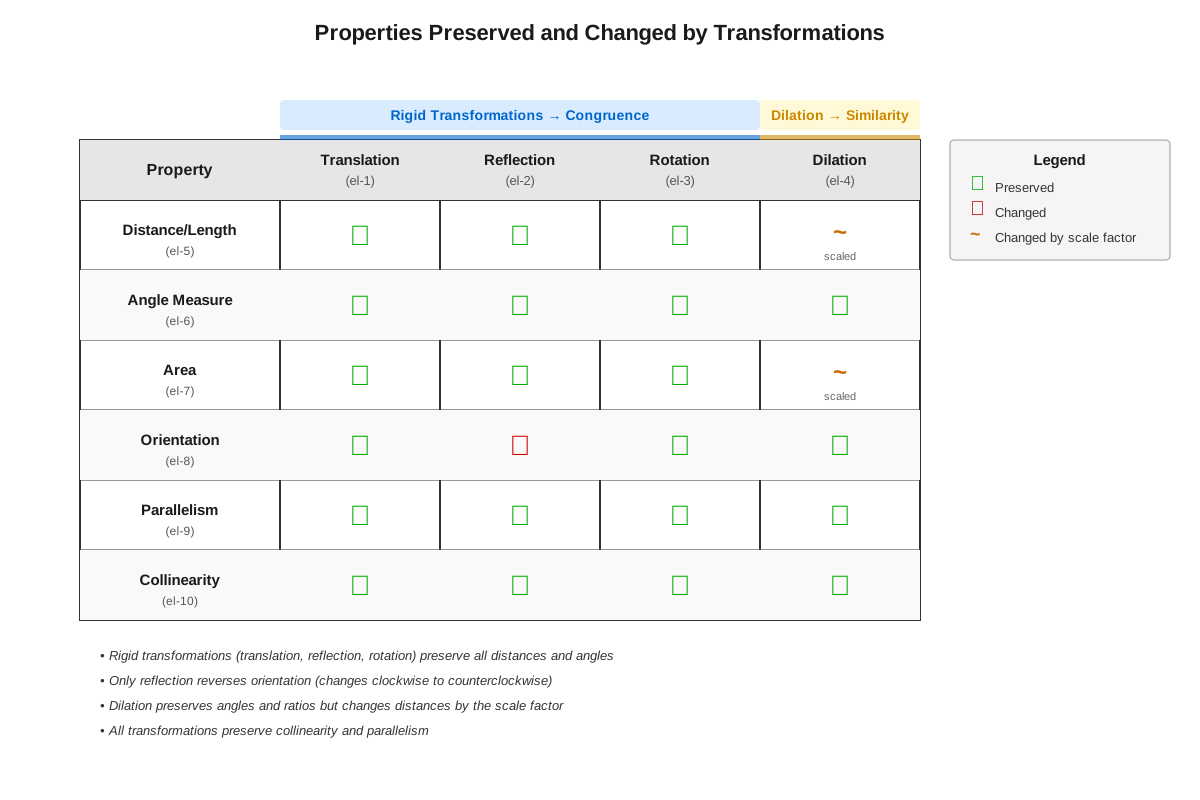
Rigid Transformations (Isometries) preserve distance and angle measures. The transformed figure is congruent to the original. The three primary rigid transformations are:
- Translation: A shift of every point in a figure by the same distance in the same direction
- Reflection: A flip of a figure across a line (the line of reflection)
- Rotation: A turn of a figure around a fixed point (the center of rotation) by a specified angle
Non-Rigid Transformations change the size or shape of figures. The most important non-rigid transformation for the GMAT is:
- Dilation: A scaling transformation that enlarges or reduces a figure by a scale factor relative to a center point
Translation
A translation moves every point of a figure the same distance in the same direction. In coordinate geometry, a translation can be described by a horizontal shift and a vertical shift.
If point P has coordinates (x, y), then translating P by h units horizontally and k units vertically produces point P' with coordinates (x + h, y + k).
Properties preserved by translation:
- Distance between any two points
- Angle measures
- Parallelism of lines
- Orientation (clockwise/counterclockwise order)
- Shape and size (congruence)
Properties that change:
- Position/location
- Specific coordinate values
Example: Triangle ABC with vertices A(1, 2), B(3, 2), C(2, 4) is translated 3 units right and 2 units down. The new vertices are A'(4, 0), B'(6, 0), C'(5, 2).
Reflection
A reflection creates a mirror image of a figure across a line called the line of reflection or axis of reflection. Each point and its image are equidistant from the line of reflection, and the line connecting them is perpendicular to the line of reflection.
Common reflections on the GMAT:
| Line of Reflection | Transformation Rule | Example |
|---|---|---|
| x-axis | (x, y) → (x, -y) | (3, 4) → (3, -4) |
| y-axis | (x, y) → (-x, y) | (3, 4) → (-3, 4) |
| Line y = x | (x, y) → (y, x) | (3, 4) → (4, 3) |
| Line y = -x | (x, y) → (-y, -x) | (3, 4) → (-4, -3) |
| Origin (point reflection) | (x, y) → (-x, -y) | (3, 4) → (-3, -4) |
Properties preserved by reflection:
- Distance between any two points
- Angle measures
- Parallelism of lines
- Shape and size (congruence)
Properties that change:
- Position/location
- Orientation (reversed: clockwise becomes counterclockwise)
- Specific coordinate values
GMAT Tip: Reflection across the origin is equivalent to a 180° rotation about the origin. Both produce the transformation (x, y) → (-x, -y).
Rotation
A rotation turns a figure around a fixed point called the center of rotation through a specified angle called the angle of rotation. Rotations are typically measured counterclockwise from the positive x-axis as the standard convention.
Common rotations about the origin:
| Angle | Transformation Rule | Example |
|---|---|---|
| 90° counterclockwise | (x, y) → (-y, x) | (3, 4) → (-4, 3) |
| 180° | (x, y) → (-x, -y) | (3, 4) → (-3, -4) |
| 270° counterclockwise (or 90° clockwise) | (x, y) → (y, -x) | (3, 4) → (4, -3) |
Properties preserved by rotation:
- Distance between any two points
- Angle measures
- Parallelism of lines
- Orientation (clockwise/counterclockwise order)
- Shape and size (congruence)
Properties that change:
- Position/location (unless rotating 360°)
- Specific coordinate values
Dilation
A dilation is a transformation that produces a figure similar to the original by scaling all distances from a center point by a constant scale factor k. If k > 1, the dilation is an enlargement; if 0 < k < 1, it's a reduction.
For dilation centered at the origin with scale factor k, point (x, y) transforms to (kx, ky).
Properties preserved by dilation:
- Angle measures
- Parallelism of lines
- Orientation
- Shape (similarity, not congruence unless k = 1)
- Ratios of lengths
Properties that change:
- Actual distances (multiplied by |k|)
- Perimeter (multiplied by |k|)
- Area (multiplied by k²)
- Specific coordinate values
High-Yield Concept: When a figure is dilated by scale factor k, its perimeter is multiplied by k, but its area is multiplied by k². This relationship appears frequently in GMAT ratio and scaling problems.
Composite Transformations
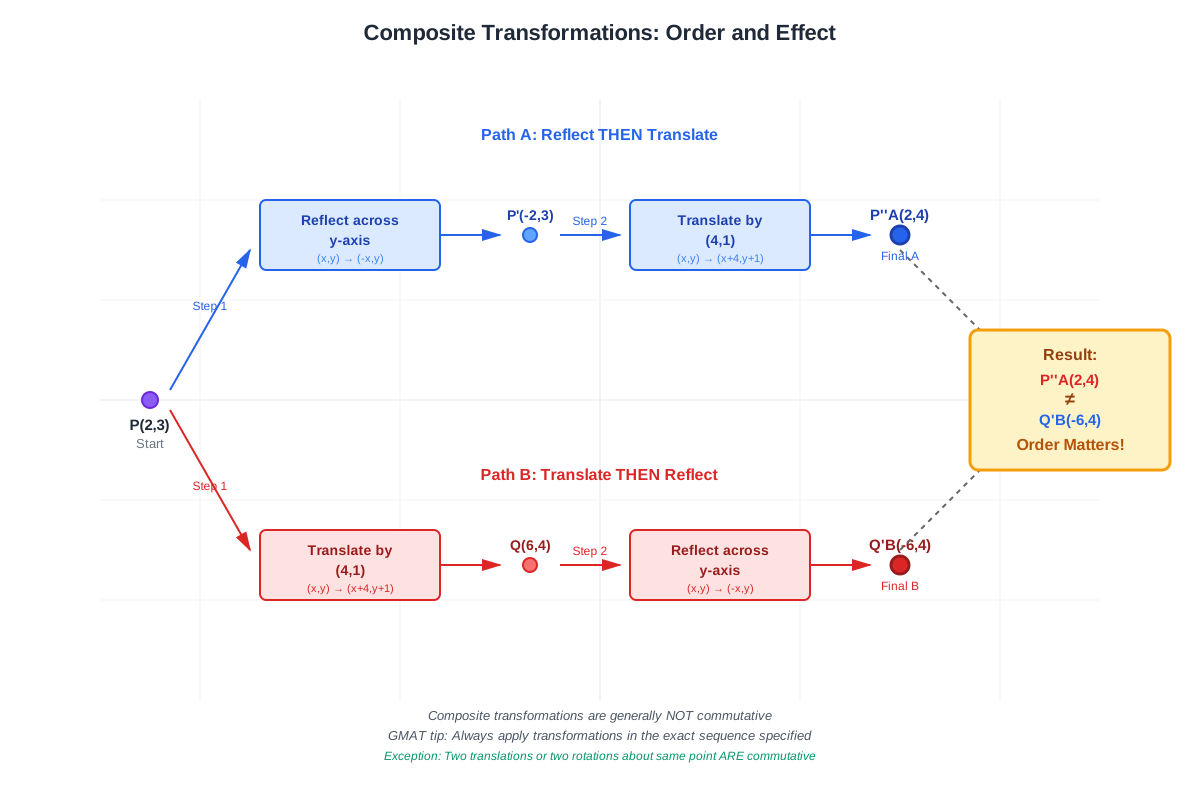
Composite transformations involve applying multiple transformations in sequence. The order of transformations generally matters—performing transformation A followed by transformation B often produces a different result than B followed by A.
Key principles:
- Two reflections across parallel lines equal a translation
- Two reflections across intersecting lines equal a rotation
- A reflection followed by another reflection across a perpendicular line equals a rotation of 180°
- Multiple translations can be combined into a single translation
Algebraic Transformations
Beyond geometric transformations, the GMAT tests understanding of how transformations affect algebraic expressions and functions.
Function transformations follow predictable patterns:
- f(x) + k: vertical shift up by k units
- f(x) - k: vertical shift down by k units
- f(x + h): horizontal shift left by h units
- f(x - h): horizontal shift right by h units
- -f(x): reflection across the x-axis
- f(-x): reflection across the y-axis
- kf(x) where k > 1: vertical stretch
- kf(x) where 0 < k < 1: vertical compression
Equation transformations involve recognizing equivalent forms. For example, transforming variables in an equation: if y = 2x + 3, and we substitute u = x - 1 (a translation), then x = u + 1, so y = 2(u + 1) + 3 = 2u + 5.
Concept Relationships
The transformation concepts form an interconnected hierarchy. At the foundation, rigid transformations (translation, reflection, rotation) share the common property of preserving congruence—they maintain all distances and angles. This connects directly to the geometric concept of congruent figures: two figures are congruent if and only if one can be transformed into the other through a sequence of rigid transformations.
Translation serves as the simplest transformation, involving only position change → Reflection adds the complexity of orientation reversal → Rotation combines aspects of both, changing position while preserving orientation → Composite transformations build on these fundamentals to create more complex mappings.
Dilation stands apart as a non-rigid transformation, connecting to the concept of similar figures rather than congruent ones. This links transformations to proportional reasoning and scaling, which appear throughout GMAT geometry and word problems.
The relationship map:
Rigid Transformations → Preserve Congruence → Isometries
    ↓
Translation (simplest) → Reflection (adds orientation change) → Rotation (combines effects)
    ↓
Composite Transformations (combining multiple operations)

Non-Rigid Transformations → Preserve Similarity → Scaling
    ↓
Dilation → Affects area by k² → Connects to ratio problems
Algebraic transformations of functions parallel geometric transformations: horizontal and vertical shifts correspond to translations, negation corresponds to reflection, and multiplication by constants corresponds to dilation. This parallel structure means that understanding geometric transformations deepens comprehension of function behavior, and vice versa.
The connection to coordinate geometry is essential: transformations provide the framework for understanding how figures behave in the coordinate plane, which is the primary context for GMAT geometry questions. Understanding transformations also connects to symmetry—a figure has line symmetry if reflection across a line maps it onto itself, and rotational symmetry if rotation maps it onto itself.
Quick check — test yourself on Transformations so far.
Try Flashcards →High-Yield Facts
⭐ Translation by (h, k) transforms point (x, y) to (x + h, y + k) and preserves all distances, angles, and orientation.
⭐ Reflection across the x-axis transforms (x, y) to (x, -y); reflection across the y-axis transforms (x, y) to (-x, y).
⭐ Rotation of 90° counterclockwise about the origin transforms (x, y) to (-y, x); 180° rotation transforms to (-x, -y).
⭐ Rigid transformations (translation, reflection, rotation) preserve congruence—the transformed figure is congruent to the original.
⭐ Dilation by scale factor k centered at the origin transforms (x, y) to (kx, ky) and multiplies all distances by |k| and all areas by k².
- Reflection reverses orientation (clockwise becomes counterclockwise), while translation and rotation preserve orientation.
- Two reflections across parallel lines produce a translation perpendicular to those lines.
- Reflection across the line y = x swaps coordinates: (x, y) → (y, x).
- The composition of two rotations about the same center equals a single rotation whose angle is the sum of the two angles.
- Under dilation with scale factor k, perimeter is multiplied by k, but area is multiplied by k².
- A 180° rotation about the origin produces the same result as reflection through the origin (point reflection).
- The distance from any point to its image under reflection equals twice the distance from the point to the line of reflection.
- Transformations that preserve distance are called isometries; all rigid transformations are isometries.
- For function transformations, f(x - h) shifts the graph h units RIGHT (counterintuitive direction).
- The order of composite transformations matters: performing A then B generally differs from performing B then A.
Common Misconceptions
Misconception: Reflection across the y-axis changes the y-coordinate.
Correction: Reflection across the y-axis changes only the x-coordinate, transforming (x, y) to (-x, y). The point moves horizontally to the opposite side of the y-axis while maintaining the same vertical position. Only reflection across the x-axis changes the y-coordinate.
Misconception: A 90° rotation and a 90° angle are the same thing.
Correction: A 90° rotation is a transformation that turns a figure 90° around a point, while a 90° angle is a geometric object (a right angle). The rotation transformation affects the entire figure, changing the coordinates of all points according to the rule (x, y) → (-y, x) when rotating counterclockwise about the origin.
Misconception: Dilation by scale factor k = 2 doubles the area of a figure.
Correction: Dilation by scale factor k = 2 actually quadruples the area (multiplies by 2² = 4) while doubling all linear dimensions. This is because area is two-dimensional. Similarly, k = 3 multiplies area by 9, not 3. Only the perimeter is multiplied by k.
Misconception: The transformation f(x + 3) shifts a function graph 3 units to the right.
Correction: The transformation f(x + 3) shifts the graph 3 units to the LEFT, not right. This counterintuitive result occurs because the input value must be 3 units smaller to produce the same output. To shift right by 3 units, use f(x - 3). Remember: the sign inside the function is opposite to the direction of horizontal shift.
Misconception: All transformations preserve the shape of a figure.
Correction: Only specific transformations preserve shape. Rigid transformations (translation, reflection, rotation) preserve both shape and size (congruence). Dilation preserves shape but not size (similarity). Other transformations, such as non-uniform scaling (stretching by different factors in different directions), can distort shape entirely.
Misconception: Rotating a point 270° counterclockwise is different from rotating it 90° clockwise.
Correction: These rotations produce identical results. A 270° counterclockwise rotation equals a 90° clockwise rotation because 360° - 270° = 90°. Both transform (x, y) to (y, -x) when rotating about the origin. Understanding this equivalence can simplify calculations.
Misconception: The center of rotation must be at the origin.
Correction: While GMAT questions often use the origin as the center of rotation for simplicity, rotation can occur about any point. When the center is not the origin, the transformation rules become more complex, typically requiring translation to move the center to the origin, performing the rotation, then translating back.
Worked Examples
Example 1: Composite Transformation with Coordinate Geometry
Problem: Point P has coordinates (4, -2). Point P is first reflected across the x-axis to create point Q, then Q is rotated 90° counterclockwise about the origin to create point R. What are the coordinates of point R?
Solution:
Step 1: Identify the first transformation—reflection across the x-axis.
The rule for reflection across the x-axis is (x, y) → (x, -y).
Starting with P(4, -2), we apply this rule:
Q = (4, -(-2)) = (4, 2)
Step 2: Identify the second transformation—90° counterclockwise rotation about the origin.
The rule for 90° counterclockwise rotation is (x, y) → (-y, x).
Starting with Q(4, 2), we apply this rule:
R = (-2, 4)
Step 3: Verify the result makes geometric sense.
- Original point P(4, -2) is in Quadrant IV (positive x, negative y)
- After reflection across x-axis, Q(4, 2) is in Quadrant I (positive x, positive y)
- After 90° counterclockwise rotation, R(-2, 4) is in Quadrant II (negative x, positive y)
This progression makes sense: reflection across the x-axis moves the point from below the x-axis to above it, and 90° counterclockwise rotation from Quadrant I lands in Quadrant II.
Answer: R has coordinates (-2, 4).
Connection to Learning Objectives: This problem requires identifying two different transformations (reflection and rotation), explaining their effects through transformation rules, and applying them sequentially to solve a GMAT-style coordinate geometry question.
Example 2: Dilation and Area Relationship
Problem: Triangle ABC has an area of 18 square units. Triangle ABC is dilated with center at the origin and scale factor k = 3 to create triangle A'B'C'. What is the area of triangle A'B'C'?
Solution:
Step 1: Recall the relationship between dilation scale factor and area.
When a figure is dilated by scale factor k, all linear dimensions are multiplied by k, but area is multiplied by k² (because area is two-dimensional).
Step 2: Identify the scale factor.
The problem states k = 3.
Step 3: Calculate the area multiplier.
Area multiplier = k² = 3² = 9
Step 4: Calculate the new area.
Original area = 18 square units
New area = 18 × 9 = 162 square units
Step 5: Verify with reasoning.
If each side length is tripled, then for a triangle with base b and height h:
- Original area = (1/2)bh = 18
- New area = (1/2)(3b)(3h) = (1/2)(9bh) = 9 × (1/2)bh = 9 × 18 = 162 ✓
Answer: The area of triangle A'B'C' is 162 square units.
Alternative Approach (if coordinates were given): If the vertices were specified, we could:
- Apply the dilation rule (x, y) → (3x, 3y) to each vertex
- Calculate the area using the coordinate formula
- Verify the result matches 9 times the original area
Connection to Learning Objectives: This problem demonstrates applying transformation concepts (specifically dilation) to solve a GMAT question involving geometric properties. It also illustrates the critical distinction between how dilation affects linear dimensions versus area—a high-yield concept frequently tested.
Exam Strategy
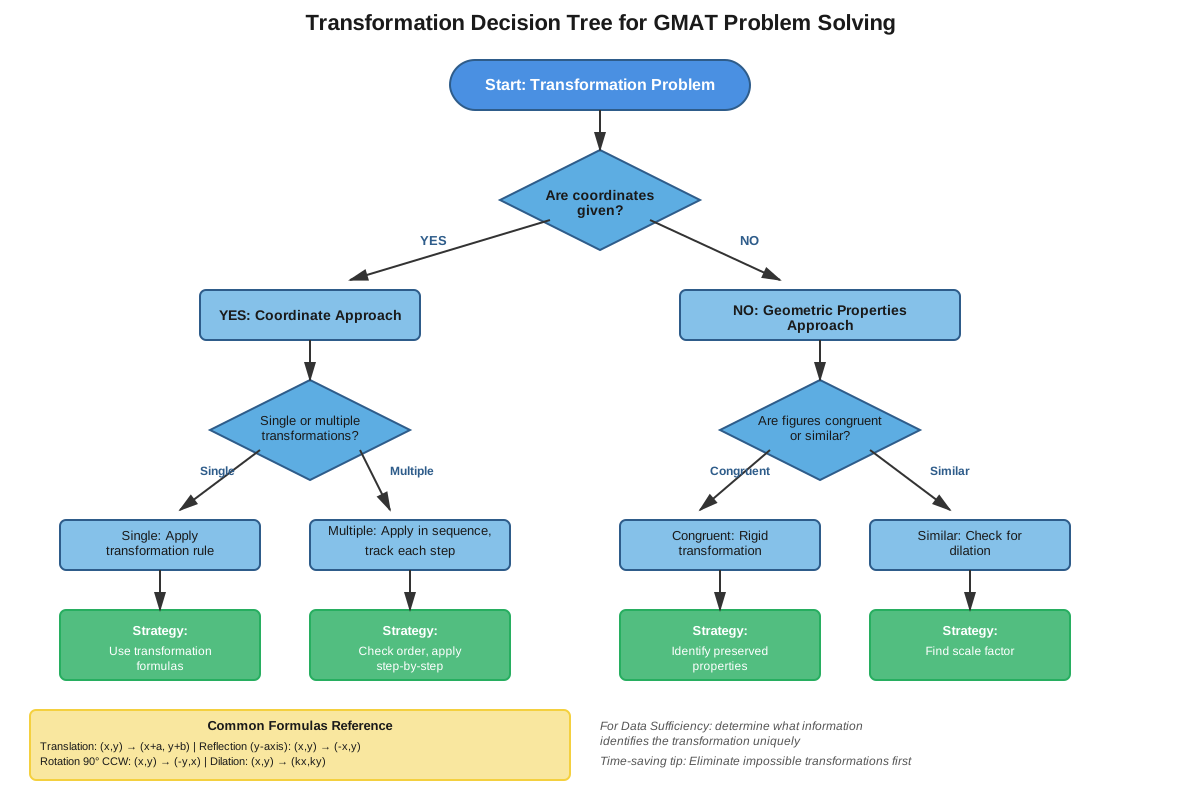
Approaching Transformation Questions on the GMAT:
- Identify the transformation type first: Before calculating anything, determine whether the question involves translation, reflection, rotation, dilation, or a combination. This dictates which rules and properties apply.
- Write down the transformation rule: For coordinate geometry problems, explicitly write the transformation rule (e.g., "reflection across x-axis: (x, y) → (x, -y)"). This prevents sign errors and provides a clear roadmap.
- Track what's preserved and what changes: Immediately identify which properties remain invariant. If the transformation is rigid, distances and angles are preserved. If it's a dilation, angles and shape are preserved but not size.
- Draw a quick sketch for geometric problems: Even a rough coordinate plane with labeled points can prevent errors and provide geometric intuition. Mark the line of reflection or center of rotation.
Trigger Words and Phrases:
- "Reflected across/over" → Reflection transformation
- "Shifted," "moved," "translated" → Translation
- "Rotated," "turned" → Rotation
- "Scaled," "enlarged," "reduced," "similar" → Dilation
- "Image of point P" → The result after transformation
- "Congruent" → Suggests rigid transformation
- "Similar" → Suggests dilation or combination with rigid transformations
Process of Elimination Tips:
- For coordinate questions: Eliminate answers that violate the transformation rule. For example, if reflecting across the y-axis, eliminate any answer where the y-coordinate changed.
- For property questions: Eliminate answers that claim a preserved property changed or vice versa. If the question involves rigid transformation, eliminate answers suggesting the figure changed size.
- For composite transformations: Work through transformations step-by-step; eliminate answers that could only result from performing transformations in the wrong order.
- For Data Sufficiency: Statement (1) or (2) is often sufficient if it provides enough information to determine the transformation type and necessary parameters (like scale factor or angle of rotation).
Time Allocation:
- Simple single transformation: 60-90 seconds
- Composite transformation or complex geometry: 2-2.5 minutes
- Data Sufficiency with transformations: 90 seconds to 2 minutes
If a transformation problem is taking longer than 2.5 minutes, consider whether there's a conceptual shortcut being missed. Often, recognizing what's preserved eliminates the need for detailed calculation.
Strategic Insight: Many GMAT transformation questions can be solved by understanding properties rather than computing coordinates. If asked whether two figures are congruent after a transformation, knowing that rigid transformations preserve congruence is sufficient—no coordinate calculation needed.
Memory Techniques
Mnemonic for Rigid Transformations - "TRR":
- Translation
- Reflection
- Rotation
All three preserve congruence (same size and shape). Think: "TRR keeps things the same" (TRR sounds like "true").
Reflection Rules Mnemonic - "X-Y-Swap":
- X-axis reflection: change the Y (x stays, y changes sign)
- Y-axis reflection: change the X (y stays, x changes sign)
- y = x reflection: Swap coordinates
Rotation Visualization - "Counter-Clockwise = Negative-Y-first":
For 90° counterclockwise rotation: (x, y) → (-y, x)
Remember: "Counter" starts with C, "Negative" starts with N, both early in alphabet
The y-coordinate becomes negative and moves to the first position
Dilation Area Rule - "Square the Scale":
When scale factor is k:
- Perimeter: multiply by k (one dimension)
- Area: multiply by k² (two dimensions) - "Square the Scale"
- Volume: multiply by k³ (three dimensions) - "Cube the Scale"
Function Transformation Direction - "Opposite Inside":
For f(x - h): the shift is OPPOSITE the sign INSIDE the function
- f(x - 3): shift RIGHT 3 (opposite of the minus)
- f(x + 3): shift LEFT 3 (opposite of the plus)
Outside the function, the direction matches the sign: f(x) + 3 shifts UP 3
Composite Transformation Order - "Right to Left Like Reading Math":
When you see "reflect then rotate," perform reflection first, then rotation (read operations right to left in the sequence described). Write the sequence down to avoid confusion.
Summary
Transformations represent systematic changes to geometric figures or algebraic expressions that alter position, size, orientation, or form while preserving specific properties. The GMAT tests four primary geometric transformations: translation (shifting position), reflection (flipping across a line), rotation (turning around a point), and dilation (scaling size). The first three are rigid transformations that preserve congruence—maintaining all distances and angles—while dilation is a non-rigid transformation that preserves similarity but changes size. Understanding which properties remain invariant under each transformation is crucial for efficient problem-solving. Translation preserves everything except position; reflection preserves distances and angles but reverses orientation; rotation preserves distances, angles, and orientation; dilation preserves angles and shape but multiplies distances by the scale factor k and areas by k². Most GMAT transformation questions appear in coordinate geometry contexts, requiring application of specific transformation rules to find new coordinates or determine relationships between figures. Success requires recognizing transformation types, applying appropriate rules accurately, and understanding the conceptual relationships between transformations and geometric properties rather than relying solely on mechanical computation.
Key Takeaways
- Rigid transformations (translation, reflection, rotation) preserve congruence—all distances and angles remain unchanged, making the original and transformed figures congruent.
- Coordinate transformation rules must be memorized: reflection across x-axis changes y-coordinate sign; reflection across y-axis changes x-coordinate sign; 90° counterclockwise rotation transforms (x, y) to (-y, x).
- Dilation by scale factor k multiplies linear dimensions by k, perimeter by k, and area by k²—this relationship is frequently tested in ratio and scaling problems.
- The order of composite transformations matters—performing transformation A followed by B typically produces different results than B followed A; work through sequences step-by-step.
- Identify what's preserved before calculating—recognizing invariant properties often provides shortcuts that eliminate the need for detailed computation, saving valuable exam time.
- Reflection reverses orientation while translation and rotation preserve it—this distinction helps verify answers and eliminate incorrect choices.
- Function transformations parallel geometric transformations—horizontal shifts correspond to translations, negation to reflections, and multiplication to dilations, creating a unified conceptual framework.
Related Topics
Coordinate Geometry: Mastering transformations enables advanced work with lines, circles, and other figures in the coordinate plane, particularly problems involving symmetry and geometric relationships.
Congruence and Similarity: Understanding transformations provides the foundation for proving figures are congruent (related by rigid transformations) or similar (related by dilation and rigid transformations).
Vectors: Translations can be represented as vector operations, connecting transformations to vector addition and geometric applications of vectors.
Symmetry: Line symmetry and rotational symmetry are defined through transformations—a figure has symmetry if a transformation maps it onto itself.
Function Graphs: Transformations of function graphs (shifts, reflections, stretches) apply the same principles as geometric transformations to algebraic contexts.
Matrices: Advanced applications represent transformations using matrix multiplication, providing a powerful algebraic framework for composite transformations.
Practice CTA
Now that you've mastered the core concepts of transformations, it's time to solidify your understanding through active practice. Attempt the practice questions to apply transformation rules in various GMAT-style contexts, from coordinate geometry to data sufficiency scenarios. Use the flashcards to reinforce transformation rules and properties until they become automatic—this fluency will save precious time on test day. Remember, transformations appear in 10-15% of GMAT Quantitative questions, making this a high-yield topic worthy of thorough practice. Each problem you solve strengthens your pattern recognition and deepens your conceptual understanding. You've built the foundation; now build the confidence through deliberate practice!
Sign up free to keep reading
Create a free AnvayaPrep account to finish this GMAT guide on Transformations — plus flashcards and practice questions.