Overview
Combinations represent one of the most powerful counting techniques tested on the GMAT Quantitative Reasoning section. At its core, a combination answers the question: "In how many ways can we select a group of items from a larger set when the order of selection does not matter?" This fundamental concept appears frequently across multiple question types, from pure probability problems to data sufficiency questions involving team selection, committee formation, and group arrangements.
Understanding combinations is essential for GMAT success because these problems test both mathematical reasoning and strategic thinking. The exam frequently disguises combination problems within word problems about business scenarios, such as selecting board members, choosing project teams, or determining possible product configurations. Students who master GMAT combinations gain a significant competitive advantage, as these questions often separate mid-range scorers from those achieving elite quantitative scores.
Within the broader landscape of Quantitative Reasoning, combinations form a critical bridge between basic counting principles and advanced probability calculations. They build upon fundamental multiplication principles while serving as prerequisites for binomial probability, expected value calculations, and complex multi-stage probability problems. The ability to recognize when order matters versus when it doesn't—distinguishing combinations from permutations—represents a crucial analytical skill that the GMAT tests repeatedly across various contexts.
Learning Objectives
- [ ] Identify Combinations in GMAT problem scenarios
- [ ] Explain Combinations using proper mathematical notation and reasoning
- [ ] Apply Combinations to GMAT questions across multiple contexts
- [ ] Distinguish between combination and permutation scenarios based on problem language
- [ ] Calculate combinations efficiently using both formula and logical reasoning methods
- [ ] Solve multi-stage problems that combine combinations with other probability concepts
- [ ] Recognize and avoid common calculation errors in combination problems
Prerequisites
- Basic multiplication and division: Required for calculating combination values and simplifying factorial expressions
- Factorial notation and computation: Combinations are defined using factorials, making fluency with n! essential
- Fundamental counting principle: Understanding how to count outcomes across multiple stages provides the foundation for combination logic
- Basic probability concepts: Many combination problems involve calculating probabilities of selected outcomes
- Permutations: Distinguishing combinations from permutations requires understanding how order affects counting
Why This Topic Matters
Combinations appear in everyday decision-making far more frequently than most people realize. Business leaders use combination logic when forming project teams, selecting investment portfolios, or determining product feature bundles. Scientists apply combinations when designing experiments with multiple variables, while statisticians use them as the foundation for calculating probabilities in complex scenarios. The ability to count selections without regard to order represents a fundamental analytical skill across disciplines.
On the GMAT specifically, combination questions appear in approximately 10-15% of Quantitative Reasoning sections, making them high-yield content for test preparation. These problems typically appear as Problem Solving questions worth 2-3 minutes each, though they also surface in Data Sufficiency formats where recognizing the combination structure becomes crucial for determining sufficiency. The exam particularly favors scenarios involving committee selection, team formation, handshake problems, and geometric configurations (such as counting triangles or line segments).
The GMAT tests combinations through several recurring patterns: direct calculation problems asking "how many ways," constraint-based problems where certain selections are required or forbidden, complementary counting scenarios where calculating what you don't want proves easier, and hybrid problems combining combinations with probability or other counting techniques. Recognizing these patterns quickly allows test-takers to allocate time efficiently and select appropriate solution strategies.
Core Concepts
Definition and Fundamental Formula
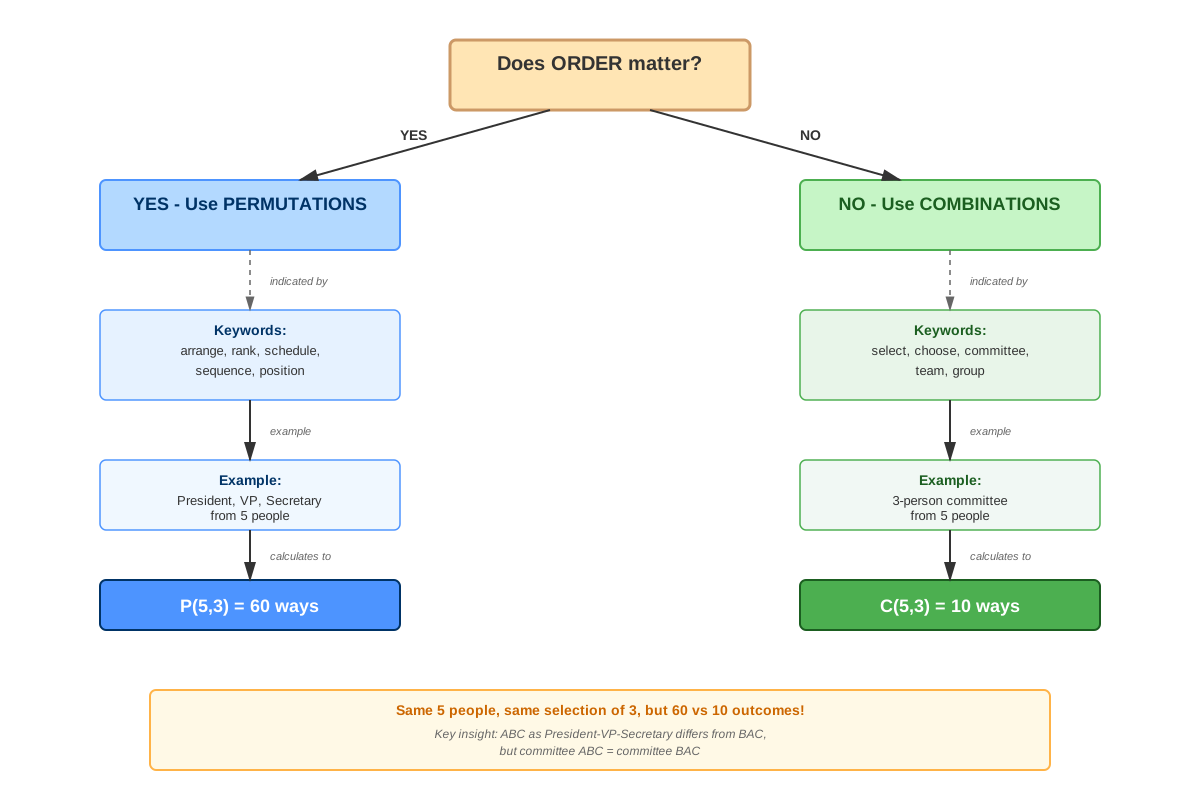
A combination is a selection of items from a larger set where the order of selection does not matter. If you're choosing 3 people from a group of 10 to form a committee, selecting Alice-Bob-Carol produces the same committee as selecting Carol-Alice-Bob. This order-independence distinguishes combinations from permutations.
The standard notation for combinations is C(n,r), nCr, or more formally using binomial coefficient notation: C(n,r) represents the number of ways to choose r items from n total items. The fundamental formula is:
C(n,r) = n! / (r! × (n-r)!)Where n! (n factorial) equals n × (n-1) × (n-2) × ... × 2 × 1. This formula derives from the relationship between permutations and combinations: since permutations count ordered arrangements and combinations don't care about order, we divide the permutation count P(n,r) = n!/(n-r)! by r! to eliminate the ordering within each selection.
Intuitive Understanding Through Examples
Consider selecting 2 letters from the set {A, B, C}. The possible combinations are: AB, AC, and BC. Notice that we don't list BA separately from AB because order doesn't matter—they represent the same selection. This gives us C(3,2) = 3.
Using the formula: C(3,2) = 3! / (2! × 1!) = 6 / (2 × 1) = 3, confirming our count.
The intuition behind the formula becomes clearer when we think about the calculation process: 3! = 6 represents all possible arrangements of 3 items. We divide by (3-2)! = 1! = 1 to account for the item we're not selecting, and by 2! = 2 to eliminate the duplicate orderings within our selection of 2 items.
Key Properties of Combinations
Several mathematical properties make combination calculations more efficient:
Symmetry Property: C(n,r) = C(n, n-r). Choosing 3 items from 10 is equivalent to choosing which 7 items to leave behind. This property often simplifies calculations: C(50,48) = C(50,2) = 1,225, which is much easier to compute.
Boundary Conditions:
- C(n,0) = 1 (there's exactly one way to choose nothing)
- C(n,n) = 1 (there's exactly one way to choose everything)
- C(n,1) = n (there are n ways to choose one item)
Pascal's Identity: C(n,r) = C(n-1,r-1) + C(n-1,r). This recursive relationship shows that the number of ways to choose r items from n equals the sum of: scenarios where a particular item is included (requiring r-1 more from the remaining n-1) plus scenarios where that item is excluded (requiring all r from the remaining n-1).
Calculation Strategies
Rather than computing full factorials, efficient calculation involves strategic cancellation:
For C(8,3) = 8! / (3! × 5!):
- Write out: (8 × 7 × 6 × 5!) / (3! × 5!)
- Cancel 5!: (8 × 7 × 6) / (3!)
- Calculate: (8 × 7 × 6) / 6 = 8 × 7 = 56
This telescoping approach prevents calculator overflow and reduces computational errors. Always expand the larger factorial only until it reaches the smaller factorial in the denominator, then cancel.
Combinations with Constraints
Many GMAT problems impose restrictions on selections. Common constraint types include:
Mandatory Inclusion: "A committee of 5 must include the president." Solution: The president is automatically selected, so choose the remaining 4 from the other available people.
Mandatory Exclusion: "Select 3 people, but Alice and Bob cannot both be chosen." Solution: Use complementary counting—calculate total combinations, then subtract cases where both are selected.
Group-Based Selection: "Choose 2 men and 3 women from 5 men and 6 women." Solution: Calculate C(5,2) × C(6,3) using the multiplication principle, since selections from different groups are independent.
Distinguishing Combinations from Permutations
| Feature | Combinations | Permutations |
|---|---|---|
| Order matters? | No | Yes |
| Formula | n!/(r!(n-r)!) | n!/(n-r)! |
| Example scenario | Selecting committee members | Assigning president, VP, secretary roles |
| Trigger words | "choose," "select," "group," "committee" | "arrange," "order," "sequence," "rank" |
| Relative size | Smaller (divides by r!) | Larger |
The critical distinction: if swapping two items creates a different outcome, use permutations; if swapping creates the same outcome, use combinations.
Concept Relationships
The hierarchy of counting concepts flows logically: Fundamental Counting Principle (multiply outcomes across independent stages) → Permutations (ordered arrangements) → Combinations (unordered selections) → Probability with Combinations (favorable combinations / total combinations).
Combinations connect directly to permutations through the relationship P(n,r) = C(n,r) × r!, showing that permutations equal combinations multiplied by the arrangements within each selection. This relationship proves useful when problems require converting between ordered and unordered counting.
Within combination problems themselves, complex scenarios decompose into simpler components: Basic Combinations → Combinations with Constraints → Multi-Stage Combination Problems → Complementary Counting with Combinations. Each level builds upon previous understanding while adding layers of complexity.
Combinations also enable advanced probability calculations. The probability of drawing specific cards from a deck, selecting defective items from a batch, or forming particular team compositions all rely on combination-based counting. The formula P(event) = C(favorable outcomes) / C(total outcomes) appears repeatedly in GMAT probability questions.
High-Yield Facts
⭐ The combination formula C(n,r) = n!/(r!(n-r)!) calculates unordered selections where order doesn't matter
⭐ C(n,r) = C(n,n-r) allows choosing the easier calculation—always compute the smaller of r or n-r
⭐ Trigger words for combinations include "choose," "select," "committee," "group," and "team"
⭐ When constraints require "at least" or "at most," consider complementary counting (total minus unwanted)
⭐ For selections from multiple distinct groups, multiply the combinations: C(n₁,r₁) × C(n₂,r₂)
- C(n,0) = C(n,n) = 1 and C(n,1) = n are boundary conditions that simplify many problems
- The handshake problem (n people each shake hands once) equals C(n,2) = n(n-1)/2
- Selecting r items from n identical items has only 1 combination (since they're indistinguishable)
- The number of diagonals in an n-sided polygon equals C(n,2) - n (all line segments minus the sides)
- When a problem asks for "different" groups or teams, verify whether ABC and CBA count as one group (combination) or two (permutation)
- Combinations appear in binomial expansion coefficients: (a+b)ⁿ has coefficients C(n,0), C(n,1), ..., C(n,n)
- For large n and small r, approximate C(n,r) ≈ nʳ/r! when n >> r
Quick check — test yourself on Combinations so far.
Try Flashcards →Common Misconceptions
Misconception: C(10,3) means "10 choose 3" equals 10 × 3 = 30 → Correction: The formula requires dividing factorials: C(10,3) = 10!/(3!×7!) = (10×9×8)/(3×2×1) = 120. Simple multiplication doesn't account for the elimination of duplicate orderings.
Misconception: Combinations and permutations are interchangeable terms for counting → Correction: Combinations count unordered selections (ABC = CBA), while permutations count ordered arrangements (ABC ≠ CBA). The distinction is fundamental—combinations always yield smaller or equal counts than permutations for the same n and r.
Misconception: When selecting with constraints, simply subtract the constraint number from the total → Correction: Constraints require careful logical analysis. If "at least 2 women must be on a 5-person committee," you cannot simply subtract 2 from 5. Instead, calculate the sum of valid scenarios: exactly 2 women + exactly 3 women + exactly 4 women + exactly 5 women.
Misconception: C(n,r) works when r > n → Correction: You cannot select more items than exist in the set. When r > n, the combination is undefined (or defined as 0 in some contexts). Always verify that r ≤ n before applying the formula.
Misconception: In "choose 3 from group A and 2 from group B" problems, add the combinations → Correction: Use multiplication, not addition. The total ways equal C(A,3) × C(B,2) because each selection from group A can pair with each selection from group B. Addition would only apply if the problem asked for "3 from A OR 2 from B."
Misconception: The order of operations in the combination formula doesn't matter → Correction: Always simplify by canceling factorials before multiplying large numbers. Computing 20! then dividing causes calculator overflow, while (20×19×18)/(3×2×1) remains manageable. Strategic cancellation is essential for accurate calculation.
Worked Examples
Example 1: Committee Selection with Constraints
Problem: A company has 8 managers (5 men and 3 women) and needs to form a 4-person committee. How many different committees can be formed if the committee must include at least 2 women?
Solution:
Step 1: Identify the problem type
The word "committee" signals combinations (order doesn't matter). The constraint "at least 2 women" requires case-by-case analysis.
Step 2: Break into valid cases
"At least 2 women" means exactly 2 women, exactly 3 women, or exactly 4 women (impossible since only 3 women exist).
Valid cases:
- Exactly 2 women and 2 men
- Exactly 3 women and 1 man
Step 3: Calculate each case
Case 1: 2 women and 2 men
- Ways to choose 2 women from 3: C(3,2) = 3!/(2!×1!) = 3
- Ways to choose 2 men from 5: C(5,2) = 5!/(2!×3!) = (5×4)/(2×1) = 10
- Total for this case: 3 × 10 = 30
Case 2: 3 women and 1 man
- Ways to choose 3 women from 3: C(3,3) = 1
- Ways to choose 1 man from 5: C(5,1) = 5
- Total for this case: 1 × 5 = 5
Step 4: Sum the cases
Total committees with at least 2 women = 30 + 5 = 35
Connection to Learning Objectives: This problem demonstrates identifying combinations (committee selection), explaining the logic (breaking constraints into cases), and applying the formula with the multiplication principle across independent selections.
Example 2: Complementary Counting
Problem: From a standard deck of 52 cards, how many 5-card hands contain at least one ace?
Solution:
Step 1: Recognize complementary counting opportunity
"At least one ace" includes many cases (exactly 1, 2, 3, or 4 aces). The complement—"no aces"—is simpler to calculate.
Step 2: Calculate total possible hands
C(52,5) = 52!/(5!×47!) = (52×51×50×49×48)/(5×4×3×2×1) = 2,598,960
Step 3: Calculate hands with no aces
If no aces are included, we choose 5 cards from the 48 non-ace cards:
C(48,5) = 48!/(5!×43!) = (48×47×46×45×44)/(5×4×3×2×1) = 1,712,304
Step 4: Apply complementary counting
Hands with at least one ace = Total hands - Hands with no aces
= 2,598,960 - 1,712,304 = 886,656
Alternative approach verification: Calculating directly would require:
[C(4,1)×C(48,4)] + [C(4,2)×C(48,3)] + [C(4,3)×C(48,2)] + [C(4,4)×C(48,1)]
This equals 778,320 + 103,776 + 4,512 + 48 = 886,656 ✓
The complementary approach saved significant calculation time—a crucial GMAT strategy.
Connection to Learning Objectives: This example shows advanced application of combinations to GMAT-style questions, demonstrates strategic problem-solving (choosing efficient methods), and illustrates how combinations integrate with probability concepts.
Exam Strategy
When approaching GMAT combinations questions, begin with a three-step identification process: (1) Confirm that order doesn't matter by checking if swapping items creates the same outcome, (2) Identify any constraints or special conditions, (3) Determine whether direct calculation or complementary counting is more efficient.
Trigger words and phrases that signal combination problems include:
- "How many different committees/teams/groups..."
- "In how many ways can we select/choose..."
- "How many combinations..."
- "Different sets of..."
- "Number of possible selections..."
Conversely, watch for permutation triggers that indicate order matters: "arrange," "sequence," "first, second, third," "president, vice-president," or any scenario where positions are distinct.
Process-of-elimination strategies for combination problems:
- Eliminate answers that exceed P(n,r): Since C(n,r) = P(n,r)/r!, combinations are always smaller than or equal to permutations. If an answer choice exceeds n!/(n-r)!, eliminate it.
- Use boundary condition checks: Verify that C(n,0) = 1 and C(n,1) = n. If answer choices violate these, eliminate them.
- Apply symmetry: If computing C(10,8), recognize it equals C(10,2) = 45. Answer choices suggesting different values for these are incorrect.
- Estimate before calculating: For C(20,3), estimate: approximately (20×20×20)/(3×2×1) ≈ 8,000/6 ≈ 1,300. The exact answer is 1,140, but estimation eliminates wildly incorrect choices.
Time allocation: Budget 2-3 minutes for standard combination problems. If a problem requires more than 30 seconds to set up, verify you've chosen the most efficient approach. Complex constraint problems may justify 3-4 minutes, but if you're not making progress after 2 minutes, mark for review and move forward.
Data Sufficiency specific tips: For combination DS questions, determine what information you need: (1) the total number of items (n), (2) the number being selected (r), and (3) any constraints. Often, Statement 1 provides n while Statement 2 provides r, making the answer C (both together sufficient).
Memory Techniques
Mnemonic for Combination Formula: "Nancy Really Reads Novels Regularly" maps to n! / (r! × (n-r)!)
- Nancy = n! (numerator)
- Really Reads = r! (first denominator term)
- Novels Regularly = (n-r)! (second denominator term)
Visualization Strategy: Picture a lineup of people. For permutations, they're standing in numbered positions (order matters). For combinations, they're sitting in a circle where no position is special (order doesn't matter). This mental image helps distinguish the two concepts.
Acronym for Problem-Solving Steps: DICE
- Distinguish: Is this combinations or permutations?
- Identify: What are n and r? Any constraints?
- Calculate: Apply formula with strategic cancellation
- Evaluate: Does the answer make logical sense?
Symmetry Reminder: "Choose the smaller, save the timer" reminds you to use C(n,r) = C(n,n-r) and always calculate with the smaller value.
Constraint Categories: "MIG" helps remember constraint types:
- Mandatory inclusion (someone must be selected)
- Incompatible pairs (certain people can't both be selected)
- Group requirements (need specific numbers from different categories)
Summary
Combinations represent a fundamental counting technique for calculating the number of ways to select items from a larger set when order doesn't matter. The formula C(n,r) = n!/(r!(n-r)!) provides the mathematical foundation, but successful GMAT performance requires recognizing when to apply combinations versus permutations, efficiently calculating values through strategic cancellation, and handling constraints through case analysis or complementary counting. The symmetry property C(n,r) = C(n,n-r) enables computational shortcuts, while the multiplication principle allows combining selections from multiple independent groups. GMAT questions test combinations through committee formation, team selection, probability calculations, and geometric counting problems, often embedding constraints that require careful logical analysis. Mastery involves not just formula application but strategic problem recognition, efficient calculation methods, and the ability to verify answers through estimation and logical reasoning. Students who internalize the distinction between ordered and unordered counting, practice constraint-based problems, and develop fluency with complementary counting techniques position themselves to handle the full spectrum of combination questions that appear on the GMAT.
Key Takeaways
- Combinations count unordered selections where choosing ABC is identical to choosing CBA, distinguishing them from permutations where order matters
- The formula C(n,r) = n!/(r!(n-r)!) calculates combinations, but efficient computation requires strategic cancellation rather than computing full factorials
- Symmetry property C(n,r) = C(n,n-r) allows choosing the easier calculation path—always compute using the smaller of r or n-r
- Constraint problems require systematic case analysis or complementary counting (total minus unwanted) rather than simple subtraction
- Trigger words like "committee," "select," "choose," and "group" signal combination problems, while "arrange," "order," and "sequence" indicate permutations
- Multiple independent selections multiply: choosing 2 from group A and 3 from group B equals C(A,2) × C(B,3)
- Estimation and boundary conditions (C(n,0)=1, C(n,1)=n) provide quick verification of answers and enable process-of-elimination strategies
Related Topics
Permutations: Understanding ordered arrangements builds directly on combination knowledge, with the relationship P(n,r) = C(n,r) × r! connecting the concepts. Mastering combinations makes permutation problems more intuitive.
Probability with Combinations: Many probability questions require calculating favorable outcomes using combinations divided by total outcomes using combinations, making this a natural next step after mastering basic combination calculations.
Binomial Probability: The binomial probability formula incorporates combinations as coefficients, representing the number of ways to achieve exactly k successes in n trials. This advanced topic becomes accessible after combination mastery.
Counting with Restrictions: More complex counting problems involve multiple constraint types, inclusion-exclusion principles, and multi-stage analysis—all building on the foundation of basic combinations.
Pascal's Triangle and Binomial Theorem: The coefficients in binomial expansions are combinations, and Pascal's Triangle provides a visual representation of combination relationships, offering deeper mathematical insight.
Practice CTA
Now that you've built a comprehensive understanding of combinations, it's time to cement your knowledge through active practice. Attempt the practice questions to test your ability to recognize combination scenarios, apply the formula efficiently, and handle constraint-based problems. Use the flashcards to reinforce key formulas, properties, and distinction criteria between combinations and permutations. Remember: mastery comes not from passive reading but from actively working through problems, making mistakes, and refining your approach. Each practice problem you solve strengthens your pattern recognition and builds the confidence you need to tackle any combination question the GMAT presents. You've invested the time to understand the concepts—now invest the effort to make them automatic through deliberate practice!
Sign up free to keep reading
Create a free AnvayaPrep account to finish this GMAT guide on Combinations — plus flashcards and practice questions.