Overview
Permutations represent one of the fundamental counting principles tested extensively on the GMAT Quantitative Reasoning section. At its core, a permutation is an arrangement of objects in a specific order, where the sequence matters. Understanding permutations enables test-takers to solve complex counting problems that appear in various forms throughout the exam, from straightforward arrangement questions to sophisticated probability scenarios. The ability to recognize when order matters—and to calculate the number of possible arrangements efficiently—is a critical skill that distinguishes high-scoring candidates from average performers.
The GMAT frequently tests permutations within the broader context of combinatorics, probability, and logical reasoning. Questions may ask candidates to determine how many ways a committee can be arranged in specific seats, how many different passwords can be created with certain constraints, or how many unique sequences can be formed from a set of letters or numbers. These problems require not only computational accuracy but also the conceptual understanding of when to apply permutation formulas versus other counting methods. The topic integrates seamlessly with probability calculations, as many probability questions require determining favorable outcomes using permutation principles.
Within the Quantitative Reasoning framework, permutations serve as a bridge between basic arithmetic operations and advanced problem-solving strategies. They connect directly to factorial notation, multiplication principles, and combinatorial analysis. Mastering GMAT permutations provides the foundation for tackling more complex topics like combinations, probability distributions, and multi-stage counting problems. The strategic importance of this topic cannot be overstated—permutation questions appear regularly on the GMAT, and the underlying principles apply to numerous other question types throughout the exam.
Learning Objectives
- [ ] Identify permutations in GMAT problem scenarios
- [ ] Explain permutations and distinguish them from other counting methods
- [ ] Apply permutations to GMAT questions with accuracy and efficiency
- [ ] Calculate permutations with and without repetition using appropriate formulas
- [ ] Solve permutation problems involving restrictions and constraints
- [ ] Recognize when to use permutations versus combinations in mixed counting problems
- [ ] Apply circular permutation principles to specialized arrangement scenarios
Prerequisites
- Factorial notation and computation: Understanding n! (n factorial) is essential because permutation formulas are built on factorial expressions
- Basic multiplication principle: The fundamental counting principle underlies all permutation calculations and provides the logical foundation for arrangement problems
- Set theory fundamentals: Recognizing distinct versus identical elements within a set is crucial for determining which permutation formula to apply
- Order of operations: Accurate calculation of permutation expressions requires proper sequencing of mathematical operations, particularly with factorials and division
Why This Topic Matters
Permutations appear in everyday decision-making scenarios far beyond standardized testing. Businesses use permutation principles to optimize scheduling, create unique product codes, analyze security protocols, and design experiments. In technology, permutations underpin encryption algorithms, password security systems, and data structure optimization. Understanding how many ways elements can be arranged helps professionals make informed decisions about resource allocation, risk assessment, and strategic planning.
On the GMAT specifically, permutation questions appear in approximately 10-15% of Quantitative Reasoning sections, making them a high-yield topic for focused study. These questions typically appear as Problem Solving items worth one point each, though the underlying principles also support Data Sufficiency questions involving probability and counting. The GMAT tests permutations both directly—asking explicitly for the number of arrangements—and indirectly, embedding permutation logic within word problems about scheduling, seating, or sequencing scenarios.
Common GMAT question formats include: arranging people in a line or around a table, forming numbers from a set of digits with specific constraints, creating passwords or codes with restrictions, determining the number of ways to assign tasks or positions, and calculating probabilities that require counting favorable arrangements. The exam frequently adds complexity through restrictions such as "certain items must be adjacent," "specific positions must be filled by particular elements," or "some elements are identical." Recognizing these patterns and applying the appropriate permutation strategy is essential for efficient problem-solving under time pressure.
Core Concepts
Fundamental Definition of Permutations
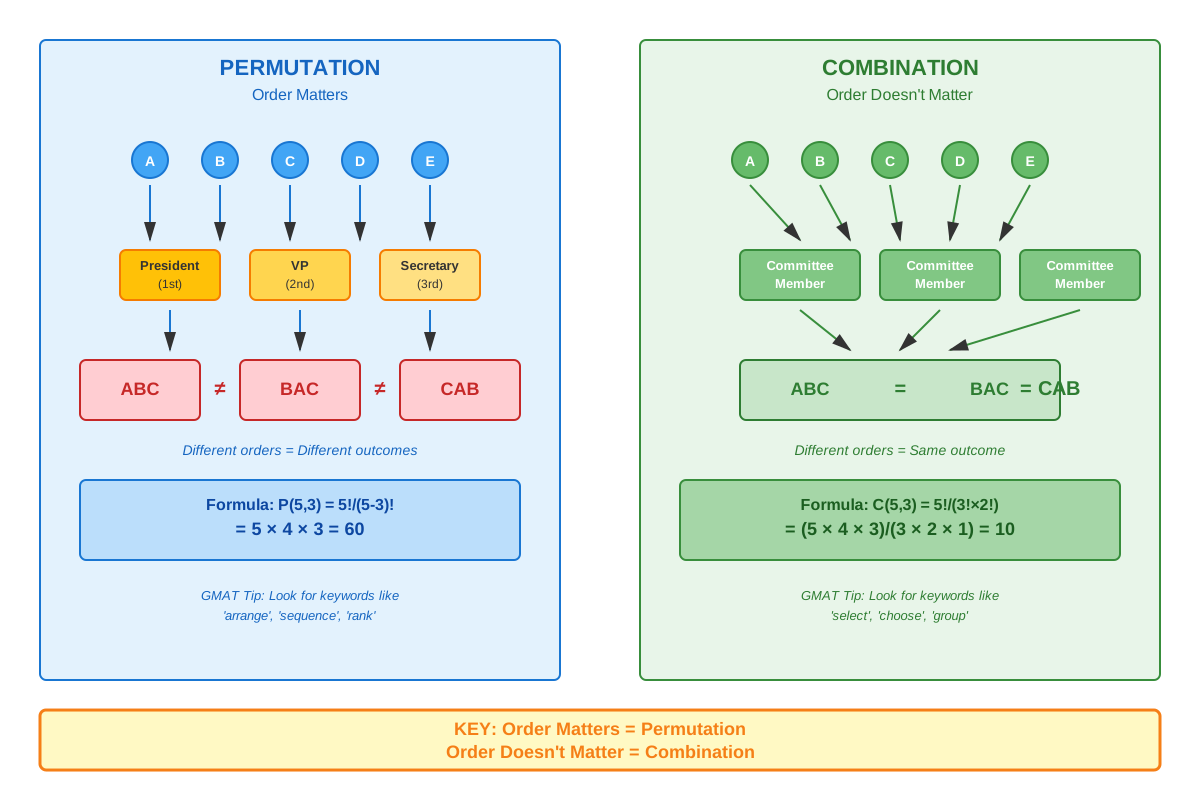
A permutation is an ordered arrangement of objects selected from a set, where the sequence of selection matters. The key distinguishing feature of permutations is that changing the order of elements creates a different permutation. For example, the arrangements ABC, ACB, BAC, BCA, CAB, and CBA are six distinct permutations of the three letters A, B, and C. This contrasts with combinations, where order does not matter and ABC would be considered identical to BAC.
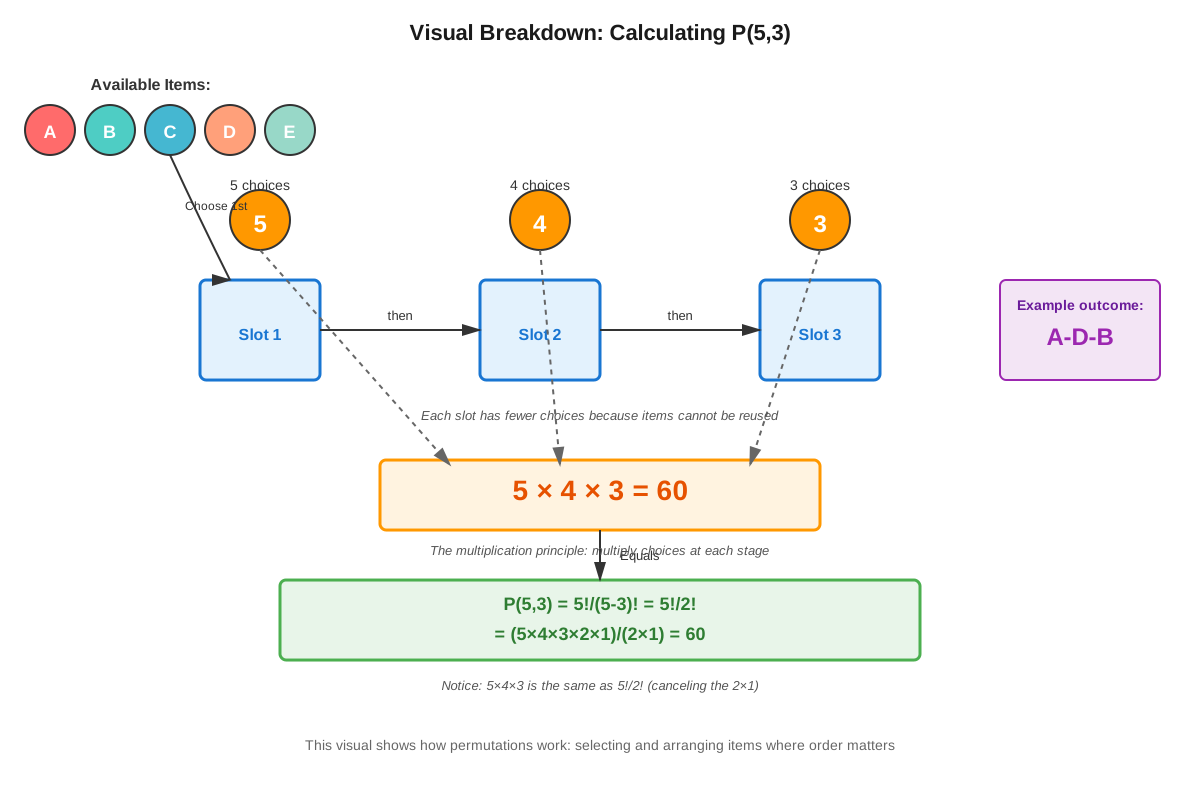
The fundamental principle underlying permutations is the multiplication principle: if one event can occur in m ways and a second independent event can occur in n ways, then both events together can occur in m × n ways. This principle extends to any number of sequential choices, forming the basis for all permutation calculations.
Basic Permutation Formula
The number of permutations of n distinct objects taken r at a time is denoted as P(n,r), nPr, or sometimes ₙPᵣ. The formula is:
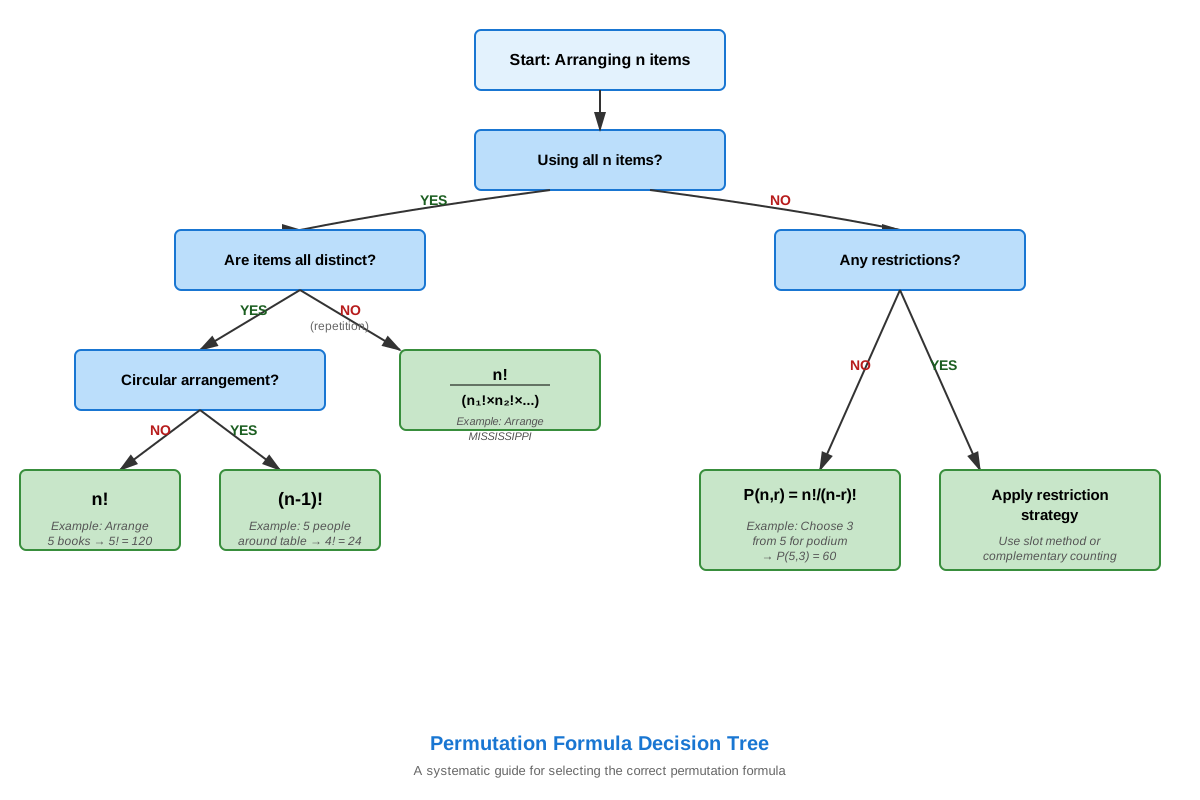
P(n,r) = n!/(n-r)!Where n! (n factorial) equals n × (n-1) × (n-2) × ... × 2 × 1, and represents the product of all positive integers from n down to 1. This formula calculates how many ways we can select and arrange r objects from a set of n distinct objects.
Example: How many ways can we arrange 3 books selected from a shelf of 7 different books?
P(7,3) = 7!/(7-3)! = 7!/4! = (7×6×5×4!)/(4!) = 7×6×5 = 210The calculation simplifies because the (n-r)! in the denominator cancels with the corresponding terms in the numerator, leaving only the first r terms of n!.
Permutations of All Objects
When arranging all n objects from a set (where r = n), the formula simplifies to:
P(n,n) = n!/0! = n!Since 0! is defined as 1, the number of ways to arrange n distinct objects in a sequence is simply n!. This represents the total number of ways to order all elements without leaving any out.
Example: How many ways can 5 people stand in a line?
P(5,5) = 5! = 5×4×3×2×1 = 120This calculation reflects that the first position has 5 choices, the second position has 4 remaining choices, the third has 3, and so on, multiplying to give 120 total arrangements.
Permutations with Repetition
When some objects in the set are identical, the standard permutation formula overcounts because swapping identical items doesn't create a new arrangement. The formula for permutations with repetition is:
n!/(n₁! × n₂! × ... × nₖ!)Where n is the total number of objects, and n₁, n₂, ..., nₖ are the frequencies of each type of identical object.
Example: How many distinct arrangements can be made from the letters in MISSISSIPPI?
The word has 11 letters total: M(1), I(4), S(4), P(2)
11!/(1! × 4! × 4! × 2!) = 39,916,800/(1 × 24 × 24 × 2) = 34,650Permutations with Restrictions
Many GMAT problems impose constraints on arrangements, requiring modified approaches:
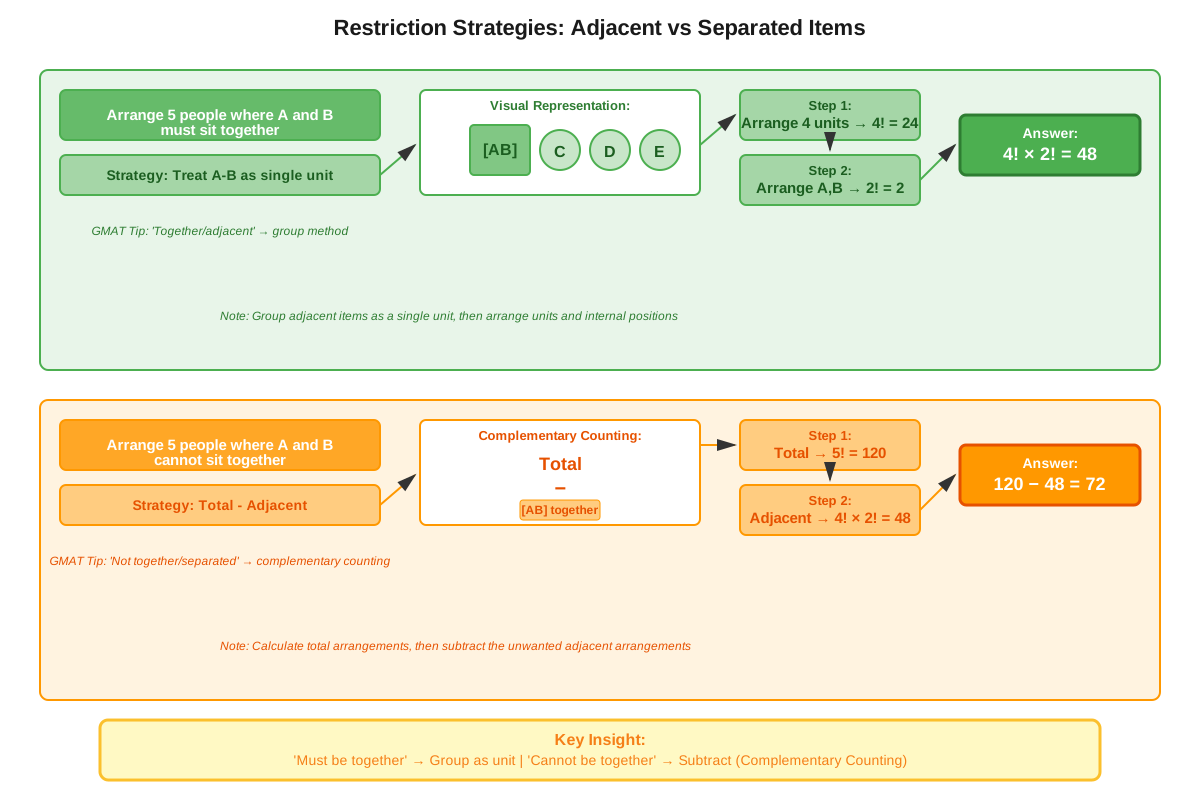
Adjacent elements: When certain objects must be together, treat them as a single unit. Calculate permutations of the units, then multiply by the internal permutations of the grouped elements.
Fixed positions: When specific objects must occupy certain positions, fill those positions first, then calculate permutations for the remaining objects in remaining positions.
Exclusion constraints: When certain objects cannot be in specific positions, use complementary counting (total arrangements minus restricted arrangements) or systematic case analysis.
Circular Permutations
When objects are arranged in a circle rather than a line, rotations that look identical are counted as one arrangement. The formula for circular permutations of n distinct objects is:
(n-1)!This accounts for the fact that rotating all elements one position clockwise produces the same circular arrangement. Fix one object's position as a reference point, then arrange the remaining (n-1) objects.
Example: How many ways can 6 people sit around a circular table?
(6-1)! = 5! = 120If reflections are also considered identical (as with a bracelet that can be flipped), divide by 2: (n-1)!/2.
Comparison Table
| Feature | Permutations | Combinations |
|---|---|---|
| Order matters | Yes | No |
| Formula | n!/(n-r)! | n!/[r!(n-r)!] |
| Example | ABC ≠ BAC | ABC = BAC |
| Typical keywords | Arrange, order, sequence, schedule | Select, choose, group, committee |
| Result magnitude | Larger values | Smaller values |
Concept Relationships
The hierarchy of permutation concepts builds systematically from foundational principles to complex applications. Factorial notation serves as the mathematical foundation → enabling calculation of basic permutations → which extend to permutations with selection (choosing r from n) → leading to specialized cases like permutations with repetition and circular permutations. Each concept layer adds complexity while maintaining the core principle that order matters.
Permutations connect directly to prerequisite knowledge of the multiplication principle, which provides the logical justification for why we multiply choices at each stage. The relationship to combinations is particularly important: permutations equal combinations multiplied by the arrangements of selected items (P(n,r) = C(n,r) × r!). This relationship helps students understand when order matters and when it doesn't.
Within probability problems, permutations often calculate the denominator (total possible outcomes) or numerator (favorable outcomes) of probability fractions. The connection flows: permutations → determine sample space size → enable probability calculations. Similarly, permutations with restrictions connect to logical reasoning and constraint satisfaction, requiring systematic case analysis and complementary counting strategies that appear throughout GMAT problem-solving.
Quick check — test yourself on Permutations so far.
Try Flashcards →High-Yield Facts
- ⭐ The fundamental permutation formula is P(n,r) = n!/(n-r)!, representing arrangements of r objects from n distinct objects
- ⭐ When order matters, use permutations; when order doesn't matter, use combinations
- ⭐ Permutations of n distinct objects in a complete arrangement equals n!
- ⭐ For circular arrangements, use (n-1)! to account for rotational equivalence
- ⭐ With identical objects, divide by the factorial of each group's size: n!/(n₁! × n₂! × ... × nₖ!)
- The value of 0! is defined as 1, which makes the formula P(n,n) = n! work correctly
- Permutations always yield larger numbers than combinations for the same n and r values
- When objects must be adjacent, treat them as a single unit and multiply by internal arrangements
- For restrictions on specific positions, fill constrained positions first, then arrange remaining objects
- The relationship P(n,r) = C(n,r) × r! connects permutations and combinations mathematically
- Complementary counting (total minus restricted) often simplifies complex restriction problems
- Sequential decision-making problems typically involve permutation logic even without explicit counting language
- The number of permutations decreases when identical elements are present because swapping identical items doesn't create new arrangements
- For passwords or codes with specific character requirements, multiply permutations of each character type
- Permutation problems often disguise themselves as scheduling, seating, or sequencing scenarios
Common Misconceptions
Misconception: Permutations and combinations are interchangeable terms for counting arrangements.
Correction: Permutations count ordered arrangements where sequence matters (ABC ≠ BAC), while combinations count unordered selections where sequence doesn't matter (ABC = BAC). The GMAT specifically tests the ability to distinguish between these concepts.
Misconception: The formula n! always gives the number of arrangements for any permutation problem.
Correction: The formula n! only applies when arranging all n distinct objects in a line. For selecting r objects from n, use P(n,r) = n!/(n-r)!. For circular arrangements, use (n-1)!. For identical objects, divide by the factorials of repetition frequencies.
Misconception: When some objects must be adjacent, simply multiply the total arrangements by the probability they'll be together.
Correction: Treat adjacent objects as a single unit, calculate arrangements of the units, then multiply by the internal arrangements of the grouped objects. For example, if 2 specific people among 5 must sit together: treat them as 1 unit, giving 4! arrangements of units, then multiply by 2! internal arrangements = 4! × 2! = 48.
Misconception: Circular permutations use the same formula as linear permutations.
Correction: Circular permutations use (n-1)! because rotations are considered identical. Fix one object's position as a reference point, then arrange the remaining objects. This prevents counting rotations as different arrangements.
Misconception: In permutations with repetition, you can ignore the identical objects and just use n!.
Correction: Identical objects create overcounting because swapping them doesn't produce a new arrangement. You must divide n! by the factorial of each group of identical objects. For MISSISSIPPI with 4 I's and 4 S's, dividing by 4! × 4! corrects the overcount.
Misconception: When calculating P(n,r), you must compute the full factorials before dividing.
Correction: Simplify by canceling the (n-r)! terms: P(n,r) = n!/(n-r)! = n×(n-1)×(n-2)×...×(n-r+1), which is just the first r terms of n! multiplied together. This saves significant calculation time on the GMAT.
Worked Examples
Example 1: Basic Permutation with Selection
Problem: A company needs to assign 4 different employees to 4 different international offices in London, Tokyo, Sydney, and New York. However, they have 7 qualified employees to choose from. How many different assignment arrangements are possible?
Solution:
Step 1: Identify the problem type. We're selecting 4 employees from 7 AND arranging them in specific offices. Since each office is distinct and which employee goes to which office matters, this is a permutation problem.
Step 2: Identify n and r. We have n = 7 employees and we're selecting and arranging r = 4 of them.
Step 3: Apply the permutation formula:
P(7,4) = 7!/(7-4)! = 7!/3!Step 4: Calculate efficiently by canceling:
P(7,4) = (7×6×5×4×3!)/(3!) = 7×6×5×4 = 840Step 5: Verify the logic. The first office has 7 choices, the second has 6 remaining choices, the third has 5, and the fourth has 4, giving 7×6×5×4 = 840.
Answer: 840 different assignment arrangements are possible.
Connection to learning objectives: This example demonstrates identifying a permutation scenario (order matters because offices are distinct), explaining why the permutation formula applies (selection with arrangement), and applying the formula accurately to a GMAT-style business context.
Example 2: Permutation with Restrictions
Problem: Seven people (A, B, C, D, E, F, G) need to stand in a line for a photograph. However, persons A and B are siblings and insist on standing next to each other. How many different arrangements are possible?
Solution:
Step 1: Recognize the restriction. A and B must be adjacent, which is a common GMAT constraint pattern.
Step 2: Apply the "treat as a unit" strategy. Consider A and B as a single unit [AB]. Now we have 6 units to arrange: [AB], C, D, E, F, G.
Step 3: Calculate arrangements of the 6 units:
6! = 720Step 4: Calculate internal arrangements of the unit. Within [AB], A and B can be arranged in 2! = 2 ways (AB or BA).
Step 5: Apply the multiplication principle:
Total arrangements = 6! × 2! = 720 × 2 = 1,440Step 6: Verify with alternative approach (complementary counting):
- Total arrangements without restriction: 7! = 5,040
- Arrangements where A and B are NOT adjacent: 5,040 - 1,440 = 3,600
- This confirms our answer of 1,440 for adjacent arrangements
Answer: 1,440 different arrangements are possible with A and B standing together.
Connection to learning objectives: This example shows how to identify permutation problems with constraints, apply specialized strategies for restrictions, and verify answers using complementary counting—all essential skills for GMAT permutation questions.
Exam Strategy
When approaching GMAT permutations questions, begin by identifying whether order matters. Look for trigger words like "arrange," "schedule," "assign," "sequence," "order," or "position"—these signal permutation problems. Contrast these with "select," "choose," or "committee," which typically indicate combinations. The GMAT often tests whether students can distinguish between these scenarios.
Develop a systematic approach: (1) Determine if it's a permutation or combination problem, (2) Identify any restrictions or constraints, (3) Choose the appropriate formula or strategy, (4) Calculate efficiently using cancellation, (5) Verify the answer makes logical sense. For complex problems, consider whether complementary counting (total minus restricted) might be simpler than direct calculation.
For restriction problems, recognize common patterns: adjacent elements (treat as a unit), fixed positions (fill constrained spots first), exclusions (use complementary counting), and identical elements (divide by repetition factorials). The GMAT frequently combines multiple restrictions in a single problem, requiring sequential application of strategies.
Time management is crucial. Simple permutation calculations should take 30-45 seconds, while complex restriction problems may require 90-120 seconds. If a problem seems to require extensive calculation, look for a shortcut or pattern. The GMAT rarely requires computing factorials larger than 7! or 8!, so if your calculation involves 10! or larger, reconsider your approach.
Process of elimination works well for permutation questions. If answer choices vary by orders of magnitude, estimate rather than calculate exactly. For example, if choosing between 120, 360, 720, and 2,520, recognize these as 5!, 6!/2, 6!, and 7! respectively, and match to your problem structure. Wrong answers often result from using n! instead of P(n,r), forgetting to account for restrictions, or confusing permutations with combinations.
Exam Tip: When you see identical elements, immediately think "divide by factorials of repetitions." When you see "adjacent" or "together," immediately think "treat as a unit." These pattern recognitions save valuable time.
Memory Techniques
Mnemonic for Permutation vs. Combination: "Permutation = Position matters" and "Combination = Choosing without order." The matching first letters help distinguish the concepts.
Formula Memory Device: Remember P(n,r) as "Pick n things, range them in r spots" = n!/(n-r)!. The denominator removes the "leftover" items you didn't pick.
Circular Permutation Reminder: "Circle = Cut one" → (n-1)!. Visualize cutting a circular arrangement at one point to make it linear, fixing one position as a reference.
Restriction Strategy Acronym - FUDGE:
- Fix constrained positions first
- Unit adjacent elements together
- Divide by repetition factorials
- Go complementary (total minus restricted)
- Enumerate cases if necessary
Visualization for Adjacent Elements: Picture adjacent people as "glued together" or in a box. This mental image reinforces treating them as a single unit.
Factorial Recall: Memorize factorials up to 7! for quick reference:
- 3! = 6
- 4! = 24
- 5! = 120
- 6! = 720
- 7! = 5,040
Recognizing these values in answer choices helps verify calculations quickly.
Summary
Permutations represent ordered arrangements where sequence matters, forming a critical component of GMAT Quantitative Reasoning. The fundamental formula P(n,r) = n!/(n-r)! calculates arrangements of r objects selected from n distinct objects, while n! gives arrangements of all n objects. Circular permutations use (n-1)! to account for rotational equivalence, and permutations with identical elements require dividing by the factorial of each repetition group. GMAT questions frequently add restrictions such as adjacent elements (treat as a unit and multiply by internal arrangements), fixed positions (fill constraints first), or exclusions (use complementary counting). Success requires distinguishing permutations from combinations by recognizing whether order matters, applying appropriate formulas efficiently, and employing strategic shortcuts for complex constraints. The multiplication principle underlies all permutation logic, connecting sequential choices through multiplication. Mastering these concepts, formulas, and strategies enables confident, accurate solutions to the 10-15% of GMAT Quantitative questions involving permutation principles.
Key Takeaways
- Permutations count ordered arrangements where sequence matters; use P(n,r) = n!/(n-r)! for selecting and arranging r objects from n distinct objects
- Distinguish permutations from combinations by identifying whether order matters in the problem context—trigger words like "arrange," "schedule," and "assign" signal permutations
- For circular arrangements, use (n-1)! to account for rotational equivalence by fixing one position as a reference point
- When objects must be adjacent, treat them as a single unit, calculate arrangements of units, then multiply by internal arrangements of the grouped elements
- With identical objects, divide n! by the factorial of each repetition group to correct for overcounting: n!/(n₁! × n₂! × ... × nₖ!)
- Apply systematic problem-solving: identify the type, recognize restrictions, choose the appropriate formula, calculate efficiently, and verify logically
- Complementary counting (total arrangements minus restricted arrangements) often provides a simpler path for complex restriction problems
Related Topics
Combinations: While permutations count ordered arrangements, combinations count unordered selections. Mastering permutations provides the foundation for understanding the relationship P(n,r) = C(n,r) × r! and knowing when to apply each counting method. This is essential for comprehensive GMAT combinatorics mastery.
Probability: Many probability problems require permutation calculations to determine sample space size or count favorable outcomes. Understanding permutations enables solving complex probability questions involving arrangements, sequences, and conditional scenarios.
Factorial Properties and Simplification: Deeper exploration of factorial notation, including simplification techniques, factorial division, and computational shortcuts, builds efficiency in permutation calculations and extends to other mathematical topics.
Combinatorics and Advanced Counting: Permutations form one component of broader combinatorial analysis, which includes combinations, the multiplication and addition principles, inclusion-exclusion, and the pigeonhole principle—all valuable for GMAT problem-solving.
Probability Distributions: Understanding how to count arrangements through permutations provides the foundation for analyzing probability distributions, expected values, and statistical reasoning that appears in advanced GMAT questions.
Practice CTA
Now that you've mastered the core concepts, formulas, and strategies for permutations, it's time to solidify your understanding through active practice. Attempt the practice questions designed specifically for this topic, focusing on applying the systematic approach outlined in this guide. Use the flashcards to reinforce formula recall and pattern recognition until identifying permutation scenarios becomes automatic. Remember, the GMAT rewards not just knowledge but efficient application under time pressure—practice transforms understanding into performance. Each problem you solve strengthens your pattern recognition and builds the confidence needed to tackle any permutation question on test day. You've built a strong foundation; now make it unshakeable through deliberate practice.
Sign up free to keep reading
Create a free AnvayaPrep account to finish this GMAT guide on Permutations — plus flashcards and practice questions.