Overview
Conditional probability is one of the most powerful and frequently tested concepts in GMAT Quantitative Reasoning. It addresses the fundamental question: "How does the probability of an event change when we know that another event has already occurred?" This concept moves beyond simple probability calculations by incorporating additional information that restricts or modifies the sample space. Understanding conditional probability is essential for solving complex probability problems that involve dependent events, sequential outcomes, and situations where prior knowledge affects future outcomes.
On the GMAT, gmat conditional probability questions appear regularly in both Problem Solving and Data Sufficiency formats, often disguised within word problems involving cards, dice, quality control scenarios, or demographic data. These questions test not only computational skills but also logical reasoning and the ability to properly interpret "given that" language. Mastering conditional probability enables test-takers to tackle multi-stage probability problems, understand independence versus dependence, and apply Bayes' theorem concepts—all of which are high-value skills for achieving top Quantitative scores.
Conditional probability serves as a bridge between basic probability theory and more advanced statistical reasoning. It connects directly to concepts like independent events, compound probability, and combinatorics, while also laying groundwork for understanding expected value and probability distributions. The ability to recognize when and how to apply conditional probability formulas distinguishes strong GMAT performers from average test-takers, making this a critical topic for focused study and practice.
Learning Objectives
- [ ] Identify conditional probability situations in GMAT problem statements
- [ ] Explain conditional probability using proper mathematical notation and language
- [ ] Apply conditional probability formulas to solve GMAT questions accurately
- [ ] Distinguish between independent and dependent events using conditional probability
- [ ] Calculate conditional probabilities using both formula-based and intuitive counting methods
- [ ] Recognize when additional information changes the sample space and affects probability calculations
Prerequisites
- Basic probability concepts: Understanding sample spaces, outcomes, and the fundamental probability formula P(event) = favorable outcomes / total outcomes is essential for building conditional probability knowledge
- Set theory and Venn diagrams: Familiarity with intersections, unions, and complements helps visualize conditional probability relationships
- Fractions and ratios: Conditional probability calculations frequently involve fraction manipulation and simplification
- Combinatorics fundamentals: Counting techniques support the calculation of favorable and total outcomes in conditional scenarios
Why This Topic Matters
Conditional probability appears in approximately 10-15% of GMAT Quantitative Reasoning questions, making it a high-yield topic for score improvement. These questions typically appear at medium to high difficulty levels (600-750 score range), meaning they serve as differentiators for competitive scores. The GMAT tests conditional probability through various contexts: quality control scenarios, card and dice problems, demographic surveys, medical testing accuracy, and business decision-making situations.
In real-world applications, conditional probability underpins critical thinking in business analytics, risk assessment, medical diagnosis, quality control, and strategic decision-making. Business professionals use conditional probability daily when evaluating market research data ("What's the probability a customer will purchase given they clicked the ad?"), assessing project risks, or interpreting financial indicators. This practical relevance makes conditional probability not just an exam topic but a fundamental reasoning tool for MBA candidates.
On the GMAT, conditional probability questions commonly appear as: (1) word problems requiring identification of "given" conditions, (2) two-way table or matrix problems, (3) sequential event problems where earlier outcomes affect later probabilities, (4) Data Sufficiency questions testing whether information is sufficient to determine conditional probabilities, and (5) problems combining conditional probability with other concepts like expected value or combinatorics.
Core Concepts
Definition and Notation
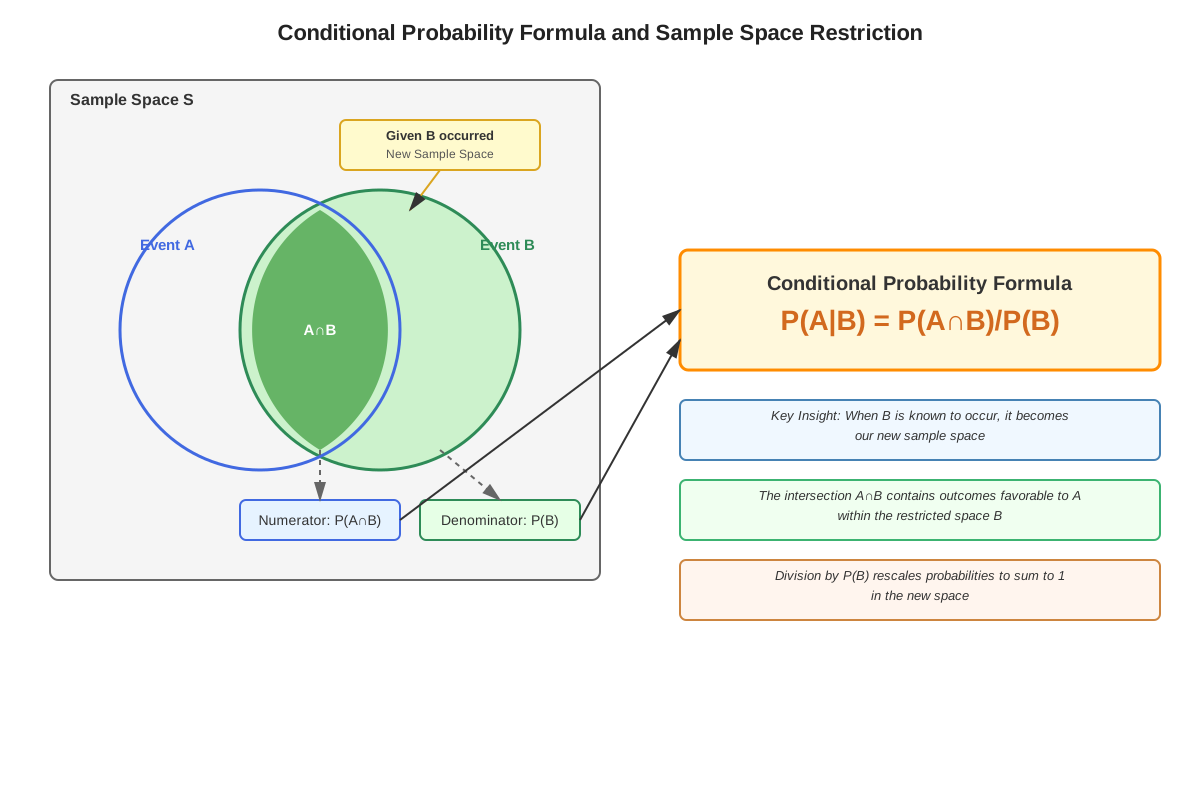
Conditional probability measures the probability of event A occurring given that event B has already occurred. The standard notation is P(A|B), read as "the probability of A given B." This represents a fundamental shift from asking "What's the probability of A?" to "What's the probability of A, knowing that B happened?"
The formal definition uses the formula:
P(A|B) = P(A ∩ B) / P(B), where P(B) > 0This formula states that the conditional probability of A given B equals the probability of both A and B occurring together, divided by the probability of B. The denominator P(B) effectively "rescales" the sample space to only include outcomes where B occurs.
Understanding the Sample Space Restriction
The key insight in conditional probability is that knowing B has occurred restricts the sample space. Instead of considering all possible outcomes, we only consider outcomes where B is true. This restriction is what changes the probability.
For example, consider rolling a fair six-sided die. The probability of rolling a 4 is 1/6. However, if someone tells you "the roll was an even number," the sample space shrinks from {1, 2, 3, 4, 5, 6} to {2, 4, 6}. Now the probability of rolling a 4 given it's even becomes 1/3, not 1/6. The additional information fundamentally changed the calculation.
The Multiplication Rule
Rearranging the conditional probability formula yields the multiplication rule:
P(A ∩ B) = P(A|B) × P(B) = P(B|A) × P(A)This rule is invaluable for calculating the probability of two events both occurring, especially in sequential scenarios. If you know the probability of the first event and the conditional probability of the second given the first, you can find their joint probability.
Independence and Conditional Probability
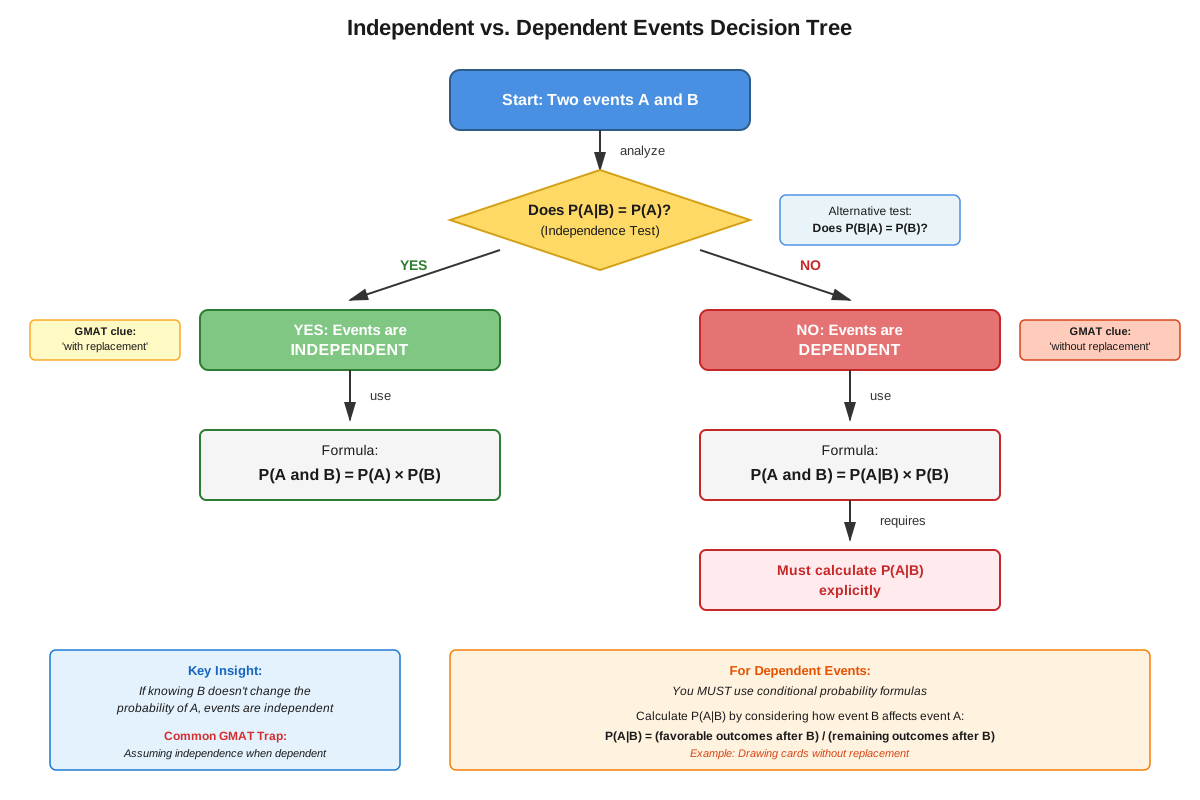
Two events A and B are independent if and only if P(A|B) = P(A). In other words, knowing B occurred doesn't change the probability of A. For independent events, the multiplication rule simplifies to:
P(A ∩ B) = P(A) × P(B)Testing for independence using conditional probability is a common GMAT task. If P(A|B) ≠ P(A), the events are dependent, meaning one event's occurrence affects the other's probability.
Two-Way Tables and Conditional Probability
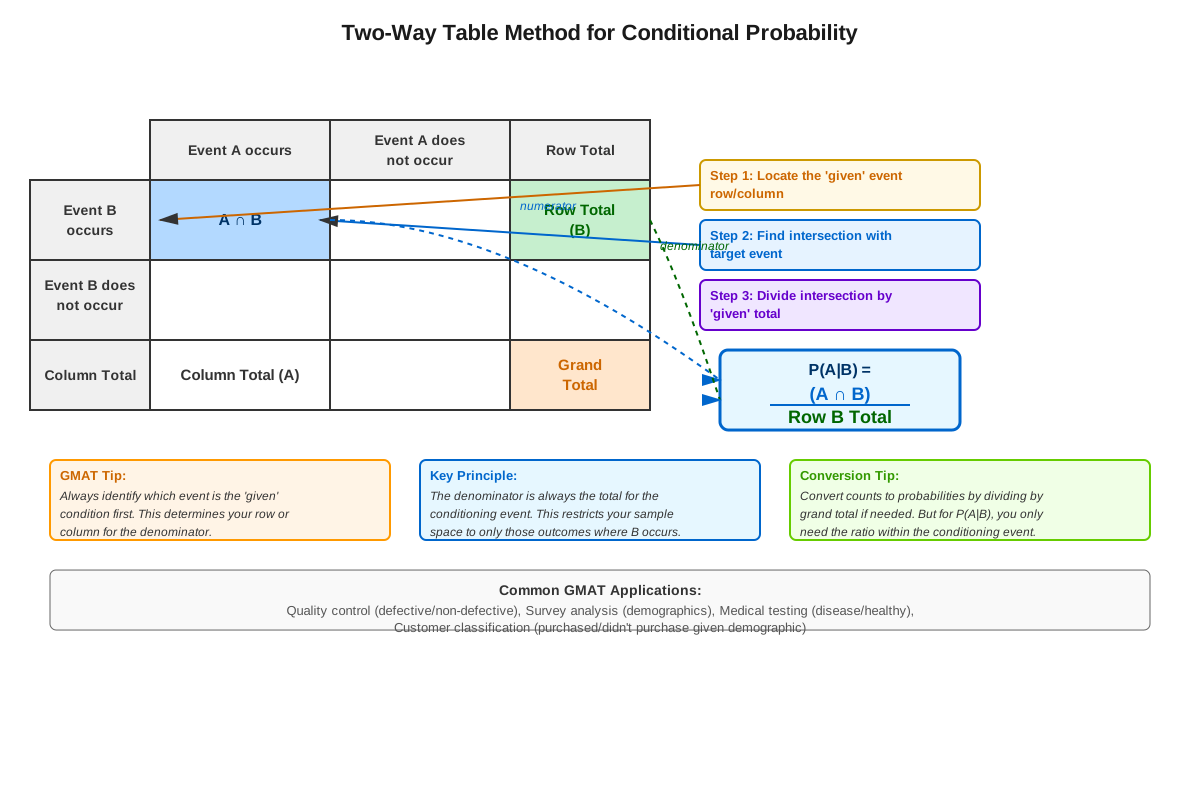
GMAT questions frequently present data in two-way tables (contingency tables). These tables organize information about two categorical variables, making conditional probability calculations straightforward through counting.
| Event B | Event B' | Total | |
|---|---|---|---|
| Event A | 30 | 20 | 50 |
| Event A' | 10 | 40 | 50 |
| Total | 40 | 60 | 100 |
To find P(A|B) from this table: focus only on the "Event B" column (40 total outcomes where B occurred), then count how many of those also have A (30 outcomes). Thus P(A|B) = 30/40 = 3/4.
Complement Rule for Conditional Probability
The complement rule applies to conditional probability:
P(A'|B) = 1 - P(A|B)This is useful when it's easier to calculate the probability of an event NOT happening given a condition, then subtract from 1.
Sequential Events and Tree Diagrams
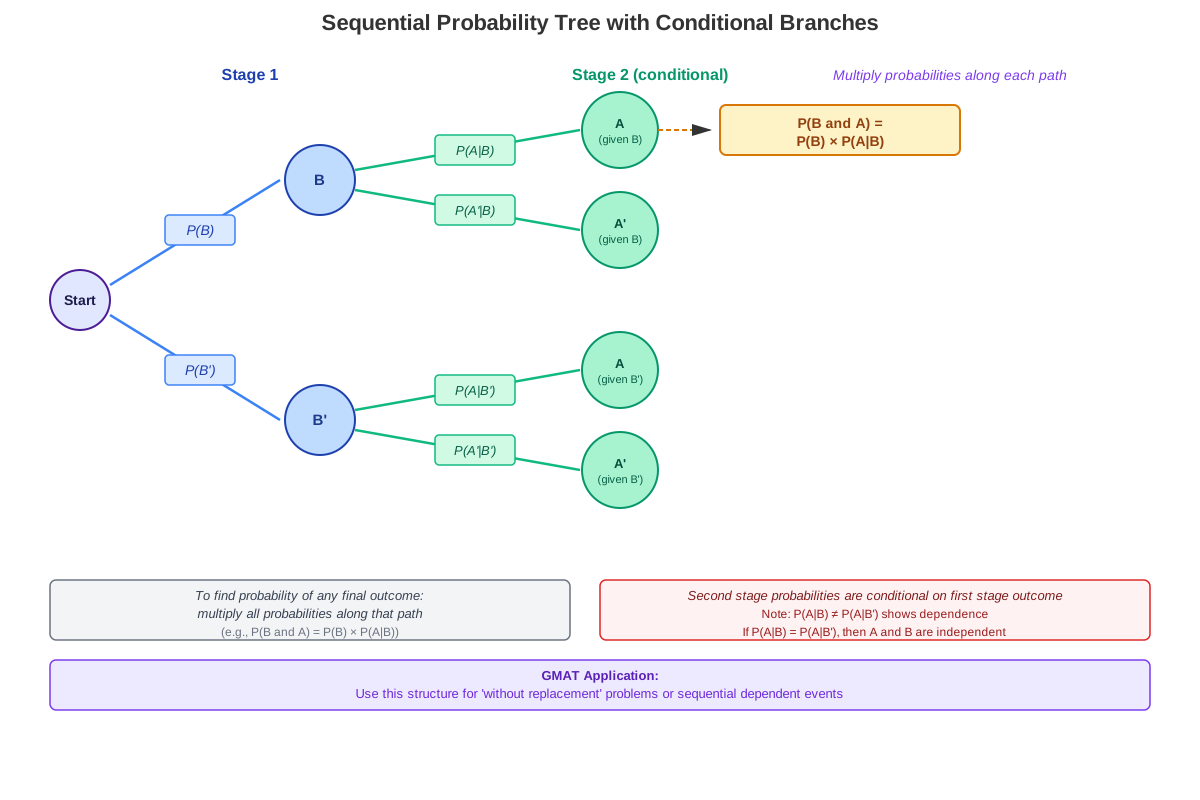
For problems involving multiple stages or sequential events, tree diagrams provide a visual framework for organizing conditional probabilities. Each branch represents a possible outcome, with probabilities labeled on branches. To find the probability of any complete path through the tree, multiply the probabilities along that path.
For example, drawing two cards without replacement: the probability of the second card depends on what the first card was, making this a conditional probability situation. Tree diagrams help track these dependencies systematically.
Common Conditional Probability Scenarios
Sampling without replacement: When items are selected sequentially without putting them back, each selection changes the composition of the remaining items, creating conditional probability situations.
Quality control problems: Questions about defective items often involve conditional probability, such as "Given a product passed the first inspection, what's the probability it passes the second?"
Demographic and survey data: Problems presenting information about populations with multiple characteristics (age and preference, gender and occupation) typically require conditional probability reasoning.
Concept Relationships
Conditional probability builds directly on basic probability concepts by adding the dimension of additional information. The fundamental probability formula P(event) = favorable/total evolves into the conditional formula by restricting what counts as "total" based on the given condition.
The relationship flows as: Basic Probability → introduces sample spaces and outcomes → Conditional Probability → restricts sample space based on given information → Independence → special case where restriction doesn't change probability → Multiplication Rule → enables calculation of joint probabilities → Sequential Probability → applies multiplication rule across multiple stages.
Conditional probability connects intimately with set theory: P(A|B) corresponds to the proportion of set B that overlaps with set A. The intersection A ∩ B represents outcomes where both events occur, while the condition "given B" means we're only considering elements within set B.
The concept also links to combinatorics through counting methods. Many conditional probability problems can be solved either by formula or by carefully counting favorable and total outcomes within the restricted sample space. Understanding both approaches provides flexibility and error-checking capability.
Finally, conditional probability enables understanding of Bayes' theorem (occasionally tested on GMAT), which relates P(A|B) to P(B|A), allowing probability "reversal" when you know one conditional probability but need the other.
High-Yield Facts
⭐ The conditional probability formula is P(A|B) = P(A ∩ B) / P(B), where P(B) > 0
⭐ Conditional probability represents a restricted sample space—only outcomes where the condition is true are considered
⭐ Two events are independent if and only if P(A|B) = P(A), meaning the condition doesn't change the probability
⭐ The multiplication rule P(A ∩ B) = P(A|B) × P(B) is essential for sequential event problems
⭐ In two-way tables, find P(A|B) by dividing the cell count for (A and B) by the total count for B
- For sampling without replacement, probabilities change with each draw, creating conditional probability situations
- P(A|B) and P(B|A) are generally different values and should not be confused
- The complement rule P(A'|B) = 1 - P(A|B) applies within conditional probability
- Tree diagrams help organize multi-stage conditional probability problems systematically
- When events are independent, P(A ∩ B) = P(A) × P(B), simplifying calculations significantly
- Conditional probability can be calculated using either formulas or intuitive counting methods—both should yield the same answer
Quick check — test yourself on Conditional probability so far.
Try Flashcards →Common Misconceptions
Misconception: P(A|B) and P(B|A) are the same thing → Correction: These are distinct conditional probabilities that typically have different values. P(A|B) asks about A given B occurred, while P(B|A) asks about B given A occurred. The order matters critically.
Misconception: If P(A|B) = 0.6, then P(A) must also equal 0.6 → Correction: The conditional probability P(A|B) can differ significantly from the unconditional probability P(A). The condition B restricts the sample space, potentially changing the probability substantially.
Misconception: Conditional probability only applies to sequential events → Correction: While sequential events often involve conditional probability, the concept applies to any situation where additional information is known, regardless of timing. Two-way table problems involve conditional probability even though no sequence is involved.
Misconception: P(A ∩ B) = P(A|B) → Correction: P(A ∩ B) represents the joint probability of both events occurring, while P(A|B) is the conditional probability. They're related by P(A ∩ B) = P(A|B) × P(B), but they're not equal unless P(B) = 1.
Misconception: In sampling without replacement, you can use the same probability for each draw → Correction: Without replacement, each draw changes the composition of the remaining items, so probabilities must be recalculated for each subsequent draw using conditional probability.
Misconception: If events are mutually exclusive, they're independent → Correction: Mutually exclusive events (cannot both occur) are actually dependent. If A and B are mutually exclusive and P(B) > 0, then P(A|B) = 0, which differs from P(A) if P(A) > 0, proving dependence.
Worked Examples
Example 1: Quality Control with Two-Way Table
Problem: A factory produces widgets on two machines. Machine A produces 60% of the widgets, and Machine B produces 40%. Of Machine A's widgets, 5% are defective. Of Machine B's widgets, 8% are defective. If a randomly selected widget is defective, what is the probability it came from Machine A?
Solution:
Step 1: Identify what we're looking for. We need P(Machine A | Defective).
Step 2: Organize the information. Let's work with 1000 widgets for easier calculation:
- Machine A produces: 1000 × 0.60 = 600 widgets
- Machine B produces: 1000 × 0.40 = 400 widgets
- Machine A defective: 600 × 0.05 = 30 widgets
- Machine B defective: 400 × 0.08 = 32 widgets
- Total defective: 30 + 32 = 62 widgets
Step 3: Create a two-way table:
| Defective | Non-defective | Total | |
|---|---|---|---|
| Machine A | 30 | 570 | 600 |
| Machine B | 32 | 368 | 400 |
| Total | 62 | 938 | 1000 |
Step 4: Apply conditional probability. We want P(Machine A | Defective).
- Focus on the "Defective" column: 62 total defective widgets
- Of these, 30 came from Machine A
- P(Machine A | Defective) = 30/62 = 15/31 ≈ 0.484
Answer: 15/31 or approximately 48.4%
Key insight: Even though Machine A produces more widgets overall (60%), it produces fewer defective widgets than Machine B (30 vs 32), so a defective widget is slightly more likely to have come from Machine B. This demonstrates how conditional probability can yield counterintuitive results.
Example 2: Sequential Card Drawing
Problem: A standard deck of 52 cards contains 4 aces. Two cards are drawn without replacement. What is the probability that the second card is an ace, given that the first card was an ace?
Solution:
Step 1: Identify the conditional probability needed: P(2nd card is ace | 1st card is ace)
Step 2: Understand the restricted sample space. Given the first card was an ace:
- The deck now has 51 cards remaining
- Of these 51 cards, only 3 are aces (since one ace was removed)
Step 3: Apply the definition of conditional probability directly through counting:
- Total outcomes (given first was ace): 51 cards remain
- Favorable outcomes (second is also ace): 3 aces remain
- P(2nd ace | 1st ace) = 3/51 = 1/17
Answer: 1/17
Alternative approach using formula:
Step 1: Calculate P(both aces):
- P(1st ace) = 4/52
- P(2nd ace | 1st ace) = 3/51
- P(both aces) = (4/52) × (3/51) = 12/2652 = 1/221
Step 2: Calculate P(1st ace) = 4/52 = 1/13
Step 3: Apply conditional probability formula:
- P(2nd ace | 1st ace) = P(both aces) / P(1st ace)
- P(2nd ace | 1st ace) = (1/221) / (1/13) = (1/221) × (13/1) = 13/221 = 1/17
Key insight: Both methods yield the same answer. The direct counting method is often faster for GMAT problems, but understanding the formula approach provides verification and deeper comprehension.
Exam Strategy
Trigger words and phrases: Watch for "given that," "if," "knowing that," "assuming," "provided that," and "on the condition that." These phrases signal conditional probability. Also watch for sequential language like "first...then," "without replacement," or "after."
Approach strategy:
- Identify the condition: Determine what information is "given" or already known
- Restrict the sample space: Mentally or on paper, identify only the outcomes where the condition is true
- Count or calculate: Within that restricted space, find the probability of the event in question
- Choose your method: Decide whether formula-based calculation or direct counting is faster for the specific problem
Process of elimination tips:
- Eliminate answers that equal the unconditional probability P(A) when the problem clearly involves a condition—the answer should differ from the base probability
- For Data Sufficiency, remember that you need both P(A ∩ B) and P(B) to calculate P(A|B), or you need direct information about the restricted sample space
- If a problem involves sampling without replacement, eliminate any answer choice that uses the same probability for multiple draws
- Check whether the answer makes intuitive sense: if the condition should increase the probability, eliminate answers lower than the base rate
Time allocation: Conditional probability problems typically require 2-3 minutes. Spend 30-45 seconds identifying the condition and organizing information (drawing a table or tree if helpful), then 60-90 seconds calculating, and 30 seconds checking your answer's reasonableness.
Common traps: GMAT writers often present P(B|A) information when you need P(A|B), testing whether you'll confuse the two. They also create problems where independence seems likely but events are actually dependent (or vice versa). Always verify independence explicitly rather than assuming it.
Memory Techniques
"Given Shrinks the Space": Remember that conditional probability always involves a restricted sample space. The word "given" tells you to shrink your universe of possibilities to only those where the condition is true.
"Vertical for Given": In two-way tables, the "given" condition typically corresponds to focusing on a single column or row. The vertical bar in P(A|B) can remind you to look at columns/rows vertically.
"Multiply Down the Tree": For tree diagrams, multiply probabilities as you move down branches to find the probability of any complete path.
"DICE" for Independence: Does Information Change Expectation? If knowing one event occurred changes your expectation about another event, they're dependent, not independent.
Formula Triangle: Visualize the conditional probability formula as a triangle:
    P(A ∩ B)
    ________

   P(A|B) × P(B)
Cover any one element to see how to calculate it from the other two.
Summary
Conditional probability represents one of the most important probability concepts tested on the GMAT, appearing in 10-15% of Quantitative Reasoning questions. The fundamental principle is that conditional probability measures how the probability of an event changes when additional information is known. The formal definition P(A|B) = P(A ∩ B) / P(B) captures this by restricting the sample space to only outcomes where B occurs. Mastery requires understanding both formula-based and counting-based approaches, recognizing trigger language like "given that," and distinguishing between independent events (where P(A|B) = P(A)) and dependent events (where these differ). Two-way tables provide a powerful organizational tool for conditional probability problems, while tree diagrams help with sequential events. The multiplication rule P(A ∩ B) = P(A|B) × P(B) enables calculation of joint probabilities and is essential for multi-stage problems. Success on GMAT conditional probability questions requires careful identification of what information is "given," systematic restriction of the sample space, and verification that answers make logical sense within the problem context.
Key Takeaways
- Conditional probability P(A|B) measures the probability of A occurring given that B has already occurred, fundamentally restricting the sample space
- The formula P(A|B) = P(A ∩ B) / P(B) relates conditional probability to joint and marginal probabilities
- Events are independent if and only if P(A|B) = P(A); otherwise, they're dependent
- Two-way tables enable efficient conditional probability calculation through direct counting within restricted rows or columns
- The multiplication rule P(A ∩ B) = P(A|B) × P(B) is essential for sequential events and multi-stage probability problems
- "Given that" language signals conditional probability and requires focusing only on outcomes where the condition is true
- Both formula-based and intuitive counting methods should yield identical answers, providing a built-in verification mechanism
Related Topics
Independent vs. Dependent Events: Understanding the formal definition of independence through conditional probability enables deeper analysis of event relationships and simplifies probability calculations when independence can be established.
Bayes' Theorem: This advanced topic builds directly on conditional probability, providing a method to "reverse" conditional probabilities and calculate P(A|B) from P(B|A), useful in diagnostic testing and decision analysis problems.
Expected Value with Conditional Probability: Combining conditional probability with expected value calculations enables analysis of sequential decision problems and games with multiple stages.
Probability Distributions: Conditional probability extends to continuous distributions and forms the foundation for understanding conditional distributions in statistics.
Combinatorics and Counting: Advanced counting techniques combined with conditional probability enable solution of complex arrangement and selection problems where constraints apply.
Practice CTA
Now that you've mastered the core concepts of conditional probability, it's time to solidify your understanding through practice. Attempt the practice questions to test your ability to identify conditional probability situations, apply the appropriate formulas, and avoid common traps. Use the flashcards to reinforce key definitions and formulas until they become automatic. Remember: conditional probability is a high-yield GMAT topic that rewards careful practice with significant score improvements. Each problem you solve builds the pattern recognition and strategic thinking that will serve you on test day. You've got this!
Sign up free to keep reading
Create a free AnvayaPrep account to finish this GMAT guide on Conditional probability — plus flashcards and practice questions.