Overview
Expected value is a fundamental concept in probability and statistics that quantifies the average outcome one can anticipate from a random event or decision when repeated many times. On the GMAT, GMAT expected value questions test a student's ability to calculate weighted averages of all possible outcomes, where each outcome is multiplied by its probability of occurrence. This concept bridges basic probability theory with practical decision-making scenarios, making it one of the most applicable mathematical tools tested on the exam.
Understanding expected value is essential for GMAT success because it appears frequently in both Problem Solving and Data Sufficiency questions, often disguised within word problems involving games, investments, business decisions, or risk assessment scenarios. The GMAT tests not just computational ability but also conceptual understanding—whether students can identify when expected value is the appropriate tool, set up the calculation correctly, and interpret results in context. Questions may involve simple scenarios with two outcomes or complex situations requiring systematic organization of multiple possibilities.
Within the broader Quantitative Reasoning framework, expected value sits at the intersection of probability, weighted averages, and algebraic reasoning. It builds directly on fundamental probability concepts (calculating individual probabilities, understanding complementary events) and connects to statistics (understanding distributions and central tendency). Mastering expected value also strengthens skills in systematic problem-solving and logical organization—competencies that transfer to other GMAT quantitative topics including combinatorics, sequences, and data interpretation.
Learning Objectives
- [ ] Identify expected value in GMAT problem contexts and recognize when it is the appropriate analytical tool
- [ ] Explain expected value conceptually as a probability-weighted average of all possible outcomes
- [ ] Apply expected value formulas to GMAT questions involving discrete probability distributions
- [ ] Calculate expected value for scenarios with multiple outcomes and varying probabilities
- [ ] Interpret expected value results in practical contexts and use them to make comparative decisions
- [ ] Recognize and avoid common calculation errors and conceptual misunderstandings about expected value
Prerequisites
- Basic probability concepts: Understanding how to calculate the probability of single events and complementary probabilities is essential since expected value requires multiplying outcomes by their probabilities
- Fractions, decimals, and percentages: Facility with converting between these forms and performing arithmetic operations is necessary for efficient calculation
- Weighted averages: Expected value is fundamentally a weighted average where probabilities serve as weights, so comfort with this concept accelerates understanding
- Algebraic manipulation: Setting up and solving equations involving variables is required for more complex expected value problems
Why This Topic Matters
Expected value has profound real-world applications across finance, economics, insurance, game theory, and decision science. Businesses use expected value to evaluate investment opportunities, insurance companies use it to set premiums, and individuals use it (often unconsciously) to make everyday decisions under uncertainty. Understanding expected value enables rational decision-making when outcomes are uncertain—a skill valuable far beyond the GMAT.
On the GMAT specifically, expected value questions appear with moderate frequency (approximately 5-8% of quantitative questions) but are considered high-yield because they're highly predictable in structure once the pattern is recognized. These questions typically appear at the medium to medium-high difficulty range (600-700 level), making them crucial for students targeting competitive scores. The GMAT tests expected value through various question formats: straightforward calculation problems, comparison questions asking which of several options has the highest expected value, and Data Sufficiency questions testing whether given information is sufficient to determine expected value.
Common GMAT scenarios include: games of chance (dice, cards, spinners), business decisions (product launches with uncertain outcomes), investment choices (stocks with probabilistic returns), quality control (defect rates and costs), and contest/lottery situations. The exam often embeds expected value within longer word problems, requiring students to first extract relevant information, identify all possible outcomes, determine their probabilities, and then perform the calculation—testing reading comprehension and problem organization alongside mathematical skills.
Core Concepts
Definition and Formula
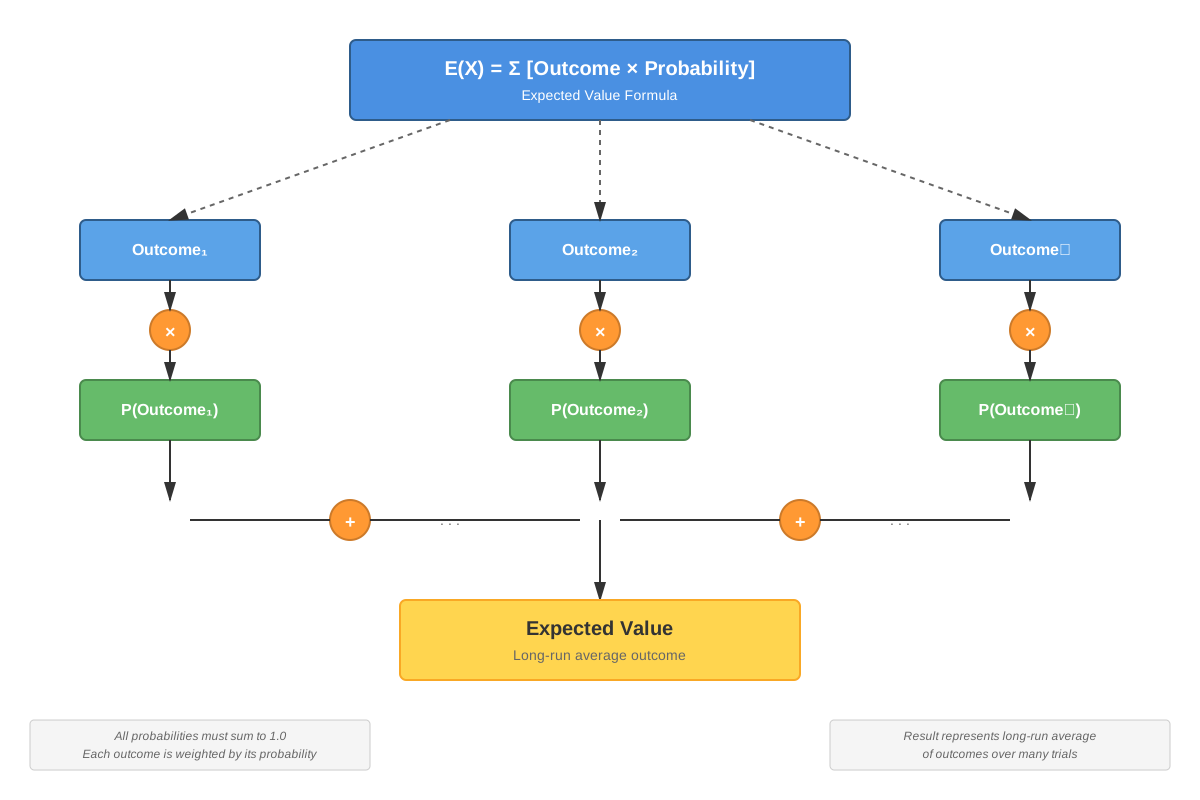
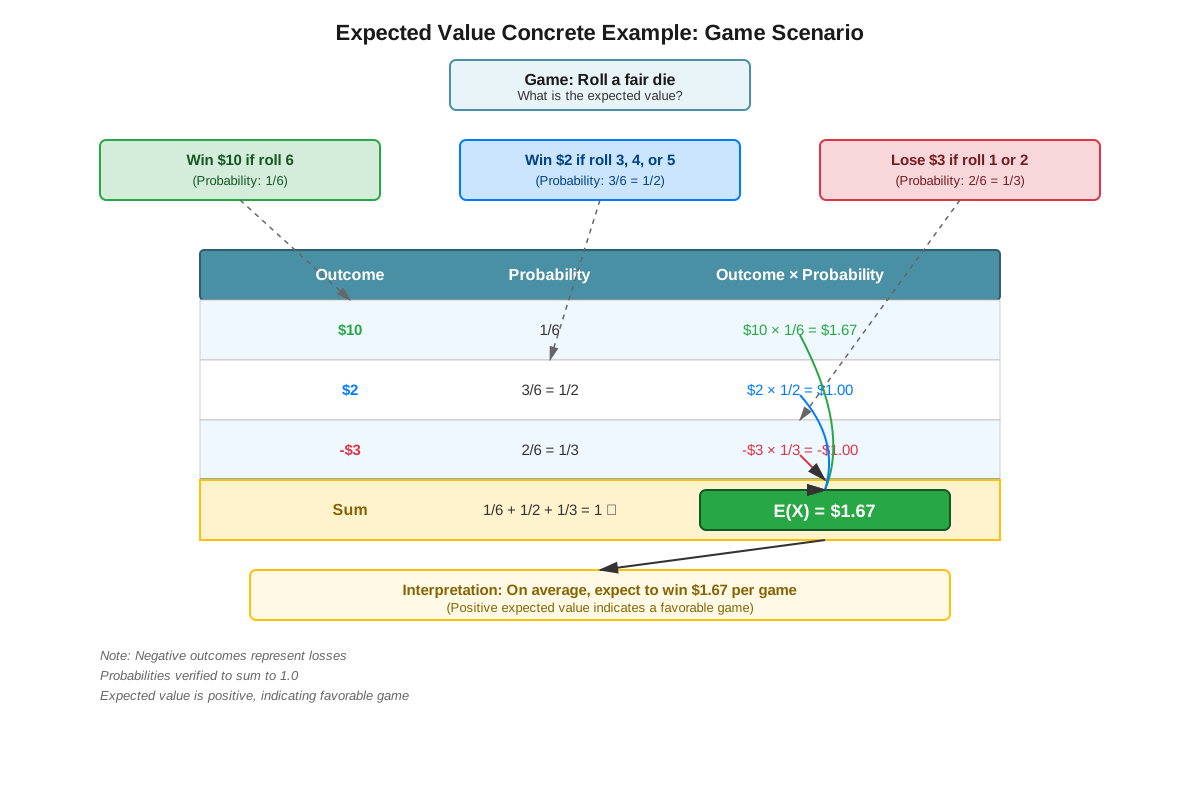
Expected value (often denoted as E(X) or EV) represents the long-run average value of a random variable if an experiment or process were repeated infinitely many times. It is calculated by multiplying each possible outcome by its probability and summing all these products.
The fundamental formula is:
E(X) = p₁ × x₁ + p₂ × x₂ + p₃ × x₃ + ... + pₙ × xₙWhere:
- x₁, x₂, x₃, ..., xₙ are all possible outcomes
- p₁, p₂, p₃, ..., pₙ are the probabilities of each respective outcome
- The sum of all probabilities equals 1 (p₁ + p₂ + ... + pₙ = 1)
For a simple example: if a game pays $10 with probability 0.3 and $0 with probability 0.7, the expected value is:
E(X) = (0.3 × $10) + (0.7 × $0) = $3
This means that over many plays, the average payout per game would approach $3.
Probability-Weighted Average Interpretation
Expected value is fundamentally a weighted average where probabilities serve as the weights. This interpretation helps build intuition: outcomes that are more likely to occur contribute more heavily to the expected value, while rare outcomes contribute less, proportional to their probability.
Consider this comparison:
| Scenario | Outcome 1 | Probability 1 | Outcome 2 | Probability 2 | Expected Value |
|---|---|---|---|---|---|
| A | $100 | 0.5 | $0 | 0.5 | $50 |
| B | $100 | 0.9 | $0 | 0.1 | $90 |
| C | $200 | 0.5 | $0 | 0.5 | $100 |
Scenario B has a higher expected value than A because the favorable outcome is more likely. Scenario C has the highest expected value because the favorable outcome is both substantial and reasonably likely.
Positive, Negative, and Zero Expected Value
Expected value can be positive, negative, or zero, depending on the nature of outcomes:
- Positive expected value: On average, you gain value (e.g., a favorable investment)
- Negative expected value: On average, you lose value (e.g., most casino games from the player's perspective)
- Zero expected value: On average, you break even (e.g., a fair game)
For scenarios involving costs or losses, these must be represented as negative values in the calculation. For example, if a game costs $5 to play and pays $20 with probability 0.2 or $0 with probability 0.8:
E(X) = (0.2 × $20) + (0.8 × $0) - $5 = $4 - $5 = -$1
The negative expected value indicates this is an unfavorable game on average.
Multi-Outcome Scenarios
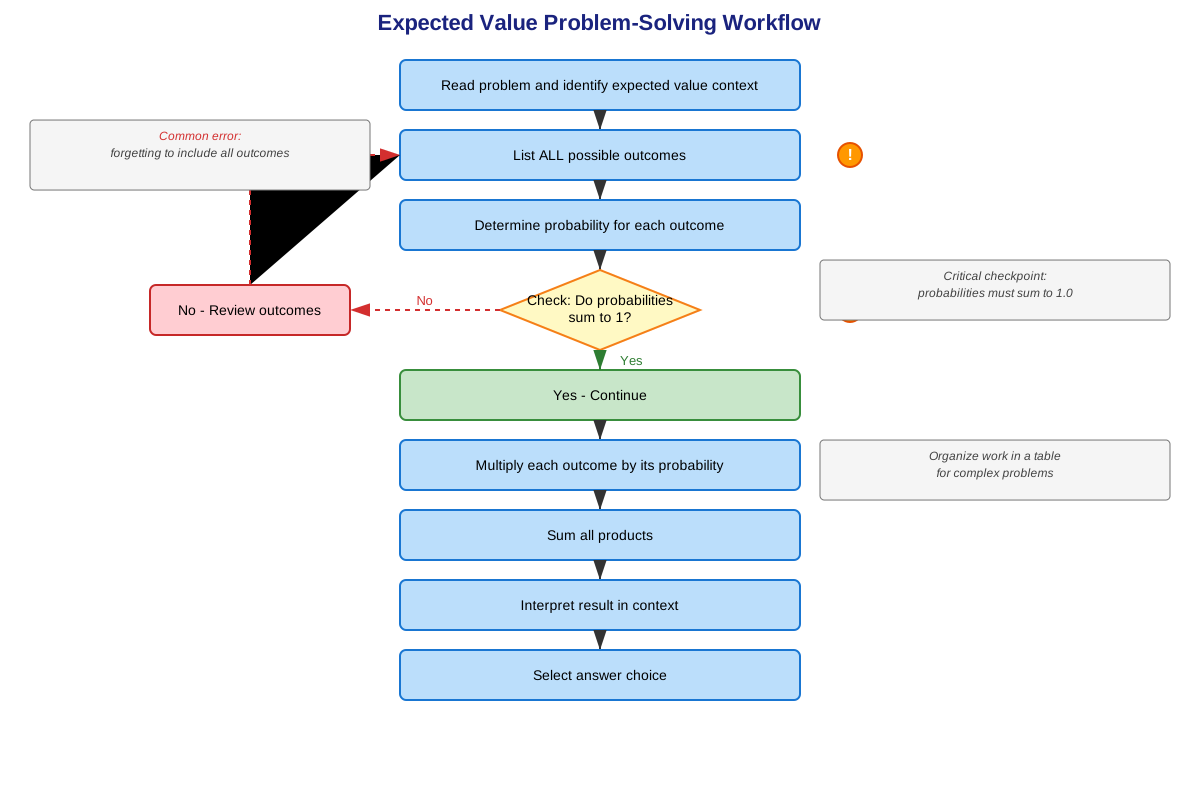
GMAT questions frequently involve more than two possible outcomes. The systematic approach remains the same:
- Identify all possible outcomes (ensure they're mutually exclusive and exhaustive)
- Determine the probability of each outcome (verify probabilities sum to 1)
- Assign a value to each outcome (monetary value, points, or other quantifiable measure)
- Multiply each value by its probability
- Sum all products to obtain the expected value
For example, a spinner game with three sections:
- 50% chance of winning $10
- 30% chance of winning $5
- 20% chance of winning $0
E(X) = (0.5 × $10) + (0.3 × $5) + (0.2 × $0) = $5 + $1.50 + $0 = $6.50
Expected Value in Decision-Making
The GMAT often tests whether students can use expected value to compare options and make optimal decisions. When comparing multiple scenarios, the option with the highest expected value is theoretically the best choice from a purely mathematical perspective (though real-world decisions may involve other factors like risk tolerance).
Decision Rule: When faced with multiple uncertain options, calculate the expected value of each and select the one with the highest expected value for maximizing long-run outcomes.
This principle applies to GMAT questions asking "Which investment should be chosen?" or "Which strategy yields the best expected outcome?"
Expected Value with Conditional Probabilities
More complex GMAT problems may involve conditional probabilities where outcomes depend on sequential events. In these cases:
- Map out all possible paths through the sequence of events
- Calculate the probability of each complete path (multiply probabilities along the path)
- Determine the final value associated with each path
- Apply the standard expected value formula
For instance, if a game involves drawing a card, and then based on that draw, spinning a wheel with different payouts, you must consider all combinations of (card outcome, wheel outcome) as distinct scenarios in your expected value calculation.
Concept Relationships
Expected value fundamentally depends on probability theory—without the ability to calculate individual probabilities, expected value cannot be determined. The relationship flows: probability concepts → expected value calculation → decision analysis.
Within expected value problems themselves, there's a hierarchical relationship: identifying all outcomes → determining probabilities → assigning values → computing weighted sum. Each step depends on the previous one being completed correctly.
Expected value connects to weighted averages through its mathematical structure. Understanding that probabilities function as weights helps students recognize that expected value is not simply the arithmetic mean of outcomes but rather accounts for how likely each outcome is to occur.
The concept also relates to algebraic reasoning when problems involve unknown variables. For example, a GMAT question might ask: "What probability p makes the expected value equal to $50?" This requires setting up an equation: p × (outcome₁) + (1-p) × (outcome₂) = 50, then solving for p.
Expected value serves as a foundation for more advanced statistical concepts like variance and standard deviation (which measure spread around the expected value), though these are less commonly tested on the GMAT. It also connects to combinatorics when determining probabilities for complex scenarios requires counting techniques.
Relationship map: Probability Fundamentals → Expected Value Calculation → Comparative Decision Analysis → Optimal Strategy Selection
High-Yield Facts
⭐ Expected value equals the sum of each outcome multiplied by its probability: E(X) = Σ(pᵢ × xᵢ)
⭐ All probabilities in an expected value calculation must sum to exactly 1: This ensures all possible outcomes are accounted for
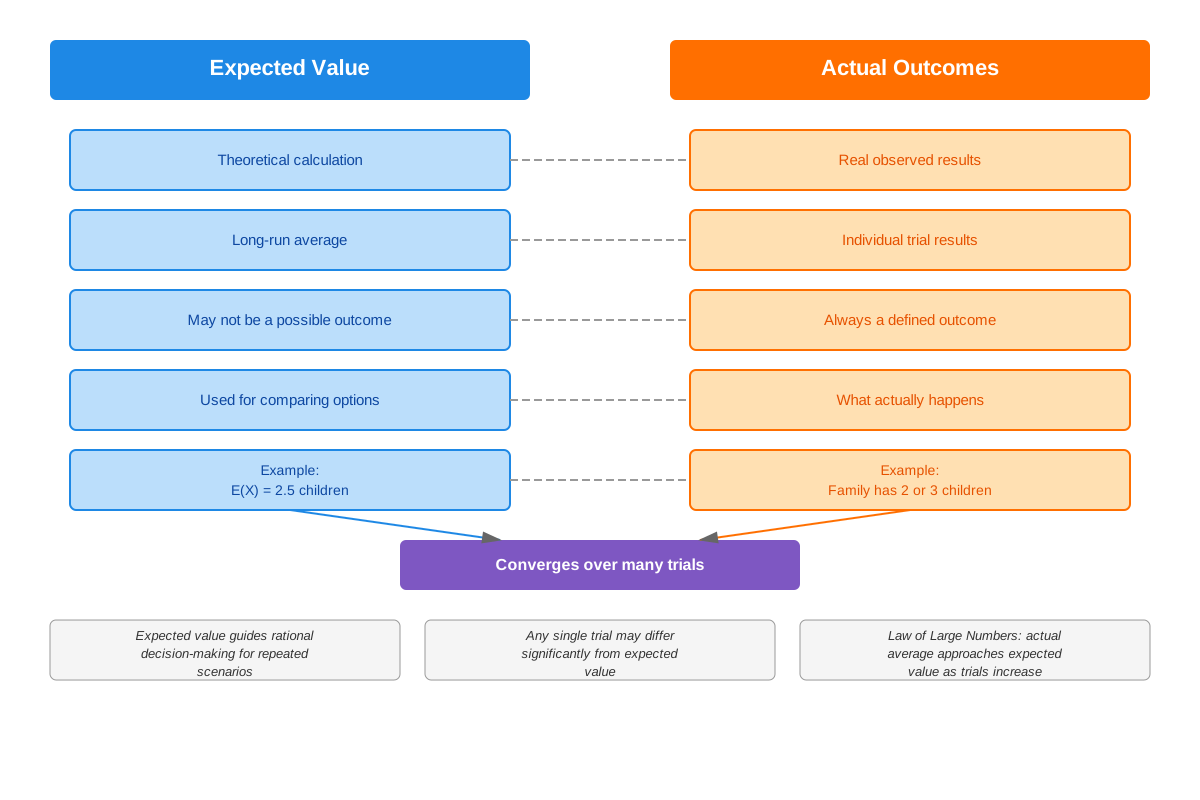
⭐ Expected value represents the long-run average, not a guaranteed outcome: A single trial may yield any of the possible outcomes, not the expected value itself
⭐ When comparing options, choose the one with the highest expected value for optimal long-run results: This is the fundamental decision rule
⭐ Costs or losses must be represented as negative values in the calculation: Failing to do so is a common error that yields incorrect results
- Expected value can be any real number (positive, negative, or zero) depending on the scenario
- The expected value may not be one of the actual possible outcomes (e.g., expected value of a die roll is 3.5, which cannot occur)
- Multiplying all outcomes by a constant k multiplies the expected value by k: E(kX) = k × E(X)
- Adding a constant c to all outcomes adds c to the expected value: E(X + c) = E(X) + c
- For independent events, the expected value of the sum equals the sum of expected values: E(X + Y) = E(X) + E(Y)
- Expected value is a linear operator, making complex calculations more manageable by breaking them into parts
- In "fair" games or bets, the expected value equals zero (neither party has an advantage)
- Casino games and lotteries typically have negative expected value for players (the "house edge")
Quick check — test yourself on Expected value so far.
Try Flashcards →Common Misconceptions
Misconception: Expected value tells you what will happen on the next trial.
Correction: Expected value represents the long-run average over many trials, not a prediction for any single event. In one coin flip bet, you'll win or lose the full amount, not the expected value.
Misconception: The expected value must be one of the possible outcomes.
Correction: Expected value is often not an achievable outcome. Rolling a standard die has an expected value of 3.5, but you cannot roll 3.5. Expected value is a theoretical average, not a possible result.
Misconception: Higher probability always means higher expected value.
Correction: Expected value depends on both probability and outcome magnitude. A 90% chance of winning $1 (EV = $0.90) has lower expected value than a 10% chance of winning $20 (EV = $2.00).
Misconception: If the expected value is positive, you'll definitely make money.
Correction: Positive expected value means you'll profit on average over many trials, but you can still lose money in any individual trial or even over a limited number of trials due to variance.
Misconception: You can ignore outcomes with zero value when calculating expected value.
Correction: While zero-value outcomes don't contribute to the sum (since anything multiplied by zero equals zero), you must still account for their probability to ensure all probabilities sum to 1. Ignoring them can lead to probability errors.
Misconception: Expected value and probability are the same thing.
Correction: Probability measures the likelihood of an event (a number between 0 and 1), while expected value measures the average outcome value (which can be any real number). Expected value uses probabilities in its calculation but represents a different concept.
Misconception: In Data Sufficiency questions, you need to calculate the exact expected value.
Correction: Data Sufficiency questions only ask whether you have sufficient information to determine the expected value, not to actually calculate it. Recognizing what information is needed (all outcomes and their probabilities) is sufficient.
Worked Examples
Example 1: Investment Decision Problem
Problem: A venture capitalist is considering two investment opportunities. Investment A has a 40% chance of returning $500,000, a 35% chance of returning $200,000, and a 25% chance of losing the entire $100,000 investment. Investment B has a 60% chance of returning $300,000 and a 40% chance of losing the entire $100,000 investment. Based solely on expected value, which investment should be chosen?
Solution:
Step 1: Calculate expected value for Investment A.
Identify all outcomes and probabilities:
- Outcome 1: Gain $500,000 with probability 0.40
- Outcome 2: Gain $200,000 with probability 0.35
- Outcome 3: Lose $100,000 with probability 0.25 (represented as -$100,000)
Verify probabilities sum to 1: 0.40 + 0.35 + 0.25 = 1.00 ✓
Calculate expected value:
E(A) = (0.40 × $500,000) + (0.35 × $200,000) + (0.25 × -$100,000)
E(A) = $200,000 + $70,000 - $25,000
E(A) = $245,000
Step 2: Calculate expected value for Investment B.
Identify all outcomes and probabilities:
- Outcome 1: Gain $300,000 with probability 0.60
- Outcome 2: Lose $100,000 with probability 0.40 (represented as -$100,000)
Verify probabilities sum to 1: 0.60 + 0.40 = 1.00 ✓
Calculate expected value:
E(B) = (0.60 × $300,000) + (0.40 × -$100,000)
E(B) = $180,000 - $40,000
E(B) = $140,000
Step 3: Compare and decide.
E(A) = $245,000 > E(B) = $140,000
Answer: Investment A should be chosen because it has a higher expected value ($245,000 vs. $140,000), meaning it will yield better returns on average over many similar investments.
Connection to Learning Objectives: This problem demonstrates applying expected value to make comparative decisions (Objective 3), correctly handling negative outcomes representing losses (Objective 4), and interpreting results in a practical business context (Objective 5).
Example 2: Game with Entry Fee
Problem: A carnival game costs $3 to play. Players spin a wheel with the following outcomes: 50% chance of winning nothing, 30% chance of winning $2, 15% chance of winning $5, and 5% chance of winning $20. What is the expected value of playing this game? Should a rational player play this game repeatedly?
Solution:
Step 1: Identify all outcomes including the cost to play.
The cost of $3 must be subtracted from all winnings (or added as a loss):
- Outcome 1: Win $0, net result = $0 - $3 = -$3, probability = 0.50
- Outcome 2: Win $2, net result = $2 - $3 = -$1, probability = 0.30
- Outcome 3: Win $5, net result = $5 - $3 = $2, probability = 0.15
- Outcome 4: Win $20, net result = $20 - $3 = $17, probability = 0.05
Step 2: Verify probabilities sum to 1.
0.50 + 0.30 + 0.15 + 0.05 = 1.00 ✓
Step 3: Calculate expected value using net outcomes.
E(X) = (0.50 × -$3) + (0.30 × -$1) + (0.15 × $2) + (0.05 × $17)
E(X) = -$1.50 - $0.30 + $0.30 + $0.85
E(X) = -$0.65
Step 4: Interpret the result.
The expected value is -$0.65, meaning on average, a player loses $0.65 per game.
Answer: The expected value of playing this game is -$0.65. A rational player should NOT play this game repeatedly because the negative expected value means they will lose money on average over time. While it's possible to win on any individual play (especially the $20 prize), the probabilities are structured such that the house has an advantage.
Connection to Learning Objectives: This problem demonstrates identifying when expected value is appropriate (Objective 1), correctly incorporating costs into the calculation (Objective 4), and interpreting negative expected value in a decision-making context (Objective 5). It also illustrates the common GMAT scenario of games with entry fees.
Exam Strategy
When approaching GMAT expected value questions, follow this systematic process:
1. Recognize the trigger: Look for keywords like "expected," "average outcome," "on average," "long run," or scenarios involving uncertain outcomes with known probabilities. Questions asking "which option is better" or "what is the anticipated result" often require expected value.
2. Organize information systematically: Create a table or list with three columns: Outcome, Probability, and Value. This prevents missing outcomes and helps verify that probabilities sum to 1.
3. Account for all costs: Entry fees, initial investments, or costs must be subtracted from outcomes. Decide whether to subtract costs from each outcome individually or subtract the total cost at the end—both approaches work if applied consistently.
4. Check probability sum: Before calculating, verify that all probabilities add to exactly 1. If they don't, you've either missed an outcome or made an error in determining probabilities.
5. Use strategic calculation: On the GMAT, you can often eliminate answer choices before completing full calculations. If you calculate part of the expected value and it already exceeds or falls short of certain answer choices, you can eliminate those options.
6. For Data Sufficiency: Remember you only need to determine whether you CAN calculate expected value, not actually calculate it. You need: (a) all possible outcomes, (b) the probability of each outcome, and (c) the value associated with each outcome. If any of these is missing, the information is insufficient.
7. Watch for comparison questions: When asked to compare multiple scenarios, you don't always need to calculate exact expected values. Sometimes you can determine which is higher through logical reasoning about probabilities and outcomes.
Time allocation: Straightforward expected value calculations should take 1.5-2 minutes. Complex multi-stage problems may require 2.5-3 minutes. If you're spending more time, you may be overcomplicating the problem—look for a simpler approach.
Process of elimination tips:
- Eliminate answers that ignore costs or fees
- Eliminate answers that are simple averages of outcomes (without probability weighting)
- Eliminate answers outside the range of possible outcomes when the expected value must fall within that range
- For negative expected value scenarios, eliminate positive answer choices
Memory Techniques
Mnemonic for Expected Value Steps: "OPVC" - Outcomes, Probabilities, Values, Calculate
- Outcomes: List all possible outcomes
- Probabilities: Determine probability of each
- Values: Assign values to each outcome
- Calculate: Multiply and sum
Visualization Strategy: Picture expected value as a "weighted balance" where each outcome is a weight on a scale, with heavier weights (higher probabilities) pulling the balance point (expected value) toward them. This reinforces that expected value is pulled toward more likely outcomes.
Formula Memory: Think "Probability Times Outcome" (PTO) for each term, then sum all PTOs. The acronym PTO can remind you of "Paid Time Off"—you're calculating what you're "paid" on average.
Acronym for Decision Rule: "HIVE" - Highest Is Value Expected
When comparing options, choose the one with the HIVE (highest expected value).
Cost Reminder: "CAFE" - Costs Are For Everyone
Remember that costs apply to ALL outcomes, not just winning outcomes. Subtract costs from every scenario or account for them separately.
Summary
Expected value is a probability-weighted average that quantifies the long-run average outcome of a random process. Calculated by multiplying each possible outcome by its probability and summing these products, expected value serves as the fundamental tool for making rational decisions under uncertainty. On the GMAT, expected value appears in approximately 5-8% of quantitative questions, typically at medium to medium-high difficulty levels, testing both computational accuracy and conceptual understanding. Success requires systematically identifying all outcomes, determining their probabilities (which must sum to 1), assigning appropriate values (with costs represented as negatives), and correctly computing the weighted sum. The key insight is that expected value represents what happens on average over many trials, not what occurs in any single instance, and the option with the highest expected value is theoretically optimal for repeated decisions. GMAT questions embed expected value in realistic scenarios involving games, investments, business decisions, and risk assessment, requiring students to extract relevant information, organize it effectively, and apply the formula correctly while avoiding common pitfalls like ignoring costs, failing to weight by probability, or confusing expected value with guaranteed outcomes.
Key Takeaways
- Expected value equals the sum of each outcome multiplied by its probability: E(X) = Σ(pᵢ × xᵢ), representing the long-run average result
- All probabilities must sum to exactly 1, and costs/losses must be represented as negative values in calculations
- Expected value is a weighted average where probabilities serve as weights, meaning more likely outcomes contribute more heavily to the result
- The expected value may not be an achievable outcome and represents average performance over many trials, not a prediction for any single event
- When comparing options, select the one with the highest expected value for optimal long-run results, making expected value the key decision-making tool under uncertainty
- Systematic organization (listing all outcomes, probabilities, and values) prevents errors and ensures complete analysis
- On Data Sufficiency questions, focus on whether you have sufficient information (all outcomes, their probabilities, and their values) rather than calculating the actual expected value
Related Topics
Probability Fundamentals: Understanding basic probability rules, complementary events, and compound probability provides the foundation for calculating the probabilities needed in expected value problems. Mastering expected value reinforces probability skills and prepares for more complex probability scenarios.
Weighted Averages: Since expected value is mathematically a weighted average with probabilities as weights, deeper study of weighted average problems strengthens expected value intuition and calculation speed.
Standard Deviation and Variance: These concepts measure the spread of outcomes around the expected value, providing a more complete picture of risk. While less common on the GMAT, understanding them deepens statistical reasoning.
Combinatorics: Complex expected value problems may require counting techniques to determine probabilities, especially in scenarios involving multiple stages or selections. Mastering expected value provides context for why accurate probability calculation matters.
Decision Trees: Visual representations of sequential decisions and uncertain outcomes help organize complex expected value problems, particularly those involving conditional probabilities.
Practice CTA
Now that you've mastered the core concepts of expected value, it's time to solidify your understanding through active practice. Attempt the practice questions to apply these concepts to GMAT-style problems, testing your ability to recognize when expected value is needed, set up calculations correctly, and interpret results. Use the flashcards to reinforce key formulas, definitions, and common pitfalls until they become automatic. Remember: expected value questions are highly predictable once you recognize the pattern, making them excellent opportunities to secure points on test day. Your systematic approach to organizing outcomes and probabilities will serve you well across many GMAT quantitative topics. Keep practicing, and you'll find these questions become some of the most manageable on the exam!
Sign up free to keep reading
Create a free AnvayaPrep account to finish this GMAT guide on Expected value — plus flashcards and practice questions.