Overview
Sets are fundamental mathematical structures that represent collections of distinct objects, and they form a critical component of GMAT Quantitative Reasoning questions. On the GMAT, GMAT sets problems typically involve analyzing groups of elements, determining relationships between different collections, and calculating the number of elements that satisfy specific conditions. These questions frequently appear in the context of overlapping groups, such as students enrolled in different courses, employees with various skill sets, or survey respondents with multiple characteristics.
Understanding sets is essential for GMAT success because set theory provides the logical framework for solving complex counting problems that appear throughout the exam. Set problems test not only mathematical computation but also logical reasoning and the ability to organize information systematically. The GMAT frequently combines set theory with other quantitative concepts such as ratios, percentages, and probability, making it a high-yield topic that connects multiple areas of the Quantitative Reasoning section.
Set theory relates directly to broader Quantitative Reasoning concepts including combinatorics, probability, and data interpretation. The principles learned in set theory—particularly the inclusion-exclusion principle—serve as building blocks for more advanced problem-solving strategies. Mastering sets enables students to approach word problems with greater confidence, organize complex information efficiently, and recognize patterns that lead to faster, more accurate solutions on test day.
Learning Objectives
- [ ] Identify sets and their elements in GMAT problem contexts
- [ ] Explain set notation, terminology, and fundamental set operations
- [ ] Apply set theory principles to solve GMAT questions involving overlapping groups
- [ ] Calculate the number of elements in unions and intersections using the inclusion-exclusion principle
- [ ] Construct and interpret Venn diagrams to visualize set relationships
- [ ] Solve three-set problems using systematic organizational strategies
- [ ] Recognize when set theory provides the most efficient solution path for word problems
Prerequisites
- Basic arithmetic operations: Essential for calculating totals, differences, and performing the numerical computations required in set problems
- Algebraic manipulation: Necessary for setting up and solving equations that arise when working with unknown quantities in set relationships
- Logical reasoning: Required to interpret word problems, identify what information is given, and determine what needs to be calculated
- Basic understanding of percentages: Often integrated with set problems when dealing with proportions of groups
Why This Topic Matters
Set theory appears with remarkable frequency on the GMAT, making it one of the highest-yield topics in Quantitative Reasoning. Approximately 10-15% of GMAT quantitative questions involve set theory concepts, either directly or as part of more complex word problems. These questions appear in both Problem Solving and Data Sufficiency formats, with Data Sufficiency questions often testing whether students understand what information is necessary and sufficient to determine set relationships.
In real-world business contexts, set theory underlies market segmentation analysis, customer demographic studies, employee skill inventories, and resource allocation decisions. Business professionals regularly encounter situations requiring them to analyze overlapping categories: customers who purchase multiple product lines, employees with multiple certifications, or markets with various characteristics. The logical thinking developed through set theory directly translates to strategic decision-making and data analysis skills valued in business school and professional settings.
On the GMAT, set problems commonly appear as word problems involving surveys, course enrollments, product ownership, or demographic characteristics. The exam tests whether students can translate verbal descriptions into mathematical relationships, organize information systematically, and apply formulas correctly. Questions may involve two sets (simpler) or three sets (more complex), and they frequently include conditions about elements belonging to none of the sets or to all sets simultaneously. The ability to quickly recognize set problems and apply the appropriate framework can save valuable time and improve accuracy significantly.
Core Concepts
Definition and Notation of Sets
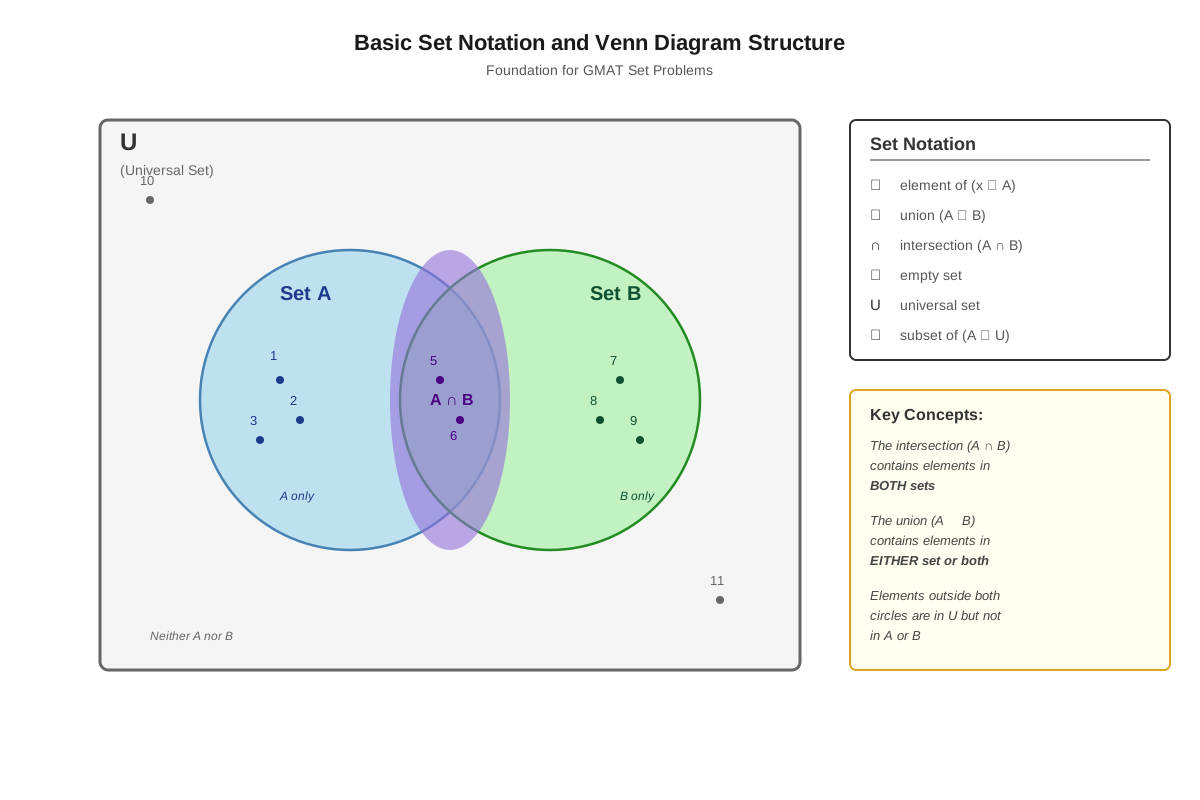
A set is a well-defined collection of distinct objects, called elements or members. In GMAT contexts, sets typically contain people, objects, or characteristics that can be clearly identified and counted. Sets are usually denoted by capital letters (A, B, C), while elements are represented by lowercase letters or specific descriptions.
The notation x ∈ A means "x is an element of set A," while x ∉ A means "x is not an element of set A." The cardinality of a set, denoted |A| or n(A), represents the number of elements in the set. For example, if set A contains students who study French, and there are 25 such students, then n(A) = 25.
The universal set (U) represents all elements under consideration in a particular problem. The empty set or null set (∅) contains no elements and has cardinality zero. Understanding these fundamental concepts is crucial because GMAT problems often require identifying what the universal set represents and accounting for elements that belong to none of the specified sets.
Basic Set Operations
Union (A ∪ B): The union of two sets contains all elements that belong to set A, set B, or both. In GMAT problems, this represents "or" relationships. For example, if A represents students studying French and B represents students studying Spanish, then A ∪ B represents all students studying French or Spanish or both languages.
Intersection (A ∩ B): The intersection of two sets contains only elements that belong to both sets simultaneously. This represents "and" relationships. Using the language example, A ∩ B represents students studying both French and Spanish. The intersection is crucial for GMAT problems because overlapping categories are central to most set questions.
Complement (A'): The complement of set A contains all elements in the universal set that are not in A. This represents "not" relationships. If the universal set contains all students and A represents students studying French, then A' represents students not studying French.
Difference (A - B): The difference contains elements in set A that are not in set B. This operation helps identify exclusive membership in one set.
The Inclusion-Exclusion Principle for Two Sets
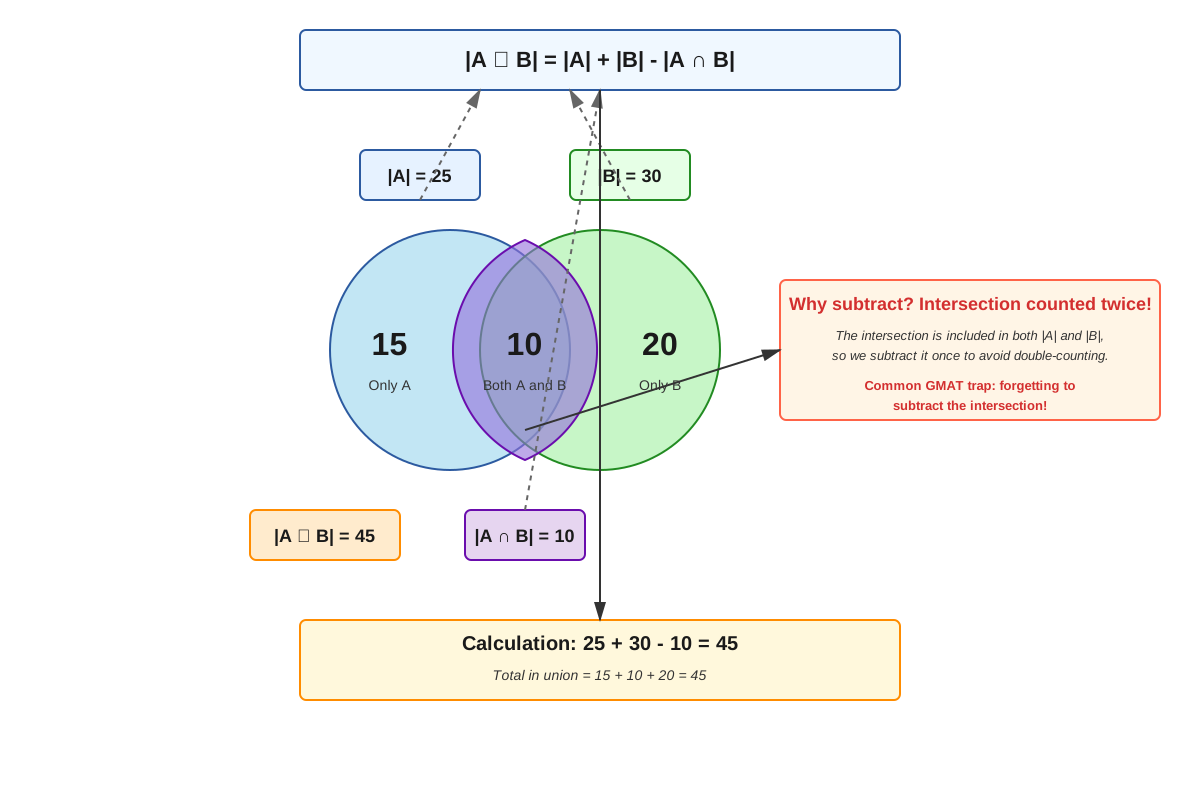
The inclusion-exclusion principle is the most important formula for GMAT set problems. For two sets A and B:
n(A ∪ B) = n(A) + n(B) - n(A ∩ B)This formula states that to find the total number of elements in either set A or set B (or both), add the number in each set and subtract the intersection. The subtraction is necessary because elements in both sets would otherwise be counted twice.
This formula can be rearranged to solve for any unknown variable:
- To find the intersection: n(A ∩ B) = n(A) + n(B) - n(A ∪ B)
- To find one set given the other: n(A) = n(A ∪ B) - n(B) + n(A ∩ B)
When the problem includes a universal set with elements belonging to neither set, the formula expands:
Total = n(A only) + n(B only) + n(A ∩ B) + n(Neither)Where:
- n(A only) = n(A) - n(A ∩ B)
- n(B only) = n(B) - n(A ∩ B)
Venn Diagrams for Two Sets
Venn diagrams provide powerful visual representations of set relationships. For two-set problems, draw two overlapping circles within a rectangle (representing the universal set). The overlapping region represents the intersection, while the non-overlapping portions represent elements exclusive to each set.
A systematic approach to filling in a Venn diagram:
- Start with the intersection (the overlapping region)
- Calculate "A only" by subtracting the intersection from the total in A
- Calculate "B only" by subtracting the intersection from the total in B
- If given the total, calculate "Neither" by subtracting all other regions from the total
This visual organization prevents double-counting errors and makes complex relationships immediately apparent.
Three-Set Problems
Three-set problems significantly increase complexity but follow similar principles. The inclusion-exclusion principle for three sets A, B, and C is:
n(A ∪ B ∪ C) = n(A) + n(B) + n(C) - n(A ∩ B) - n(A ∩ C) - n(B ∩ C) + n(A ∩ B ∩ C)The formula adds all three sets, subtracts the three pairwise intersections (to correct for double-counting), then adds back the three-way intersection (because it was subtracted three times but should only be subtracted twice).
For three-set Venn diagrams, draw three overlapping circles creating seven distinct regions:
- A only
- B only
- C only
- A and B only (not C)
- A and C only (not B)
- B and C only (not A)
- All three (A ∩ B ∩ C)
Plus an eighth region outside all circles representing "None."
The systematic approach for three sets:
- Start with the center (all three sets)
- Fill in the three pairwise-only regions
- Calculate the three exclusive regions
- Determine "None" if the total is given
Common GMAT Set Problem Patterns
| Pattern Type | Description | Key Strategy |
|---|---|---|
| Exactly one | Elements in exactly one set (not both) | Calculate (A only) + (B only) |
| At least one | Elements in one or more sets | Use n(A ∪ B) |
| Neither | Elements in none of the sets | Total - n(A ∪ B) |
| Both | Elements in the intersection | Find n(A ∩ B) directly |
| Only A | Elements exclusively in A | n(A) - n(A ∩ B) |
| Maximum/Minimum | Optimization problems | Consider extreme scenarios |
Concept Relationships
The core concepts within set theory build upon each other in a logical progression. Understanding basic set notation and definitions → enables recognition of set operations (union, intersection, complement) → which form the foundation for the inclusion-exclusion principle → that can be visualized through Venn diagrams → allowing systematic solution of two-set problems → which extend naturally to three-set problems using the same logical framework.
Set theory connects to prerequisite knowledge of algebra through equation-solving when unknown quantities appear in set relationships. The logical reasoning required for sets relates directly to conditional statements and logical operators studied in Critical Reasoning. Furthermore, set theory provides essential groundwork for probability questions, where calculating favorable outcomes often requires determining the number of elements in specific sets or intersections.
The relationship between sets and other Quantitative Reasoning topics is particularly strong with combinatorics (counting principles), probability (sample spaces and events), and data interpretation (categorizing information). Many GMAT word problems that initially appear to be pure arithmetic or percentage problems can be solved more efficiently by recognizing the underlying set structure and applying inclusion-exclusion principles.
High-Yield Facts
⭐ The inclusion-exclusion formula for two sets is: n(A ∪ B) = n(A) + n(B) - n(A ∩ B)
⭐ When solving set problems, always start by identifying what the universal set represents and what the total is
⭐ In Venn diagrams for two sets, always fill in the intersection first, then calculate the exclusive regions
⭐ The number of elements in "exactly one set" equals n(A only) + n(B only), which equals n(A) + n(B) - 2×n(A ∩ B)
⭐ For three-set problems, the center region (all three sets) must be filled in first to avoid calculation errors
- The complement of set A contains all elements in the universal set that are not in A: n(A') = Total - n(A)
- Elements in "at least one set" equals the union: n(A ∪ B)
- Elements in "neither set" equals: Total - n(A ∪ B)
- The maximum possible intersection occurs when the smaller set is completely contained in the larger set
- The minimum possible intersection can be zero if the sets are disjoint (no overlap)
- For three sets, there are eight distinct regions in a complete Venn diagram (including "none")
- When a problem states "only A," it means A but not B: n(A) - n(A ∩ B)
- Data Sufficiency set problems often test whether you know that both individual set sizes and the intersection are needed to determine the union
Quick check — test yourself on Sets so far.
Try Flashcards →Common Misconceptions
Misconception: The union n(A ∪ B) equals n(A) + n(B) → Correction: This is only true when sets are disjoint (no overlap). Generally, n(A ∪ B) = n(A) + n(B) - n(A ∩ B) because the intersection must be subtracted to avoid double-counting elements that belong to both sets.
Misconception: "At least one" and "exactly one" mean the same thing → Correction: "At least one" includes elements in A only, B only, or both (the union), while "exactly one" includes only elements in A only or B only, excluding the intersection. The difference is n(A ∩ B).
Misconception: In three-set problems, you can simply add all three sets and subtract all three intersections → Correction: You must add back the three-way intersection n(A ∩ B ∩ C) because it gets subtracted three times when you subtract the pairwise intersections, but it should only be subtracted twice.
Misconception: The maximum intersection of two sets equals the larger set → Correction: The maximum intersection equals the smaller set (when the smaller set is completely contained within the larger set). If n(A) = 30 and n(B) = 50, the maximum n(A ∩ B) is 30, not 50.
Misconception: When filling in a Venn diagram, you can start with any region → Correction: Always start with the most specific region (the intersection for two sets, or the center for three sets) and work outward. Starting with other regions leads to errors because you don't know how much overlap to account for.
Misconception: "Neither A nor B" is the same as the complement of A → Correction: "Neither A nor B" means elements in neither set, which equals the complement of the union: (A ∪ B)'. The complement of A alone, A', includes elements in B but not A, which is different.
Misconception: In Data Sufficiency, knowing n(A) and n(B) is always sufficient to determine n(A ∪ B) → Correction: You also need to know n(A ∩ B). Without information about the intersection, the union cannot be determined because the overlap could range from zero to the minimum of n(A) and n(B).
Worked Examples
Example 1: Two-Set Problem with Universal Set
Problem: In a survey of 100 students, 65 students study Mathematics, 48 students study Physics, and 10 students study neither subject. How many students study both Mathematics and Physics?
Solution:
Step 1: Identify the given information and what we need to find.
- Total students (Universal set): 100
- n(M) = 65 (Mathematics students)
- n(P) = 48 (Physics students)
- Neither = 10
- Find: n(M ∩ P) (students studying both)
Step 2: Determine n(M ∪ P), the number studying at least one subject.
Since 10 students study neither subject:
n(M ∪ P) = Total - Neither = 100 - 10 = 90
Step 3: Apply the inclusion-exclusion principle.
n(M ∪ B) = n(M) + n(P) - n(M ∩ P)
90 = 65 + 48 - n(M ∩ P)
90 = 113 - n(M ∩ P)
n(M ∩ P) = 113 - 90 = 23
Answer: 23 students study both Mathematics and Physics.
Verification using a Venn diagram:
- Both subjects: 23
- Mathematics only: 65 - 23 = 42
- Physics only: 48 - 23 = 25
- Neither: 10
- Total: 42 + 23 + 25 + 10 = 100 ✓
This problem demonstrates the essential strategy of first calculating the union when given information about "neither," then applying inclusion-exclusion to find the intersection.
Example 2: Three-Set Problem
Problem: A company surveyed 200 employees about their language skills. 90 speak Spanish, 80 speak French, 75 speak German, 35 speak both Spanish and French, 30 speak both Spanish and German, 28 speak both French and German, and 15 speak all three languages. How many employees speak none of these languages?
Solution:
Step 1: Organize the given information.
- Total = 200
- n(S) = 90, n(F) = 80, n(G) = 75
- n(S ∩ F) = 35, n(S ∩ G) = 30, n(F ∩ G) = 28
- n(S ∩ F ∩ G) = 15
- Find: None
Step 2: Apply the three-set inclusion-exclusion principle to find n(S ∪ F ∪ G).
n(S ∪ F ∪ G) = n(S) + n(F) + n(G) - n(S ∩ F) - n(S ∩ G) - n(F ∩ G) + n(S ∩ F ∩ G)
n(S ∪ F ∪ G) = 90 + 80 + 75 - 35 - 30 - 28 + 15
n(S ∪ F ∪ G) = 245 - 93 + 15 = 167
Step 3: Calculate employees speaking none of the languages.
None = Total - n(S ∪ F ∪ G) = 200 - 167 = 33
Answer: 33 employees speak none of these languages.
Verification using Venn diagram regions:
- All three: 15
- Spanish and French only: 35 - 15 = 20
- Spanish and German only: 30 - 15 = 15
- French and German only: 28 - 15 = 13
- Spanish only: 90 - 20 - 15 - 15 = 40
- French only: 80 - 20 - 13 - 15 = 32
- German only: 75 - 15 - 13 - 15 = 32
- None: 33
- Total: 15 + 20 + 15 + 13 + 40 + 32 + 32 + 33 = 200 ✓
This example illustrates the systematic approach required for three-set problems and demonstrates why the three-way intersection must be added back in the inclusion-exclusion formula.
Exam Strategy
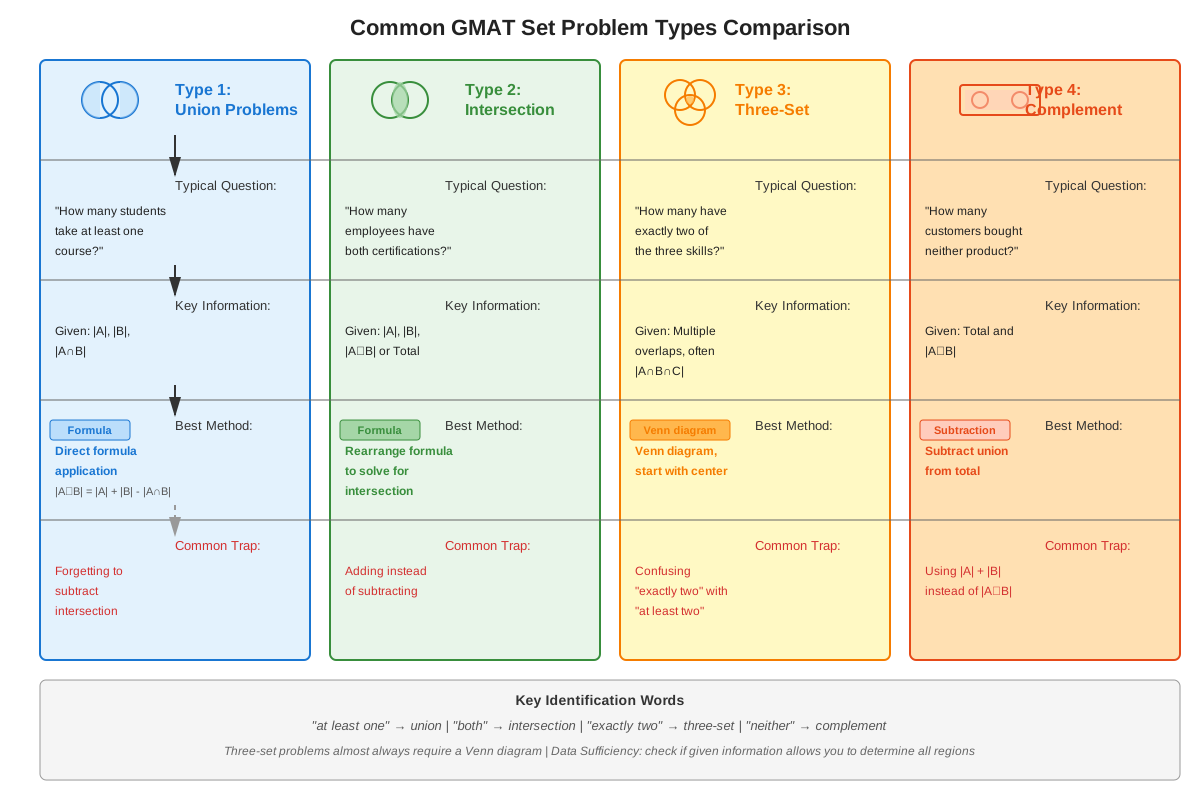
When approaching GMAT set problems, begin by quickly identifying whether the question involves two or three sets, as this determines which formula and strategy to apply. Look for keywords that signal set relationships: "both," "either," "neither," "only," "at least," and "exactly" are critical trigger words that define what you need to calculate.
Trigger words and their meanings:
- "Both" → intersection (A ∩ B)
- "Either...or" → union (A ∪ B)
- "Neither...nor" → complement of union
- "Only A" → A but not B
- "At least one" → union
- "Exactly one" → exclusive regions only
- "All three" → three-way intersection
Systematic problem-solving approach:
- Read carefully and identify the universal set (total)
- List all given information with proper notation
- Identify what the question asks for
- Draw a Venn diagram if the problem involves multiple relationships
- Fill in the diagram starting from the most specific region (intersection/center)
- Apply the inclusion-exclusion principle
- Verify your answer makes logical sense (no negative numbers, doesn't exceed total)
Data Sufficiency specific strategies:
For set problems in Data Sufficiency format, remember that to determine a union, you typically need three pieces of information: n(A), n(B), and n(A ∩ B). Each statement alone often provides only one or two of these values. Look for statements that provide:
- Direct information about the intersection
- Information about "only A" or "only B" (which allows calculating the intersection)
- The total and information about "neither" (which gives the union)
Time management:
Two-set problems should take 1.5-2 minutes, while three-set problems may require 2-3 minutes. If you find yourself spending more time, consider whether you've drawn a Venn diagram—visual organization often speeds up solution time significantly. For complex three-set problems, investing 30 seconds to draw and label a diagram carefully can save a minute in calculations and prevent errors.
Process of elimination tips:
- Eliminate answers that exceed the total or any individual set size
- Eliminate answers that are negative (impossible for counting problems)
- For intersection questions, eliminate answers greater than the smaller set
- For union questions, eliminate answers less than the larger individual set
- Check extreme cases: what if there's no overlap? What if maximum overlap?
Memory Techniques
Mnemonic for the inclusion-exclusion principle: "Add Both, Subtract Overlap" (ABSO)
- Add set A
- Add set B (Both sets)
- Subtract the Overlap (intersection)
Visualization strategy for Venn diagrams: Think of the acronym "COIN" for filling in two-set diagrams:
- Center first (intersection)
- Outside regions next (A only, B only)
- Integrate the total
- Neither last (if applicable)
Three-set formula memory aid: "Add Three, Subtract Pairs, Add Center"
- Add all three individual sets
- Subtract all three pairs of intersections
- Add back the center (three-way intersection)
For "exactly one" vs. "at least one": Remember "EXACT = EXclude intersection"
- Exactly one excludes the intersection
- At least one includes everything (the union)
Maximum/Minimum intersection memory trick: "Small Max, Zero Min"
- Maximum intersection = the smaller set (when one set contains the other)
- Minimum intersection = zero (when sets don't overlap at all)
Summary
Sets represent collections of distinct elements and form a critical foundation for GMAT Quantitative Reasoning questions involving overlapping groups and counting problems. The inclusion-exclusion principle—n(A ∪ B) = n(A) + n(B) - n(A ∩ B) for two sets—is the essential formula that prevents double-counting when calculating unions. Venn diagrams provide powerful visual tools for organizing information, and the systematic approach of filling in the most specific regions first (intersections before exclusive regions) prevents calculation errors. Three-set problems extend these principles with a more complex formula that adds all three sets, subtracts the three pairwise intersections, and adds back the three-way intersection. Success on GMAT set problems requires recognizing trigger words like "both," "either," "neither," and "only," translating verbal descriptions into mathematical relationships, and applying formulas systematically. Understanding when elements belong to "exactly one" set versus "at least one" set is crucial, as is accounting for elements belonging to none of the sets when a universal set is specified. Mastery of set theory enables efficient solution of word problems involving surveys, demographics, course enrollments, and any scenario with overlapping categories.
Key Takeaways
- The inclusion-exclusion principle for two sets—n(A ∪ B) = n(A) + n(B) - n(A ∩ B)—is the most important formula for GMAT set problems and must be memorized and applied correctly
- Always start Venn diagrams by filling in the intersection (two sets) or center region (three sets) first, then work outward to exclusive regions to avoid double-counting errors
- "At least one" refers to the union (includes intersection), while "exactly one" excludes the intersection—this distinction appears frequently in GMAT questions
- For problems involving a universal set, calculate "neither" by subtracting the union from the total: Neither = Total - n(A ∪ B)
- The maximum possible intersection equals the size of the smaller set; the minimum possible intersection is zero (when sets are disjoint)
- Three-set problems require adding back the three-way intersection after subtracting pairwise intersections to avoid over-correction
- Trigger words like "both," "either," "neither," and "only" signal specific set operations and should immediately guide your solution approach
Related Topics
Probability: Set theory provides the foundation for calculating probabilities, as events in probability are sets of outcomes. Understanding unions and intersections directly translates to calculating probabilities of compound events using addition and multiplication rules.
Combinatorics and Counting: Advanced counting problems often require set theory to avoid double-counting when objects can be categorized in multiple ways. The inclusion-exclusion principle extends to more complex counting scenarios.
Data Interpretation: Many data interpretation questions involve categorizing information into overlapping groups. Set theory provides the framework for analyzing tables and charts showing multiple characteristics.
Logic and Conditional Statements: The logical operators "and," "or," and "not" correspond directly to set operations (intersection, union, and complement), making set theory essential for formal logical reasoning.
Mastering sets creates a strong foundation for these related topics and enhances overall problem-solving ability across the Quantitative Reasoning section.
Practice CTA
Now that you've mastered the core concepts of sets, it's time to reinforce your learning through active practice. Attempt the practice questions to apply the inclusion-exclusion principle, construct Venn diagrams, and solve both two-set and three-set problems under timed conditions. Use the flashcards to memorize key formulas, trigger words, and common problem patterns until they become automatic. Remember, set theory is one of the highest-yield topics on the GMAT—investing time in deliberate practice now will pay significant dividends on test day. Challenge yourself with increasingly complex problems, and don't just solve for the answer; analyze why each approach works and how you can recognize similar patterns faster. Your ability to quickly identify set relationships and apply systematic strategies will set you apart and boost your Quantitative Reasoning score significantly.
Sign up free to keep reading
Create a free AnvayaPrep account to finish this GMAT guide on Sets — plus flashcards and practice questions.