Overview
Causal reasoning is one of the most frequently tested concepts in GMAT Critical Reasoning, appearing in approximately 25-30% of all Critical Reasoning questions. This topic examines the relationship between causes and effects, requiring test-takers to evaluate whether one event or condition genuinely produces another, or whether the relationship might be coincidental, reversed, or influenced by other factors. Mastering causal reasoning is essential because the GMAT consistently tests the ability to identify flawed causal claims, strengthen or weaken causal arguments, and recognize alternative explanations for observed correlations.
GMAT causal reasoning questions challenge students to think critically about the logical structure of arguments that claim one thing causes another. These questions appear across multiple question types including Strengthen, Weaken, Assumption, Evaluate, and Explain questions. The ability to dissect causal claims separates high scorers from average performers because it requires sophisticated analytical thinking rather than mere content knowledge. Students must learn to distinguish between correlation and causation, identify confounding variables, recognize reverse causation, and spot alternative explanations.
Within the broader Verbal Reasoning section, causal reasoning connects intimately with other Critical Reasoning skills such as identifying assumptions, evaluating evidence, and recognizing argument structure. It also relates to Reading Comprehension passages that present scientific studies or business analyses where causal claims appear. Understanding causal reasoning provides a foundation for analyzing complex arguments throughout the GMAT and develops critical thinking skills applicable to business school case studies and real-world decision-making.
Learning Objectives
- [ ] Identify causal reasoning patterns in GMAT Critical Reasoning passages
- [ ] Explain the logical structure and components of causal arguments
- [ ] Apply causal reasoning principles to strengthen, weaken, and evaluate GMAT questions
- [ ] Distinguish between correlation and causation in argument passages
- [ ] Recognize common causal fallacies including reverse causation and confounding variables
- [ ] Evaluate alternative explanations that challenge causal claims
- [ ] Construct valid causal reasoning chains to solve complex multi-step problems
Prerequisites
- Basic argument structure: Understanding premises, conclusions, and how evidence supports claims is essential because causal reasoning builds upon fundamental argument analysis
- Logical reasoning fundamentals: Familiarity with necessary and sufficient conditions helps distinguish between causes that must occur versus those that merely correlate
- Evidence evaluation: The ability to assess the strength and relevance of evidence enables proper evaluation of whether data truly supports a causal claim
- Reading comprehension skills: Accurately identifying what an argument states versus what it assumes is critical for spotting unstated causal links
Why This Topic Matters
Causal reasoning appears throughout business, science, and policy-making contexts that MBA students will encounter. Understanding causation enables executives to make data-driven decisions, avoid costly mistakes based on spurious correlations, and design effective interventions. When a company observes that sales increased after launching a marketing campaign, causal reasoning helps determine whether the campaign actually caused the increase or whether other factors (seasonality, competitor actions, economic trends) explain the change.
On the GMAT, causal reasoning questions appear in approximately 8-10 of the 36 Verbal questions, making them among the highest-yield topics for score improvement. These questions typically present arguments claiming that X causes Y, then ask test-takers to identify assumptions, strengthen or weaken the argument, or explain an apparent paradox. The GMAT favors causal reasoning because it directly tests the analytical skills needed for business school success.
Common manifestations include: business scenarios where companies attribute outcomes to specific strategies; scientific studies claiming one variable affects another; social science research linking behaviors to outcomes; and policy arguments asserting that interventions will produce desired effects. The GMAT particularly favors scenarios involving surveys, studies, correlations between variables, and before-after comparisons where causal claims seem plausible but may be flawed.
Core Concepts
Understanding Causal Claims
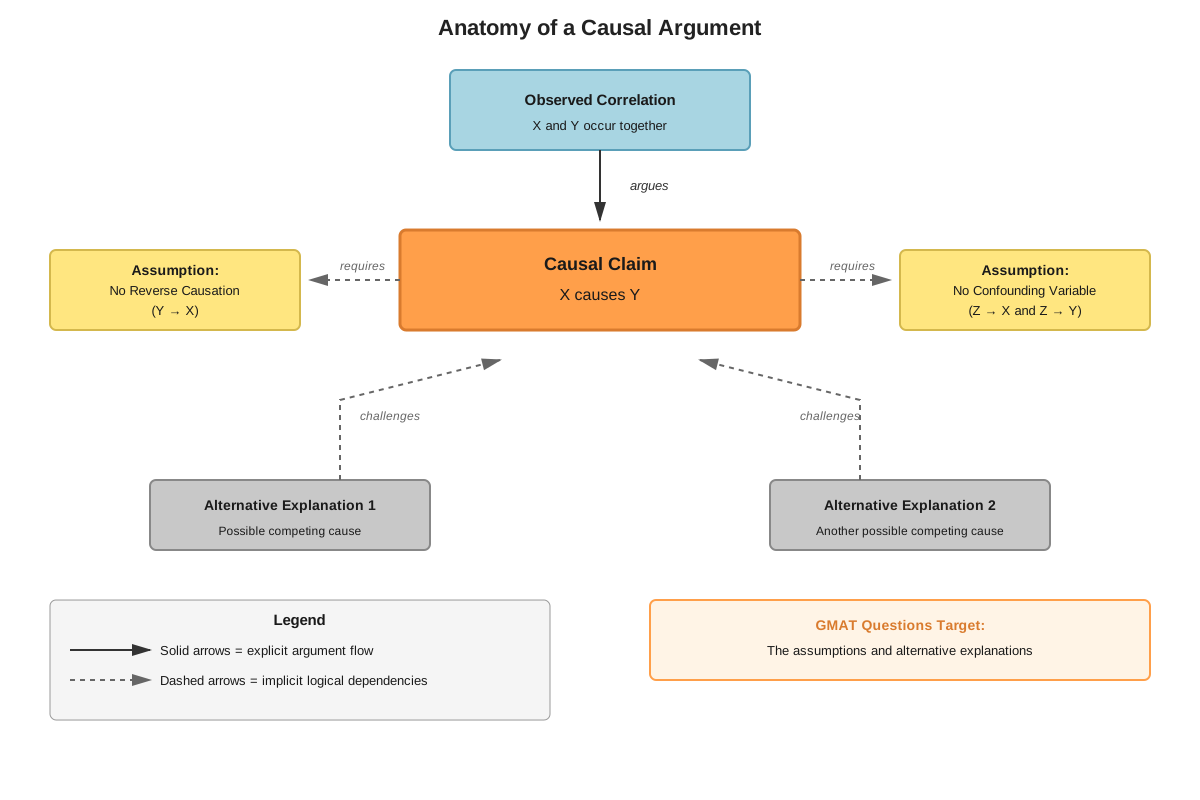
A causal claim asserts that one event, condition, or factor (the cause) produces, brings about, or is responsible for another event or condition (the effect). The basic structure follows: "X causes Y" or "Y occurs because of X." In GMAT passages, causal language includes phrases like "leads to," "results in," "is responsible for," "produces," "brings about," "due to," "because of," and "accounts for." Recognizing these trigger phrases helps identify when an argument makes a causal assertion.
Causal relationships differ fundamentally from mere correlations. A correlation means two things occur together or vary together, but one doesn't necessarily cause the other. The GMAT exploits this distinction relentlessly. When an argument observes that A and B occur together and concludes that A causes B, it commits a logical leap that creates vulnerability. The argument assumes no alternative explanation exists for the correlation.
The Correlation-Causation Distinction
This represents the foundation of GMAT causal reasoning. Consider: "Countries with higher chocolate consumption have more Nobel Prize winners; therefore, eating chocolate causes intellectual achievement." The correlation exists (the data may be accurate), but the causal inference is flawed. Alternative explanations include: wealth enables both chocolate consumption and quality education; cultural factors promote both; or the relationship is purely coincidental.
The GMAT tests this distinction by presenting arguments that observe correlations and jump to causal conclusions. Strong test-takers immediately ask: "Could something else explain this correlation?" This critical question unlocks most causal reasoning questions.
Types of Causal Flaws
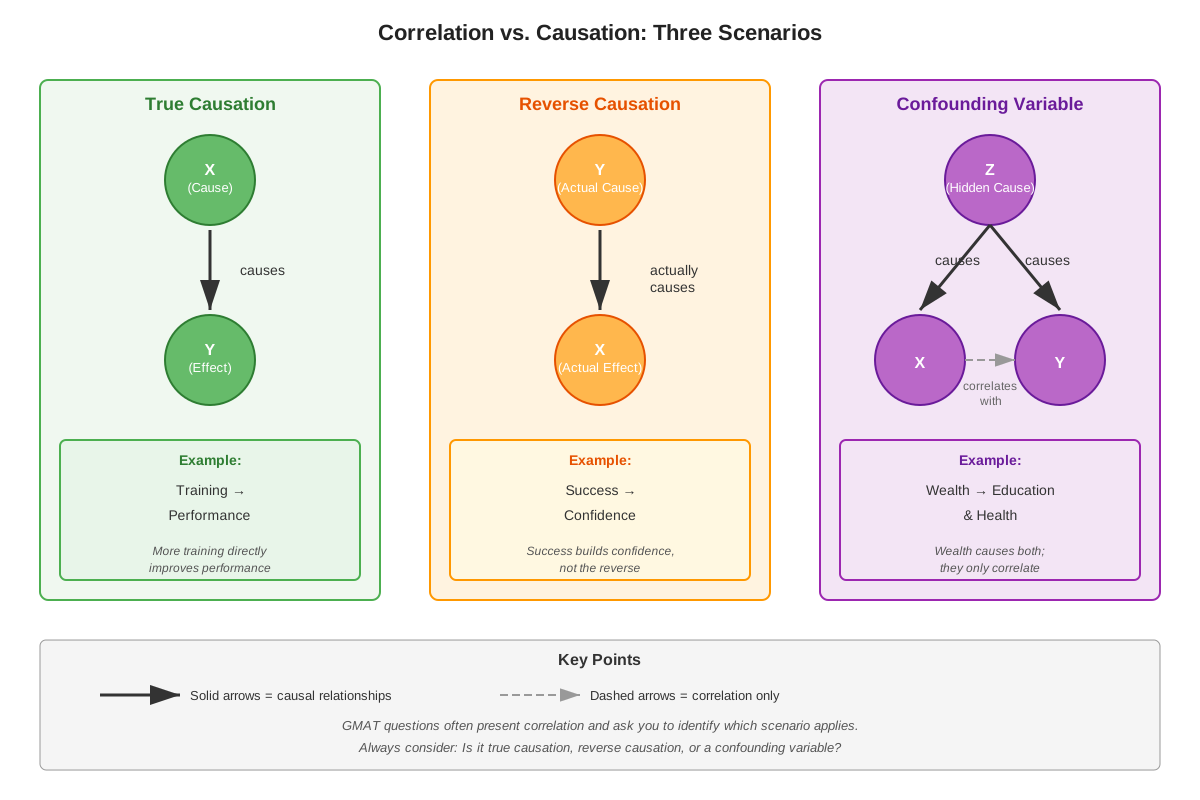
Reverse Causation: The argument claims X causes Y when actually Y causes X, or the causation runs in the opposite direction. Example: "People who exercise regularly report better moods; therefore, good moods cause people to exercise." The reverse may be true—exercise may cause better moods.
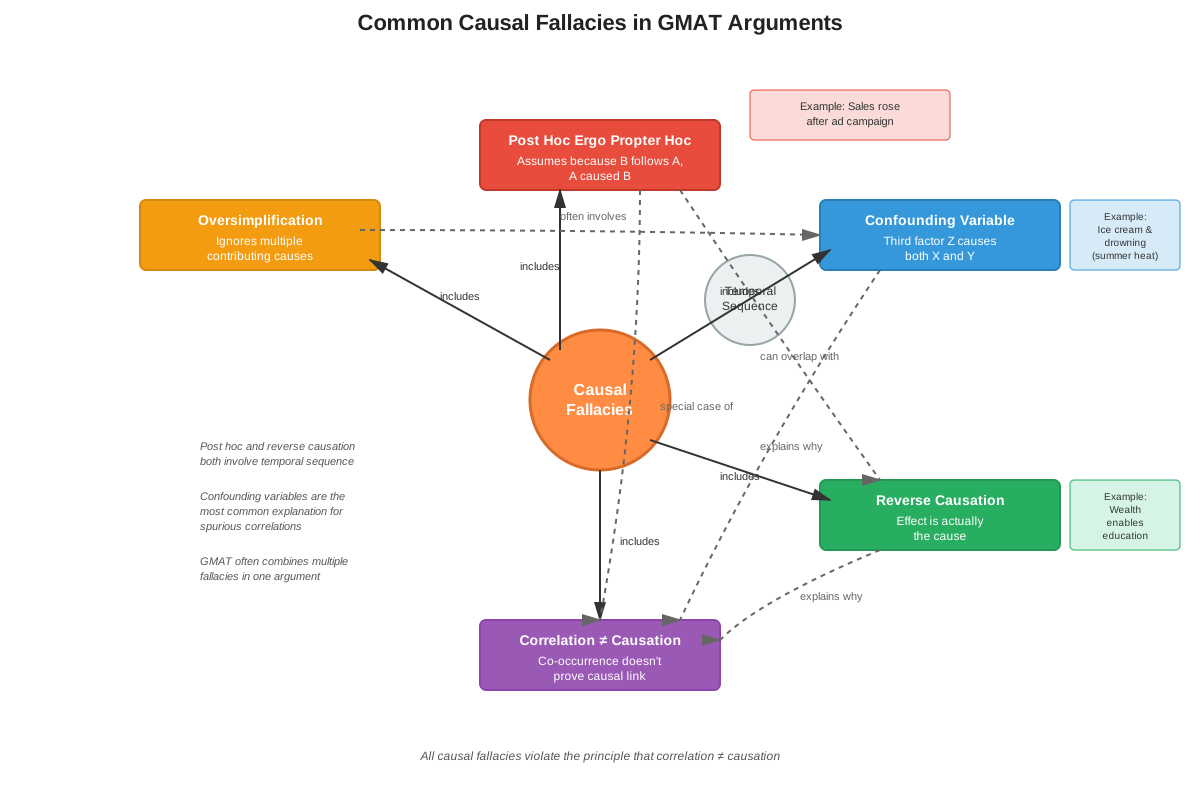
Common Cause (Confounding Variable): A third factor Z causes both X and Y, creating a correlation between them without direct causation. Example: "Ice cream sales and drowning deaths both increase in summer; therefore, ice cream causes drowning." Temperature (Z) causes both increased ice cream consumption (X) and more swimming/drowning (Y).
Coincidence: The correlation is purely accidental with no causal relationship. This is less common on the GMAT but appears when the sample size is small or the relationship is implausible.
Multiple Causes: The argument assumes X is the only cause of Y, ignoring that Y might have multiple contributing factors. Example: "Sales increased after we hired a new manager; therefore, the new manager caused the sales increase." Other factors (market conditions, new products, competitor problems) might contribute.
Causal Reasoning Question Types
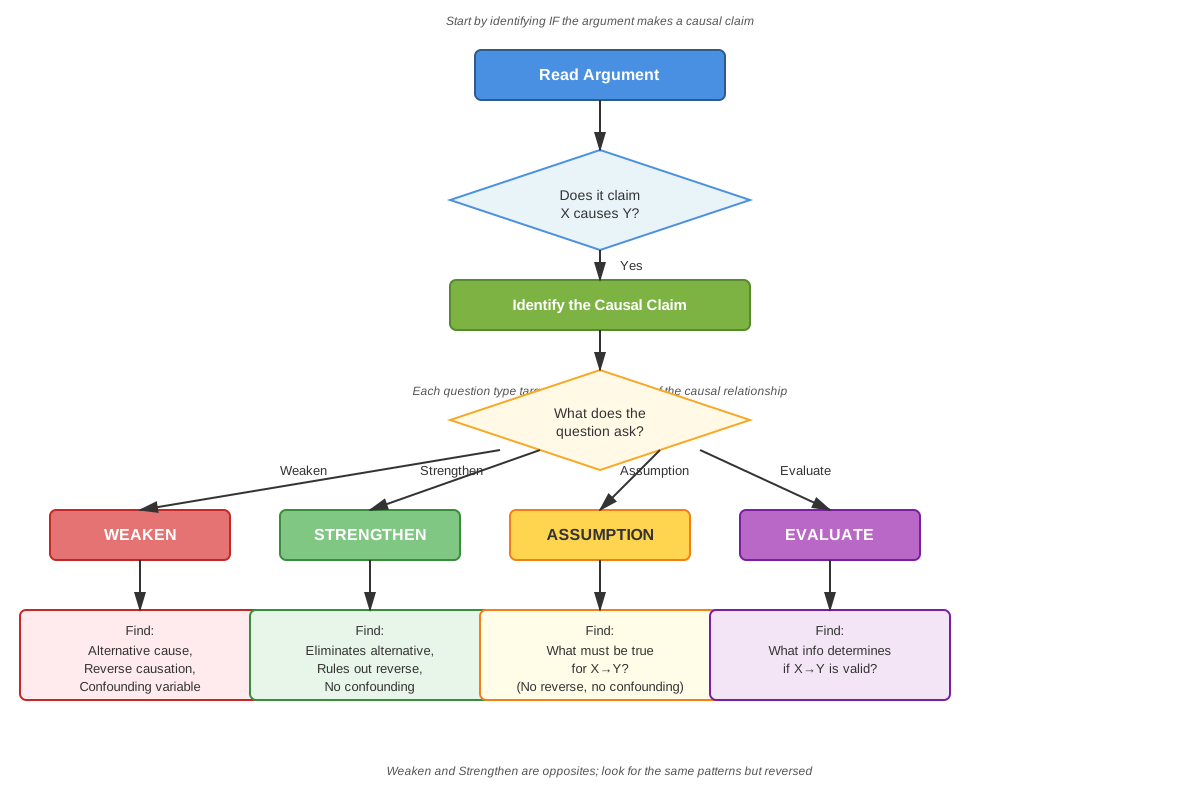
| Question Type | What It Tests | Approach |
|---|---|---|
| Weaken | Finding evidence that challenges the causal claim | Identify alternative causes, show correlation without causation, demonstrate reverse causation |
| Strengthen | Finding evidence that supports the causal claim | Eliminate alternative explanations, show cause precedes effect, demonstrate mechanism |
| Assumption | Identifying what the argument takes for granted | Find the gap between correlation and causation, identify assumed absence of alternatives |
| Evaluate | Determining what information would help assess the argument | Ask what would distinguish between the claimed cause and alternatives |
| Explain | Resolving an apparent paradox in causal relationships | Find a factor that accounts for unexpected results |
Strengthening Causal Arguments
To strengthen a causal claim that X causes Y, evidence should:
- Eliminate alternative explanations: Show that other potential causes are not responsible
- Establish temporal sequence: Demonstrate that X occurs before Y (causes must precede effects)
- Show mechanism: Explain how X produces Y through a logical process
- Demonstrate correlation strength: Show the relationship is consistent and proportional
- Rule out reverse causation: Prove Y doesn't cause X instead
- Control for confounding variables: Show the relationship holds when other factors are constant
Weakening Causal Arguments
To weaken a causal claim that X causes Y, evidence should:
- Provide alternative explanations: Identify other factors that could cause Y
- Show reverse causation: Demonstrate that Y might cause X
- Identify confounding variables: Point to a common cause of both X and Y
- Break the temporal sequence: Show Y sometimes occurs before X
- Demonstrate inconsistency: Show cases where X occurs without Y or Y without X
- Question the mechanism: Challenge how X could plausibly produce Y
Causal Chains and Complex Causation
Some GMAT questions present causal chains where X causes Y, which causes Z. These arguments are vulnerable at each link. To weaken such arguments, attack any single link. To strengthen them, support all links. Example: "Reducing prices (X) will increase sales volume (Y), which will increase total revenue (Z)." This assumes price reduction causes higher volume AND higher volume causes higher revenue—both links need support.
Necessary versus Sufficient Causes: A necessary cause must be present for the effect to occur, but its presence alone doesn't guarantee the effect. A sufficient cause, when present, guarantees the effect occurs. The GMAT tests whether students confuse these concepts. Most causal claims on the GMAT assert sufficient causation (X is enough to produce Y) when only correlation or necessary causation exists.
Concept Relationships
Causal reasoning forms the analytical core connecting multiple Critical Reasoning concepts. The relationship flows as follows:
Argument Structure → Causal Reasoning → Assumption Identification: Understanding basic argument structure (premises supporting conclusions) enables recognition of causal claims, which then reveals unstated assumptions about the absence of alternative causes.
Evidence Evaluation ↔ Causal Reasoning: These concepts interact bidirectionally. Evaluating whether evidence supports a conclusion requires assessing causal claims, while understanding causation helps determine what evidence would be relevant.
Causal Reasoning → Strengthen/Weaken Questions: Mastering causal reasoning directly enables solving the most common Critical Reasoning question types, as these typically involve supporting or challenging causal claims.
Correlation-Causation Distinction → Alternative Explanations → Confounding Variables: This progression represents increasing sophistication in causal analysis. First, recognize that correlation doesn't prove causation. Second, actively generate alternative explanations. Third, specifically identify confounding variables that create spurious correlations.
Reverse Causation ↔ Temporal Sequence: Understanding that causes must precede effects helps identify reverse causation errors and strengthens arguments by establishing proper timing.
Within the broader Verbal Reasoning section, causal reasoning connects to Reading Comprehension passages that present research studies, business analyses, or policy arguments. The same analytical skills apply: questioning whether claimed relationships are truly causal, considering alternatives, and evaluating evidence quality.
High-Yield Facts
⭐ Correlation does not prove causation—this is the single most important principle in GMAT causal reasoning and appears in approximately 40% of causal questions
⭐ Causal arguments assume no alternative explanation exists—identifying this assumption is key to solving Assumption questions
⭐ Reverse causation is a common wrong answer trap—the GMAT frequently includes answer choices suggesting Y causes X when the argument claims X causes Y
⭐ Strengthening causal arguments requires eliminating alternatives—the most effective strengtheners rule out other potential causes
⭐ Temporal sequence is necessary but not sufficient for causation—X must occur before Y for X to cause Y, but this alone doesn't prove causation
- Confounding variables create spurious correlations by causing both observed factors
- Multiple causes can produce the same effect, making single-cause arguments vulnerable
- The phrase "responsible for" signals a causal claim requiring scrutiny
- Causal mechanisms (explaining how X produces Y) strengthen arguments more than mere correlation data
- Sample size and representativeness affect the reliability of causal inferences from studies
- Control groups help establish causation by isolating the proposed cause from other variables
- Proportional relationships (more X correlates with more Y) suggest but don't prove causation
- The absence of the cause should correlate with absence of the effect if true causation exists
- Causal claims in business contexts often ignore market conditions, competitor actions, and economic trends
- Scientific studies cited in GMAT passages may have methodological flaws that undermine causal claims
Quick check — test yourself on Causal reasoning so far.
Try Flashcards →Common Misconceptions
Misconception: If X and Y are correlated, X must cause Y, Y must cause X, or they must cause each other.
Correction: Correlation can result from X causing Y, Y causing X, a third factor causing both, or pure coincidence. The GMAT exploits this by presenting correlations and asking students to evaluate causal claims.
Misconception: Temporal sequence proves causation—if X happens before Y, X causes Y.
Correction: While causes must precede effects, temporal sequence alone is insufficient. Many things happen before other things without causing them. The rooster crows before sunrise, but doesn't cause it.
Misconception: To weaken a causal argument, you must prove the cause doesn't produce the effect.
Correction: Weakening requires only raising reasonable doubt, not definitive disproof. Identifying a plausible alternative explanation or confounding variable sufficiently weakens the argument.
Misconception: Strengthening a causal argument requires proving the causal mechanism.
Correction: While explaining the mechanism helps, the most effective strengtheners eliminate alternative explanations. Showing that other potential causes are absent or controlled for provides stronger support than mechanism alone.
Misconception: If an argument identifies a correlation, it's automatically flawed.
Correction: Correlations can indicate genuine causal relationships when properly supported. The flaw occurs when arguments jump from correlation to causation without adequate justification, not in observing correlations themselves.
Misconception: Reverse causation and confounding variables are the same thing.
Correction: Reverse causation means the effect actually causes the supposed cause (Y→X instead of X→Y). Confounding variables mean a third factor Z causes both X and Y. These are distinct logical flaws requiring different types of evidence to identify.
Misconception: All causal arguments on the GMAT are flawed.
Correction: Some causal arguments are well-supported. The GMAT tests the ability to distinguish strong from weak causal reasoning, not to reflexively reject all causal claims. Strengthen questions require identifying evidence that supports causal arguments.
Worked Examples
Example 1: Weaken Question
Passage: "A recent study found that employees who work from home three or more days per week report 30% higher job satisfaction than those who work exclusively in the office. Therefore, allowing employees to work from home causes increased job satisfaction."
Question: Which of the following, if true, most weakens the argument?
Analysis Process:
- Identify the causal claim: Working from home (cause) → increased job satisfaction (effect)
- Recognize the evidence type: Correlation between work location and satisfaction
- Identify the logical gap: The argument assumes the work arrangement causes satisfaction rather than other factors explaining both
- Generate alternative explanations:
- Reverse causation: Satisfied employees might be granted work-from-home privileges
- Confounding variable: Job type, seniority, or personality might affect both work location and satisfaction
- Selection bias: Employees who choose to work from home might differ systematically
- Evaluate answer choices (hypothetical):
- (A) Employees who work from home save an average of 90 minutes daily on commuting [Irrelevant—doesn't address causation]
- (B) The study included only employees who had specifically requested work-from-home arrangements [CORRECT—suggests selection bias; satisfied employees request the arrangement]
- (C) Job satisfaction has been increasing across all work arrangements over the past five years [Weakens slightly but doesn't address the specific causal claim]
- (D) Working from home requires reliable internet and a dedicated workspace [Irrelevant to the causal relationship]
- (E) Some employees report feeling isolated when working from home [Weakens but less directly than B]
Answer: (B) most effectively weakens the argument by suggesting reverse causation or selection bias—employees who are already satisfied (or have certain characteristics) request and receive work-from-home arrangements, rather than the arrangement causing satisfaction.
Connection to Learning Objectives: This example demonstrates identifying causal reasoning (the claim that work arrangement causes satisfaction), explaining the logical structure (correlation presented as causation), and applying principles to weaken the argument by identifying alternative explanations.
Example 2: Strengthen Question
Passage: "City officials noticed that neighborhoods with more street trees have lower crime rates. They concluded that planting more trees in high-crime areas will reduce crime."
Question: Which of the following, if true, most strengthens the city officials' conclusion?
Analysis Process:
- Identify the causal claim: More street trees (cause) → lower crime rates (effect)
- Identify vulnerabilities:
- Reverse causation: Low-crime neighborhoods might invest more in beautification including trees
- Confounding variables: Wealth, community engagement, or population density might affect both tree planting and crime
- Correlation without causation: The relationship might be coincidental
- Determine what would strengthen: Evidence that eliminates alternative explanations or establishes the causal mechanism
- Evaluate answer choices (hypothetical):
- (A) Neighborhoods with more trees also have better lighting and more foot traffic [Introduces confounding variables—weakens rather than strengthens]
- (B) A controlled experiment in a similar city showed that randomly selected neighborhoods where trees were planted experienced crime reductions, while matched control neighborhoods did not [CORRECT—eliminates confounding variables through randomization and controls]
- (C) Trees provide shade and aesthetic benefits that residents value [Irrelevant to crime reduction]
- (D) High-crime neighborhoods typically have fewer resources for tree maintenance [Explains the correlation but doesn't support causation]
- (E) Crime rates vary significantly across neighborhoods with similar tree coverage [Weakens by showing inconsistent correlation]
Answer: (B) most effectively strengthens by describing a controlled experiment that eliminates alternative explanations. Random assignment ensures that confounding variables (wealth, community characteristics) are distributed equally between treatment and control groups, isolating trees as the causal factor.
Connection to Learning Objectives: This example shows how to identify causal reasoning, explain why the argument is vulnerable (confounding variables), and apply strengthening principles by recognizing that controlled experiments eliminate alternatives.
Exam Strategy
Recognition Phase
When reading a Critical Reasoning passage, immediately flag causal language: "causes," "leads to," "results in," "is responsible for," "due to," "because of," "produces," "brings about," "accounts for," "explains why," and "is the reason for." These phrases signal that causal reasoning will be tested. Also watch for correlations presented as evidence: "associated with," "linked to," "correlated with," "occurs together with," or "found in conjunction with."
Analysis Phase
Once you've identified a causal claim, systematically ask:
- What is the claimed cause and effect? Clearly identify both components
- What evidence supports the claim? Usually correlation or temporal sequence
- What's assumed? Typically that no alternative explanation exists
- What are plausible alternatives? Generate 2-3 quickly: reverse causation, confounding variables, multiple causes
Question-Specific Approaches
For Weaken questions: The correct answer typically provides an alternative explanation, identifies a confounding variable, suggests reverse causation, or shows the correlation is inconsistent. Eliminate answers that are irrelevant to the causal claim or that actually strengthen it.
For Strengthen questions: The correct answer eliminates alternatives, establishes temporal sequence, explains the mechanism, or shows the relationship is consistent and proportional. Avoid answers that merely restate the correlation or introduce new confounding variables.
For Assumption questions: The correct answer bridges the gap between correlation and causation, typically stating that no alternative explanation exists or that a potential confounding variable is not responsible.
For Evaluate questions: The correct answer asks about information that would distinguish between the claimed cause and alternatives. Look for questions about temporal sequence, alternative causes, or confounding variables.
Time Management
Allocate approximately 90-120 seconds per Critical Reasoning question. For causal reasoning questions:
- 20-30 seconds: Read and identify the causal claim
- 30-40 seconds: Analyze the logical structure and generate alternatives
- 40-50 seconds: Evaluate answer choices systematically
If you're stuck, eliminate answers that are clearly irrelevant to the causal relationship, then choose from remaining options based on which most directly addresses alternative explanations.
Process of Elimination
Eliminate answers that:
- Address a different part of the argument than the causal claim
- Introduce irrelevant information about the cause or effect
- For Weaken: Actually strengthen the argument or are neutral
- For Strengthen: Introduce new confounding variables or weaken the argument
- Make extreme claims unsupported by the passage
- Confuse necessary and sufficient conditions
Favor answers that:
- Directly address the gap between correlation and causation
- Identify or eliminate specific alternative explanations
- Establish or challenge temporal sequence
- Provide or undermine mechanistic explanations
Memory Techniques
The RACE Mnemonic for Causal Flaws
Reverse causation: Does Y actually cause X?
Alternative explanations: What else could cause Y?
Confounding variables: Does Z cause both X and Y?
Evidence quality: Is the correlation strong, consistent, and well-measured?
The STEM Framework for Strengthening
Show temporal sequence: Cause precedes effect
Test alternatives: Eliminate other explanations
Explain mechanism: How does X produce Y?
Match proportions: More X correlates with more Y consistently
Visualization Strategy
Picture causal relationships as arrows: X → Y. When analyzing arguments, mentally draw alternative arrow patterns:
- Reverse: Y → X
- Common cause: Z → X and Z → Y (two arrows from Z)
- Multiple causes: X → Y and W → Y (two arrows to Y)
This visual approach helps quickly identify which type of flaw or support the question tests.
The "Third Factor" Reminder
When you see correlation, immediately think "third factor?" This automatic response triggers consideration of confounding variables, the most common causal flaw on the GMAT.
Summary
Causal reasoning represents a cornerstone of GMAT Critical Reasoning, testing the ability to distinguish between correlation and causation—a fundamental analytical skill for business decision-making. Arguments claiming that X causes Y are vulnerable when they rely solely on observed correlations without eliminating alternative explanations. The primary causal flaws include reverse causation (Y actually causes X), confounding variables (Z causes both X and Y), and multiple causes (other factors contribute to Y). Strengthening causal arguments requires eliminating alternatives, establishing temporal sequence, or explaining mechanisms. Weakening them involves identifying plausible alternative explanations or confounding variables. Success on causal reasoning questions depends on systematically analyzing the logical structure, generating alternatives, and recognizing that correlation, while potentially indicative of causation, never proves it without additional supporting evidence. The GMAT rewards test-takers who automatically question causal claims and consider what else might explain observed relationships.
Key Takeaways
- Correlation never proves causation—this principle underlies approximately 40% of Critical Reasoning questions and must become automatic
- Causal arguments assume no alternative explanation exists—identifying this gap is key to Assumption questions
- The RACE framework (Reverse, Alternative, Confounding, Evidence) provides a systematic approach to analyzing any causal claim
- Strengthening requires eliminating alternatives, not just providing more correlation data or restating the claim
- Weakening requires only reasonable doubt, not definitive proof that the cause doesn't produce the effect
- Temporal sequence is necessary but insufficient—causes must precede effects, but this alone doesn't establish causation
- Generate 2-3 alternative explanations immediately when you identify a causal claim to prepare for answer choice evaluation
Related Topics
Assumption Questions: Causal reasoning directly enables mastery of Assumption questions, which frequently test unstated assumptions about the absence of alternative causes. Understanding causal logic reveals what arguments take for granted.
Statistical Reasoning: Many causal arguments rely on statistical evidence from studies or surveys. Mastering causal reasoning prepares students to evaluate whether statistical correlations support causal conclusions.
Argument Evaluation: The ability to assess what information would strengthen or weaken arguments builds directly on causal reasoning principles, particularly regarding what evidence would distinguish between competing explanations.
Logical Fallacies: Causal reasoning connects to broader fallacy recognition, including post hoc ergo propter hoc (after this, therefore because of this) and cum hoc ergo propter hoc (with this, therefore because of this).
Scientific Method and Experimental Design: Understanding how controlled experiments establish causation through randomization and control groups deepens causal reasoning skills and appears in advanced GMAT questions.
Practice CTA
Now that you've mastered the principles of causal reasoning, it's time to apply these concepts to actual GMAT questions. The practice questions and flashcards will reinforce your ability to quickly identify causal claims, generate alternative explanations, and select correct answers under time pressure. Remember: causal reasoning is a skill that improves dramatically with deliberate practice. Each question you analyze strengthens your pattern recognition and makes the analytical process faster and more automatic. Approach the practice materials systematically, using the RACE framework and the strategies outlined above. Your investment in mastering this high-yield topic will pay dividends throughout the Critical Reasoning section and beyond.
Sign up free to keep reading
Create a free AnvayaPrep account to finish this GMAT guide on Causal reasoning — plus flashcards and practice questions.