Overview
Statistical reasoning is a critical component of GMAT Critical Reasoning that tests a student's ability to evaluate arguments based on numerical data, surveys, studies, and statistical claims. This skill involves analyzing how data is collected, interpreted, and applied to support or weaken conclusions. On the GMAT, GMAT statistical reasoning questions require test-takers to identify flaws in statistical arguments, recognize sampling biases, understand correlation versus causation, and evaluate the validity of generalizations drawn from limited data sets.
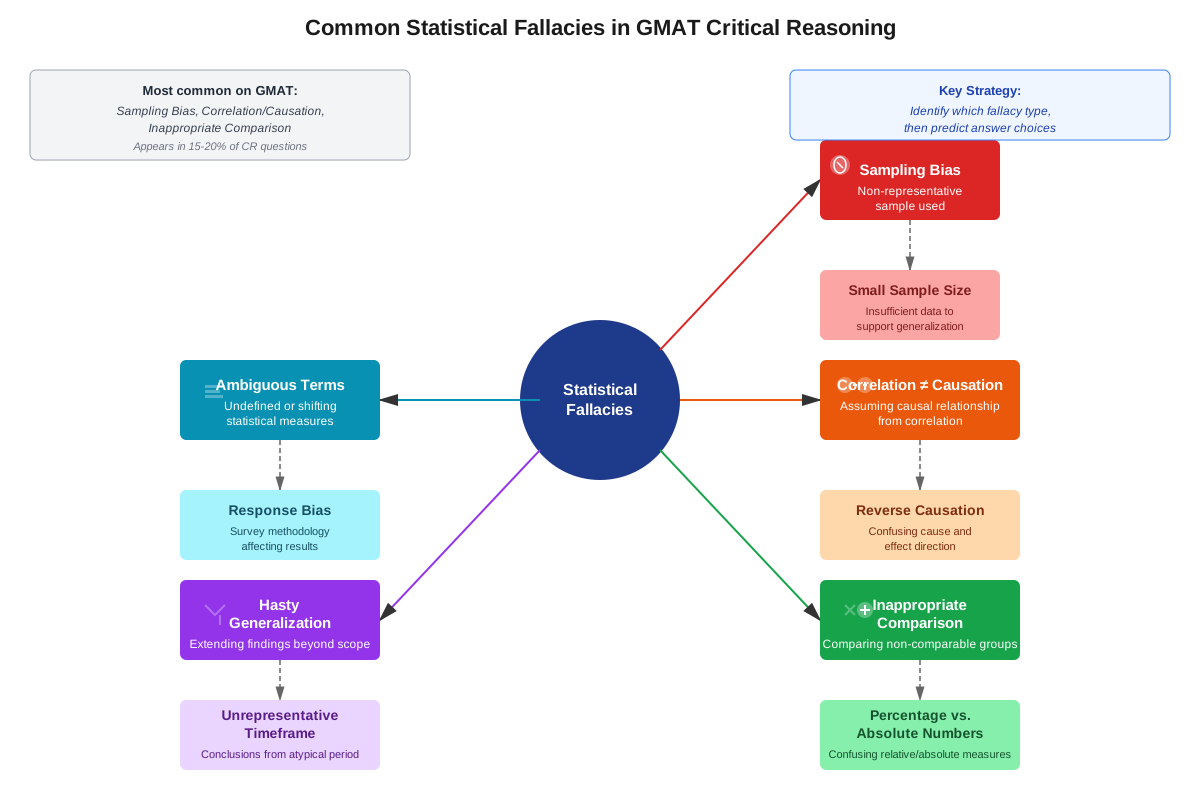
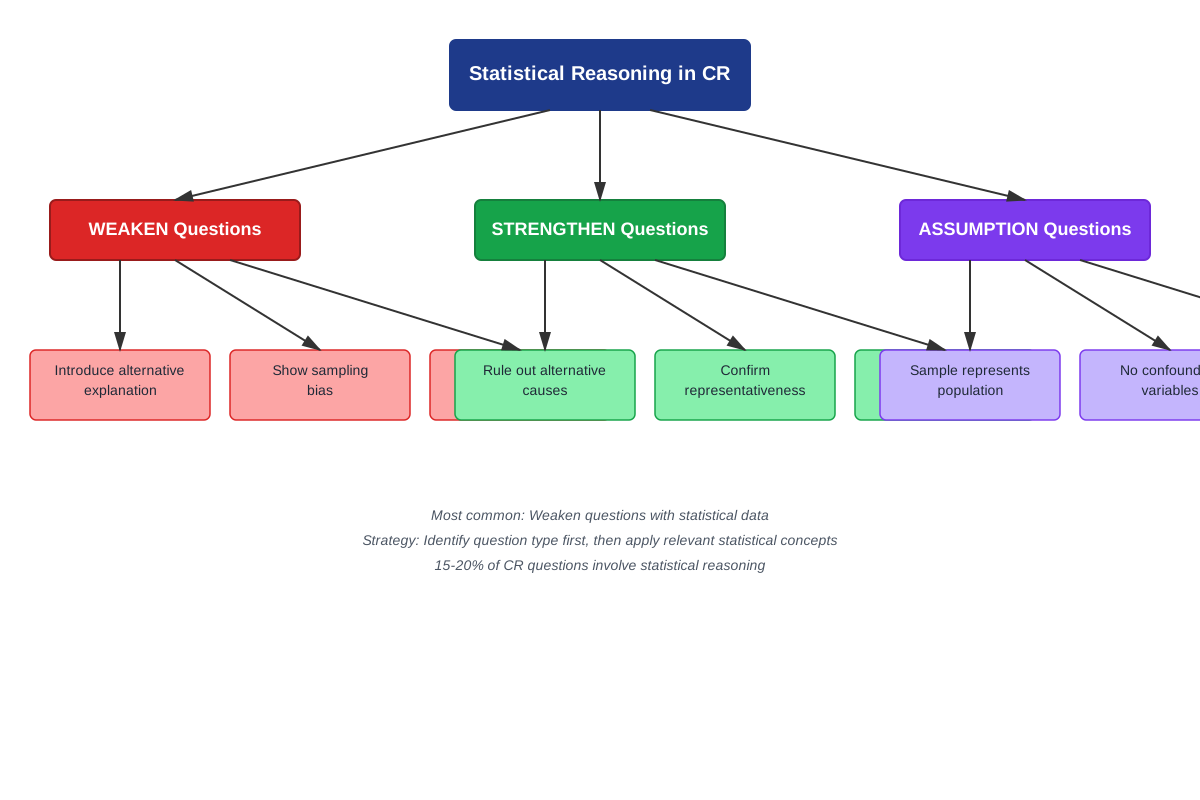
Mastering statistical reasoning is essential for GMAT success because approximately 15-20% of Critical Reasoning questions involve statistical concepts, making it one of the highest-yield topics within Verbal Reasoning. These questions often appear as Weaken, Strengthen, Assumption, or Evaluate questions that incorporate numerical evidence, percentages, averages, or study results. Students who can quickly identify statistical fallacies and reasoning errors gain a significant competitive advantage on test day.
Statistical reasoning connects deeply to other Critical Reasoning concepts, particularly causal reasoning, assumption identification, and evidence evaluation. While causal reasoning examines cause-and-effect relationships, statistical reasoning provides the quantitative framework for evaluating whether such relationships are supported by data. Understanding statistical reasoning also enhances performance on Reading Comprehension passages that present research findings and on Data Insights questions that require interpreting quantitative information within argumentative contexts.
Learning Objectives
- [ ] Identify statistical reasoning patterns and structures in GMAT Critical Reasoning questions
- [ ] Explain common statistical fallacies and errors in reasoning that appear on the GMAT
- [ ] Apply statistical reasoning principles to evaluate, strengthen, and weaken arguments containing numerical data
- [ ] Distinguish between correlation and causation in statistical arguments
- [ ] Recognize sampling bias, representativeness issues, and generalization errors
- [ ] Evaluate the validity of statistical comparisons and percentage-based claims
- [ ] Analyze survey methodology and study design flaws in GMAT passages
Prerequisites
- Basic arithmetic and percentage calculations: Understanding percentages, ratios, and proportions is necessary to interpret statistical claims accurately
- Fundamental Critical Reasoning skills: Ability to identify conclusions, premises, and assumptions forms the foundation for analyzing statistical arguments
- Argument structure recognition: Knowing how to break down arguments into components enables focused analysis of statistical evidence
- Logical reasoning fundamentals: Understanding basic logical relationships helps identify when statistical data does or does not support a conclusion
Why This Topic Matters
Statistical reasoning appears throughout professional and academic contexts, from business analytics and market research to scientific studies and policy decisions. The ability to critically evaluate statistical claims protects against manipulation by misleading data presentations and enables informed decision-making based on evidence. In business settings, executives must assess market research, financial projections, and performance metrics—all requiring statistical reasoning skills.
On the GMAT, statistical reasoning questions appear in approximately 3-5 questions per Verbal section, representing a significant portion of the Critical Reasoning question pool. These questions typically appear as:
- Weaken questions asking which answer choice undermines a statistically-based conclusion
- Strengthen questions requiring identification of data that supports a statistical argument
- Assumption questions testing understanding of what must be true for statistical evidence to support a conclusion
- Evaluate questions asking what additional information would help assess a statistical claim
The GMAT frequently embeds statistical reasoning in business contexts such as sales data analysis, employee productivity studies, customer satisfaction surveys, and market trend evaluations. Questions often involve comparing groups, analyzing changes over time, or evaluating the representativeness of samples. Recognizing these patterns enables faster question identification and more efficient problem-solving.
Core Concepts
Understanding Statistical Arguments
A statistical argument uses numerical data, percentages, averages, or study results as evidence to support a conclusion. The structure typically includes:
- Statistical evidence: Data from surveys, studies, or observations
- Interpretation: How the data is analyzed or characterized
- Conclusion: A claim based on the statistical evidence
The GMAT tests whether students can identify gaps between the evidence presented and the conclusion drawn. Strong statistical reasoning requires examining not just what the numbers say, but what they don't say, how they were collected, and whether they actually support the stated conclusion.
Sampling and Representativeness
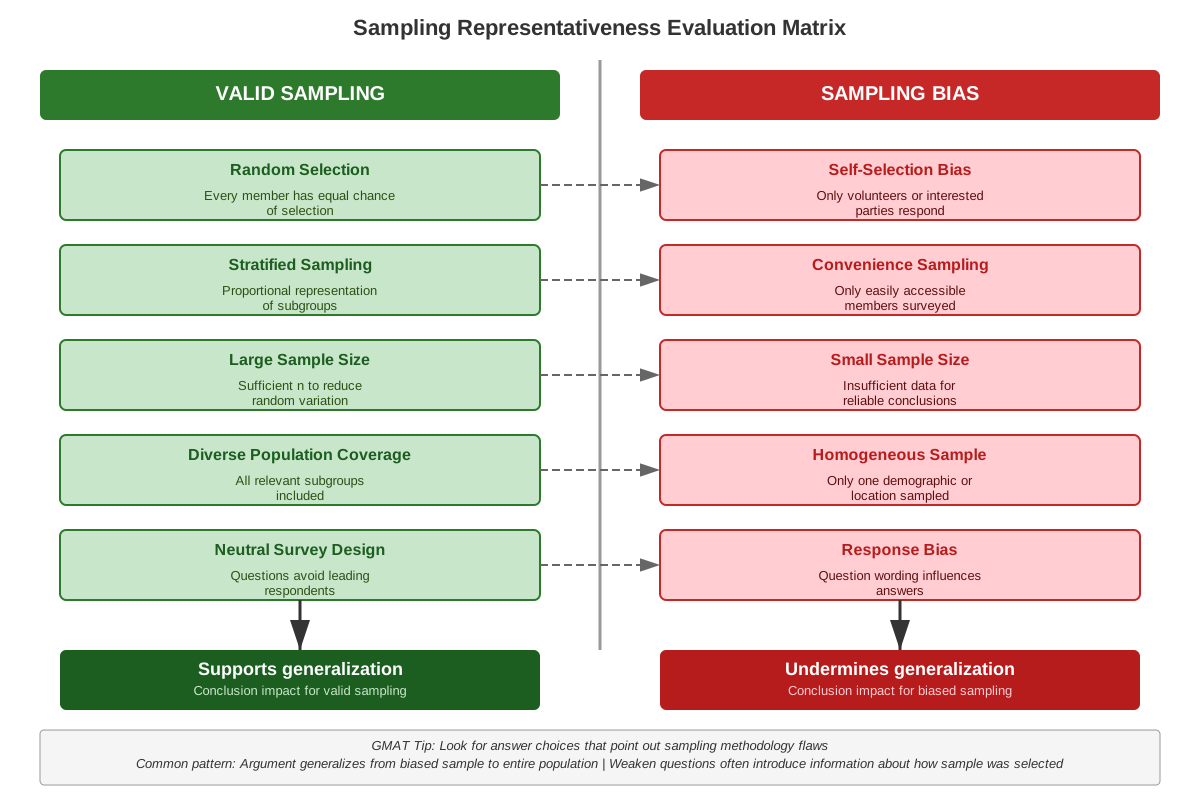
Sampling bias occurs when the sample used in a study does not accurately represent the population about which conclusions are drawn. This is one of the most frequently tested concepts in GMAT statistical reasoning questions.
Key sampling issues include:
- Self-selection bias: When participants volunteer, they may differ systematically from non-participants
- Small sample size: Limited data may not capture the full range of variation in a population
- Non-random sampling: Selecting participants through convenience rather than random selection
- Unrepresentative samples: When the sample differs from the target population in important ways
For example, if a company surveys only customers who visit their website to conclude that "most customers prefer online shopping," this ignores customers who prefer in-store shopping and may never visit the website. The sample is biased toward those already inclined to shop online.
Correlation vs. Causation
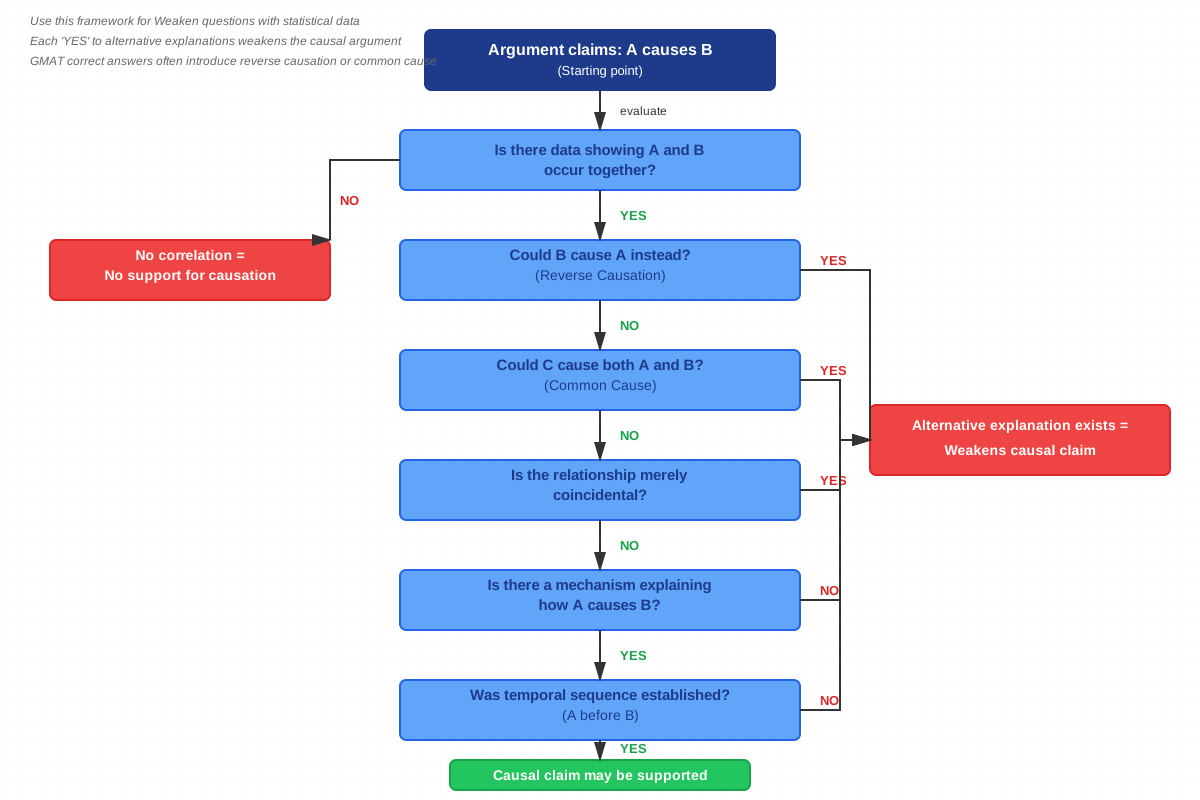
A fundamental principle in statistical reasoning is that correlation (two things occurring together) does not prove causation (one thing causing another). The GMAT frequently presents arguments that confuse these concepts.
Three possible explanations for correlation exist:
- A causes B: The proposed causal relationship is correct
- B causes A: The reverse causal relationship is true
- C causes both A and B: A third factor causes both observed phenomena
Additionally, the correlation might be coincidental with no causal relationship at all. For instance, if ice cream sales and drowning deaths both increase in summer, this correlation doesn't mean ice cream causes drowning—both are caused by warm weather and increased outdoor activity.
Percentage vs. Absolute Numbers
The GMAT often exploits the difference between percentages and absolute numbers. An argument might claim that "Company X's profits increased by 50% while Company Y's profits increased by only 10%, so Company X performed better." However, if Company Y started with much larger profits, their 10% increase might represent more absolute dollars than Company X's 50% increase.
| Scenario | Starting Value | Percentage Increase | Absolute Increase |
|---|---|---|---|
| Company X | $100,000 | 50% | $50,000 |
| Company Y | $1,000,000 | 10% | $100,000 |
This table illustrates how percentage changes can be misleading without considering base values.
Rate vs. Total Confusion
Similar to percentage issues, confusing rates with totals creates common statistical fallacies. An argument might state that "City A has more traffic accidents than City B, so City A's roads are more dangerous." However, if City A has significantly more drivers, the accident rate per driver might actually be lower than City B's rate.
Temporal Issues in Statistical Reasoning
Time-based comparisons require careful analysis of:
- Baseline differences: Were the groups comparable before the change being measured?
- External factors: Did other changes occur during the time period that could explain the results?
- Trend vs. snapshot: Does a single data point represent a genuine trend or an anomaly?
For example, if a school implements a new teaching method and test scores increase, the argument assumes no other factors changed (teacher quality, student demographics, curriculum, etc.).
Survey and Study Methodology
The validity of statistical conclusions depends heavily on methodology—how data was collected and analyzed. GMAT questions often contain flaws in:
- Question wording: Leading or ambiguous survey questions
- Response options: Limited choices that don't capture the full range of opinions
- Response rate: Low response rates may indicate non-response bias
- Control groups: Lack of appropriate comparison groups
- Confounding variables: Failure to account for other factors that might explain results
Statistical Comparisons
Valid comparisons require comparable groups and consistent measurement. Common comparison errors include:
- Comparing different time periods without accounting for seasonal variations
- Comparing groups with different baseline characteristics
- Using different measurement methods for different groups
- Failing to adjust for population size differences
Generalization Errors
Overgeneralization occurs when conclusions drawn from one context are applied too broadly. The GMAT tests whether students recognize when:
- Results from one demographic group are applied to all groups
- Findings from one geographic region are assumed universal
- Short-term results are projected indefinitely into the future
- Specific conditions of a study are ignored when applying results
Concept Relationships
Statistical reasoning concepts form an interconnected web where understanding one principle enhances comprehension of others. Sampling and representativeness serves as the foundation → determining whether data collection methods are sound → which then affects whether correlations observed in the data are meaningful → leading to questions about whether causation can be inferred → which requires examining temporal relationships and ruling out alternative explanations.
The relationship between percentages and absolute numbers connects directly to rate vs. total confusion, as both involve understanding what numerical measures actually represent. These concepts together inform statistical comparisons, which require ensuring that numbers being compared are truly comparable in terms of base values, measurement methods, and context.
Survey methodology affects all other concepts because flawed data collection undermines any subsequent analysis. Poor methodology can introduce sampling bias, create misleading correlations, and produce invalid generalizations. Understanding methodology enables evaluation of whether statistical evidence actually supports the conclusions drawn from it.
These statistical reasoning concepts connect to broader Critical Reasoning skills: assumption identification (what must be true for statistical evidence to support a conclusion), strengthening/weakening (what additional evidence would support or undermine statistical claims), and evaluation (what information would help assess the validity of statistical arguments).
High-Yield Facts
⭐ Correlation does not prove causation—two variables occurring together does not establish that one causes the other; alternative explanations must be ruled out.
⭐ Sample representativeness is crucial—conclusions about a population are only valid if the sample accurately represents that population without systematic bias.
⭐ Percentage changes require knowing base values—a large percentage increase from a small base may be less significant than a small percentage increase from a large base.
⭐ Rates and totals are different measures—a higher total number does not necessarily mean a higher rate when population sizes differ.
⭐ Survey methodology affects validity—how questions are worded, who responds, and response rates all impact whether survey results support conclusions.
- Self-selected samples are typically biased toward those with stronger opinions or greater interest in the topic.
- Temporal comparisons require ensuring that no other relevant factors changed during the time period examined.
- Generalizing from one group to another assumes the groups are similar in relevant characteristics.
- Small sample sizes increase the likelihood that results reflect random variation rather than genuine patterns.
- Control groups are necessary to determine whether an observed effect is due to the intervention or would have occurred anyway.
- Non-response bias occurs when those who don't respond to surveys differ systematically from those who do respond.
- Confounding variables are alternative factors that might explain observed correlations between two variables.
- Statistical significance differs from practical significance—a result can be statistically reliable but too small to matter in practice.
Quick check — test yourself on Statistical reasoning so far.
Try Flashcards →Common Misconceptions
Misconception: If a study shows a correlation between two variables, one must cause the other.
Correction: Correlation indicates only that two variables change together; causation requires ruling out reverse causation, third-variable explanations, and coincidence. The GMAT frequently includes answer choices that strengthen arguments by eliminating alternative causal explanations.
Misconception: A larger percentage change always represents a more significant change than a smaller percentage change.
Correction: Percentage changes must be evaluated in context of base values. A 100% increase from 10 to 20 is less significant in absolute terms than a 10% increase from 1,000 to 1,100. GMAT questions often exploit this by presenting percentage data without absolute numbers.
Misconception: Survey results always accurately reflect the opinions of the entire population.
Correction: Survey validity depends on sampling methodology, response rates, question wording, and representativeness. Self-selected surveys, leading questions, and low response rates all compromise the ability to generalize from survey results to broader populations.
Misconception: If a group has a higher total number of incidents, they have a higher rate of those incidents.
Correction: Rates account for population size while totals do not. A city with more total crimes might have a lower crime rate per capita if its population is proportionally larger. Always consider whether the argument confuses absolute numbers with rates.
Misconception: Statistical evidence is always objective and unbiased.
Correction: How data is collected, analyzed, and presented can introduce bias. The GMAT tests recognition that statistical evidence can be flawed through sampling bias, measurement errors, selective reporting, or inappropriate comparisons.
Misconception: A single data point or short-term trend reliably predicts future patterns.
Correction: Statistical patterns require sufficient data over appropriate time periods. Short-term fluctuations may reflect random variation or temporary factors rather than genuine trends. GMAT questions often present arguments that project limited data too far into the future.
Misconception: If two groups are compared and show different outcomes, the comparison is automatically valid.
Correction: Valid comparisons require that groups are similar in relevant characteristics (baseline equivalence) and that measurements are consistent. Comparing groups that differ in important ways or using different measurement methods produces invalid conclusions.
Worked Examples
Example 1: Sampling Bias and Representativeness
Question: A restaurant chain surveyed customers who used their mobile app and found that 85% prefer ordering through the app rather than calling. The chain concluded that they should eliminate phone ordering to reduce costs. Which of the following, if true, most weakens the argument?
A) The mobile app was introduced only six months ago
B) Customers who prefer phone ordering are less likely to use the mobile app
C) The restaurant chain operates in multiple cities
D) App users receive a 10% discount on orders
E) The survey included responses from over 1,000 customers
Solution:
Step 1: Identify the statistical reasoning structure
- Evidence: 85% of app users prefer app ordering
- Conclusion: Phone ordering should be eliminated
- Gap: The sample (app users) may not represent all customers
Step 2: Recognize the sampling bias
The survey only reached customers who already use the app. This creates self-selection bias—people who prefer phone ordering wouldn't be in the sample.
Step 3: Evaluate answer choices
- (A) Timing doesn't address representativeness
- (B) CORRECT - Directly identifies that the sample excludes the very group whose preferences matter most for the decision
- (C) Geographic diversity doesn't address the sampling issue
- (D) Incentives might affect preferences but doesn't address who was surveyed
- (E) Large sample size doesn't fix bias if the sample is unrepresentative
Answer: B
This question tests the core concept that sample representativeness matters more than sample size. Even 1,000 responses don't help if the sample systematically excludes relevant populations.
Example 2: Correlation vs. Causation with Confounding Variables
Question: A study found that employees who take regular breaks throughout the workday are 30% more productive than those who work continuously. The company concluded that implementing mandatory breaks would increase overall productivity. The conclusion depends on which of the following assumptions?
A) Employees who take breaks are not already more productive for other reasons
B) All employees currently work continuously without breaks
C) Productivity can be accurately measured across different job types
D) The 30% increase represents a statistically significant difference
E) Employees would comply with mandatory break policies
Solution:
Step 1: Identify the argument structure
- Evidence: Correlation between break-taking and productivity
- Conclusion: Mandatory breaks will cause increased productivity
- Reasoning gap: Assumes correlation indicates causation
Step 2: Consider alternative explanations
The correlation might exist because:
- More productive employees feel confident taking breaks (reverse causation)
- Certain personality types both take breaks and work more efficiently (third variable)
- More experienced employees both take breaks and are more productive (confounding variable)
Step 3: Identify the necessary assumption
For mandatory breaks to increase productivity, it must be true that break-taking itself causes the productivity increase, not some other factor that correlates with both.
Step 4: Evaluate answer choices
- (A) CORRECT - This assumption is necessary; if employees who take breaks are already more productive due to other factors (experience, personality, job type), then forcing breaks on others won't replicate the productivity gains
- (B) Not necessary—the argument works even if some employees already take breaks
- (C) Measurement accuracy is important but not the core assumption about causation
- (D) Statistical significance is assumed in the evidence presentation
- (E) Compliance is a practical concern but not the logical assumption about causation
Answer: A
This question illustrates how the GMAT tests understanding that correlation requires additional assumptions to support causal conclusions. The correct answer identifies the assumption that rules out alternative explanations for the observed correlation.
Exam Strategy
Question Identification
Recognize statistical reasoning questions through trigger phrases:
- "A survey found that..."
- "Studies show that..."
- "Statistics indicate..."
- "X percent of..."
- "The rate of... increased/decreased..."
- "More/fewer... than..."
- "On average..."
When these phrases appear, immediately activate statistical reasoning analysis: check sampling, consider correlation vs. causation, examine comparisons, and evaluate generalization validity.
Systematic Approach
- Identify the statistical evidence: What data is presented?
- Identify the conclusion: What claim is made based on the data?
- Find the gap: What assumption connects the evidence to the conclusion?
- Predict the answer: Before reading choices, anticipate what would strengthen, weaken, or be assumed
- Eliminate systematically: Remove choices that don't address the statistical reasoning gap
Common Answer Choice Patterns
For Weaken questions, correct answers often:
- Identify sampling bias or unrepresentative samples
- Provide alternative causal explanations
- Show that comparison groups differ in important ways
- Reveal confounding variables
- Demonstrate that percentages mislead without absolute numbers
For Strengthen questions, correct answers often:
- Confirm sample representativeness
- Rule out alternative causal explanations
- Establish baseline equivalence between compared groups
- Provide missing information about absolute numbers or rates
- Confirm that observed patterns are not due to external factors
For Assumption questions, correct answers often:
- State that the sample represents the population
- Assume no relevant differences between compared groups
- Assume correlation indicates causation
- Assume no confounding variables exist
- Assume measurements are accurate and consistent
Time Management
Exam Tip: Spend 10-15 seconds identifying the statistical reasoning pattern before reading answer choices. This upfront investment saves time by enabling focused evaluation of choices.
Statistical reasoning questions typically require 1.5-2 minutes. Allocate:
- 20 seconds: Read and understand the argument
- 10 seconds: Identify the statistical reasoning gap
- 10 seconds: Predict the answer type
- 40-60 seconds: Evaluate answer choices
- 10 seconds: Confirm and select
Process of Elimination
Eliminate answer choices that:
- Address irrelevant aspects of the argument
- Discuss implementation or practical concerns rather than logical validity
- Provide information that doesn't affect the statistical reasoning gap
- Strengthen when you need to weaken (or vice versa)
- Are too extreme or absolute when the argument involves probabilities
Memory Techniques
SCRAM Acronym for Statistical Reasoning Analysis
Sampling - Is the sample representative?
Causation - Does correlation prove causation?
Rates vs. totals - Are percentages or rates confused with absolute numbers?
Alternatives - Are there alternative explanations?
Methodology - Is the study design sound?
Use SCRAM as a mental checklist when analyzing any statistical argument.
Visualization for Correlation vs. Causation
Picture three arrows:
- Arrow 1: A → B (proposed causation)
- Arrow 2: B → A (reverse causation)
- Arrow 3: C → A and C → B (third variable)
When you see correlation, visualize these three arrows to remember that multiple explanations exist.
The "Representative Sample" Mantra
Remember: "Big doesn't mean unbiased"—a large sample size doesn't fix sampling bias. Repeat this when tempted by answer choices that mention large numbers of survey respondents.
Percentage vs. Absolute Mnemonic
"Percent of what?"—Always ask this question when arguments present percentage changes or comparisons. This triggers consideration of base values.
Survey Validity Checklist: WHO-HOW-WHAT
- WHO was surveyed? (representativeness)
- HOW were they selected? (methodology)
- WHAT were they asked? (question wording)
Summary
Statistical reasoning on the GMAT requires analyzing arguments that use numerical data, surveys, studies, and statistical claims as evidence. Success depends on recognizing common statistical fallacies: sampling bias, correlation-causation confusion, percentage-absolute number confusion, rate-total confusion, and invalid generalizations. The key skill is identifying gaps between statistical evidence and conclusions—what assumptions must be true for the data to support the claim? Strong performance requires systematically checking sample representativeness, considering alternative causal explanations, evaluating comparison validity, and assessing methodology. The GMAT frequently tests these concepts through Weaken, Strengthen, and Assumption questions embedded in business contexts. Students who master statistical reasoning gain the ability to quickly identify flawed statistical arguments and select answer choices that address the specific reasoning gap. This skill applies across approximately 15-20% of Critical Reasoning questions, making it one of the highest-yield topics for GMAT preparation.
Key Takeaways
- Statistical reasoning questions test the gap between data and conclusions, not mathematical calculation ability
- Sample representativeness matters more than sample size—large biased samples remain unreliable
- Correlation never proves causation without ruling out alternative explanations including reverse causation and third variables
- Percentages and rates must be evaluated in context of base values and population sizes
- Valid comparisons require baseline equivalence and consistent measurement methods
- Survey methodology affects validity—question wording, selection methods, and response rates all matter
- Use SCRAM (Sampling, Causation, Rates, Alternatives, Methodology) as a systematic analysis framework for all statistical reasoning questions
Related Topics
Causal Reasoning: Statistical reasoning provides the quantitative framework for evaluating causal claims. Mastering statistical reasoning enables more sophisticated analysis of cause-and-effect arguments that incorporate numerical evidence.
Assumption Questions: Many statistical reasoning questions appear as assumption questions, requiring identification of what must be true for statistical evidence to support conclusions. Strong statistical reasoning skills directly improve assumption question performance.
Strengthen and Weaken Questions: Statistical reasoning concepts frequently appear in strengthen/weaken questions where answer choices provide additional data or reveal flaws in statistical arguments. Understanding statistical fallacies enables quick identification of relevant answer choices.
Reading Comprehension - Science Passages: Statistical reasoning skills transfer to Reading Comprehension passages that present research studies, experimental results, and data analysis, particularly in social science and natural science passages.
Data Insights Section: While this guide focuses on Verbal Reasoning, statistical reasoning principles apply throughout the GMAT, particularly in Data Insights questions that require interpreting tables, graphs, and multi-source reasoning.
Practice CTA
Now that you've mastered the core concepts of statistical reasoning, it's time to apply these skills to actual GMAT-style questions. Complete the practice questions to reinforce your understanding of sampling bias, correlation vs. causation, and statistical comparisons. Use the flashcards to memorize high-yield concepts and common fallacy patterns. Remember: statistical reasoning is one of the most frequently tested and highest-yield topics in Critical Reasoning—your investment in practice will directly translate to points on test day. Approach each practice question systematically using the SCRAM framework, and review both correct and incorrect answers to deepen your understanding of statistical reasoning patterns. You've built the foundation; now strengthen it through deliberate practice!
Sign up free to keep reading
Create a free AnvayaPrep account to finish this GMAT guide on Statistical reasoning — plus flashcards and practice questions.