Overview
Comparative reading is a specialized question format within the GMAT Reading Comprehension section that requires test-takers to analyze and synthesize information from two related passages simultaneously. Unlike traditional single-passage questions, GMAT comparative reading presents two shorter passages (typically 100-150 words each) that address the same topic from different perspectives, time periods, or argumentative stances. This format tests the ability to identify relationships between texts, recognize points of agreement and disagreement, and understand how different authors approach similar subject matter.
This topic is essential for GMAT success because comparative reading questions appear consistently on the exam and demand a unique skill set that combines traditional reading comprehension with comparative analysis. Test-takers must not only understand each passage independently but also evaluate how the passages relate to one another—whether they complement, contradict, or extend each other's arguments. The GMAT uses this format to assess higher-order thinking skills such as synthesis, evaluation, and the ability to navigate multiple perspectives on complex issues.
Within the broader Verbal Reasoning framework, comparative reading represents an advanced application of fundamental reading comprehension skills. It builds upon core abilities like identifying main ideas, understanding author's tone, and recognizing logical structure, but adds the critical dimension of inter-textual analysis. Mastering comparative reading enhances overall verbal reasoning performance by developing the mental flexibility to hold multiple viewpoints simultaneously—a skill that also benefits Critical Reasoning and Sentence Correction by improving logical analysis and attention to nuanced differences in meaning.
Learning Objectives
- [ ] Identify comparative reading passages and question types on the GMAT
- [ ] Explain the key characteristics and structural elements of comparative reading formats
- [ ] Apply comparative reading strategies to GMAT questions efficiently and accurately
- [ ] Analyze the relationship between two passages (agreement, disagreement, extension)
- [ ] Synthesize information from multiple sources to answer complex questions
- [ ] Distinguish between passage-specific questions and comparative questions
- [ ] Evaluate how different authors approach the same topic using varying evidence and reasoning
Prerequisites
- Basic Reading Comprehension Skills: Understanding main ideas, supporting details, and passage structure forms the foundation for analyzing multiple texts simultaneously
- Ability to Identify Author's Tone and Purpose: Recognizing authorial intent in single passages is essential before comparing perspectives across passages
- Logical Reasoning Fundamentals: Understanding argument structure, evidence types, and inference-making enables effective comparison of argumentative approaches
- Time Management Skills: Proficiency with single-passage questions provides the baseline efficiency needed to handle the added complexity of dual passages
Why This Topic Matters
Comparative reading reflects real-world analytical demands that professionals face daily: evaluating competing proposals, synthesizing research from multiple sources, and making informed decisions based on diverse perspectives. In academic and business contexts, the ability to quickly identify areas of consensus and disagreement among sources is invaluable for literature reviews, market analysis, and strategic planning.
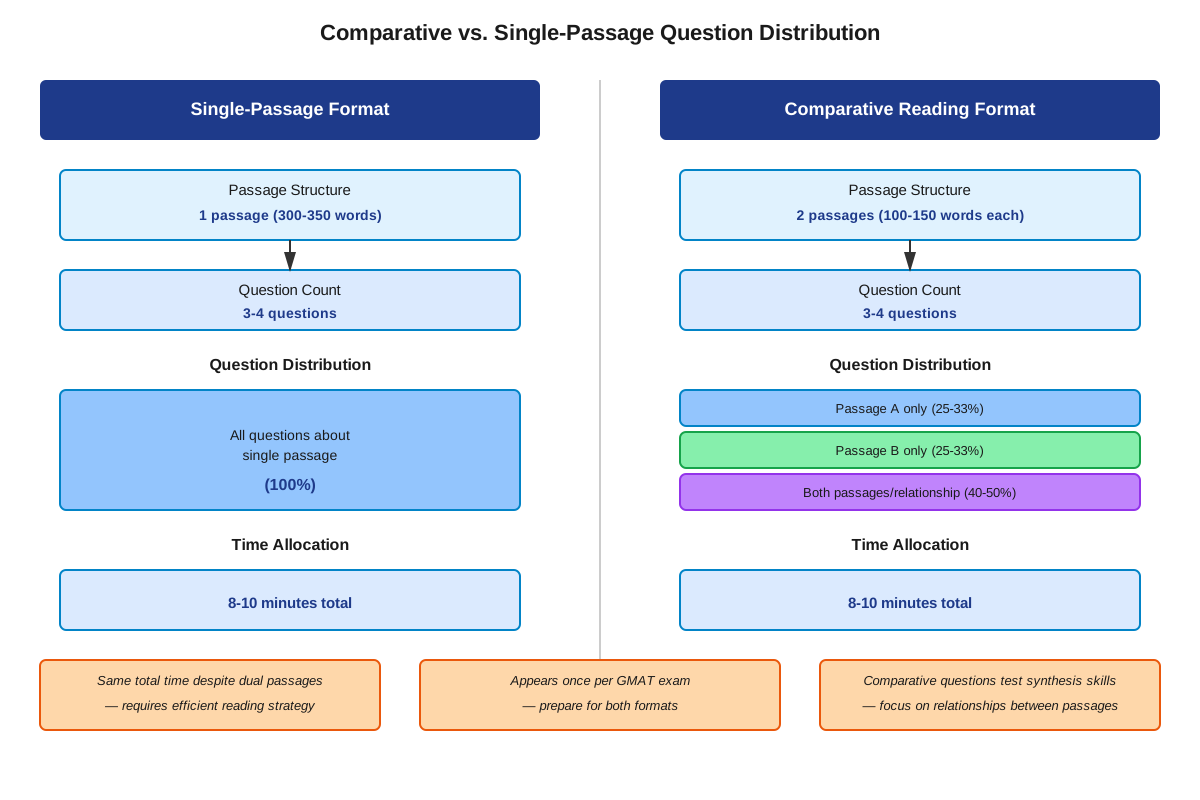
On the GMAT, comparative reading typically appears once per exam, comprising 3-4 questions worth approximately 10-12% of the Reading Comprehension score. This format appears in the Verbal Reasoning section alongside traditional single-passage questions, and its consistent presence makes it a high-yield study area. The Educational Testing Service (ETS) and Graduate Management Admission Council (GMAC) include comparative reading to assess skills directly relevant to business school success, where case studies often require synthesizing multiple viewpoints.
Comparative reading questions manifest in several distinct patterns on the exam: questions asking about the relationship between passages (agreement/disagreement), questions targeting one specific passage, questions requiring synthesis of information from both passages, and questions about how one author would likely respond to the other's argument. The dual-passage format also appears in questions about tone comparison, methodological differences, and the extent to which passages share common ground or diverge in their conclusions.
Core Concepts
Structure of Comparative Reading Passages
Comparative reading passages on the GMAT follow a predictable structural pattern that test-takers can leverage for efficient analysis. Each comparative reading set consists of Passage A and Passage B, typically ranging from 80-150 words each, for a combined length of 200-300 words. The passages are always thematically linked, addressing the same general topic, phenomenon, or question, but they approach it from different angles.
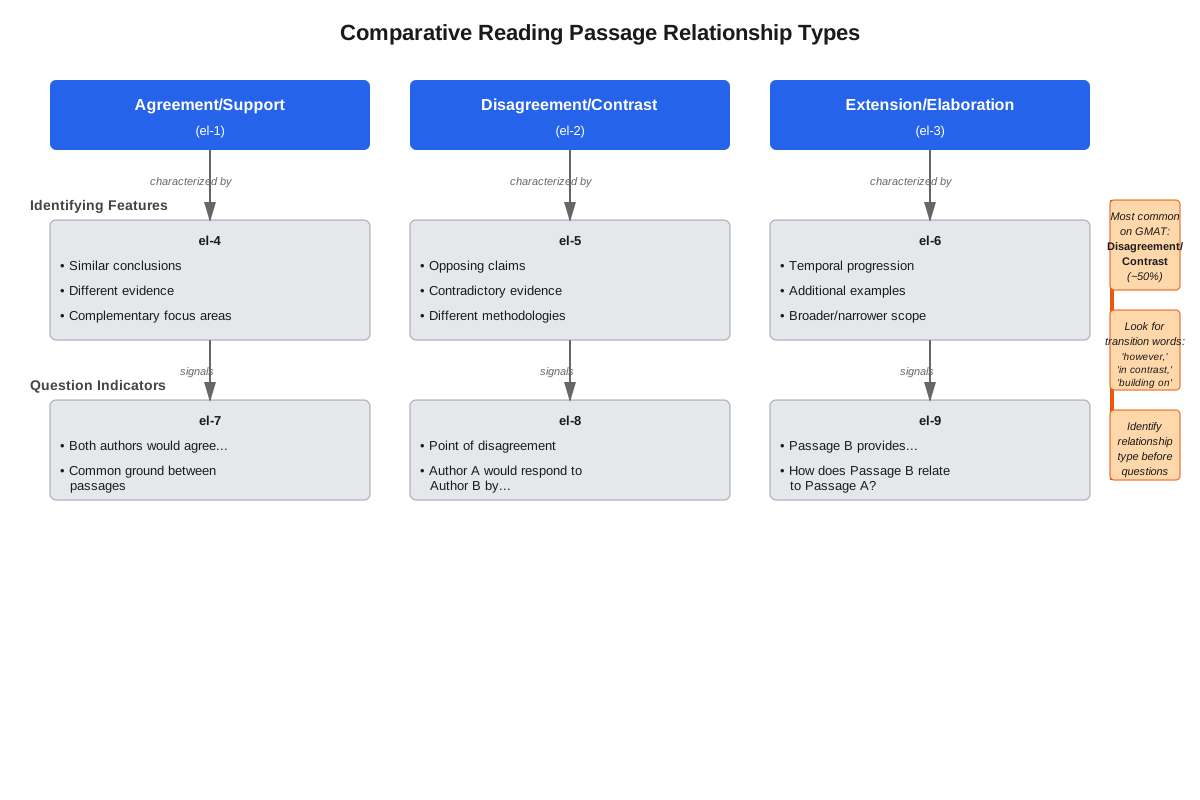
The relationship between passages falls into several categories:
| Relationship Type | Description | Example Topics |
|---|---|---|
| Contrasting Viewpoints | Passages present opposing arguments or interpretations | Economic policy approaches, scientific theories |
| Complementary Perspectives | Passages examine different aspects of the same issue | Historical event from political and social angles |
| Temporal Progression | Passages represent different time periods or stages | Earlier vs. current understanding of a phenomenon |
| Methodological Differences | Passages use different approaches to study the same subject | Quantitative vs. qualitative research methods |
| Scope Variation | One passage is broader/narrower than the other | General principle vs. specific application |
Types of Comparative Reading Questions
GMAT comparative reading questions divide into three distinct categories, each requiring different analytical approaches:
Passage-Specific Questions target only one passage, asking about its main idea, specific details, or author's tone. These questions explicitly reference "Passage A" or "Passage B" and can be answered without considering the other passage. They function identically to traditional single-passage questions but appear within the comparative reading set.
Relationship Questions form the core of comparative reading assessment, asking test-takers to identify how the passages relate to one another. Common question stems include: "The two passages differ primarily in their..." "Both passages mention X in order to..." "The author of Passage B would most likely respond to the claim in Passage A by..." These questions require understanding both passages and the nature of their interaction.
Synthesis Questions demand integration of information from both passages to reach a conclusion that neither passage explicitly states. These questions might ask: "Which of the following, if true, would support the argument in Passage A but weaken the argument in Passage B?" or "Both authors would most likely agree with which of the following statements?"
Key Analytical Skills for Comparative Reading
Identifying Points of Agreement and Disagreement requires careful attention to what each author explicitly states versus what can be inferred. Authors may agree on facts but disagree on interpretations, or they may disagree on premises while reaching similar conclusions. Test-takers must distinguish between fundamental disagreements and superficial differences in emphasis or scope.
Recognizing Tone and Attitude Differences involves detecting subtle variations in how authors present their arguments. One author might be cautiously optimistic while another is enthusiastically supportive; one might be mildly critical while another is dismissive. The GMAT tests the ability to perceive these nuanced differences and understand how they affect the passages' overall messages.
Understanding Structural Relationships means recognizing how passages are organized relative to each other. Does Passage B provide evidence for a claim made in Passage A? Does Passage A present a problem that Passage B attempts to solve? Does Passage B critique the methodology described in Passage A? These structural relationships guide interpretation and help predict question types.
Strategic Reading Approach
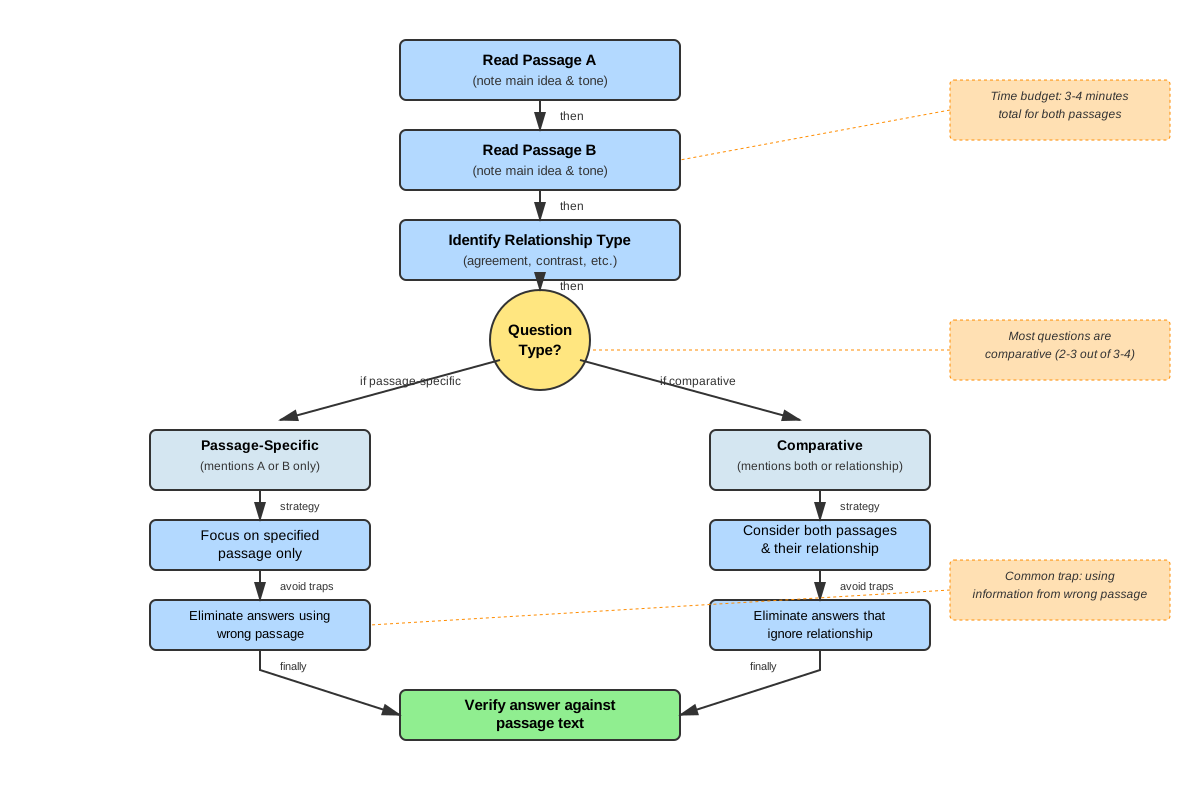
Effective comparative reading requires a systematic approach that balances thoroughness with time efficiency. The recommended process involves:
- Read Passage A completely while noting its main idea, author's purpose, and tone
- Immediately identify Passage A's core argument before moving to Passage B
- Read Passage B with Passage A in mind, actively looking for connections, contrasts, and relationships
- Mentally summarize the relationship between passages before approaching questions
- Categorize each question as passage-specific, relationship-focused, or synthesis-based
- Answer passage-specific questions first to build confidence and refresh passage content
- Tackle relationship and synthesis questions with clear understanding of both passages
This approach prevents the common error of treating comparative reading as two separate single-passage exercises, ensuring that test-takers maintain awareness of inter-passage relationships throughout the question set.
Concept Relationships
The concepts within comparative reading form an interconnected hierarchy where foundational skills enable more complex analytical tasks. Passage structure understanding serves as the base, allowing readers to quickly identify each passage's main idea, supporting evidence, and organizational pattern. This foundation directly enables relationship identification, as recognizing how individual passages are constructed makes it easier to see how they interact with one another.
Relationship identification → leads to → effective question categorization, because understanding whether passages agree, disagree, or complement each other helps predict which question types will appear and how to approach them. Question categorization → enables → strategic answer selection, as different question types require different analytical processes and elimination strategies.
The connection to prerequisite topics is equally important. Basic reading comprehension provides the ability to understand individual passages, which is necessary but insufficient for comparative reading success. Logical reasoning skills enhance the ability to evaluate how arguments in different passages relate, particularly when identifying implicit agreements or unstated assumptions that both authors share. Time management becomes more critical in comparative reading because the dual-passage format requires efficient processing of more information within the same time constraints as single-passage questions.
Comparative reading also connects forward to other GMAT skills. The synthesis abilities developed through comparative reading directly benefit Critical Reasoning questions that require evaluating multiple perspectives or considering how different pieces of evidence interact. The attention to nuanced differences in meaning and tone enhances Sentence Correction performance by sharpening awareness of how subtle word choices affect meaning.
High-Yield Facts
⭐ Comparative reading appears exactly once on each GMAT exam, typically consisting of two passages totaling 200-300 words with 3-4 associated questions.
⭐ Relationship questions are the most common question type in comparative reading sets, appearing more frequently than passage-specific or synthesis questions.
⭐ The passages always share a common topic but approach it from different perspectives, time periods, methodologies, or argumentative stances.
⭐ Passage-specific questions can be answered without reference to the other passage, making them ideal starting points for building confidence and refreshing passage content.
⭐ Authors may agree on facts while disagreeing on interpretations, requiring careful distinction between empirical claims and evaluative judgments.
- Comparative reading questions test synthesis and evaluation skills more heavily than recall or basic comprehension.
- The relationship between passages is typically more important than the specific content of either individual passage.
- Tone and attitude differences between authors are frequently tested, even when the passages present similar factual information.
- Questions asking how one author would respond to the other's argument require understanding both passages' underlying assumptions and reasoning patterns.
- Time allocation for comparative reading should be approximately 6-8 minutes total (reading both passages and answering all questions).
- Wrong answer choices in relationship questions often accurately describe one passage but mischaracterize the relationship between passages.
- The GMAT rarely presents passages that completely agree; there is almost always some point of divergence or difference in emphasis.
Common Misconceptions
Misconception: Comparative reading passages always present directly opposing viewpoints.
Correction: While passages often differ in perspective, they may also be complementary, with one extending or applying the other's ideas, or they may agree on some points while disagreeing on others. The relationship is frequently more nuanced than simple opposition.
Misconception: Each passage should be read and analyzed completely independently before considering their relationship.
Correction: While Passage A should be read first without reference to Passage B, Passage B should be read with active awareness of Passage A's content, specifically looking for connections, contrasts, and relationships. This comparative mindset during reading improves efficiency and comprehension.
Misconception: Passage-specific questions are easier than relationship questions.
Correction: Passage-specific questions can be just as challenging as relationship questions; they simply test different skills. The difficulty depends on the specific question content, not the question category. However, passage-specific questions are often more efficient to answer because they require analyzing only one passage.
Misconception: If two passages discuss the same topic, they must share the same main idea.
Correction: Passages can address the same topic while having entirely different main ideas. For example, both passages might discuss renewable energy, but Passage A's main idea could be about economic feasibility while Passage B's main idea concerns environmental impact. Topic and main idea are distinct concepts.
Misconception: Synthesis questions require finding information that appears in both passages.
Correction: Synthesis questions require integrating or combining information from both passages to reach a conclusion, but this doesn't mean the same information must appear in both. The question might ask what both authors would agree on based on their different arguments, or what conclusion follows from combining evidence from both passages.
Misconception: The longer passage is always more important or contains the main argument.
Correction: Passage length on the GMAT comparative reading is typically similar, and neither passage is inherently more important. Questions are distributed across both passages, and relationship questions require equal understanding of both. Focusing disproportionately on one passage leads to incomplete analysis.
Quick check — test yourself on Comparative reading so far.
Try Flashcards →Worked Examples
Example 1: Contrasting Viewpoints on Urban Planning
Passage A
Urban density is essential for sustainable city development. High-density neighborhoods reduce per-capita infrastructure costs, decrease automobile dependence, and create vibrant street life that supports local businesses. Cities like Tokyo and Barcelona demonstrate that density, when properly managed with adequate public transportation and green spaces, enhances quality of life rather than diminishing it. The environmental benefits alone—reduced carbon emissions from shorter commutes and shared walls reducing heating costs—justify prioritizing density in urban planning.
Passage B
The push for urban density overlooks significant quality-of-life concerns. While density may offer environmental advantages, it often comes at the cost of personal space, privacy, and access to nature. Studies show that residents of high-density neighborhoods report higher stress levels and lower life satisfaction than those in lower-density areas. Furthermore, the infrastructure required to make density livable—extensive public transportation, parks, and community facilities—requires massive public investment that many cities cannot afford. A balanced approach that includes medium-density development may better serve most communities.
Question: The authors of the two passages would most likely agree on which of the following?
Answer Choices:
A) Urban density should be the primary goal of city planners
B) High-density neighborhoods always improve residents' quality of life
C) Environmental factors are relevant considerations in urban planning
D) Public transportation is unnecessary in properly designed cities
E) Tokyo and Barcelona provide models that all cities should follow
Worked Solution:
Step 1: Identify each passage's main argument.
- Passage A argues FOR urban density, emphasizing sustainability and environmental benefits
- Passage B argues AGAINST prioritizing density, emphasizing quality-of-life concerns
Step 2: Identify explicit points of agreement.
- Both passages acknowledge environmental considerations (Passage A emphasizes environmental benefits; Passage B concedes "environmental advantages")
- Both passages mention infrastructure needs (Passage A: "adequate public transportation"; Passage B: "extensive public transportation")
Step 3: Eliminate answers that one author would reject.
- Choice A: Only Passage A supports this; Passage B explicitly opposes prioritizing density. Eliminate.
- Choice B: Passage B directly contradicts this with stress and satisfaction data. Eliminate.
- Choice D: Both passages mention public transportation as important. Eliminate.
- Choice E: Passage B doesn't discuss these cities and advocates for different approaches. Eliminate.
Step 4: Confirm the remaining answer.
- Choice C: Passage A explicitly discusses environmental benefits; Passage B acknowledges "environmental advantages" even while arguing against density. Both authors treat environmental factors as relevant, even though they weigh them differently against other concerns.
Correct Answer: C
Connection to Learning Objectives: This example demonstrates applying comparative reading to identify points of agreement between passages with contrasting viewpoints, requiring synthesis of both passages' arguments.
Example 2: Complementary Perspectives on Scientific Discovery
Passage A
Marie Curie's discovery of radium in 1898 revolutionized physics and medicine. Working in a converted shed with minimal equipment, Curie processed tons of pitchblende ore to isolate this new element. Her meticulous experimental methodology—carefully measuring radioactive emissions and systematically testing various compounds—established standards for radiochemistry that persist today. The discovery earned her two Nobel Prizes and opened entirely new fields of scientific inquiry into atomic structure and radioactive decay.
Passage B
The social context of Marie Curie's work reveals how gender barriers shaped scientific progress in the early 20th century. Despite her groundbreaking discoveries, Curie faced significant discrimination: she was initially excluded from presenting her own research, nearly denied her first Nobel Prize, and was rejected by the French Academy of Sciences explicitly because of her gender. Her perseverance in this hostile environment makes her achievements even more remarkable and highlights how many potential scientific contributions may have been lost due to systematic exclusion of women from research institutions.
Question: Which of the following best describes the relationship between the two passages?
Answer Choices:
A) Passage B provides historical context that explains the significance of the work described in Passage A
B) Passage B challenges the accuracy of the claims made in Passage A
C) Passage A presents a scientific perspective while Passage B presents a social perspective on the same subject
D) Passage A describes causes while Passage B describes effects
E) Passage B offers a more recent interpretation that supersedes the outdated view in Passage A
Worked Solution:
Step 1: Identify what each passage focuses on.
- Passage A: Scientific aspects of Curie's work (methodology, discoveries, impact on physics)
- Passage B: Social aspects of Curie's work (gender discrimination, institutional barriers, perseverance)
Step 2: Determine if passages agree, disagree, or complement.
- No contradiction exists between passages
- Both treat Curie's work as significant and groundbreaking
- They examine different dimensions of the same historical subject
Step 3: Evaluate each answer choice.
- Choice A: Passage B doesn't explain the significance of the work itself; it discusses the social context of achievement. Eliminate.
- Choice B: Passage B doesn't challenge any factual claims from Passage A. Eliminate.
- Choice C: Accurately captures that one passage takes a scientific lens (methodology, discoveries) while the other takes a social lens (discrimination, barriers). Keep.
- Choice D: Neither passage is organized around cause-effect relationships between the two topics. Eliminate.
- Choice E: Passage B doesn't supersede or update Passage A; they address different aspects. Eliminate.
Step 4: Confirm the answer.
- Choice C correctly identifies that the passages are complementary, examining the same subject (Curie's work) from different analytical perspectives (scientific vs. social).
Correct Answer: C
Connection to Learning Objectives: This example demonstrates explaining the structural relationship between passages and applying comparative reading strategies to identify complementary perspectives rather than opposing viewpoints.
Exam Strategy
Approaching Comparative Reading Questions Systematically
When encountering comparative reading on the GMAT, implement a structured approach that maximizes efficiency while ensuring thorough analysis. Begin by reading Passage A completely without looking ahead to Passage B, treating it as a standalone passage. Identify its main idea, note the author's tone, and recognize the passage's organizational structure. This foundation prevents confusion when processing the second passage.
Read Passage B with active comparison, constantly asking: "How does this relate to Passage A? Does this agree, disagree, extend, or qualify what Passage A stated?" This comparative mindset during initial reading dramatically improves question performance because the relationships are fresh in working memory.
Trigger Words and Phrases
Certain question stems signal specific question types and required analytical approaches:
Relationship Question Triggers:
- "The two passages differ primarily in..."
- "Both passages mention X in order to..."
- "Unlike the author of Passage A, the author of Passage B..."
- "The relationship between the two passages is most analogous to..."
Synthesis Question Triggers:
- "Both authors would most likely agree..."
- "Which of the following, if true, would support Passage A but weaken Passage B..."
- "Information in the two passages suggests that..."
Passage-Specific Triggers:
- "According to Passage A..." (or "Passage B")
- "The author of Passage B mentions X primarily to..."
- "In Passage A, the author's attitude toward X can best be described as..."
Process-of-Elimination Strategies
For Relationship Questions, eliminate answers that:
- Accurately describe only one passage while mischaracterizing the other
- Overstate the degree of agreement or disagreement between passages
- Confuse the direction of the relationship (e.g., claiming Passage A critiques Passage B when the reverse is true)
- Introduce topics or relationships not present in either passage
For Synthesis Questions, eliminate answers that:
- Could be supported by only one passage rather than requiring both
- Contradict information in either passage
- Make claims that neither author would accept based on their stated positions
- Require assumptions beyond what the passages provide
For Passage-Specific Questions, eliminate answers that:
- Contain information from the wrong passage
- Confuse details or misrepresent the passage's claims
- Introduce extreme language not supported by the passage's tone
Time Allocation Guidance
Allocate approximately 6-8 minutes total for the complete comparative reading set:
- 2-3 minutes: Reading both passages with active comparison
- 4-5 minutes: Answering 3-4 questions (approximately 1-1.5 minutes per question)
If a question requires more than 2 minutes, make an educated guess and move forward. The comparative reading set is worth the same as any other Reading Comprehension set, so spending excessive time here creates time pressure elsewhere.
Exam Tip: Answer passage-specific questions before relationship questions when possible. This strategy refreshes your memory of passage content and builds confidence before tackling more complex comparative analysis.
Memory Techniques
The COMPARE Acronym
Use COMPARE to remember the systematic approach to comparative reading:
- Categorize the relationship (agree, disagree, complement, extend)
- Observe each passage's main idea independently
- Mark points of agreement and disagreement
- Predict question types based on passage relationship
- Answer passage-specific questions first
- Review both passages when answering relationship questions
- Eliminate answers that mischaracterize either passage
Visualization Strategy: The Venn Diagram Mental Model
Visualize the two passages as overlapping circles in a Venn diagram:
- Left circle: Content unique to Passage A
- Right circle: Content unique to Passage B
- Overlapping section: Shared ideas, common ground, or points of agreement
- Space outside both circles: Potential synthesis conclusions that neither passage explicitly states but both support
This mental model helps organize information and quickly identify which questions require analyzing one passage, both passages, or the relationship between them.
The "Agree-Disagree-Silent" Framework
For each major claim or topic, categorize how the passages relate:
- Agree: Both passages support this claim (even if for different reasons)
- Disagree: Passages take opposing positions on this claim
- Silent: One passage addresses this claim while the other doesn't mention it
This framework prevents the common error of assuming disagreement when one passage simply doesn't address a topic, and helps identify genuine points of contention versus differences in scope or emphasis.
Summary
Comparative reading on the GMAT requires synthesizing information from two related passages that approach the same topic from different perspectives, time periods, or argumentative stances. Success depends on reading strategically—understanding Passage A independently before reading Passage B with active awareness of connections and contrasts. Questions divide into three categories: passage-specific questions targeting one passage, relationship questions examining how passages interact, and synthesis questions requiring integration of both passages. The key to high performance is recognizing that comparative reading tests not just comprehension of individual passages but the ability to analyze relationships between texts, identify points of agreement and disagreement, and understand how different authors approach similar subject matter. Effective test-takers categorize questions quickly, answer passage-specific questions first to refresh content, and apply systematic elimination strategies that account for the unique demands of each question type. Time management is critical—allocating 6-8 minutes for the complete set ensures adequate attention without creating pressure elsewhere in the Verbal section.
Key Takeaways
- Comparative reading appears once per GMAT exam with two passages (200-300 words total) and 3-4 questions testing synthesis and relationship analysis
- Read Passage A independently, then read Passage B with active comparison to identify connections, contrasts, and relationships
- Questions divide into three types: passage-specific (answerable from one passage), relationship (examining how passages interact), and synthesis (integrating both passages)
- The passages always share a common topic but differ in perspective, approach, time period, or argumentative stance—they rarely agree completely
- Answer passage-specific questions first to build confidence and refresh passage content before tackling complex relationship and synthesis questions
- Eliminate wrong answers by checking whether they accurately characterize both passages, correctly identify the relationship, and avoid overstating agreement or disagreement
- Allocate 6-8 minutes total for comparative reading sets, maintaining awareness that this format is worth the same as traditional single-passage questions
Related Topics
Advanced Reading Comprehension Strategies: Building on comparative reading skills, advanced strategies include analyzing complex argument structures, identifying implicit assumptions, and evaluating evidence quality across multiple paragraphs and passages.
Critical Reasoning - Evaluate the Argument: The synthesis skills developed through comparative reading directly transfer to Critical Reasoning questions that require evaluating how different pieces of evidence interact or how multiple perspectives affect an argument's strength.
Inference Questions in Reading Comprehension: Mastering comparative reading enhances inference skills by developing the ability to draw conclusions from multiple sources and recognize what must be true based on combining information from different texts.
Author's Tone and Purpose Analysis: Comparative reading deepens understanding of how subtle differences in tone and purpose affect meaning, a skill that applies across all Reading Comprehension passages and improves overall verbal reasoning performance.
Practice CTA
Now that you've mastered the core concepts and strategies for comparative reading, it's time to apply these skills to authentic GMAT-style questions. Complete the practice questions and flashcards for this topic to reinforce your understanding and build the speed and accuracy needed for test day. Remember: comparative reading appears on every GMAT, making this practice time a high-yield investment in your score. Each practice question you complete strengthens your ability to analyze relationships between passages and synthesize information efficiently—skills that will serve you throughout the Verbal Reasoning section and beyond.
Sign up free to keep reading
Create a free AnvayaPrep account to finish this GMAT guide on Comparative reading — plus flashcards and practice questions.