Overview
Evaluate questions represent one of the most distinctive and strategically important question types in GMAT Critical Reasoning. Unlike other question types that ask test-takers to strengthen, weaken, or identify assumptions in arguments, GMAT evaluate questions require a fundamentally different analytical approach: identifying what additional information would be most useful in assessing the logical soundness of an argument. These questions test the ability to recognize the critical gaps or uncertainties in reasoning that, if clarified, would significantly impact the argument's validity.
Mastering evaluate questions is essential for GMAT success because they appear regularly in the Verbal Reasoning section and demand a sophisticated understanding of argument structure. These questions assess whether test-takers can identify the pivotal issues upon which an argument's conclusion depends. Rather than directly attacking or supporting an argument, evaluate questions require recognizing what remains uncertain—what piece of information, if known, would make the argument either significantly stronger or significantly weaker. This skill reflects real-world critical thinking abilities that business schools value: the capacity to identify key uncertainties in business proposals, strategic plans, or analytical reports.
Within the broader landscape of Critical Reasoning, evaluate questions occupy a unique position. They build upon foundational skills in identifying conclusions, evidence, and assumptions, while also connecting to strengthen/weaken question types. However, evaluate questions require a more nuanced approach—the ability to formulate the right question rather than simply assess given information. This metacognitive skill of "knowing what you need to know" represents a higher-order thinking ability that distinguishes top GMAT performers.
Learning Objectives
- [ ] Identify Evaluate questions by recognizing their distinctive question stems and structural characteristics
- [ ] Explain the logical framework and purpose of Evaluate questions within Critical Reasoning
- [ ] Apply Evaluate strategies to GMAT questions to select answers that reveal critical information gaps
- [ ] Distinguish between relevant and irrelevant information when evaluating argument validity
- [ ] Formulate the "key question" that an argument's validity depends upon
- [ ] Recognize how answering an evaluate question in different ways would strengthen or weaken the argument
- [ ] Eliminate answer choices that provide information irrelevant to the argument's logical structure
Prerequisites
- Argument Structure Identification: Understanding premises, conclusions, and evidence is essential because evaluate questions require recognizing what information is present versus what is missing
- Assumption Recognition: Familiarity with implicit assumptions helps identify the gaps that evaluate questions target, as the most valuable information often relates to unstated assumptions
- Logical Reasoning Fundamentals: Basic understanding of valid and invalid reasoning patterns enables recognition of which additional information would meaningfully impact an argument's strength
- Strengthen/Weaken Question Experience: Prior exposure to these question types provides context for understanding how information can affect argument validity in different directions
Why This Topic Matters
Evaluate questions represent approximately 10-15% of all Critical Reasoning questions on the GMAT, making them a high-frequency question type that cannot be ignored. Unlike some specialized question types that appear rarely, evaluate questions consistently appear on virtually every GMAT administration, typically 2-3 times per test. This frequency, combined with their medium-to-high difficulty level, makes them significant point-earning opportunities for well-prepared test-takers.
In real-world business contexts, the skill tested by evaluate questions proves invaluable. Business professionals constantly face incomplete information when making decisions about market entry, product launches, strategic partnerships, or resource allocation. The ability to identify what additional information would be most valuable—what questions need answering before proceeding—directly translates to better business judgment. MBA programs seek candidates who can recognize information gaps and formulate the right questions, not just those who can work with complete datasets.
On the GMAT, evaluate questions typically appear in several recognizable formats. The most common question stems include: "Which of the following would it be most useful to know in order to evaluate the argument?" or "The answer to which of the following questions would be most helpful in evaluating the conclusion?" These questions often follow arguments that contain subtle logical gaps, unstated assumptions about causation versus correlation, or comparisons that lack crucial baseline information. Arguments involving business scenarios, scientific studies, policy proposals, or comparative analyses frequently serve as the basis for evaluate questions.
Core Concepts
The Nature of Evaluate Questions
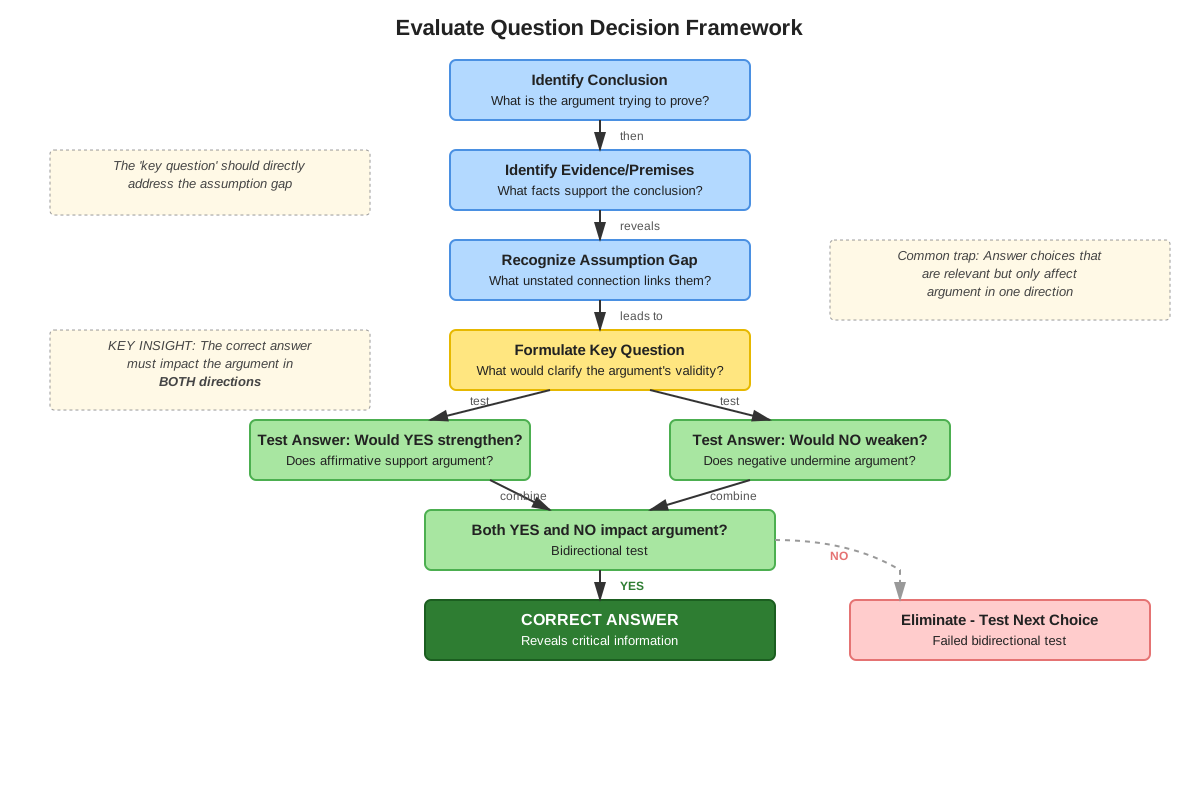
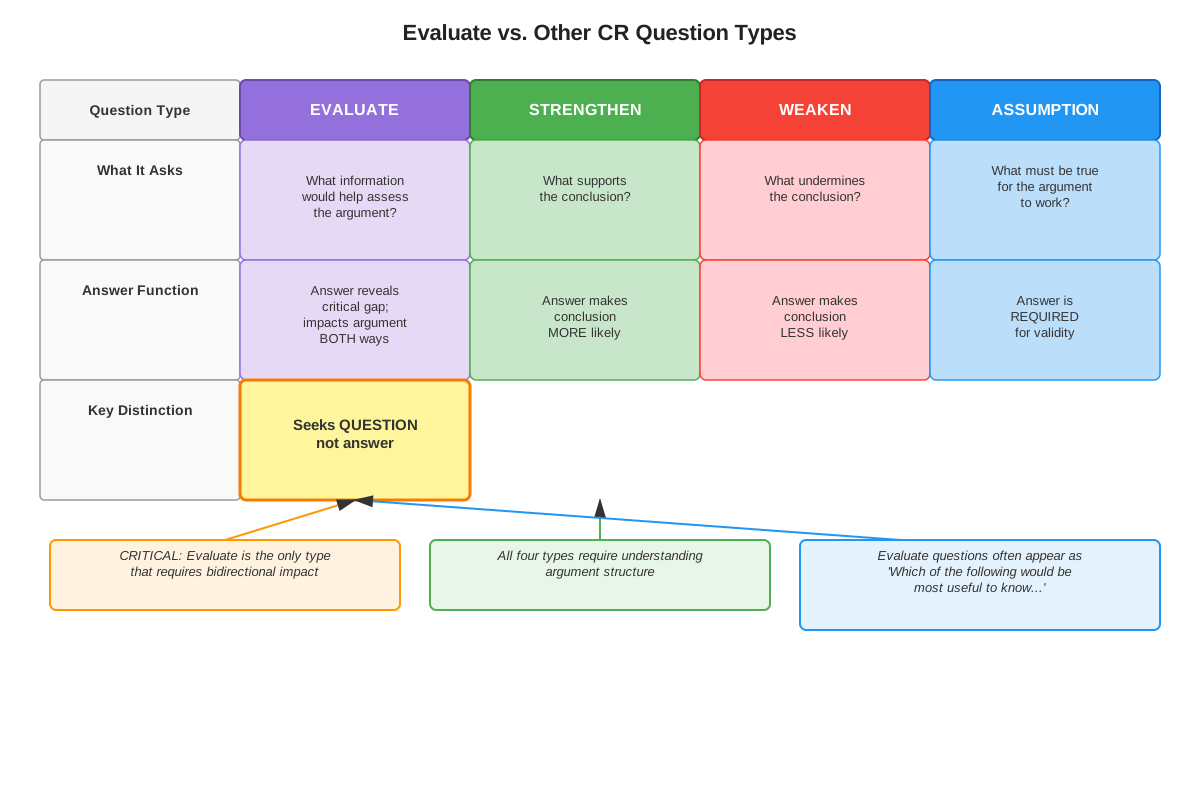
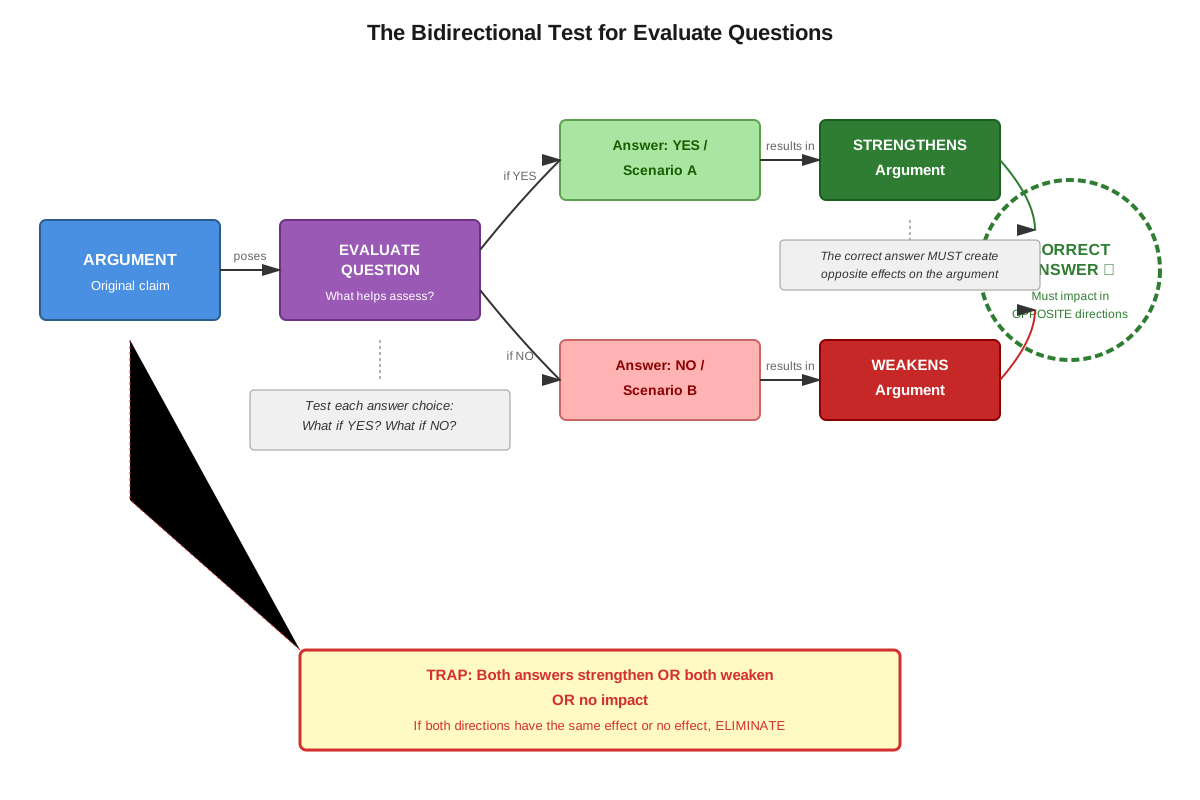
Evaluate questions ask test-takers to identify what additional piece of information would be most useful in determining whether an argument is strong or weak. The correct answer to an evaluate question has a distinctive characteristic: answering that question one way would strengthen the argument, while answering it the opposite way would weaken the argument. This "two-way street" property distinguishes evaluate questions from other Critical Reasoning types.
The fundamental logic behind evaluate questions centers on identifying critical information gaps. Every argument makes certain claims explicit while leaving other assumptions implicit. Evaluate questions target the most significant of these implicit elements—the ones that, if clarified, would substantially affect our confidence in the conclusion. The correct answer doesn't provide the information itself; rather, it identifies what question needs answering.
The Variance Test
The most powerful tool for solving evaluate questions is the variance test (also called the "answer test"). This technique involves taking each answer choice and considering: "If I knew the answer to this question was YES, how would that affect the argument? If I knew the answer was NO, how would that affect the argument?" The correct answer will show significant variance—one answer strengthens the argument while the opposite answer weakens it.
For example, if an argument concludes that "Company X's new training program caused productivity to increase," a relevant evaluate question might be: "Did productivity increase in departments that did not receive the training?" If YES (productivity increased everywhere), this weakens the causal claim. If NO (productivity only increased where training occurred), this strengthens the causal claim. This variance indicates a highly relevant question.
Identifying the Argument's Assumption
Evaluate questions closely relate to assumption identification. The most valuable information to know typically concerns the argument's key assumptions—the unstated premises that must be true for the conclusion to follow logically. However, evaluate questions frame this differently: rather than stating the assumption, the correct answer asks whether the assumption holds true.
Consider an argument structure: "Sales of Product A increased after the advertising campaign. Therefore, the advertising campaign was effective." The key assumption is that something other than the advertising didn't cause the sales increase. An evaluate question might ask: "Were there other factors during this period that could have increased sales?" This question directly probes the assumption.
Types of Information Gaps
Evaluate questions commonly target several categories of logical gaps:
Causal Relationship Gaps: When arguments claim one thing caused another, evaluate questions often ask whether alternative causes existed, whether the correlation was coincidental, or whether the cause-effect relationship could be reversed.
Comparison Gaps: Arguments comparing two things often lack baseline information. Evaluate questions may ask whether the comparison groups were similar in relevant ways, whether the same measurement standards applied, or whether confounding variables differed between groups.
Representativeness Gaps: Arguments generalizing from samples to populations may lack information about sample representativeness. Evaluate questions probe whether the sample accurately reflects the broader group.
Implementation Gaps: Arguments proposing solutions often assume implementation will occur as planned. Evaluate questions may ask about feasibility, cost, side effects, or practical obstacles.
The Relevance Criterion
Not all information gaps matter equally. The correct answer to an evaluate question must identify information that is directly relevant to the argument's logical structure. Tangentially related information, background context that doesn't affect validity, or details about minor premises rather than the main conclusion typically represent incorrect answers.
| Relevant Information | Irrelevant Information |
|---|---|
| Directly affects conclusion validity | Provides interesting context only |
| Relates to key assumptions | Concerns minor details |
| Shows variance under the answer test | Doesn't change argument strength either way |
| Addresses logical gaps | Addresses factual details already established |
| Concerns the causal/logical connection | Concerns peripheral circumstances |
The Bidirectional Nature
A hallmark of correct evaluate answers is their bidirectional impact. The information sought must be capable of affecting the argument in both directions depending on what the answer turns out to be. If knowing the answer would only strengthen the argument (or only weaken it), regardless of whether the answer is yes or no, then it's not testing a true uncertainty in the argument.
For instance, if an argument claims "The new policy will save money," asking "Will the policy save money?" is not a good evaluate question because it simply restates the conclusion. However, asking "Does the policy have implementation costs that exceed the projected savings?" is excellent because YES weakens the argument while NO strengthens it.
Concept Relationships
The concepts within evaluate questions form an interconnected logical framework. Identifying information gaps serves as the foundation, which requires first understanding the argument's structure and assumptions. Once gaps are identified, applying the variance test determines which gap is most critical. The relevance criterion filters out tangentially related information, while the bidirectional nature confirms that the identified question truly tests an uncertainty rather than restating known information.
Evaluate questions connect backward to prerequisite topics in Critical Reasoning. Assumption identification directly enables evaluate question success—the best evaluate questions typically probe key assumptions. Argument structure analysis provides the framework for recognizing what's stated versus what's assumed. Understanding strengthen and weaken questions helps because evaluate questions essentially ask: "What information could either strengthen OR weaken this argument?"
The relationship map flows as follows: Argument Structure Analysis → Assumption Identification → Information Gap Recognition → Variance Test Application → Relevance Filtering → Correct Answer Selection. Each step depends on the previous one, creating a systematic approach to these questions.
High-Yield Facts
- ⭐ The correct answer to an evaluate question must show variance: answering it one way strengthens the argument, answering it the opposite way weakens the argument
- ⭐ Evaluate questions ask what information would be useful to know, not what information is already established in the argument
- ⭐ The variance test is the most reliable method for confirming correct answers: test each choice by asking "What if YES?" and "What if NO?"
- ⭐ Evaluate questions most commonly target the argument's key unstated assumptions rather than explicit premises
- ⭐ Common question stems include "most useful to know," "most helpful in evaluating," and "answer to which question would be most relevant"
- Arguments involving causal claims are particularly common in evaluate questions because causation requires assumptions about alternative explanations
- The correct answer addresses the logical connection between premises and conclusion, not peripheral details
- Information that would only strengthen (or only weaken) the argument regardless of the answer is incorrect
- Evaluate questions differ from assumption questions: evaluate asks what question to answer, assumption questions ask what must be true
- Comparison-based arguments frequently appear in evaluate questions because comparisons require assumptions about similarity and measurement consistency
- Time-based arguments (before/after comparisons) often need evaluation of whether other factors changed during the same period
- The most tempting wrong answers often address interesting but ultimately irrelevant contextual information
Quick check — test yourself on Evaluate so far.
Try Flashcards →Common Misconceptions
Misconception: Evaluate questions ask for information that would strengthen the argument.
Correction: Evaluate questions ask for information that could go either way—the same question answered differently could either strengthen OR weaken the argument. The correct answer identifies an uncertainty, not a one-directional support.
Misconception: The correct answer provides the missing information needed to complete the argument.
Correction: The correct answer identifies what question needs answering, not the answer itself. Evaluate questions ask "What would be useful to know?" not "What is true?"
Misconception: Any information related to the argument's topic is relevant for evaluation.
Correction: Only information that directly affects the logical validity of the conclusion is relevant. Background context, interesting tangential facts, or details about minor points don't help evaluate the core argument unless they impact the main logical connection.
Misconception: If an answer choice would weaken the argument, it must be correct.
Correction: The correct answer must be capable of both strengthening AND weakening depending on how it's answered. An answer that only weakens (or only strengthens) fails the variance test and is incorrect.
Misconception: Evaluate questions are essentially the same as assumption questions.
Correction: While related, these question types differ fundamentally. Assumption questions ask what must be true for the argument to work. Evaluate questions ask what we need to know to determine whether the argument works. Assumptions are stated as facts; evaluate answers are stated as questions.
Misconception: The longest or most detailed answer choice is usually correct in evaluate questions.
Correction: Length and detail don't indicate correctness. Many incorrect answers are lengthy but address irrelevant issues. The correct answer may be concise but precisely target the argument's critical gap.
Misconception: Information already stated or implied in the argument can be the correct answer.
Correction: The correct answer must identify genuinely unknown information. If the argument already establishes something (even implicitly), asking about it doesn't help evaluate the argument further.
Worked Examples
Example 1: Business Strategy Argument
Argument: "TechCorp's market share increased by 15% in the quarter following the launch of their new advertising campaign. Therefore, the advertising campaign successfully attracted new customers to TechCorp."
Question: Which of the following would be most useful to know in evaluating the argument?
Answer Choices:
A) Whether TechCorp's competitors reduced their advertising spending during the same quarter
B) What percentage of TechCorp's budget was allocated to the advertising campaign
C) Whether TechCorp's market share had been declining in previous quarters
D) How many different media channels TechCorp used in the advertising campaign
E) Whether the advertising campaign won any industry awards
Analysis:
First, identify the argument structure:
- Premise: Market share increased 15% after advertising campaign launch
- Conclusion: The advertising campaign successfully attracted new customers
- Key Assumption: The advertising campaign caused the market share increase (not other factors)
Now apply the variance test to each choice:
Choice A: "Whether TechCorp's competitors reduced their advertising spending during the same quarter"
- If YES (competitors reduced spending): This would strengthen the argument that TechCorp's campaign was effective, as it suggests the market share gain came from competitive advantage
- If NO (competitors maintained spending): This would weaken the argument, suggesting TechCorp gained share despite equal competitive pressure, or that other factors were at play
- Variance: Strong bidirectional impact ✓
Choice B: "What percentage of TechCorp's budget was allocated to the advertising campaign"
- Knowing the budget percentage doesn't help evaluate whether the campaign caused the market share increase
- This is about resource allocation, not causal effectiveness
- Variance: No meaningful impact on argument validity ✗
Choice C: "Whether TechCorp's market share had been declining in previous quarters"
- This provides context but doesn't address whether the campaign caused the increase
- Market share could increase after a decline for many reasons unrelated to advertising
- Variance: Minimal impact on the causal claim ✗
Choice D: "How many different media channels TechCorp used"
- This is a detail about campaign execution, not about whether it caused the result
- Doesn't address alternative explanations for market share growth
- Variance: No impact on argument validity ✗
Choice E: "Whether the advertising campaign won any industry awards"
- Awards indicate creative quality but don't establish causal effectiveness
- The argument is about customer attraction, not industry recognition
- Variance: Irrelevant to the causal claim ✗
Correct Answer: A
Key Lesson: The argument makes a causal claim (advertising caused market share increase). The correct answer probes whether alternative explanations exist. If competitors reduced their efforts, TechCorp's campaign looks more effective. If competitors maintained efforts, other factors might explain TechCorp's gains.
Example 2: Scientific Study Argument
Argument: "A recent study found that people who drink green tea daily have 20% lower rates of heart disease than those who don't drink green tea. Researchers concluded that drinking green tea reduces the risk of heart disease."
Question: The answer to which of the following questions would be most helpful in evaluating the researchers' conclusion?
Answer Choices:
A) What percentage of the study participants were over age 50?
B) Did the green tea drinkers differ from non-drinkers in other health-related behaviors?
C) How long did the study track participants?
D) What specific compounds in green tea might affect heart health?
E) Were the study results published in a peer-reviewed journal?
Analysis:
Argument structure:
- Premise: Green tea drinkers have 20% lower heart disease rates
- Conclusion: Green tea drinking reduces heart disease risk
- Key Assumption: The correlation indicates causation; no confounding variables explain the difference
Apply the variance test:
Choice A: "What percentage of the study participants were over age 50?"
- Age distribution affects study generalizability but not the causal claim
- Knowing the age breakdown doesn't tell us whether green tea caused the difference
- Variance: Doesn't affect the causal validity ✗
Choice B: "Did the green tea drinkers differ from non-drinkers in other health-related behaviors?"
- If YES (they differed in exercise, diet, etc.): This weakens the conclusion by suggesting confounding variables might explain the heart disease difference
- If NO (groups were similar in other behaviors): This strengthens the conclusion by eliminating alternative explanations
- Variance: Strong bidirectional impact on the causal claim ✓
Choice C: "How long did the study track participants?"
- Study duration affects data quality but doesn't address whether green tea caused the difference
- A longer or shorter study doesn't resolve the causation question
- Variance: Limited impact on causal validity ✗
Choice D: "What specific compounds in green tea might affect heart health?"
- This addresses mechanism, not whether causation exists
- Understanding how something works doesn't establish that it does work
- Variance: Doesn't evaluate the causal claim ✗
Choice E: "Were the study results published in a peer-reviewed journal?"
- Publication venue indicates credibility but not causal validity
- Even peer-reviewed studies can have confounding variable problems
- Variance: Doesn't address the logical gap ✗
Correct Answer: B
Key Lesson: When arguments claim causation based on correlation, the critical question is whether confounding variables exist. If green tea drinkers also exercise more, eat better, or have other healthy habits, those factors might explain the heart disease difference rather than the tea itself.
Exam Strategy
When approaching evaluate questions on the GMAT, begin by identifying the question type through trigger phrases. Look for question stems containing "most useful to know," "most helpful in evaluating," "answer to which question," or "most relevant to assessing." These phrases signal an evaluate question and should trigger a specific strategic approach.
Step 1: Identify the Conclusion and Key Assumption
Before looking at answer choices, clearly identify what the argument concludes and what assumption makes that conclusion possible. Write down (on your noteboard) the conclusion in abbreviated form and the key logical gap. Most evaluate questions target the primary assumption connecting premises to conclusion.
Step 2: Predict the Type of Information Needed
Based on the argument type, predict what category of information would be most valuable:
- Causal arguments: Need to know about alternative causes
- Comparison arguments: Need to know about baseline similarity
- Generalization arguments: Need to know about sample representativeness
- Proposal arguments: Need to know about implementation feasibility or side effects
Step 3: Apply the Variance Test Systematically
For each answer choice, explicitly ask: "If the answer to this question were YES, how would it affect the argument? If the answer were NO, how would it affect the argument?" The correct answer will show clear variance—one direction strengthens, the other weakens. Eliminate any choice that doesn't show this bidirectional impact.
Step 4: Eliminate Irrelevant Information
Watch for common trap answers:
- Background context that's interesting but doesn't affect validity
- Implementation details when the argument is about whether something will work, not how
- Restatements of the conclusion phrased as questions
- Information already established in the argument
- Tangential factors that don't connect to the main logical gap
Time Management: Allocate approximately 2 minutes per evaluate question. Spend 30 seconds understanding the argument structure, 15 seconds predicting the information type needed, and 60-75 seconds applying the variance test to answer choices. If stuck between two choices, both probably show some variance—choose the one more directly related to the main conclusion rather than a subsidiary point.
Process of Elimination: Evaluate questions often include 2-3 answer choices that are completely irrelevant (fail the variance test entirely) and 1-2 that show weak or one-directional impact. Quickly eliminate the clearly irrelevant choices first, then apply the variance test more carefully to remaining options.
Exam Tip: If you're unsure between two answer choices, ask yourself: "Which one addresses the argument's main assumption versus a minor detail?" The correct answer almost always targets the central logical gap, not peripheral issues.
Memory Techniques
VARIANCE Acronym for the variance test process:
- Verify the conclusion first
- Assume each answer is YES
- Reverse and assume it's NO
- Identify which direction strengthens
- Analyze which direction weakens
- Note if both directions matter
- Choose the answer with strongest bidirectional impact
- Eliminate one-directional or no-impact choices
The "Two-Way Street" Visualization: Picture the correct answer as a fork in the road. One path (YES answer) leads toward strengthening the argument, the other path (NO answer) leads toward weakening it. Wrong answers are dead-ends or one-way streets—they don't create this meaningful choice point.
The "Gap Bridge" Mental Model: Visualize the argument as two cliffs (premises and conclusion) with a gap between them. The assumption is an invisible bridge. Evaluate questions ask: "What do we need to know to determine if that bridge is sturdy?" The correct answer identifies the critical structural question about the bridge.
Question Stem Recognition Mnemonic - "KNOW":
- Key question to answer
- Need to evaluate
- Order to assess
- Would be useful/helpful
When you see these words in question stems, immediately think "evaluate question" and activate the variance test strategy.
Summary
Evaluate questions in GMAT Critical Reasoning require test-takers to identify what additional information would be most useful in determining an argument's validity. Unlike strengthen or weaken questions that provide information and ask about its impact, evaluate questions ask which question needs answering. The defining characteristic of correct answers is bidirectional variance: answering the question one way strengthens the argument, while answering it the opposite way weakens the argument. Success on evaluate questions depends on identifying the argument's key assumptions and recognizing which information gaps most significantly affect the conclusion's validity. The variance test—systematically considering how YES and NO answers would affect the argument—provides the most reliable method for selecting correct answers. Common argument types in evaluate questions include causal claims requiring information about alternative explanations, comparisons requiring information about baseline similarity, and generalizations requiring information about sample representativeness. Mastering evaluate questions requires distinguishing between genuinely relevant information that affects logical validity and tangentially related context that, while interesting, doesn't impact whether the conclusion follows from the premises.
Key Takeaways
- Evaluate questions ask what information would be useful to know, not what information is true or what would strengthen/weaken the argument
- The variance test is essential: correct answers must show bidirectional impact—one answer strengthens the argument, the opposite answer weakens it
- Evaluate questions typically target the argument's key unstated assumptions, particularly in causal, comparison, and generalization arguments
- Information already established in the argument, background context that doesn't affect validity, and one-directional impacts are common wrong answer traps
- Identify the conclusion and main assumption before examining answer choices to predict what type of information would be most valuable
- The correct answer addresses the logical connection between premises and conclusion, not peripheral details or implementation specifics
- Systematic application of the variance test to each answer choice, combined with elimination of clearly irrelevant options, provides the most efficient path to correct answers
Related Topics
Assumption Questions: These questions ask test-takers to identify what must be true for an argument to be valid. Mastering evaluate questions builds directly on assumption identification skills, as evaluate questions essentially ask "What do we need to know about the assumption?"
Strengthen and Weaken Questions: Understanding how information can support or undermine arguments provides essential context for evaluate questions. The variance test in evaluate questions essentially combines strengthen and weaken thinking—the correct answer could do either depending on how it's answered.
Causal Reasoning: Many evaluate questions involve causal arguments. Deeper study of causation, correlation, and confounding variables enhances the ability to identify what information would help assess causal claims.
Argument Structure and Scope: Advanced understanding of how arguments are constructed, including scope limitations and logical boundaries, helps identify precisely what information gaps matter most for evaluation purposes.
Practice CTA
Now that you understand the framework and strategy for evaluate questions, it's time to apply these concepts to actual GMAT-style problems. The practice questions and flashcards will reinforce your ability to identify information gaps, apply the variance test, and distinguish between relevant and irrelevant information. Remember that evaluate questions reward systematic thinking—each practice question is an opportunity to refine your variance test technique and build the pattern recognition that leads to confident, accurate answers under time pressure. Approach each practice question methodically, and you'll develop the instincts that make evaluate questions a reliable source of points on test day.
Sign up free to keep reading
Create a free AnvayaPrep account to finish this GMAT guide on Evaluate — plus flashcards and practice questions.