Overview
The main idea is the central concept, argument, or purpose that unifies an entire passage in GMAT Reading Comprehension. It represents what the author fundamentally wants to communicate—the overarching message that ties together all supporting details, examples, and subordinate points. Understanding and identifying the main idea is not merely about finding a topic sentence; it requires synthesizing information across multiple paragraphs to grasp the author's primary intent and the passage's essential purpose.
Mastering GMAT main idea questions is critical because they appear in virtually every Reading Comprehension passage on the exam. These questions test whether students can distinguish between central themes and peripheral details, between what the passage is fundamentally about versus what it merely mentions. The GMAT frequently presents passages with complex structures where the main idea emerges gradually or is stated implicitly rather than explicitly, making this skill essential for achieving high Verbal Reasoning scores.
Within the broader context of Verbal Reasoning, main idea identification serves as the foundation for all other Reading Comprehension question types. Once students accurately identify the main idea, they can more effectively answer specific detail questions, inference questions, and structure questions. The main idea acts as an anchor point—a reference framework against which all other passage elements can be evaluated. This skill also connects directly to Critical Reasoning, where understanding an argument's core conclusion parallels identifying a passage's main idea.
Learning Objectives
- [ ] Identify the main idea in GMAT Reading Comprehension passages of varying complexity and structure
- [ ] Explain the difference between main idea, primary purpose, and supporting details
- [ ] Apply main idea identification strategies to GMAT questions under timed conditions
- [ ] Distinguish between explicit and implicit main ideas in academic and business passages
- [ ] Evaluate answer choices to eliminate options that are too broad, too narrow, or off-topic
- [ ] Synthesize information across multiple paragraphs to construct an accurate main idea statement
Prerequisites
- Basic reading comprehension skills: The ability to understand college-level prose is essential for processing GMAT passages that contain sophisticated vocabulary and complex sentence structures.
- Understanding of passage structure: Familiarity with how academic and argumentative texts are organized helps students navigate where main ideas typically appear.
- Ability to distinguish topics from themes: Recognizing that a topic is what a passage discusses while the main idea is what the passage says about that topic prevents common identification errors.
Why This Topic Matters
Main idea questions constitute approximately 20-30% of all GMAT Reading Comprehension questions, making them one of the most frequently tested question types. Beyond their direct appearance, the ability to identify main ideas indirectly supports performance on virtually all other Reading Comprehension question types, as understanding the passage's central message provides context for evaluating specific details, inferences, and structural elements.
In professional contexts, the skill of quickly identifying main ideas translates directly to business communication, where executives must extract key messages from lengthy reports, proposals, and analyses. Graduate business programs value this skill because MBA students must process enormous volumes of case studies, research papers, and business literature efficiently.
On the GMAT, main idea questions typically appear as the first question following a passage, though they can appear anywhere in the question set. Common question stems include: "Which of the following best expresses the main idea of the passage?", "The primary purpose of the passage is to...", "The passage is primarily concerned with...", and "Which of the following most accurately describes the contents of the passage?" These questions appear across all passage types—biological sciences, social sciences, business, and humanities—making main idea identification a universal skill requirement.
Core Concepts
Defining the Main Idea
The main idea is the central message, argument, or purpose that the author intends to convey throughout an entire passage. It answers the question: "What is this passage fundamentally about, and what is the author's primary point regarding this subject?" The main idea differs from the topic (the general subject matter) by including the author's perspective, argument, or analytical approach to that topic.
A complete main idea statement typically contains two components: (1) the subject or topic being discussed, and (2) what the author asserts, explains, or argues about that subject. For example, if a passage discusses renewable energy, the topic is "renewable energy," but the main idea might be "renewable energy technologies have become economically competitive with fossil fuels due to recent technological advances and policy support."
Main Idea vs. Primary Purpose
While closely related, main idea and primary purpose represent subtly different concepts that GMAT questions may test separately:
| Aspect | Main Idea | Primary Purpose |
|---|---|---|
| Focus | What the passage says | Why the author wrote it |
| Form | Declarative statement | Infinitive verb phrase |
| Example | "Coral reefs are declining due to ocean acidification" | "To explain the causes of coral reef decline" |
| Question stem | "The main point is..." | "The author's primary purpose is to..." |
Understanding this distinction helps students select appropriate answer choices. Primary purpose answers typically begin with verbs like "to explain," "to argue," "to describe," "to challenge," "to reconcile," or "to evaluate," while main idea answers present complete statements about the passage content.
Explicit vs. Implicit Main Ideas
GMAT passages present main ideas in two fundamental ways:
Explicit main ideas are directly stated in the passage, typically in a thesis statement within the first or last paragraph. These are more straightforward to identify but still require verification that the statement truly encompasses the entire passage rather than just one section.
Implicit main ideas are not directly stated but must be inferred by synthesizing information across the passage. The GMAT frequently employs implicit main ideas in medium and high-difficulty passages, requiring students to construct the main idea from cumulative evidence. For example, a passage might describe three different theories about economic development without explicitly stating "economists disagree about the primary drivers of economic development," yet this represents the passage's main idea.
Structural Positions of Main Ideas
Main ideas appear in predictable structural positions, though the GMAT intentionally varies these to test adaptability:
- Opening thesis model: The main idea appears in the first paragraph, often in the first or second sentence, with subsequent paragraphs providing support, examples, and elaboration.
- Concluding synthesis model: The passage builds through examples, details, or contrasting viewpoints, with the main idea emerging in the final paragraph as a synthesis or conclusion.
- Pivot model: The passage begins with a common belief or previous theory, then pivots (often signaled by "however," "but," or "yet") to present the author's contrasting main idea.
- Distributed model: The main idea is constructed across multiple paragraphs, with each paragraph contributing an essential component that must be synthesized.
Scope and the Main Idea
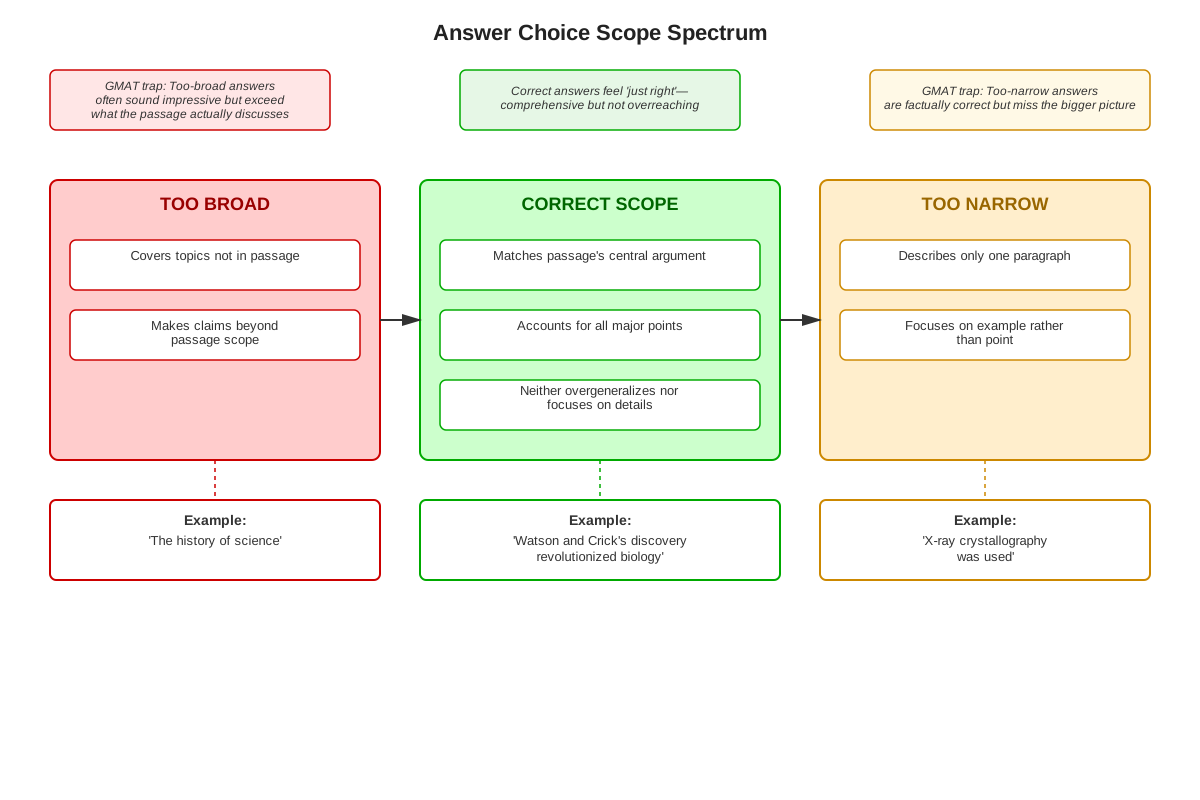
The main idea must match the passage's scope—neither too broad nor too narrow. This principle helps eliminate incorrect answer choices:
Too broad: An answer choice that could apply to a much longer work or encompasses topics the passage doesn't address. For example, if a passage discusses one specific application of artificial intelligence in medical diagnosis, an answer stating "artificial intelligence is transforming multiple industries" is too broad.
Too narrow: An answer choice that captures only one paragraph or supporting detail rather than the entire passage. If a passage argues that three factors contribute to urban heat islands, an answer focusing only on one factor is too narrow.
Appropriate scope: The correct answer encompasses everything the passage discusses without extending beyond it, matching the level of generality at which the author operates.
Supporting Details vs. Main Idea
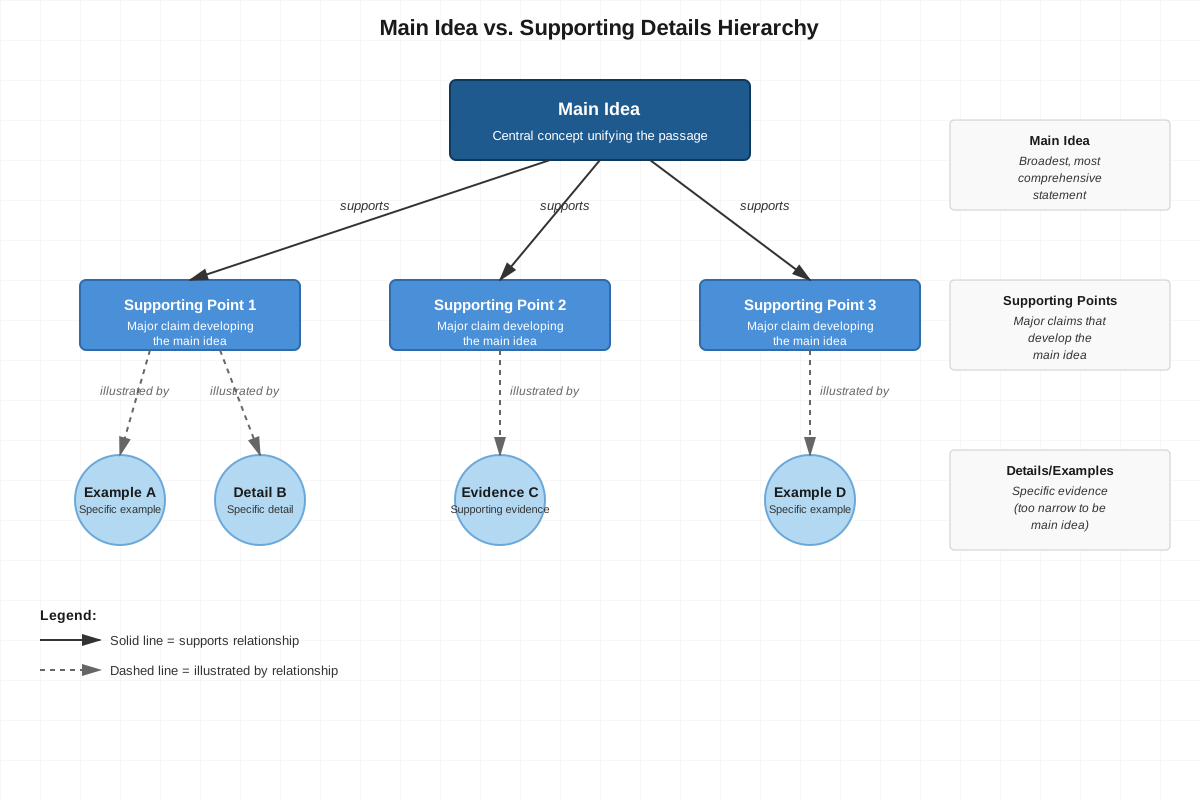
A critical skill involves distinguishing the main idea from supporting details, examples, and subordinate points. Supporting details serve to illustrate, prove, or elaborate the main idea but are not themselves the central message. The GMAT frequently includes answer choices that accurately reflect passage content but represent supporting details rather than the main idea.
To distinguish them, ask: "Is this point the reason the passage was written, or is it evidence/explanation for a larger point?" Supporting details answer questions like "how," "why," or "for example," while the main idea answers "what is the author's fundamental message?"
Concept Relationships
The main idea serves as the hierarchical apex of passage organization, with all other elements subordinate to it. Supporting details → provide evidence for → the main idea. Examples → illustrate → supporting points → which develop → the main idea. Counterarguments or alternative viewpoints → are presented to be refuted or contextualized → in service of establishing → the main idea.
Understanding passage structure (a prerequisite concept) enables main idea identification because recognizing organizational patterns reveals where authors typically position their central messages. Conversely, once the main idea is identified, it illuminates the passage structure by clarifying why each paragraph exists and how sections relate to one another.
Main idea identification directly enables success with other Reading Comprehension question types: inference questions require understanding what logically extends from the main idea; specific detail questions are easier when students understand how details support the main idea; and tone/attitude questions become clearer when the main idea reveals the author's stance. This creates a relationship map: Main Idea Mastery → Enhanced Passage Comprehension → Improved Performance on All Question Types.
High-Yield Facts
- ⭐ The main idea must account for the entire passage, not just one or two paragraphs; if an answer choice doesn't encompass all major sections, it's incorrect
- ⭐ Main idea questions often appear first in a question set, and correctly answering them provides a framework for subsequent questions
- ⭐ Answer choices that use extreme language ("only," "always," "never," "completely") are rarely correct for main idea questions unless the passage itself uses such definitive language
- ⭐ The correct main idea answer will match the passage's tone; if the passage is neutral and descriptive, eliminate answers that suggest the author is arguing or criticizing
- ⭐ When two answer choices seem equally valid, the one that better captures the author's purpose or perspective (not just the topic) is typically correct
- Supporting details, examples, and statistics are never the main idea, even if they occupy significant passage space
- The main idea often appears near structural transition words like "however," "thus," "therefore," or "in fact" that signal the author's key point
- If a passage presents multiple viewpoints, the main idea typically involves the relationship between those viewpoints rather than any single viewpoint
- Main idea answers should be specific enough to distinguish the passage from other passages on similar topics
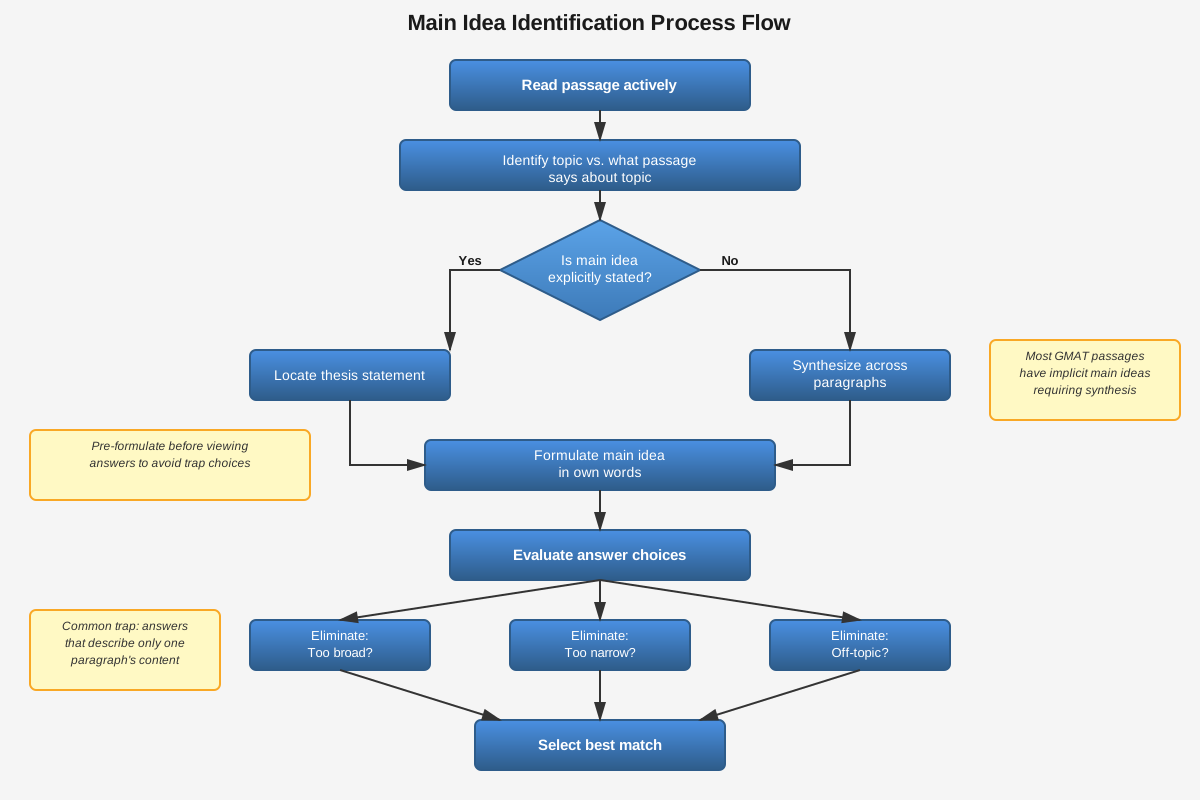
- Eliminating answers that are too broad, too narrow, or off-topic is often more efficient than trying to identify the perfect answer immediately
Quick check — test yourself on Main idea so far.
Try Flashcards →Common Misconceptions
Misconception: The main idea is always explicitly stated in the first paragraph.
Correction: While first paragraphs often contain or hint at the main idea, GMAT passages frequently place the main idea in concluding paragraphs, distribute it across multiple sections, or leave it implicit, requiring synthesis. Students must read the entire passage before confidently identifying the main idea.
Misconception: The longest or most detailed section of a passage represents the main idea.
Correction: Passages often devote substantial space to examples, background information, or supporting evidence that illustrates the main idea without being the main idea itself. Length indicates emphasis but not necessarily centrality to the author's primary message.
Misconception: The main idea and the topic are the same thing.
Correction: The topic is what the passage discusses (e.g., "renewable energy"), while the main idea is what the author says about that topic (e.g., "renewable energy has become cost-competitive with fossil fuels"). The main idea includes the author's perspective, argument, or analytical approach.
Misconception: If an answer choice contains information from the passage, it must be the main idea.
Correction: All answer choices in main idea questions typically contain accurate information from the passage. The correct answer is distinguished not by accuracy but by scope—it must encompass the entire passage's central message rather than a supporting detail or single paragraph's content.
Misconception: Main idea questions and primary purpose questions are identical and interchangeable.
Correction: While related, these question types require different answer formats. Main idea answers are declarative statements about passage content ("The passage argues that X causes Y"), while primary purpose answers describe the author's intent using infinitive verbs ("To explain why X causes Y"). The same passage might have both question types requiring differently structured answers.
Worked Examples
Example 1: Business Passage
Passage: "Traditional economic theory suggests that increased competition invariably benefits consumers through lower prices and improved quality. However, recent research in behavioral economics challenges this assumption. Studies conducted across multiple industries demonstrate that excessive choice can lead to decision paralysis, reducing consumer satisfaction and purchase completion rates. In the telecommunications sector, for instance, companies offering more than seven service plans experienced 15% lower conversion rates than those offering three to five options. Similarly, retirement fund participants presented with numerous investment options contributed at lower rates than those with limited choices. These findings suggest that businesses may optimize consumer outcomes not by maximizing options but by curating a strategic selection that balances variety with cognitive manageability."
Question: Which of the following best expresses the main idea of the passage?
Answer Choices:
(A) Traditional economic theory has been completely disproven by behavioral economics research
(B) Consumers make better decisions when presented with fewer than seven options
(C) Excessive choice can reduce consumer satisfaction, suggesting businesses should strategically limit options
(D) Telecommunications companies and retirement fund managers should reduce their service offerings
(E) Behavioral economics provides more accurate predictions than traditional economic theory
Analysis:
Step 1: Identify the passage structure. The passage follows a pivot model: it begins with traditional theory, pivots with "However," and then presents contrasting evidence and a conclusion.
Step 2: Locate the author's main point. The final sentence beginning with "These findings suggest" synthesizes the evidence and presents the author's conclusion.
Step 3: Evaluate scope. The main idea should encompass: (1) the challenge to traditional theory, (2) the evidence about excessive choice, and (3) the implication for business strategy.
Step 4: Eliminate answers:
- (A) is too extreme ("completely disproven") and too broad (not limited to the choice issue)
- (B) is too narrow (focuses only on the "seven options" detail from one example)
- (D) is too narrow (mentions only two industries) and too prescriptive (the passage suggests strategic curation, not simple reduction)
- (E) is too broad (makes a general claim about behavioral vs. traditional economics beyond the passage scope)
- (C) correctly captures the scope: it acknowledges the problem (excessive choice reduces satisfaction) and the implication (strategic limitation), matching both the passage's content and tone
Correct Answer: (C)
Connection to Learning Objectives: This example demonstrates identifying an implicit main idea (synthesized from the final sentence), distinguishing it from supporting details (the specific statistics), and applying scope analysis to eliminate incorrect answers.
Example 2: Science Passage
Passage: "The human microbiome—the collection of microorganisms inhabiting the human body—has emerged as a critical factor in health and disease. Researchers have identified correlations between microbiome composition and conditions ranging from obesity to depression. What remains unclear, however, is the direction of causality: do microbiome alterations cause these conditions, or do the conditions alter the microbiome? Recent longitudinal studies tracking individuals before and after disease onset provide some clarity. In inflammatory bowel disease, microbiome changes precede symptom development by an average of six months, suggesting a causal role. Conversely, in depression, psychological symptoms typically emerge before significant microbiome shifts, indicating that mental state may influence microbial populations. These findings underscore the complexity of host-microbiome interactions and the need for condition-specific research rather than universal microbiome interventions."
Question: The passage is primarily concerned with:
Answer Choices:
(A) Describing the composition of the human microbiome
(B) Explaining why microbiome research has become important in medicine
(C) Examining the causal relationship between microbiome changes and disease
(D) Arguing that microbiome interventions are ineffective for treating disease
(E) Comparing inflammatory bowel disease with depression
Analysis:
Step 1: Identify the question type. "Primarily concerned with" indicates a primary purpose question, requiring an infinitive verb phrase answer.
Step 2: Map the passage structure. Paragraph flow: introduction of microbiome importance → identification of the causality question → evidence from longitudinal studies → conclusion about complexity and research needs.
Step 3: Identify the central focus. The passage revolves around the causality question introduced in the second sentence and explored through examples.
Step 4: Eliminate answers:
- (A) is too narrow and factually incorrect (the passage doesn't describe composition)
- (B) is too broad and doesn't capture the causality focus
- (D) is incorrect (the passage doesn't argue interventions are ineffective, only that they should be condition-specific)
- (E) is too narrow (the comparison serves as evidence for the larger causality point)
- (C) correctly identifies the central concern: the passage examines (investigates) the causal relationship, using examples to explore whether microbiome changes cause disease or vice versa
Correct Answer: (C)
Connection to Learning Objectives: This example demonstrates distinguishing between main idea and supporting examples, recognizing that the comparison between two diseases serves the larger purpose of examining causality, and applying the appropriate scope to match the passage's analytical focus.
Exam Strategy
Initial Reading Strategy: During the first read-through, actively ask "Why did the author write this?" and "What is the author's main point?" rather than trying to memorize details. Pay special attention to the first and last sentences of each paragraph, as these often contain topic sentences and transitions that reveal the passage's direction.
Trigger Words for Main Ideas: Watch for structural signals that often precede or indicate main ideas:
- Contrast words: "however," "but," "yet," "nevertheless" (often signal the author's true position after presenting an opposing view)
- Conclusion words: "thus," "therefore," "consequently," "in sum" (frequently introduce synthesizing statements)
- Emphasis words: "importantly," "significantly," "crucially," "the key point" (directly flag central ideas)
- Purpose phrases: "this suggests," "these findings indicate," "the evidence demonstrates" (often precede main idea statements)
Process of Elimination Approach:
- First, eliminate answers that are factually incorrect or not mentioned in the passage
- Second, eliminate answers that are too narrow (covering only one paragraph or example)
- Third, eliminate answers that are too broad (could apply to many passages on the general topic)
- Fourth, eliminate answers that mismatch the passage's tone (argumentative vs. descriptive, critical vs. neutral)
- Finally, choose between remaining options by asking which better captures the author's purpose
Time Allocation: Spend approximately 3-3.5 minutes on the initial passage reading, making mental notes about structure and potential main ideas. Main idea questions themselves should take 30-45 seconds once the passage is understood, as they test comprehension rather than requiring re-reading. If uncertain between two answers, briefly scan the passage structure (first and last paragraphs) rather than re-reading the entire passage.
Answer Choice Analysis: Correct main idea answers typically:
- Use moderate, qualified language rather than extremes
- Match the passage's scope precisely
- Capture both the topic and the author's perspective on it
- Account for all major paragraphs or sections
- Reflect the passage's tone and purpose
Exam Tip: If you're uncertain about the main idea, try summarizing the passage in one sentence to a friend. The summary you'd naturally provide often reveals the main idea more clearly than over-analyzing answer choices.
Memory Techniques
SCOPE Acronym for Evaluating Main Ideas:
- Synthesizes all paragraphs (not just one section)
- Captures author's perspective (not just the topic)
- Omits extreme language (unless passage is extreme)
- Precise in scope (neither too broad nor too narrow)
- Echoes passage tone (matches argumentative/descriptive style)
The "Headline Test": Imagine the passage is a newspaper article. What headline would accurately represent the entire article without being misleading? This mental exercise helps distinguish main ideas from supporting details, as headlines capture central messages, not examples.
The "Cocktail Party Summary": Visualize explaining the passage to someone at a social gathering who asks "What was it about?" The natural, concise explanation you'd provide typically reflects the main idea better than overthinking formal answer choices.
First-Last Technique: Remember "FL" (First-Last). The first paragraph often introduces the topic and context, while the last paragraph frequently contains or strongly hints at the main idea. When time is limited, focusing on these two sections provides maximum main idea identification efficiency.
Purpose Verb List: Memorize common primary purpose verbs to quickly evaluate answer choices: explain, describe, argue, challenge, reconcile, evaluate, compare, analyze, propose, critique. Matching the passage's action to the appropriate verb helps identify correct primary purpose answers.
Summary
The main idea represents the central message or purpose that unifies an entire GMAT Reading Comprehension passage, encompassing what the author fundamentally wants to communicate about the topic. Mastering main idea identification requires distinguishing between the topic (what the passage discusses) and the main idea (what the author says about that topic), recognizing that main ideas may be explicit or implicit, and understanding that they must match the passage's scope—neither too broad nor too narrow. Successful identification involves synthesizing information across all paragraphs, recognizing structural signals like contrast and conclusion words, and eliminating answer choices that represent supporting details rather than central messages. The main idea serves as the foundation for all other Reading Comprehension skills, providing the framework for understanding passage structure, evaluating specific details, and making valid inferences. Students must practice distinguishing main ideas from primary purposes, applying scope analysis to eliminate incorrect answers, and efficiently using structural cues to identify central messages under timed conditions.
Key Takeaways
- The main idea encompasses the entire passage's central message, including both the topic and the author's perspective or argument about that topic
- Main ideas may be explicitly stated (typically in first or last paragraphs) or implicit (requiring synthesis across multiple sections)
- Correct main idea answers match the passage's scope precisely—eliminating options that are too broad, too narrow, or off-topic is often the most efficient strategy
- Supporting details, examples, and statistics serve to illustrate the main idea but are never themselves the main idea, regardless of how much space they occupy
- Structural signals like "however," "thus," and "these findings suggest" frequently precede or indicate main idea statements
- Main idea mastery directly improves performance on all other Reading Comprehension question types by providing a comprehension framework
- Primary purpose questions require infinitive verb phrases ("to explain"), while main idea questions require declarative statements about content
Related Topics
Passage Structure and Organization: Understanding how GMAT passages are constructed—including common organizational patterns like problem-solution, cause-effect, and compare-contrast—enables more efficient main idea identification by revealing where authors typically position central messages.
Inference Questions: Once students master main idea identification, they can more effectively answer inference questions, which require understanding what logically follows from the passage's central message and supporting evidence.
Specific Detail Questions: Main idea mastery provides context for evaluating specific details, helping students understand whether details support, illustrate, or contrast with the central message.
Author's Tone and Attitude: Identifying the main idea reveals the author's stance on the topic, which directly connects to questions about tone, attitude, and purpose.
Critical Reasoning - Conclusion Identification: The skill of identifying a passage's main idea parallels identifying an argument's main conclusion in Critical Reasoning, creating cross-topic skill transfer.
Practice CTA
Now that you've mastered the core concepts of main idea identification, it's time to apply these strategies to actual GMAT-style passages. Complete the practice questions to reinforce your ability to distinguish main ideas from supporting details, apply scope analysis, and efficiently use structural cues. Review the flashcards to internalize key concepts and trigger words that signal main ideas. Remember: main idea mastery is not just about answering one question type—it's about building the comprehension framework that elevates your performance across all Reading Comprehension questions. Your investment in this foundational skill will yield returns throughout your GMAT preparation and beyond.
Sign up free to keep reading
Create a free AnvayaPrep account to finish this GMAT guide on Main idea — plus flashcards and practice questions.