Overview
Passage structure refers to the organizational framework and logical architecture that authors use to present ideas, arguments, and information in GMAT Reading Comprehension passages. Understanding GMAT passage structure is not merely about identifying where paragraphs begin and end—it involves recognizing the functional role each paragraph plays, how ideas connect and build upon one another, and the overall purpose the author seeks to accomplish. This skill transforms reading from a passive activity into an active analytical process that enables test-takers to anticipate content, locate information efficiently, and answer questions with greater accuracy and speed.
Mastering passage structure is essential for GMAT success because approximately 40% of Reading Comprehension questions directly or indirectly test your understanding of how a passage is organized. Questions may ask about the primary purpose of a paragraph, the function of a specific detail, or the overall organization of the passage. More importantly, understanding structure allows you to create a mental "map" of the passage that serves as a reference point when answering all question types—from specific detail questions to inference questions. This mental framework dramatically reduces the time spent re-reading and searching for information.
Within the broader context of Verbal Reasoning, passage structure serves as the foundation for all other Reading Comprehension skills. It connects directly to identifying main ideas (which often appear at structurally significant locations), understanding author's tone and purpose (which structure helps reveal), and making inferences (which require understanding how ideas relate across the passage). Without a solid grasp of passage structure, students often struggle with time management, miss subtle relationships between ideas, and fail to distinguish between primary and supporting information—all critical skills for achieving a competitive GMAT score.
Learning Objectives
By the end of this study guide, you should be able to:
- [ ] Identify passage structure in GMAT Reading Comprehension passages
- [ ] Explain passage structure and the function of each structural component
- [ ] Apply passage structure analysis to GMAT questions efficiently
- [ ] Predict the likely content and direction of subsequent paragraphs based on structural cues
- [ ] Distinguish between different passage structure types and their characteristic features
- [ ] Create effective passage maps that capture structural relationships
- [ ] Recognize structural keywords and transitions that signal organizational patterns
Prerequisites
Students should have the following foundational knowledge before studying this topic:
- Basic reading comprehension skills: Ability to understand college-level prose is necessary to focus on structure rather than basic meaning
- Familiarity with paragraph structure: Understanding topic sentences and supporting details helps recognize these elements at the passage level
- Knowledge of common argument components: Recognizing claims, evidence, and conclusions enables identification of their structural roles
- Awareness of transition words: Understanding how words like "however," "furthermore," and "in contrast" signal relationships aids structural analysis
Why This Topic Matters
Understanding passage structure has profound practical applications beyond the GMAT. In professional settings, executives and managers must quickly grasp the organization of reports, proposals, and research documents to extract key information efficiently. Legal professionals analyze the structure of arguments to identify strengths and weaknesses. Researchers evaluate how studies are organized to assess methodology and conclusions. The analytical skills developed through studying passage structure transfer directly to these real-world contexts.
On the GMAT specifically, passage structure appears with remarkable consistency and importance. Approximately 12-14 of the 36 Verbal questions are Reading Comprehension questions, and structural understanding impacts performance on virtually all of them. Explicit structure questions—those asking about the organization of the passage, the purpose of a paragraph, or the function of a detail—constitute roughly 15-20% of Reading Comprehension questions. However, implicit reliance on structural understanding affects another 30-40% of questions, including primary purpose, inference, and strengthening/weakening questions.
Common manifestations of this topic in GMAT passages include: passages that present a theory and then challenge it with new evidence; passages that compare and contrast two or more viewpoints; passages that describe a problem and evaluate potential solutions; passages that trace the historical development of an idea; and passages that present a phenomenon and explain its causes or mechanisms. Recognizing these structural patterns immediately upon reading allows test-takers to anticipate question types and locate information with precision.
Core Concepts
Fundamental Elements of Passage Structure
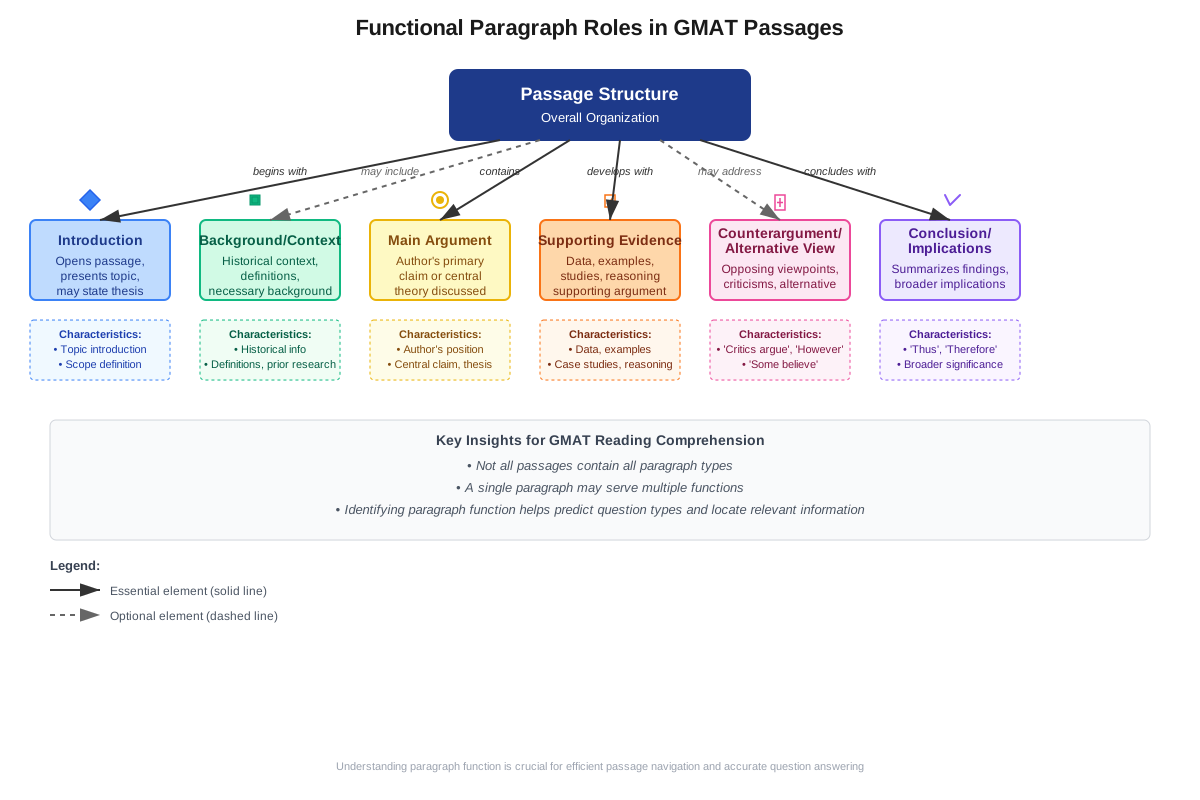
Every GMAT passage, regardless of topic or length, consists of functional building blocks that work together to convey the author's message. The main idea represents the central claim or thesis the author wishes to communicate—the "big picture" takeaway. This typically appears in the first or second paragraph, though occasionally it emerges only after background information or contrasting views are presented. The supporting ideas provide evidence, examples, explanations, or elaboration that develops and substantiates the main idea. These occupy most of the passage's real estate and vary in their importance to the author's overall argument.
Structural keywords serve as signposts that reveal relationships between ideas and signal organizational patterns. These include contrast indicators (however, nevertheless, despite, although), continuation indicators (furthermore, additionally, moreover), cause-and-effect markers (therefore, consequently, because, thus), and emphasis signals (indeed, in fact, importantly). Recognizing these keywords allows readers to anticipate whether the next sentence will support, contradict, or elaborate on the previous idea.
The paragraph function refers to the specific role each paragraph plays within the overall passage architecture. Common functions include: introducing a topic or phenomenon, presenting a traditional or widely-held view, challenging or contradicting a previous view, providing evidence or examples, explaining a mechanism or process, comparing alternatives, and stating conclusions or implications. Understanding paragraph function enables efficient passage mapping and rapid information retrieval.
Common Passage Structure Types
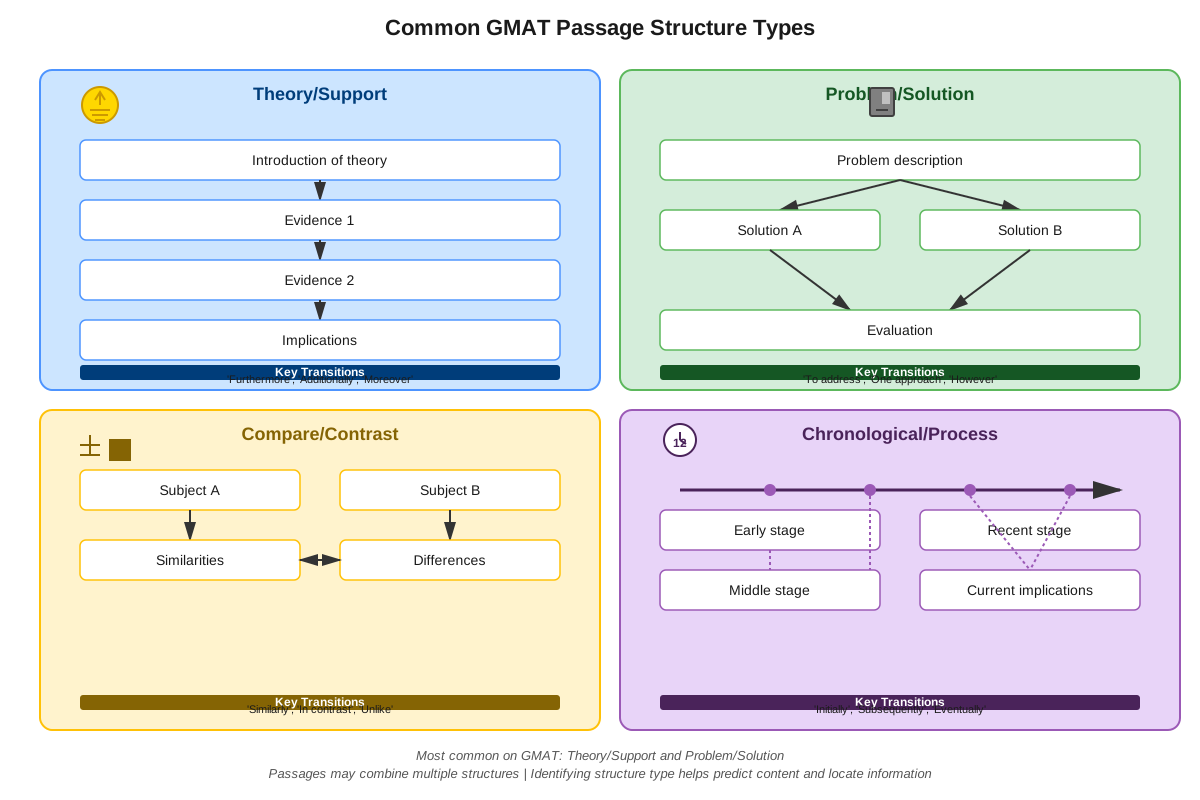
GMAT passages typically follow recognizable organizational patterns. The Theory-Evidence structure presents a hypothesis, theory, or claim, then provides supporting evidence or examples. Variations include presenting evidence that challenges or modifies the initial theory. This structure appears frequently in science passages discussing research findings or in social science passages exploring behavioral phenomena.
The Problem-Solution structure identifies a challenge, issue, or question, then discusses one or more approaches to addressing it. The passage may evaluate the effectiveness of proposed solutions or present obstacles to implementation. This structure commonly appears in passages about business strategy, environmental issues, or technological innovation.
The Comparison-Contrast structure examines two or more subjects, theories, approaches, or time periods, highlighting similarities and differences. The author may ultimately favor one option or present them as equally valid alternatives. This structure frequently appears in passages discussing competing scientific theories, different artistic movements, or alternative business models.
The Chronological-Development structure traces how an idea, field, technology, or understanding has evolved over time. These passages often move from historical context through various stages of development to current understanding. This structure appears in passages about scientific discoveries, artistic movements, or technological advancement.
The Phenomenon-Explanation structure describes an observed pattern, behavior, or occurrence, then explains the underlying causes, mechanisms, or reasons. Science passages frequently use this structure when discussing natural phenomena, biological processes, or physical principles.
Passage Mapping Technique
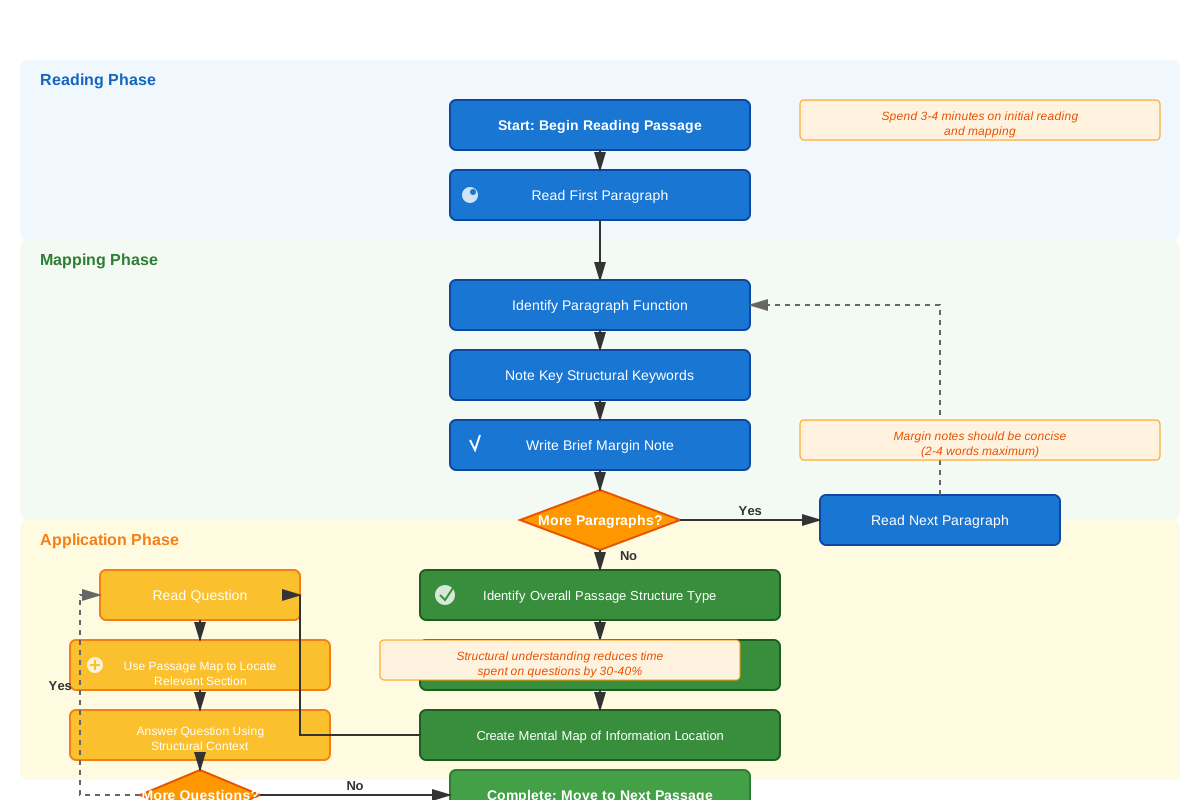
Passage mapping involves creating a brief written or mental outline that captures the function and main point of each paragraph. An effective passage map uses 3-7 words per paragraph, focuses on function rather than specific details, and captures relationships between paragraphs. For example:
| Paragraph | Function | Brief Note |
|---|---|---|
| 1 | Introduce phenomenon | Coral reefs declining globally |
| 2 | Traditional explanation | Blamed on temperature rise |
| 3 | Challenge traditional view | New study: pollution more significant |
| 4 | Evidence for new view | Data from Caribbean reefs |
| 5 | Implications | Need policy shift |
This map immediately reveals the passage follows a Theory-Challenge-Evidence structure and allows rapid navigation when answering questions about the traditional view (paragraph 2), the new perspective (paragraph 3), or supporting evidence (paragraph 4).
Structural Indicators and Transitions
Certain phrases and sentence positions carry disproportionate structural significance. Opening sentences of paragraphs typically signal the paragraph's function and main point. Concluding sentences often emphasize key takeaways or transition to the next idea. Contrast transitions (however, yet, but, although, despite) indicate the author is shifting direction, challenging a previous idea, or presenting an alternative view—these moments often contain the passage's most important content.
Emphasis markers (importantly, significantly, notably, crucially) signal that the following information carries particular weight in the author's argument. Causation indicators (because, since, therefore, thus, consequently) reveal logical relationships that are frequently tested. Example indicators (for instance, such as, for example) signal supporting details that illustrate broader claims.
Author's Purpose and Tone in Structure
The overall structure reveals the author's primary purpose—whether to explain a phenomenon, argue for a position, compare alternatives, trace historical development, or challenge conventional wisdom. This purpose manifests through structural choices: an author arguing for a position will present opposing views primarily to refute them, while an author comparing alternatives will give more balanced treatment to multiple perspectives.
The author's tone—their attitude toward the subject matter—also emerges through structural analysis. An author who presents a theory in paragraph 1, then spends three paragraphs detailing its flaws, clearly holds a critical or skeptical tone toward that theory. Conversely, an author who presents challenges to a theory only to refute them demonstrates support for the theory.
Concept Relationships
The concepts within passage structure form an interconnected system where each element reinforces and depends upon others. Structural keywords → signal → paragraph functions → which combine to create → overall passage structure types → which reveal → author's purpose and tone. This chain of relationships means that identifying keywords helps determine paragraph function, which in turn clarifies the overall organizational pattern.
Passage mapping serves as the practical application that integrates all other structural concepts. Creating an effective map requires recognizing keywords, determining paragraph functions, and understanding how paragraphs relate to one another. The map then becomes the tool that enables efficient question-answering.
The relationship to prerequisite knowledge is equally important. Understanding basic paragraph structure (topic sentences and supporting details) scales up to passage-level analysis where paragraphs themselves function as "sentences" in a larger argument. Knowledge of argument components (claims, evidence, conclusions) helps identify when a paragraph is making a claim versus providing support. Familiarity with transition words directly enables recognition of structural keywords.
Passage structure also connects forward to other Reading Comprehension skills. Understanding structure is prerequisite to efficiently answering specific detail questions (structure tells you where to look), inference questions (structure reveals relationships between ideas that enable inferences), primary purpose questions (structure reveals overall intent), and strengthening/weakening questions (structure shows which elements are claims versus support).
High-Yield Facts
⭐ Approximately 15-20% of GMAT Reading Comprehension questions explicitly test passage structure understanding
⭐ The first and last sentences of each paragraph carry disproportionate structural significance
⭐ Contrast keywords (however, yet, nevertheless) typically introduce the most important information in a passage
⭐ Most GMAT passages follow one of five common structures: Theory-Evidence, Problem-Solution, Comparison-Contrast, Chronological-Development, or Phenomenon-Explanation
⭐ An effective passage map uses 3-7 words per paragraph and focuses on function rather than details
- Passages are typically 200-350 words long and divided into 2-4 paragraphs
- The main idea usually appears in the first or second paragraph, though occasionally it emerges only in the conclusion
- Supporting details that appear as examples (signaled by "for instance," "such as") are frequently tested in specific detail questions
- When an author presents multiple viewpoints, the final viewpoint discussed typically represents the author's own position or the passage's main focus
- Structural questions often use phrases like "the primary purpose," "the author mentions X in order to," or "the organization of the passage is best described as"
- Passages that spend multiple paragraphs on one topic before shifting to another topic typically follow a comparison-contrast structure
- The presence of dates, time periods, or phrases like "initially," "later," and "currently" signals chronological-development structure
- When a passage presents a problem in early paragraphs, expect later paragraphs to discuss solutions, even if those solutions are presented as inadequate
- Authors rarely present information neutrally—structure reveals whether they support, oppose, or remain neutral toward ideas discussed
Quick check — test yourself on Passage structure so far.
Try Flashcards →Common Misconceptions
Misconception: Passage structure only matters for questions explicitly asking about organization or paragraph function.
Correction: While structure questions directly test organizational understanding, structural analysis improves performance on all question types by enabling efficient navigation, revealing relationships between ideas, and clarifying the author's emphasis and purpose.
Misconception: Every detail in a passage is equally important and should be read with equal attention.
Correction: GMAT passages contain a hierarchy of information. Main ideas and structural turning points (signaled by contrast keywords) deserve careful attention, while supporting examples can be noted for location and returned to only if a question requires them.
Misconception: The main idea always appears in the first paragraph.
Correction: While the main idea frequently appears early, some passages provide background information or present traditional views before introducing the main idea in the second paragraph or even later. The main idea is wherever the author's primary claim or thesis appears.
Misconception: Longer paragraphs are more important than shorter ones.
Correction: Paragraph length reflects the amount of detail or evidence provided, not inherent importance. A short paragraph introducing a new perspective may be more structurally significant than a longer paragraph providing examples.
Misconception: Passage mapping wastes valuable time that should be spent answering questions.
Correction: Effective passage mapping takes 30-60 seconds and saves significantly more time by eliminating repeated re-reading and enabling rapid information location. Test-takers who skip mapping typically spend more total time on the passage and questions combined.
Misconception: All GMAT passages follow unique, unpredictable organizational patterns.
Correction: While content varies widely, GMAT passages consistently follow a limited set of recognizable structural patterns. Familiarity with these patterns enables prediction and efficient comprehension.
Misconception: Understanding structure means memorizing specific details from each paragraph.
Correction: Structural understanding focuses on the function and main point of each paragraph, not specific details. Details should be noted for location and retrieved only when questions require them.
Worked Examples
Example 1: Identifying Structure in a Science Passage
Passage Excerpt:
Paragraph 1: For decades, scientists attributed the decline of coral reefs primarily to rising ocean temperatures caused by climate change. Elevated temperatures cause coral bleaching, a process in which corals expel the symbiotic algae that provide them with nutrients and their characteristic colors.
Paragraph 2: However, recent research by marine biologist Dr. Elena Rodriguez suggests that pollution from agricultural runoff may be a more significant factor in reef decline than previously recognized. Rodriguez's five-year study of Caribbean reefs found that reefs in areas with high agricultural runoff showed 60% greater decline than reefs in areas with similar temperatures but lower pollution levels.
Paragraph 3: The mechanism appears to involve nitrogen and phosphorus from fertilizers, which promote algae growth on reef surfaces. This algae blocks sunlight and competes with coral for space, ultimately smothering the reef ecosystem.
Analysis:
Step 1: Identify the function of each paragraph.
- Paragraph 1: Presents the traditional/established explanation for coral reef decline
- Paragraph 2: Challenges the traditional view with new research findings (note the contrast keyword "However")
- Paragraph 3: Explains the mechanism behind the new explanation
Step 2: Determine the overall structure type.
This passage follows a Theory-Challenge-Evidence structure (also called Traditional View-New View structure). The author presents an established explanation, introduces research that challenges it, and provides mechanistic evidence supporting the new view.
Step 3: Identify the author's purpose and likely tone.
The author's purpose is to present new research that modifies understanding of coral reef decline. The tone toward the new research is likely positive or neutral-informative, as the author dedicates space to explaining its mechanism without presenting counterarguments.
Step 4: Create a passage map.
- P1: Traditional view - temperature causes decline
- P2: New research - pollution more significant
- P3: Mechanism - fertilizer promotes competing algae
Step 5: Predict likely question types.
- Primary purpose: "To present research that challenges the traditional explanation for coral reef decline"
- Specific detail: Questions about the traditional view (P1), Rodriguez's findings (P2), or the mechanism (P3)
- Function: "The author mentions coral bleaching in order to..." (explain the traditional view)
- Inference: Questions about the relative importance of temperature versus pollution
Connection to Learning Objectives: This example demonstrates how to identify passage structure (recognizing the Theory-Challenge pattern), explain passage structure (articulating the function of each paragraph), and apply structure to predict questions and locate information efficiently.
Example 2: Applying Structure to Answer Questions
Passage Excerpt:
Paragraph 1: The rise of artificial intelligence has prompted concerns about job displacement across numerous industries. Economists have traditionally viewed technological advancement as ultimately creating more jobs than it eliminates, citing historical examples such as the Industrial Revolution.
Paragraph 2: Yet some contemporary economists argue that AI represents a fundamentally different type of technological change. Unlike previous innovations that automated physical tasks, AI can perform cognitive tasks previously requiring human judgment, potentially affecting white-collar professions that have historically been insulated from automation.
Paragraph 3: Despite these concerns, recent data from the technology sector suggests a more nuanced picture. Companies implementing AI systems have simultaneously increased hiring in roles focused on AI oversight, ethical compliance, and human-AI collaboration. These emerging roles require uniquely human skills such as ethical reasoning and creative problem-solving.
Question: The primary purpose of the passage is to:
(A) Argue that concerns about AI-driven job displacement are entirely unfounded
(B) Explain why AI represents a more significant threat than previous technological innovations
(C) Present evidence that AI will create more jobs than it eliminates
(D) Discuss competing perspectives on AI's impact on employment while noting emerging trends
(E) Advocate for increased regulation of AI implementation in the workplace
Solution Process:
Step 1: Recall the passage structure from your map.
- P1: Traditional view - technology creates jobs overall
- P2: Challenge - AI different, threatens white-collar jobs
- P3: Nuance - data shows new roles emerging
Step 2: Identify the structure type.
This is a Multiple Perspectives structure where the author presents different viewpoints and adds nuance rather than definitively supporting one side.
Step 3: Eliminate answers inconsistent with the structure.
(A) Eliminate - The passage presents legitimate concerns (P2), not dismissing them as "entirely unfounded"
(B) Eliminate - While P2 discusses this view, it's not the primary purpose; P3 provides counterbalancing information
(C) Eliminate - Too strong; P3 shows some job creation but doesn't claim AI will create "more jobs than it eliminates"
(E) Eliminate - Regulation is never mentioned; this introduces new information
Step 4: Confirm the correct answer.
(D) Correct - This accurately captures the structure: "competing perspectives" (traditional view in P1, challenge in P2) "while noting emerging trends" (P3's data about new roles)
Connection to Learning Objectives: This example demonstrates applying passage structure to answer questions efficiently. Understanding the Multiple Perspectives structure immediately reveals that extreme answers (A, C) are unlikely to be correct, and that the answer should acknowledge multiple viewpoints (D) rather than advocate for a single position.
Exam Strategy
When approaching GMAT Reading Comprehension passages, implement a structured process that leverages passage structure understanding. First, read actively with the goal of understanding structure, not memorizing details. As you read each paragraph, ask: "What is this paragraph doing? How does it relate to what came before?" Second, create a brief passage map immediately after reading, investing 30-60 seconds to capture the function of each paragraph. This small time investment pays dividends throughout the question set.
Trigger words and phrases that signal structural importance include:
- Contrast indicators: however, yet, nevertheless, despite, although, while, but, in contrast, on the other hand
- Emphasis markers: importantly, significantly, notably, crucially, indeed, in fact, particularly
- Causation signals: therefore, thus, consequently, as a result, because, since, due to
- Continuation indicators: furthermore, moreover, additionally, also, in addition
- Example indicators: for instance, for example, such as, to illustrate
- Conclusion markers: in conclusion, ultimately, finally, in sum
When these words appear, slow down and pay extra attention—they often introduce the most testable content.
Process-of-elimination strategies specific to structure questions:
- For "primary purpose" questions, eliminate answers that describe only one paragraph's content rather than the entire passage
- For "function" questions asking why the author mentions a detail, eliminate answers that simply restate what the detail says rather than explaining its role
- For "organization" questions, eliminate answers that describe structures not present (e.g., "chronological" when no time progression exists)
- Eliminate extreme answers (using words like "only," "entirely," "completely") unless the passage takes an unusually strong stance
Time allocation: Spend approximately 3-3.5 minutes reading a typical passage and creating your map, then 1-1.5 minutes per question. If you find yourself re-reading large portions of the passage for multiple questions, your initial reading and mapping were likely insufficient. Conversely, if you finish questions very quickly but get many wrong, you may be rushing the initial reading.
Exam Tip: When you encounter a contrast keyword like "however" or "yet," immediately recognize that you're likely reading the most important sentence in the paragraph. This is where authors typically introduce their main point, challenge previous ideas, or shift direction.
Memory Techniques
PASSAGE Acronym for structural analysis:
- Purpose: What is the author trying to accomplish?
- Argument: What is the main claim or thesis?
- Structure: How is the passage organized?
- Support: What evidence backs up the main idea?
- Attitude: What is the author's tone?
- Gist: What's the one-sentence summary?
- Each paragraph: What does each paragraph do?
The "However Rule": Whenever you see "however," "yet," "but," or similar contrast words, mentally highlight that sentence. In 80% of passages, the most important content appears immediately after a contrast transition.
Visualization Strategy: Picture the passage as a building where each paragraph is a floor. The foundation (first paragraph) typically introduces the topic. Upper floors build upon or challenge the foundation. The roof (final paragraph) often contains conclusions or implications. This spatial metaphor helps recall where information appeared.
Function Categories Mnemonic - "PIECE":
- Present a view/theory
- Introduce a topic/phenomenon
- Explain a mechanism/process
- Challenge a previous view
- Evidence/examples supporting a claim
Every paragraph typically performs one of these five functions.
Structure Type Mnemonic - "TCP-CP" (like the internet protocol):
- Theory-Evidence
- Chronological-Development
- Problem-Solution
- Comparison-Contrast
- Phenomenon-Explanation
Summary
Passage structure represents the organizational framework and functional architecture of GMAT Reading Comprehension passages. Mastering this topic requires understanding that passages consist of hierarchical elements—main ideas, supporting ideas, and details—organized according to recognizable patterns such as Theory-Evidence, Problem-Solution, Comparison-Contrast, Chronological-Development, and Phenomenon-Explanation structures. Structural keywords serve as signposts revealing relationships between ideas, with contrast indicators (however, yet, nevertheless) typically introducing the most important content. Each paragraph performs a specific function within the overall architecture, such as presenting a view, challenging a previous idea, providing evidence, or explaining a mechanism. Effective passage mapping—creating a brief outline capturing each paragraph's function and main point—enables efficient navigation and question-answering. Understanding structure impacts performance on all Reading Comprehension question types, not merely those explicitly asking about organization. The first and last sentences of paragraphs carry disproportionate structural significance, and recognizing overall structure reveals the author's purpose and tone. Students who master passage structure transform reading from passive absorption to active analysis, dramatically improving both accuracy and efficiency on GMAT Reading Comprehension questions.
Key Takeaways
- Passage structure refers to the organizational framework and functional relationships between ideas in GMAT passages, not merely the physical arrangement of paragraphs
- Five common structure types appear repeatedly: Theory-Evidence, Problem-Solution, Comparison-Contrast, Chronological-Development, and Phenomenon-Explanation
- Contrast keywords (however, yet, nevertheless) typically introduce the most important and testable content in a passage
- Effective passage mapping takes 30-60 seconds and dramatically improves efficiency by eliminating repeated re-reading
- Understanding structure impacts performance on all question types, not just explicit structure questions, by revealing relationships between ideas and the author's purpose
- Each paragraph performs a specific function (presenting a view, challenging it, providing evidence, explaining a mechanism, or drawing conclusions) that should be captured in your passage map
- The first and last sentences of each paragraph carry disproportionate structural significance and deserve careful attention during initial reading
Related Topics
Main Idea Identification: Understanding passage structure directly enables efficient main idea identification, as the main idea typically appears at structurally significant locations (often the first or second paragraph, or immediately after a major contrast transition). Mastering structure provides the framework for distinguishing main ideas from supporting details.
Inference Questions: Structural understanding reveals relationships between ideas that enable valid inferences. Recognizing how paragraphs connect and build upon one another allows test-takers to draw conclusions that follow logically from the passage's organization.
Author's Tone and Purpose: The organizational choices an author makes reveal their attitude toward the subject matter and their overall purpose. Mastering structure enables more accurate identification of whether the author seeks to argue, explain, compare, or challenge.
Specific Detail Questions: While these questions test recall of particular information, structural understanding dramatically improves efficiency by enabling rapid location of where specific details appeared. Your passage map serves as a reference guide for navigating to the relevant paragraph.
Critical Reasoning: The structural analysis skills developed through studying passage structure transfer directly to Critical Reasoning questions, where identifying the structure of arguments (premise, conclusion, assumption) is essential for success.
Practice CTA
Now that you've mastered the fundamentals of passage structure, it's time to put your knowledge into practice. Attempt the practice questions and flashcards associated with this topic to reinforce your understanding and build the pattern recognition that leads to automatic, efficient structural analysis. Remember: understanding structure intellectually is only the first step—applying it consistently under timed conditions is what translates knowledge into score improvement. Each practice passage you analyze with structural awareness strengthens the neural pathways that will serve you on test day. Your investment in mastering this high-yield topic will pay dividends across every Reading Comprehension passage you encounter.
Sign up free to keep reading
Create a free AnvayaPrep account to finish this GMAT guide on Passage structure — plus flashcards and practice questions.