Overview
Organization in GMAT Reading Comprehension refers to the structural framework and logical arrangement of ideas within a passage. Understanding how authors organize their arguments, evidence, and conclusions is fundamental to answering questions efficiently and accurately. On the GMAT, recognizing organizational patterns allows test-takers to predict where information will appear, understand the author's purpose, and navigate complex passages with confidence.
The ability to identify and analyze GMAT organization patterns is not merely about recognizing that a passage has an introduction, body, and conclusion. It involves understanding the functional relationships between paragraphs, the progression of ideas, the placement of contrasting viewpoints, and the strategic positioning of evidence and counterarguments. Questions about organization frequently appear on the GMAT, asking students to identify the purpose of specific paragraphs, understand how ideas relate to one another, or determine the overall structure of the passage.
Within the broader context of Verbal Reasoning, organization serves as the architectural blueprint that connects all other reading comprehension skills. While main idea questions ask what the passage is about, and detail questions test specific information recall, organization questions examine how the passage is constructed and why the author chose that particular structure. Mastering organization enhances performance across all question types because it provides a mental map of the passage, reducing the need to re-read and enabling strategic navigation during time-pressured testing conditions.
Learning Objectives
- [ ] Identify Organization patterns in GMAT Reading Comprehension passages
- [ ] Explain Organization structures and their functional purposes
- [ ] Apply Organization analysis to GMAT questions efficiently
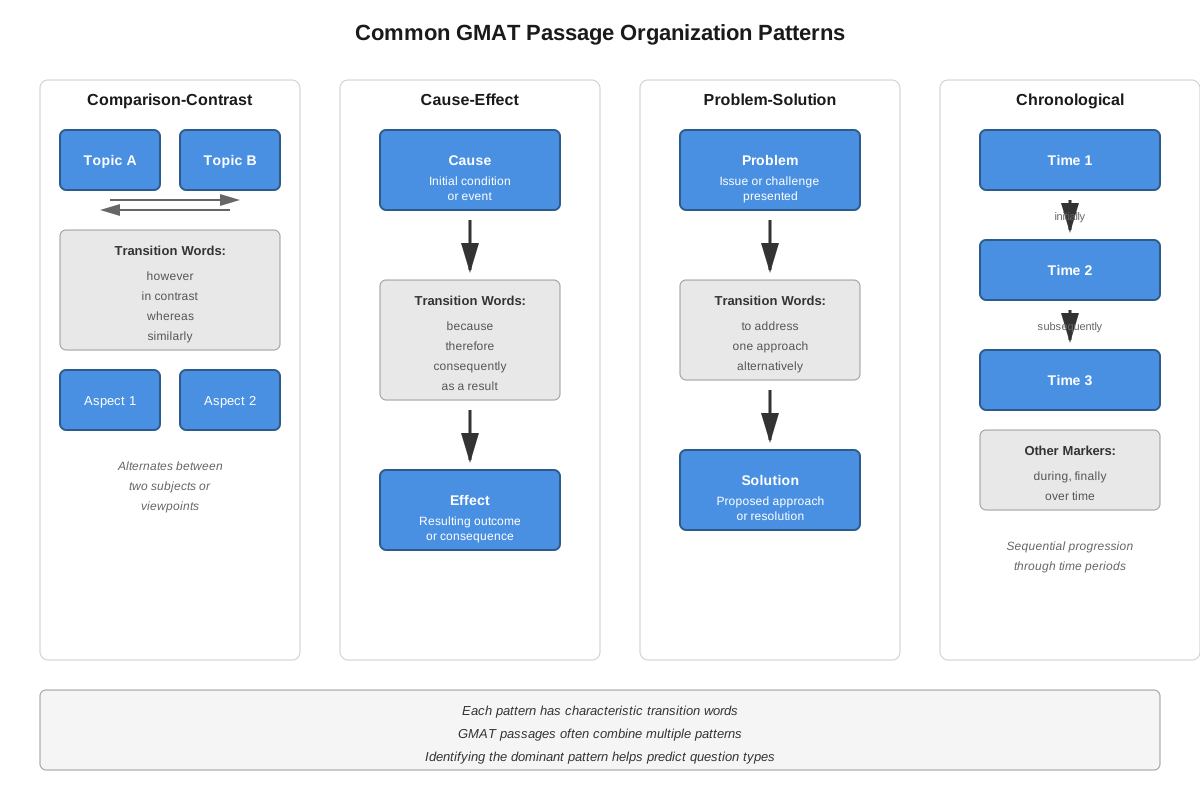
- [ ] Distinguish between different organizational patterns (comparison-contrast, cause-effect, problem-solution, chronological)
- [ ] Predict question types based on organizational structure
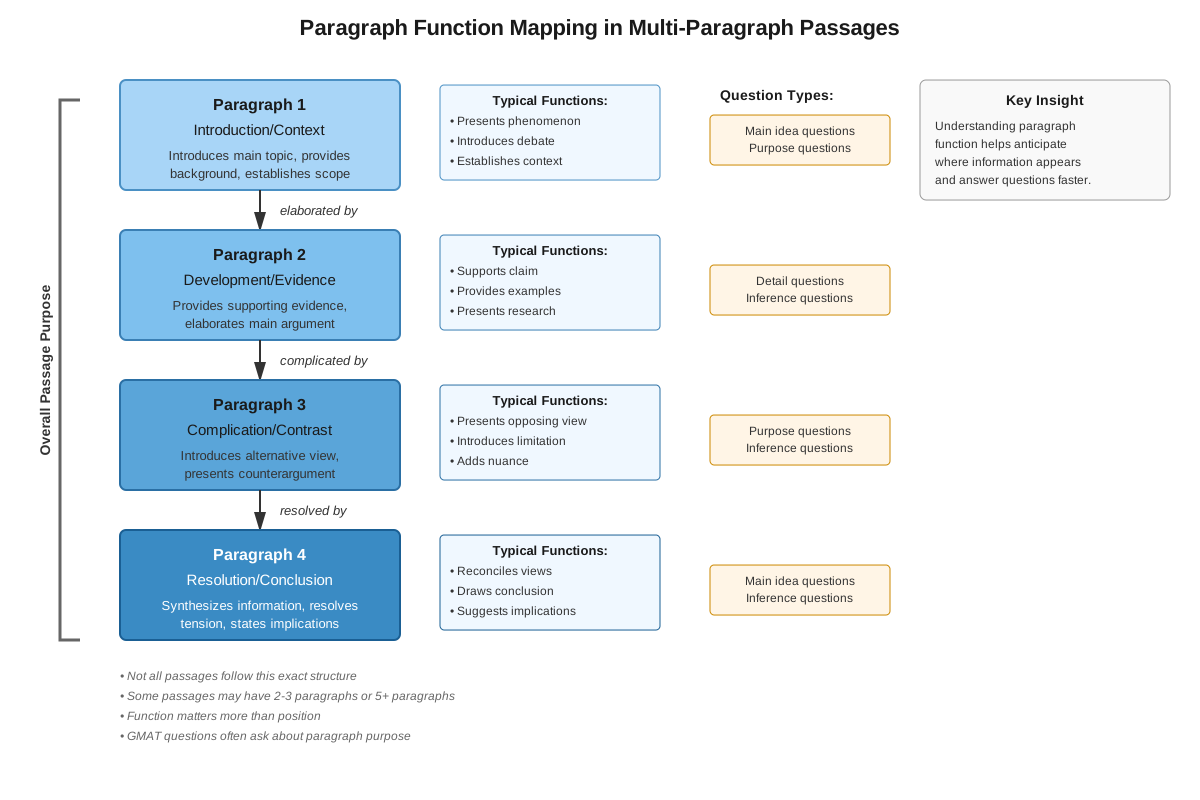
- [ ] Map paragraph functions within multi-paragraph passages
- [ ] Recognize transitional markers that signal organizational shifts
Prerequisites
- Basic reading comprehension skills: Understanding literal meaning and main ideas provides the foundation for analyzing how those ideas are arranged and connected.
- Familiarity with paragraph structure: Recognizing topic sentences, supporting details, and concluding statements enables identification of functional roles within larger organizational frameworks.
- Understanding of logical relationships: Knowledge of cause-effect, comparison-contrast, and other logical connections helps identify how authors structure arguments and evidence.
Why This Topic Matters
Organization questions constitute approximately 15-20% of GMAT Reading Comprehension questions, making them a high-frequency, high-value topic for test preparation. These questions directly test a student's ability to understand passage structure, which is a skill that business schools value because it reflects analytical thinking and the ability to process complex information efficiently—skills essential for case studies, business reports, and strategic analysis.
In real-world business contexts, professionals must quickly grasp how documents are organized to extract relevant information, understand arguments, and make informed decisions. The ability to recognize organizational patterns translates directly to analyzing market research reports, understanding legal documents, evaluating strategic proposals, and synthesizing information from multiple sources.
On the GMAT, organization appears in several question formats: "The primary purpose of the second paragraph is to...", "The passage is primarily concerned with...", "Which of the following best describes the organization of the passage?", and "The author mentions X in order to...". These questions test whether students understand not just what the passage says, but how and why it's structured in a particular way. Passages may employ various organizational patterns including chronological progression, comparison-contrast frameworks, problem-solution structures, cause-effect chains, or argumentative structures with thesis, evidence, and counterarguments.
Core Concepts
Fundamental Definition of Organization
Organization in GMAT Reading Comprehension refers to the deliberate arrangement and sequencing of ideas, arguments, evidence, and conclusions within a passage. It encompasses both the macro-level structure (how paragraphs relate to one another) and micro-level structure (how sentences within paragraphs connect). Understanding organization means recognizing the functional role each paragraph plays in advancing the author's overall purpose.
The GMAT tests organization because business communication requires clear, logical structure. Recognizing organizational patterns allows readers to anticipate where information will appear, understand relationships between ideas, and efficiently locate specific details when answering questions.
Common Organizational Patterns
Comparison-Contrast Structure
This pattern presents two or more subjects, theories, viewpoints, or phenomena and examines their similarities and differences. The passage may alternate between subjects (Subject A, then Subject B, then back to A) or discuss all aspects of one subject before moving to the other.
Key markers: "in contrast," "similarly," "whereas," "on the other hand," "unlike," "both," "however"
Typical paragraph functions:
- Paragraph 1: Introduce both subjects and establish comparison framework
- Paragraph 2: Discuss characteristics of first subject
- Paragraph 3: Discuss characteristics of second subject with explicit comparisons
- Paragraph 4: Synthesize or evaluate the comparison
Cause-Effect Structure
This organizational pattern explains how one phenomenon leads to another, establishing causal relationships. It may present a single cause with multiple effects, multiple causes leading to one effect, or a causal chain where one effect becomes the cause of subsequent effects.
Key markers: "because," "therefore," "consequently," "as a result," "leads to," "causes," "due to," "thus"
Typical paragraph functions:
- Paragraph 1: Introduce the phenomenon or problem
- Paragraph 2: Explain primary causes
- Paragraph 3: Describe resulting effects
- Paragraph 4: Discuss implications or secondary effects
Problem-Solution Structure
This pattern identifies a problem, challenge, or question and then presents one or more solutions, responses, or answers. GMAT passages often include evaluation of the proposed solutions or discussion of their limitations.
Key markers: "problem," "challenge," "difficulty," "solution," "address," "resolve," "overcome," "approach"
Typical paragraph functions:
- Paragraph 1: Present and explain the problem
- Paragraph 2: Describe first solution or approach
- Paragraph 3: Present alternative solution or critique first solution
- Paragraph 4: Evaluate effectiveness or recommend best approach
Chronological/Historical Structure
This pattern arranges information according to time sequence, tracing the development or evolution of ideas, theories, events, or phenomena. Common in science and history passages.
Key markers: "initially," "subsequently," "later," "eventually," "first," "then," "finally," "over time," "historically"
Typical paragraph functions:
- Paragraph 1: Establish historical context or earliest stage
- Paragraph 2: Describe next developmental phase
- Paragraph 3: Present more recent developments
- Paragraph 4: Discuss current state or future implications
Argumentative Structure
This pattern presents a thesis or claim and supports it with evidence, reasoning, and responses to counterarguments. The author builds a case for a particular position or interpretation.
Key markers: "argues," "claims," "evidence suggests," "supports," "demonstrates," "critics contend," "however," "despite"
Typical paragraph functions:
- Paragraph 1: Present thesis or main argument
- Paragraph 2: Provide primary evidence
- Paragraph 3: Address counterarguments or alternative views
- Paragraph 4: Reinforce thesis with additional support or implications
Paragraph Function Analysis
Each paragraph in a GMAT passage serves a specific functional role within the overall organizational structure. Understanding these functions is crucial for answering organization questions:
| Paragraph Function | Purpose | Common Locations |
|---|---|---|
| Introduction/Context | Establish background, define terms, present the topic | First paragraph |
| Thesis/Main Claim | State the author's primary argument or the passage's central focus | First or second paragraph |
| Evidence/Support | Provide data, examples, or reasoning that supports claims | Middle paragraphs |
| Counterargument | Present opposing views or alternative explanations | Middle to late paragraphs |
| Rebuttal | Respond to or refute counterarguments | Following counterargument |
| Elaboration | Expand on or clarify previous points | Middle paragraphs |
| Synthesis/Conclusion | Summarize, draw implications, or suggest future directions | Final paragraph |
| Transition | Bridge between major sections or shift focus | Any middle paragraph |
Structural Markers and Transitions
Recognizing transitional words and phrases helps identify organizational patterns and predict what information will follow:
Addition/Continuation: furthermore, moreover, additionally, in addition, also
Contrast: however, nevertheless, nonetheless, conversely, in contrast, yet, although
Cause-Effect: therefore, thus, consequently, as a result, hence, accordingly
Example: for instance, for example, specifically, such as, to illustrate
Emphasis: indeed, in fact, certainly, undoubtedly, clearly
Sequence: first, second, finally, next, subsequently, then
Comparison: similarly, likewise, in the same way, analogously
Mapping Passage Structure
Effective GMAT test-takers create mental or brief written maps of passage organization while reading. This involves noting the primary function of each paragraph in 2-4 words:
Example map:
- P1: Problem introduced
- P2: Traditional solution + limitations
- P3: New approach proposed
- P4: Evidence supporting new approach
This mapping technique enables quick navigation when answering questions and provides immediate insight into the passage's overall structure.
Concept Relationships
Organization serves as the foundational framework that connects all other Reading Comprehension concepts. The relationship flows as follows:
Organization → Main Idea: The organizational structure reveals the author's main idea. A problem-solution structure indicates the main idea involves addressing a challenge, while a comparison-contrast structure suggests the main idea involves evaluating alternatives.
Organization → Detail Questions: Understanding where different types of information appear (evidence in middle paragraphs, counterarguments before rebuttals) enables efficient location of specific details without re-reading the entire passage.
Organization → Inference Questions: The structural relationships between paragraphs provide context for making valid inferences. Information positioned as a counterargument should be interpreted differently than information presented as the author's primary evidence.
Organization → Tone and Purpose: The organizational pattern chosen by the author reflects their purpose. An argumentative structure indicates persuasive intent, while a chronological structure suggests descriptive or explanatory purpose.
Within organization itself, concepts connect hierarchically: Passage-level organization (overall structure) → Paragraph-level organization (function of each paragraph) → Sentence-level organization (transitions and logical connections). Recognizing transitions helps identify paragraph functions, which collectively reveal the passage's overall organizational pattern.
High-Yield Facts
⭐ Organization questions account for 15-20% of GMAT Reading Comprehension questions, making them high-frequency and high-value.
⭐ The five most common organizational patterns on the GMAT are: comparison-contrast, cause-effect, problem-solution, chronological, and argumentative.
⭐ Each paragraph in a GMAT passage serves a specific functional role: introduction, thesis, evidence, counterargument, rebuttal, elaboration, or conclusion.
⭐ Transitional words and phrases are explicit markers that signal organizational structure and relationships between ideas.
⭐ Mapping paragraph functions in 2-4 words while reading enables efficient navigation and quick answers to organization questions.
- The second paragraph of a GMAT passage frequently presents the author's thesis or main argument after contextual introduction in paragraph one.
- Counterarguments typically appear in the third paragraph of four-paragraph passages, followed by the author's rebuttal or synthesis.
- Organization questions often use phrases like "primary purpose," "in order to," "function of," and "organization of the passage."
- Understanding organization reduces re-reading time by 30-40% because test-takers know where to locate specific information types.
- GMAT passages rarely use simple chronological organization alone; they typically combine chronological elements with argumentative or analytical structures.
- The final paragraph often serves to synthesize information, present implications, or suggest future directions rather than introduce entirely new concepts.
Quick check — test yourself on Organization so far.
Try Flashcards →Common Misconceptions
Misconception: Organization only refers to the order of paragraphs in a passage.
Correction: Organization encompasses both the sequence of paragraphs and the functional relationships between them. Two passages might have the same number of paragraphs but completely different organizational structures based on how those paragraphs relate to one another and what purpose each serves.
Misconception: All GMAT passages follow a standard introduction-body-conclusion format.
Correction: While passages have beginnings and endings, GMAT passages employ diverse organizational patterns. Some begin with a question, others with a surprising fact, and still others with a historical overview. The "body" may contain comparisons, causal chains, or argumentative structures that don't fit simple categorization.
Misconception: Identifying organization requires reading the entire passage carefully before answering any questions.
Correction: Effective test-takers identify organizational patterns while reading actively, noting paragraph functions in real-time. This simultaneous reading and mapping approach is more time-efficient than reading once for content and again for structure.
Misconception: Transitional words always appear at the beginning of sentences or paragraphs.
Correction: While many transitions do appear at the start of sentences, crucial organizational markers often appear mid-sentence or mid-paragraph. Words like "however," "although," and "despite" can signal important structural shifts regardless of their position.
Misconception: The author's main argument always appears in the first paragraph.
Correction: GMAT passages frequently use the first paragraph to establish context, present a problem, or introduce competing viewpoints, reserving the author's actual thesis for the second paragraph. Assuming the first paragraph contains the main argument can lead to misidentifying the passage's primary purpose.
Misconception: Organization questions are easier than detail or inference questions.
Correction: Organization questions require sophisticated analytical skills and holistic passage understanding. They test whether students grasp not just what the passage says but how and why it's structured, which demands higher-order thinking than simple detail recall.
Worked Examples
Example 1: Identifying Organizational Pattern
Passage Excerpt:
Paragraph 1: For decades, economists believed that increased productivity inevitably led to higher wages for workers. This assumption formed the basis of labor policy throughout the industrialized world.
Paragraph 2: However, recent data from the past twenty years reveals a troubling divergence. While productivity has continued to rise steadily, wage growth has stagnated for middle-income workers in most developed economies.
Paragraph 3: Several factors explain this disconnect. Globalization has enabled companies to source labor internationally, reducing bargaining power for domestic workers. Additionally, technological automation has displaced routine jobs while creating fewer high-skill positions than anticipated.
Paragraph 4: These trends suggest that policymakers must reconsider traditional assumptions about the productivity-wage relationship and develop new frameworks for ensuring that economic growth benefits workers broadly.
Question: Which of the following best describes the organization of the passage?
(A) A historical overview followed by current applications
(B) A theory is presented, contradicted by evidence, explained, and implications are discussed
(C) Two competing theories are compared and one is endorsed
(D) A problem is identified and multiple solutions are evaluated
(E) A chronological account of economic development
Solution Process:
Step 1: Map each paragraph's function
- P1: Traditional theory/assumption presented
- P2: Contradictory evidence introduced
- P3: Explanation of the contradiction
- P4: Implications for policy
Step 2: Identify the overall pattern
This follows a theory-contradiction-explanation-implication structure, which is a variant of the argumentative pattern.
Step 3: Evaluate answer choices
- (A) Incorrect - Not primarily historical; focuses on theory vs. evidence
- (B) Correct - Precisely matches the mapped structure
- (C) Incorrect - Only one theory is presented, not two competing theories
- (D) Incorrect - No solutions are evaluated; implications are discussed but not as solutions
- (E) Incorrect - Not chronological; organized around logical argument structure
Answer: (B)
Connection to Learning Objectives: This example demonstrates how to identify organization (Objective 1) by mapping paragraph functions, explain organization (Objective 2) by recognizing the theory-evidence-explanation pattern, and apply organization analysis to GMAT questions (Objective 3) by systematically eliminating incorrect answers.
Example 2: Determining Paragraph Function
Passage Excerpt:
Paragraph 1: Marine biologists have long observed that coral reefs exhibit remarkable resilience, recovering from environmental disturbances that would devastate other ecosystems.
Paragraph 2: This resilience stems from the symbiotic relationship between coral polyps and zooxanthellae algae. The algae provide nutrients through photosynthesis while receiving protection and access to sunlight from the coral structure.
Paragraph 3: Some researchers argue that this symbiosis makes reefs particularly vulnerable to climate change. As ocean temperatures rise, the delicate balance is disrupted, causing coral bleaching events that can prove fatal.
Paragraph 4: Yet recent studies suggest a more nuanced picture. Certain coral species demonstrate adaptive capacity, hosting different algae species better suited to warmer conditions. This flexibility may provide hope for reef survival in changing oceans.
Question: The primary purpose of the third paragraph is to
(A) provide evidence supporting the claim in paragraph two
(B) introduce a contrasting perspective on coral reef resilience
(C) describe the mechanism of coral bleaching in detail
(D) refute the argument presented in paragraph one
(E) summarize the main argument of the passage
Solution Process:
Step 1: Identify the function of paragraph 3 within the overall structure
- P1: Establishes coral resilience as the topic
- P2: Explains the biological mechanism behind resilience
- P3: Introduces a counterargument - the same mechanism creates vulnerability
- P4: Presents a rebuttal/nuanced view - adaptive capacity provides hope
Step 2: Recognize the organizational pattern
This is an argumentative structure with claim (P1-2), counterargument (P3), and rebuttal (P4).
Step 3: Evaluate answer choices based on paragraph function
- (A) Incorrect - P3 contradicts rather than supports P2's optimistic implication
- (B) Correct - P3 introduces the contrasting view that resilience mechanisms create vulnerability
- (C) Incorrect - Coral bleaching is mentioned but not described in detail; the focus is on the vulnerability argument
- (D) Incorrect - P3 doesn't refute P1; it adds complexity to the resilience discussion
- (E) Incorrect - P3 is not a summary; it's a counterargument within the passage
Answer: (B)
Connection to Learning Objectives: This example shows how to identify paragraph function within organizational structure, distinguish between different organizational roles (evidence vs. counterargument), and apply this understanding to answer purpose questions efficiently.
Exam Strategy
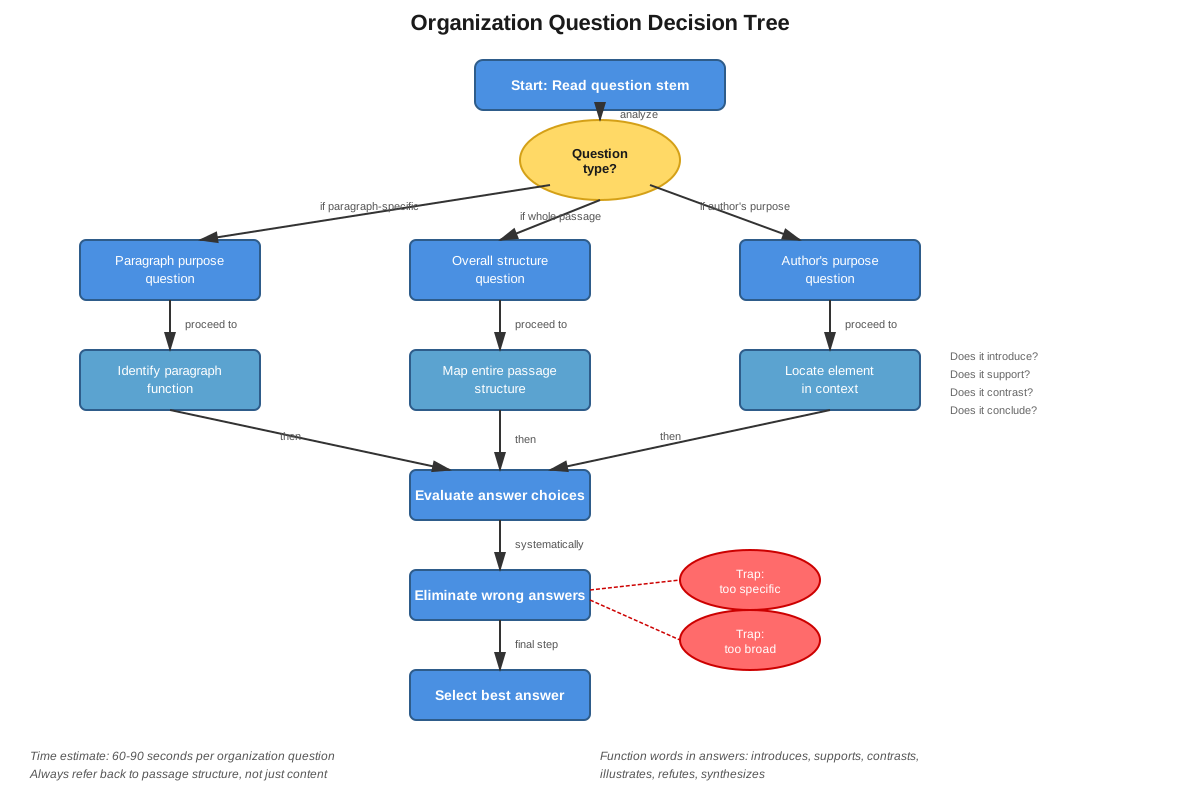
Approaching Organization Questions
Step 1: Map While Reading
As you read each paragraph, jot down its function in 2-4 words in your scratch paper margin or create a mental map. This real-time mapping prevents the need to re-read when organization questions appear.
Step 2: Identify Structural Markers
Pay special attention to transitional words and phrases that signal organizational shifts: "however" (contrast), "therefore" (conclusion), "for example" (illustration), "some argue" (counterargument).
Step 3: Recognize Question Types
Organization questions typically use these trigger phrases:
- "The primary purpose of paragraph X is to..."
- "The passage is primarily concerned with..."
- "Which of the following best describes the organization..."
- "The author mentions X in order to..."
- "The function of the second paragraph is to..."
Step 4: Use Process of Elimination Strategically
Eliminate answers that:
- Describe content rather than function (organization questions ask "why" or "how," not "what")
- Misidentify the paragraph's role (e.g., calling evidence a "counterargument")
- Are too narrow (focusing on one detail when the paragraph serves a broader purpose)
- Are too broad (claiming a paragraph does something the entire passage does)
Time Allocation
Exam Tip: Spend 15-20 seconds mapping paragraph functions while reading. This upfront investment saves 30-45 seconds per organization question by eliminating re-reading.
Organization questions should take 45-60 seconds to answer once you've read the passage, as they test your understanding of structure rather than requiring you to locate specific details.
Trigger Words to Watch
For comparison-contrast structures: "unlike," "whereas," "in contrast," "similarly," "both," "differ"
For cause-effect structures: "because," "consequently," "results in," "leads to," "due to," "therefore"
For problem-solution structures: "challenge," "difficulty," "addresses," "resolves," "approach," "solution"
For argumentative structures: "claims," "argues," "contends," "critics," "proponents," "however"
For counterarguments: "some researchers," "critics argue," "alternatively," "opponents suggest"
Strategic Reading Approach
- First paragraph: Identify whether it provides context, states a thesis, or presents a problem
- Middle paragraphs: Note whether each provides evidence, presents counterarguments, or elaborates on previous points
- Final paragraph: Determine if it synthesizes, presents implications, or offers conclusions
- Transitions between paragraphs: Pay attention to how each paragraph connects to the previous one
Memory Techniques
MAPS Acronym for Organizational Patterns
Main idea/thesis
Argument and evidence
Problem and solution
Sequence (chronological or cause-effect)
When you begin reading a passage, quickly determine which of these patterns dominates the structure.
CAFE Framework for Paragraph Functions
Claim/thesis
Argument/counterargument
Facts/evidence
Elaboration/examples
Every paragraph serves one of these four functions. Identifying which one helps you map the passage structure.
Transition Signal Visualization
Create mental associations for transition categories:
Contrast transitions = Red stop sign (the argument is changing direction)
Support transitions = Green arrow (the argument continues forward)
Cause-effect transitions = Chain links (one idea connects to the next)
Example transitions = Magnifying glass (zooming in on specific instances)
The "Function First" Rule
Remember: Organization questions ask about FUNCTION, not CONTENT
When you see an organization question, immediately think "What job does this paragraph do?" rather than "What information does this paragraph contain?"
Paragraph Position Patterns
First paragraph: Usually context, background, or problem introduction (80% of passages)
Second paragraph: Often contains the author's thesis or main argument (60% of passages)
Third paragraph: Frequently presents counterarguments or alternative views (50% of four-paragraph passages)
Final paragraph: Typically synthesizes, concludes, or discusses implications (70% of passages)
These patterns aren't absolute rules but provide useful expectations that help you read strategically.
Summary
Organization in GMAT Reading Comprehension refers to the structural framework and logical arrangement of ideas within a passage. Mastering organization involves identifying common patterns (comparison-contrast, cause-effect, problem-solution, chronological, and argumentative), recognizing the functional role of each paragraph, and using transitional markers to understand relationships between ideas. Effective test-takers map paragraph functions while reading, creating a mental blueprint that enables efficient navigation and quick answers to organization questions. Understanding organization enhances performance across all question types because it provides strategic insight into where information appears and how ideas connect. The key to success is recognizing that organization questions test function rather than content—they ask why the author structured the passage in a particular way, not merely what information the passage contains.
Key Takeaways
- Organization patterns (comparison-contrast, cause-effect, problem-solution, chronological, argumentative) provide predictable frameworks for GMAT passages
- Paragraph function mapping while reading eliminates the need for time-consuming re-reading when answering organization questions
- Transitional words and phrases serve as explicit markers that signal structural relationships and organizational shifts
- Organization questions test function, not content—focus on what role a paragraph plays rather than what information it contains
- The second paragraph frequently contains the author's thesis after contextual setup in paragraph one
- Counterarguments typically appear before rebuttals, creating a claim-counterclaim-response structure in argumentative passages
- Strategic mapping saves 30-45 seconds per organization question by providing immediate structural insight without re-reading
Related Topics
Main Idea and Primary Purpose: Understanding organization directly supports identifying the main idea, as the structural pattern reveals the author's central focus and intent. Mastering organization enables more accurate and efficient main idea identification.
Inference Questions: Organizational context provides crucial information for making valid inferences. Knowing whether information appears as the author's claim or as a counterargument affects how that information should be interpreted.
Detail and Specific Information Questions: Organization knowledge enables strategic navigation to locate specific details quickly. Understanding that evidence typically appears in middle paragraphs and that examples follow general claims helps pinpoint information efficiently.
Author's Tone and Attitude: The organizational choices an author makes reflect their purpose and attitude. An argumentative structure with counterarguments suggests a persuasive, analytical tone, while a descriptive chronological structure indicates a more neutral, informative approach.
Critical Reasoning: The organizational patterns studied in Reading Comprehension—particularly cause-effect and argumentative structures—directly transfer to analyzing arguments in Critical Reasoning questions.
Practice CTA
Now that you understand the fundamental principles of organization in GMAT Reading Comprehension, it's time to apply this knowledge through practice. Attempt the practice questions to test your ability to identify organizational patterns, determine paragraph functions, and answer organization questions efficiently. Use the flashcards to reinforce key concepts, transitional markers, and common organizational patterns. Remember: organization is a high-yield topic that appears in 15-20% of Reading Comprehension questions, and mastering it will improve your performance across all question types by providing strategic insight into passage structure. Each practice question you complete strengthens your pattern recognition skills and builds the confidence needed to tackle organization questions quickly and accurately on test day.
Sign up free to keep reading
Create a free AnvayaPrep account to finish this GMAT guide on Organization — plus flashcards and practice questions.