Overview
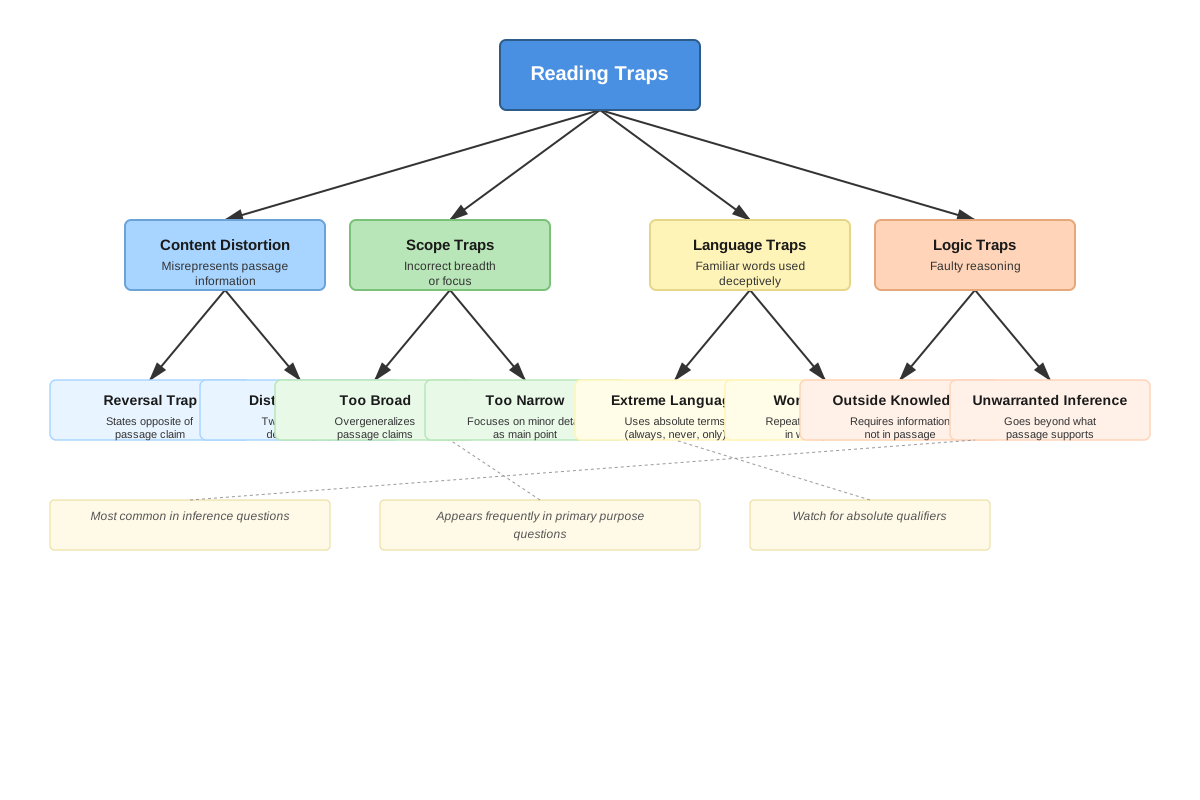
Reading traps are deliberate distractors embedded in GMAT Reading Comprehension answer choices that exploit common cognitive biases and reading errors. These traps are systematically designed by test makers to lure unprepared test-takers away from correct answers by presenting options that seem correct on superficial examination but fail under careful scrutiny. Understanding GMAT reading traps is not merely helpful—it is essential for achieving a competitive Verbal Reasoning score, as these traps appear in virtually every Reading Comprehension passage on the exam.
The GMAT is fundamentally a reasoning test, not just a reading test. Test makers assume that most candidates can comprehend the literal meaning of a passage; what separates high scorers from average performers is the ability to recognize when an answer choice distorts, overgeneralizes, or subtly misrepresents the passage content. Reading traps capitalize on natural reading tendencies: the brain's preference for familiar language, the tendency to bring outside knowledge into interpretation, and the inclination to select answers that "sound good" rather than those that precisely match the passage's scope and tone.
Within the broader Verbal Reasoning section, reading traps connect directly to critical reasoning skills and the ability to evaluate argument structure. The same analytical precision required to identify assumption gaps in Critical Reasoning questions applies to detecting subtle distortions in Reading Comprehension answer choices. Mastering reading traps enhances overall verbal performance by training test-takers to read with skepticism, verify claims against source material, and distinguish between what is stated, implied, and assumed.
Learning Objectives
- [ ] Identify reading traps in GMAT Reading Comprehension answer choices
- [ ] Explain the mechanisms by which different types of reading traps function
- [ ] Apply reading trap recognition strategies to GMAT questions under timed conditions
- [ ] Distinguish between trap answers and correct answers that may initially seem less appealing
- [ ] Analyze passage language to predict which types of traps are likely to appear
- [ ] Develop systematic elimination strategies based on trap patterns
Prerequisites
- Basic Reading Comprehension skills: Ability to understand main ideas, supporting details, and passage structure is necessary before learning to identify subtle distortions
- Familiarity with GMAT question types: Understanding the difference between inference, main idea, detail, and purpose questions helps predict which traps are most likely
- Passage annotation techniques: Effective trap identification requires knowing what the passage actually says, making active reading skills foundational
Why This Topic Matters
Reading traps represent one of the highest-yield study areas for GMAT preparation because they appear in approximately 70-80% of Reading Comprehension answer choices. Every Reading Comprehension question typically contains 3-4 incorrect answers, and the majority of these incorrect options are not random distractors but carefully constructed traps designed to exploit specific reading errors.
On the GMAT, Reading Comprehension accounts for roughly one-third of Verbal Reasoning questions, and the difference between a 650 and a 730+ score often comes down to avoiding trap answers rather than improving reading speed or comprehension. Test-takers who can systematically eliminate trap answers increase their accuracy from 60-70% to 85-95% on Reading Comprehension questions, representing a score improvement of 50-100 points on the overall GMAT.
Reading traps appear most frequently in inference questions (where test-takers must distinguish between what is stated and what is merely suggested), primary purpose questions (where scope traps are common), and specific detail questions (where extreme language and reversal traps predominate). Business school passages—covering topics in economics, management theory, science, and social sciences—are particularly susceptible to traps that exploit outside knowledge, as test-takers often unconsciously substitute their own expertise for what the passage actually states.
Core Concepts
What Are Reading Traps?
Reading traps are incorrect answer choices that possess one or more characteristics designed to make them appear correct to test-takers who are reading carelessly, making unwarranted assumptions, or failing to verify claims against the passage. Unlike random distractors, traps are systematically wrong in predictable ways. The GMAT uses approximately 8-10 distinct trap categories, each exploiting a different cognitive vulnerability.
The fundamental principle underlying all reading traps is the distinction between what seems right and what is actually supported by the passage. Trap answers feel correct because they align with common sense, use familiar passage vocabulary, or address topics the passage discusses—but they fail the critical test of being directly supported by or logically inferable from the passage text.
The Extreme Language Trap
The extreme language trap uses absolute or categorical statements that go beyond what the passage supports. This trap exploits test-takers' tendency to overlook qualifying language and degree modifiers. Words like "always," "never," "all," "none," "impossible," "must," "only," and "completely" should trigger immediate scrutiny.
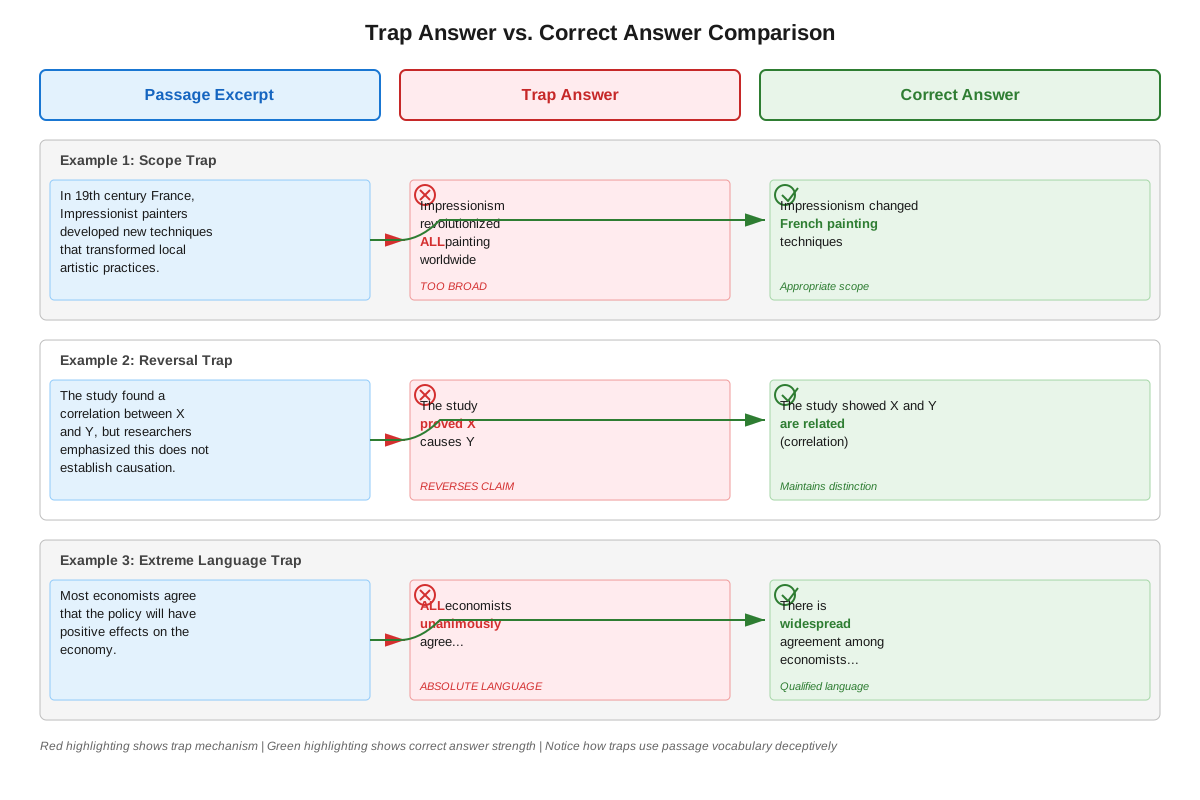
Example: If a passage states "Many economists believe monetary policy is effective in controlling inflation," a trap answer might say "Monetary policy is the only effective tool for controlling inflation." The trap introduces both an extreme qualifier ("only") and removes the hedging language ("many economists believe").
Contrast with correct answers: GMAT correct answers typically include moderate language such as "some," "often," "may," "can," "suggests," "indicates," "typically," and "tends to." This reflects the academic writing style of GMAT passages, which rarely make absolute claims.
The Reversal Trap
The reversal trap presents a statement that inverts a relationship, cause-effect sequence, or position described in the passage. This trap is particularly effective because it uses accurate passage vocabulary and addresses relevant topics—but reverses the direction of the relationship.
Example: If a passage states "Increased consumer confidence leads to higher spending," a reversal trap might say "Higher spending leads to increased consumer confidence." Both statements discuss the same concepts, but the causal direction is reversed.
Reversal traps also appear as opposite traps, where an answer choice attributes a position to the wrong party or states the opposite of what the passage claims. If the passage says "Critics argue that the policy is ineffective," a trap might say "Supporters argue that the policy is ineffective."
The Out-of-Scope Trap
The out-of-scope trap introduces information, topics, or claims that are not addressed in the passage. This trap exploits test-takers' tendency to bring outside knowledge into their analysis or to assume that related topics must have been discussed.
Scope violations come in several forms:
- Topic scope: Introducing subjects not mentioned in the passage
- Time scope: Discussing time periods the passage doesn't address
- Geographic scope: Referencing locations not mentioned
- Degree scope: Making claims stronger or weaker than the passage supports
Example: A passage discussing 19th-century American literature might generate a trap answer about 20th-century American literature, or a passage about corporate governance in the United States might generate a trap about corporate governance in Europe.
The Distortion Trap
The distortion trap takes information that appears in the passage but twists, exaggerates, or misrepresents it. Unlike out-of-scope traps, distortion traps stay within the passage's topic area but alter the meaning, emphasis, or relationship of ideas.
Common distortion patterns include:
- Overgeneralization: Taking a specific example and presenting it as a universal principle
- Undergeneralization: Taking a general principle and presenting it as applying only to specific cases
- Relationship distortion: Changing correlation to causation, or vice versa
- Emphasis distortion: Presenting a minor detail as a main point, or vice versa
Example: If a passage mentions "One study found a correlation between exercise and improved mood," a distortion trap might state "Exercise causes improved mood" (changing correlation to causation) or "Research conclusively proves exercise improves mood" (overstating the strength of evidence).
The Half-Right Trap
The half-right trap contains both accurate and inaccurate information within a single answer choice. This trap is particularly insidious because test-takers who recognize the accurate portion may select the answer without carefully evaluating the entire statement.
Example: "The author argues that renewable energy is cost-effective (TRUE) and that fossil fuels should be immediately banned (FALSE)." If the passage supports the first claim but never advocates for banning fossil fuels, the answer is incorrect despite being partially accurate.
Exam Tip: On the GMAT, an answer choice must be entirely correct to be the right answer. If any portion of an answer choice is unsupported, exaggerated, or contradicted by the passage, the entire answer is wrong.
The Emotional Appeal Trap
The emotional appeal trap presents an answer that aligns with test-takers' values, beliefs, or emotional responses rather than with passage content. This trap is especially common in passages discussing social issues, environmental topics, or ethical questions.
Example: In a passage presenting multiple perspectives on environmental regulation, a trap answer might say "The author believes environmental protection should be prioritized over economic growth" simply because this statement aligns with many test-takers' values—even if the passage presents a neutral analysis without advocating for either position.
The Familiar Language Trap
The familiar language trap uses words and phrases directly from the passage to create an illusion of correctness. Test-takers see familiar vocabulary and assume the answer must be right without verifying that the words are used in the same context and relationship as in the passage.
Example: If a passage states "The company's innovative marketing strategy contributed to its success," a trap might say "The company's success was due to its innovative product design." Both answers use passage vocabulary ("innovative," "company," "success"), but "product design" substitutes for "marketing strategy," making the answer incorrect.
Comparison of Major Trap Types
| Trap Type | Key Characteristic | Red Flag Words | Verification Strategy |
|---|---|---|---|
| Extreme Language | Absolute statements | always, never, only, must, all, none | Check for qualifying language in passage |
| Reversal | Inverted relationships | (uses passage vocabulary) | Verify direction of cause-effect, who holds what view |
| Out-of-Scope | Information not in passage | (introduces new topics/time periods) | Ask: "Where does the passage discuss this?" |
| Distortion | Twisted passage information | (exaggerates or minimizes) | Compare degree and emphasis to passage |
| Half-Right | Partially correct | (combines true and false claims) | Evaluate each component separately |
| Emotional Appeal | Aligns with values | (morally appealing statements) | Focus on what passage says, not what "should" be true |
| Familiar Language | Uses passage words incorrectly | (direct passage vocabulary) | Verify context and relationships, not just vocabulary |
Concept Relationships
Reading traps exist in a hierarchical relationship where understanding fundamental trap mechanisms enables recognition of more sophisticated combinations. The extreme language trap and reversal trap represent foundational patterns that test-takers should master first, as these appear most frequently and are easiest to identify through systematic verification.
Extreme language traps → connect to → distortion traps through the mechanism of degree manipulation. Both involve altering the strength of claims, but distortion traps are more subtle, changing emphasis rather than using obviously absolute language.
Out-of-scope traps → relate to → familiar language traps because both exploit the difference between topical relevance and actual support. Out-of-scope traps introduce entirely new information, while familiar language traps rearrange existing information incorrectly.
Half-right traps → represent combinations of → multiple trap types, often pairing accurate information with out-of-scope or distorted claims. Mastering individual trap types enables decomposition of complex half-right answers.
The relationship to broader Reading Comprehension skills flows as follows: Active reading and annotation → enables → accurate passage representation → which allows → trap identification → leading to → systematic elimination → resulting in → correct answer selection.
Understanding reading traps also enhances Critical Reasoning performance, as many CR trap answers use similar distortion and scope violation patterns. The analytical skills developed through trap recognition transfer directly to evaluating argument assumptions and identifying logical flaws.
High-Yield Facts
⭐ Approximately 75% of incorrect GMAT Reading Comprehension answers contain identifiable trap patterns rather than being random distractors
⭐ Extreme language (always, never, only, must, all, none) appears in wrong answers 3-4 times more frequently than in correct answers
⭐ Correct GMAT answers typically use moderate, qualified language (some, often, may, can, suggests, tends to)
⭐ If an answer choice introduces a topic, time period, or geographic location not mentioned in the passage, it is almost certainly a trap
⭐ Half-right traps are most common in inference questions, where test-takers must distinguish between what is stated and what is assumed
- Reversal traps most frequently appear in questions asking about author's perspective or positions held by different parties mentioned in the passage
- Familiar language traps are designed to exploit speed-reading, as test-takers recognize vocabulary without verifying context
- Emotional appeal traps are most common in passages discussing social issues, ethics, or controversial topics
- The GMAT rarely includes "trick" questions where the correct answer contradicts common sense; instead, traps exploit careless reading
- Distortion traps often change correlation to causation or present minor supporting details as main ideas
Quick check — test yourself on Reading traps so far.
Try Flashcards →Common Misconceptions
Misconception: If an answer choice uses words directly from the passage, it must be correct.
Correction: The familiar language trap specifically exploits this assumption. Correct answers often paraphrase passage content rather than quoting it directly, while trap answers may use passage vocabulary in incorrect contexts or relationships.
Misconception: The correct answer is always the most "reasonable" or "sensible" option based on real-world knowledge.
Correction: GMAT Reading Comprehension tests reading accuracy, not outside knowledge. The correct answer is the one best supported by the passage, even if other answers seem more reasonable based on general knowledge. Out-of-scope traps exploit the tendency to bring external information into analysis.
Misconception: If part of an answer choice is correct, the answer might be worth selecting if other options seem worse.
Correction: An answer must be entirely correct to be right. Half-right traps are designed to capture test-takers who recognize accurate elements without evaluating the complete statement. Even one unsupported word can make an entire answer choice incorrect.
Misconception: Extreme language always indicates a wrong answer.
Correction: While extreme language appears much more frequently in wrong answers, occasionally passages make absolute claims that correct answers must reflect. The key is verifying whether the passage itself uses extreme language, not automatically eliminating all absolute statements.
Misconception: The longest or most detailed answer choice is usually correct because it provides more information.
Correction: Answer length has no correlation with correctness on the GMAT. Trap answers are often longer because they include additional unsupported claims or out-of-scope information. Correct answers are precisely as long as necessary to accurately reflect passage content.
Misconception: If you can't find direct evidence for an answer in the passage, it must be wrong.
Correction: This is only partially true. For detail questions, direct evidence is required. However, for inference questions, the correct answer may not be explicitly stated but must be logically derivable from passage information. The distinction is between "not stated" (which can be correct for inferences) and "contradicted or unsupported" (which is always wrong).
Worked Examples
Example 1: Identifying Multiple Trap Types
Passage excerpt: "Recent studies suggest that companies implementing flexible work arrangements have seen modest improvements in employee satisfaction. However, researchers caution that the relationship between flexibility and productivity remains unclear, with some studies showing positive effects and others showing no significant impact. The technology sector has been particularly active in adopting these policies."
Question: According to the passage, which of the following is true about flexible work arrangements?
Answer choices:
(A) Flexible work arrangements always improve both employee satisfaction and productivity.
(B) The technology sector has proven that flexible work arrangements increase productivity.
(C) Research indicates that flexible work arrangements may improve employee satisfaction, though their effect on productivity is uncertain.
(D) Companies should implement flexible work arrangements because they improve employee satisfaction.
(E) Flexible work arrangements have been adopted by all sectors, with the technology sector leading the way.
Analysis:
(A) Trap type: Extreme language + Distortion
- "Always" is extreme language not supported by "modest improvements"
- Combines satisfaction (which is supported) with productivity (which the passage says is "unclear")
- Elimination reason: Overstates certainty and scope
(B) Trap type: Distortion + Out-of-scope
- Changes "adopted these policies" to "proven that...increase productivity"
- The passage explicitly states the productivity relationship is "unclear"
- Elimination reason: Contradicts passage content about uncertain productivity effects
(C) CORRECT ANSWER
- "May improve" matches "modest improvements" and "suggest" (qualified language)
- "Uncertain" directly reflects "remains unclear"
- Accurately represents both claims without overstatement
- Selection reason: Precisely matches passage scope and certainty level
(D) Trap type: Emotional appeal + Out-of-scope
- "Should implement" is prescriptive; the passage is descriptive
- Introduces a recommendation not made in the passage
- Elimination reason: Passage reports findings but doesn't advocate for action
(E) Trap type: Extreme language + Distortion
- "All sectors" is extreme; passage only mentions technology sector was "particularly active"
- Overgeneralizes from one sector to all sectors
- Elimination reason: Unsupported generalization
Key lesson: The correct answer (C) uses the most qualified, moderate language and precisely matches the passage's scope and certainty level. Every trap answer violates passage content through extremity, distortion, or scope expansion.
Example 2: Half-Right Trap Recognition
Passage excerpt: "The decline of coral reefs has been attributed to multiple factors, including rising ocean temperatures, pollution, and overfishing. Marine biologists emphasize that temperature increase appears to be the most significant contributor, as it triggers coral bleaching events. While some coral species have demonstrated resilience to moderate temperature changes, the majority of reef systems show vulnerability to sustained warming."
Question: The passage suggests which of the following about coral reef decline?
Answer choices:
(A) Rising ocean temperatures are the sole cause of coral reef decline.
(B) Most coral species cannot adapt to any temperature changes.
(C) Temperature increase is identified as a major factor in reef decline, though multiple causes contribute to the problem.
(D) Marine biologists have proven that pollution and overfishing are more damaging than temperature changes.
(E) Some coral species are resilient to temperature changes, indicating that coral reefs are not seriously threatened.
Analysis:
(A) Trap type: Extreme language + Distortion
- "Sole cause" contradicts "multiple factors"
- Elimination: Ignores pollution and overfishing
(B) Trap type: Extreme language + Reversal
- "Cannot adapt to any" is extreme; passage says "some...have demonstrated resilience"
- Reverses the claim about resilient species
- Elimination: Contradicts passage statement about some species' resilience
(C) CORRECT ANSWER
- "Major factor" matches "most significant contributor"
- "Multiple causes" reflects "multiple factors"
- Balanced representation without overstatement
- Selection: Accurately captures both the primary cause and contributing factors
(D) Trap type: Reversal + Distortion
- Reverses the relationship; passage says temperature is "most significant"
- Changes "emphasize" to "proven"
- Elimination: Inverts the relative importance of factors
(E) Trap type: Half-right + Distortion
- First part is accurate: "Some coral species are resilient"
- Second part is unsupported: "not seriously threatened" contradicts overall decline discussion
- Elimination: Draws an unsupported conclusion from a minor detail
Key lesson: Answer (E) demonstrates the classic half-right trap—it begins with accurate information that test-takers recognize from the passage, then adds an unsupported conclusion. Test-takers must evaluate the entire answer choice, not just the portion that seems familiar.
Exam Strategy
Systematic Trap Elimination Process
Step 1: Read the question stem carefully to understand what type of support is required (direct statement, inference, main idea, etc.). Different question types are susceptible to different trap patterns.
Step 2: Before looking at answer choices, formulate a prediction based on passage content. This prevents trap answers from anchoring your thinking.
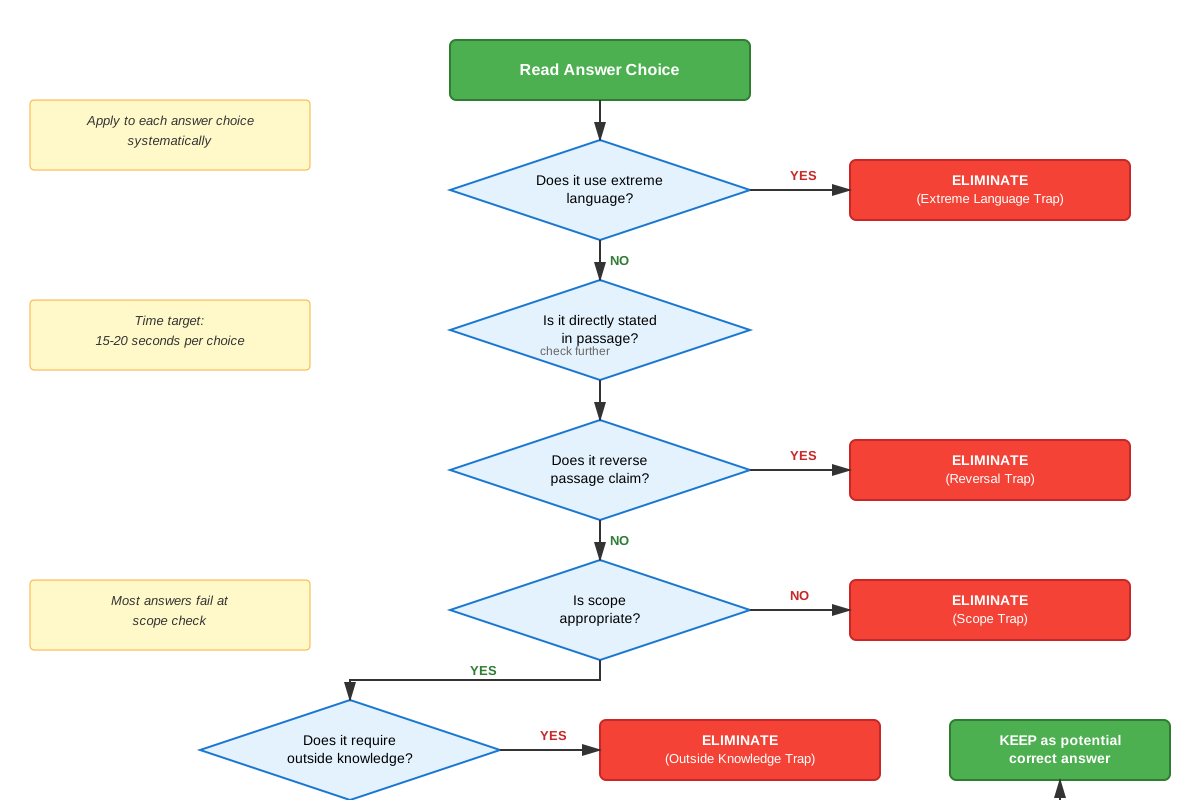
Step 3: Evaluate each answer choice systematically using the following verification sequence:
- Scope check: Does this answer introduce topics, time periods, or locations not in the passage?
- Extreme language check: Does this answer use absolute terms not supported by passage language?
- Relationship check: Does this answer correctly represent cause-effect, comparison, or position relationships?
- Degree check: Does this answer match the strength and certainty level of passage claims?
Step 4: For remaining contenders, return to the passage to verify specific claims. Don't rely on memory for close decisions.
Step 5: Between two similar answers, the correct choice typically has more moderate language and narrower scope.
Trigger Words and Phrases
Red flag words in answer choices (suggest possible traps):
- Absolute: always, never, only, must, all, none, every, impossible, certainly
- Extreme: completely, entirely, totally, absolutely, exclusively
- Prescriptive: should, ought, need to, required (in descriptive passages)
- Causal: proves, demonstrates, establishes (when passage only suggests)
Green flag words in answer choices (often appear in correct answers):
- Qualified: some, many, often, typically, generally, tends to
- Uncertain: may, might, can, could, suggests, indicates
- Comparative: more, less, relatively, compared to
- Conditional: if, when, under certain conditions
Time Allocation Strategy
Spend 15-20 seconds per answer choice on initial evaluation, but don't hesitate to invest 30-45 seconds returning to the passage to verify a specific claim when choosing between two contenders. Time spent verifying against the passage is almost always more valuable than time spent re-reading answer choices.
For questions where you've eliminated three answers but are uncertain between two remaining options, use this tiebreaker hierarchy:
- Scope: Choose the answer with narrower, more specific scope
- Language: Choose the answer with more qualified, moderate language
- Passage alignment: Choose the answer that uses passage structure and emphasis
Critical Exam Tip: If you find yourself thinking "This answer isn't stated in the passage, but it must be true based on common sense," you are likely falling for an out-of-scope or emotional appeal trap. The GMAT tests reading accuracy, not real-world reasoning.
Memory Techniques
The SERVED Acronym for Trap Types
Scope violations (out-of-scope information)
Extreme language (always, never, only, must)
Reversals (inverted relationships or positions)
Vocabulary misuse (familiar language trap)
Emotional appeals (what "should" be true)
Distortions (twisted or exaggerated information)
The "Three Cs" Verification Method
When evaluating an answer choice, verify:
- Content: Is this information actually in the passage?
- Context: Is this information used in the same way as in the passage?
- Certainty: Does the answer match the passage's level of confidence and qualification?
Visualization Strategy
Picture a target with concentric circles:
- Bullseye: What the passage explicitly states
- Inner ring: What can be directly inferred from passage statements
- Outer ring: What seems reasonable but isn't supported
- Outside the target: Out-of-scope information
Correct answers hit the bullseye or inner ring. Trap answers fall in the outer ring or outside the target.
The "Prove It" Technique
For each answer choice, mentally ask "Where in the passage does it say this?" If you cannot point to specific lines or make a clear logical connection, the answer is likely a trap.
Summary
Reading traps are systematic patterns of incorrect answer choices that exploit predictable reading errors and cognitive biases. The GMAT uses approximately 8-10 distinct trap types, with extreme language, reversals, out-of-scope information, and distortions being the most common. Mastering trap recognition requires understanding that the GMAT tests reading accuracy rather than reasoning ability or outside knowledge—the correct answer is always the one best supported by the passage, regardless of what seems reasonable or aligns with personal beliefs. Effective trap avoidance depends on systematic verification: checking scope, evaluating language extremity, confirming relationships, and matching certainty levels. The distinction between correct answers and traps often comes down to subtle differences in qualification, scope, or emphasis rather than completely different content. Test-takers who develop systematic elimination strategies based on trap patterns can improve Reading Comprehension accuracy from 60-70% to 85-95%, representing significant score improvements. The key insight is that trap answers are not randomly wrong—they are wrong in predictable, identifiable ways that can be systematically detected and eliminated.
Key Takeaways
- Reading traps appear in 75% of incorrect GMAT Reading Comprehension answers and follow predictable patterns that can be systematically identified and eliminated
- Extreme language (always, never, only, must) appears 3-4 times more frequently in wrong answers than correct answers; qualified language (some, may, suggests) characterizes correct answers
- The most common trap types are extreme language, reversals, out-of-scope information, distortions, half-right combinations, emotional appeals, and familiar language misuse
- An answer choice must be entirely correct to be right—partially accurate answers are still wrong, making half-right traps particularly dangerous
- Effective trap avoidance requires verifying three elements: content (is it in the passage?), context (is it used the same way?), and certainty (does it match qualification level?)
- The GMAT tests reading accuracy, not outside knowledge or reasoning ability—correct answers are supported by the passage, even if other options seem more reasonable
- Systematic elimination using trap recognition can improve Reading Comprehension accuracy by 15-25 percentage points, translating to 50-100 point score improvements
Related Topics
Critical Reasoning Trap Patterns: Many trap types in Reading Comprehension (especially scope violations and distortions) appear in similar forms in Critical Reasoning questions. Mastering reading traps builds analytical skills that transfer directly to evaluating argument assumptions and identifying logical flaws.
Inference Question Strategies: Inference questions are particularly susceptible to half-right and out-of-scope traps. Advanced inference strategies build on trap recognition by teaching test-takers to distinguish between what is stated, what is implied, and what is assumed.
Passage Structure Analysis: Understanding how GMAT passages are organized (main idea, supporting details, contrasts, examples) helps predict which trap types are likely to appear in questions about different passage elements.
Active Reading and Annotation: Effective trap identification depends on accurate passage representation. Advanced annotation techniques ensure test-takers can quickly verify claims against passage content rather than relying on potentially faulty memory.
Practice CTA
Now that you understand the systematic patterns behind GMAT reading traps, it's time to apply these concepts to real questions. Attempt the practice questions for this topic, focusing on identifying the specific trap type in each incorrect answer choice before selecting the correct answer. Use the flashcards to reinforce trap type recognition until you can identify patterns automatically. Remember: trap recognition is a skill that improves dramatically with deliberate practice. Each trap you identify strengthens your ability to spot similar patterns under timed conditions, building the systematic elimination skills that separate good scores from great scores. Your investment in mastering this high-yield topic will pay dividends across every Reading Comprehension passage you encounter on test day.
Sign up free to keep reading
Create a free AnvayaPrep account to finish this GMAT guide on Reading traps — plus flashcards and practice questions.