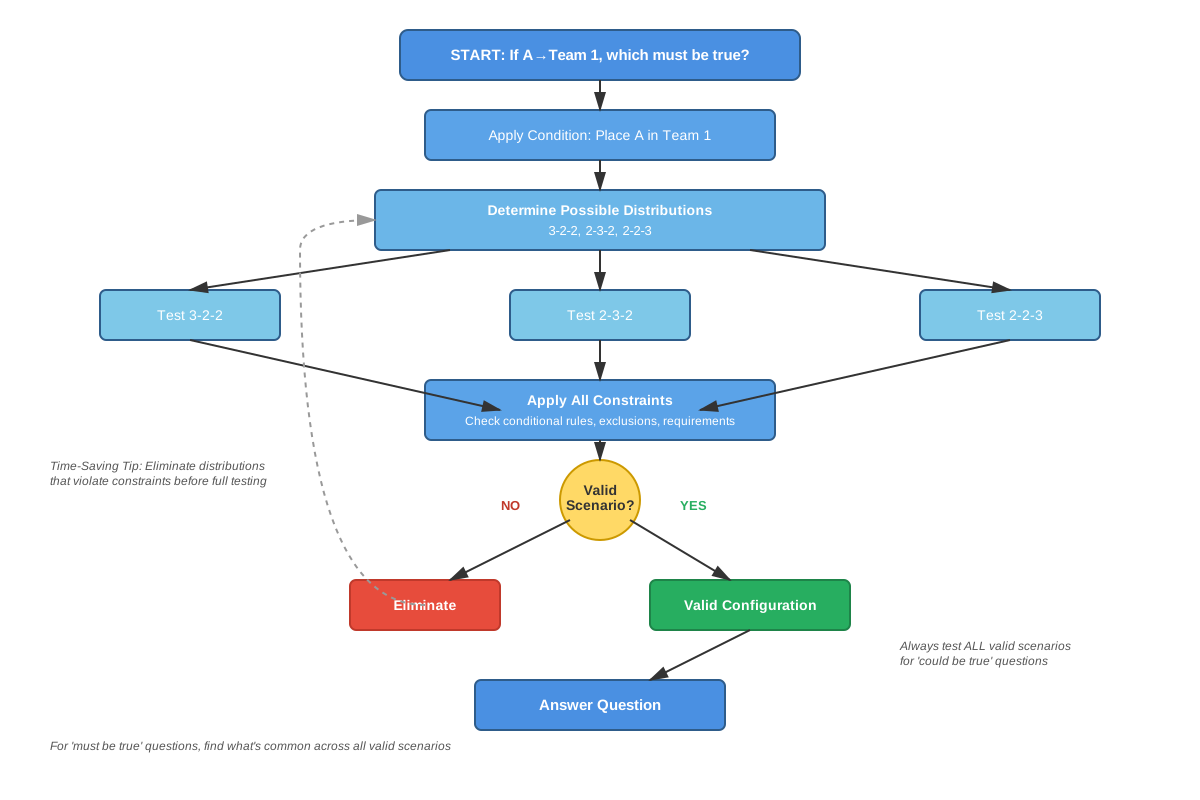
Overview
Grouping with teams represents one of the most frequently tested subcategories within Analytical Reasoning Legacy on the LSAT. This game type challenges test-takers to distribute a set of variables (typically people, objects, or entities) into multiple distinct groups or teams, where each group has specific characteristics, constraints, or requirements. Unlike simple selection games where elements are merely chosen or rejected, grouping with teams requires understanding complex relationships between multiple subsets simultaneously. The fundamental challenge lies in tracking which elements can or must be grouped together, which must remain separate, and how the composition of one team affects the possibilities for other teams.
The significance of mastering LSAT grouping with teams extends beyond individual game performance—it develops critical logical reasoning skills that appear throughout the entire Analytical Reasoning section. These games test the ability to visualize multiple categories simultaneously, apply conditional logic across different groups, and recognize how constraints cascade through interconnected systems. Students who excel at grouping with teams demonstrate superior spatial reasoning and the capacity to manage complex rule interactions, skills that translate directly to success on other grouping games legacy challenges.
Within the broader landscape of Analytical Reasoning, grouping with teams occupies a middle ground between pure selection games (in/out scenarios) and more complex hybrid games that combine grouping with sequencing. Understanding this topic provides the foundation for tackling advanced game types while reinforcing fundamental skills like rule representation, deduction-making, and systematic scenario testing. The patterns learned here—particularly regarding numerical distributions and conditional relationships—appear repeatedly across different game formats, making this topic a cornerstone of LSAT preparation.
Learning Objectives
- [ ] Identify how Grouping with teams appears in LSAT questions
- [ ] Explain the reasoning pattern behind Grouping with teams
- [ ] Apply Grouping with teams to solve LSAT-style problems accurately
- [ ] Construct effective visual representations for team-based grouping scenarios
- [ ] Recognize and apply numerical distribution principles in team formation
- [ ] Distinguish between fixed and variable team size constraints
- [ ] Execute systematic scenario analysis when team compositions are restricted
Prerequisites
- Basic set theory and categorical logic: Understanding how elements belong to or are excluded from groups forms the foundation for tracking team membership
- Conditional reasoning (if-then statements): Many team constraints are expressed as conditional rules that determine which elements can or cannot be grouped together
- Rule notation and diagramming: The ability to translate written constraints into symbolic representations is essential for efficient problem-solving
- Fundamental counting principles: Recognizing how many ways elements can be distributed requires basic combinatorial awareness
Why This Topic Matters
Grouping with teams appears in approximately 25-30% of all Analytical Reasoning games on recent LSAT administrations, making it one of the highest-yield topics for focused study. These games typically generate 5-7 questions per game, and a single Logic Games section often includes at least one team-based grouping scenario. The question types range from straightforward "could be true" questions to complex "if" hypotheticals that require complete scenario reconstruction.
In real-world applications, the logical skills developed through team grouping problems mirror decision-making processes in legal practice: assigning cases to different attorneys based on expertise and conflicts of interest, organizing evidence into categories for trial presentation, or determining which parties have standing in multi-party litigation. The ability to manage multiple overlapping constraints while maintaining awareness of how decisions in one area affect possibilities in another directly parallels the analytical demands of legal reasoning.
On the LSAT, grouping with teams most commonly appears as committee formation scenarios (selecting members for multiple committees), team assignments (distributing players or workers across teams), or classification problems (sorting items into categories with specific requirements). The games may specify fixed team sizes ("exactly three members on each committee") or variable sizes ("at least two but no more than four"), with the latter creating additional complexity. Recognition of these patterns during the initial game setup saves crucial time and prevents strategic errors.
Core Concepts
Fundamental Structure of Team Grouping Games
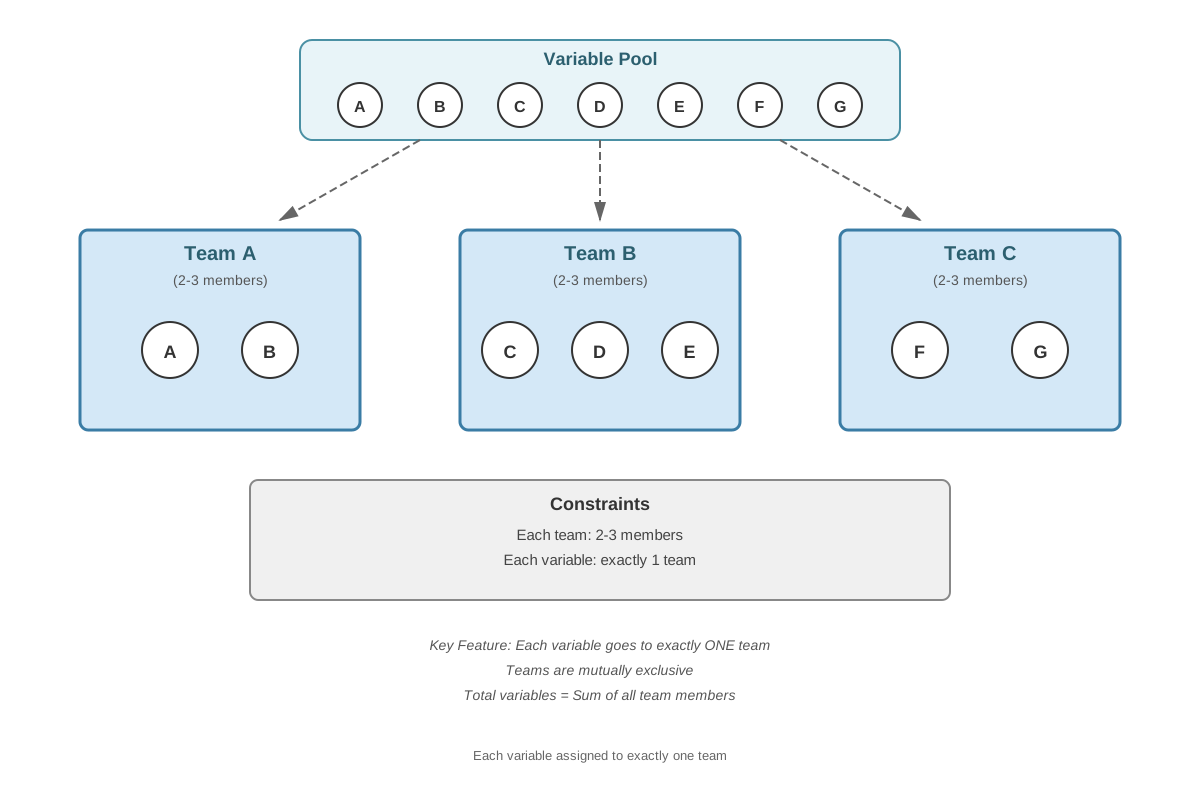
Grouping with teams involves distributing a fixed set of variables across two or more distinct groups, where each group represents a separate team, committee, category, or classification. The defining characteristic is that variables are assigned to specific, labeled groups rather than simply being selected or rejected. For example, eight employees (A, B, C, D, E, F, G, H) might be assigned to three project teams (Team 1, Team 2, Team 3), with various rules governing who can work together or which teams must include certain members.
The basic framework requires identifying three essential components: (1) the variable set (the elements being distributed), (2) the group structure (how many teams exist and their characteristics), and (3) the constraints (rules governing distribution). Each component must be clearly understood before attempting to solve questions, as confusion about any element leads to systematic errors throughout the game.
Fixed vs. Variable Team Sizes
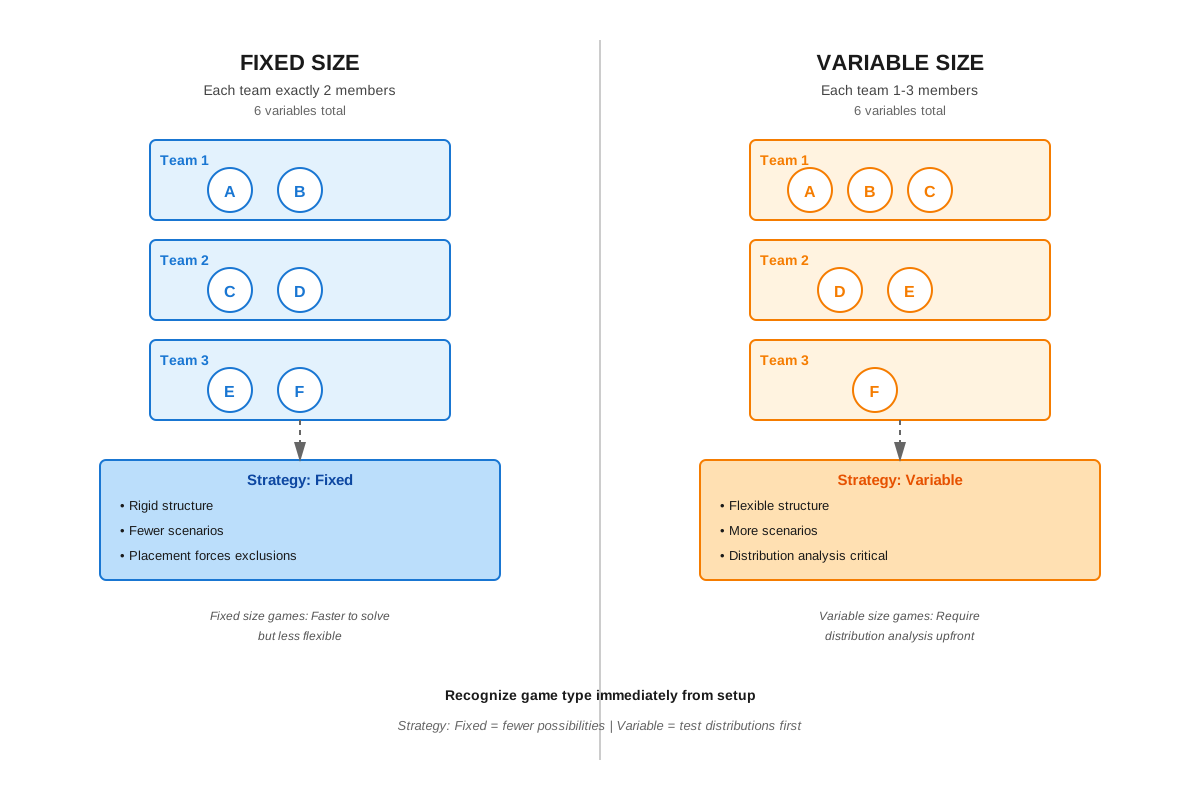
Team grouping games divide into two major categories based on whether team sizes are predetermined or flexible. Fixed team size games specify exactly how many members each team must have (e.g., "Each of the three committees has exactly three members"). These games offer more structural certainty and often allow for more definitive deductions early in the problem-solving process.
Variable team size games permit flexibility in group composition (e.g., "Each team has at least two members" or "No team can have more than four members"). These scenarios require tracking multiple possible distributions and often demand scenario-based analysis. The key distinction affects strategy: fixed-size games benefit from immediate numerical analysis, while variable-size games require identifying the range of possible distributions before applying specific constraints.
| Feature | Fixed Team Size | Variable Team Size |
|---|---|---|
| Certainty | High - exact composition known | Lower - multiple distributions possible |
| Initial Deductions | Often numerous and definitive | Typically fewer and conditional |
| Question Difficulty | Generally moderate | Often more challenging |
| Strategic Approach | Focus on rule interactions | Identify distribution scenarios first |
Distribution Analysis and Numerical Constraints
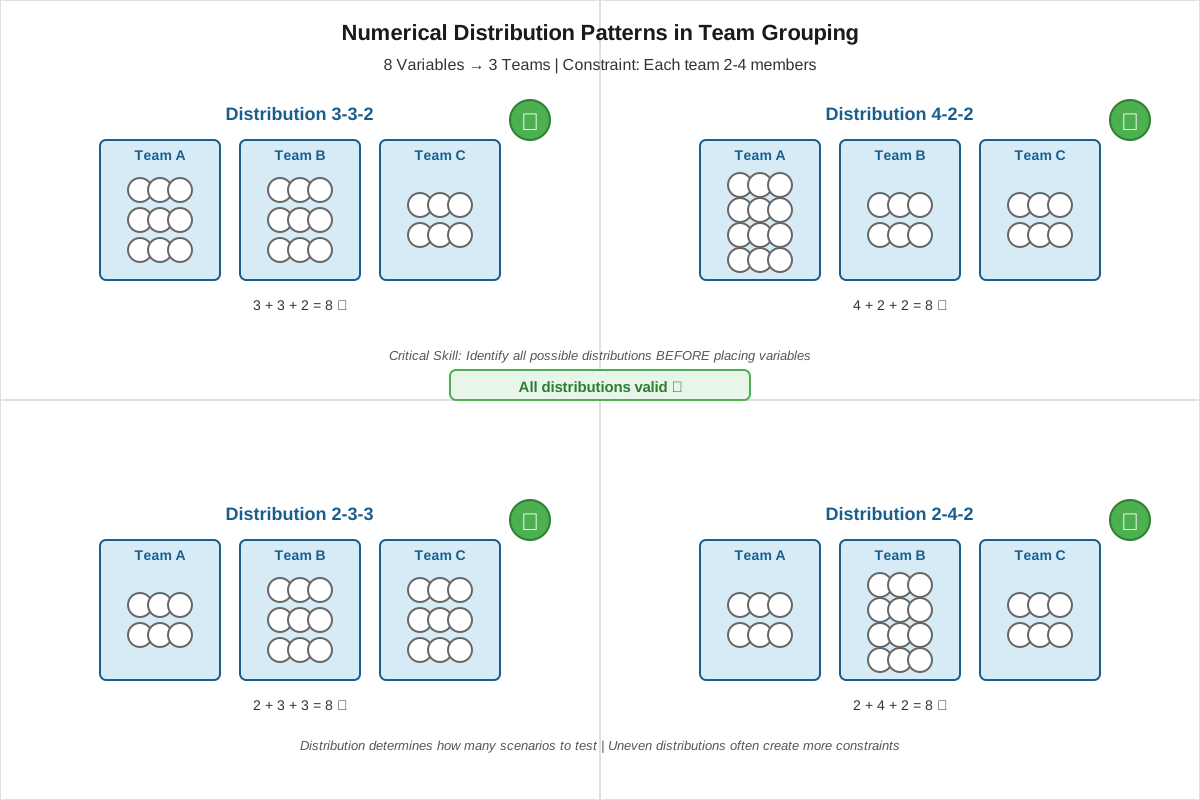
Before applying specific rules, successful test-takers perform distribution analysis—determining how many elements must go into each group given the total number of variables and any size constraints. For example, with 9 variables and 3 teams where each team has at least 2 members, possible distributions include 2-2-5, 2-3-4, or 3-3-3. Identifying all viable distributions prevents wasted effort on impossible scenarios.
The process follows these steps:
- Count total variables in the set
- Identify minimum and maximum constraints for each team
- Calculate all distributions that satisfy both the total and individual constraints
- Note which distributions are most restrictive (often leading to more deductions)
- Consider whether rules make certain distributions impossible or required
Rule Types in Team Grouping
Team grouping games employ several distinct rule categories, each requiring specific notation and analytical approaches:
Positive grouping rules specify that certain variables must be on the same team (e.g., "A and B are on the same committee"). These create blocks that move together through the game, reducing flexibility but often enabling powerful deductions.
Negative grouping rules prohibit certain variables from being together (e.g., "C and D cannot be on the same team"). These anti-blocks create separation requirements that often force specific distributions when combined with other constraints.
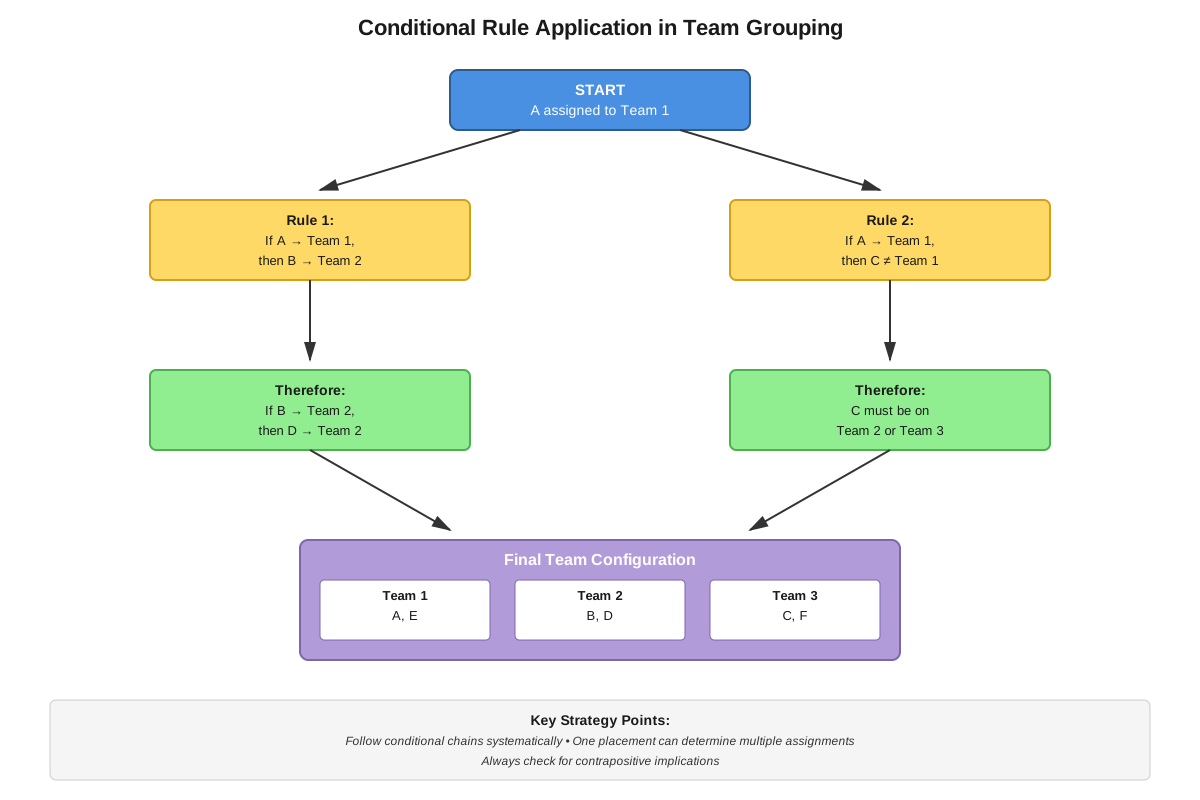
Conditional assignment rules establish if-then relationships about team membership (e.g., "If E is on Team 1, then F must be on Team 2"). These require careful contrapositive analysis and often create chains of implications.
Numerical rules specify how many of a certain type of variable each team must have (e.g., "Each team must have at least one senior member"). These interact with distribution analysis to further restrict possibilities.
Visual Representation Strategies
Effective diagramming is crucial for team grouping success. The standard approach uses a slot-based diagram with columns or sections for each team:
Team 1:  ___  ___  ___
Team 2:  ___  ___  ___
Team 3:  ___  ___  ___
Variables are placed in slots as deductions are made, with notation indicating possibilities (small letters), certainties (capital letters), and exclusions (crossed-out letters). For games with variable team sizes, flexible notation using brackets or expandable spaces accommodates different distributions.
Alternative representations include roster-style diagrams that list team names with space for members, or matrix diagrams showing variables on one axis and teams on the other, with checkmarks or X's indicating assignments and exclusions. The choice depends on personal preference and the specific game structure, but consistency within a game is essential.
Making Deductions in Team Grouping
The deduction process in team grouping follows a systematic sequence:
- Distribution deductions: Determine possible numerical arrangements
- Block deductions: Identify where positive grouping rules force or prevent certain placements
- Anti-block deductions: Recognize how separation requirements interact with limited team spaces
- Conditional chain deductions: Trace through if-then rules to find forced placements
- Capacity deductions: Notice when teams reach maximum capacity or minimum requirements
The most powerful deductions often emerge from combining rule types. For example, if A and B must be together (positive grouping), C and D cannot be together (negative grouping), and each team has exactly two members, placing A-B on Team 1 might force C and D onto Teams 2 and 3 respectively, creating a complete solution.
Scenario-Based Analysis
When initial deductions don't fully determine the game, scenario analysis becomes necessary. This involves identifying a key variable or decision point that splits the game into distinct possibilities, then working through each scenario to see what follows. The goal is to find the most restrictive branching point—the decision that generates the most additional deductions in each branch.
Effective scenario analysis requires discipline: fully explore one scenario before moving to the next, clearly mark which scenario is being tested, and recognize when a scenario becomes impossible (allowing elimination of that branch). Many questions can be answered by recognizing which scenario they describe, making this investment highly efficient.
Concept Relationships
The concepts within team grouping form an interconnected system where understanding one element enhances comprehension of others. Distribution analysis serves as the foundation, establishing the numerical framework within which all other constraints operate. This framework directly determines how rule types can interact—for example, positive grouping rules have different implications in fixed versus variable team size scenarios.
Visual representation strategies translate the abstract relationships defined by rules into concrete spatial arrangements, making deduction-making more intuitive and systematic. The diagram serves as the central workspace where distribution possibilities, rule constraints, and logical inferences converge. As deductions accumulate, they often trigger scenario-based analysis when multiple viable arrangements remain.
The relationship to prerequisite knowledge is equally important: conditional reasoning from basic logic directly enables interpretation of conditional assignment rules, while set theory concepts underlie the fundamental understanding of group membership and exclusion. The progression flows: Prerequisites → Distribution Framework → Rule Application → Visual Representation → Deduction Process → Scenario Analysis → Question Answering.
Within the broader grouping games legacy category, team grouping connects to selection games (which can be viewed as two-team grouping: selected vs. not selected) and serves as preparation for hybrid games that combine grouping with sequencing or other elements. Mastery of team grouping provides transferable skills for any game involving multiple categories or classifications.
High-Yield Facts
⭐ Team grouping games always involve distributing ALL variables across the available teams—no variable remains unassigned unless explicitly stated otherwise.
⭐ Distribution analysis must be completed before applying specific rules—knowing possible numerical arrangements prevents wasted effort on impossible scenarios.
⭐ Positive grouping rules (must be together) are more restrictive than negative grouping rules (cannot be together) in games with many teams but few slots per team.
⭐ When a team reaches its maximum capacity, all remaining variables are excluded from that team—this often triggers cascading deductions.
⭐ Conditional rules in team grouping require tracking both the positive statement and its contrapositive—if X on Team 1 → Y on Team 2, then Y NOT on Team 2 → X NOT on Team 1.
- Fixed team size games typically allow more upfront deductions than variable team size games, making them generally faster to solve.
- The most efficient branching point for scenario analysis is usually the variable involved in the most rules or the decision that most restricts team composition.
- When two variables must be separated (anti-block) and there are only two teams, they must be on different teams—an immediate and certain deduction.
- Numerical rules about types of variables (e.g., "each team needs at least one manager") often combine with distribution analysis to force specific placements.
- Questions asking "which could be a complete and accurate list of Team X's members" can often be answered by checking a single rule violation rather than verifying all possibilities.
- In games where teams have different characteristics (e.g., Team A is senior, Team B is junior), those characteristics often function as additional constraints on which variables can be assigned where.
- The contrapositive of "If A is on Team 1, then B is NOT on Team 1" is "If B IS on Team 1, then A is NOT on Team 1"—both statements express the same anti-block relationship.
Quick check — test yourself on Grouping with teams so far.
Try Flashcards →Common Misconceptions
Misconception: All variables must be used in every question's scenario.
Correction: While the game setup typically requires all variables to be assigned somewhere, individual question stems may add constraints that make certain assignments impossible or may ask about partial team compositions. Always read the question stem carefully to determine whether it's asking about a complete scenario or just one team's composition.
Misconception: "At least two members" means exactly two members.
Correction: "At least" establishes a minimum, not a fixed number. A team with "at least two members" could have two, three, four, or more members depending on other constraints. This distinction is crucial for distribution analysis in variable team size games.
Misconception: If A and B must be together, and B and C must be together, then A, B, and C form a block of three that must all be on the same team.
Correction: This is actually correct reasoning—the misconception is thinking these rules don't create a three-person block. Transitive property applies to positive grouping rules: if A is with B, and B is with C, then A must be with C.
Misconception: Negative grouping rules (cannot be together) mean the variables must be as far apart as possible.
Correction: Negative grouping rules only require that the variables not be on the same team. In a three-team game, if A and B cannot be together, A could be on Team 1 and B on Team 2, or A on Team 1 and B on Team 3—there's no requirement to maximize separation beyond ensuring they're on different teams.
Misconception: When a question asks "which of the following could be true," any answer that doesn't directly violate a stated rule must be correct.
Correction: The correct answer must be consistent with all rules AND all deductions that follow from those rules. An answer choice might not directly violate a stated rule but could contradict a necessary inference, making it impossible and therefore incorrect.
Misconception: Variable team size games are always harder than fixed team size games.
Correction: While variable team size games often require more scenario analysis, they can sometimes be easier if the rules heavily restrict distributions. Conversely, fixed team size games with many complex conditional rules can be quite challenging. Difficulty depends on the specific combination of constraints, not just whether team sizes are fixed or variable.
Worked Examples
Example 1: Fixed Team Size with Positive and Negative Grouping
Setup: Eight students—A, B, C, D, E, F, G, and H—are being assigned to three study groups: Group 1, Group 2, and Group 3. Each group has exactly two or three members, and each student is assigned to exactly one group. The following conditions apply:
- A and B must be in the same group
- C and D cannot be in the same group
- E must be in Group 1
- If F is in Group 2, then G is in Group 3
Question: If Group 1 has exactly three members, which of the following must be true?
Solution Process:
Step 1: Analyze distribution. With 8 students and three groups, if Group 1 has 3 members, the remaining 5 students distribute across Groups 2 and 3. Possible distributions: 3-2-3 or 3-3-2.
Step 2: Apply the definite rule. E must be in Group 1, so Group 1 has E plus two others.
Step 3: Consider the A-B block. A and B must be together. They could be the other two members of Group 1 (with E), or they could be together in Group 2 or Group 3.
Step 4: Test Scenario A—A and B in Group 1 with E.
- Group 1: A, B, E (complete)
- Remaining: C, D, F, G, H (5 students for Groups 2 and 3)
- Distribution must be 2-3 or 3-2 for Groups 2 and 3
- C and D must be separated, so one goes to Group 2, one to Group 3
- F, G, H fill remaining slots
- Check conditional: If F is in Group 2, G must be in Group 3 (possible in either distribution)
Step 5: Test Scenario B—A and B together in Group 2 or 3.
- Group 1: E + two others (not A or B)
- The two others must come from {C, D, F, G, H}
- If C is in Group 1, D must be in Group 2 or 3 (satisfies separation)
- If D is in Group 1, C must be in Group 2 or 3 (satisfies separation)
- Multiple arrangements work
Step 6: Identify what MUST be true across all valid scenarios.
- E is always in Group 1 (given rule)
- A and B are always together (given rule)
- C and D are always separated (given rule)
- Looking at both scenarios, no other placement is forced in all cases
Answer: The only statement that must be true is "E is in Group 1" (which was already given). If the question offered answer choices, we'd look for deductions that hold in both scenarios. For instance, "A and B are in the same group" must be true, or "C and D are in different groups" must be true.
Example 2: Variable Team Size with Conditional Rules
Setup: A law firm is assigning six associates—J, K, L, M, N, and O—to three cases: Case X, Case Y, and Case Z. Each associate works on at least one case, and each case has at least one associate assigned to it. The following conditions apply:
- J works on Case X
- If K works on Case X, then L works on Case Y
- M and N work on exactly the same cases as each other
- O does not work on Case Y
Question: If exactly two associates work on Case Z, which of the following could be true?
Solution Process:
Step 1: Identify what's definite.
- J is on Case X (certain)
- O is NOT on Case Y (certain)
- M and N are always together on the same case(s) (they're a block)
Step 2: Analyze the constraint. Exactly two associates work on Case Z. Note that associates can work on multiple cases, so this doesn't mean only two associates total are assigned—it means Case Z's roster has exactly two names.
Step 3: Consider who could be the two on Case Z.
- Could be M and N (they count as two and must be together)
- Could be any other pair: J-K, J-L, J-O, K-L, K-O, L-O, etc.
- Could include J (who's definitely on X) since J can work on multiple cases
Step 4: Apply the conditional rule. If K is on Case X, then L must be on Case Y. Contrapositive: If L is NOT on Case Y, then K is NOT on Case X.
Step 5: Test answer choices (in actual exam context). Let's test: "K works on Case Z but not Case X."
- If K is on Case Z but not Case X, the conditional rule doesn't trigger (it only applies if K IS on X)
- J is on Case X (required)
- O is not on Case Y (required)
- M and N are together somewhere
- Case Z has exactly two: could be K and one other (maybe L, O, or even J if J works on both X and Z)
- Let's say Case Z has K and O
- Case X has J (and possibly others)
- Case Y needs at least one person; could have L, M, N
- This scenario violates no rules, so "K works on Case Z but not Case X" COULD be true
Answer: The statement "K works on Case Z but not Case X" could be true. This example demonstrates how careful tracking of conditional rules and the distinction between case assignments (which can overlap) versus team assignments (which typically don't) is crucial.
Exam Strategy
When approaching grouping with teams questions on the LSAT, begin by investing 60-90 seconds in thorough setup before attempting any questions. Read the scenario carefully to identify: (1) how many variables exist, (2) how many teams/groups exist, (3) whether team sizes are fixed or variable, and (4) any special characteristics of teams. This upfront investment prevents costly errors and speeds up question-answering.
Trigger words that signal team grouping games include: "assigned to," "committees," "teams," "groups," "categories," "projects," "cases," or "departments." Phrases like "each person is on exactly one team" indicate exclusive assignment (no overlap), while "each person works on at least one case" suggests possible overlap. This distinction fundamentally changes the game's logic.
For process of elimination, systematically check each answer choice against rules in a consistent order: start with the most concrete, definite rules (like "X must be in Group 1") before testing conditional rules. When a question asks "which could be true," eliminate answers that violate rules or necessary deductions. When a question asks "which must be true," eliminate answers that are merely possible but not required. One efficient technique: if four answers seem possible, the fifth (which must be impossible) is likely the correct answer to a "must be false" question.
Time allocation for team grouping games should follow this pattern: 1.5-2 minutes for initial setup and deductions, then 30-45 seconds per question. If a question requires extensive scenario testing and exceeds 60 seconds, mark it and return after completing faster questions. The first question in a game set is often a "which could be a complete and accurate assignment" question—use this to verify your understanding of the rules before proceeding to harder questions.
Exam Tip: When stuck on a team grouping question, return to distribution analysis. Often, the question stem adds a constraint that eliminates all but one possible distribution, and recognizing this immediately narrows the possibilities dramatically.
Memory Techniques
TEAM acronym for the systematic approach:
- Tally the variables and groups (count everything)
- Establish distribution possibilities (numerical analysis)
- Apply rules to create deductions (work through constraints)
- Map scenarios if needed (branch on key decisions)
"Blocks stick, anti-blocks split" - A simple phrase to remember that positive grouping rules create units that move together (blocks stick together), while negative grouping rules force separation (anti-blocks split apart).
The "Capacity Cascade" visualization: Picture each team as a container with limited space. When one container fills up, imagine the remaining variables cascading down to the other containers. This mental image helps track how filling one team affects possibilities for others.
"Fixed = Fast, Variable = Vigilant" - Fixed team sizes typically allow faster solving through immediate deductions, while variable team sizes require vigilant tracking of multiple distribution scenarios.
For conditional rules, use the "If-Then-Flip-Not" pattern: If X → Y becomes "If NOT Y → NOT X" (contrapositive). Visualize flipping the statement and adding "not" to both parts.
Summary
Grouping with teams represents a high-frequency, high-value question type within LSAT Analytical Reasoning Legacy that requires distributing variables across multiple distinct groups according to specific constraints. Success depends on mastering distribution analysis (determining possible numerical arrangements), recognizing and properly applying different rule types (positive grouping, negative grouping, conditional, and numerical), and creating effective visual representations that support systematic deduction-making. The fundamental distinction between fixed and variable team sizes affects strategic approach, with fixed sizes enabling more immediate deductions and variable sizes requiring scenario-based analysis. Students must develop fluency in translating written constraints into symbolic notation, identifying the most restrictive branching points for scenario analysis, and recognizing how rules interact to force or prevent specific placements. The key to excellence lies in methodical setup, disciplined application of rules in a consistent sequence, and recognition of high-yield deduction patterns such as capacity constraints and conditional chains. These skills transfer broadly across the Analytical Reasoning section and form essential preparation for more complex hybrid game types.
Key Takeaways
- Distribution analysis must precede rule application—determine all possible numerical arrangements before testing specific constraints to avoid wasting time on impossible scenarios
- Positive grouping rules create blocks that move together; negative grouping rules create anti-blocks that must be separated—these are the most common and powerful rule types in team grouping games
- Fixed team sizes enable more upfront deductions; variable team sizes require tracking multiple distribution scenarios—adjust your strategy based on which type you encounter
- Conditional rules require contrapositive analysis—always identify both the original statement and its contrapositive to catch all implications
- Visual representation is not optional—a clear, consistent diagram is essential for tracking assignments, exclusions, and possibilities across multiple teams
- Capacity deductions trigger cascading inferences—when a team reaches maximum capacity or minimum requirements, immediately consider how this affects remaining variables and teams
- Scenario analysis should branch on the most restrictive decision point—choose the variable or placement that generates the most additional deductions in each branch to maximize efficiency
Related Topics
Selection Games (In/Out Grouping): The simpler predecessor to team grouping, where variables are divided into just two categories (selected vs. not selected). Mastering team grouping makes selection games feel straightforward, as they're essentially two-team grouping with one team often unnamed.
Hybrid Games (Grouping + Sequencing): Advanced game types that combine team assignment with ordering constraints. Success with pure team grouping provides the foundation for managing the grouping component while simultaneously tracking sequence.
Numerical Distribution Analysis: A broader skill applicable across multiple game types, involving systematic enumeration of how quantities can be arranged. Deep mastery of this concept, developed through team grouping, enhances performance on complex games with multiple numerical constraints.
Conditional Logic Chains: While introduced in basic logic, conditional reasoning reaches greater complexity in team grouping contexts where multiple if-then statements interact across different teams. This topic extends conditional reasoning skills to multi-dimensional scenarios.
Practice CTA
Now that you've mastered the core concepts of grouping with teams, it's time to cement your understanding through active practice. Attempt the practice questions associated with this topic, focusing on applying the systematic TEAM approach and recognizing the rule patterns discussed above. Use the flashcards to reinforce high-yield facts and test your ability to quickly recall key distinctions between fixed and variable team sizes, positive and negative grouping rules, and effective deduction strategies. Remember: reading about team grouping builds knowledge, but solving actual problems builds the speed and confidence needed for test day success. Challenge yourself to complete each practice game within the recommended time limits, and review any mistakes to identify whether errors stem from setup issues, rule misapplication, or deduction gaps. Your investment in deliberate practice now will pay dividends in points on exam day!
Sign up free to keep reading
Create a free AnvayaPrep account to finish this LSAT guide on Grouping with teams — plus flashcards and practice questions.