Overview
Minimum maximum rules are a critical component of grouping games legacy within the Analytical Reasoning Legacy section of the LSAT. These rules establish constraints on how many elements can or must be placed into specific groups, creating boundaries that govern the entire game setup. Unlike simple assignment rules that dictate where specific elements go, minimum maximum rules define the numerical limits of group composition, making them foundational to understanding the structure and possibilities within any grouping scenario.
On the LSAT, minimum maximum rules appear frequently in grouping games where test-takers must distribute elements (people, objects, activities) among different categories or teams. These rules might state that "at least two members must be on the committee" (minimum) or "no more than four items can be selected" (maximum). Understanding these constraints is essential because they often trigger cascading inferences that unlock entire games. When a group has both minimum and maximum constraints, the interplay between these limits creates a finite set of possible distributions that skilled test-takers can map out systematically.
The mastery of lsat minimum maximum rules connects directly to broader analytical reasoning skills, particularly the ability to recognize numerical constraints, calculate remaining possibilities, and identify when groups become "full" or when certain placements become mandatory. These rules frequently interact with other rule types—such as conditional statements and block rules—to create complex logical chains that separate high-scoring test-takers from those who struggle with the Analytical Reasoning section.
Learning Objectives
- [ ] Identify how Minimum maximum rules appears in LSAT questions
- [ ] Explain the reasoning pattern behind Minimum maximum rules
- [ ] Apply Minimum maximum rules to solve LSAT-style problems accurately
- [ ] Distinguish between minimum rules, maximum rules, and exact number rules in game setups
- [ ] Calculate the implications of minimum maximum rules on remaining group compositions
- [ ] Recognize when minimum maximum rules create forced placements or impossibilities
- [ ] Combine minimum maximum rules with other constraint types to generate valid inferences
Prerequisites
- Basic grouping game structure: Understanding how elements are distributed among distinct groups is essential because minimum maximum rules govern the numerical boundaries of these distributions
- Rule notation and symbolization: The ability to translate written rules into symbolic shorthand enables efficient tracking of minimum maximum constraints during timed conditions
- Inference generation: Recognizing how rules combine to produce new information is necessary because minimum maximum rules frequently trigger cascading deductions
- Number sense and basic arithmetic: Quick mental calculation of remaining slots and possible distributions is required when working with numerical constraints
Why This Topic Matters
Minimum maximum rules appear in approximately 60-70% of all grouping games on the LSAT, making them one of the most frequently tested constraint types in Analytical Reasoning Legacy. These rules are particularly important because they often serve as the foundation for major deductions that unlock entire games. Test-takers who can quickly identify and exploit minimum maximum constraints gain significant time advantages and accuracy improvements.
In real-world applications, minimum maximum reasoning mirrors resource allocation problems, committee formation decisions, scheduling constraints, and capacity planning—all scenarios where understanding numerical boundaries determines feasible solutions. Legal professionals regularly encounter similar reasoning when considering case loads, jury selection parameters, or regulatory compliance requirements that specify minimum or maximum thresholds.
On the LSAT, minimum maximum rules typically appear in several distinct formats: explicit statements ("at least three," "no more than two"), implicit constraints derived from game setup (if there are five elements and three groups, certain distributions become impossible), and compound rules that combine minimum and maximum limits for the same group. Questions frequently test whether test-takers can identify when these constraints force specific placements, eliminate answer choices, or determine the full range of possible group sizes. The most challenging questions combine minimum maximum rules with conditional statements, creating scenarios where satisfying one constraint triggers others in a chain reaction.
Core Concepts
Understanding Minimum Rules
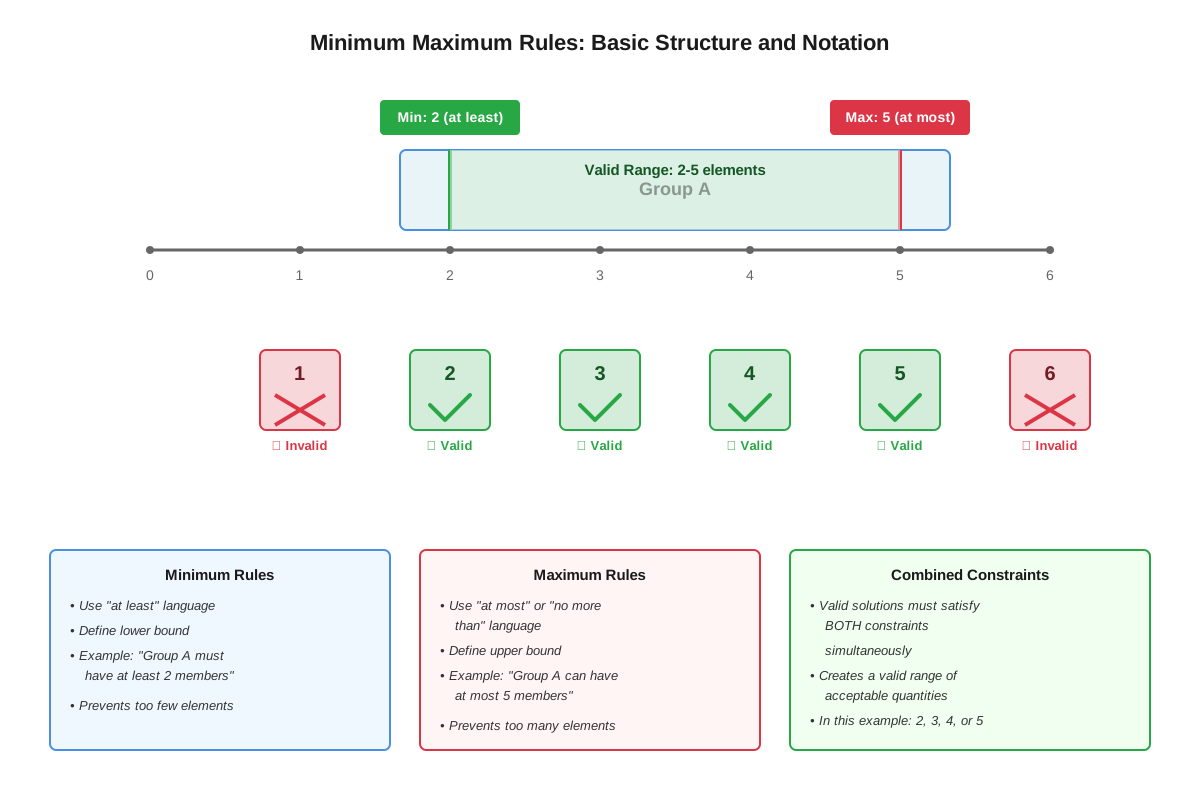
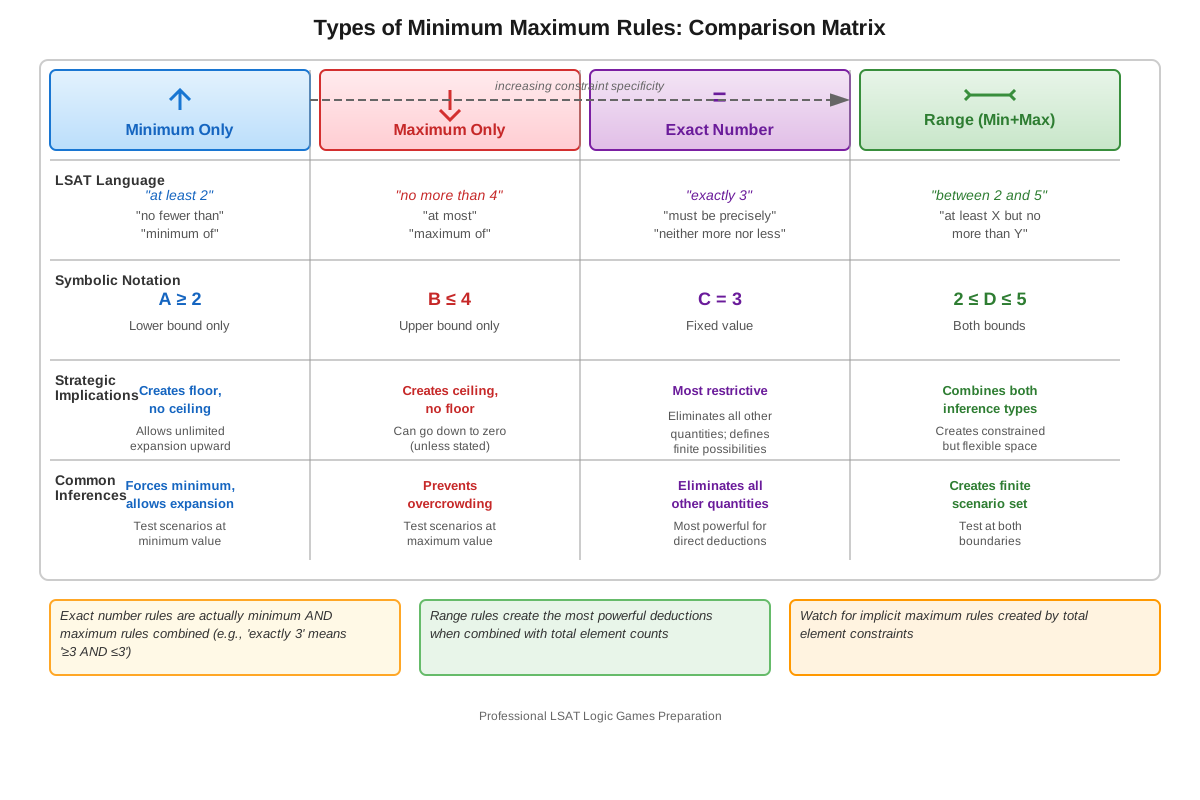
A minimum rule establishes the smallest number of elements that must be placed in a particular group. When a rule states "at least two members must serve on the finance committee," this creates a floor below which the group cannot fall. Minimum rules are typically expressed using phrases like "at least," "no fewer than," or "must include at least."
The critical insight with minimum rules is recognizing when they become binding constraints—situations where you must immediately place elements to satisfy the minimum. If a group requires at least three members and only three elements remain unassigned, all three must go into that group. This forced placement often triggers additional inferences through interaction with other rules.
Minimum rules also establish a baseline for possibility testing. When evaluating answer choices or hypothetical scenarios, any configuration that fails to meet the minimum for any group can be immediately eliminated. This makes minimum rules powerful tools for process of elimination.
Understanding Maximum Rules
A maximum rule establishes the largest number of elements that can be placed in a particular group, creating a ceiling that cannot be exceeded. Phrases like "no more than," "at most," or "cannot exceed" signal maximum constraints. When a rule states "no more than four items can be selected," the group is capped at four elements regardless of how many remain available.
Maximum rules become particularly important when groups approach their capacity limits. Once a group reaches its maximum, it becomes "closed" or "full," and all remaining elements must be distributed among other groups. This redistribution often creates forced placements elsewhere, especially when combined with minimum requirements in other groups.
The strategic value of maximum rules lies in recognizing saturation points—moments when filling a group to its maximum creates deterministic outcomes for the remaining elements. Skilled test-takers actively track how close each group is to its maximum and anticipate the cascading effects of reaching capacity.
Exact Number Rules
Some rules specify an exact number of elements for a group, functioning simultaneously as both a minimum and maximum. When a rule states "exactly three members must be selected," this creates a precise target that must be met—no more, no fewer. Exact number rules are the most restrictive type of numerical constraint and often serve as the primary organizing principle for entire games.
Exact number rules eliminate flexibility in group size, which paradoxically can make games easier by reducing the number of possible distributions. When multiple groups have exact number requirements, the game becomes a matter of determining which specific elements satisfy each quota rather than exploring different size configurations.
Implicit Numerical Constraints
Not all minimum maximum rules are explicitly stated. The game setup itself often creates implicit numerical constraints through the relationship between total elements and available groups. If a game presents seven elements to be distributed among three groups with no element appearing in multiple groups, the mathematical reality constrains possible distributions even without explicit rules.
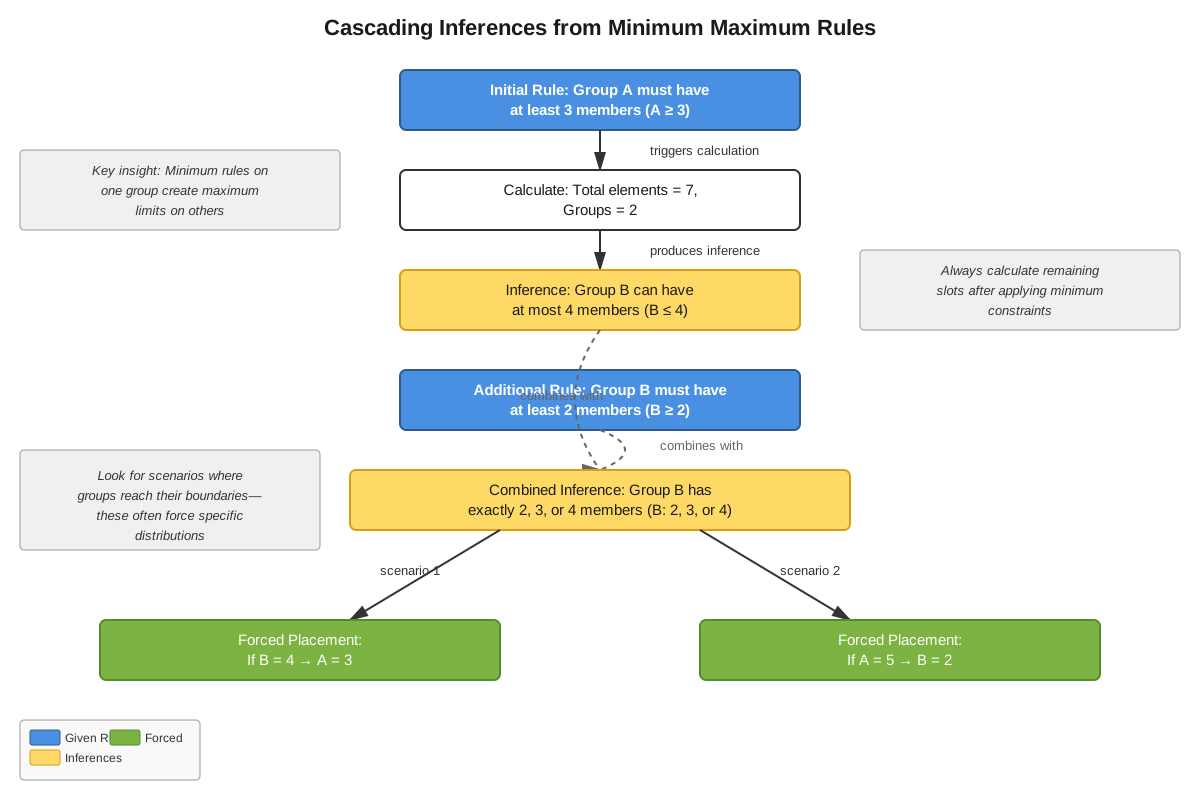
Consider a scenario with eight elements divided into two groups. Even without stated rules, neither group can have more than eight elements, and together they must account for all eight. If one group has a minimum of three, the other group automatically has a maximum of five. These derived constraints are just as binding as explicit rules and often provide the key to unlocking difficult games.
Interaction with Selection vs. Distribution
Minimum maximum rules function differently depending on whether the game involves selection (choosing elements from a larger pool) or distribution (assigning all elements to groups). In selection games, maximum rules limit how many can be chosen, while minimum rules establish how many must be chosen. The remaining elements are simply not selected.
In distribution games, all elements must be placed somewhere, creating a zero-sum environment where placing elements in one group reduces availability for others. This interconnection makes minimum maximum rules in distribution games particularly powerful for generating inferences, as constraints in one group directly impact possibilities in all other groups.
Calculating Remaining Possibilities
A crucial skill with minimum maximum rules is possibility calculation—determining how many elements remain available and how they can be distributed given existing constraints. This involves tracking:
- How many elements have been placed
- How many slots remain in each group (maximum minus current occupancy)
- How many elements must still be placed (sum of all minimums minus current total)
- Whether remaining elements can satisfy all minimum requirements
When the sum of all minimum requirements equals the total number of elements, every group must be filled to exactly its minimum, eliminating all flexibility. When maximum capacities are reached in some groups, remaining elements become forced into other groups.
Trigger Points and Forced Placements
Trigger points occur when minimum maximum rules create situations where specific placements become mandatory. Common trigger scenarios include:
- A group reaches its maximum capacity, forcing all remaining elements elsewhere
- Remaining unplaced elements exactly equal a group's minimum requirement
- All groups except one have reached their maximum, forcing remaining elements into the last group
- The sum of remaining minimums equals the number of unplaced elements
Recognizing these trigger points quickly is essential for efficient game execution. Expert test-takers actively monitor how close each group is to triggering forced placements and use this awareness to generate inferences proactively rather than reactively.
Concept Relationships
Minimum maximum rules serve as the foundational numerical framework upon which other rule types operate. Minimum rules establish floors that must be satisfied, while maximum rules create ceilings that cannot be exceeded. When both apply to the same group, they define a range of possible sizes that constrains the entire game structure.
These numerical constraints interact directly with conditional rules (if-then statements) to create powerful inference chains. For example, if a conditional rule states "If X is selected, then Y must be selected," and the group has a maximum of two, selecting X and Y fills the group to capacity, excluding all other elements. Similarly, if a group requires a minimum of three and a conditional rule links two elements together, placing that pair means at least one more element must join them.
The relationship flows as follows: Game Setup → establishes total elements and groups → Minimum Maximum Rules → define numerical boundaries → Derived Constraints → emerge from mathematical relationships → Conditional Rules → interact with numerical limits → Forced Placements → result from constraint satisfaction → Complete Solution → emerges from systematic application.
Minimum maximum rules also connect to block rules (elements that must be together) and anti-block rules (elements that cannot be together). When a block of three elements must stay together and a group has a maximum of two, that block cannot go in that group. Conversely, if a group requires a minimum of four and an anti-block prevents two elements from being together, at least one of those elements must be placed elsewhere.
High-Yield Facts
⭐ Minimum rules create floors: Any group with a minimum requirement must have at least that many elements; configurations violating this are automatically invalid
⭐ Maximum rules create ceilings: Once a group reaches its maximum capacity, it cannot accept additional elements regardless of what remains unplaced
⭐ Exact number rules are both minimum and maximum: A rule specifying exactly N elements means the group must have precisely N—no more, no fewer
⭐ Implicit constraints emerge from game structure: The total number of elements and groups creates mathematical boundaries even without explicit rules
⭐ Trigger points force placements: When remaining elements exactly equal a minimum requirement, all must be placed in that group
- Maximum capacity in all but one group forces remaining elements into the last available group
- The sum of all minimum requirements establishes the absolute minimum number of elements that must be distributed
- When minimums sum to the total number of elements, every group must be filled to exactly its minimum
- Distribution games create zero-sum environments where placing elements in one group reduces availability for others
- Selection games allow elements to remain unchosen, making maximum rules particularly important for limiting selections
Quick check — test yourself on Minimum maximum rules so far.
Try Flashcards →Common Misconceptions
Misconception: Minimum rules mean a group can have exactly that number and no more → Correction: Minimum rules establish only a floor; unless a maximum is also specified, the group can contain more than the minimum. "At least three" means three, four, five, or more are all possible.
Misconception: If no maximum is stated, a group can contain unlimited elements → Correction: The total number of available elements and the requirements of other groups create implicit maximum constraints. A group cannot contain more elements than exist in the game or more than remain after satisfying other groups' minimums.
Misconception: Minimum maximum rules only affect the specific group mentioned → Correction: These rules create ripple effects throughout the entire game. Filling one group to its maximum forces redistribution of remaining elements; satisfying one group's minimum reduces what's available for others.
Misconception: "At least two" and "exactly two" mean the same thing → Correction: "At least two" is a minimum rule allowing two or more; "exactly two" is an exact number rule requiring precisely two—no more, no fewer. This distinction is critical for determining valid configurations.
Misconception: You must wait until other rules are applied before using minimum maximum rules → Correction: Minimum maximum rules should be analyzed immediately during game setup because they often generate the most powerful initial inferences and establish the framework for applying other rules.
Misconception: Minimum maximum rules are less important than conditional rules → Correction: Minimum maximum rules are often more foundational than conditional rules because they establish the numerical structure within which all other rules operate. Many games are primarily solved through numerical constraint analysis.
Worked Examples
Example 1: Committee Selection with Minimum and Maximum
Game Setup: A company must form a project committee by selecting from seven employees: A, B, C, D, E, F, and G. The following rules apply:
- At least three employees must be selected
- No more than five employees can be selected
- If A is selected, B must also be selected
- D and E cannot both be selected
Question: If exactly four employees are selected and A is among them, which of the following must be true?
Solution Process:
Step 1: Identify the numerical constraint. We're told exactly four employees are selected, which satisfies both the minimum (at least three) and maximum (no more than five) requirements.
Step 2: Apply the conditional rule. Since A is selected, B must also be selected (given conditional). This accounts for two of our four slots: A and B are IN.
Step 3: Determine remaining slots. We need exactly four total, and we have two confirmed (A and B), so exactly two more employees must be selected from C, D, E, F, and G.
Step 4: Apply the anti-block rule. D and E cannot both be selected. Since we need exactly two more employees, we could select: (1) D and one of C, F, or G; (2) E and one of C, F, or G; or (3) two from C, F, and G.
Step 5: Identify what must be true. Looking at our options, we know with certainty that:
- A is selected (given)
- B is selected (forced by conditional)
- Exactly two more from {C, D, E, F, G} are selected
- D and E are not both selected
Answer: B must be selected (this must be true in all valid scenarios given our constraints).
Key Takeaway: The exact number rule (exactly four) combined with the conditional rule created a forced placement. Recognizing that satisfying the conditional consumed two of our four slots immediately narrowed the possibilities.
Example 2: Distribution Game with Multiple Groups
Game Setup: Eight books—J, K, L, M, N, O, P, Q—must be distributed among three shelves: Shelf 1, Shelf 2, and Shelf 3. Each book goes on exactly one shelf. The following rules apply:
- Shelf 1 must contain at least two books
- Shelf 2 must contain at least three books
- Shelf 3 can contain at most two books
Question: If Shelf 3 contains exactly two books, what is the minimum number of books that must be on Shelf 1?
Solution Process:
Step 1: Establish what we know. Total books = 8. Shelf 3 contains exactly 2 books (given in question).
Step 2: Calculate remaining books. 8 total - 2 on Shelf 3 = 6 books must be distributed between Shelf 1 and Shelf 2.
Step 3: Identify the minimum requirements. Shelf 1 needs at least 2 books (minimum rule). Shelf 2 needs at least 3 books (minimum rule).
Step 4: Check if minimums can be satisfied. Minimum for Shelf 1 (2) + Minimum for Shelf 2 (3) = 5 books needed. We have 6 books available for these two shelves, so the minimums can be satisfied with one book left over.
Step 5: Determine where the extra book goes. To find the minimum for Shelf 1, we should place as few books there as possible. This means putting the extra book on Shelf 2 rather than Shelf 1.
Step 6: Calculate the answer. Shelf 1 minimum = 2 books, Shelf 2 gets 4 books (its minimum of 3 plus the extra book), Shelf 3 has 2 books. Total: 2 + 4 + 2 = 8 ✓
Answer: The minimum number of books on Shelf 1 is 2.
Key Takeaway: In distribution games, after accounting for fixed placements (Shelf 3's two books), calculate how remaining elements can be distributed to satisfy all minimum requirements. To find a minimum for one group, maximize the others within their constraints.
Exam Strategy
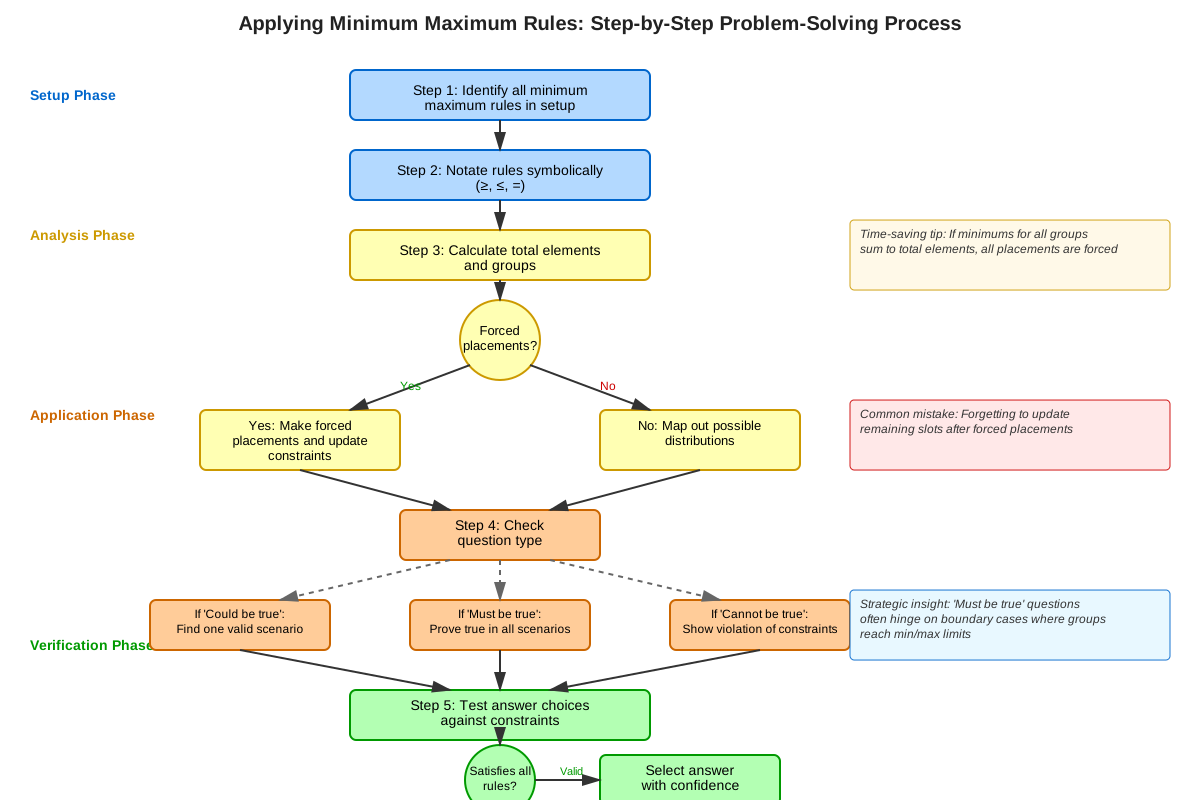
When approaching LSAT questions involving minimum maximum rules, begin by immediately identifying and notating all numerical constraints during your initial game setup. Use clear symbols: "≥3" for "at least three," "≤4" for "no more than four," and "=2" for "exactly two." This visual representation helps track constraints quickly during timed conditions.
Trigger words to watch for include: "at least," "at most," "no more than," "no fewer than," "exactly," "must contain," "cannot exceed," "minimum," and "maximum." These phrases signal numerical constraints that will govern the entire game structure. Also watch for implicit constraints in phrases like "some but not all" (minimum of 1, maximum of total minus 1) or "most" (more than half).
Process of elimination strategy: When evaluating answer choices, immediately eliminate any option that violates a minimum or maximum constraint. This is often the fastest elimination method because numerical violations are objective and easy to verify. Check each answer choice against every minimum and maximum rule before considering more complex rule interactions.
Time allocation approach: Spend extra time during initial setup calculating derived constraints from minimum maximum rules. This upfront investment pays dividends because these inferences eliminate possibilities and often unlock the entire game. For a typical grouping game with minimum maximum rules, allocate:
- 90 seconds for initial setup and notation
- 60 seconds for deriving numerical implications
- 30-45 seconds per question
Priority sequence for analysis:
- Identify all explicit minimum and maximum rules
- Calculate implicit constraints from game structure
- Determine if any groups have exact number requirements
- Check if minimums sum to total elements (creates rigid structure)
- Identify which groups are closest to their limits
- Look for trigger points where forced placements will occur
Exam Tip: When a question asks "what must be true," focus on scenarios where minimum maximum rules create forced placements. When asked "what could be true," verify that the option doesn't violate any numerical constraints.
Memory Techniques
MIN-MAX-EXACT Mnemonic: Remember the three types of numerical rules with M.E.X.:
- Minimum = floor (think "M" for "More than or equal to")
- Exact = target (think "E" for "Equals precisely")
- X (max) = ceiling (think "X marks the spot where you must stop")
The TRIGGER Acronym for recognizing forced placements:
- Total elements accounted for
- Reached maximum capacity
- Insufficient slots remaining elsewhere
- Group minimum equals remaining elements
- Game structure creates mathematical necessity
- Exact number requirement activated
- Remaining options exhausted
Visualization Strategy: Picture groups as containers with visible capacity markers. Imagine minimum requirements as a colored baseline that must be filled, and maximum limits as a lid that cannot be exceeded. As you place elements, visualize the containers filling up, making it easier to spot when groups approach capacity or when minimums remain unsatisfied.
The Sum Rule: Create a quick mental formula: ΣMin ≤ Total ≤ ΣMax. The sum of all minimums must be less than or equal to the total number of elements, which must be less than or equal to the sum of all maximums. If this relationship is violated, the game setup is impossible. When ΣMin = Total, every group must be exactly at its minimum.
Summary
Minimum maximum rules establish the numerical boundaries that govern grouping games on the LSAT, creating floors (minimums), ceilings (maximums), and exact targets that constrain how elements can be distributed. These rules appear in the majority of grouping games and serve as the foundation for generating powerful inferences. Mastery requires recognizing both explicit numerical constraints stated in rules and implicit constraints derived from game structure, such as the mathematical relationships between total elements and group requirements. The key to success lies in immediately calculating derived constraints during setup, tracking how close groups are to their limits, and recognizing trigger points where forced placements become necessary. Minimum maximum rules interact with all other rule types—particularly conditional statements—to create inference chains that unlock entire games. Test-takers who can quickly identify when groups reach capacity, when remaining elements must satisfy minimum requirements, and when the sum of constraints creates rigid structures gain significant advantages in both speed and accuracy on the Analytical Reasoning section.
Key Takeaways
- Minimum rules establish floors that must be satisfied; maximum rules create ceilings that cannot be exceeded; exact number rules specify precise targets
- Implicit numerical constraints emerge from game structure even without explicit rules—always calculate the mathematical relationships between total elements and group requirements
- Trigger points occur when groups reach maximum capacity or when remaining elements exactly equal minimum requirements, creating forced placements
- In distribution games, placing elements in one group reduces availability for others, creating a zero-sum environment where constraints cascade throughout the game
- The sum of all minimum requirements must not exceed total available elements; when they equal the total, every group must be filled to exactly its minimum
- Minimum maximum rules should be analyzed first during game setup because they establish the numerical framework within which all other rules operate
- Process of elimination using numerical constraints is often the fastest way to eliminate wrong answers because violations are objective and easy to verify
Related Topics
Conditional Rules in Grouping Games: Understanding how if-then statements interact with minimum maximum rules to create forced placements and eliminate possibilities. Mastering minimum maximum rules provides the numerical foundation needed to recognize when conditional rules trigger capacity constraints.
Selection Games: A specialized type of grouping game where elements are chosen from a larger pool rather than distributed among groups. Minimum maximum rules in selection games determine how many must be chosen and how many can be chosen, building directly on the concepts covered here.
Numerical Distribution Analysis: Advanced techniques for mapping out all possible ways elements can be distributed among groups given multiple numerical constraints. This topic extends minimum maximum rule mastery to complex scenarios with multiple interacting constraints.
In-Out Grouping Games: Games where elements are divided into two categories (selected/not selected, in/out). Minimum maximum rules in these binary scenarios create particularly powerful inferences because constraints in one group automatically determine possibilities in the other.
Practice CTA
Now that you understand the fundamental principles of minimum maximum rules, it's time to cement your mastery through active practice. The concepts you've learned—identifying numerical constraints, calculating derived limits, recognizing trigger points, and generating forced placements—become automatic only through repeated application to actual LSAT-style problems. Challenge yourself with the practice questions and flashcards designed specifically for this topic. Focus on speed as well as accuracy; your goal is to recognize minimum maximum patterns instantly and exploit them efficiently under timed conditions. Each practice problem you complete strengthens the neural pathways that will serve you on test day. You've built the foundation—now construct mastery through deliberate practice!
Sign up free to keep reading
Create a free AnvayaPrep account to finish this LSAT guide on Minimum maximum rules — plus flashcards and practice questions.