Overview
Assignment sequencing hybrids represent one of the most challenging and frequently tested game types in the Analytical Reasoning Legacy section of the LSAT. These complex puzzles combine two fundamental game structures: assignment games (where variables must be placed into groups or categories) and sequencing games (where variables must be ordered chronologically or spatially). Understanding how to navigate these hybrid games legacy questions is crucial for achieving a competitive LSAT score, as they test multiple reasoning skills simultaneously and often appear in the most difficult positions within the Analytical Reasoning section.
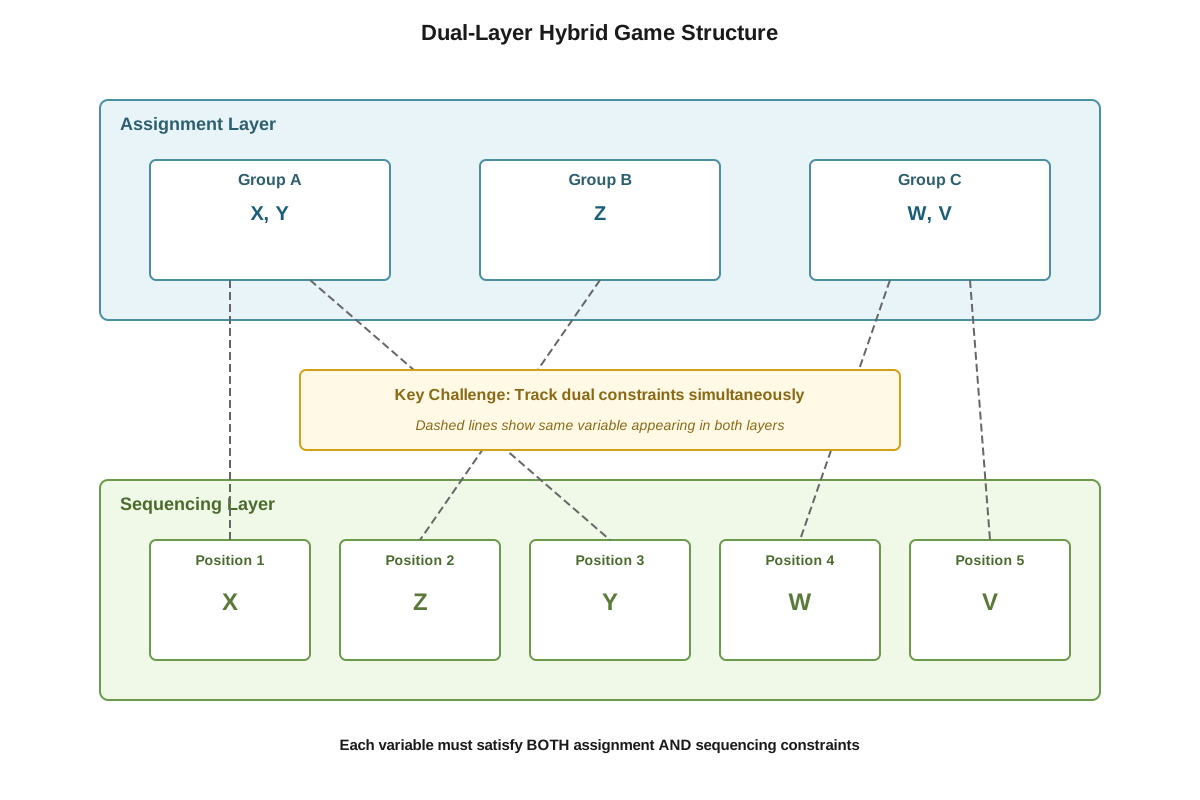
The complexity of LSAT assignment sequencing hybrids stems from the dual constraint system they impose. Students must track not only which variables belong to which groups or possess which attributes (the assignment component), but also the relative order or temporal relationships between these variables (the sequencing component). This dual-tracking requirement demands sophisticated diagramming techniques and the ability to synthesize multiple types of logical relationships. For example, a game might require determining which of five speakers presents at which of three conferences (assignment) while also establishing the chronological order of presentations (sequencing).
Within the broader landscape of analytical reasoning legacy questions, assignment sequencing hybrids occupy a critical position because they integrate foundational skills from simpler game types. Mastery of pure assignment games and pure sequencing games serves as the prerequisite foundation, but hybrid games demand an additional layer of strategic thinking: recognizing which component (assignment or sequencing) provides the most powerful deductions at each stage of problem-solving. This topic connects directly to other hybrid game types and represents the kind of multi-dimensional reasoning that the LSAT uses to differentiate high-scoring test-takers from average performers.
Learning Objectives
- [ ] Identify how Assignment sequencing hybrids appears in LSAT questions
- [ ] Explain the reasoning pattern behind Assignment sequencing hybrids
- [ ] Apply Assignment sequencing hybrids to solve LSAT-style problems accurately
- [ ] Construct effective dual-layer diagrams that simultaneously represent both assignment and sequencing constraints
- [ ] Recognize which component (assignment or sequencing) should drive initial deductions in a given scenario
- [ ] Synthesize information from both constraint types to eliminate answer choices efficiently
- [ ] Distinguish assignment sequencing hybrids from other hybrid game types based on setup language and rule structures
Prerequisites
- Pure sequencing games: Understanding basic ordering relationships (before/after, relative positioning) is essential because the sequencing component forms half of the hybrid structure
- Pure assignment games: Familiarity with grouping variables into categories or assigning attributes provides the foundation for the assignment component
- Basic conditional logic: The ability to process if-then statements and their contrapositives is necessary for interpreting complex rules that span both game components
- Diagramming fundamentals: Competence with standard LSAT game notation enables the creation of hybrid diagrams that track multiple constraint types simultaneously
- Rule combination techniques: Experience identifying how multiple rules interact is critical because hybrid games require synthesizing constraints across both assignment and sequencing dimensions
Why This Topic Matters
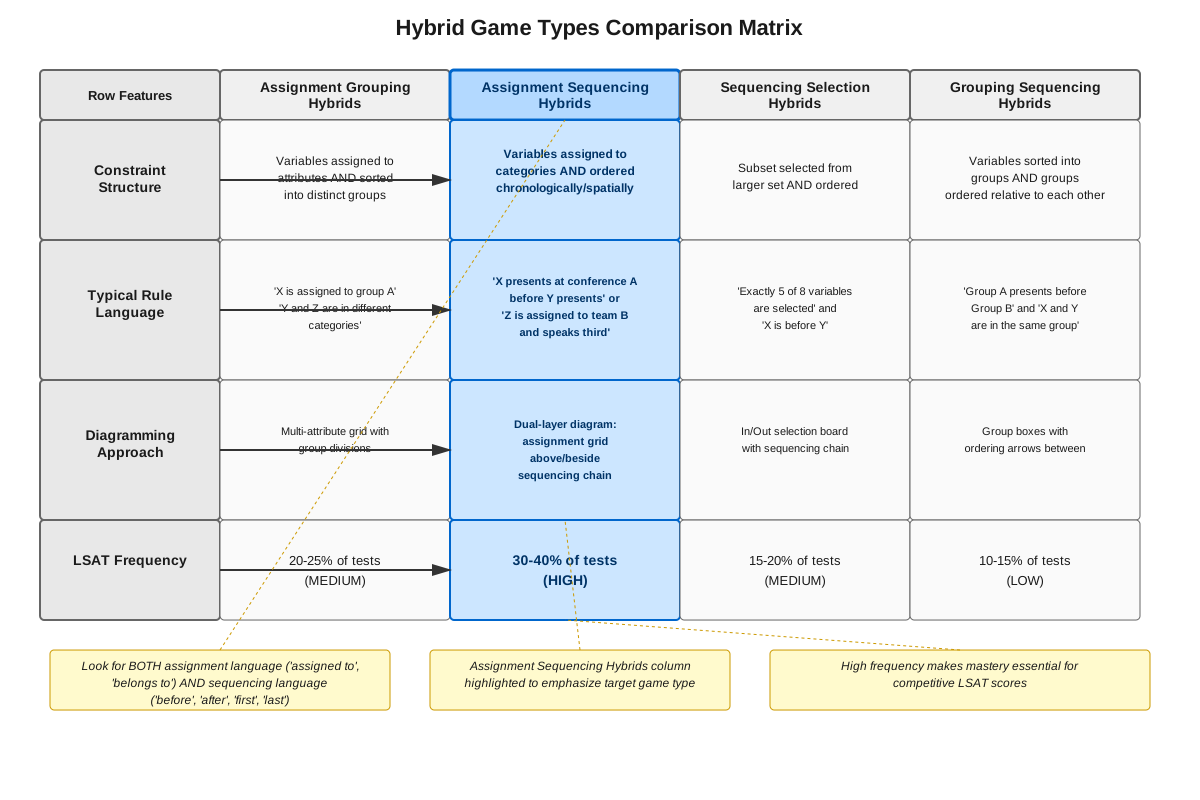
Assignment sequencing hybrids appear with significant frequency on modern LSAT administrations, typically constituting one of the four analytical reasoning games in approximately 30-40% of tests. When they do appear, they often serve as the most difficult game in the section, placed strategically in the third or fourth position to challenge test-takers under time pressure. The LSAC (Law School Admission Council) favors these hybrids because they effectively measure the multi-dimensional analytical skills required for legal reasoning: the ability to track multiple variables simultaneously, synthesize disparate pieces of information, and recognize how different constraint systems interact.
In real-world legal practice, attorneys regularly encounter situations requiring hybrid reasoning. Consider a litigation attorney managing multiple cases (assignment to different legal teams) while also tracking filing deadlines and court dates (sequencing in time). Similarly, a corporate lawyer might need to assign different contract provisions to various parties while sequencing the order of negotiations and approvals. The cognitive skills tested by assignment sequencing hybrids—simultaneous tracking of categorical relationships and temporal/spatial ordering—directly parallel the analytical demands of legal work.
On the LSAT, these hybrids most commonly appear in scenarios involving: scheduling events across multiple venues or time slots, assigning participants to teams or groups with performance order requirements, distributing tasks among workers with completion sequence constraints, or organizing presentations/performances with both venue assignments and chronological ordering. The questions typically include a mix of "could be true," "must be true," "complete and accurate list," and "if" hypothetical questions that test both components of the hybrid structure. Recognition of the hybrid nature from the initial setup is crucial for efficient problem-solving and proper time allocation.
Core Concepts
Defining Assignment Sequencing Hybrids
Assignment sequencing hybrids are analytical reasoning games that simultaneously impose two types of constraints on a set of variables: (1) assignment constraints that determine which variables belong to which groups, categories, or possess which attributes, and (2) sequencing constraints that establish the relative order or chronological/spatial relationships among the variables. The defining characteristic is that both constraint types are essential to solving the game—neither can be ignored, and deductions typically require integrating information from both systems.
The assignment component typically involves distributing variables among two or more groups, assigning attributes or characteristics to variables, or matching variables to positions that have categorical distinctions (not merely numerical order). The sequencing component establishes ordering relationships using rules like "X comes before Y," "Z is third," or "A and B are consecutive." The hybrid nature emerges when these two systems interact: for example, when the order of variables affects which group they can join, or when group membership constrains possible positions in the sequence.
Structural Components and Recognition
Identifying an assignment sequencing hybrid requires analyzing the game setup for specific structural markers. The setup will explicitly or implicitly establish both a grouping/categorization system and an ordering system. Key recognition phrases include:
| Assignment Indicators | Sequencing Indicators |
|---|---|
| "assigned to teams" | "in order from first to last" |
| "each belongs to exactly one group" | "earlier than" / "later than" |
| "categorized as either X or Y" | "immediately before/after" |
| "distributed among" | "consecutive positions" |
| "matched with" | "third position" / "fifth slot" |
The game board for these hybrids requires a dual-layer diagram that represents both dimensions simultaneously. The most effective approach typically places the sequencing component as the primary structure (horizontal slots numbered 1 through n) with the assignment component represented either above each slot, below each slot, or through notation systems that indicate group membership for each position.
Rule Types and Constraint Integration
Rules in assignment sequencing hybrids fall into three categories:
- Pure assignment rules: These constrain only group membership or attribute assignment without reference to order (e.g., "F must be assigned to the red team")
- Pure sequencing rules: These constrain only relative order without reference to group membership (e.g., "G presents before H")
- Hybrid rules: These are the most powerful and challenging rules, explicitly linking the two constraint systems (e.g., "Any member of the blue team must present before all members of the green team" or "K presents third and must be assigned to team 2")
The most valuable deductions emerge from hybrid rules and from recognizing implicit connections between pure rules. For example, if a pure assignment rule places two variables in the same group, and a hybrid rule states that all members of that group must appear consecutively in the sequence, the combination creates powerful ordering constraints.
Diagramming Strategies
Effective diagramming for assignment sequencing hybrids requires representing both dimensions clearly while maintaining visual simplicity. The recommended approach:
Primary structure: Create a horizontal sequence of numbered slots (1, 2, 3, 4, 5, etc.) representing the ordering dimension.
Secondary notation: Above or below each slot, indicate the possible group assignments for that position. Alternatively, use subscripts or superscripts attached to variables to denote group membership.
Rule representation: Write pure sequencing rules using standard notation (arrows for before/after relationships, brackets for blocks of consecutive variables). Write pure assignment rules as lists showing which variables can or must belong to each group. Write hybrid rules in a separate area with clear notation showing the connection between both dimensions.
Deduction tracking: As deductions emerge, update both the sequence slots and the group membership information. Use different notation styles (capital letters for definite placements, lowercase for possibilities) to distinguish certain information from possibilities.
Deduction Strategies and Solving Approaches
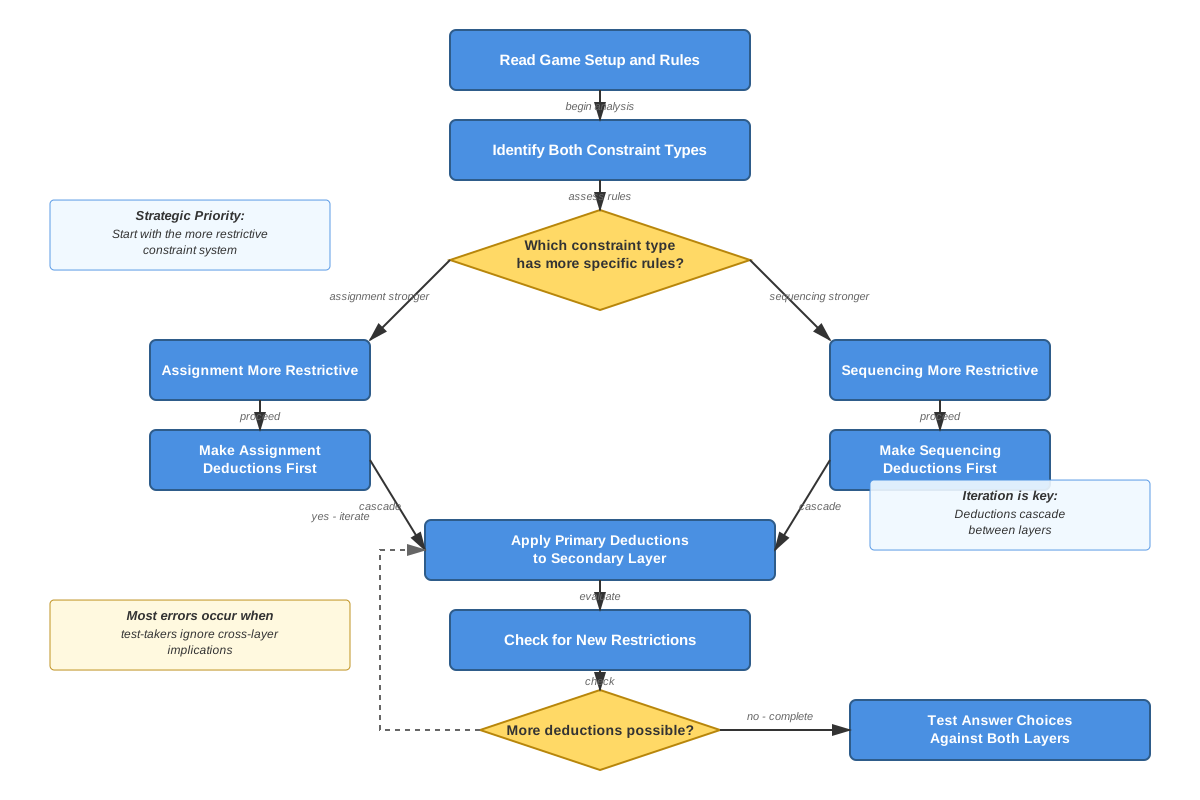
The key strategic question in assignment sequencing hybrids is: Which component should drive the initial deductions? The answer depends on the specific rule set:
Sequencing-driven approach: When the game includes strong sequencing constraints (many before/after rules, blocks of consecutive variables, or fixed positions), begin by making sequencing deductions. Determine the possible orderings first, then apply assignment constraints to these orderings. This approach works well when the sequencing component is more restrictive.
Assignment-driven approach: When the game includes strong assignment constraints (limited group capacity, many variables forced into specific groups, or powerful hybrid rules linking groups to sequence positions), begin by determining group membership. Once variables are assigned to groups, apply sequencing rules within and between groups. This approach works well when group membership is highly constrained.
Integrated approach: Many hybrids require alternating between both components, making a sequencing deduction, then using that information to make an assignment deduction, which in turn enables another sequencing deduction. Recognizing this iterative pattern is crucial for efficiency.
Common Hybrid Scenarios
Several scenario types appear repeatedly in LSAT assignment sequencing hybrids:
Multi-venue scheduling: Variables (speakers, performers, events) must be assigned to different venues/locations AND ordered chronologically. Example: "Five speakers—F, G, H, J, K—each present at exactly one of two conferences, and the presentations occur in order from first to fifth."
Team competitions with performance order: Variables are assigned to teams AND the teams or individuals perform in a specific sequence. Example: "Six athletes compete in three events, with two athletes assigned to each event, and the events occur in order from first to third."
Task distribution with completion sequence: Variables (tasks or projects) are assigned to different workers or departments AND must be completed in a specific order. Example: "Seven projects are distributed among three managers, and the projects are completed one at a time in order from first to seventh."
Attribute assignment with temporal ordering: Variables receive categorical attributes AND are ordered in time or space. Example: "Five houses on a street are each painted exactly one color—red, blue, or green—and the houses are arranged in order from west to east."
Concept Relationships
The concepts within assignment sequencing hybrids form an interconnected system where each element builds upon and reinforces the others. The foundation begins with structural recognition—identifying that a game contains both assignment and sequencing components. This recognition leads directly to diagramming strategy selection, as the dual nature of the game demands a diagram that represents both dimensions effectively.
Once the diagram is established, the solver must analyze the rule types to determine which constraints are pure assignment rules, pure sequencing rules, or hybrid rules. This categorization directly influences the deduction strategy chosen: sequencing-driven, assignment-driven, or integrated. The deduction strategy, in turn, determines the order in which constraints are applied and combined.
The relationship map flows as follows:
Game Setup Analysis → Structural Recognition (identifying hybrid nature) → Diagram Construction (dual-layer representation) → Rule Categorization (pure vs. hybrid constraints) → Strategic Approach Selection (which component drives deductions) → Constraint Integration (combining rules across both dimensions) → Deduction Generation → Question Answering
This topic connects to prerequisite knowledge by building directly on pure sequencing games and pure assignment games. The sequencing component uses identical logical structures (before/after relationships, blocks, fixed positions) as pure sequencing games, while the assignment component employs the same grouping logic as pure assignment games. The novel challenge is the integration of these two familiar systems.
Assignment sequencing hybrids also relate to other hybrid game types within the analytical reasoning legacy curriculum. The analytical skills developed here—simultaneous tracking of multiple constraint systems and recognition of cross-dimensional interactions—transfer directly to other hybrids such as grouping-sequencing hybrids or assignment-distribution hybrids. Mastery of assignment sequencing hybrids provides a template for approaching any multi-dimensional analytical reasoning challenge.
High-Yield Facts
⭐ Assignment sequencing hybrids always require a dual-layer diagram that represents both the grouping/assignment dimension and the ordering/sequencing dimension simultaneously.
⭐ Hybrid rules that explicitly connect assignment and sequencing constraints are typically the most powerful source of deductions in these games.
⭐ The most efficient solving approach depends on which component (assignment or sequencing) is more restrictive in the specific game—always analyze the rule set before choosing a strategy.
⭐ When a game states that all members of a particular group must appear consecutively in the sequence, this creates a "block" that can be treated as a single unit for sequencing purposes.
⭐ Fixed position rules (e.g., "X is third") in the sequencing component often create powerful deductions when combined with assignment constraints.
- Questions asking "which of the following could be true" typically require testing each answer choice against both assignment and sequencing constraints.
- The contrapositive of hybrid rules is especially valuable: if a rule states "all blue team members present before all red team members," the contrapositive tells you that if something presents before a blue team member, it cannot be on the red team.
- When variables are assigned to groups with different sizes, the size constraints often limit possible sequences (e.g., if group A has three members and group B has two, and all group A members must present consecutively, they can only occupy positions 1-3, 2-4, or 3-5 in a five-slot sequence).
- "Complete and accurate list" questions in assignment sequencing hybrids often test understanding of how assignment constraints limit sequencing possibilities or vice versa.
- Time pressure is particularly acute in these hybrids—spending adequate time on the initial diagram and deductions (2-3 minutes) typically saves time on individual questions and improves accuracy.
Quick check — test yourself on Assignment sequencing hybrids so far.
Try Flashcards →Common Misconceptions
Misconception: Assignment sequencing hybrids can be solved by addressing the assignment component and sequencing component separately, then combining the results at the end.
Correction: These hybrids require integrated reasoning throughout the solving process. Deductions in one dimension immediately affect possibilities in the other dimension, and the most powerful deductions emerge from recognizing these interactions in real-time. Treating the components separately leads to missed deductions and inefficient problem-solving.
Misconception: The sequencing component always takes priority and should be solved first in every assignment sequencing hybrid.
Correction: The optimal approach depends on the specific constraint structure of each game. When assignment constraints are more restrictive (e.g., very limited group capacity or many forced assignments), an assignment-driven approach is more efficient. Always analyze which component provides more immediate deductions before choosing a strategy.
Misconception: Hybrid rules are just combinations of assignment and sequencing rules and don't provide any unique deductive power.
Correction: Hybrid rules are typically the most powerful constraints in these games because they create direct links between the two dimensions. A hybrid rule like "all members of team X must present before all members of team Y" simultaneously constrains both group membership and sequence position in ways that pure rules cannot, often leading to the most significant deductions.
Misconception: If a variable's group assignment is determined, its position in the sequence is also determined (or vice versa).
Correction: Determining one dimension does not automatically determine the other unless specific rules create that connection. A variable can be definitively assigned to a group while still having multiple possible sequence positions, and a variable can be fixed in a sequence position while still having multiple possible group assignments. Only hybrid rules or the combination of multiple constraints creates definitive cross-dimensional determinations.
Misconception: The diagram for an assignment sequencing hybrid should show all possible combinations of assignments and sequences.
Correction: Creating an exhaustive diagram showing every possible combination is impractical and time-consuming. Instead, the diagram should represent the structure (sequence slots with assignment notation) and be updated with deductions as they emerge. The goal is a flexible framework that can accommodate new information from questions, not a complete enumeration of possibilities.
Worked Examples
Example 1: Conference Presentations
Setup: Five speakers—F, G, H, J, and K—each present exactly once at one of two conferences, Conference 1 or Conference 2. The presentations occur in order from first to fifth, with the following constraints:
- F presents at Conference 1
- G presents at Conference 2
- H presents before J
- K presents immediately before or immediately after a speaker from Conference 1
- All Conference 1 speakers present before all Conference 2 speakers
Question: If H presents third, which of the following must be true?
Solution Process:
Step 1 - Diagram Construction: Create a sequence of five slots (1, 2, 3, 4, 5) with notation for conference assignment above each slot.
Step 2 - Initial Deductions: The rule "All Conference 1 speakers present before all Conference 2 speakers" is a powerful hybrid rule. Combined with F being at Conference 1 and G being at Conference 2, we know F must present before G. This creates a division point in the sequence: all Conference 1 presentations, then all Conference 2 presentations.
Step 3 - Apply the New Information: H presents third. We need to determine H's conference assignment. Since H presents before J (given rule), and we need to determine where the Conference 1/Conference 2 division occurs, we must consider possibilities.
Step 4 - Test Conference Assignment for H:
- If H is at Conference 1, then positions 1-3 could all be Conference 1 (including F and H), and positions 4-5 would be Conference 2 (including G).
- If H is at Conference 2, then the Conference 1 section must end by position 2, meaning only positions 1-2 are Conference 1, and positions 3-5 are Conference 2.
Step 5 - Apply K's Constraint: K must be immediately before or after a Conference 1 speaker. This means K must be adjacent to the Conference 1/Conference 2 boundary or within the Conference 1 section.
Step 6 - Synthesize: If H (in position 3) is at Conference 2, then Conference 1 occupies only positions 1-2. F must be in position 1 or 2. The remaining Conference 1 speaker must be J or K. But H presents before J, and if H is in position 3, J must be in position 4 or 5 (Conference 2 section). So J cannot be in Conference 1. Therefore, K must be the other Conference 1 speaker. K would be in position 1 or 2 (whichever F doesn't occupy). But then K would be adjacent to H (position 3), and H is at Conference 2, satisfying K's constraint. This scenario works.
If H is at Conference 1 (position 3), then F and H are both at Conference 1 in positions 1-3. We need one more Conference 1 speaker or the division happens after position 3. J and K remain. G must be at Conference 2 (given). If the division is after position 3, then positions 4-5 are Conference 2, containing G and one of {J, K}. The other of {J, K} would be in positions 1-2 at Conference 1. Since H presents before J, J could be in position 4 or 5 (Conference 2). K must be adjacent to a Conference 1 speaker, so K could be in position 4 (adjacent to H in position 3, who is Conference 1). This scenario also works.
Step 7 - Identify What Must Be True: In both valid scenarios, we need to find a statement that holds in all possibilities. Testing the answer choices against both scenarios reveals that F must present in position 1 or 2 (must be true in both scenarios, as F is at Conference 1 and Conference 1 speakers present before Conference 2 speakers, and with H in position 3, the Conference 1 section cannot extend beyond position 3).
Example 2: Team Relay Race
Setup: Six runners—L, M, N, O, P, and Q—compete in a relay race. Each runner is assigned to exactly one of two teams, Team A or Team B, with three runners on each team. The runners complete their legs in order from first to sixth, with the following constraints:
- L and M are on the same team
- N runs before O
- P is on Team A
- No team has all three of its members run consecutively
- Q runs fourth
Question: Which of the following could be a complete and accurate list of the runners on Team A?
Solution Process:
Step 1 - Diagram and Initial Deductions: Create slots 1-6 with team notation. P is on Team A. L and M are on the same team (either both Team A or both Team B). Q runs fourth. Each team has exactly three members.
Step 2 - Apply the Consecutive Constraint: "No team has all three of its members run consecutively" is a critical hybrid rule. This means that for each team, the three members must be distributed across the sequence such that they don't occupy three consecutive slots.
Step 3 - Analyze Q's Position: Q runs fourth. Q is on either Team A or Team B.
Step 4 - Consider Team A Composition: Team A has three members, including P. We need to determine which other runners could be on Team A.
Step 5 - Test Answer Choices: Let's say an answer choice proposes "L, P, Q" as Team A.
- This means M, N, O are on Team B (since L and M are on the same team, if L is on Team A, M must be... wait, this violates the L-M constraint. So this cannot be correct.)
Let's test "M, P, Q" as Team A:
- This means L, N, O are on Team B (L and M are on the same team, so if M is on Team A, L must be on Team A too—this violates the proposal. So this cannot be correct.)
Let's test "N, O, P" as Team A:
- This means L, M, Q are on Team B. L and M are on the same team (Team B), which satisfies that constraint. N runs before O (both on Team A). Q runs fourth. We need to check if the consecutive constraint can be satisfied.
- Team A has N, O, P. They cannot all run consecutively. Team B has L, M, Q, with Q in position 4.
- Possible arrangement: If N is in position 1, O in position 3, P in position 5, then Team A members are in positions 1, 3, 5 (not consecutive—satisfies constraint). Team B members would be in positions 2, 4, 6 (not consecutive—satisfies constraint). N runs before O (position 1 before position 3—satisfied). This works!
Answer: "N, O, P" could be a complete and accurate list of Team A members.
Exam Strategy
When approaching assignment sequencing hybrids on the LSAT, implement this systematic strategy:
Initial Recognition (15-20 seconds): Read the setup carefully to identify both the assignment component (groups, teams, categories, attributes) and the sequencing component (order, positions, before/after relationships). Look for trigger phrases like "assigned to" combined with "in order" or "first through last."
Diagram Construction (30-45 seconds): Create a dual-layer diagram immediately. Place the sequencing component as the primary structure (horizontal numbered slots) and add notation for assignment possibilities above or below each slot. This visual framework is essential for tracking both dimensions simultaneously.
Rule Analysis and Categorization (45-60 seconds): As you write out each rule, mentally categorize it as pure assignment, pure sequencing, or hybrid. Pay special attention to hybrid rules—these typically provide the most powerful deductions. Look for rules that use words like "all members of [group] must [sequence constraint]" or "[sequence position] must be [group assignment]."
Strategic Approach Selection (15-20 seconds): Before diving into deductions, assess which component is more restrictive. Count the number of strong constraints in each dimension. If you have many fixed positions or blocks in the sequencing component, start there. If you have tight group capacity limits or many forced assignments, start with the assignment component. When in doubt, look for hybrid rules and let them guide your initial deductions.
Deduction Phase (60-90 seconds): Make all possible deductions before attempting questions. Focus on:
- Combining hybrid rules with pure rules
- Identifying where the assignment groups divide in the sequence
- Recognizing blocks or consecutive requirements
- Determining any fixed positions
- Eliminating impossible combinations
Question Approach:
- For "could be true" questions, eliminate answers that violate either assignment or sequencing constraints
- For "must be true" questions, test each answer against your deductions and look for statements that hold in all possible scenarios
- For "complete and accurate list" questions, verify that the proposed list satisfies all constraints in both dimensions
- For "if" hypothetical questions, add the new constraint to your diagram, make new deductions, then answer
Time Management: Allocate approximately 2.5-3 minutes for setup and initial deductions, leaving 5.5-6 minutes for the 5-7 questions. Assignment sequencing hybrids typically require more upfront investment but pay dividends in faster question-answering once the deductions are complete.
Exam Tip: If you find yourself stuck on a question, return to your diagram and verify that you've fully integrated the assignment and sequencing constraints. The answer often emerges from recognizing a connection between the two dimensions that wasn't immediately obvious.
Memory Techniques
DASH Acronym for approaching assignment sequencing hybrids:
- Diagram both dimensions (dual-layer structure)
- Analyze rules for hybrid connections
- Select strategy (assignment-driven vs. sequencing-driven)
- Hybrid rules first (prioritize the most powerful constraints)
Visualization Strategy: Picture the assignment component as vertical layers (different groups stacked on top of each other) and the sequencing component as horizontal movement through time or space. The hybrid game requires moving both vertically (between groups) and horizontally (through the sequence) simultaneously, like a chess knight that moves in two dimensions at once.
The "Bridge" Metaphor: Think of hybrid rules as bridges connecting the assignment island and the sequencing island. Pure assignment rules only affect the assignment island, pure sequencing rules only affect the sequencing island, but hybrid rules create pathways between them. The most efficient solution path crosses these bridges frequently.
Color Coding Mental Model: Mentally assign colors to different groups in the assignment component. As you work through the sequence, visualize the colored variables filling the sequence slots. This creates a visual pattern that makes it easier to spot violations of consecutive constraints or group-based sequencing rules.
The "Two-Question Test": For any variable, always ask two questions: "Which group?" and "Which position?" If you can answer both questions definitively, the variable is fully determined. If you can only answer one, look for rules that might connect the known dimension to the unknown dimension.
Summary
Assignment sequencing hybrids represent a sophisticated integration of two fundamental analytical reasoning structures: the categorical organization of assignment games and the temporal/spatial ordering of sequencing games. Success with these hybrids requires recognizing the dual-constraint system from the initial setup, constructing effective dual-layer diagrams that represent both dimensions simultaneously, and strategically determining whether assignment constraints or sequencing constraints should drive the deduction process. The most powerful deductions emerge from hybrid rules that explicitly link group membership to sequence position, and from recognizing implicit connections between pure assignment rules and pure sequencing rules. Efficient solving demands integrated reasoning throughout the process—treating the two components as interconnected systems rather than separate puzzles. The key to mastery is developing fluency with dual-dimensional thinking: simultaneously tracking which variables belong to which groups while maintaining awareness of their relative positions in the sequence, and recognizing how constraints in one dimension immediately affect possibilities in the other dimension.
Key Takeaways
- Assignment sequencing hybrids combine grouping/categorization constraints with ordering/temporal constraints in a single game that requires integrated reasoning across both dimensions
- Effective dual-layer diagrams with sequence slots as the primary structure and assignment notation as the secondary layer are essential for tracking both constraint types simultaneously
- Hybrid rules that explicitly connect assignment and sequencing components typically provide the most powerful deductions and should be prioritized during analysis
- The optimal solving strategy (assignment-driven vs. sequencing-driven) depends on which component has more restrictive constraints in the specific game—always analyze before choosing an approach
- Questions in these hybrids test the ability to synthesize information across both dimensions, requiring verification that proposed answers satisfy constraints in both the assignment and sequencing systems
- Time invested in thorough initial deductions (2.5-3 minutes) pays dividends in faster, more accurate question-answering
- Recognition of common scenario types (multi-venue scheduling, team competitions with performance order, task distribution with completion sequences) accelerates setup and diagram construction
Related Topics
Pure Sequencing Games: Mastering the foundational sequencing concepts (relative ordering, blocks, fixed positions) provides half of the skill set needed for assignment sequencing hybrids. Advanced sequencing techniques like chain diagrams and contrapositive analysis transfer directly to the sequencing component of hybrids.
Pure Assignment Games: Understanding group capacity constraints, distribution rules, and categorical logic forms the other half of the hybrid foundation. Techniques for tracking group membership and testing assignment possibilities apply directly to the assignment component of hybrids.
Grouping-Sequencing Hybrids: These related hybrids combine grouping games (where variables are selected in/out or distributed among groups with variable sizes) with sequencing components. The analytical skills developed with assignment sequencing hybrids—particularly dual-dimensional reasoning and hybrid rule analysis—transfer directly to this related game type.
Advanced Hybrid Games: Some LSAT games combine three or more constraint systems (e.g., assignment + sequencing + matching). Mastery of assignment sequencing hybrids provides the foundation for approaching these even more complex multi-dimensional puzzles.
Conditional Sequencing: Advanced sequencing games that incorporate conditional logic (if-then statements affecting sequence positions) share the multi-layered reasoning demands of assignment sequencing hybrids and benefit from similar strategic approaches.
Practice CTA
Now that you've mastered the core concepts of assignment sequencing hybrids, it's time to solidify your understanding through active practice. Attempt the practice questions associated with this topic, focusing on implementing the dual-layer diagramming technique and identifying hybrid rules that connect both constraint dimensions. Use the flashcards to reinforce recognition of common scenario types and trigger phrases that signal assignment sequencing hybrids. Remember: these hybrids are challenging precisely because they test sophisticated analytical skills, but with deliberate practice using the strategies outlined in this guide, you'll develop the fluency needed to approach them with confidence. Each practice problem you complete strengthens your ability to synthesize multi-dimensional constraints—a skill that will serve you throughout the Analytical Reasoning section and beyond. You've built the foundation; now apply it!
Sign up free to keep reading
Create a free AnvayaPrep account to finish this LSAT guide on Assignment sequencing hybrids — plus flashcards and practice questions.