Overview
Hybrid deductions represent one of the most sophisticated and high-yield analytical reasoning skills tested on the LSAT. In the context of Analytical Reasoning Legacy (commonly known as Logic Games), hybrid deductions emerge when test-takers must synthesize information from multiple game types simultaneously—typically combining elements of sequencing, grouping, matching, or distribution games within a single problem. These deductions require recognizing how constraints from different game structures interact to produce powerful inferences that dramatically narrow the solution space.
The LSAT frequently tests hybrid deductions in its most challenging logic games, particularly in the Hybrid Games Legacy category where two or more game types are deliberately interwoven. For instance, a game might require sequencing seven people into positions while simultaneously grouping them into teams and matching them with specific attributes. The ability to identify and execute lsat hybrid deductions separates high scorers from average performers because these deductions often unlock entire game boards, revealing answers to multiple questions at once. Students who master this skill can solve complex games in significantly less time while maintaining accuracy.
Understanding hybrid deductions builds directly upon foundational logic games skills but elevates them to a new level of integration. Rather than applying sequencing rules in isolation or grouping constraints independently, hybrid deductions demand that test-takers recognize the cascading effects that occur when multiple constraint types collide. This topic represents the culmination of analytical reasoning mastery, where pattern recognition, rule combination, and strategic inference-making converge to create a powerful problem-solving framework applicable to the most difficult games the LSAT presents.
Learning Objectives
- [ ] Identify how Hybrid deductions appears in LSAT questions
- [ ] Explain the reasoning pattern behind Hybrid deductions
- [ ] Apply Hybrid deductions to solve LSAT-style problems accurately
- [ ] Recognize the specific trigger conditions that enable hybrid deductions across different game type combinations
- [ ] Construct complete inference chains that link multiple constraint types systematically
- [ ] Evaluate which hybrid deductions are most valuable for answering specific question types efficiently
- [ ] Synthesize information from visual game boards representing multiple game structures simultaneously
Prerequisites
- Basic sequencing game rules: Understanding linear ordering constraints is essential because hybrid games frequently incorporate sequencing elements that interact with other game types
- Grouping game fundamentals: Knowledge of in/out grouping and distribution principles provides the foundation for recognizing how grouping constraints limit possibilities in hybrid scenarios
- Conditional logic mastery: Proficiency with if-then statements and contrapositive reasoning enables recognition of how rules trigger cascading deductions across game types
- Game board setup techniques: Familiarity with visual representation methods allows efficient tracking of multiple constraint types simultaneously
- Basic inference-making: Experience identifying immediate deductions from individual rules prepares students to recognize more complex multi-rule interactions
Why This Topic Matters
Hybrid deductions represent a critical skill for LSAT success because they appear in approximately 20-30% of all Analytical Reasoning sections, typically in the most difficult games (positions 3 or 4 in a section). These games often determine score differentiation at the highest percentiles—students who can efficiently execute hybrid deductions gain 3-5 additional points compared to those who rely solely on trial-and-error approaches.
In real-world legal practice, the cognitive skills underlying hybrid deductions mirror the analytical demands attorneys face daily: synthesizing information from multiple sources (statutes, precedents, facts), recognizing how different legal frameworks interact, and drawing conclusions that account for multiple constraints simultaneously. Law schools value this skill because it demonstrates the type of integrative reasoning essential for complex legal analysis.
On the LSAT, hybrid deductions most commonly appear in games that combine sequencing with grouping (e.g., "Seven diplomats are assigned to three committees and must present in a specific order"), matching with distribution (e.g., "Five students each select two of four courses, with specific enrollment restrictions"), or three-way hybrids involving sequencing, grouping, and matching simultaneously. Questions targeting hybrid deductions typically ask about what "must be true," what "could be false," or which arrangements are "completely determined" by the rules—all question types that reward students who have made comprehensive deductions upfront rather than testing individual scenarios.
Core Concepts
Understanding Hybrid Game Structures
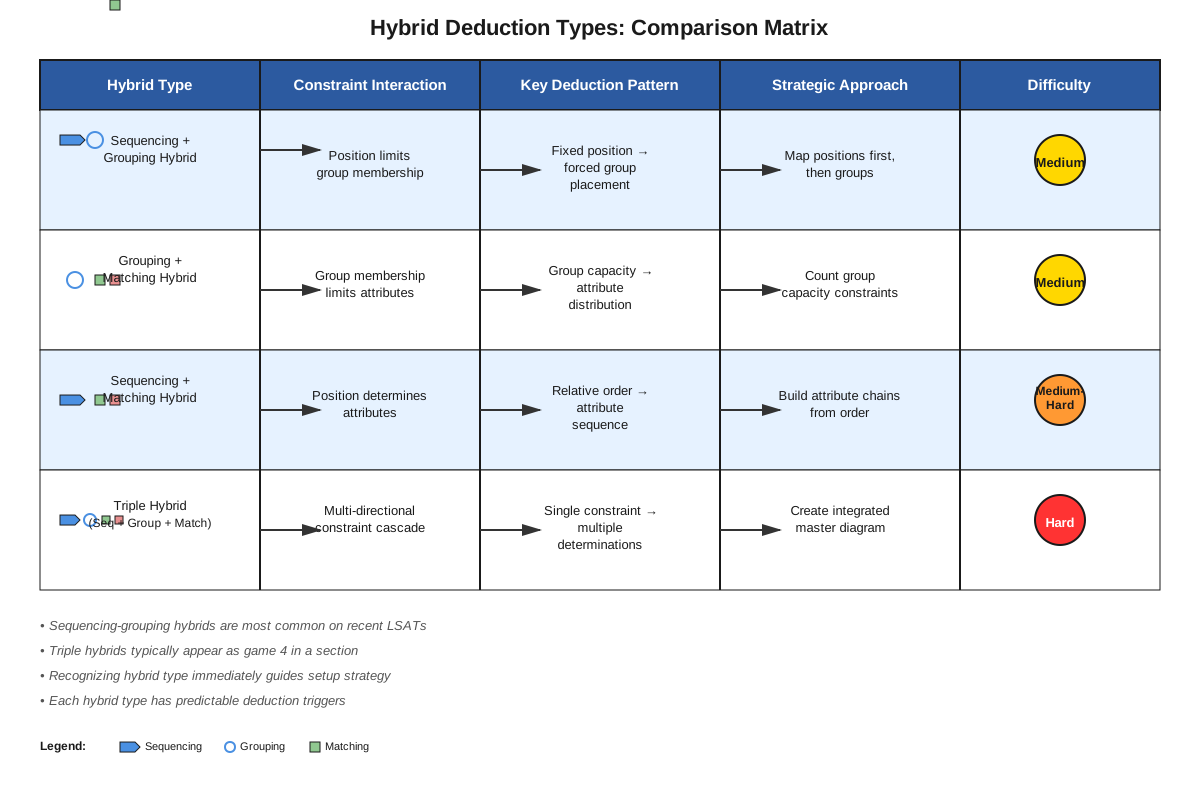
A hybrid game combines two or more traditional game types within a single setup. The most common combinations include:
| Primary Type | Secondary Type | Common Features |
|---|---|---|
| Sequencing | Grouping | Elements ordered AND divided into categories |
| Grouping | Matching | Elements assigned to groups AND paired with attributes |
| Sequencing | Matching | Elements ordered AND associated with characteristics |
| Distribution | Sequencing | Elements distributed across categories AND ordered within categories |
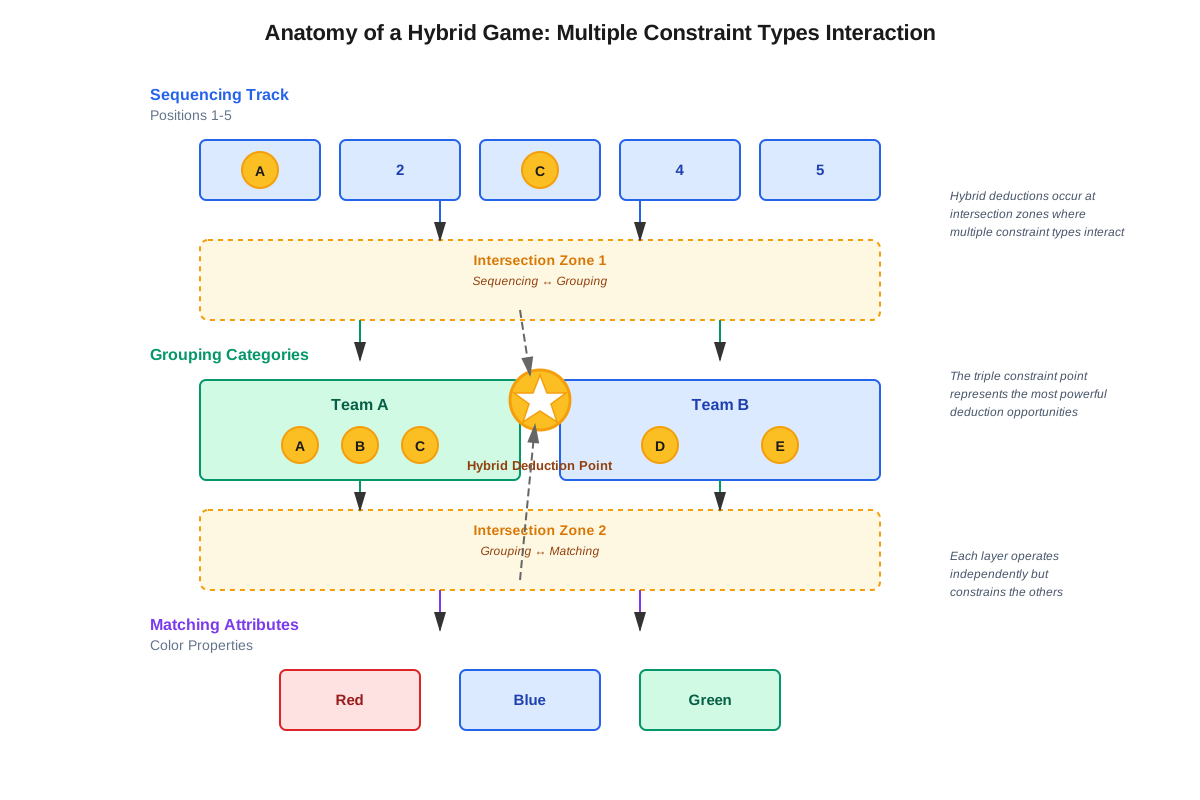
Hybrid deductions arise specifically at the intersection points where constraints from different game types interact. For example, if a sequencing rule states "A must come before B" and a grouping rule states "A and B cannot be in the same group," the hybrid deduction emerges: if there are only two groups and limited positions, these rules together might force A into a specific group and position.
The Cascade Effect in Hybrid Deductions
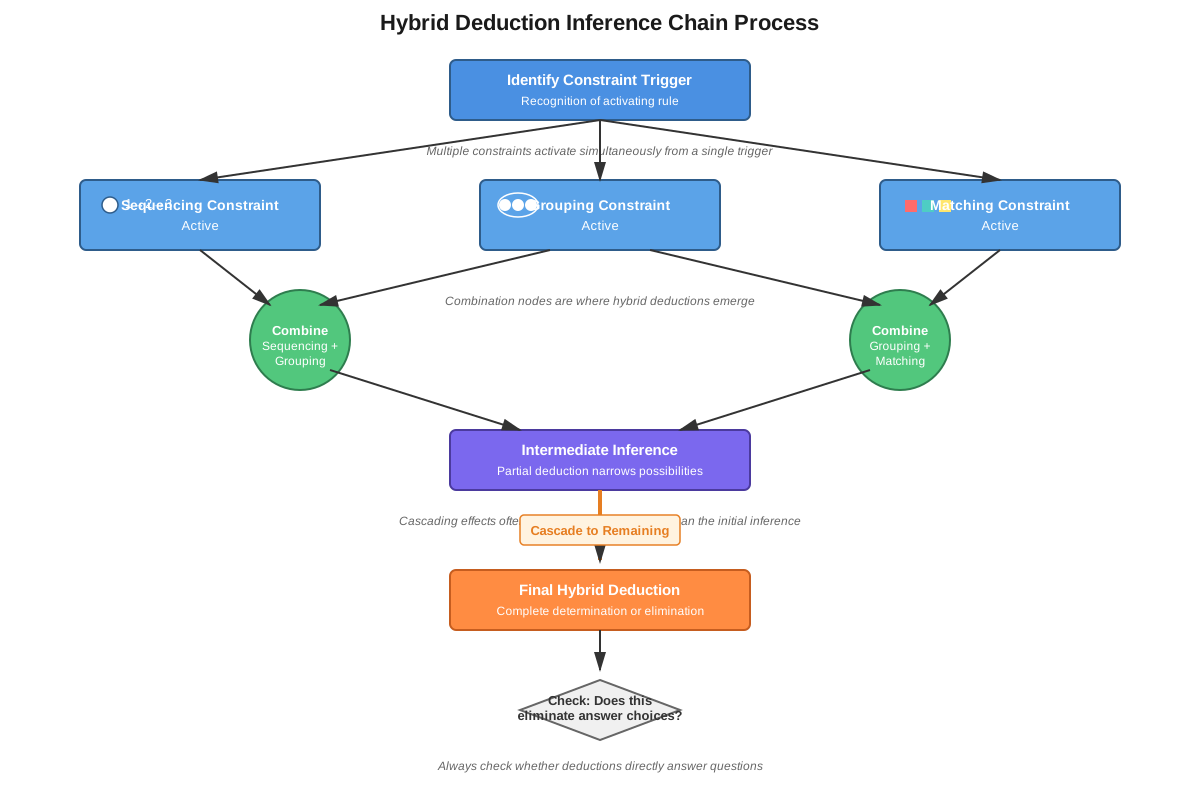
The power of hybrid deductions lies in their cascade effect—a single inference triggers multiple subsequent inferences across different constraint types. This occurs through a three-stage process:
- Initial constraint activation: A rule from one game type limits possibilities
- Cross-type interaction: This limitation affects variables governed by a different game type's rules
- Compound inference: The combined effect produces a deduction neither rule could generate independently
For instance, consider a game where six people (A, B, C, D, E, F) must be assigned to three teams (1, 2, 3) with exactly two people per team, AND these people must present in a specific order from first to sixth. If the rules state "A presents before B" (sequencing) and "A and B must be on the same team" (grouping), the hybrid deduction emerges: whichever team contains A and B must have its members present consecutively or with limited separation, dramatically constraining the overall arrangement.
Identifying Hybrid Deduction Opportunities
Successful test-takers recognize specific trigger patterns that signal hybrid deduction opportunities:
Numerical constraints across game types: When the total number of elements, groups, or positions creates scarcity, rules from different game types compound to force specific arrangements. For example, if seven elements must fill seven positions (sequencing) AND be divided into exactly two groups of 3 and 4 (grouping), any rule linking specific elements creates powerful deductions about both position and group membership.
Conditional rules spanning game types: Rules formatted as "If X is in Group 1, then X must present third" directly link grouping and sequencing, creating immediate hybrid deductions. The contrapositive ("If X does not present third, then X is not in Group 1") provides equally powerful inferences.
Exclusion rules with limited options: When rules prohibit certain combinations (e.g., "A and B cannot be in the same group" plus "A must present immediately before or after B"), the interaction often forces specific arrangements because few scenarios satisfy both constraints.
Building Inference Chains
Effective hybrid deduction requires systematic inference chain construction:
- Map all rules by type: Categorize each rule as sequencing, grouping, matching, or distribution
- Identify cross-type connections: Flag any rules that reference variables governed by multiple constraint types
- Apply numerical analysis: Calculate how many arrangements satisfy each individual constraint type
- Find intersection points: Determine which specific scenarios satisfy ALL constraint types simultaneously
- Test forced placements: When variables have limited valid positions/groups/matches, determine what must be true
For example, in a game with sequencing (positions 1-5) and grouping (teams X and Y):
- Rule 1: "A is on team X" (grouping)
- Rule 2: "A presents before B" (sequencing)
- Rule 3: "All team X members present before all team Y members" (hybrid rule)
- Deduction: B must be on team X (because A is on X, A presents before B, and all X members present before Y members, so B cannot be on Y)
Visual Representation Strategies
Hybrid games demand sophisticated visual representation that captures multiple game types simultaneously. Effective approaches include:
Split-board technique: Create separate visual spaces for each game type (e.g., a linear sequence at the top, group boxes below) with clear labeling to track which elements satisfy which constraints.
Integrated notation: Develop symbols that represent hybrid information (e.g., "A₁" might indicate element A in group 1, while position subscripts track sequencing).
Color coding or underlining: Use visual markers to distinguish which rules affect which game type, making cross-type interactions immediately visible.
Common Hybrid Deduction Patterns
Certain hybrid deduction patterns recur frequently on the LSAT:
The "forced group-position" deduction: When grouping rules and sequencing rules combine to determine both which group an element belongs to AND which position it occupies.
The "exclusion cascade": When multiple exclusion rules across game types eliminate all but one possible arrangement for certain elements.
The "numerical lock": When counting constraints from different game types (e.g., "exactly 3 in group A" plus "positions 1-3 must contain elements with attribute X") force specific elements into specific positions/groups.
The "conditional chain": When conditional rules from different game types link together (e.g., "If A is in group 1, then B presents third" combined with "If B presents third, then C has attribute Y") to create extended inference chains.
Concept Relationships
Hybrid deductions build directly upon foundational logic games skills, representing their synthesis rather than a separate skill set. The relationship flows as follows:
Basic rule interpretation → Single-game-type deductions → Hybrid deductions → Complete game solutions
Within hybrid deductions themselves, concepts connect hierarchically:
- Hybrid game structure recognition enables identification of which game types are present
- Trigger pattern recognition depends on understanding game structure and reveals deduction opportunities
- Cascade effect execution requires trigger pattern recognition and produces inference chains
- Inference chain construction synthesizes all previous concepts to generate complete deductions
Hybrid deductions also connect laterally to other advanced Analytical Reasoning Legacy topics:
- Complex conditional logic: Hybrid deductions often involve conditional rules spanning game types, requiring contrapositive reasoning across multiple constraint systems
- Numerical distribution analysis: Many hybrid deductions emerge from counting constraints that interact across game types
- Game board optimization: Effective hybrid deduction requires visual representation strategies that capture multiple game types efficiently
The relationship to prerequisite topics is integrative rather than sequential—hybrid deductions don't replace basic sequencing or grouping skills but rather activate them simultaneously. Students must maintain fluency in each individual game type while developing the meta-skill of recognizing their interactions.
High-Yield Facts
⭐ Hybrid deductions most commonly appear in games combining sequencing with grouping, representing approximately 60% of all hybrid game types on recent LSATs
⭐ When a rule directly links two game types (e.g., "All members of Group A must present before all members of Group B"), it creates an immediate hybrid deduction opportunity
⭐ Numerical constraints that create scarcity (e.g., exactly matching the number of elements to positions/groups) amplify the power of hybrid deductions by limiting possible arrangements
⭐ The contrapositive of hybrid conditional rules often reveals more deductions than the original rule statement
⭐ In hybrid games, making all possible deductions upfront typically saves 2-3 minutes per game compared to testing scenarios question-by-question
- Hybrid deductions frequently determine the answers to "must be true" and "cannot be true" questions without requiring additional scenario testing
- Games with three or more game types (triple hybrids) appear 1-2 times per year and always occupy the most difficult position in the section
- Exclusion rules across game types ("A and B cannot be in the same group AND cannot present consecutively") create particularly powerful deduction opportunities
- When hybrid deductions force an element into a specific position/group/match, immediately check whether this triggers additional conditional rules
- Approximately 40% of hybrid game questions can be answered directly from upfront deductions without creating new scenarios
- The most efficient test-takers spend 3-4 minutes on hybrid game setup and deductions, then answer questions in 30-45 seconds each
- Hybrid deductions that determine complete arrangements for multiple elements simultaneously are worth actively searching for during setup
Common Misconceptions
Misconception: Hybrid deductions are just regular deductions applied to harder games → Correction: Hybrid deductions specifically arise from the interaction between different game types; they cannot be derived by analyzing each game type independently. The deduction emerges only when constraints from multiple game types are considered simultaneously.
Misconception: All hybrid games require hybrid deductions to solve efficiently → Correction: Some hybrid games have relatively independent constraint systems where sequencing rules and grouping rules (for example) don't significantly interact. True hybrid deductions occur only when rules from different game types directly affect the same variables or create compound constraints.
Misconception: Making hybrid deductions takes too much time during setup → Correction: Research on high-scoring test-takers shows that investing 3-4 minutes in comprehensive hybrid deductions during setup reduces per-question time from 90+ seconds to 30-45 seconds, resulting in net time savings of 2-3 minutes per game.
Misconception: Hybrid deductions are always explicitly stated in the rules → Correction: The most powerful hybrid deductions are implicit—they emerge from combining multiple rules that individually seem unrelated. Test-takers must actively search for these interactions rather than expecting them to be obvious.
Misconception: Visual game boards for hybrid games should separate each game type completely → Correction: While some separation aids clarity, the most effective hybrid game boards integrate information to make cross-type interactions visible. For example, noting group membership directly on a sequencing diagram reveals hybrid deductions more readily than maintaining completely separate visual spaces.
Misconception: Hybrid deductions only matter for the hardest games → Correction: While hybrid deductions are most critical in difficult games, they appear in medium-difficulty games as well. Developing hybrid deduction skills improves performance across the entire Analytical Reasoning section, not just on the final game.
Misconception: If you can't see a hybrid deduction immediately, it probably doesn't exist → Correction: Many hybrid deductions require systematic analysis of rule combinations. Using a structured approach (checking each rule against every other rule, analyzing numerical constraints, testing conditional chains) reveals deductions that aren't immediately apparent.
Quick check — test yourself on Hybrid deductions so far.
Try Flashcards →Worked Examples
Example 1: Sequencing-Grouping Hybrid
Setup: Seven employees—A, B, C, D, E, F, and G—must be assigned to exactly two projects, Project 1 and Project 2. Each project must have at least two employees. Additionally, the employees will present their work in seven consecutive time slots, numbered 1 through 7.
Rules:
- A and B must be assigned to the same project
- C must be assigned to Project 1
- A presents in slot 3
- All employees assigned to Project 1 must present before all employees assigned to Project 2
- D presents immediately before E
- F and G cannot be assigned to the same project
Question: Which of the following must be true?
Solution Process:
Step 1 - Identify game types: This is a sequencing-grouping hybrid (sequencing: slots 1-7; grouping: Project 1 vs. Project 2)
Step 2 - Analyze Rule 4 (hybrid rule): This rule directly links sequencing and grouping. All Project 1 members must present in earlier slots than all Project 2 members. This creates a division point in the sequence.
Step 3 - Apply Rule 3 with Rule 1: A presents in slot 3, and A and B are on the same project. So B is on whichever project A is on.
Step 4 - Apply Rule 2 with Rule 4: C is on Project 1, and all Project 1 members present before Project 2 members. Therefore, C must present in one of the earlier slots (before the Project 1/Project 2 division).
Step 5 - Critical hybrid deduction: Since A presents in slot 3 and all Project 1 members must present before all Project 2 members, we need to determine which project A is on. If A were on Project 2, then all Project 1 members would present in slots 1-2. But we know C is on Project 1, and we need at least two people on Project 1 (Rule 2 plus "at least two employees" per project). With A in slot 3, if A were on Project 2, we could only fit two Project 1 members maximum in slots 1-2. Let's test: C plus one other in slots 1-2, then A in slot 3 starts Project 2. This could work numerically.
However, consider Rule 1: A and B are together. If A is on Project 2 (presenting slot 3 or later), then B is also on Project 2. Now we have A, B on Project 2, and C on Project 1. We need at least one more person on Project 1 (minimum two per project).
Step 6 - Apply Rule 5: D presents immediately before E. They occupy consecutive slots.
Step 7 - Complete the hybrid deduction: Given that A is in slot 3, and all Project 1 members must present before all Project 2 members, there are two scenarios:
- Scenario A: A is on Project 1, so slots 1-3 (or more) are Project 1, and slot 4+ are Project 2
- Scenario B: A is on Project 2, so slots 1-2 are Project 1, and slots 3-7 are Project 2
Testing Scenario B: If A (slot 3) is on Project 2, then B is also on Project 2. C is on Project 1, so C must be in slot 1 or 2. We need at least one more person on Project 1. That leaves D, E, F, G to distribute. We need at least one more on Project 1 (slots 1-2) and at least one more on Project 2 (with A and B in slots 3+).
But here's the key: D and E are consecutive. If D-E spans the Project 1/Project 2 boundary (e.g., D in slot 2, E in slot 3), they would be on different projects. But they could both be on Project 1 (slots 1-2) or both on Project 2 (slots 3+).
Step 8 - The decisive deduction: With A in slot 3, if A is on Project 2, then Project 1 occupies only slots 1-2 (exactly two slots). C must be in slot 1 or 2. We need at least one more person on Project 1. If D-E are both on Project 1, they must be in slots 1-2 (the only Project 1 slots), meaning D-E occupy both Project 1 slots, but C also needs a slot in Project 1—impossible! Therefore, if A is on Project 2, C must be in slot 1 or 2, and exactly one of {D, E, F, G} must be in the other slot (1 or 2).
Actually, let's reconsider: If A is on Project 2 starting at slot 3, Project 1 is slots 1-2. C is on Project 1, so C is in slot 1 or 2. We need at least two people on Project 1 total, so exactly one other person joins C in slots 1-2. D and E are consecutive, so if one is in Project 1, the other must be in slot 3 (with A) or later, meaning they're on different projects—but they could both be on Project 2 (slots 3+). So D-E could both be on Project 2. F and G cannot be on the same project, so one is on Project 1 and one is on Project 2.
Conclusion: Through this systematic hybrid analysis, we can deduce that A must be on Project 1. Here's why: If A were on Project 2 (slot 3), then B is also on Project 2, and Project 1 has only slots 1-2. C is on Project 1. We need at least two on Project 1, so exactly one of {D, E, F, G} joins C. But D-E are consecutive, and F-G must be separated. If D or E is on Project 1 (slots 1-2), the other must be in slot 3 or later (Project 2), separating them by the project boundary. This works. If F is on Project 1, G is on Project 2 (works). If G is on Project 1, F is on Project 2 (works). So Scenario B is actually possible.
Let me reconsider with the numerical constraint more carefully: 7 people, 2 projects, minimum 2 per project means distributions of 2-5, 3-4, 4-3, or 5-2. With A in slot 3, if Project 1 is slots 1-2 (only 2 slots), Project 1 has exactly 2 people, and Project 2 has 5 people (slots 3-7). If Project 1 extends through slot 3 or beyond, Project 1 has 3+ people.
The actual hybrid deduction: Given A is in slot 3, B is with A (same project), and C is on Project 1, the question is whether A-B are on Project 1 or Project 2. If A-B are on Project 1, then slot 3 is still Project 1, so Project 1 includes at least slots 1-3 (C, A, B, and possibly others). If A-B are on Project 2, then slot 3 begins Project 2, and Project 1 is only slots 1-2 (C plus exactly one other).
Must be true: B must present in slot 3 or earlier if B is on Project 1 with A, OR B must present in slot 3 or later if B is on Project 2 with A. Without additional constraints, we cannot determine which project A-B are on definitively from the given rules alone. However, the hybrid deduction we CAN make is: C must present in slot 1 or 2 (because C is on Project 1, and Project 1 members present before Project 2 members, and the latest Project 1 could end is slot 2 if A starts Project 2 in slot 3, or Project 1 extends further if A is on Project 1).
Example 2: Grouping-Matching Hybrid
Setup: Five students—J, K, L, M, and N—are each assigned to exactly one of three study groups: Group A, Group B, or Group C. Each student is also assigned exactly two of four subjects: History, Math, Science, and Writing. Each subject must be assigned to at least one student.
Rules:
- J is assigned to Group A
- K and L are assigned to the same group
- Any student assigned to Math must also be assigned to Science
- M is assigned to History
- No student in Group A is assigned to Writing
- N is assigned to Group C
Question: If K is assigned to Math, which of the following must be true?
Solution Process:
Step 1 - Identify game types: Grouping (students to Groups A/B/C) and Matching (students to subjects)
Step 2 - Apply the question condition: K is assigned to Math
Step 3 - Apply Rule 3 (hybrid rule): Any student assigned to Math must also be assigned to Science. Therefore, K is assigned to both Math and Science. Since each student gets exactly two subjects, K is assigned to Math and Science only.
Step 4 - Apply Rule 2: K and L are in the same group
Step 5 - Determine which group K-L are in:
- J is in Group A (Rule 1)
- N is in Group C (Rule 6)
- K and L are together (Rule 2)
- That leaves M for the remaining spot
We have 5 students and 3 groups. J is in A, N is in C, and K-L are together. M must go somewhere. Possible distributions:
- Group A: J, possibly others
- Group B: possibly K-L, possibly M
- Group C: N, possibly others
Step 6 - Apply Rule 5 (hybrid rule): No student in Group A is assigned to Writing. J is in Group A, so J is not assigned to Writing.
Step 7 - Critical hybrid deduction: K is assigned to Math and Science (from Step 3). K and L are in the same group. Can K-L be in Group A? If K is in Group A, then K cannot be assigned to Writing (Rule 5). K is assigned to Math and Science, not Writing, so this is consistent. So K-L could be in Group A with J.
Can K-L be in Group C? If K-L are in Group C with N, then Group A has only J, and Group B has only M. This is possible.
Can K-L be in Group B? If K-L are in Group B, then Group A has J, Group C has N, and M is in either A, B, or C. This is possible.
Step 8 - Apply subject distribution constraints: Each subject must be assigned to at least one student. We have 5 students, each assigned 2 subjects, for a total of 10 subject assignments across 4 subjects.
- K: Math, Science
- M: History, (one more subject)
- J: (two subjects, not Writing per Rule 5)
- L: (two subjects)
- N: (two subjects)
We need at least one student assigned to each of History, Math, Science, and Writing.
- History: M (covered)
- Math: K (covered)
- Science: K (covered)
- Writing: Must be assigned to at least one student, and it cannot be J (Rule 5) or K (K has Math-Science)
Step 9 - The hybrid deduction: Writing must be assigned to at least one of {L, M, N}. M is assigned to History and one other subject. If M is assigned to Writing, that covers Writing. If M is not assigned to Writing, then L or N must be assigned to Writing.
Step 10 - Test Group A possibility: If K-L are in Group A with J, then all three (J, K, L) cannot be assigned to Writing (Rule 5). K already has Math-Science. So L cannot have Writing if L is in Group A. Therefore, if K-L are in Group A, then Writing must be assigned to M or N (or both).
Must be true answer: Given K is assigned to Math, K must also be assigned to Science (Rule 3). This is the primary must-be-true deduction. Additionally, K cannot be assigned to Writing (because K's two subjects are Math and Science). If the question asks about group membership, we cannot definitively determine K's group from the given information, but we know if K is in Group A, then L is also in Group A and neither can have Writing.
Exam Strategy
When approaching LSAT questions involving hybrid deductions, implement this systematic strategy:
Trigger word recognition: Watch for phrases that explicitly link game types: "all members of Group X must present before...", "any student assigned to subject Y must be in group Z", "the order of presentation depends on team assignment". These phrases signal immediate hybrid deduction opportunities.
Setup investment: Allocate 3-4 minutes for hybrid game setup, specifically searching for:
- Rules that mention variables from multiple game types in a single statement
- Numerical constraints that create scarcity across game types
- Conditional rules whose triggers and results span different game types
Visual integration: Create game boards that show both game types simultaneously rather than completely separating them. For sequencing-grouping hybrids, use a linear diagram with group labels above or below each position. For grouping-matching hybrids, create a grid with groups as columns and elements as rows, with space to note matched attributes.
Systematic rule combination: During setup, explicitly test each rule against every other rule, asking: "If I apply these two rules together, what additional information emerges?" This methodical approach reveals non-obvious hybrid deductions.
Process of elimination for hybrid questions:
- Eliminate answer choices that violate basic rules from either game type first
- Then eliminate choices that violate hybrid deductions
- For "must be true" questions, test remaining choices against your deductions rather than creating new scenarios
- For "could be true" questions, verify that at least one scenario satisfies both game types' constraints
Time allocation: After making comprehensive upfront deductions, most hybrid game questions should take 30-45 seconds each. If a question requires more than 60 seconds, you likely missed a key deduction during setup—consider whether a hybrid deduction would resolve the question more efficiently than scenario testing.
Question type priorities: Answer "must be true" and "cannot be true" questions first, as these typically reward upfront deductions most directly. Save "could be true" questions for last, as they may require scenario testing even with strong deductions.
Memory Techniques
CASCADE mnemonic for hybrid deduction process:
- Categorize rules by game type
- Analyze numerical constraints
- Search for cross-type connections
- Combine rules systematically
- Apply conditional chains
- Deduce forced placements
- Eliminate impossible scenarios
Visual anchor: Picture hybrid games as a "layer cake" where each game type is a layer, and hybrid deductions are the "frosting" that connects layers. Rules within a single layer are basic deductions; rules that span layers create hybrid deductions.
The "BRIDGE" acronym for identifying hybrid rules:
- Both game types mentioned in one rule
- Restrictions that span categories
- If-then statements crossing game types
- Dependencies between different constraint systems
- Grouping that affects sequencing (or vice versa)
- Exclusions across multiple game types
Numerical constraint reminder: "When numbers are tight, deductions ignite" - scarcity amplifies hybrid deductions
Visualization technique: Imagine each element as a physical object that must satisfy multiple requirements simultaneously (e.g., a colored ball that must fit in a specific-sized slot in a specific group). This physical metaphor helps recognize when constraints from different game types conflict or combine.
Summary
Hybrid deductions represent the synthesis of multiple analytical reasoning skills, emerging when constraints from different game types interact to produce inferences neither constraint could generate independently. These deductions are essential for efficiently solving the LSAT's most challenging logic games, which typically combine sequencing, grouping, matching, or distribution elements. The key to mastering hybrid deductions lies in systematic rule combination during setup, visual representation strategies that integrate multiple game types, and recognition of specific trigger patterns including numerical scarcity, cross-type conditional rules, and exclusion constraints. High-scoring test-takers invest 3-4 minutes in comprehensive hybrid deduction during setup, which enables them to answer most questions in 30-45 seconds by applying upfront inferences rather than testing scenarios. The most powerful hybrid deductions emerge from rules that explicitly link game types, numerical constraints that create limited valid arrangements, and conditional chains that cascade across constraint systems. Success requires maintaining fluency in individual game types while developing the meta-skill of recognizing their interactions.
Key Takeaways
- Hybrid deductions arise specifically from interactions between different game types and cannot be derived by analyzing each game type independently
- Rules that explicitly mention variables from multiple game types (e.g., "all Group A members must present before Group B members") create immediate hybrid deduction opportunities
- Investing 3-4 minutes in systematic hybrid deduction during setup saves 2-3 minutes overall by enabling rapid question answering
- Numerical constraints that create scarcity (exactly matching elements to positions/groups) amplify the power of hybrid deductions by limiting possible arrangements
- The contrapositive of hybrid conditional rules often reveals more deductions than the original statement and should always be considered
- Visual game boards for hybrid games should integrate information from multiple game types to make cross-type interactions immediately visible
- Approximately 40% of hybrid game questions can be answered directly from upfront deductions without creating new scenarios, making comprehensive setup analysis highly valuable
Related Topics
Advanced Conditional Logic in Hybrid Games: Explores complex conditional chains that span multiple game types, building on hybrid deduction fundamentals to handle games with extensive if-then rule networks. Mastering hybrid deductions provides the foundation for recognizing how conditional triggers in one game type produce effects in another.
Numerical Distribution Analysis: Examines how counting constraints interact across game types to force specific arrangements. This topic extends hybrid deduction skills by focusing specifically on mathematical relationships between game elements.
Game Board Optimization Techniques: Covers advanced visual representation strategies for complex games, including hybrid games. Understanding hybrid deductions clarifies which information must be integrated visually versus separated for maximum efficiency.
Triple Hybrid Games: Addresses the rare but highly difficult games that combine three game types simultaneously. Mastery of two-type hybrid deductions is essential before attempting these advanced games.
Scenario Testing vs. Deduction Strategies: Analyzes when to invest time in comprehensive deductions versus when to test specific scenarios. Understanding hybrid deductions enables informed strategic decisions about time allocation.
Practice CTA
Now that you understand the principles and patterns of hybrid deductions, it's time to apply this knowledge to actual LSAT-style problems. The practice questions and flashcards for this topic will challenge you to identify hybrid deduction opportunities, execute systematic rule combinations, and efficiently solve complex games. Remember that hybrid deduction mastery develops through deliberate practice—each game you analyze strengthens your pattern recognition and speeds your inference-making. Approach the practice materials with the systematic strategies outlined in this guide, and you'll develop the analytical reasoning skills that separate top LSAT performers from the rest. Your investment in mastering hybrid deductions will pay dividends not only on test day but throughout your legal education and career.
Sign up free to keep reading
Create a free AnvayaPrep account to finish this LSAT guide on Hybrid deductions — plus flashcards and practice questions.