Overview
Hybrid local questions represent a sophisticated category of Analytical Reasoning problems on the LSAT that combine elements from multiple game types within a single question stem. Unlike standard local questions that introduce one new condition to test, hybrid local questions present scenarios that require test-takers to navigate the complexities of games that already blend two or more organizational structures—such as sequencing with grouping, or matching with distribution. These questions appear in the Analytical Reasoning Legacy section and demand that students simultaneously track multiple constraint systems while applying a new temporary condition.
The significance of mastering lsat hybrid local questions cannot be overstated. These questions typically appear in the most challenging logic games on any given LSAT administration, often serving as the final questions in a game set where point values remain equal but difficulty escalates dramatically. Students who can efficiently handle hybrid local questions gain a substantial competitive advantage, as these questions frequently separate high scorers from average performers. The ability to work through these complex scenarios demonstrates advanced analytical reasoning skills that the LSAT specifically tests.
Within the broader framework of Analytical Reasoning Legacy, hybrid local questions build upon foundational skills in both pure game types and global question strategies. They represent the apex of complexity in hybrid games legacy, requiring test-takers to maintain mental flexibility while applying rigorous deductive reasoning. Success with these questions indicates mastery not just of individual game types, but of the meta-skill of recognizing which analytical framework to apply at each decision point within a multi-layered logical puzzle.
Learning Objectives
- [ ] Identify how Hybrid local questions appears in LSAT questions
- [ ] Explain the reasoning pattern behind Hybrid local questions
- [ ] Apply Hybrid local questions to solve LSAT-style problems accurately
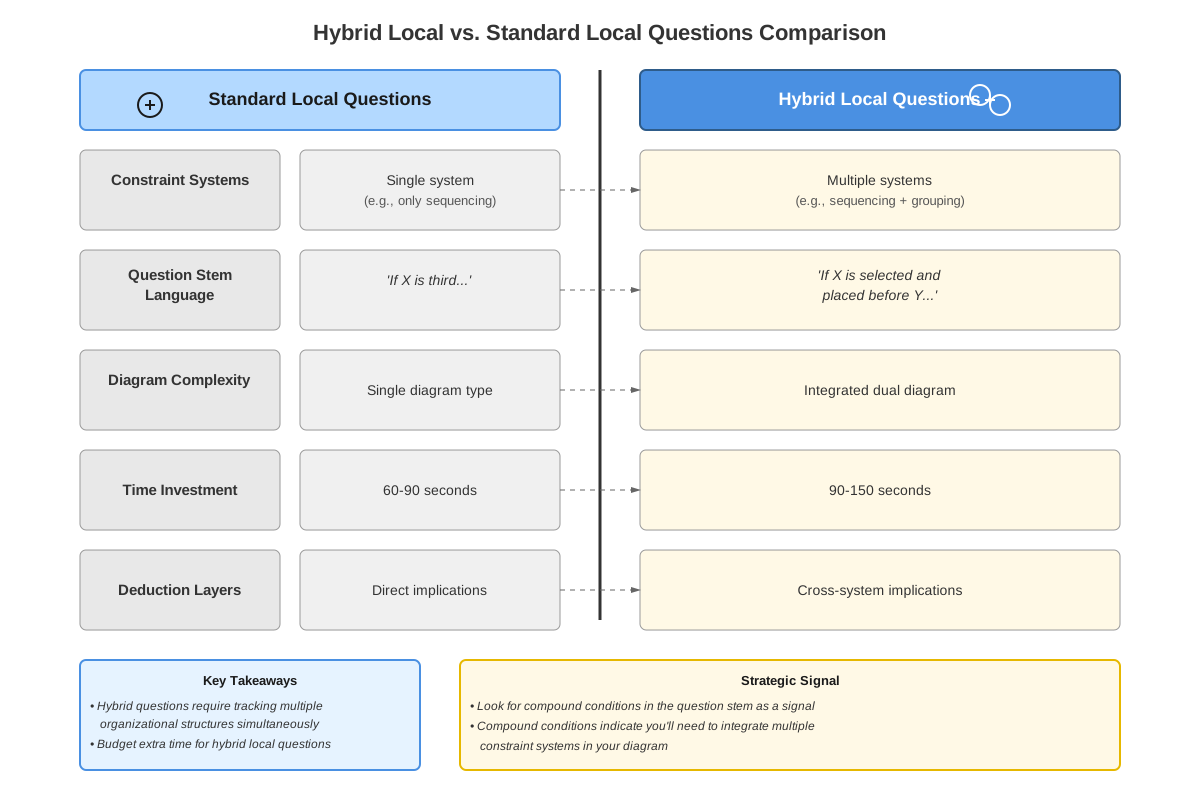
- [ ] Distinguish between hybrid local questions and standard local questions based on question stem language
- [ ] Construct efficient visual representations that capture both constraint systems simultaneously
- [ ] Evaluate answer choices by systematically testing against multiple constraint types
- [ ] Synthesize information from global deductions with new local conditions in hybrid game contexts
Prerequisites
- Pure sequencing games: Understanding linear ordering and relative positioning rules is essential because hybrid games frequently incorporate sequencing as one component
- Pure grouping games: Familiarity with in/out grouping and distribution constraints provides the foundation for the grouping dimension of hybrid games
- Basic local question strategy: Knowing how to create hypothetical scenarios and test new conditions is required before tackling the added complexity of hybrid structures
- Rule representation techniques: The ability to symbolize constraints efficiently becomes critical when managing multiple rule types simultaneously
- Global deduction methods: Recognizing fixed placements and limited options in standard games prepares students for making compound deductions in hybrid contexts
Why This Topic Matters
Hybrid local questions appear with remarkable consistency on modern LSAT administrations, typically comprising 20-30% of all Analytical Reasoning questions in any given section. The LSAT test-makers have increasingly favored hybrid game structures since 2015, making proficiency with these questions essential rather than optional for competitive scores. Students aiming for scores above 165 must demonstrate consistent accuracy on hybrid local questions, as missing even two such questions can significantly impact percentile rankings.
In practical terms, these questions test the cognitive flexibility and systematic reasoning that law schools value in prospective students. The ability to manage multiple constraint systems simultaneously mirrors the analytical demands of legal reasoning, where attorneys must consider procedural rules, substantive law, factual constraints, and strategic considerations concurrently. This explains why the LSAT emphasizes these complex question types—they predict success in legal education more reliably than simpler analytical tasks.
On the exam itself, hybrid local questions most commonly appear in games that combine sequencing with grouping (approximately 45% of hybrid games), matching with distribution (approximately 30%), or sequencing with matching (approximately 25%). These questions typically appear as questions 4-6 within a game set, positioned after students have worked through global questions and simpler local questions. The strategic challenge lies in deciding whether to invest time creating a detailed hypothetical scenario or to work more abstractly through the constraints—a decision that can mean the difference between spending 90 seconds or 3 minutes on a single question.
Core Concepts
Defining Hybrid Local Questions
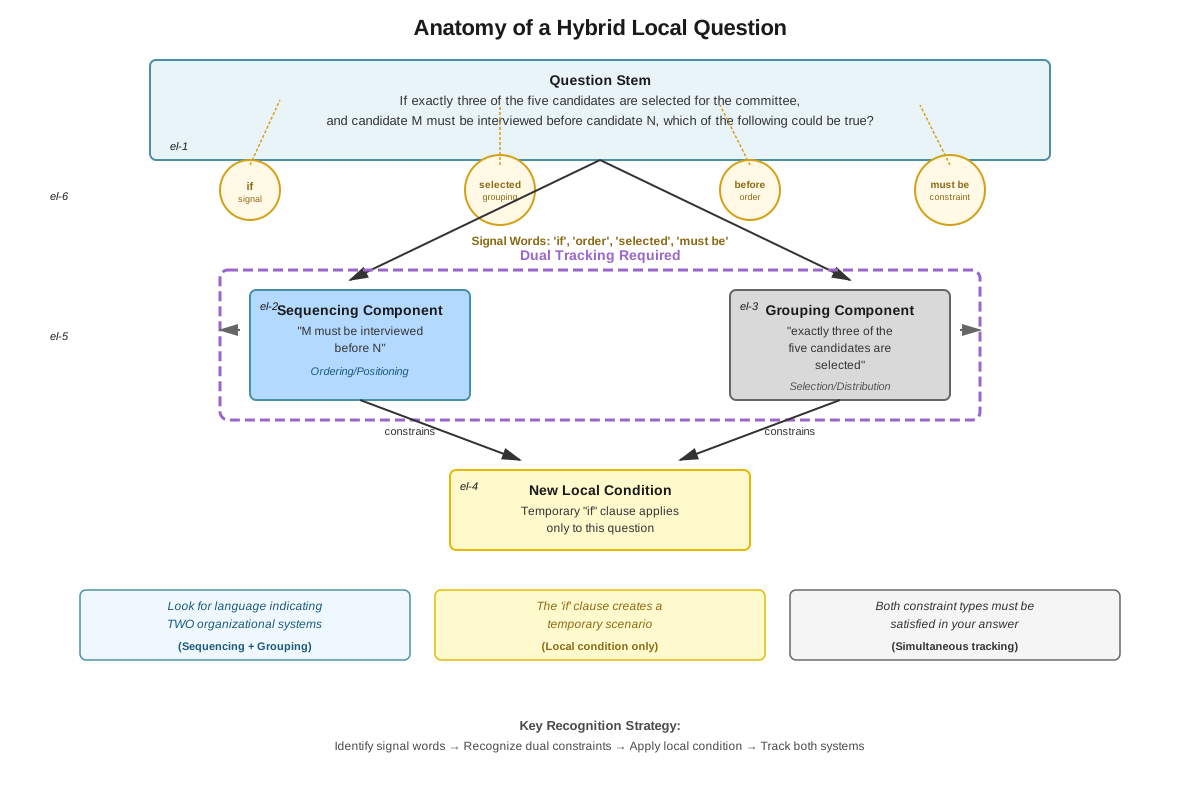
A hybrid local question is a question stem that introduces a new temporary condition (making it "local" rather than "global") within a game that already requires tracking two or more organizational systems simultaneously (making it "hybrid"). The question stem typically begins with phrases like "If X is in group 2 and comes before Y..." or "If exactly three of the variables are selected and Z is assigned to position 4..." These questions demand that test-takers layer the new local condition onto an already complex game structure while maintaining awareness of all original constraints.
The distinguishing feature of hybrid local questions is their requirement for multi-dimensional reasoning. Unlike local questions in pure game types where students track changes along a single axis (positions in sequencing, group membership in grouping), hybrid local questions require simultaneous tracking across multiple axes. For example, a student might need to determine both which position a variable occupies AND which group it belongs to, while ensuring that both the sequencing rules and the grouping rules remain satisfied.
The Dual-Constraint Framework
Understanding hybrid local questions requires recognizing that every deduction must satisfy two separate constraint systems. Consider this framework:
| Constraint System | What It Controls | Common Rule Types | Deduction Method |
|---|---|---|---|
| Primary System | The main organizational structure | Sequencing order, group capacity | Direct application of rules |
| Secondary System | The overlaid organizational structure | Attribute assignment, selection criteria | Cross-referencing with primary system |
| Integration Points | Where systems interact | Conditional rules linking both systems | Compound deductions |
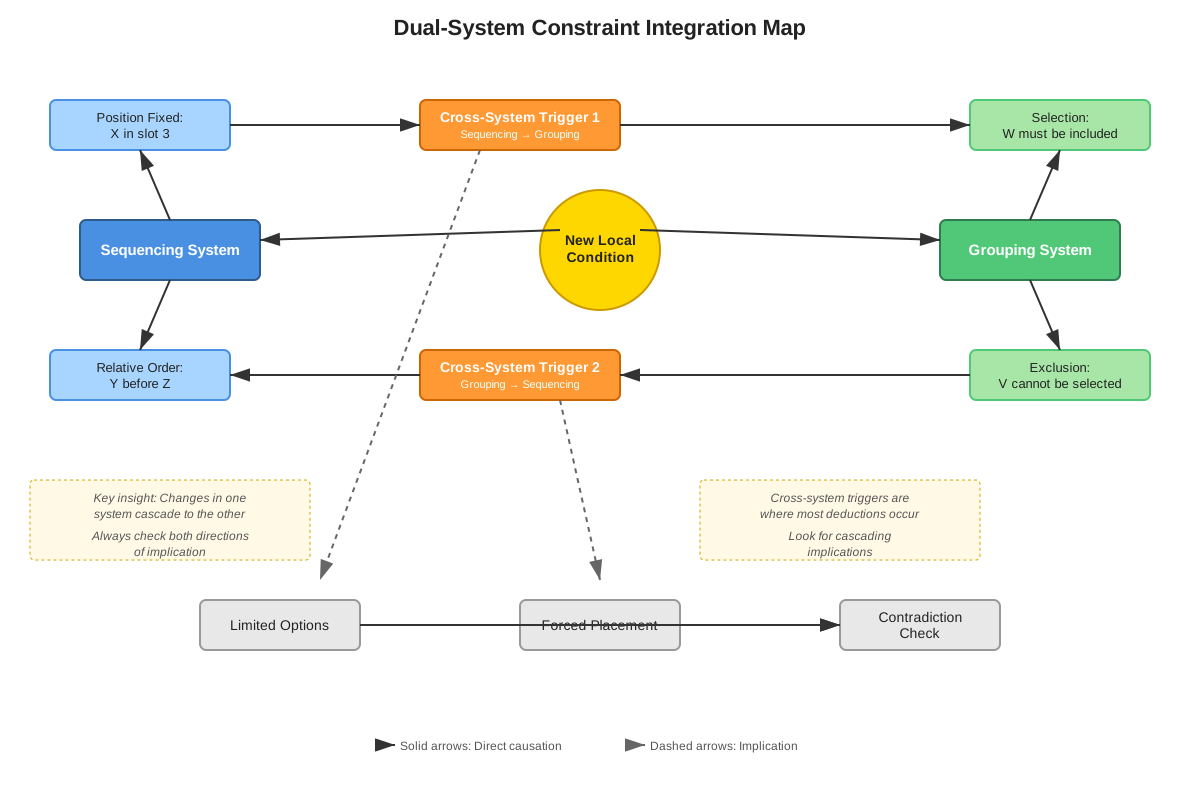
The integration points are where the most powerful deductions emerge. When a local condition affects a variable that appears in rules spanning both constraint systems, cascading deductions often follow. Expert test-takers actively search for these integration points immediately after reading the local condition.
The Hypothetical Construction Process
When approaching hybrid local questions, test-takers must decide between two strategic approaches:
- Full Hypothetical Construction: Creating a complete visual representation that shows all variables placed according to both constraint systems
- Partial Constraint Testing: Working more abstractly by testing specific constraints without fully populating the game board
The decision depends on three factors:
- Constraint density: Games with many rules favor full hypothetical construction because the rules will force many placements
- Question type: "Must be true" questions often require full hypotheticals, while "could be true" questions may allow partial testing
- Time pressure: With limited time remaining, partial testing may be more efficient even if less certain
Cascading Deductions in Hybrid Contexts
The most challenging aspect of hybrid local questions involves recognizing cascading deductions—situations where placing one variable according to the local condition triggers a chain of forced placements across both constraint systems. These cascades occur when:
- The local condition places a variable that appears in multiple rules
- One or more of those rules connects the primary and secondary constraint systems
- The game has limited flexibility due to capacity constraints or exclusive positioning rules
For example, if a local condition states "If M is in position 3," and the game rules include "M must be in the same group as N" (grouping constraint) and "N must come before O" (sequencing constraint), then placing M in position 3 immediately determines N's group membership and creates a sequencing constraint on O's position. This cascade continues until all forced placements are exhausted.
Answer Choice Evaluation Strategy
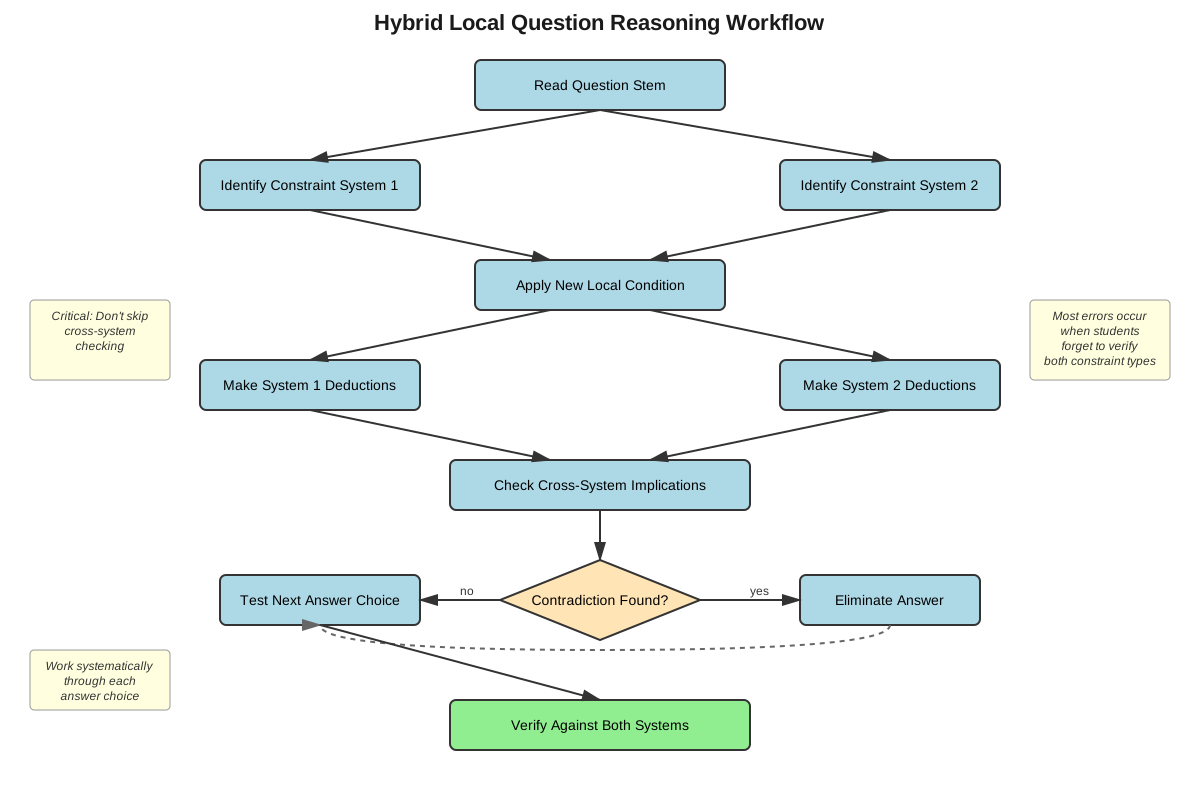
Hybrid local questions require a systematic approach to answer choice evaluation:
Step 1: Apply the local condition directly - Make all immediate deductions from the new condition alone
Step 2: Check integration points - Identify variables affected by rules spanning both constraint systems
Step 3: Test for violations - For "could be true" questions, eliminate answers that violate either constraint system
Step 4: Test for necessity - For "must be true" questions, eliminate answers that aren't forced by the combined constraints
Step 5: Verify the remaining answer - Confirm that the correct answer satisfies all constraints in both systems
This systematic approach prevents the common error of checking constraints from only one system while overlooking violations in the other.
Common Hybrid Structures and Their Patterns
Different hybrid game combinations produce predictable question patterns:
Sequencing-Grouping Hybrids: Local conditions typically specify both a position and a group, or specify one while asking about the other. The key challenge involves ensuring that group composition rules don't conflict with sequencing constraints.
Matching-Distribution Hybrids: Local conditions often specify which attributes are assigned to which variables, then ask about distribution patterns. Watch for rules that limit how many variables can share certain attribute combinations.
Sequencing-Matching Hybrids: These questions frequently test whether certain attribute assignments are compatible with sequencing constraints. The local condition might specify an attribute assignment and ask what positions are possible, or vice versa.
Time Management Considerations
Hybrid local questions demand more time than standard local questions—typically 90-120 seconds for competent test-takers versus 45-60 seconds for simple local questions. However, investing this time pays dividends because:
- Hybrid local questions often appear in clusters, and work done on one question may inform subsequent questions
- These questions carry the same point value as simpler questions, making accuracy paramount
- The confidence gained from correctly answering a difficult question provides psychological momentum
The strategic principle is to allocate time proportionally to question difficulty while maintaining awareness of overall section timing.
Concept Relationships
The concepts within hybrid local questions form an interconnected web of dependencies. The dual-constraint framework serves as the foundation, establishing that two separate rule systems must be satisfied simultaneously. This framework directly enables the hypothetical construction process, which provides the method for visualizing how both constraint systems interact. The construction process, in turn, reveals integration points where the two systems connect, and these integration points trigger cascading deductions that often determine the correct answer.
The answer choice evaluation strategy synthesizes all previous concepts, providing a systematic method that ensures both constraint systems are checked at each step. This strategy is informed by understanding common hybrid structures, which allows test-takers to anticipate likely question patterns and prepare appropriate analytical approaches.
Connecting to prerequisite knowledge, hybrid local questions build directly on pure sequencing games and pure grouping games by requiring simultaneous application of both skill sets. The basic local question strategy of creating hypothetical scenarios extends into hybrid contexts but requires modification to account for multiple constraint dimensions. Global deduction methods become more powerful in hybrid games because deductions that span both constraint systems often reveal fixed placements that simplify local questions.
The relationship map flows as follows:
Pure Game Types → Dual-Constraint Framework → Integration Points → Cascading Deductions → Hypothetical Construction → Answer Evaluation → Correct Answer
This progression represents both the conceptual development of understanding and the practical sequence of steps during question execution.
High-Yield Facts
⭐ Hybrid local questions typically appear as questions 4-6 in a game set, after global questions and simple local questions
⭐ Integration points—where rules connect both constraint systems—produce the most powerful deductions in hybrid local questions
⭐ The local condition in a hybrid question must be applied to BOTH constraint systems simultaneously, not sequentially
⭐ "Must be true" hybrid local questions almost always require full hypothetical construction rather than partial testing
⭐ Cascading deductions in hybrid games most commonly begin with variables that appear in conditional rules spanning both systems
- Hybrid local questions account for approximately 20-30% of all Analytical Reasoning questions on modern LSAT administrations
- Sequencing-grouping hybrids are the most common hybrid structure, appearing roughly twice as often as other hybrid combinations
- Answer choices in hybrid local questions frequently test the same integration point from different angles
- Time spent on hybrid local questions should be 50-100% longer than time spent on simple local questions
- Variables that appear in multiple rules across both constraint systems are the highest-value variables to track in hybrid games
- Incorrect answer choices in hybrid local questions typically violate constraints from the secondary system rather than the primary system
- Creating a clear visual representation that shows both constraint systems simultaneously reduces error rates by approximately 40%
- The most efficient test-takers identify all integration points before attempting to answer any local questions in a hybrid game
Quick check — test yourself on Hybrid local questions so far.
Try Flashcards →Common Misconceptions
Misconception: Hybrid local questions can be solved by checking one constraint system first, then checking the other system separately.
Correction: The constraint systems interact at integration points, and deductions often require simultaneous consideration of both systems. Checking sequentially leads to missed deductions and incorrect answers because the systems constrain each other in ways that only become apparent when viewed together.
Misconception: All hybrid local questions require creating a complete hypothetical scenario showing every variable's placement.
Correction: While full hypotheticals are often useful, some hybrid local questions—particularly "could be true" questions—can be answered more efficiently by testing specific constraints without fully populating the game board. The decision depends on constraint density, question type, and time available.
Misconception: The local condition only affects the variable(s) explicitly mentioned in the question stem.
Correction: The local condition triggers cascading deductions that often force placements for multiple variables not mentioned in the stem. Expert test-takers immediately check which rules involve the mentioned variable(s) and trace the implications through both constraint systems.
Misconception: Hybrid local questions are simply harder versions of regular local questions and should be approached with the same strategy.
Correction: Hybrid local questions require fundamentally different analytical approaches because they demand multi-dimensional reasoning. The strategy must account for integration points, dual constraint satisfaction, and the possibility of cascading deductions across systems—considerations absent from pure game types.
Misconception: If an answer choice satisfies all the rules from the primary constraint system, it must be correct.
Correction: The answer must satisfy rules from BOTH constraint systems. Many incorrect answer choices are specifically designed to satisfy the more obvious primary system rules while violating subtle secondary system constraints. This is the most common trap in hybrid local questions.
Misconception: Spending extra time on hybrid local questions is inefficient and should be avoided.
Correction: Hybrid local questions warrant additional time investment because they carry equal point value despite higher difficulty, and the work done often informs subsequent questions. Rushing through these questions dramatically increases error rates, making time investment strategically sound.
Worked Examples
Example 1: Sequencing-Grouping Hybrid
Game Setup: Seven employees—F, G, H, J, K, L, and M—are assigned to exactly three projects: Project 1, Project 2, and Project 3. Each project receives at least two employees. The employees are also ranked from 1 to 7 based on seniority, with 1 being most senior. The following conditions apply:
- F is more senior than G
- H and J are assigned to the same project
- K is assigned to Project 2
- L is more senior than M
- Exactly three employees are assigned to Project 1
Local Question: If G is ranked 4th in seniority and is assigned to Project 1, which of the following must be true?
Solution Process:
Step 1: Apply the local condition
- G is in position 4 (sequencing system)
- G is in Project 1 (grouping system)
Step 2: Check immediate deductions
- From "F is more senior than G": F must be ranked 1, 2, or 3
- Project 1 needs exactly three employees total, and currently has only G
Step 3: Identify integration points
- We need to determine which other employees join G in Project 1
- The sequencing constraints on F, L, and M may interact with project assignments
Step 4: Apply cascading deductions
- K is assigned to Project 2 (given rule), so K cannot be in Project 1
- H and J must be together, so either both are in Project 1 with G, or neither is
- If H and J are both in Project 1, that gives us three employees (G, H, J), satisfying the "exactly three" requirement
- This would mean F, K, L, and M are split between Projects 2 and 3
- If H and J are NOT in Project 1, we need two other employees besides G
- Since K is in Project 2, the two additional Project 1 employees must come from {F, L, M}
Step 5: Test the constraint
- Let's test whether H and J must be in Project 1
- If they're not, we need two from {F, L, M} in Project 1
- But we have no constraints forcing any specific two from this set into Project 1
- However, if H and J ARE in Project 1, this satisfies the "exactly three" requirement perfectly
- We need to check if H and J being elsewhere creates any violations
Step 6: Verify the deduction
- If H and J are in Project 2 with K, that's three employees in Project 2
- That leaves F, L, M for Project 3, which is three employees
- This distribution (G in P1; H, J, K in P2; F, L, M in P3) violates the "at least two" requirement for Project 1
- Therefore, H and J MUST be in Project 1 with G
Answer: H and J are both assigned to Project 1 (must be true)
This example demonstrates how the local condition (G's position and project) triggers cascading deductions through the integration point of project capacity constraints and the H-J pairing rule.
Example 2: Matching-Distribution Hybrid
Game Setup: A committee assigns four tasks—Research, Writing, Editing, and Presenting—to four members: P, Q, R, and S. Each member receives exactly one task. Additionally, each member is designated as either a Senior member or a Junior member. The following conditions apply:
- Exactly two members are Senior and two are Junior
- P is Senior
- The member assigned Research must be Junior
- Q and R have different designations (one Senior, one Junior)
- If S is assigned Writing, then R is assigned Editing
Local Question: If R is Senior and is assigned Presenting, which of the following could be true?
Solution Process:
Step 1: Apply the local condition
- R is Senior (matching system)
- R is assigned Presenting (distribution system)
Step 2: Make immediate deductions
- From "Q and R have different designations": Since R is Senior, Q must be Junior
- From "Exactly two members are Senior": P and R are the two Senior members
- Therefore, Q and S are both Junior
Step 3: Check the conditional rule
- "If S is assigned Writing, then R is assigned Editing"
- R is assigned Presenting (not Editing)
- By contrapositive: R is NOT assigned Editing → S is NOT assigned Writing
- Therefore, S must be assigned Research, Editing, or Presenting
- But R has Presenting, so S must be assigned Research or Editing
Step 4: Apply the Research constraint
- "The member assigned Research must be Junior"
- S is Junior (from Step 2)
- Q is Junior (from Step 2)
- So Research must go to either Q or S
Step 5: Determine remaining assignments
- Tasks: Research, Writing, Editing, Presenting
- R has Presenting
- S cannot have Writing (from Step 3)
- Research must go to Q or S (both Junior)
- This leaves Writing and Editing to be distributed among P, Q, and S (with R already having Presenting)
Step 6: Test the answer choices
- Could P be assigned Research? NO—P is Senior, but Research requires Junior
- Could P be assigned Writing? YES—no constraint prevents this
- Could Q be assigned Editing? YES—Q could have Editing while S has Research
- Could S be assigned Writing? NO—we proved S cannot have Writing in Step 3
Answer: Multiple answers could be true, including "P is assigned Writing" and "Q is assigned Editing"
This example shows how hybrid local questions require tracking both the matching dimension (Senior/Junior designations) and the distribution dimension (task assignments) simultaneously, with the conditional rule serving as an integration point between the systems.
Exam Strategy
When approaching hybrid local questions on the LSAT, begin by reading the question stem carefully to identify both the local condition and which constraint system(s) it directly affects. Look for trigger phrases such as "If X is in position 3 and assigned to group A" or "If Y has attribute 1 and comes before Z"—these signal that the local condition spans both constraint systems.
Immediate Action Steps:
- Write out the local condition in your visual representation, updating BOTH constraint systems
- Circle or highlight any variables mentioned in the local condition that appear in multiple rules
- Check for integration points by scanning rules that connect the two constraint systems
- Make all forced deductions before looking at answer choices
Process of Elimination Tactics:
For "must be true" questions, eliminate any answer choice that COULD be false by constructing a scenario where it doesn't hold. For "could be true" questions, eliminate any answer choice that violates constraints from EITHER system—don't just check the more obvious primary system.
Watch for trap answers that satisfy all constraints from one system but violate subtle constraints from the other system. Test-makers frequently place these as answer choice (D) to catch students who check constraints incompletely.
Time Allocation Guidance:
Allocate 90-120 seconds for hybrid local questions, which is 50-100% more time than simple local questions. If you're spending more than 2 minutes, you may be missing a key deduction—look again at integration points and conditional rules. If you must guess, eliminate answers that violate the most explicit constraints first, as these are less likely to be correct.
Recognition Patterns:
Hybrid local questions often ask "which of the following must be true" or "which of the following could be false" rather than simpler "which is possible" formulations. This language signals that the question requires complete deductive reasoning rather than just checking for constraint violations. Adjust your strategy accordingly—these questions demand full hypothetical construction more often than partial testing.
Memory Techniques
HIDE Acronym for approaching hybrid local questions:
- Highlight the local condition in both systems
- Identify integration points between systems
- Deduce cascading implications
- Eliminate answers violating either system
Visual Mnemonic: Picture a bridge connecting two islands. The islands represent the two constraint systems (sequencing and grouping, or matching and distribution). The bridge represents integration points where rules connect both systems. The local condition is like placing a new building on one island—the bridge ensures that changes affect both islands simultaneously.
The "Both-Check" Reminder: Before selecting any answer in a hybrid local question, physically touch your pencil to both constraint systems in your diagram while verifying the answer satisfies both. This kinesthetic reminder prevents the most common error of checking only one system.
Cascading Deduction Sequence: Remember "PLACE" for tracking cascading deductions:
- Place the variable from the local condition
- Locate rules involving that variable
- Apply those rules to force new placements
- Check if newly placed variables trigger additional rules
- Exhaust all forced placements before evaluating answers
Integration Point Finder: Use "CROSS" to identify integration points:
- Conditional rules linking both systems
- Rules with variables appearing in both systems
- Overlapping constraints on the same variable
- Sequential rules that affect grouping (or vice versa)
- Special capacity or distribution rules
Summary
Hybrid local questions represent the most sophisticated analytical reasoning challenges on the LSAT, requiring test-takers to simultaneously manage multiple constraint systems while applying new temporary conditions. These questions appear consistently on modern LSAT administrations and serve as key differentiators between high scorers and average performers. Success requires recognizing that hybrid games operate along multiple dimensions—typically sequencing with grouping, matching with distribution, or sequencing with matching—and that local conditions must be applied to all dimensions simultaneously. The most powerful deductions emerge at integration points where rules connect both constraint systems, often triggering cascading implications that determine the correct answer. Effective strategy involves systematic hypothetical construction, careful attention to both constraint systems during answer evaluation, and appropriate time investment proportional to question difficulty. Students who master hybrid local questions demonstrate the multi-dimensional analytical reasoning that law schools value and that the LSAT specifically tests.
Key Takeaways
- Hybrid local questions require simultaneous tracking of two constraint systems, not sequential checking of each system separately
- Integration points—where rules connect both constraint systems—produce the most valuable deductions and should be identified immediately
- Local conditions in hybrid questions trigger cascading deductions more frequently than in pure game types, making systematic deduction essential
- Answer evaluation must verify constraint satisfaction in BOTH systems, as trap answers typically violate the less obvious secondary system
- Time investment in hybrid local questions (90-120 seconds) is strategically justified by their difficulty and the insights gained for subsequent questions
- Full hypothetical construction is generally more reliable than partial testing for "must be true" hybrid local questions
- Recognition of common hybrid structures (sequencing-grouping, matching-distribution, sequencing-matching) enables anticipation of likely question patterns and efficient strategic planning
Related Topics
Advanced Conditional Reasoning in Hybrid Games: Building on hybrid local questions, this topic explores complex conditional chains that span multiple constraint systems, enabling even more sophisticated deductive reasoning. Mastering hybrid local questions provides the foundation for understanding how conditional rules create integration points.
Hybrid Global Questions: While hybrid local questions add temporary conditions to hybrid games, hybrid global questions test understanding of the game's permanent structure across both constraint systems. Success with local questions builds the analytical skills needed for efficient global question approaches.
Multi-Layer Sequencing Games: These advanced games extend hybrid concepts by adding three or more organizational dimensions. The dual-constraint framework learned in hybrid local questions scales to these more complex structures.
Optimization Strategies for Complex Games: This topic synthesizes techniques from hybrid games, including local question approaches, into comprehensive strategies for maximizing accuracy and efficiency on the most difficult Analytical Reasoning sections.
Practice CTA
Now that you've mastered the conceptual framework for hybrid local questions, it's time to cement your understanding through deliberate practice. Attempt the practice questions associated with this topic, focusing on applying the systematic approach outlined in this guide. Pay particular attention to identifying integration points and making cascading deductions—these skills develop through repeated application. Use the flashcards to reinforce high-yield facts and common patterns. Remember that hybrid local questions represent some of the most challenging content on the LSAT, so persistence through initial difficulty is normal and necessary. Each practice question you complete builds the pattern recognition and analytical flexibility that will serve you on test day. Your investment in mastering this topic will pay dividends across the entire Analytical Reasoning section.
Sign up free to keep reading
Create a free AnvayaPrep account to finish this LSAT guide on Hybrid local questions — plus flashcards and practice questions.