Overview
Hybrid scenarios represent one of the most challenging and frequently tested elements within Analytical Reasoning Legacy on the LSAT. Unlike pure sequencing games or pure grouping games, hybrid games legacy require test-takers to simultaneously manage multiple constraint types—often combining ordering, selection, grouping, and matching elements within a single logic game. These scenarios demand flexible thinking and the ability to integrate different reasoning frameworks seamlessly.
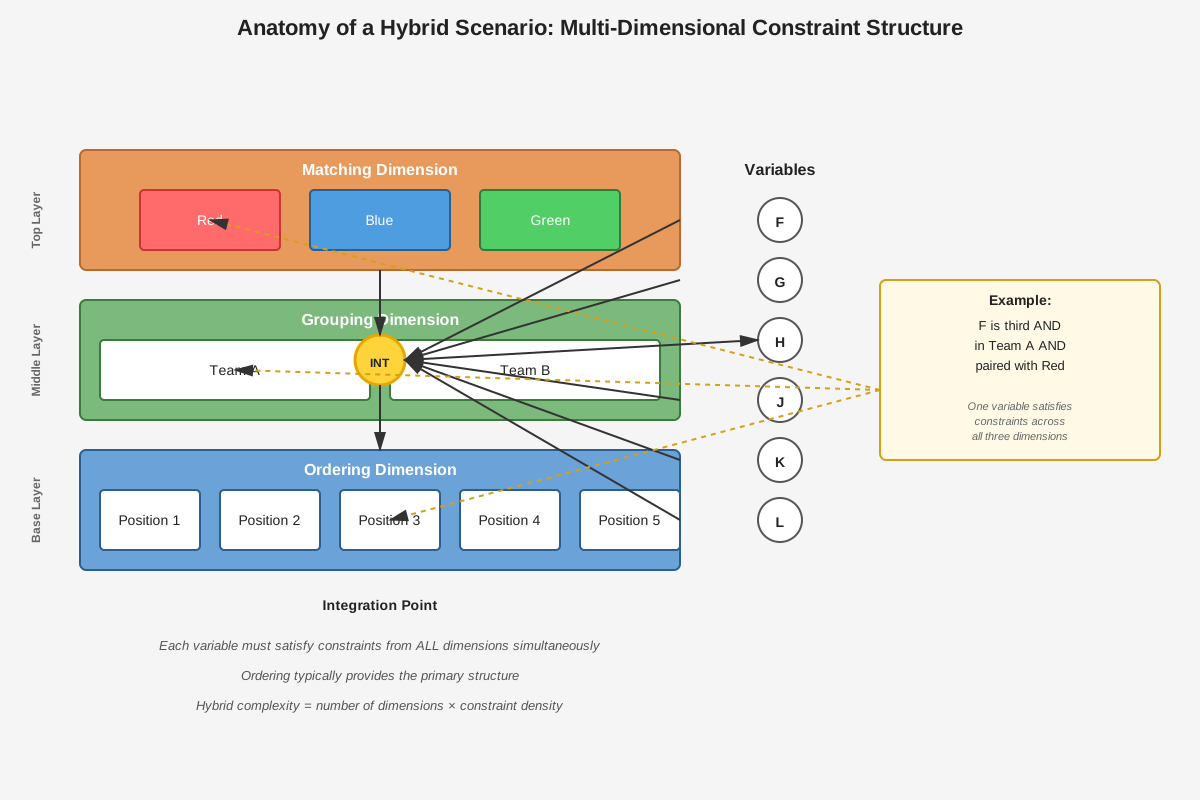
The complexity of lsat hybrid scenarios stems from their multi-dimensional nature. A typical hybrid game might require you to determine not only which items are selected but also the order in which they appear, who they're paired with, or which category they belong to. This layered structure mirrors real-world decision-making processes where multiple variables interact simultaneously. For example, you might need to schedule presentations (ordering) while ensuring certain speakers present together (grouping) and that specific topics are covered (selection).
Mastering hybrid scenarios is essential for achieving a competitive LSAT score because these games appear regularly on modern tests and often constitute the most difficult game in a section. They test the full range of analytical reasoning skills developed throughout your LSAT preparation. Understanding how to decompose hybrid scenarios into their component parts, recognize which constraints govern which dimensions, and systematically work through the logical implications will dramatically improve both accuracy and speed on test day.
Learning Objectives
- [ ] Identify how Hybrid scenarios appears in LSAT questions
- [ ] Explain the reasoning pattern behind Hybrid scenarios
- [ ] Apply Hybrid scenarios to solve LSAT-style problems accurately
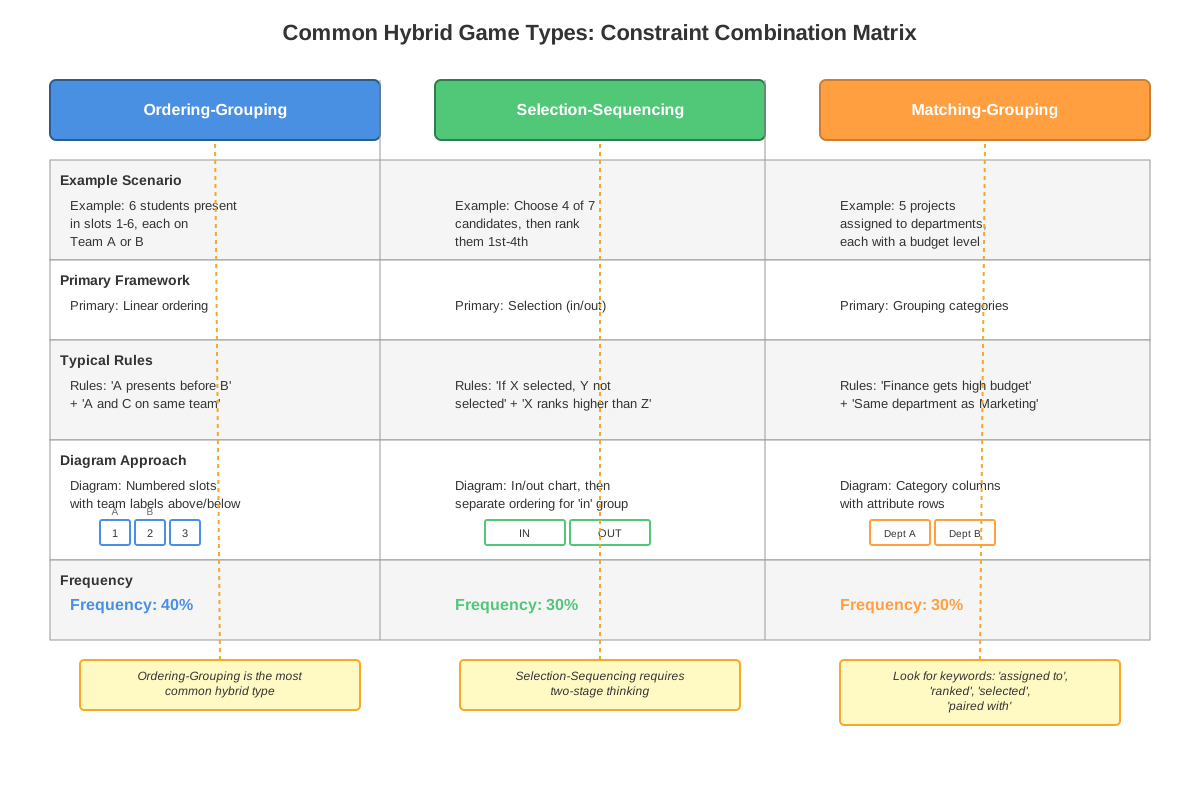
- [ ] Distinguish between different types of hybrid combinations (ordering-grouping, selection-sequencing, matching-grouping)
- [ ] Construct effective visual representations that capture multiple constraint dimensions simultaneously
- [ ] Recognize when to prioritize one constraint type over another during setup and deduction phases
Prerequisites
- Basic Sequencing Games: Understanding linear ordering and relative positioning is essential because most hybrid scenarios incorporate an ordering component that serves as the structural foundation
- Grouping Fundamentals: Familiarity with in/out grouping and distribution principles is necessary since hybrid games frequently require sorting elements into categories while managing other constraints
- Matching Game Mechanics: Knowledge of one-to-one and one-to-many relationships helps when hybrid scenarios involve pairing elements with attributes or characteristics
- Rule Representation: Ability to symbolize conditional statements, numerical constraints, and spatial relationships ensures efficient translation of complex hybrid rules
Why This Topic Matters
Hybrid scenarios represent the evolution of LSAT Analytical Reasoning toward more complex, multi-layered problems that better assess sophisticated logical thinking. In real-world legal practice, attorneys must constantly juggle multiple constraints simultaneously—scheduling depositions while managing witness availability, case priorities, and procedural requirements. Hybrid games directly simulate this cognitive demand.
From an exam perspective, hybrid scenarios appear in approximately 25-35% of modern LSAT Analytical Reasoning sections, making them one of the most frequent advanced game types. They typically appear as the third or fourth game in a section and often carry the highest difficulty rating. Questions stemming from hybrid scenarios tend to be worth more strategic value because they separate high scorers from mid-range performers.
Common manifestations include: scheduling scenarios where people are assigned to time slots with additional grouping restrictions; tournament brackets combining ordering with matching; committee assignments involving both selection and hierarchical positioning; and distribution problems where items are grouped while maintaining sequential relationships. The LSAT frequently disguises these scenarios with creative contexts—from organizing museum exhibits to arranging diplomatic meetings—but the underlying logical structure remains consistent.
Core Concepts
Defining Hybrid Scenarios
A hybrid scenario in analytical reasoning legacy is any logic game that combines two or more distinct constraint types that must be satisfied simultaneously. The defining characteristic is that no single game type framework (pure sequencing, pure grouping, pure matching) adequately captures all the relationships. Instead, test-takers must integrate multiple analytical approaches within a unified representation.
The three most common hybrid combinations are:
- Ordering-Grouping Hybrids: Elements must be arranged in sequence while also being divided into distinct categories
- Selection-Sequencing Hybrids: A subset of elements must be chosen from a larger pool and then arranged in order
- Matching-Grouping Hybrids: Elements are assigned attributes or characteristics while simultaneously being sorted into groups
Structural Components of Hybrid Games
Every hybrid scenario contains these essential elements:
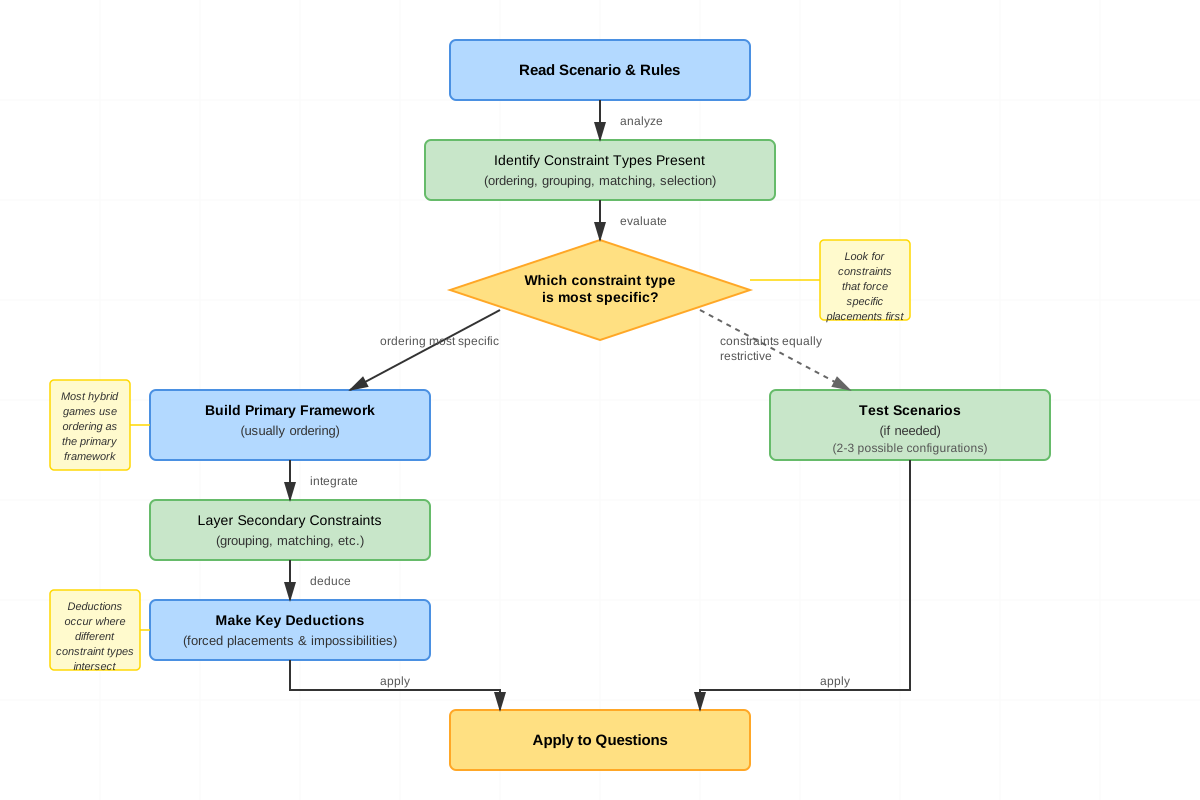
Primary Framework: One constraint type typically provides the structural backbone. This is usually the ordering component, as linear sequences offer the most intuitive visual organization. Identifying the primary framework is the critical first step in setup.
Secondary Constraint Layer: Additional rules overlay the primary structure, creating interdependencies. These might be grouping restrictions ("A and B cannot both be selected"), matching requirements ("Each person wears exactly one color"), or conditional relationships linking different dimensions.
Variable Sets: Hybrid games often involve multiple sets of variables. For example, you might have people (set 1) being assigned to days (set 2) and topics (set 3). Understanding which sets are fixed versus flexible determines your setup approach.
Numerical Constraints: Many hybrid scenarios include distribution rules specifying how many elements occupy each position or category. These constraints often generate powerful deductions when combined with other rules.
Recognition Patterns
Identifying hybrid scenarios quickly during the exam is crucial for time management. Look for these trigger phrases in the setup paragraph:
- "Each of X is assigned to exactly one of Y and presents on one of Z" (matching + grouping)
- "Exactly N of the M items are selected and arranged in order" (selection + sequencing)
- "Items are placed in positions 1 through 6, with some positions containing multiple items" (ordering + grouping)
- "Each person is assigned to a team and a time slot" (grouping + scheduling)
The word "and" connecting two different types of assignments is the strongest indicator of a hybrid structure.
Setup Strategies
Effective hybrid game setup requires a multi-dimensional representation:
| Setup Approach | Best For | Key Advantage |
|---|---|---|
| Stacked Frameworks | Ordering-Grouping | Visually separates constraint types while maintaining spatial relationships |
| Branching Diagrams | Selection-Sequencing | Shows decision points and their downstream implications |
| Matrix Grids | Matching-Grouping | Captures all possible pairings and allows systematic elimination |
| Hybrid Notation | Complex three-way hybrids | Combines multiple visual techniques in a single integrated diagram |
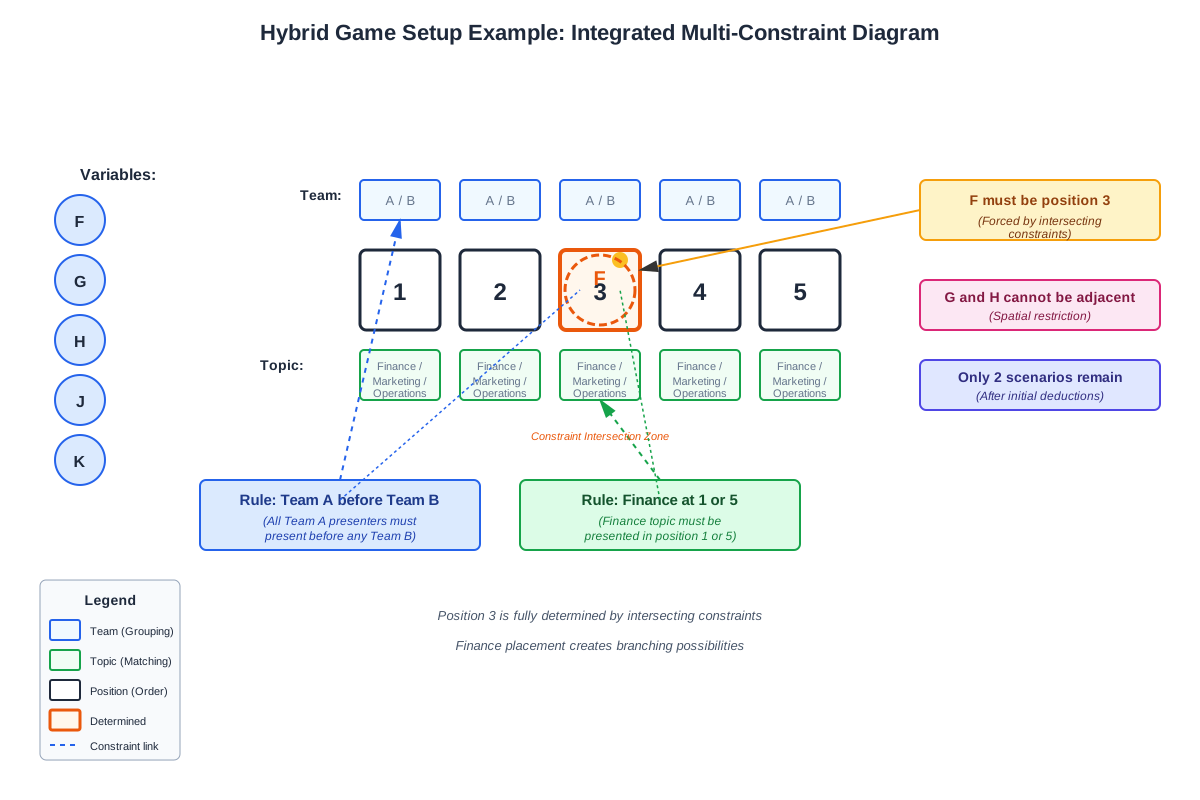
The stacked framework approach is most versatile: create your primary ordering structure (typically a linear sequence of positions), then add rows or columns above/below to track secondary constraints like group membership or attribute assignments.
Deduction Techniques
Hybrid scenarios generate deductions through constraint interaction:
- Cross-Dimensional Forcing: When a rule in one dimension (e.g., "A is in position 3") triggers implications in another dimension (e.g., "A must be in the red group"), mark both immediately
- Numerical Cascades: Distribution limits in one constraint type often force specific arrangements in another
- Conditional Chains: Rules linking different dimensions create extended if-then sequences that span multiple constraint types
- Elimination Patterns: Impossibilities in one dimension restrict options in others, creating a cascading elimination effect
Question Type Adaptations
Hybrid scenarios generate unique question variations:
Multi-Dimensional "Could Be True" Questions: These require checking whether a proposed arrangement satisfies constraints across all dimensions simultaneously. Approach systematically by verifying each constraint type separately.
Partial Determination Questions: "If A is in position 2 and in the blue group, which must be true?" These leverage the interaction between constraint types to force additional deductions.
Complete Arrangement Questions: Asking for a fully specified solution across all dimensions. These reward thorough upfront deduction work during setup.
Concept Relationships
The core concepts within hybrid scenarios build upon each other hierarchically. Recognition patterns must be mastered first, as they determine whether you correctly identify a game as hybrid versus pure type. This recognition directly informs your setup strategy choice—selecting the wrong primary framework wastes valuable time and obscures deductions.
Once setup is complete, deduction techniques become operational. The effectiveness of these techniques depends entirely on how well your setup captures the multi-dimensional relationships. Cross-dimensional forcing and numerical cascades only work when your visual representation makes constraint interactions visible.
Question type adaptations represent the application phase, where all previous concepts converge. Success on multi-dimensional questions requires fluid movement between constraint types, which is only possible with solid setup and thorough deductions.
Connecting to prerequisite knowledge: Basic sequencing games provide the primary framework for most hybrids → Grouping fundamentals add the secondary constraint layer → Matching game mechanics introduce the attribute dimension → Rule representation enables efficient capture of complex interactions.
The progression flows: Recognition → Setup → Deduction → Application, with each stage dependent on mastery of the previous.
High-Yield Facts
⭐ Approximately 30% of modern LSAT Analytical Reasoning sections contain at least one hybrid scenario, making them among the most frequently tested advanced game types.
⭐ The ordering component almost always serves as the primary framework in ordering-grouping hybrids because linear sequences provide the most intuitive organizational structure.
⭐ Numerical constraints in hybrid games generate more deductions than in pure game types because they restrict possibilities across multiple dimensions simultaneously.
⭐ The word "and" connecting two different assignment types in the setup paragraph is the strongest indicator of a hybrid structure requiring multi-dimensional representation.
⭐ Stacked frameworks (linear sequence with additional rows/columns for secondary constraints) are the most versatile setup approach for hybrid scenarios, applicable to 70%+ of hybrid game types.
- Hybrid scenarios typically appear as the third or fourth game in an Analytical Reasoning section, positioned after simpler games to increase difficulty progression.
- Selection-sequencing hybrids require two distinct phases: first determine which elements are included, then arrange those selected elements in order.
- Cross-dimensional forcing occurs when satisfying a constraint in one dimension automatically triggers implications in another dimension.
- Complete arrangement questions in hybrid games reward thorough upfront deduction work more than any other question type.
- The most common error in hybrid scenarios is treating them as pure game types and missing an entire constraint dimension.
- Hybrid games with three or more constraint dimensions (rare but appearing occasionally) should be approached by identifying the two dominant constraint types and treating the third as supplementary rules.
Quick check — test yourself on Hybrid scenarios so far.
Try Flashcards →Common Misconceptions
Misconception: All complex games are hybrid games. → Correction: Complexity alone doesn't define a hybrid. A game is hybrid only when it requires simultaneously satisfying constraints from two or more distinct game type categories (ordering, grouping, matching, selection). A pure sequencing game with many rules is still pure sequencing.
Misconception: You should complete one constraint type entirely before addressing the other. → Correction: Hybrid games require integrated thinking. The most powerful deductions emerge from constraint interactions across dimensions. Always look for cross-dimensional implications rather than solving each dimension in isolation.
Misconception: The setup for hybrid games should combine all constraint types into a single unified diagram. → Correction: While integration is important, the most effective setups maintain visual separation between constraint types (like stacked frameworks) while showing their connections. Attempting to merge everything into one representation often creates confusion.
Misconception: Hybrid games always take longer than pure game types. → Correction: With proper recognition and setup, hybrid games can be solved as efficiently as pure types. The key is investing adequate time in setup and deductions upfront, which actually saves time on questions.
Misconception: If you can't immediately see how to set up a hybrid game, you should skip it. → Correction: Hybrid games often appear difficult initially but become manageable once you identify the primary framework. Take 30-60 seconds to analyze the constraint types before deciding to skip. Many test-takers who skip hybrids could solve them with proper setup.
Worked Examples
Example 1: Ordering-Grouping Hybrid
Setup: Six students—F, G, H, J, K, L—each give exactly one presentation, numbered 1 through 6. Each student is assigned to either the morning group or the afternoon group. The following conditions apply:
- F presents before G
- H and J are in the same group
- K is in the morning group
- L presents fourth
- Exactly three students are in each group
Solution Process:
Step 1 - Recognition: This is an ordering-grouping hybrid. The phrase "each give exactly one presentation, numbered 1 through 6" signals ordering, while "assigned to either the morning group or the afternoon group" signals grouping.
Step 2 - Setup: Create a stacked framework:
Position:  1    2    3    4    5    6
Student:   __   __   __    L   __   __
Group:     __   __   __   __   __   __
           (M = morning, A = afternoon)
Step 3 - Initial Deductions:
- L is in position 4 (given)
- K must be marked as morning group (given)
- F must come before G somewhere in positions 1-6
- H and J must be in the same group (either both M or both A)
- Exactly 3 in each group (numerical constraint)
Step 4 - Numerical Cascade: Since K is morning and we need exactly 3 in each group, we need 2 more morning students and 3 afternoon students. Since H and J must be together, they're either both morning (making K, H, J the three morning students) or both afternoon (meaning two of F, G, L must be morning with K).
Step 5 - Scenario Split: This creates two major scenarios worth diagramming:
Scenario A: H and J are morning (with K)
- Morning: K, H, J
- Afternoon: F, G, L
Scenario B: H and J are afternoon
- Morning: K + two of {F, G, L}
- Afternoon: H, J + one of {F, G, L}
Step 6 - Apply Additional Constraints: In Scenario A, since F must precede G and both are afternoon, we know F comes before G in the afternoon slots. In Scenario B, we need to determine which of F, G, L joins H and J in afternoon.
This setup enables rapid answering of questions by checking each scenario against the proposed conditions.
Example 2: Selection-Sequencing Hybrid
Setup: A committee will select exactly four of seven candidates—R, S, T, U, V, W, X—and rank them from first to fourth. The following conditions apply:
- If R is selected, then S is not selected
- T is selected and ranked higher than U if U is selected
- V is selected only if W is selected
- X is ranked second if X is selected
Solution Process:
Step 1 - Recognition: The phrase "select exactly four of seven" signals selection, while "rank them from first to fourth" signals sequencing. This is a selection-sequencing hybrid requiring two-phase analysis.
Step 2 - Phase 1 (Selection): Determine which combinations of four candidates are possible:
- R and S cannot both be selected (conditional rule)
- If V is selected, W must be selected (conditional rule)
- These rules constrain but don't fully determine selection
Step 3 - Phase 2 (Sequencing): For any valid selection, determine possible orderings:
- If X is selected, X must be in position 2 (fixed position rule)
- If both T and U are selected, T must rank higher than U (relative ordering)
Step 4 - Integrated Analysis: The most efficient approach is to consider the fixed position rule first. Create two major branches:
Branch 1: X is selected
Position:  1    2    3    4
          __    X   __   __
Now select 3 more from {R, S, T, U, V, W} following selection rules.
Branch 2: X is not selected
Position:  1    2    3    4
          __   __   __   __
Select 4 from {R, S, T, U, V, W} following selection rules.
Step 5 - Apply Selection Constraints: In Branch 1, if we select V, we must select W (using two of our three remaining slots). This limits flexibility. If we select R, we cannot select S. Working through these constraints systematically reveals which combinations are viable.
Step 6 - Question Application: For "could be true" questions, check both selection validity (does this combination violate selection rules?) and sequencing validity (does this ordering violate sequencing rules?). Both dimensions must be satisfied.
Exam Strategy
Initial Recognition (15-20 seconds): Read the setup paragraph carefully, highlighting words that indicate different constraint types. The moment you see "and" connecting two different types of assignments, flag the game as hybrid and mentally prepare for multi-dimensional setup.
Setup Investment (90-120 seconds): Hybrid games reward thorough setup more than pure game types. Invest adequate time creating a clear visual representation that captures both constraint dimensions. Don't rush this phase—a good setup makes questions dramatically faster.
Trigger Phrases to Watch For:
- "Each... is assigned to... and..." (signals multiple dimensions)
- "Exactly N of M are selected and arranged" (selection-sequencing)
- "Some positions contain multiple items" (ordering-grouping)
- "Each person is paired with exactly one..." (matching component)
Process of Elimination Tips:
- On "could be true" questions, eliminate answers that violate either constraint dimension—you don't need to verify both dimensions for wrong answers
- On "must be true" questions, test answers against both dimensions; correct answers must be forced by constraint interactions
- On "complete arrangement" questions, check the easiest constraint type first (usually numerical constraints) to eliminate impossible answers quickly
Time Allocation:
- Setup and deductions: 2-2.5 minutes (longer than pure games)
- Questions: 30-45 seconds each (faster than pure games if setup is solid)
- Total: 5-6 minutes for a typical 5-6 question hybrid game
Priority Strategy: If you're running short on time, hybrid games with strong numerical constraints and fixed positions offer the best return on investment because they generate forced deductions that make questions faster.
Exam Tip: When stuck on a hybrid game, return to the numerical constraints. In 70% of cases, combining numerical limits with other rules generates the breakthrough deduction needed to unlock the game.
Memory Techniques
H.Y.B.R.I.D. Framework for systematic approach:
- Highlight constraint types in the setup paragraph
- Yield to the primary framework (usually ordering)
- Build your stacked or integrated diagram
- Record all rules in both dimensions
- Identify numerical constraints and fixed positions
- Deduce cross-dimensional implications
"STACK" for Setup:
- Sequence first (establish the primary ordering framework)
- Track secondary constraints (add grouping/matching layer)
- Analyze numerical limits (note distribution requirements)
- Connect dimensions (mark cross-dimensional rules)
- Key deductions (make forced inferences before questions)
Visual Mnemonic: Picture a layer cake where each layer represents a different constraint type. Just as you can't eat one layer without the others, you can't solve hybrid games by addressing only one dimension. The frosting between layers represents the cross-dimensional rules that connect everything together.
The "AND" Rule: Whenever you see "and" connecting two different types of assignments in the setup, physically circle it and write "HYBRID" in the margin. This simple habit prevents the most common error—treating a hybrid as a pure game type.
Summary
Hybrid scenarios represent the integration of multiple constraint types within a single analytical reasoning game, requiring test-takers to simultaneously manage ordering, grouping, selection, and/or matching elements. These games appear in approximately 30% of modern LSAT sections and typically constitute the most challenging game in a set. Success depends on rapid recognition of the hybrid structure, selection of an appropriate multi-dimensional setup (most commonly stacked frameworks), and systematic deduction of cross-dimensional implications. The most powerful deductions emerge from constraint interactions—particularly numerical limits combined with conditional rules spanning multiple dimensions. Effective time management requires investing 2-2.5 minutes in thorough setup and deduction work, which enables faster question answering. The key distinction between hybrid and pure games is that no single game type framework adequately captures all relationships; instead, multiple analytical approaches must be integrated within a unified representation that maintains visual clarity while showing connections between constraint types.
Key Takeaways
- Hybrid scenarios combine two or more distinct constraint types (ordering, grouping, matching, selection) that must be satisfied simultaneously, requiring multi-dimensional analytical frameworks
- The word "and" connecting different assignment types in the setup paragraph is the primary recognition trigger for identifying hybrid structures quickly during the exam
- Stacked frameworks—linear sequences with additional rows/columns for secondary constraints—provide the most versatile setup approach for 70%+ of hybrid game types
- Cross-dimensional deductions, where satisfying one constraint type forces implications in another, generate the most powerful inferences and separate high scorers from average performers
- Numerical constraints in hybrid games are exceptionally high-yield because they restrict possibilities across multiple dimensions simultaneously, often creating forced scenarios
- Invest 2-2.5 minutes in setup and deduction for hybrid games—this longer upfront investment pays dividends through faster question answering
- Never solve hybrid games by completing one dimension entirely before addressing another—the most efficient approach integrates both dimensions from the start, looking for constraint interactions
Related Topics
Advanced Conditional Reasoning in Games: Builds on hybrid scenarios by exploring complex conditional chains that span multiple constraint dimensions, particularly useful for hybrid games with extensive if-then rules.
Game Scenario Splitting: Deepens understanding of when and how to create multiple scenario diagrams in hybrid games, especially when numerical constraints or key conditional rules create natural division points.
Optimization Strategies for Difficult Games: Applies hybrid game principles to the most challenging LSAT games, including three-dimensional hybrids and games with unusual constraint combinations.
Timing and Triage in Analytical Reasoning: Uses hybrid game recognition as a key component of section-wide strategy, helping determine which games to attempt first and which to save for later.
Mastering hybrid scenarios creates a foundation for tackling any complex analytical reasoning challenge on the LSAT, as these games require the full integration of skills developed throughout your preparation.
Practice CTA
Now that you understand the structure and strategy behind hybrid scenarios, it's time to apply these concepts to actual LSAT-style problems. The practice questions and flashcards have been specifically designed to reinforce the recognition patterns, setup techniques, and deduction strategies covered in this guide. Each practice problem will challenge you to integrate multiple constraint types, just as you'll encounter on test day. Remember: hybrid games become significantly more manageable with practice, as pattern recognition develops through repetition. Approach each practice problem systematically using the H.Y.B.R.I.D. framework, and review your work to identify which deduction techniques you're applying successfully and which need more development. Your investment in mastering hybrid scenarios will pay substantial dividends on test day—these games separate good scores from great scores!
Sign up free to keep reading
Create a free AnvayaPrep account to finish this LSAT guide on Hybrid scenarios — plus flashcards and practice questions.