Overview
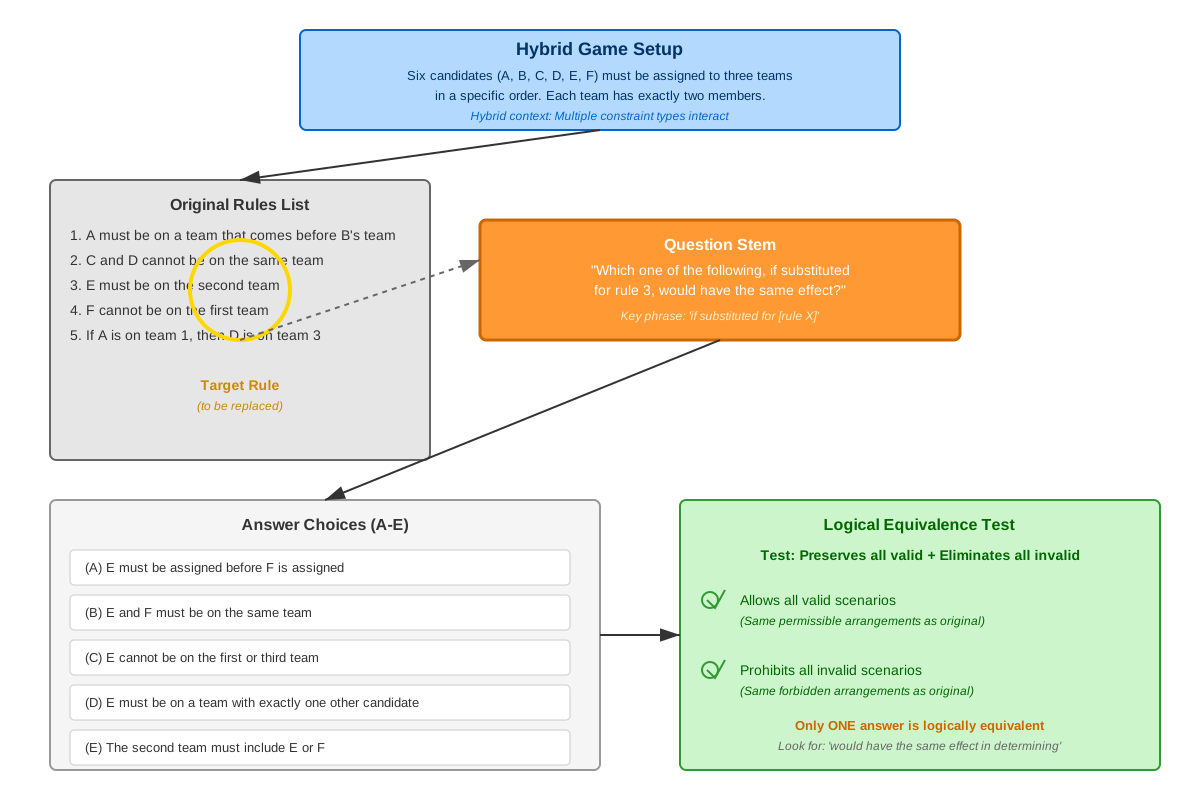
Hybrid substitution questions represent one of the most challenging and strategically important question types within the Analytical Reasoning Legacy section of the LSAT. These questions appear in hybrid games legacy scenarios where test-takers must evaluate whether a new rule can completely replace an existing rule while maintaining all the same logical constraints and deductions. Unlike standard rule substitution questions that appear in pure sequencing or grouping games, hybrid substitution questions require students to navigate the complex interplay between multiple game types simultaneously—often combining elements of ordering, grouping, and matching within a single logical framework.
The difficulty of LSAT hybrid substitution questions stems from their demand for comprehensive game understanding. Students cannot simply test the new rule against the original constraints; they must verify that the substitution preserves every valid scenario while eliminating every invalid one. This requires mastery of conditional logic, spatial reasoning, and the ability to recognize equivalent logical statements across different game structures. A successful approach demands that test-takers understand not just what the original rule explicitly states, but also what it implicitly prevents and allows within the game's architecture.
Within the broader context of analytical reasoning legacy, hybrid substitution questions serve as a culminating assessment of logical reasoning skills. They test whether students can synthesize multiple constraint types, recognize logical equivalence across different formulations, and systematically evaluate complex rule interactions. These questions typically appear as the final question in a game set and often determine the difference between a good score and an exceptional one, making them essential for students targeting top-tier law schools.
Learning Objectives
- [ ] Identify how hybrid substitution questions appear in LSAT questions
- [ ] Explain the reasoning pattern behind hybrid substitution questions
- [ ] Apply hybrid substitution questions to solve LSAT-style problems accurately
- [ ] Distinguish between rules that are logically equivalent versus merely compatible with game constraints
- [ ] Systematically test potential substitute rules against both positive and negative scenarios
- [ ] Recognize common trap answers that preserve some but not all implications of the original rule
- [ ] Efficiently allocate time to substitution questions based on their strategic value
Prerequisites
- Basic rule representation and notation: Understanding how to symbolize conditional statements, sequencing constraints, and grouping rules is essential because substitution questions require comparing different rule formulations
- Hybrid game structure recognition: Familiarity with games that combine multiple constraint types (ordering, grouping, matching) is necessary because substitution questions in hybrid games involve interactions across game dimensions
- Deductive reasoning and inference chains: The ability to derive secondary conclusions from primary rules is critical because substitute rules must preserve all original inferences, not just the explicit constraint
- Contrapositive logic: Understanding how to form and apply contrapositives is fundamental because logically equivalent rules often appear in contrapositive form
- Game board setup and diagramming: Proficiency in creating visual representations of game constraints is required because testing substitute rules demands quick scenario verification
Why This Topic Matters
Hybrid substitution questions represent approximately 8-12% of all analytical reasoning questions on modern LSAT administrations, appearing in roughly one out of every two to three test sections. Their strategic importance far exceeds their frequency, however, because they consistently rank among the most difficult questions in any given section, with average accuracy rates typically falling between 35-45% among test-takers. This difficulty level makes them prime candidates for score differentiation at the highest percentiles.
On the LSAT, these questions most commonly appear as the final question in a hybrid game set, following the stem format: "Which one of the following, if substituted for the constraint that [original rule], would have the same effect in determining the arrangement?" This placement is strategic—the test makers position these questions last to reward students who have thoroughly understood the game's logical structure through working previous questions. Students who have built a comprehensive understanding of the game's constraints and deductions are positioned to answer substitution questions efficiently, while those who have merely "gotten by" on earlier questions often struggle significantly.
The practical significance extends beyond test performance. Hybrid substitution questions develop the legal reasoning skill of recognizing when different statutory or contractual language produces identical legal effects—a fundamental competency for law school case analysis and legal practice. The ability to determine whether two differently worded provisions are functionally equivalent is central to contract interpretation, statutory construction, and precedent analysis.
Core Concepts
Understanding Hybrid Substitution Question Structure
Hybrid substitution questions in analytical reasoning require test-takers to identify a rule that can completely replace an existing constraint while maintaining identical logical effects across all possible scenarios. The "hybrid" designation indicates that these questions appear in games combining multiple structural elements—typically mixing ordering (sequencing), grouping (selection), and matching (assignment) constraints within a single framework.
The fundamental challenge lies in the word "same effect." A substitute rule must satisfy three critical conditions:
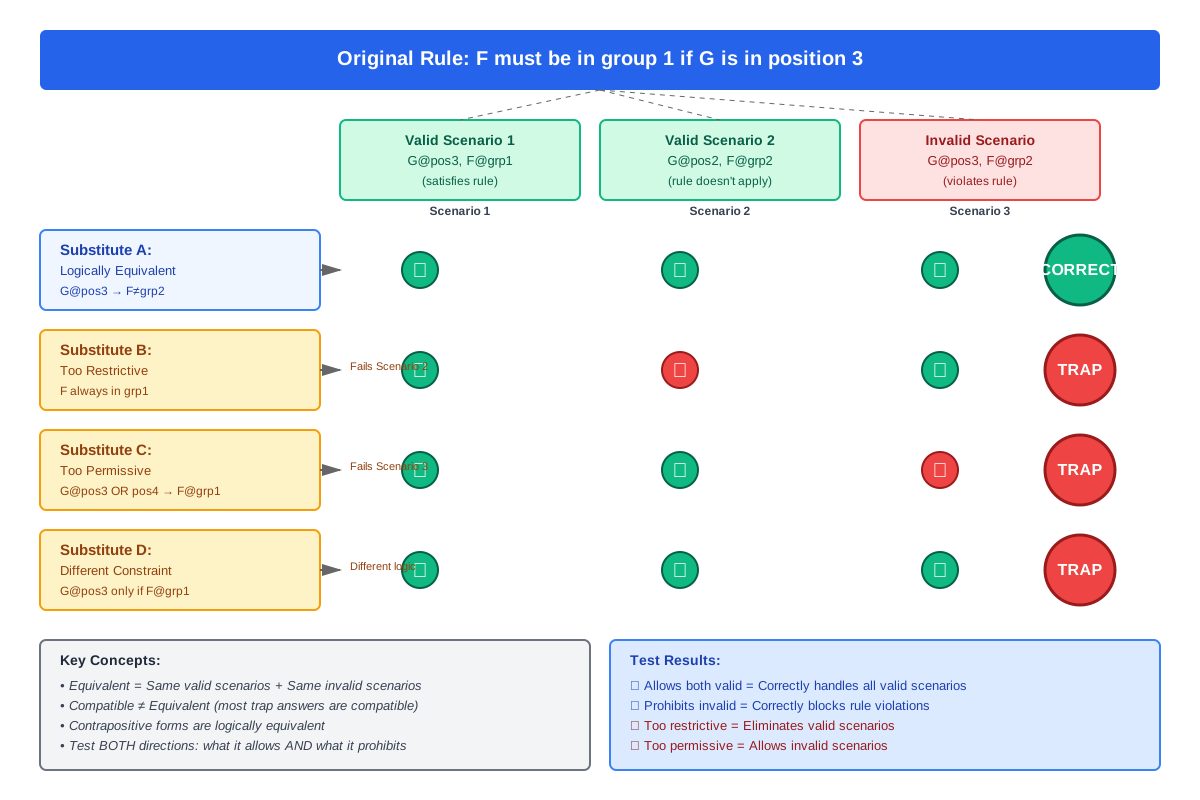
- Permit everything the original rule permits: Every valid scenario under the original rule must remain valid under the substitute
- Prohibit everything the original rule prohibits: Every invalid scenario under the original rule must remain invalid under the substitute
- Create no additional restrictions or permissions: The substitute cannot be more restrictive or more permissive than the original
The Logical Equivalence Principle
At the heart of substitution questions lies the concept of logical equivalence—two statements are logically equivalent if and only if they have identical truth conditions in all possible worlds. In LSAT terms, this means the substitute rule must divide the universe of possible arrangements into valid and invalid scenarios in exactly the same way as the original rule.
Consider a simple example: In a sequencing game, the rule "A is before B" is logically equivalent to "B is after A" but NOT equivalent to "A is not immediately after B." The first substitution preserves all implications; the second is merely compatible but allows scenarios (like B before A with no adjacency) that the original rule prohibits.
Testing Methodology for Substitution Questions
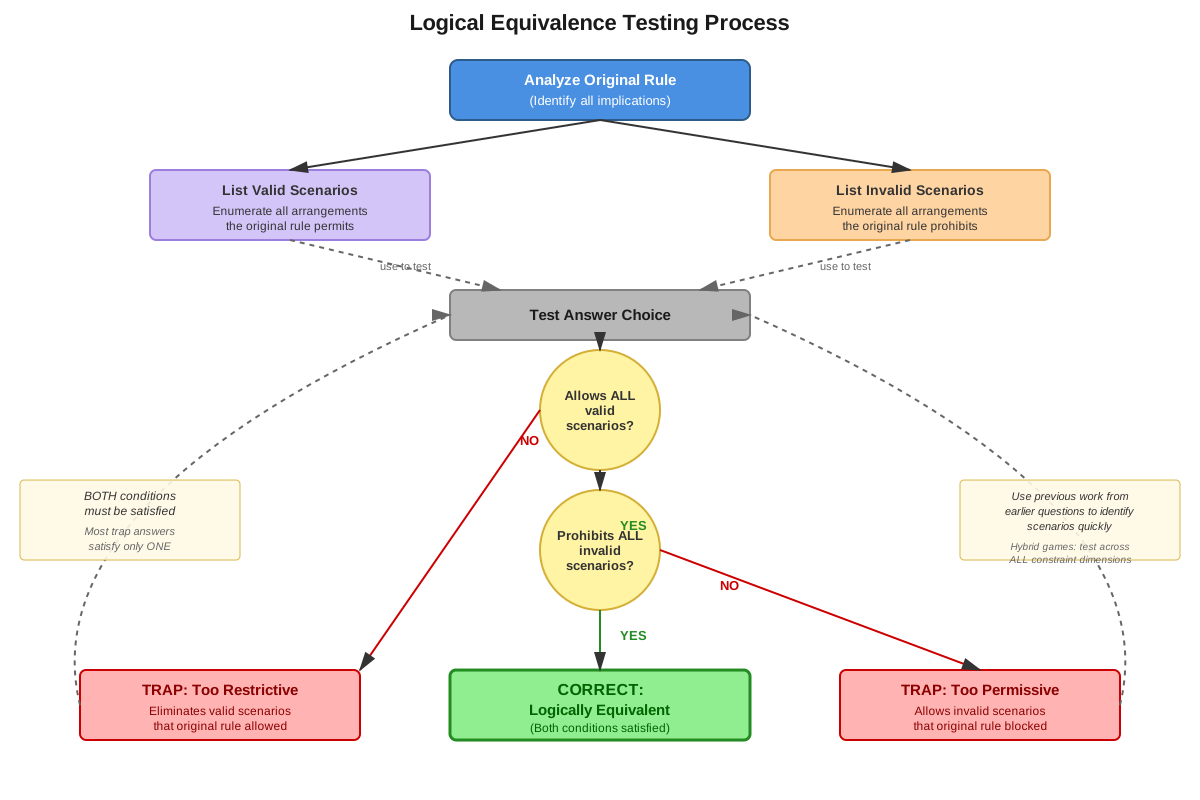
The systematic approach to evaluating potential substitute rules involves:
- Identify all implications of the original rule: List both direct constraints and derived inferences
- Test each answer choice against known valid scenarios: Use scenarios from previous questions or create simple test cases
- Test each answer choice against known invalid scenarios: Verify that the substitute still prohibits what should be prohibited
- Check for over-restriction: Ensure the substitute doesn't eliminate valid possibilities
- Check for under-restriction: Ensure the substitute doesn't permit invalid possibilities
The Role of Previous Question Work
A critical strategic insight for hybrid substitution questions is that previous questions in the game set provide invaluable testing scenarios. Specifically:
- Acceptable arrangement questions provide complete valid scenarios that any substitute rule must permit
- "Could be true" questions identify possibilities that must remain possible under the substitute
- "Must be false" questions identify impossibilities that must remain impossible under the substitute
- Local rule questions (though modified by additional constraints) can reveal implications of the original rule
Common Trap Answer Patterns
Test makers construct incorrect answer choices for substitution questions using predictable patterns:
| Trap Type | Description | Example Context |
|---|---|---|
| Partial Equivalence | Captures some but not all implications of the original rule | Preserves ordering but not grouping constraint in hybrid game |
| Contrapositive Confusion | Appears to be contrapositive but introduces subtle logical shift | Changes "if A then B" to "if not B then not A" with additional restriction |
| Over-Restriction | Eliminates valid scenarios the original rule permitted | Adds unnecessary constraint that narrows possibilities |
| Under-Restriction | Permits invalid scenarios the original rule prohibited | Fails to capture a secondary inference of the original |
| Dimension Mismatch | Addresses only one dimension of a multi-dimensional constraint | In hybrid game, addresses sequencing but ignores grouping element |
Hybrid Game Complexity Factors
Substitution questions in hybrid games present unique challenges because the original rule often operates across multiple game dimensions simultaneously. For example, a rule might state: "If K is selected, then K must be assigned before L." This single rule contains:
- A conditional trigger (selection of K)
- A grouping implication (K's selection status affects the game)
- A sequencing constraint (relative ordering of K and L)
A valid substitute must preserve all three dimensions of constraint. An answer choice that correctly captures the sequencing relationship but fails to maintain the conditional nature would be incorrect.
The Inference Preservation Requirement
Perhaps the most sophisticated aspect of hybrid substitution questions is the requirement that substitute rules preserve not just explicit constraints but also derived inferences. When an original rule combines with other game constraints to produce secondary conclusions, the substitute rule must generate those same conclusions.
For instance, if the original rule "M and N cannot both be selected" combines with another rule "If P is selected, then M is selected" to produce the inference "If P is selected, then N is not selected," then any valid substitute must also generate this inference when combined with the second rule.
Concept Relationships
The concepts within hybrid substitution questions form an interconnected logical hierarchy. Logical equivalence serves as the foundational principle, establishing the standard that substitute rules must meet. This principle directly informs the testing methodology, which operationalizes equivalence through systematic scenario verification. The inference preservation requirement extends logical equivalence beyond explicit rule statements to include derived conclusions, creating a more demanding standard.
Previous question work provides the practical toolkit for implementing the testing methodology, offering concrete scenarios against which to evaluate potential substitutes. This connects back to the broader prerequisite knowledge of game setup and deduction-making, as students must have correctly solved earlier questions to leverage their scenarios effectively.
Trap answer patterns represent the inverse of correct substitution—each trap type illustrates a specific way that logical equivalence can fail. Understanding these patterns creates a negative space definition of equivalence: a correct substitute is one that avoids all forms of partial equivalence, over-restriction, under-restriction, and dimension mismatch.
The hybrid game complexity factors interact with all other concepts by multiplying the dimensions across which equivalence must be verified. In a pure sequencing game, equivalence might require checking only relative positions; in a hybrid game, equivalence must be verified across ordering, grouping, and matching dimensions simultaneously.
Relationship Map:
Logical Equivalence Principle → defines standard for → Testing Methodology → implemented using → Previous Question Work → reveals → Trap Answer Patterns → which violate → Logical Equivalence Principle (completing the cycle)
Hybrid Game Complexity Factors → amplifies difficulty of → all other concepts by adding dimensional requirements
High-Yield Facts
⭐ Hybrid substitution questions almost always appear as the final question in a game set, making them strategically skippable if time is limited, but highly valuable if the game has been thoroughly understood.
⭐ A correct substitute rule must preserve ALL inferences of the original rule, not just the explicit constraint stated—this is the most common reason students select incorrect answers.
⭐ Valid scenarios from acceptable arrangement questions provide the fastest way to eliminate incorrect answer choices by testing whether the substitute would still permit those arrangements.
⭐ The correct answer to a substitution question is often the contrapositive or logical equivalent of the original rule combined with another game constraint, requiring recognition of multi-rule interactions.
⭐ If an answer choice is more restrictive than the original rule (eliminates valid possibilities), it cannot be correct, even if it seems to capture the rule's "spirit."
- Substitution questions typically have the lowest accuracy rate of any question type in a game set, averaging 35-45% correct responses among test-takers.
- The phrase "same effect in determining" is the key language that signals a substitution question, distinguishing it from questions asking what "could replace" or "would be consistent with" a rule.
- In hybrid games, substitute rules often need to address multiple game dimensions (ordering AND grouping, for example) within a single statement to achieve equivalence.
- Incorrect answer choices frequently capture the contrapositive of the original rule but add an unnecessary additional restriction.
- Testing the substitute rule against scenarios where the original rule was "inactive" (not triggered) is as important as testing scenarios where it was active.
Quick check — test yourself on Hybrid substitution questions so far.
Try Flashcards →Common Misconceptions
Misconception: A substitute rule is correct if it produces the same result in most scenarios.
Correction: Logical equivalence requires identical results in ALL possible scenarios. A rule that works in 90% of cases but fails in even one valid or invalid scenario is incorrect. The LSAT tests absolute logical equivalence, not practical similarity.
Misconception: The correct substitute will be worded similarly to the original rule.
Correction: Logically equivalent rules often appear in dramatically different formulations. The correct substitute might use entirely different variables, express the relationship in contrapositive form, or combine multiple constraints into a single statement. Focus on logical effect, not surface similarity.
Misconception: If a substitute rule doesn't contradict any other game rules, it must be correct.
Correction: Compatibility with other rules is necessary but not sufficient. A substitute must not only avoid contradiction but must also generate all the same inferences as the original rule when combined with other constraints. Many trap answers are compatible but under-restrictive.
Misconception: Substitution questions require testing every possible scenario from scratch.
Correction: Efficient test-takers leverage work from previous questions, using established valid and invalid scenarios as test cases. This approach typically allows elimination of 3-4 answer choices quickly, leaving only 1-2 choices that require deeper analysis.
Misconception: The correct answer will be the most restrictive option that doesn't violate any rules.
Correction: Over-restriction is as fatal as under-restriction. The correct substitute must permit everything the original permitted while prohibiting everything the original prohibited—no more, no less. The "safest" or most restrictive option is often a trap answer.
Misconception: In hybrid games, a substitute rule only needs to address the most prominent game dimension.
Correction: Hybrid game substitution requires preserving constraints across all game dimensions simultaneously. A rule that correctly captures the sequencing aspect but ignores the grouping aspect (or vice versa) will be incorrect, even if it seems to address the "main" constraint.
Worked Examples
Example 1: Hybrid Sequencing-Grouping Game
Game Setup: Six candidates—F, G, H, J, K, and L—are being considered for three positions: analyst, consultant, and director. Each position will be filled by exactly one candidate, and the remaining three candidates will not be selected. The following constraints apply:
- If F is selected, F must be assigned to a position that comes before any position assigned to G
- G and H cannot both be selected
- K must be selected
- If L is selected, L must be the director
Original Rule: "If F is selected, F must be assigned to a position that comes before any position assigned to G."
Question: Which of the following, if substituted for the constraint that if F is selected, F must be assigned to a position that comes before any position assigned to G, would have the same effect in determining which candidates are selected and their position assignments?
Answer Choices:
(A) If G is selected, G must be assigned to a position that comes after any position assigned to F
(B) F and G cannot both be selected
(C) If G is selected, F must be selected and assigned to a position before G
(D) If F is selected, G cannot be the analyst
(E) Either F is not selected or G is not selected or F is assigned before G
Analysis:
Step 1: Identify all implications of the original rule
- Direct: If F is selected AND G is selected, then F comes before G
- Contrapositive: If G comes before or equal to F, then either F is not selected OR G is not selected
- Key insight: The rule allows three scenarios: (1) F selected, G not selected; (2) F not selected, G selected; (3) Both selected with F before G
Step 2: Test answer choice (A)
This appears to be the contrapositive, but let's verify: "If G is selected, G must be assigned to a position that comes after any position assigned to F." This requires F to be selected whenever G is selected (otherwise "any position assigned to F" is undefined). This is MORE restrictive than the original—it prohibits scenario (2) where G is selected but F is not. Eliminate (A).
Step 3: Test answer choice (B)
"F and G cannot both be selected" eliminates scenario (3) where both are selected with F before G. The original rule PERMITS this scenario. This is over-restrictive. Eliminate (B).
Step 4: Test answer choice (C)
"If G is selected, F must be selected and assigned to a position before G." This requires F whenever G is selected, prohibiting scenario (2). Over-restrictive. Eliminate (C).
Step 5: Test answer choice (D)
"If F is selected, G cannot be the analyst." This allows F and G both to be selected with G as consultant or director, even if those positions come before F's position (if F is director and G is consultant, G comes before F). This permits scenarios the original prohibits. Eliminate (D).
Step 6: Test answer choice (E)
"Either F is not selected or G is not selected or F is assigned before G." This is a logical disjunction covering all three permitted scenarios:
- F not selected (covers scenario 2)
- G not selected (covers scenario 1)
- F assigned before G (covers scenario 3)
This is logically equivalent to the original rule expressed in disjunctive form. It permits exactly what the original permits and prohibits exactly what the original prohibits.
Correct Answer: (E)
Example 2: Hybrid Grouping-Matching Game
Game Setup: A committee will select exactly four of seven volunteers—R, S, T, V, W, X, and Y—and assign each selected volunteer to exactly one of four roles: leader, recorder, treasurer, or member. The following constraints apply:
- If R is selected, R must be assigned to leader
- S and T cannot both be selected
- If V is selected, W must also be selected
- X must be selected
Original Rule: "If V is selected, W must also be selected."
Question: Which of the following, if substituted for the constraint that if V is selected, W must also be selected, would have the same effect in determining which volunteers are selected and their role assignments?
Answer Choices:
(A) If W is not selected, V is not selected
(B) V and W must both be selected or both not be selected
(C) If V is selected, V and W cannot be assigned to the same role
(D) W is selected
(E) If V is selected, W must be selected and assigned to a role other than leader
Analysis:
Step 1: Identify implications of the original rule
- Direct: V selected → W selected
- Contrapositive: W not selected → V not selected
- Permits: (1) V selected, W selected; (2) V not selected, W selected; (3) V not selected, W not selected
- Prohibits: V selected, W not selected
Step 2: Test answer choice (A)
"If W is not selected, V is not selected" is the exact contrapositive of the original rule. Contrapositives are logically equivalent to their original statements. This permits and prohibits exactly the same scenarios. Strong candidate.
Step 3: Test answer choice (B)
"V and W must both be selected or both not be selected" prohibits scenario (2) where V is not selected but W is selected. The original rule permits this. Over-restrictive. Eliminate (B).
Step 4: Test answer choice (C)
This addresses role assignment but doesn't address the selection relationship. It would permit V selected without W selected (as long as they're not in the same role—which is impossible if W isn't selected). Under-restrictive. Eliminate (C).
Step 5: Test answer choice (D)
"W is selected" makes W's selection mandatory, prohibiting scenario (3) where neither V nor W is selected. Over-restrictive. Eliminate (D).
Step 6: Test answer choice (E)
This adds an unnecessary restriction about W's role assignment. The original rule says nothing about W's role, only about W's selection. Over-restrictive. Eliminate (E).
Correct Answer: (A)
The contrapositive is logically equivalent to the original conditional statement and preserves all implications across both selection and assignment dimensions of this hybrid game.
Exam Strategy
Approach Sequence for Hybrid Substitution Questions:
- Timing Decision First: Recognize that substitution questions typically appear last and are time-intensive. If fewer than 4-5 minutes remain for the game, consider skipping and returning if time permits.
- Harvest Previous Work: Before reading answer choices, review scenarios from earlier questions, particularly acceptable arrangement questions. Note which arrangements were valid and which were prohibited.
- Articulate Original Rule's Full Effect: Write out or mentally note: (a) what the rule explicitly requires, (b) its contrapositive, (c) any inferences it generates when combined with other rules.
- Use Elimination Aggressively: Test each answer choice against one known valid scenario. Any choice that would prohibit that scenario is immediately incorrect. This often eliminates 2-3 choices quickly.
- Test Remaining Choices Against Invalid Scenarios: For choices that survived step 4, verify they still prohibit what should be prohibited.
Trigger Words and Phrases:
- "Same effect in determining": The definitive phrase for substitution questions
- "If substituted for the constraint that": Identifies which original rule is being replaced
- "Would have the same effect": Emphasizes the equivalence requirement
Process of Elimination Tips:
- Eliminate choices that are more restrictive first: These are easier to identify because they prohibit scenarios you know are valid from previous questions
- Watch for dimension mismatches in hybrid games: If the original rule addresses both grouping and ordering, eliminate any choice that addresses only one dimension
- Be suspicious of choices that seem "safer" or "stronger": Test makers know students gravitate toward more restrictive rules, making these common trap answers
- Contrapositive answers are often correct but not always: Verify that the contrapositive is stated precisely without additional restrictions
Time Allocation:
- Budget 90-120 seconds for substitution questions (longer than typical questions)
- Spend 20-30 seconds reviewing previous work before engaging answer choices
- Allocate 10-15 seconds per answer choice for initial elimination
- Reserve 30-40 seconds for final verification of the remaining choice(s)
Exam Tip: If two answer choices remain after elimination and time is limited, choose the one that most closely resembles the contrapositive of the original rule or combines the original rule with another game constraint. These patterns appear in correct answers more frequently than novel formulations.
Memory Techniques
SPIDER Mnemonic for Testing Substitute Rules:
- Same scenarios permitted (test against valid arrangements)
- Prohibitions preserved (test against invalid arrangements)
- Inferences intact (verify derived conclusions still follow)
- Dimensions covered (in hybrid games, check all game types)
- Equivalence exact (not just similar or compatible)
- Review previous work (leverage earlier questions)
Visualization Strategy:
Picture the original rule as a fence dividing a field into "valid" and "invalid" sections. The substitute rule must place the fence in exactly the same location—not slightly to the left (over-restrictive), not slightly to the right (under-restrictive), and not at a different angle (dimension mismatch). Every arrangement must fall on the same side of the fence under both rules.
The "Three Scenarios" Acronym (TSA):
For conditional rules "If A then B," remember TSA:
- Trigger active, consequence satisfied (A and B)
- Skip trigger (not A, B possible)
- Avoid violation via contrapositive (not B, therefore not A)
A correct substitute must permit all three scenarios and prohibit only "A and not B."
Hybrid Game Dimension Checklist (OGM):
When evaluating substitutes in hybrid games, check:
- Ordering/sequencing preserved
- Grouping/selection preserved
- Matching/assignment preserved
Summary
Hybrid substitution questions represent the apex of analytical reasoning complexity on the LSAT, requiring test-takers to identify rules that are logically equivalent to original constraints within games that combine multiple structural elements. Success demands understanding that logical equivalence means identical effects across all possible scenarios—permitting everything the original permits, prohibiting everything the original prohibits, and generating all the same inferences when combined with other rules. The strategic approach involves leveraging previous question work to identify valid and invalid scenarios, systematically testing answer choices against these scenarios, and recognizing common trap patterns including over-restriction, under-restriction, and dimension mismatches. In hybrid games specifically, substitute rules must preserve constraints across all game dimensions simultaneously—ordering, grouping, and matching. The most efficient test-takers recognize that substitution questions, while challenging, become manageable when approached with a systematic methodology that emphasizes elimination of clearly incorrect choices before deep analysis of remaining options. Mastery of these questions distinguishes high-scoring test-takers and directly develops the legal reasoning skill of recognizing functional equivalence across different formulations.
Key Takeaways
- Hybrid substitution questions test logical equivalence, not mere compatibility—the substitute must have identical effects in all scenarios, not just most scenarios
- Leverage valid scenarios from previous questions (especially acceptable arrangement questions) to quickly eliminate over-restrictive answer choices
- In hybrid games legacy, correct substitutes must preserve constraints across all game dimensions simultaneously (ordering, grouping, matching)
- The contrapositive of the original rule is often but not always the correct answer—verify it's stated precisely without additional restrictions
- Common trap answers include partial equivalence (captures some implications), over-restriction (too limiting), and under-restriction (too permissive)
- Substitution questions typically appear last in game sets and are strategically skippable if time is severely limited, but highly valuable for score differentiation when time permits
- Testing for inference preservation—verifying that derived conclusions remain intact—is essential and frequently overlooked by test-takers
Related Topics
Pure Sequencing Substitution Questions: After mastering hybrid substitution, students should explore how substitution works in games with only ordering constraints, where the logical relationships are simpler but the equivalence principle remains identical. This builds confidence before returning to hybrid complexity.
Conditional Logic Chains in Analytical Reasoning: Understanding complex conditional relationships and their contrapositives deepens substitution question performance, as many correct substitutes involve recognizing multi-step conditional equivalences.
Rule Replacement vs. Rule Suspension Questions: Distinguishing between questions asking for equivalent rules versus questions asking what happens when rules are removed or modified helps avoid confusion about what "substitution" means in different contexts.
Advanced Hybrid Game Strategies: Mastering substitution questions enables progression to the most complex hybrid game scenarios, where multiple conditional triggers interact across different game dimensions.
Practice CTA
Now that you've mastered the conceptual framework for hybrid substitution questions, it's time to cement your understanding through active practice. Attempt the practice questions designed for this topic, focusing on applying the SPIDER methodology and leveraging previous question work. As you work through problems, pay special attention to identifying trap answer patterns—recognizing these patterns in practice will make them immediately visible on test day. Create flashcards for the key distinctions between logical equivalence and mere compatibility, and review the worked examples until you can articulate each reasoning step without reference to the solutions. Remember: substitution questions separate good scores from great scores. Your investment in mastering this challenging topic will pay dividends not only on test day but throughout your legal education, where recognizing functional equivalence across different formulations is a daily requirement. You've built the foundation—now apply it with confidence!
Sign up free to keep reading
Create a free AnvayaPrep account to finish this LSAT guide on Hybrid substitution questions — plus flashcards and practice questions.