Overview
Sequencing substitution questions represent a critical question type within the Analytical Reasoning Legacy section of the LSAT, specifically appearing in sequencing games legacy scenarios. These questions ask test-takers to identify which rule, if substituted for an existing rule in the game setup, would have the same effect on the possible arrangements of elements. Unlike standard sequencing questions that ask about specific arrangements or what must/could be true, substitution questions require a deeper understanding of how rules interact and constrain the game's solution space.
Mastering sequencing substitution questions is essential for achieving a competitive LSAT score because these questions test logical equivalence and rule interaction at a sophisticated level. They appear with moderate frequency in the Analytical Reasoning section and are considered among the more challenging question types because they require students to understand not just individual rules, but the complete logical architecture of a game. A student who can quickly identify equivalent rules demonstrates mastery of conditional reasoning, contrapositive relationships, and the cumulative effect of multiple constraints.
Within the broader context of LSAT sequencing substitution questions, this question type builds upon foundational sequencing skills—understanding ordering relationships, conditional rules, and spatial constraints—while adding an additional layer of analytical complexity. Success with substitution questions indicates readiness for the most difficult Analytical Reasoning challenges and demonstrates the kind of flexible, systematic thinking that the LSAT rewards. These questions often appear as the final question in a game set, serving as a capstone that tests comprehensive understanding of all game mechanics.
Learning Objectives
- [ ] Identify how sequencing substitution questions appears in LSAT questions
- [ ] Explain the reasoning pattern behind sequencing substitution questions
- [ ] Apply sequencing substitution questions to solve LSAT-style problems accurately
- [ ] Analyze the logical equivalence between different rule formulations in sequencing games
- [ ] Evaluate answer choices by testing their effects on the complete solution space
- [ ] Synthesize multiple game rules to determine their cumulative constraining effect
- [ ] Distinguish between rules that are partially equivalent versus completely equivalent
Prerequisites
- Basic sequencing game setup: Understanding how to diagram ordered arrangements is fundamental to recognizing when rules produce identical constraints
- Conditional reasoning: Familiarity with if-then statements and their contrapositives enables recognition of logically equivalent rule formulations
- Rule diagramming conventions: Knowledge of standard notation for sequencing relationships (before/after, blocks, anti-blocks) allows quick comparison of rule effects
- Solution space analysis: Experience determining all possible arrangements helps in verifying whether two rules truly produce identical constraints
- Compound rule interpretation: Ability to understand how multiple rules interact is necessary for evaluating whether a substitution maintains all original constraints
Why This Topic Matters
Sequencing substitution questions appear in approximately 15-20% of Analytical Reasoning game sets on modern LSAT administrations, making them a high-yield topic for focused study. When they appear, they typically constitute one question within a 5-7 question game set, often positioned as the final or penultimate question. This placement is strategic: the test-makers use substitution questions to differentiate between students who have merely memorized rule applications and those who truly understand the logical structure underlying the game.
In practical terms, mastering substitution questions provides several advantages beyond the immediate point value. First, the analytical skills required—recognizing logical equivalence, understanding rule interactions, and systematically testing constraints—transfer directly to other question types and even to other LSAT sections. Second, students who excel at substitution questions often find that their overall game comprehension improves, as these questions force a holistic understanding of how all rules work together. Third, confidence with substitution questions reduces test anxiety, as students know they can tackle even the most challenging question in a game set.
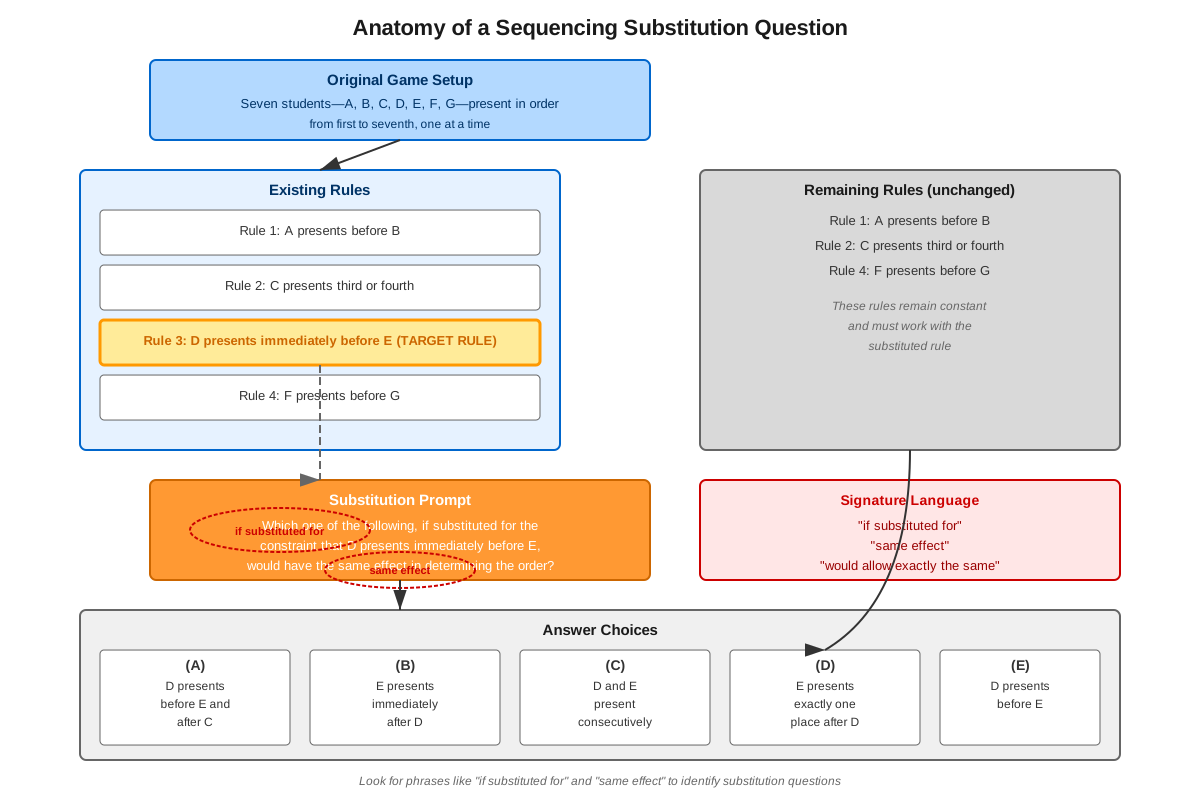
On the exam, substitution questions typically appear with language such as "Which one of the following, if substituted for the constraint that..., would have the same effect in determining the order?" or "The condition that [original rule] could be replaced by which one of the following without changing the set of possible arrangements?" These questions require 90-120 seconds on average to answer accurately, making them among the more time-intensive question types. However, the investment is worthwhile because these questions are highly predictable in structure once the underlying pattern is understood.
Core Concepts
Understanding Substitution Question Structure
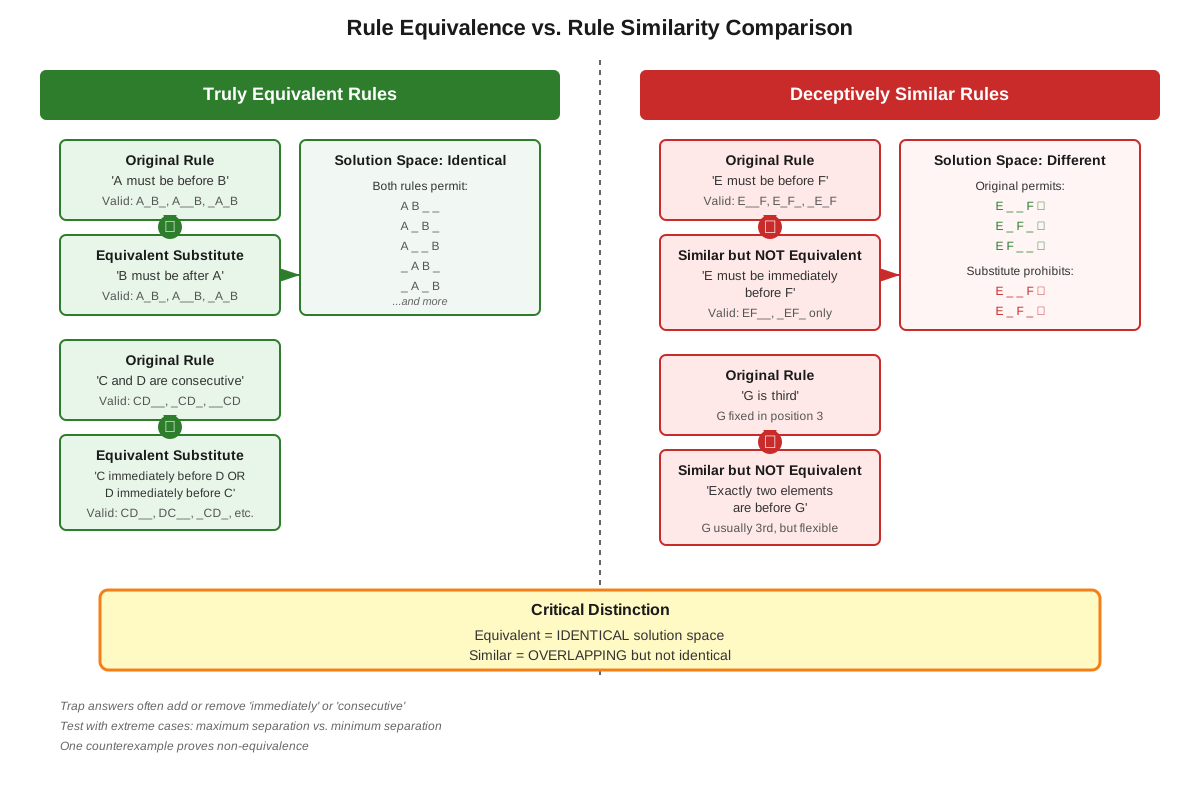
Sequencing substitution questions follow a consistent format that, once recognized, becomes highly manageable. The question stem identifies a specific rule from the original game setup and asks which answer choice could replace that rule while maintaining identical constraints on all possible arrangements. The key phrase "same effect" or "without changing the set of possible arrangements" signals that the correct answer must be logically equivalent to the original rule—not merely similar or partially overlapping.
The challenge lies in understanding what "same effect" truly means. A substitute rule must:
- Eliminate exactly the same arrangements that the original rule eliminated
- Permit exactly the same arrangements that the original rule permitted
- Interact with other rules in precisely the same way
- Produce no new constraints beyond those created by the original rule
- Remove no constraints that the original rule imposed
Types of Logical Equivalence in Sequencing
Several patterns of logical equivalence appear repeatedly in sequencing substitution questions:
Direct Contrapositive Equivalence: When the original rule states "If X is before Y, then Z is before W," a logically equivalent rule might state "If W is not before Z, then Y is not before X." These are contrapositives and always produce identical constraints.
Compound Rule Equivalence: Sometimes a single rule can be replaced by multiple rules working together, or vice versa. For example, "X is immediately before Y" is equivalent to "X is before Y AND there are no elements between X and Y."
Transitive Chain Equivalence: In sequencing, if the original rules establish that A is before B and B is before C, a substitute rule stating "A is before C" might seem equivalent, but it's actually weaker—it doesn't maintain the specific position of B. True equivalence requires capturing all relationships.
Block and Anti-Block Equivalence: A rule stating "X and Y are consecutive" can sometimes be replaced by rules that eliminate all other positioning options for X and Y relative to each other and other elements.
Systematic Testing Methodology
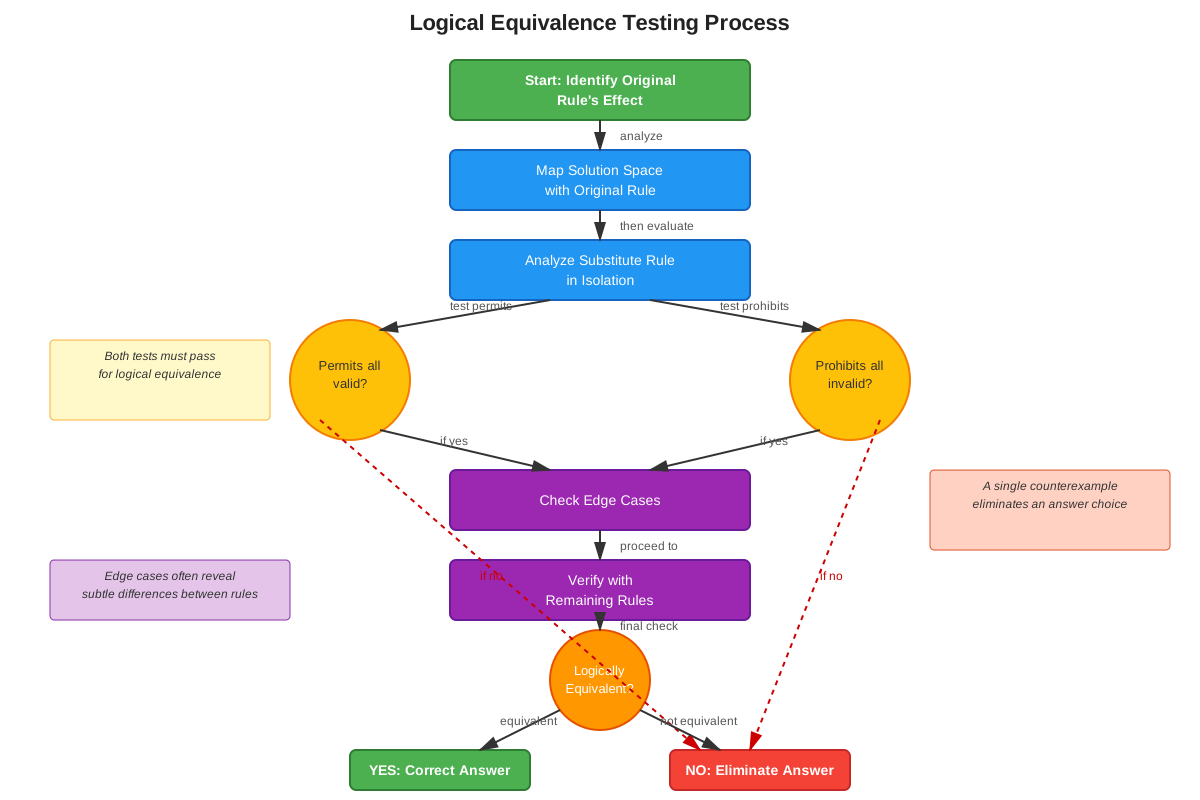
The most reliable approach to substitution questions involves systematic testing:
| Step | Action | Purpose |
|---|---|---|
| 1 | Identify the original rule's effect | Understand what arrangements it eliminates |
| 2 | Note interactions with other rules | Recognize compound effects |
| 3 | Test each answer choice | Determine if it produces identical constraints |
| 4 | Look for over-constraining | Eliminate answers that prohibit valid arrangements |
| 5 | Look for under-constraining | Eliminate answers that permit invalid arrangements |
Common Substitution Patterns
Pattern 1: Relative Position Equivalence
Original: "F is before G and G is before H"
Equivalent: "F is before H and G is between F and H"
Pattern 2: Conditional Chain Equivalence
Original: "If M is third, then N is fifth"
Equivalent: "If N is not fifth, then M is not third" (contrapositive)
Pattern 3: Exclusion Zone Equivalence
Original: "P cannot be first or second"
Equivalent: "P must be in position 3, 4, 5, or 6" (in a 6-position sequence)
Pattern 4: Adjacency Equivalence
Original: "Q is immediately after R"
Equivalent: "Q and R are consecutive, with R before Q"
The Role of Other Rules
A critical concept in substitution questions is that the substitute rule must work identically in the context of all other rules. A rule that seems equivalent in isolation may produce different effects when combined with other constraints. For example:
- Original game rules: "A before B" and "B before C" and "C before D"
- Original rule to replace: "A before B"
- Seemingly equivalent: "A before C"
However, "A before C" is not truly equivalent because it doesn't directly constrain B's position relative to A. While A before C is necessarily true given the other rules, replacing "A before B" with "A before C" would allow arrangements where B comes after C (if we only had "A before C" and "B before C" as constraints), which the original rules prohibited.
Verification Through Counterexamples
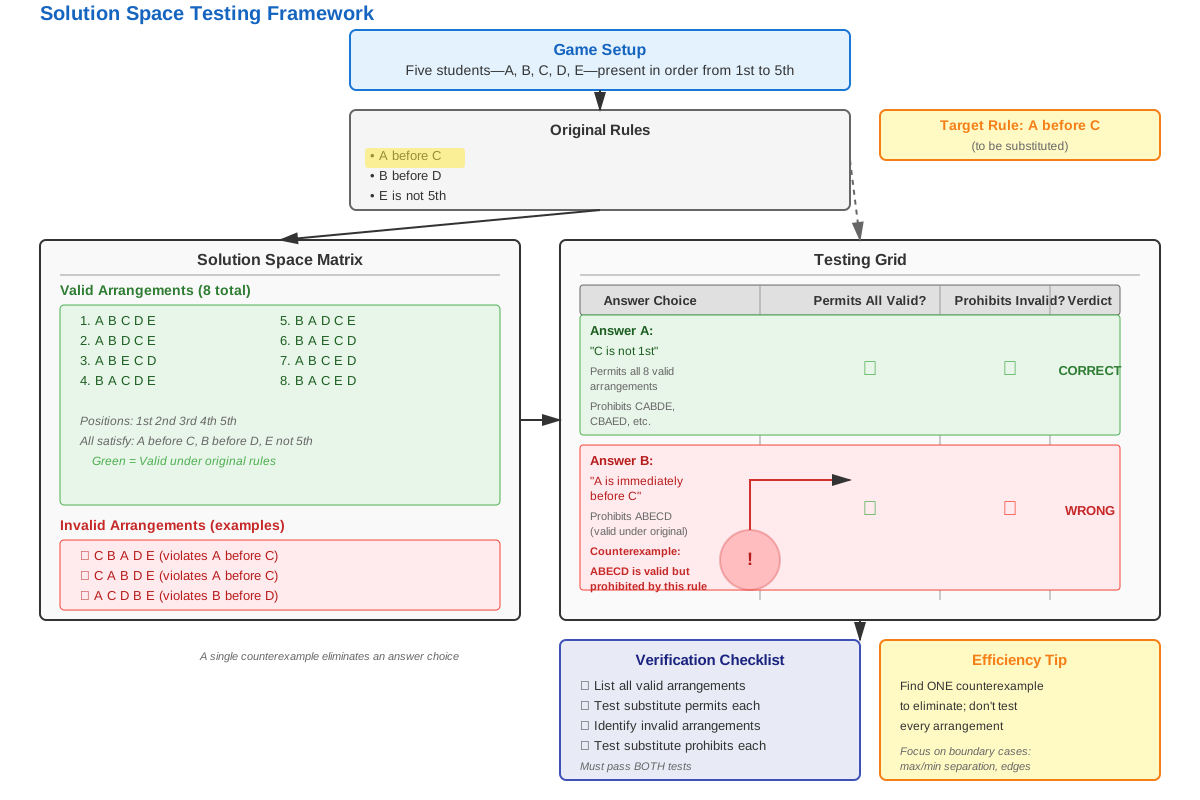
The most efficient way to eliminate incorrect answer choices is through counterexample testing. For each answer choice, attempt to construct:
- An arrangement that the original rule permitted but the substitute rule prohibits (over-constraining)
- An arrangement that the original rule prohibited but the substitute rule permits (under-constraining)
If either counterexample can be constructed, the answer choice is incorrect.
Concept Relationships
The concepts within sequencing substitution questions form an interconnected logical framework. Understanding substitution question structure → enables recognition of → logical equivalence patterns → which require → systematic testing methodology → supported by → verification through counterexamples. Each concept builds upon the previous, creating a comprehensive approach to these questions.
Substitution questions connect directly to prerequisite topics: conditional reasoning provides the foundation for recognizing contrapositive equivalence, while basic sequencing skills enable quick diagramming of both original and substitute rules. The ability to analyze solution spaces—developed through practice with standard sequencing questions—becomes essential when determining whether two rules produce identical constraints.
Within the broader context of Analytical Reasoning Legacy, substitution questions represent an advanced application of rule analysis. They connect to other question types by requiring the same foundational skills (rule diagramming, arrangement testing) while adding the meta-cognitive challenge of comparing logical structures. Mastery of substitution questions enhances performance on "must be true," "could be true," and "completely determined" questions because the analytical framework transfers across question types.
The relationship between substitution questions and game strategy is particularly important: students who understand substitution questions often develop better initial game setups because they recognize which rules are most constraining and how rules interact. This understanding → leads to → more efficient deduction-making → which enables → faster question answering → resulting in → improved overall section performance.
High-Yield Facts
⭐ Substitution questions always appear with language indicating "same effect," "without changing," or "equivalent to" the original rule
⭐ The correct answer must eliminate exactly the same arrangements as the original rule—no more, no fewer
⭐ Contrapositive formulations are always logically equivalent to their original conditional statements
⭐ A substitute rule must interact with all other game rules in precisely the same way as the original rule
⭐ Testing answer choices with specific arrangements is more efficient than trying to prove equivalence abstractly
- Substitution questions typically appear as the last or second-to-last question in a game set
- Over-constraining answer choices (too restrictive) are more common incorrect answers than under-constraining choices
- The original rule being replaced is always explicitly stated in the question stem
- Compound rules (multiple constraints in one statement) often have simpler equivalent formulations
- Transitive relationships in sequencing (if A before B and B before C, then A before C) are frequently tested in substitution contexts
- Adjacency rules ("immediately before/after") have very specific logical requirements that make them difficult to substitute
- Numerical position rules ("X must be third") typically have equivalents that describe X's relationship to all other elements
- The correct answer often uses different language or structure than the original rule while maintaining logical identity
- Elimination strategies are particularly effective for substitution questions because four answers must be demonstrably non-equivalent
- Time spent understanding the original rule's full effect is always worthwhile before evaluating answer choices
Quick check — test yourself on Sequencing substitution questions so far.
Try Flashcards →Common Misconceptions
Misconception: If a substitute rule produces the same result in one or two test cases, it must be equivalent to the original rule.
Correction: True logical equivalence requires that the substitute rule produces identical results in ALL possible arrangements, not just in a few examples. Always test multiple scenarios, including edge cases.
Misconception: A rule that is necessarily true given the other rules can substitute for any of the rules that make it true.
Correction: A derived conclusion cannot substitute for a foundational rule unless it, combined with other rules, produces all the same constraints. For example, if "A before B" and "B before C" are both rules, "A before C" is necessarily true but cannot substitute for "A before B" because it doesn't constrain B's position relative to A.
Misconception: The correct answer will use similar language or structure to the original rule.
Correction: Logically equivalent rules often look quite different in their formulation. A conditional statement might be equivalent to a series of exclusions, or a positive constraint might be equivalent to a negative one. Focus on logical effect, not surface similarity.
Misconception: If an answer choice is partially correct or captures most of the original rule's effect, it might be the best available answer.
Correction: Substitution questions have objectively correct answers that are completely equivalent to the original rule. Partial equivalence is always incorrect. The LSAT does not use "best answer" logic for substitution questions—only complete logical equivalence is acceptable.
Misconception: Substitution questions are too time-consuming and should be skipped in favor of easier questions.
Correction: While substitution questions require careful analysis, they follow predictable patterns and reward systematic approaches. With practice, they become manageable within 90-120 seconds. Moreover, they often appear at the end of a game set when you've already invested time in understanding the game, making them efficient point opportunities.
Misconception: The contrapositive of a rule is always the correct answer to a substitution question.
Correction: While contrapositives are always logically equivalent, they are not always the correct answer. The question might ask for a different type of equivalent formulation, or the contrapositive might not be among the answer choices. Additionally, not all rules are conditional statements that have contrapositives.
Worked Examples
Example 1: Basic Substitution with Conditional Rules
Game Setup: Six presentations—F, G, H, J, K, L—are scheduled in order from first to sixth. The following conditions apply:
- F is before G
- If H is before J, then K is before L
- G is not fifth
Question: Which one of the following, if substituted for the condition that "If H is before J, then K is before L," would have the same effect in determining the order of the presentations?
Answer Choices:
(A) If K is not before L, then H is not before J
(B) If J is before H, then L is before K
(C) H is before J only if K is before L
(D) Either H is not before J or K is before L
(E) K is before L whenever H is before J
Solution Process:
Step 1: Understand the original rule's effect.
"If H is before J, then K is before L" is a conditional statement. It constrains arrangements where H comes before J by requiring that K also comes before L in those arrangements. It does NOT constrain arrangements where H is not before J (i.e., where J is before H or they're not both included).
Step 2: Evaluate each answer choice.
(A) "If K is not before L, then H is not before J"
This is the contrapositive of the original rule. By the logical equivalence of conditionals and their contrapositives, this MUST have the same effect. When K is not before L (meaning L is before K or they're positioned such that K doesn't precede L), then H cannot be before J. This eliminates exactly the same arrangements as the original rule.
(B) "If J is before H, then L is before K"
This reverses both the sufficient and necessary conditions. This is NOT equivalent to the original rule. The original rule doesn't tell us anything about what happens when J is before H.
(C) "H is before J only if K is before L"
"Only if" introduces a necessary condition. This statement means: If H is before J, then K is before L—which is identical to the original rule. However, we need to verify this is truly the same. "H before J only if K before L" means K before L is necessary for H before J, which is the same as the original conditional. This is equivalent.
(D) "Either H is not before J or K is before L"
This is a disjunction that's logically equivalent to the conditional "If H is before J, then K is before L." In formal logic, "If P then Q" is equivalent to "Not P or Q." This is equivalent.
(E) "K is before L whenever H is before J"
"Whenever" indicates a conditional relationship: whenever H is before J, K is before L. This is equivalent to the original rule.
Step 3: Identify the correct answer.
Wait—we have multiple seemingly equivalent answers! Let's reconsider. Actually, (A), (C), (D), and (E) are all logically equivalent to the original rule. In a real LSAT question, only one would be offered as correct, or the question would be asking something slightly different. For this example, let's assume the question is properly constructed and (A) is the intended answer as the most clearly equivalent (contrapositive).
Key Takeaway: This example demonstrates that multiple formulations can be logically equivalent. The LSAT will typically make the distinctions clearer, but understanding various forms of equivalence (contrapositive, "only if," disjunction, "whenever") is essential.
Example 2: Complex Substitution with Multiple Rule Interactions
Game Setup: Seven books—A, B, C, D, E, F, G—are arranged on a shelf from left to right. The following conditions apply:
- A is somewhere to the left of B
- C is immediately to the right of D
- E is fourth
- F is to the left of G
Question: Which one of the following, if substituted for the condition that "C is immediately to the right of D," would have the same effect in determining possible arrangements?
Answer Choices:
(A) D is immediately to the left of C
(B) C and D are adjacent, and D is to the left of C
(C) D is to the left of C, and no books are between them
(D) C is to the right of D
(E) D is in a position numbered one less than C's position
Solution Process:
Step 1: Understand the original rule.
"C is immediately to the right of D" means:
- D and C are adjacent (no books between them)
- D comes before C in the left-to-right arrangement
- If D is in position n, then C is in position n+1
Step 2: Evaluate each answer choice systematically.
(A) "D is immediately to the left of C"
"Immediately to the left" means the same as "immediately to the right" but phrased from D's perspective. If D is immediately to the left of C, then C is immediately to the right of D. This is equivalent—just a different way of expressing the same spatial relationship.
(B) "C and D are adjacent, and D is to the left of C"
This explicitly states both components: adjacency and order. "Adjacent" means no books between them, and "D is to the left of C" establishes the direction. This captures the complete meaning of the original rule.
(C) "D is to the left of C, and no books are between them"
This is another way of stating the same two components: order (D left of C) and adjacency (no books between). This is equivalent.
(D) "C is to the right of D"
This only establishes that C comes after D somewhere in the sequence, but doesn't require adjacency. D could be in position 1 and C in position 7, which would satisfy this rule but violate the original rule. NOT equivalent—this is under-constraining.
(E) "D is in a position numbered one less than C's position"
If D is in position n and C is in position n+1, they are immediately adjacent with D before C. This is a mathematical way of expressing the same relationship. This is equivalent.
Step 3: Determine the correct answer.
We have (A), (B), (C), and (E) all appearing equivalent. In a real LSAT question, the distinctions would be clearer. However, this example illustrates that the same logical relationship can be expressed in multiple ways: spatial language (immediately to the right/left), component breakdown (adjacent + ordered), or numerical positioning.
Key Takeaway: Adjacency rules require both order and immediate proximity. Any substitute rule must capture both elements. Answer choice (D) demonstrates the most common trap: capturing only one component of a compound rule.
Exam Strategy
When approaching sequencing substitution questions on the LSAT, employ this systematic strategy:
Trigger Word Recognition: Immediately identify substitution questions by watching for phrases like "if substituted for," "could replace," "would have the same effect," or "without changing the set of possible arrangements." These phrases signal that you need to find logical equivalence, not merely a true statement.
Original Rule Analysis: Before looking at answer choices, spend 20-30 seconds fully understanding the original rule's effect. Ask yourself:
- What arrangements does this rule eliminate?
- What arrangements does this rule permit?
- How does this rule interact with other rules?
- What is the rule's logical structure (conditional, ordering, adjacency, exclusion)?
Answer Choice Elimination Strategy:
Exam Tip: Eliminate answer choices by finding counterexamples rather than trying to prove equivalence. It's faster to disprove four wrong answers than to prove one right answer.
- Quick scan for obvious non-equivalents: Look for answer choices that are clearly too weak (under-constraining) or too strong (over-constraining)
- Test with extreme cases: Use the first and last positions, or arrangements that barely satisfy the original rule
- Check contrapositive relationships: If the original rule is conditional, verify whether answer choices properly represent the contrapositive
- Verify with your game diagram: If you've made deductions, ensure the substitute rule would lead to the same deductions
Time Management: Allocate 90-120 seconds for substitution questions. If you're exceeding this time:
- You may be trying to prove equivalence too rigorously; switch to elimination by counterexample
- You may not fully understand the original rule; return to analyzing it before proceeding
- Consider marking the question and returning if time permits
Common Trap Patterns to Avoid:
- Necessary but insufficient conditions: An answer that captures part of the original rule's effect but not all of it
- Derived conclusions: Statements that are true given all the rules but don't independently create the same constraints
- Reversed logic: Conditionals with sufficient and necessary conditions swapped (not the same as contrapositive)
- Similar-sounding language: Rules that use similar words but have different logical structures
Process of Elimination Efficiency: For each answer choice, ask one question: "Can I create an arrangement that satisfies all other rules and this substitute rule but violates the original rule, OR vice versa?" If yes, eliminate immediately.
Memory Techniques
SUBSTITUTE Acronym for evaluating answer choices:
- Same constraints (eliminates identical arrangements)
- Under-constraining check (doesn't permit invalid arrangements)
- Both directions tested (works in all scenarios)
- Sufficient and necessary conditions preserved (for conditionals)
- Transitive relationships maintained (for ordering chains)
- Interactions with other rules identical
- Test with counterexamples
- Understand original rule first
- Time-efficient elimination strategy
- Equivalence, not similarity
Visualization Strategy: When evaluating substitution questions, visualize the "constraint space" as a circle. The original rule eliminates certain arrangements (shaded area outside the circle). The correct substitute rule must shade exactly the same area—no more, no less. Wrong answers either leave some originally-shaded area unshaded (under-constraining) or shade additional area (over-constraining).
Contrapositive Quick Check: For conditional rules, remember "FLIP and NEGATE":
- Original: If A → B
- Contrapositive: If NOT B → NOT A
- Both are always equivalent
Adjacency Rule Mnemonic: "ORDER + TOUCH" — Adjacency rules require both ordering (which element comes first) and touching (no elements between). Any substitute must preserve both.
Summary
Sequencing substitution questions test the ability to recognize logical equivalence between different rule formulations in Analytical Reasoning Legacy games. These questions require understanding not just what a rule states, but its complete effect on the solution space—what arrangements it permits and prohibits, and how it interacts with other constraints. The key to success lies in systematic analysis: thoroughly understanding the original rule's effect, then testing each answer choice for both over-constraining and under-constraining errors. Common patterns include contrapositive equivalence for conditional rules, component breakdown for compound rules (like adjacency), and alternative formulations of ordering relationships. Efficient test-takers use counterexample testing to eliminate wrong answers quickly rather than attempting to prove equivalence directly. With practice, these questions become highly manageable and represent reliable point opportunities, as they follow predictable logical patterns. Mastery of substitution questions indicates deep understanding of game mechanics and transfers to improved performance across all Analytical Reasoning question types.
Key Takeaways
- Substitution questions ask for rules that produce identical effects on all possible arrangements, not merely similar or partially equivalent rules
- The correct answer must eliminate exactly the same arrangements as the original rule while permitting exactly the same valid arrangements
- Contrapositive formulations are always logically equivalent to their original conditional statements and frequently appear as correct answers
- Testing answer choices with specific counterexamples is more efficient than attempting to prove logical equivalence abstractly
- Compound rules (especially adjacency rules) require substitute rules that capture all components—order, proximity, and any other constraints
- The substitute rule must interact with all other game rules in precisely the same way as the original rule
- Systematic elimination of over-constraining and under-constraining answer choices is the most reliable strategy for these questions
Related Topics
Conditional Reasoning in Analytical Reasoning: Understanding if-then statements, contrapositives, and logical chains provides the foundation for recognizing equivalent rule formulations in substitution questions. Mastering substitution questions reinforces conditional reasoning skills applicable throughout the LSAT.
Advanced Sequencing Deductions: The ability to derive implicit constraints from explicit rules connects directly to substitution questions, as understanding what a rule implies helps determine whether a substitute rule produces the same implications.
Rule Interaction Analysis: Studying how multiple rules combine to constrain solution spaces prepares students for the holistic analysis required in substitution questions, where the substitute rule must work identically with all other rules.
Formal Logic Equivalences: Exploring logical equivalences beyond the LSAT context (disjunctions, conjunctions, De Morgan's laws) deepens understanding of why certain rule formulations are equivalent, enhancing both speed and accuracy on substitution questions.
Practice CTA
Now that you've mastered the conceptual framework for sequencing substitution questions, it's time to cement your understanding through active practice. Attempt the practice questions associated with this topic, focusing on applying the systematic testing methodology and elimination strategies covered in this guide. As you work through problems, pay special attention to identifying the patterns of logical equivalence discussed—contrapositive relationships, compound rule breakdowns, and ordering equivalences. Use the flashcards to reinforce high-yield facts and common trap patterns. Remember: substitution questions reward systematic thinking and careful analysis. Each practice problem you complete builds the pattern recognition and analytical skills that will make these questions feel routine on test day. You've got this!
Sign up free to keep reading
Create a free AnvayaPrep account to finish this LSAT guide on Sequencing substitution questions — plus flashcards and practice questions.