Overview
Sequencing grouping hybrids represent one of the most challenging and frequently tested game types in LSAT Analytical Reasoning Legacy sections. These complex puzzles require test-takers to simultaneously manage two distinct logical frameworks: determining the order in which elements appear (sequencing) and deciding which elements belong to specific categories or groups (grouping). Unlike pure sequencing games that focus solely on relative positioning or pure grouping games that concentrate exclusively on set membership, hybrid games demand fluency in both skill sets and the ability to recognize how constraints in one dimension affect possibilities in the other.
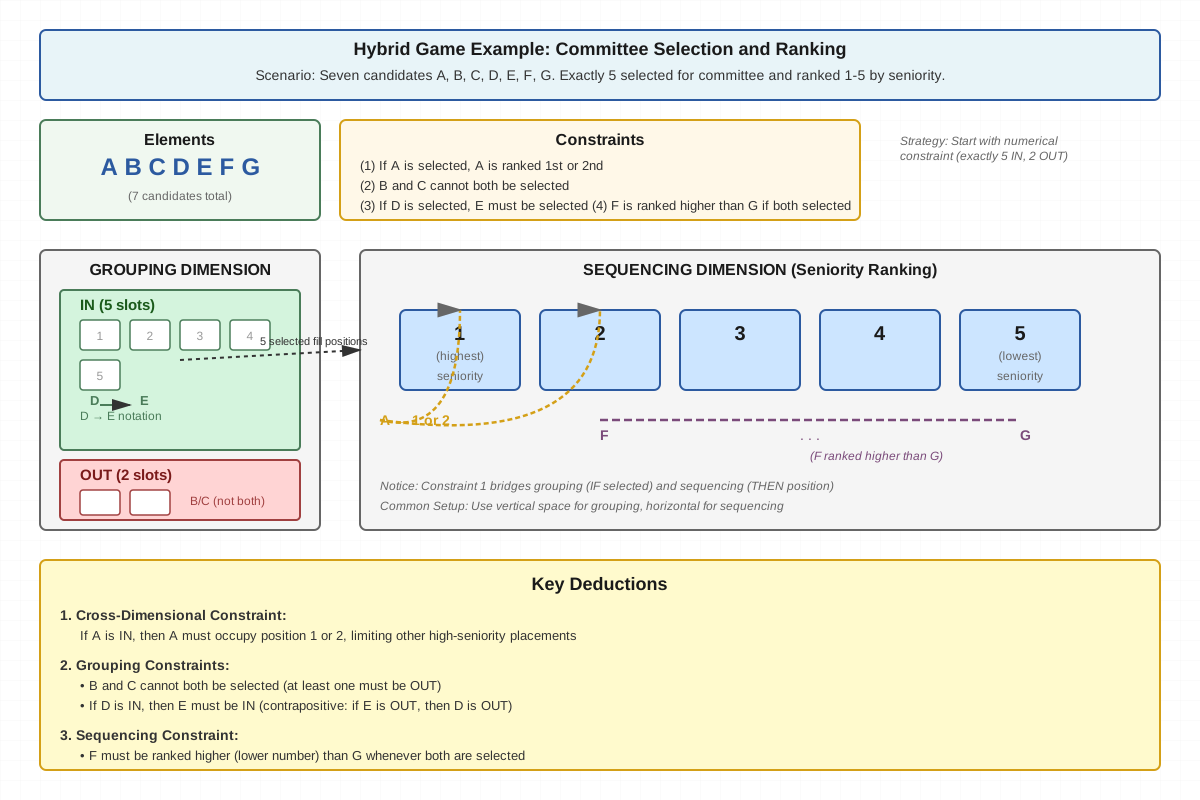
The difficulty of lsat sequencing grouping hybrids stems from their cognitive load—students must track multiple variables across two organizational systems while applying rules that often bridge both dimensions. For example, a game might require determining which of seven candidates will be selected for a committee (grouping) and then arranging those selected candidates in order of seniority (sequencing). The interplay between these two tasks creates a rich constraint environment where deductions in one framework immediately impact the other. Mastering these games is essential because they appear regularly on modern LSAT administrations and typically generate 5-7 questions per game, making them high-value targets for score improvement.
Within the broader landscape of Analytical Reasoning Legacy, sequencing grouping hybrids occupy an intermediate position between basic game types and the most complex multi-layered scenarios. They build upon foundational sequencing skills (understanding relative order, creating linear diagrams) and grouping fundamentals (tracking in/out decisions, managing numerical distributions) while introducing the meta-skill of coordinating multiple organizational systems. Success with hybrid games legacy requires not just mechanical proficiency with each component but also strategic thinking about which framework to prioritize when making deductions and how to represent both dimensions efficiently in a unified diagram.
Learning Objectives
- [ ] Identify how Sequencing grouping hybrids appears in LSAT questions
- [ ] Explain the reasoning pattern behind Sequencing grouping hybrids
- [ ] Apply Sequencing grouping hybrids to solve LSAT-style problems accurately
- [ ] Construct integrated diagrams that effectively represent both sequencing and grouping constraints simultaneously
- [ ] Recognize trigger language in game scenarios that signals hybrid structure
- [ ] Execute strategic decision-making about whether to prioritize sequencing or grouping deductions based on rule density
- [ ] Synthesize cross-dimensional inferences where grouping decisions constrain sequencing possibilities and vice versa
Prerequisites
- Basic sequencing game mechanics: Understanding relative order, creating linear diagrams, and applying ordering rules is essential because half of every hybrid game involves sequencing logic
- Fundamental grouping concepts: Familiarity with in/out grouping, selection games, and numerical distributions provides the foundation for the grouping dimension of hybrid games
- Rule representation techniques: The ability to symbolize conditional statements, numerical constraints, and spatial relationships enables efficient diagram construction for complex hybrid scenarios
- Deductive reasoning skills: Competence in making valid inferences from multiple constraints is critical because hybrid games generate their difficulty through constraint interaction across dimensions
Why This Topic Matters
Sequencing grouping hybrids represent approximately 15-20% of all Analytical Reasoning games on modern LSAT administrations, making them one of the most frequently tested advanced game types. Their prevalence has increased in recent years as test-makers have moved toward more complex, multi-dimensional scenarios that better assess sophisticated logical reasoning. Each hybrid game typically generates 5-7 questions worth 5-7 raw points, meaning that mastery of this game type can directly impact 2-3 points on the scaled score—often the difference between admission to a target law school and rejection.
In practical terms, hybrid games assess the cognitive flexibility that legal practice demands. Attorneys regularly manage multiple organizational frameworks simultaneously: tracking both the chronological sequence of events in a case and the categorical relationships between parties, or determining both which arguments to include in a brief and the optimal order for presenting them. The mental discipline required to coordinate sequencing and grouping mirrors the multitasking demands of legal analysis.
On the LSAT, sequencing grouping hybrids most commonly appear in scenarios involving: (1) selection and ordering of candidates or applicants, (2) scheduling events where not all events occur and those that do must be ordered, (3) assignment of tasks to time slots where some tasks may be excluded, and (4) tournament or competition structures where participants are both selected and ranked. Question types typically include standard "could be true" and "must be true" questions, but also frequently feature complex "if" hypotheticals that add temporary constraints to one or both dimensions, testing the ability to rapidly recalculate possibilities under modified conditions.
Core Concepts
Defining Sequencing Grouping Hybrids
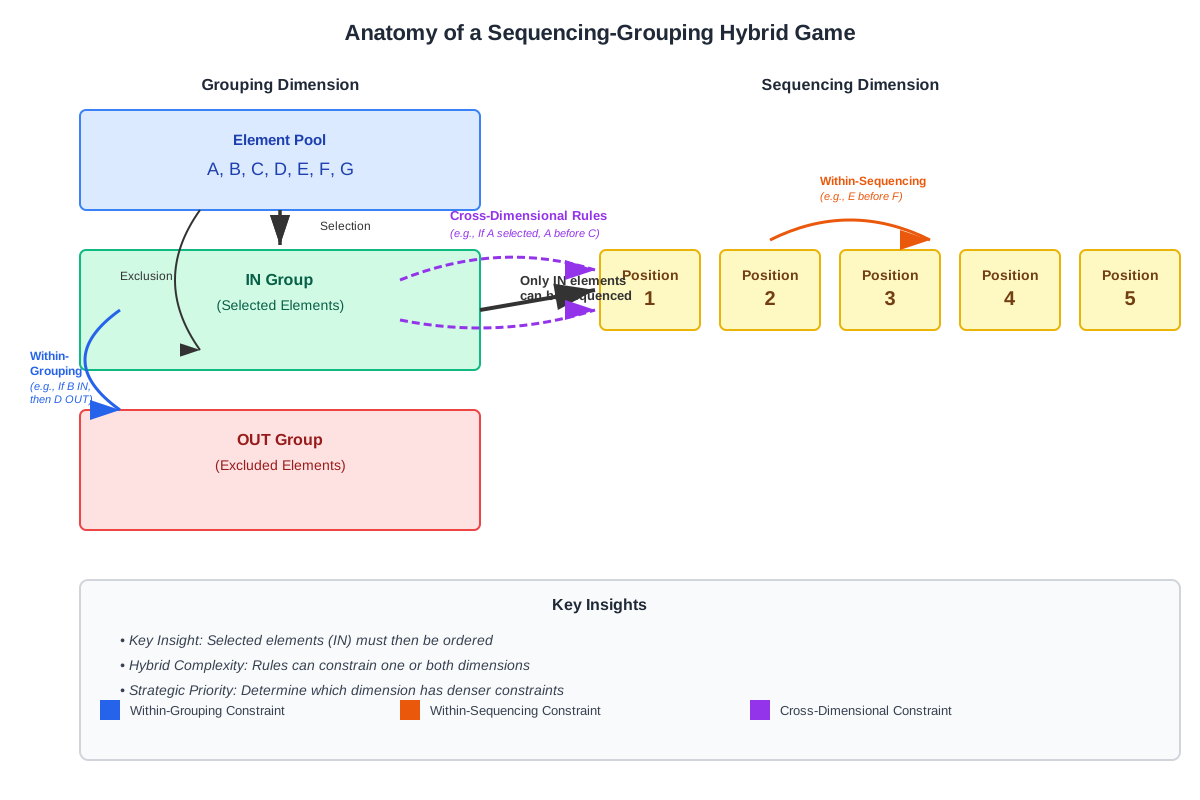
A sequencing grouping hybrid is an analytical reasoning game that requires test-takers to make determinations in two distinct logical dimensions: (1) which elements from a larger set will be selected or included (the grouping component), and (2) what order or sequence those selected elements will occupy (the sequencing component). The defining characteristic is that both dimensions are essential to solving the game—neither can be ignored or treated as secondary. The grouping decision directly constrains the sequencing possibilities, and sequencing rules often limit which grouping configurations are permissible.
The structural signature of these games appears in the scenario description. Typical language includes phrases like "select three of seven candidates and rank them," "some but not all of the events will occur in sequence," or "assign tasks to consecutive time slots, leaving some tasks unassigned." This language explicitly establishes two separate questions: a selection question (which elements?) and an ordering question (in what sequence?).
The Two-Stage Framework
Most sequencing grouping hybrids operate through a logical two-stage framework, though the stages may not be temporally distinct in the solving process:
Stage 1: Grouping/Selection - Determine which elements from the universal set will be included ("in") versus excluded ("out"). This stage involves applying grouping rules, numerical constraints (e.g., "exactly four will be selected"), and categorical requirements (e.g., "at least two from category X must be included").
Stage 2: Sequencing/Ordering - Arrange the selected elements in the required sequence, applying ordering rules and positional constraints. This stage only involves the elements determined to be "in" during the grouping stage.
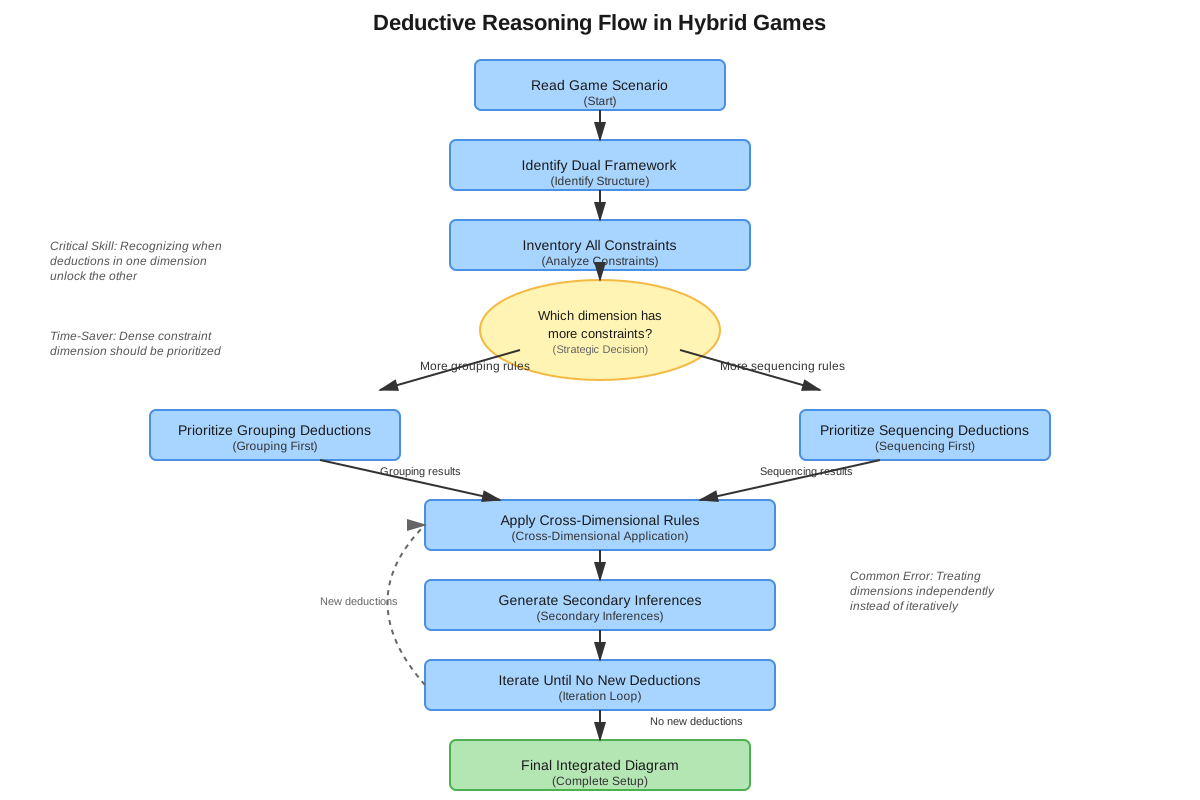
However, the solving process rarely proceeds linearly through these stages. Instead, effective solvers recognize that rules and deductions in one dimension immediately impact the other, creating a dynamic interplay where grouping decisions constrain sequencing options and sequencing requirements force grouping conclusions.
Constraint Types in Hybrid Games
Hybrid games feature three categories of constraints, each requiring different analytical approaches:
| Constraint Type | Description | Example | Primary Impact |
|---|---|---|---|
| Pure Grouping Rules | Constraints that affect only selection/inclusion decisions | "If M is selected, then N is not selected" | Determines which elements can be "in" together |
| Pure Sequencing Rules | Constraints that affect only the order of selected elements | "P must come before Q" | Establishes relative positions among selected elements |
| Cross-Dimensional Rules | Constraints that bridge both dimensions | "If R is selected, it must be first" | Creates powerful deductions by linking selection to position |
Cross-dimensional rules are particularly high-yield because they generate cascading inferences. For example, if a rule states "K must be third if selected" and another rule establishes "exactly five elements are selected," then selecting K immediately determines one-fifth of the sequencing dimension while also constraining which other elements can occupy the third position.
Diagram Construction Strategies
Effective hybrid game solving requires an integrated diagrammatic approach that represents both dimensions simultaneously. The most common and efficient method uses a two-tier diagram:
Upper Tier (Sequencing): A linear sequence of slots (positions 1, 2, 3, etc.) where selected elements will be placed. This tier shows the ordering dimension.
Lower Tier (Grouping): An "in/out" tracking system below the sequencing tier, showing which elements from the universal set have been selected versus excluded. This tier shows the selection dimension.
This unified representation allows solvers to see immediately how grouping decisions (moving an element from "out" to "in") create new sequencing possibilities, and how sequencing constraints (e.g., "X must be first") might force grouping conclusions (e.g., "if all five positions are filled and X must be first, then X must be selected").
Deductive Reasoning Patterns
Hybrid games generate their complexity through specific deductive patterns that exploit the interaction between dimensions:
- Numerical Forcing: When the number of selected elements equals or nearly equals the number of available positions, grouping decisions become highly constrained. If exactly four elements must be selected for four positions, then every "in" decision is final and every "out" decision is definitive.
- Positional Forcing: When sequencing rules create a highly constrained position (e.g., "only A or B can be first"), and grouping rules limit selection (e.g., "A and B cannot both be selected"), the interaction forces specific conclusions about both dimensions.
- Conditional Cascades: Cross-dimensional conditional rules create chains of inference. "If X is selected → X is third → Y cannot be third → Y must be first or second → if Y is first, then Z is selected" represents a cascade where a single grouping decision triggers multiple sequencing and grouping consequences.
- Exclusion Deductions: When sequencing rules establish that certain elements cannot occupy any available position (e.g., "M must come after N, O, and P, but only four positions exist and N, O, and P must all be selected"), the element can be deduced to be "out" even without explicit grouping rules excluding it.
Strategic Prioritization
A critical skill in hybrid games is determining which dimension to prioritize when beginning deductions. This decision should be based on rule density—which dimension has more constraints?
If grouping rules are dense (many conditional relationships, numerical constraints, or categorical requirements), begin by working through grouping deductions to determine which elements must be in/out. Once the selection is clarified, sequencing becomes simpler because fewer elements need to be ordered.
If sequencing rules are dense (many relative ordering constraints, fixed positions, or blocks), begin by mapping the sequencing relationships. This often reveals that certain elements cannot fit into the available positions, forcing grouping conclusions.
When rule density is balanced, look for cross-dimensional rules as entry points—these generate deductions in both dimensions simultaneously and often unlock the game's logic most efficiently.
Concept Relationships
The core concepts within sequencing grouping hybrids form an interconnected logical system. The two-stage framework (grouping then sequencing) provides the conceptual foundation, but the constraint types determine how information flows between stages. Pure grouping rules feed into the grouping stage, pure sequencing rules operate within the sequencing stage, and cross-dimensional rules create bidirectional connections between stages, enabling deductions to flow in both directions.
Diagram construction strategies serve as the practical implementation of the two-stage framework, translating abstract concepts into visual representations that facilitate reasoning. The two-tier diagram specifically embodies the relationship between grouping and sequencing by spatially separating yet visually connecting the two dimensions.
Deductive reasoning patterns emerge from the interaction of constraint types within the diagram structure. Numerical forcing arises when grouping constraints (number of selected elements) interact with sequencing constraints (number of positions). Positional forcing occurs when sequencing rules (limited position options) combine with grouping rules (limited selection options). Conditional cascades result from chains of cross-dimensional rules, while exclusion deductions represent the ultimate synthesis—using sequencing impossibilities to force grouping conclusions.
Strategic prioritization sits atop this conceptual hierarchy as a meta-skill, requiring assessment of rule density across constraint types to determine the optimal entry point for deductive reasoning. This decision-making process depends on understanding all other concepts because it requires evaluating which dimension's constraints will generate the most productive initial inferences.
Connection to prerequisites: The grouping dimension directly applies fundamental grouping concepts (in/out tracking, numerical distributions), while the sequencing dimension builds on basic sequencing mechanics (linear diagrams, relative order). Rule representation techniques enable the symbolization of all constraint types, and deductive reasoning skills power all inference patterns.
High-Yield Facts
⭐ Sequencing grouping hybrids appear in approximately 15-20% of modern LSAT Analytical Reasoning sections, typically generating 5-7 questions per game.
⭐ Cross-dimensional rules (constraints that link selection to position) are the highest-yield rules in hybrid games because they generate deductions in both dimensions simultaneously.
⭐ When the number of selected elements equals the number of positions, every grouping decision becomes final and the game's difficulty typically decreases significantly.
⭐ The most common scenario structures involve selection and ranking of candidates, scheduling with optional events, or tournament/competition formats.
⭐ Two-tier diagrams (sequencing slots above, in/out tracking below) are the most efficient representation method for hybrid games.
- Pure sequencing rules only constrain the relative order of elements that have already been selected, not the selection decision itself.
- Numerical constraints in the grouping dimension (e.g., "exactly four selected") often create the most powerful forcing deductions when combined with sequencing limitations.
- If an element must occupy a specific position when selected, that element's selection becomes a high-impact decision point affecting both dimensions.
- Exclusion deductions (proving an element must be "out") often arise from sequencing impossibilities rather than explicit grouping rules.
- Questions that add temporary "if" conditions frequently target the interaction between dimensions, testing whether a grouping change forces sequencing changes or vice versa.
- Elements with the most restrictive sequencing rules (e.g., "must be first or last") are often key to unlocking the game's logic.
- When rules create a complete sequencing chain among selected elements (A before B before C before D), focus on whether all chain members must be selected or if the chain can be broken by exclusion.
Quick check — test yourself on Sequencing grouping hybrids so far.
Try Flashcards →Common Misconceptions
Misconception: Hybrid games should always be solved by completing the grouping stage first, then moving to sequencing.
Correction: The optimal approach depends on rule density. When sequencing rules are more numerous or restrictive, beginning with sequencing deductions often reveals grouping conclusions more efficiently. The two dimensions interact dynamically, and rigid stage-by-stage solving ignores productive cross-dimensional inferences.
Misconception: Pure sequencing rules (like "A before B") apply even when elements are not selected.
Correction: Sequencing rules only constrain elements that are actually selected ("in"). If A is "out," the rule "A before B" places no constraint on B's position. This distinction is critical—many wrong answers exploit confusion about whether sequencing rules apply to excluded elements.
Misconception: Cross-dimensional rules are just regular conditional rules and don't require special attention.
Correction: Cross-dimensional rules are uniquely powerful because they create forcing deductions across both dimensions. A rule like "If M is selected, M must be third" simultaneously constrains grouping (selecting M has consequences) and sequencing (the third position has limited options). These rules deserve priority attention and often serve as optimal entry points for deductions.
Misconception: When a game states "some but not all" elements will be selected, the exact number doesn't matter much.
Correction: The numerical relationship between selected elements and available positions is often the key constraint. If five elements will be selected for five positions, the game behaves very differently than if three of seven elements will be selected for three positions. The tighter the numerical fit, the more forcing the deductions.
Misconception: Hybrid games are just two separate games (one grouping, one sequencing) combined together.
Correction: True hybrid games feature essential interaction between dimensions—the grouping decisions constrain sequencing possibilities and sequencing requirements force grouping conclusions. If the two dimensions operate independently without interaction, the game is not a genuine hybrid but rather two separate tasks that happen to appear in one scenario.
Misconception: Elements that appear in many rules are always selected ("in").
Correction: Elements that appear in many rules are certainly important to track, but rule frequency doesn't determine selection. An element might appear in multiple rules precisely because its selection is uncertain and has major consequences. Focus on what the rules prove, not on rule frequency as a selection heuristic.
Worked Examples
Example 1: Committee Selection and Ranking
Scenario: A company will select exactly three of seven employees—F, G, H, J, K, L, and M—for a special committee and rank them first, second, and third based on seniority. The following conditions apply:
- If F is selected, F must be ranked first.
- G and H cannot both be selected.
- K must be ranked higher than L if both are selected.
- J cannot be ranked second.
- Either G or M must be selected, but not both.
Analysis:
First, identify this as a sequencing grouping hybrid: we must select 3 of 7 (grouping) and rank them 1-2-3 (sequencing).
Set up a two-tier diagram:
Positions:    1    2    3
              _    _    _
In:
Out:
Step 1: Analyze grouping constraints
- "Either G or M, but not both" means exactly one of G/M is in, exactly one is out.
- "G and H cannot both be selected" means at least one of G/H is out.
- Combining these: If G is in, then M is out and H is out. If M is in, then G is out (and H could be in or out).
Step 2: Analyze cross-dimensional rules
- "If F is selected, F must be first" is cross-dimensional. This means F can only be in if position 1 is available for F.
- "J cannot be ranked second" is a sequencing constraint on J if selected—J can only occupy positions 1 or 3.
Step 3: Make deductions
Since exactly 3 are selected and we have 7 candidates, 4 must be out. We know one of G/M is out. We need 3 more to be out.
Consider the G-in scenario:
- G in → M out, H out (2 out so far)
- Need to select 2 more from {F, J, K, L}
- If F is selected, F must be first
- J cannot be second, so J could be first or third
- K before L if both selected
Consider the M-in scenario:
- M in → G out (1 out so far)
- H could be in or out
- Need to select 2 more from {F, H, J, K, L}
Step 4: Test specific configurations
Let's test: Can F, G, and J all be selected?
- F selected → F is first
- G selected → M out, H out
- J selected → J cannot be second, so J must be third (since F is first)
- This gives: F-?-J with G in position 2
- Configuration: F(1), G(2), J(3) ✓ This works!
Step 5: Apply to question types
If asked "Which could be the complete ranking from first to third?"
- We've proven F-G-J is possible
- We'd need to test other options against all constraints
Key takeaway: The cross-dimensional rule about F forced us to consider F's position immediately upon selection, demonstrating how hybrid games require simultaneous tracking of both dimensions.
Example 2: Event Scheduling with Optional Events
Scenario: A festival will feature exactly four of six possible events—P, Q, R, S, T, and U—occurring in four consecutive time slots (1, 2, 3, 4). The following rules apply:
- P and Q cannot both be included.
- If R is included, it must occur in slot 1.
- S must occur before T if both are included.
- U cannot occur in slot 3.
- T must be included.
Analysis:
This is a hybrid: select 4 of 6 (grouping) and order them in slots 1-4 (sequencing).
Step 1: Apply definite grouping rules
- T must be included (definite "in")
- Need 3 more from {P, Q, R, S, U}
- Exactly 2 will be "out"
Step 2: Analyze the P/Q constraint
- "P and Q cannot both be included" means at least one of P/Q is out
- Since exactly 2 are out total, and at least 1 of P/Q is out, only 1 more can be out
- This means at least 3 of {R, S, U} must be in (since T is already in, that's 4 total)
Step 3: Consider R's cross-dimensional rule
- "If R is included, it must be in slot 1"
- Contrapositive: If R is not in slot 1, R is not included
- This is powerful: R's selection is tied to a specific position
Step 4: Build scenarios
Scenario A: R is included
- R must be in slot 1
- T is in (required)
- S before T if both in
- Need 2 more from {P, Q, S, U} (but not both P and Q)
- If S is in, then S before T, so possible orders: R(1), S(2), T(3), ?(4) or R(1), S(2), T(4), ?(3)
Scenario B: R is not included
- R is out
- At least one of P/Q is out
- So P and Q are the two "out" elements
- Therefore S, T, U must all be in (that's only 3, need 4 total)
- Wait—this is impossible! We need exactly 4 in, but if R is out and one of P/Q is out, we can't get to 4.
- Actually, recount: If R is out, that's 1 out. We need exactly 2 out total. So exactly 1 of P/Q is out.
- Elements in: T (required), 3 of {P, Q, S, U}
- If P is in and Q is out: P, S, T, U are in
- If Q is in and P is out: Q, S, T, U are in
Step 5: Apply sequencing constraints to viable scenarios
Scenario B1: P, S, T, U are in (R out, Q out)
- S before T
- U cannot be in slot 3
- Possible arrangements: S-P-U-T, S-U-P-T, P-S-U-T, etc. (checking S before T and U not in 3)
Key deduction: R's cross-dimensional rule creates a major fork in the game. If R is in, slot 1 is determined. If R is out, the grouping becomes highly constrained because we need exactly 4 elements and have limited options.
Key takeaway: Cross-dimensional rules often create the primary scenario split in hybrid games. The interaction between R's positional requirement and the numerical constraint (exactly 4 selected) forces specific grouping configurations.
Exam Strategy
Identification Phase
When reading the game scenario, watch for trigger language that signals a hybrid structure:
- "Select [number] of [larger number] and arrange/rank/order them"
- "Some but not all will occur in sequence"
- "Assign [subset] to consecutive slots/positions"
- Any scenario that explicitly asks two questions: which elements are included AND what order they appear in
Immediately upon identification, note the numerical relationship: How many will be selected? How many positions exist? When these numbers are equal, expect tighter constraints and more forcing deductions.
Rule Analysis Phase
As you read rules, categorize them immediately:
- Pure grouping (affects only selection): Mark with "G"
- Pure sequencing (affects only order): Mark with "S"
- Cross-dimensional (links selection to position): Mark with "X" and star these—they're highest priority
Count rules in each category. If grouping rules outnumber sequencing rules 2:1 or more, plan to begin with grouping deductions. If sequencing rules dominate, start there. If cross-dimensional rules are numerous, they should be your entry point.
Diagram Construction
Always use a two-tier diagram:
- Top tier: Linear slots for sequencing (1, 2, 3, etc.)
- Bottom tier: In/Out tracking for grouping
Place cross-dimensional rules directly on the diagram where they create constraints. For example, if "R must be first if selected," write "R?" in position 1 and note "R→1" in your rule list.
Deduction Phase
Execute deductions in this priority order:
- Definite placements: Any element that must be selected and must occupy a specific position
- Cross-dimensional forcing: Rules that link selection to position, creating cascades
- Numerical forcing: When selection numbers and position numbers create tight constraints
- Conditional chains: Follow "if-then" rules across dimensions
Question-Answering Strategy
For "could be true" questions: Eliminate answers that violate rules in either dimension. Check grouping violations first (is an element selected that should be out?), then sequencing violations (is the order wrong?).
For "must be true" questions: Look for answers that are forced by the interaction of dimensions. Often the correct answer involves an element that must be selected because of sequencing requirements or must occupy a position because of grouping constraints.
For "if" hypotheticals: Determine which dimension the new condition affects. If it's a grouping condition ("if M is selected"), immediately check sequencing implications. If it's a sequencing condition ("if N is third"), immediately check grouping implications. The answer often lies in the cross-dimensional consequences.
Time Management
Allocate approximately:
- 2-3 minutes: Initial setup, rule analysis, and diagram construction
- 2-3 minutes: Upfront deductions and scenario development
- 4-5 minutes: Answering 5-7 questions (40-50 seconds per question)
If you spend the full setup time and still feel uncertain, you may have missed a key cross-dimensional deduction. Quickly review rules marked "X" before proceeding to questions.
Memory Techniques
HYBRID - Mnemonic for approaching these games:
- Highlight cross-dimensional rules first
- Yield to numerical constraints (they force deductions)
- Build two-tier diagrams (sequencing above, grouping below)
- Read for trigger language (select AND order)
- Interact dimensions (grouping affects sequencing and vice versa)
- Deduce from the tightest constraints first
"Select-Then-Sequence" - Remember the conceptual flow: grouping decisions determine which elements are available for sequencing, so selection logically precedes ordering (even if you don't solve in that order).
"Position-Selection Link" - Visualize cross-dimensional rules as bridges connecting the two tiers of your diagram. When you see "if selected, then position X," draw a literal line from the in/out area to the specific position.
The 3-2-1 Rule - In any hybrid game, identify:
- 3 most constrained elements (most rules apply to them)
- 2 key numerical constraints (number selected, number of positions)
- 1 most powerful cross-dimensional rule (usually determines your entry point)
"Tight Fit = Forced Conclusions" - When the number of selected elements equals or nearly equals the number of positions, expect many forced deductions. Visualize this as a puzzle where pieces must fit exactly, leaving no flexibility.
Summary
Sequencing grouping hybrids represent a sophisticated LSAT game type that requires simultaneous management of selection decisions and ordering constraints. These games appear in 15-20% of Analytical Reasoning sections and demand fluency in both grouping mechanics (determining which elements are in versus out) and sequencing logic (establishing relative order among selected elements). The defining characteristic is essential interaction between dimensions—grouping decisions constrain sequencing possibilities while sequencing requirements force grouping conclusions. Success requires constructing integrated two-tier diagrams that represent both dimensions, prioritizing cross-dimensional rules that bridge selection and position, and executing deductive reasoning patterns that exploit numerical forcing, positional forcing, and conditional cascades. Strategic solvers assess rule density to determine whether to begin with grouping or sequencing deductions, recognizing that the tightest constraints generate the most productive initial inferences. Mastery of hybrid games provides a significant competitive advantage because these games are high-value (5-7 questions each), frequently tested, and disproportionately challenging for unprepared test-takers who attempt to solve the two dimensions independently rather than leveraging their interaction.
Key Takeaways
- Sequencing grouping hybrids require simultaneous tracking of which elements are selected (grouping) and what order they appear in (sequencing), with essential interaction between both dimensions.
- Cross-dimensional rules that link selection to specific positions are the highest-yield constraints, generating deductions in both dimensions and often serving as optimal entry points for analysis.
- Two-tier diagrams (sequencing slots above, in/out tracking below) provide the most efficient visual representation for managing both dimensions simultaneously.
- When the number of selected elements equals the number of available positions, the game becomes highly constrained and generates numerous forced deductions.
- Strategic prioritization based on rule density—beginning with whichever dimension has more constraints—accelerates the deduction process and prevents wasted effort.
- Pure sequencing rules only apply to elements that have been selected; excluded elements are not constrained by ordering rules.
- Numerical constraints in the grouping dimension often create the most powerful forcing deductions when combined with positional limitations in the sequencing dimension.
Related Topics
Advanced Hybrid Games with Three Dimensions: Building on sequencing grouping hybrids, some games add a third organizational dimension such as attribute assignment, creating even more complex constraint interactions. Mastering two-dimensional hybrids provides the foundation for these rare but high-difficulty games.
Pure Sequencing Games with Complex Ordering Rules: Understanding sophisticated sequencing techniques (blocks, anti-blocks, conditional ordering) enhances performance on the sequencing dimension of hybrid games and enables faster recognition of sequencing impossibilities that force grouping conclusions.
Distribution Games: These grouping variants involve assigning elements to multiple groups with numerical constraints. The skills developed in managing grouping constraints in hybrids transfer directly to distribution games, particularly when distribution games include ordering within groups.
Mapping and Spatial Reasoning Games: Another category of hybrid games combines spatial relationships with grouping or sequencing. The meta-skill of coordinating multiple organizational frameworks developed through sequencing grouping hybrids enables progression to these spatial hybrids.
Practice CTA
Now that you've mastered the conceptual framework for sequencing grouping hybrids, it's time to cement your understanding through application. Attempt the practice questions associated with this topic, focusing on identifying cross-dimensional rules, constructing efficient two-tier diagrams, and executing the deductive reasoning patterns covered in this guide. Use the flashcards to reinforce high-yield facts and rule categorization skills. Remember: hybrid games are high-value targets—every minute invested in practice translates directly to points on test day. Your ability to coordinate multiple dimensions of logic is exactly what top law schools are looking for. You've got this!
Sign up free to keep reading
Create a free AnvayaPrep account to finish this LSAT guide on Sequencing grouping hybrids — plus flashcards and practice questions.