Overview
Sequencing deductions represent one of the most powerful and frequently tested skills in the Analytical Reasoning Legacy section of the LSAT. When students encounter sequencing games legacy, they must not only understand the explicit rules provided but also derive implicit conclusions—deductions—that follow necessarily from combining those rules. These deductions form the backbone of efficient game solving, often revealing fixed positions, restricted possibilities, or complete orderings that dramatically simplify question answering.
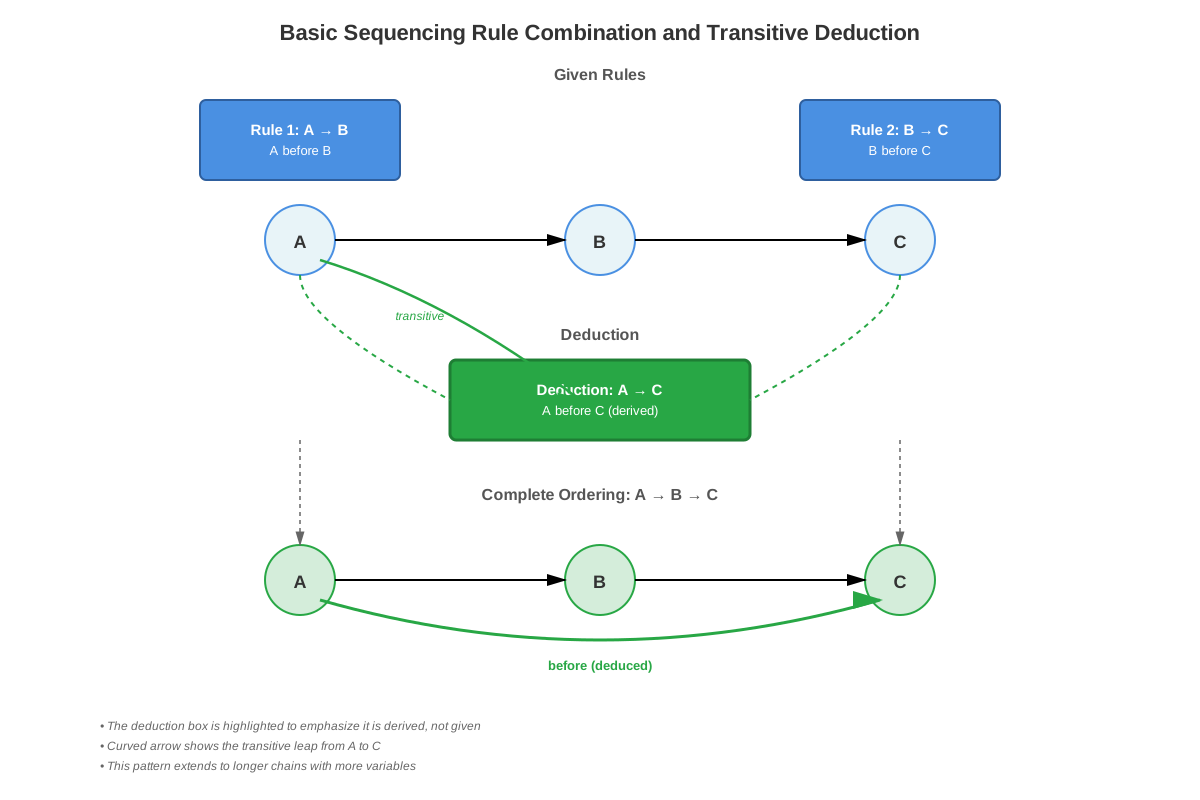
Mastering sequencing deductions transforms a student's approach from tentative trial-and-error to confident, systematic problem-solving. The LSAT rewards test-takers who can quickly identify when two or more rules interact to produce new information. For example, if Rule 1 states "A comes before B" and Rule 2 states "B comes before C," the deduction "A comes before C" follows necessarily. While this example is straightforward, LSAT sequencing games typically involve 5-7 variables and multiple overlapping constraints, creating opportunities for sophisticated chains of reasoning that separate high scorers from average performers.
Within the broader landscape of Analytical Reasoning Legacy, sequencing deductions serve as a foundational skill that connects to virtually every other game type. Pure sequencing games appear regularly on the LSAT, but hybrid games that combine sequencing with grouping or selection also require these deductive skills. Understanding how to extract maximum information from sequencing rules before attempting questions saves precious time and prevents careless errors. The ability to "see" what must be true, what cannot be true, and what remains uncertain distinguishes students who achieve 170+ scores from those who plateau in the mid-160s.
Learning Objectives
- [ ] Identify how Sequencing deductions appears in LSAT questions
- [ ] Explain the reasoning pattern behind Sequencing deductions
- [ ] Apply Sequencing deductions to solve LSAT-style problems accurately
- [ ] Recognize when multiple sequencing rules combine to create fixed positions
- [ ] Construct complete or partial ordering diagrams that incorporate all valid deductions
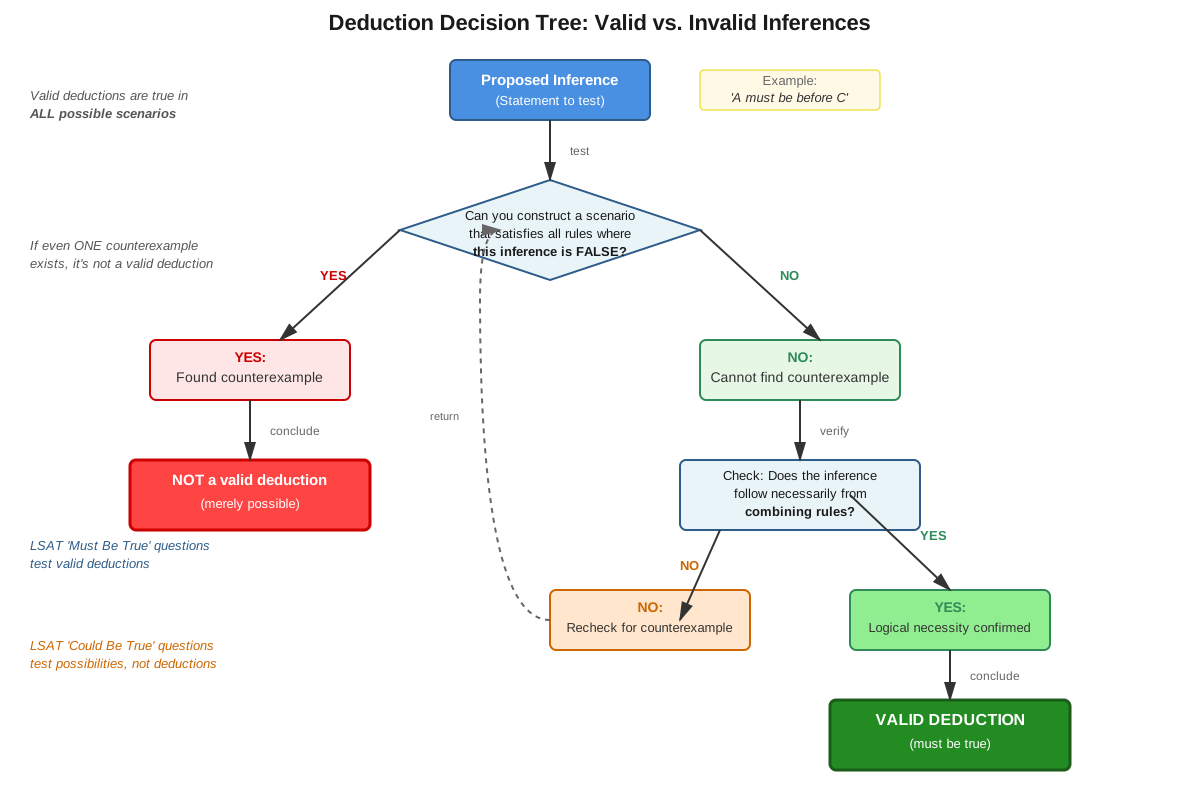
- [ ] Distinguish between valid deductions and mere possibilities in sequencing scenarios
- [ ] Evaluate answer choices efficiently by referencing pre-made deductions rather than testing each option independently
Prerequisites
- Basic sequencing notation: Understanding how to represent "before" and "after" relationships using arrows, dashes, or other symbolic systems is essential because all deduction work builds on accurate rule representation.
- Conditional reasoning fundamentals: Recognizing "if-then" statements and their contrapositives matters because many sequencing rules contain conditional elements that trigger specific ordering requirements.
- Set theory basics: Knowing how to work with finite sets of elements helps because sequencing games involve arranging a defined group of variables into positions.
- Logical necessity vs. possibility: Distinguishing what must be true from what could be true is critical because deductions represent only necessary conclusions, not speculative scenarios.
Why This Topic Matters
Sequencing deductions appear in approximately 25-30% of all Analytical Reasoning Legacy games on the LSAT, making them one of the highest-yield topics for score improvement. According to LSAC data analysis, students who master deduction-making in sequencing games answer questions 30-40% faster than those who rely on testing answer choices individually. This time savings compounds across the section, often making the difference between completing all questions and leaving several blank.
In actual LSAT administration, sequencing deductions manifest in several question types. "Must Be True" questions directly test whether students have identified valid deductions. "Could Be True" questions require students to recognize what their deductions have left open as possibilities. "Complete and Accurate List" questions reward students who have deduced fixed positions or restricted options. Even "If" hypothetical questions become dramatically easier when students have already completed thorough upfront deduction work, as the hypothetical simply adds one more constraint to an already-mapped system.
The practical significance extends beyond test day. Legal reasoning frequently involves determining what follows necessarily from established facts and rules—precisely the skill sequencing deductions develop. Attorneys must constantly distinguish between what evidence proves conclusively versus what it merely suggests. Contract interpretation, statutory construction, and precedent analysis all require the same rigorous deductive thinking that sequencing games train. Students who excel at sequencing deductions develop mental habits that serve them throughout law school and legal practice.
Core Concepts
The Nature of Sequencing Deductions
Lsat sequencing deductions are conclusions that follow necessarily and inevitably from combining two or more explicit rules in a sequencing game. Unlike guesses or strategic assumptions, deductions represent information that must be true in every valid scenario that satisfies the game's constraints. The key word is "must"—a valid deduction holds in all possible arrangements, not just some.
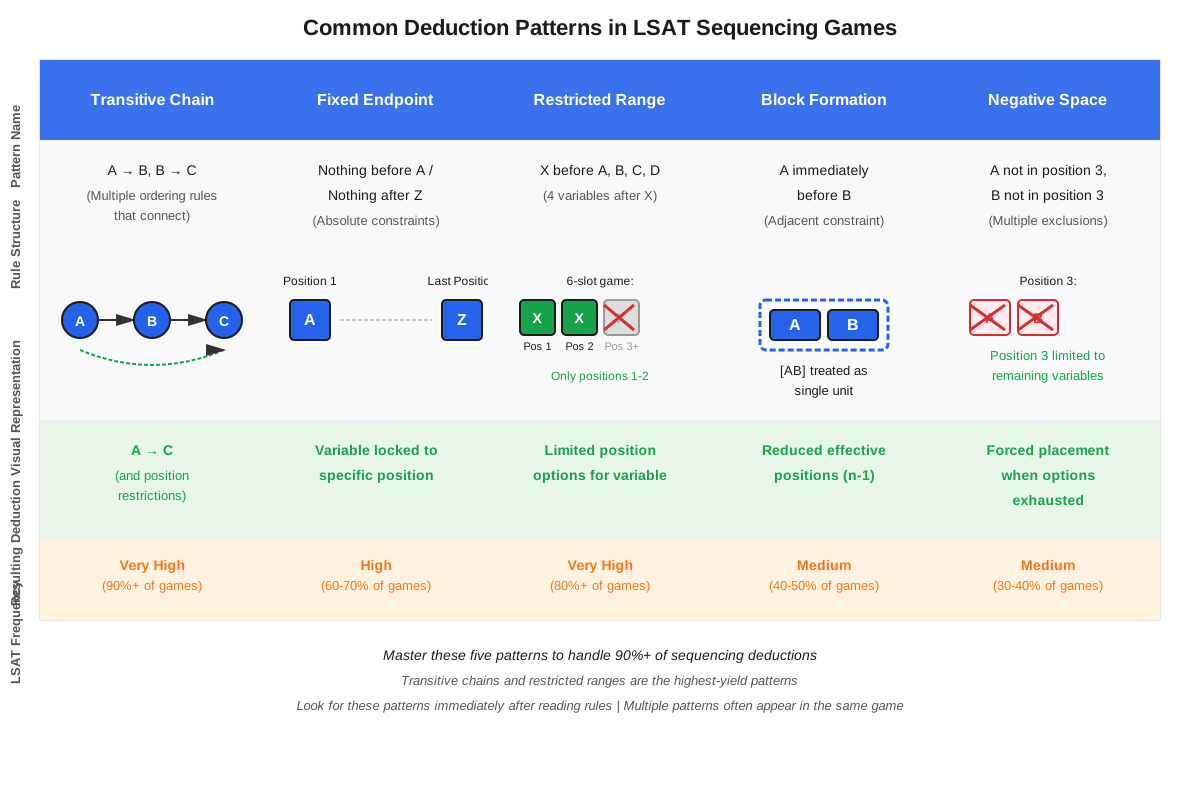
The foundation of deduction-making rests on transitive relationships. If A precedes B, and B precedes C, then A must precede C. This transitive property allows students to chain together multiple rules into longer sequences. However, LSAT games rarely present rules in convenient order. Students must actively search for connection points where rules share common variables, then link those rules together.
Types of Sequencing Deductions
Direct Transitivity Deductions
The most fundamental deduction type occurs when rules share a common element and can be directly chained. Consider these rules:
- Rule 1: F is before G
- Rule 2: G is before H
The deduction: F is before H. This follows immediately and requires no additional reasoning. In notation: F—G—H creates a single chain where F's relationship to H becomes explicit.
Indirect Transitivity Through Multiple Steps
More complex games require chaining three or more rules:
- Rule 1: A is before B
- Rule 2: B is before C
- Rule 3: C is before D
These combine to show: A is before D (skipping two intermediate positions). The chain A—B—C—D reveals that A must occupy an earlier position than D, even though no rule directly states this relationship.
Fixed Position Deductions
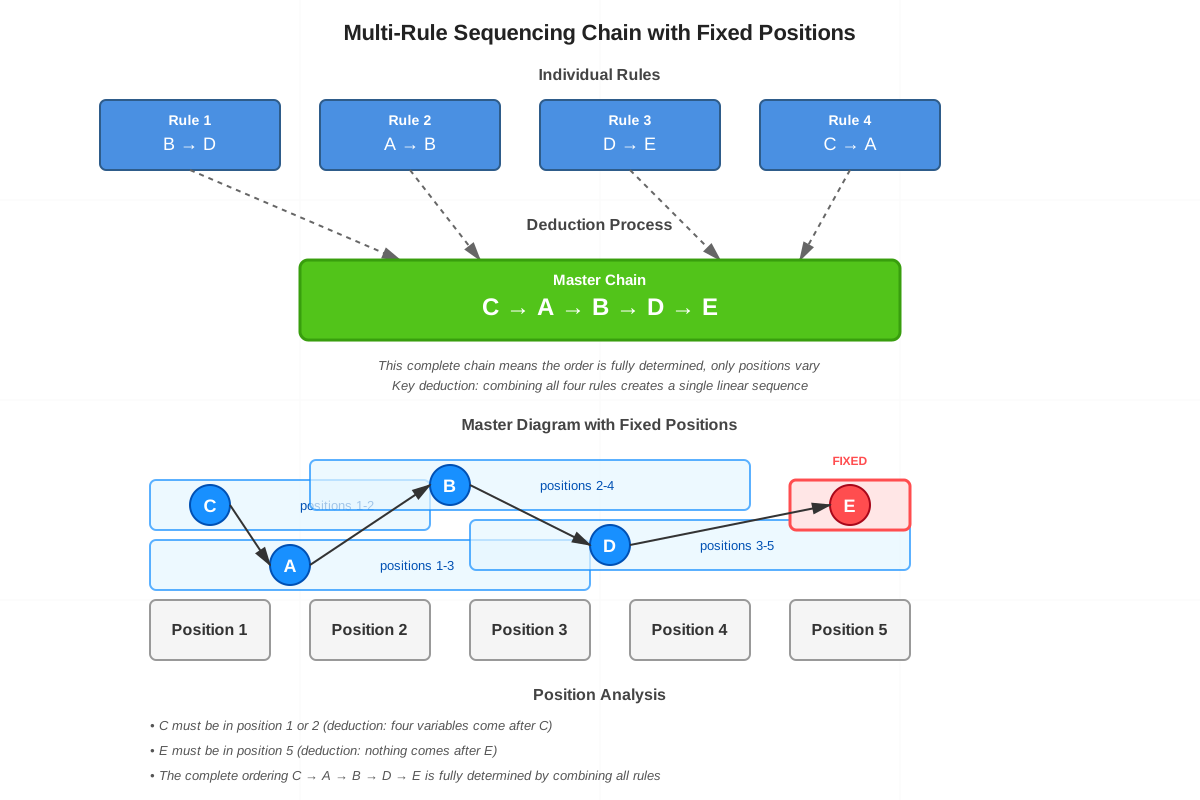
When a chain becomes long enough relative to the total number of positions, certain variables must occupy specific slots. In a 5-position game, if the chain is A—B—C—D—E, then A must be first and E must be fifth. Even shorter chains can create fixed positions:
| Chain Length | Total Positions | Fixed Position Deductions |
|---|---|---|
| 3 variables | 3 positions | First and last are fixed |
| 4 variables | 5 positions | First position is fixed |
| 5 variables | 6 positions | First and last are fixed |
Block Deductions
When rules specify that certain variables must be adjacent or separated by a specific number of positions, blocks form. If "M is immediately before N" and "N is immediately before O," then M-N-O forms a three-element block that moves as a unit. This block can only fit in positions 1-2-3, 2-3-4, or 3-4-5 in a five-position game, immediately limiting possibilities.
Exclusion Deductions
Combining rules sometimes reveals where variables cannot go. If A must be before B, and B must be before C, then in a three-position game, C cannot be first (A must be), and A cannot be last (C must be). These negative deductions are equally valuable as positive ones.
The Deduction-Making Process
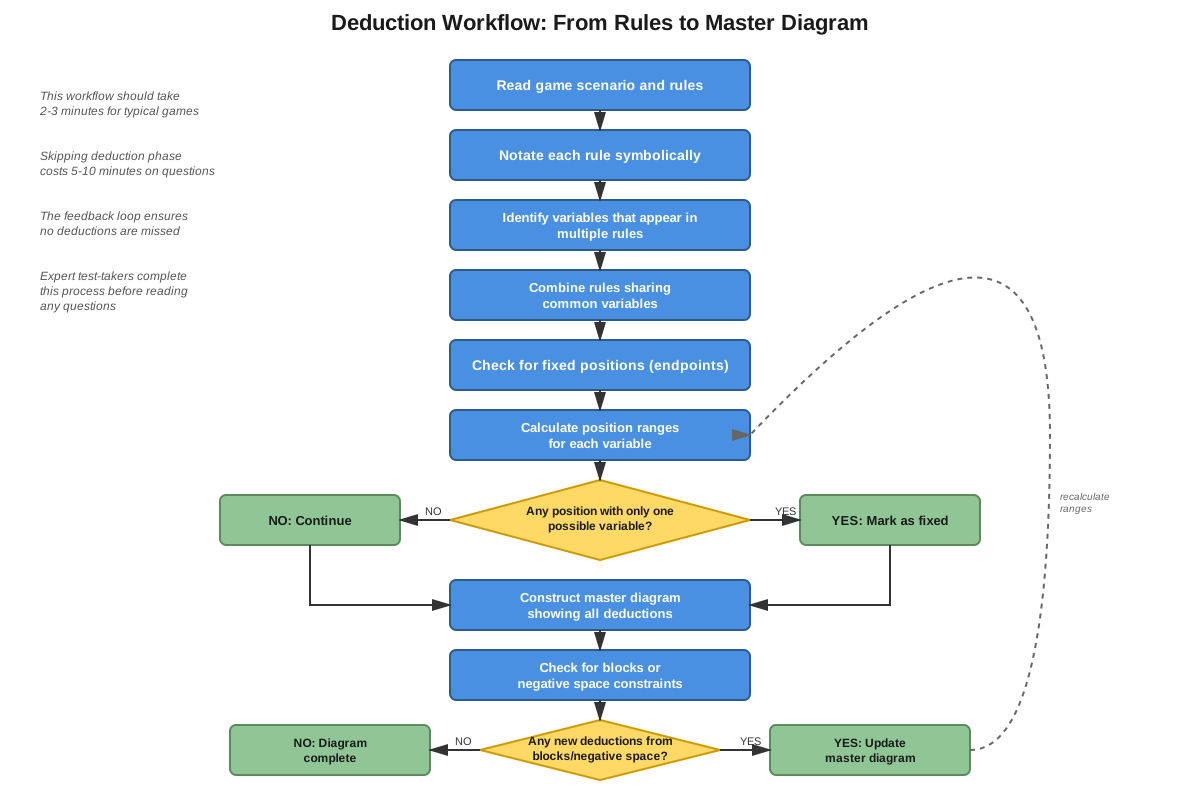
Effective sequencing deduction follows a systematic approach:
- Represent all rules visually using consistent notation (arrows, dashes, or vertical arrangements)
- Identify shared variables between rules—these are connection points
- Combine rules that share variables into longer chains
- Check for fixed positions by comparing chain length to total positions
- Note exclusions for variables at chain ends (first element cannot be last; last element cannot be first)
- Look for numerical constraints that limit where blocks or chains can fit
- Test extreme scenarios (what if the first element goes first? what if it goes as late as possible?)
Conditional Sequencing Deductions
Many sequencing games include conditional rules: "If X is selected, then X is before Y." These create conditional chains that only apply when triggered. The deduction process must track both:
- What must be true unconditionally (from non-conditional rules)
- What must be true if certain conditions are met
For conditional rules, always identify the contrapositive: If X is before Y is required when X is selected, then if Y is before X (or X is not before Y), then X is not selected.
Numerical Constraint Deductions
When games specify exact positions or ranges ("A must be in position 1, 2, or 3"), these constraints combine with ordering rules to create powerful deductions. If A must be in the first three positions, and B must be before A, then B must be in positions 1 or 2 (it needs room for A to follow).
Concept Relationships
The concepts within sequencing deductions form a hierarchical structure. Direct transitivity serves as the foundation—students must master simple two-rule combinations before tackling complex chains. Indirect transitivity builds on this foundation by extending chains across multiple rules. Once students can construct complete chains, fixed position deductions emerge naturally by comparing chain length to available positions.
Block deductions represent a specialized application of transitivity where the relationship is "immediately before" rather than simply "before." These blocks then interact with fixed position logic—a three-element block in a five-position game has only three possible placements, which may trigger additional deductions about other variables.
Exclusion deductions and numerical constraint deductions represent meta-level reasoning that applies across all other deduction types. Any time a positive deduction is made ("X must be here"), exclusion reasoning follows ("therefore X cannot be there"). Numerical constraints act as filters that limit where chains and blocks can fit.
The relationship map flows as follows:
Basic Rule Representation → Direct Transitivity → Indirect Transitivity (Chains) → Fixed Positions + Blocks → Exclusion Deductions → Complete Game Setup
This progression connects to prerequisite knowledge of conditional reasoning (for conditional sequencing rules) and extends forward to question-answering strategies where pre-made deductions enable rapid elimination of incorrect answers.
High-Yield Facts
⭐ Transitive property is the foundation: If A is before B, and B is before C, then A must be before C—this applies regardless of how many steps separate them in the chain.
⭐ Fixed positions emerge when chain length approaches total positions: In an n-position game, a chain of n variables fixes both endpoints; a chain of n-1 variables fixes at least one endpoint.
⭐ The first element in any chain cannot be last: This exclusion deduction applies to every sequencing game and immediately eliminates answer choices.
⭐ The last element in any chain cannot be first: The mirror of the previous fact, equally powerful for eliminating wrong answers.
⭐ Blocks reduce flexibility dramatically: A three-element block in a five-position game has only three possible placements, often triggering cascading deductions.
- Variables that appear in multiple rules are connection points for building longer chains—prioritize analyzing these variables first.
- Conditional sequencing rules require tracking both the rule and its contrapositive for complete deduction coverage.
- When two chains cannot be connected, the game has multiple "floating" sequences that can be arranged relative to each other in various ways.
- Numerical constraints ("X must be in position 1, 2, or 3") combine multiplicatively with ordering rules to restrict possibilities.
- The maximum number of positions a variable can occupy equals total positions minus the number of variables that must precede it minus the number that must follow it.
- In games with ties or simultaneous positions allowed, transitivity still applies but fixed position deductions become less common.
- Exclusion deductions are often easier to spot than positive deductions—systematically checking what cannot be true reveals hidden constraints.
Quick check — test yourself on Sequencing deductions so far.
Try Flashcards →Common Misconceptions
Misconception: If A is before B, and C is before D, then A must be before D.
Correction: Without a shared variable connecting the two rules, no deduction is possible. A and D could appear in any relative order. Deductions require connection points where rules overlap.
Misconception: If A is before B, then A must be immediately before B.
Correction: "Before" means only that A comes earlier in the sequence; any number of variables could appear between A and B. Only rules explicitly stating "immediately before" or "adjacent" create blocks without gaps.
Misconception: In a five-position game with the chain A—B—C, A must be in position 1.
Correction: A could be in position 1, 2, or 3 (with B and C following). Fixed position deductions require comparing chain length to total positions. A three-element chain in five positions does not fix any positions.
Misconception: If the rules don't explicitly connect all variables, the game is unsolvable.
Correction: Many sequencing games intentionally leave some variables "floating" with flexible placement. The deductions reveal what must be true while leaving some arrangements open—this is by design, not a flaw.
Misconception: Making deductions wastes time that could be spent answering questions.
Correction: Research on LSAT performance shows that spending 2-3 minutes on upfront deductions reduces per-question time by 50% or more. Students who skip deduction work answer questions more slowly and less accurately.
Misconception: Conditional sequencing rules only matter when the condition is explicitly triggered in a question.
Correction: The contrapositive of conditional rules creates deductions even when the condition isn't met. If "X selected → X before Y," then "Y before X → X not selected" provides valuable information in all questions.
Worked Examples
Example 1: Basic Chain Construction with Fixed Position
Setup: Seven presentations—F, G, H, J, K, L, M—are scheduled in seven consecutive time slots. The following conditions apply:
- F is before G
- G is before H
- H is before J
- K is before L
- L is before M
Step 1: Represent Rules Visually
Chain 1: F—G—H—J
Chain 2: K—L—M
Step 2: Identify Shared Variables
No variables appear in both chains, so these are two independent sequences.
Step 3: Make Fixed Position Deductions
Chain 1 has 4 elements in 7 positions. F could be in positions 1-4 (needs room for G, H, J to follow). J could be in positions 4-7 (needs F, G, H before it).
Chain 2 has 3 elements in 7 positions. K could be in positions 1-5. M could be in positions 3-7.
Step 4: Make Exclusion Deductions
- F cannot be in positions 5, 6, or 7 (insufficient room for G, H, J)
- J cannot be in positions 1, 2, or 3 (needs F, G, H before it)
- K cannot be in positions 6 or 7 (needs room for L, M)
- M cannot be in positions 1 or 2 (needs K, L before it)
Step 5: Consider Extreme Scenarios
If F is in position 1 (earliest possible), then G-H-J occupy three of the remaining six positions. If J is in position 7 (latest possible), then F-G-H occupy three of the first six positions.
Application to Questions: When a question asks "Which could be in position 1?" immediately eliminate G, H, J, L, and M based on deductions. Only F and K remain possible.
Example 2: Conditional Sequencing with Numerical Constraints
Setup: Six athletes—R, S, T, U, V, W—finish a race in six distinct positions. The following conditions apply:
- R finishes before S
- If T finishes before U, then V finishes before W
- U finishes in position 1, 2, or 3
- W finishes in position 4, 5, or 6
Step 1: Represent Non-Conditional Rules
R—S (unconditional chain)
U: positions 1, 2, or 3 (numerical constraint)
W: positions 4, 5, or 6 (numerical constraint)
Step 2: Analyze Conditional Rule
If T—U, then V—W (conditional chain)
Contrapositive: If W—V, then U—T
Step 3: Combine Numerical Constraints with Conditional
W is in position 4, 5, or 6. If the conditional triggers (T before U), then V must be before W. Since W is in position 4, 5, or 6, V must be in position 1, 2, 3, 4, or 5 (at least one position before W's earliest possible position).
Step 4: Test Contrapositive Scenario
If W finishes before V, then U finishes before T. But W is in position 4, 5, or 6, and U is in position 1, 2, or 3. For W to be before V, V must be in position 5 or 6 (after W's earliest position of 4). This scenario is possible.
Step 5: Identify Key Deduction
The conditional creates two possible worlds:
- World A: T before U, therefore V before W
- World B: U before T, therefore W before V (contrapositive)
In World A, since U is in position 1-3 and T is before U, T must be in position 1 or 2. In World B, since W is in position 4-6 and V is after W, V must be in position 5 or 6.
Application to Questions: When a question places T in position 1, World A is triggered. Immediately deduce that V must be before W, and U must be in position 2 or 3. This eliminates multiple answer choices instantly.
Exam Strategy
When approaching LSAT sequencing games, invest 2-3 minutes in systematic deduction work before attempting any questions. This upfront investment pays dividends across all questions in the game. Follow this process:
Trigger Words to Watch For:
- "before," "after," "earlier," "later" → sequencing relationships
- "immediately," "adjacent," "consecutive" → block formations
- "if," "when," "whenever" → conditional sequencing rules
- "must be in," "cannot be in," "exactly" → numerical constraints
- "at least," "at most," "no more than" → range constraints
Question-Answering Approach:
For "Must Be True" questions, reference your deductions first. If the answer doesn't appear in your deductions, it's likely wrong. These questions test whether you've identified the game's necessary conclusions.
For "Could Be True" questions, check whether the answer violates any deductions. If it contradicts a fixed position or exclusion deduction, eliminate it immediately. The correct answer will be something your deductions left open as possible.
For "Complete and Accurate List" questions, use your fixed position and exclusion deductions to eliminate answers. If your deductions show X cannot be first, eliminate any answer listing X as a possibility for first position.
Process of Elimination Tips:
- Always eliminate answers that place the first element of a chain in the last position
- Always eliminate answers that place the last element of a chain in the first position
- Check answers against fixed position deductions before testing them fully
- In "If" questions, add the new constraint to your existing deductions rather than starting from scratch
- When stuck, test the most restrictive answer choice first—it's easier to disprove
Time Allocation:
- Setup and deductions: 2-3 minutes
- First question (often a "complete arrangement" question): 30-45 seconds
- Subsequent questions: 45-75 seconds each
- If a question takes more than 90 seconds, mark it and return after completing easier questions
Exam Tip: Students who complete thorough deduction work answer questions 30-40% faster than those who don't. The time spent on deductions is recovered multiple times over during question-answering.
Memory Techniques
CHAIN Mnemonic for the deduction process:
- Connect rules with shared variables
- Hook together into longer sequences
- Analyze fixed positions (compare chain length to total positions)
- Identify exclusions (what cannot be where)
- Note numerical constraints and their implications
Visualization Strategy: Picture the sequence as a physical line of people or objects. When rules state "A before B," visualize A standing to the left of B. This spatial representation makes transitivity intuitive—if A is left of B, and B is left of C, you can "see" that A must be left of C.
The "Bookend Rule": Remember that the first element in any chain cannot be last, and the last element cannot be first. Think of these as bookends that hold the sequence in place—they mark the boundaries.
Conditional Sequencing Acronym - IF/THEN/CONTRA:
- IF: Identify the condition that triggers the rule
- THEN: Note what follows when triggered
- CONTRA: Write the contrapositive immediately (flip and negate)
Fixed Position Formula: In an n-position game, a chain of length L fixes positions when L ≥ n-1. Memorize this threshold—it's the tipping point where deductions become definite.
Summary
Sequencing deductions represent the systematic process of deriving necessary conclusions from combining multiple ordering rules in LSAT Analytical Reasoning Legacy games. The foundation rests on transitive relationships—if A precedes B and B precedes C, then A must precede C—which allows students to chain rules together into longer sequences. As chains grow longer relative to the total number of positions, fixed position deductions emerge, revealing that certain variables must occupy specific slots. Exclusion deductions follow naturally: the first element in any chain cannot be last, and the last element cannot be first. Block deductions arise when rules specify adjacency, creating multi-element units that move together and have limited placement options. Conditional sequencing rules add complexity by creating multiple possible worlds, each with its own set of deductions. Numerical constraints interact multiplicatively with ordering rules, further restricting where variables can appear. Mastering sequencing deductions transforms LSAT performance by enabling students to answer questions rapidly and accurately, drawing on pre-made conclusions rather than testing each answer choice independently. The key to success lies in systematic upfront work: represent rules visually, identify connection points, build chains, check for fixed positions, and note exclusions before attempting any questions.
Key Takeaways
- Transitive chaining is fundamental: Combine rules with shared variables to build longer sequences that reveal relationships between variables not directly connected by rules
- Fixed positions emerge from long chains: When chain length approaches the total number of positions, certain variables must occupy specific slots—this is one of the highest-yield deduction types
- Exclusion deductions are equally valuable: Knowing where variables cannot go eliminates wrong answers just as effectively as knowing where they must go
- Invest time in upfront deductions: 2-3 minutes of systematic deduction work before questions saves 5-10 minutes during question-answering and dramatically improves accuracy
- Conditional rules create multiple worlds: Track both the rule and its contrapositive, recognizing that different scenarios may have different deduction sets
- Blocks reduce flexibility: Multi-element blocks that must stay together have limited placement options, often triggering cascading deductions about other variables
- Numerical constraints multiply with ordering rules: When a variable must be in certain positions AND must be before/after other variables, the intersection of these constraints creates powerful deductions
Related Topics
Grouping Deductions: After mastering sequencing deductions, students should explore how similar deductive reasoning applies to grouping games where variables are distributed into categories rather than ordered. The logical principles remain similar, but the spatial representation differs.
Hybrid Game Deductions: Many LSAT games combine sequencing with grouping or selection, requiring students to make deductions across multiple constraint types simultaneously. Mastering pure sequencing deductions provides the foundation for these more complex scenarios.
Advanced Conditional Reasoning in Games: Building on basic conditional sequencing rules, advanced games feature nested conditionals, conditional chains, and complex contrapositive reasoning that extends the deduction techniques covered here.
Spatial Reasoning Games: Some LSAT games involve physical arrangements (seating charts, building floors) that incorporate sequencing elements. The deduction principles transfer directly while adding geometric considerations.
Practice CTA
Now that you've mastered the core concepts of sequencing deductions, it's time to put your knowledge into action. The practice questions and flashcards for this topic will challenge you to identify connection points between rules, build complete chains, and derive fixed position deductions under timed conditions. Remember: deduction skills improve dramatically with deliberate practice. Each game you work through strengthens your pattern recognition and speeds up your deduction process. Approach the practice materials systematically, following the CHAIN mnemonic, and review any mistakes carefully to understand where your deduction process broke down. Your investment in mastering sequencing deductions will pay dividends across the entire Analytical Reasoning section—this is one of the highest-yield skills for LSAT score improvement. You've got this!
Sign up free to keep reading
Create a free AnvayaPrep account to finish this LSAT guide on Sequencing deductions — plus flashcards and practice questions.