Overview
Split block rules are a fundamental constraint type in Analytical Reasoning Legacy (Logic Games) that appear frequently in sequencing games legacy on the LSAT. These rules specify that two or more elements must be separated by a precise number of positions in a sequence, creating a fixed spatial relationship between variables. Unlike simple ordering rules that merely establish relative position (e.g., "A comes before B"), split block rules impose exact distance requirements, such as "exactly two positions separate X and Y" or "Z is exactly three spaces after W."
Understanding split block rules is essential for LSAT success because they dramatically constrain the solution space in sequencing games, often serving as the key to unlocking entire game boards. These rules create predictable patterns that test-takers can exploit to make rapid deductions and eliminate incorrect answer choices. When combined with other constraints, split block rules frequently generate limited scenarios that allow for complete or near-complete determination of the sequence. The LSAC (Law School Admission Council) favors these rules because they test a candidate's ability to visualize spatial relationships, track multiple constraints simultaneously, and recognize how restrictions interact to limit possibilities.
Within the broader framework of Analytical Reasoning Legacy, split block rules represent an intermediate complexity level between basic ordering constraints and more complex conditional relationships. They share characteristics with both block rules (where elements must be adjacent) and distribution rules (where elements must occupy specific positions), making them a bridge concept that integrates multiple reasoning skills. Mastery of split block rules builds directly on foundational sequencing concepts while preparing students for advanced game types that combine multiple constraint categories.
Learning Objectives
- [ ] Identify how split block rules appear in LSAT questions
- [ ] Explain the reasoning pattern behind split block rules
- [ ] Apply split block rules to solve LSAT-style problems accurately
- [ ] Diagram split block rules using standard notation systems
- [ ] Generate all possible configurations that satisfy a given split block constraint
- [ ] Combine split block rules with other constraint types to make compound deductions
- [ ] Recognize when split block rules create limited scenario opportunities
Prerequisites
- Basic sequencing notation: Understanding how to represent ordered positions (1, 2, 3, etc.) and variables in linear arrangements is fundamental to visualizing split block constraints
- Relative ordering rules: Familiarity with "before/after" relationships provides the foundation for understanding more precise distance-based constraints
- Block rules (adjacent elements): Split block rules are conceptually related to standard blocks but with separation rather than adjacency
- Game board setup: Ability to create visual representations of sequencing games with numbered positions and variable slots
- Basic deductive reasoning: Capacity to draw logical inferences from given constraints and recognize when rules combine to limit possibilities
Why This Topic Matters
Split block rules appear in approximately 15-20% of all Analytical Reasoning Legacy games on the LSAT, making them one of the most frequently tested constraint types in sequencing contexts. They are particularly common in games involving scheduling, ordering, or ranking scenarios where precise spacing matters. The LSAC uses these rules because they efficiently test multiple cognitive skills: spatial reasoning, constraint satisfaction, and systematic case analysis.
In real-world legal practice, the reasoning patterns underlying split block rules mirror common analytical tasks attorneys face daily. Lawyers must frequently work with temporal constraints (filing deadlines separated by specific intervals), procedural requirements (steps that must occur with precise spacing), and regulatory compliance (events that must be separated by mandated periods). The ability to visualize and manipulate these constraints under time pressure directly translates to practical legal reasoning.
On the LSAT, split block rules typically appear in three primary contexts: (1) explicit distance statements ("exactly two positions separate A and B"), (2) indirect spacing requirements ("C is third after D"), and (3) compound constraints that combine spacing with other rules ("E and F are separated by exactly one position, and both come before G"). Questions testing split block rules often ask test-takers to identify possible positions for variables, determine what must or could be true, or recognize valid complete arrangements. These rules frequently serve as the pivot point for creating limited scenarios, making them high-value constraints for strategic game-solving.
Core Concepts
Definition and Basic Structure
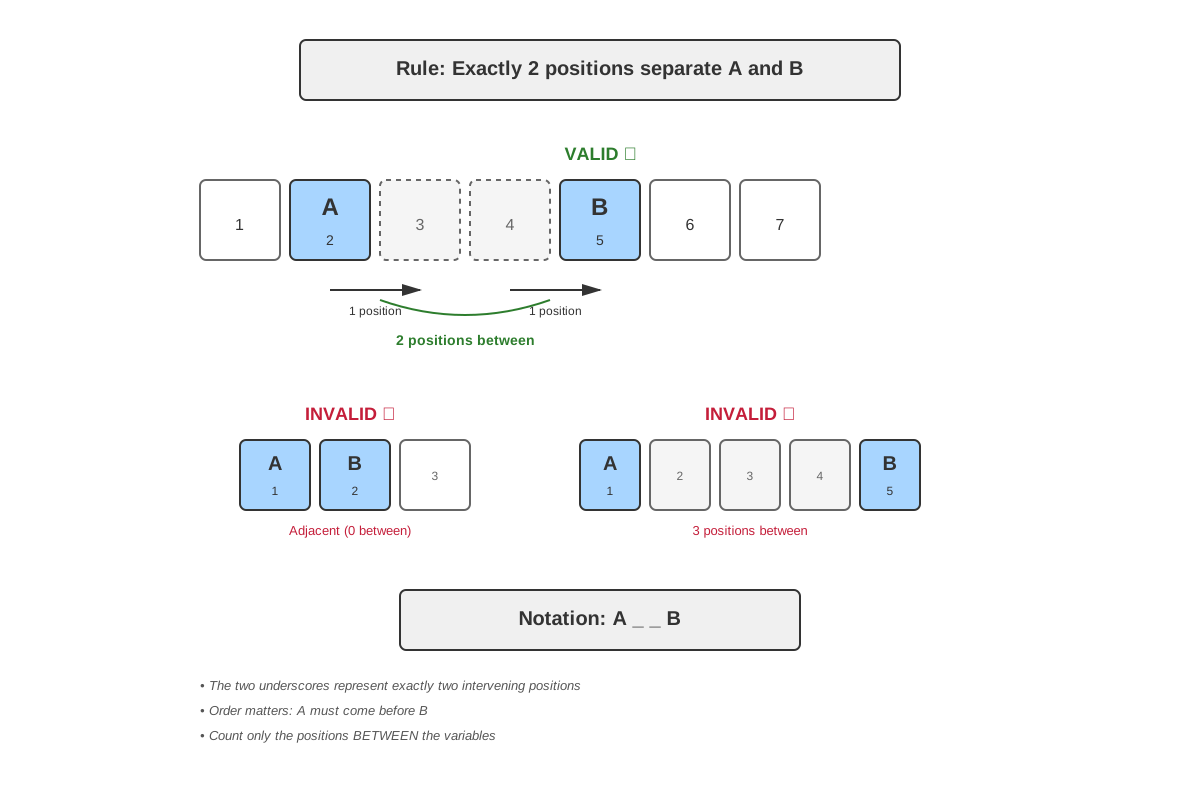
Split block rules (also called lsat split block rules) are constraints that specify an exact number of positions that must separate two or more elements in a sequence. The defining characteristic is precision: unlike relative ordering rules that allow flexible spacing, split block rules mandate a fixed distance. The general form is "X and Y are separated by exactly N positions" or equivalently "X is N+1 positions away from Y."
The mathematical relationship is crucial: if two elements are separated by N positions, they are N+1 spaces apart in absolute distance. For example, if A and B are separated by exactly one position, they are two spaces apart (positions 1 and 3, or 2 and 4, etc.). This distinction between "separated by" and "apart from" is a common source of confusion but essential for accurate diagramming.
Standard Notation Systems
Multiple notation systems exist for representing split block rules, and familiarity with all common forms is essential:
Linear notation with dashes: A - _ - B (indicating A and B with exactly one position between them)
Subscript notation: A₂B or A₊₂B (indicating B is two positions after A)
Absolute distance notation: |A - B| = 2 (indicating two positions of separation)
Visual block notation: [A _ B] with the understanding that the underscore represents exactly one intervening position
The most universally understood notation uses dashes to represent intervening positions, as this provides immediate visual clarity about the spatial relationship. For a rule stating "exactly two positions separate X and Y," the notation would be: X - _ - _ - Y
Directional vs. Non-Directional Split Blocks
Split block rules come in two fundamental varieties based on whether order matters:
Non-directional split blocks specify distance but not order. "A and B are separated by exactly one position" allows both A - _ - B and B - _ - A. These rules provide spacing constraints without determining which element comes first.
Directional split blocks specify both distance and order. "C is exactly two positions after D" means only D - _ - _ - C is valid, not the reverse. These rules are more restrictive and typically generate fewer possible configurations.
| Rule Type | Example | Valid Configurations | Invalid Configurations |
|---|---|---|---|
| Non-directional | "X and Y separated by 1" | X_Y or Y_X | XY, X__Y |
| Directional | "P is 2 after Q" | Q__P only | P__Q, QP |
Calculating Possible Positions
For a sequence of length N, determining how many valid placements exist for a split block is a critical skill. The formula depends on the separation distance and whether the rule is directional:
For a directional split block with separation S (meaning S+1 total positions occupied):
- Number of valid placements = N - S
For example, in a 7-position sequence with the rule "A is exactly two positions after B" (separation of 2, occupying 3 total positions):
- Valid placements = 7 - 2 = 5 configurations
- Specifically: B__A can start at positions (1,4), (2,5), (3,6), (4,7), or (5,7)... wait, that's incorrect. Let me recalculate.
- Actually: B at position 1 means A at position 4; B at position 2 means A at position 5; continuing through B at position 5 means A at position 8 (impossible in 7-position sequence)
- Correct count: B can be in positions 1-5, giving exactly 5 valid placements
For a non-directional split block, double this number (unless it would create duplicates at the boundaries).
Interaction with Other Constraints
Split block rules rarely appear in isolation. Their true power emerges when combined with other constraint types:
Split blocks + fixed positions: If "A and B are separated by exactly one position" and "A is in position 3," then B must be in position 1 or position 5 (the only positions exactly one space away from 3).
Split blocks + ordering rules: If "X - _ - Y" (X and Y separated by one) and "X comes before Z" and "Z comes before Y," then the sequence must be X - Z - Y, with Z occupying the intervening position.
Multiple split blocks: When two split block rules share a common element, they often create very limited scenarios. For example, "A - _ - B" and "B - _ - C" means the sequence must contain A - _ - B - _ - C (occupying 5 consecutive positions).
Scenario Creation and Case Analysis
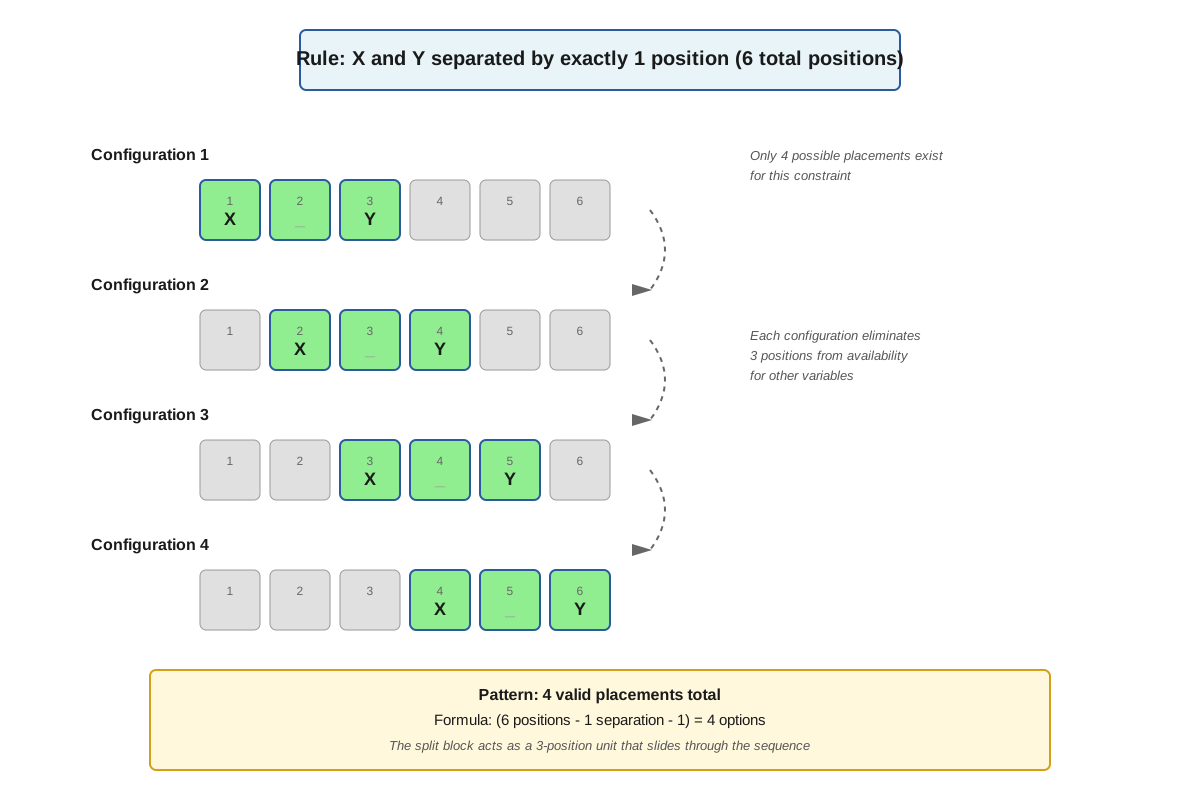
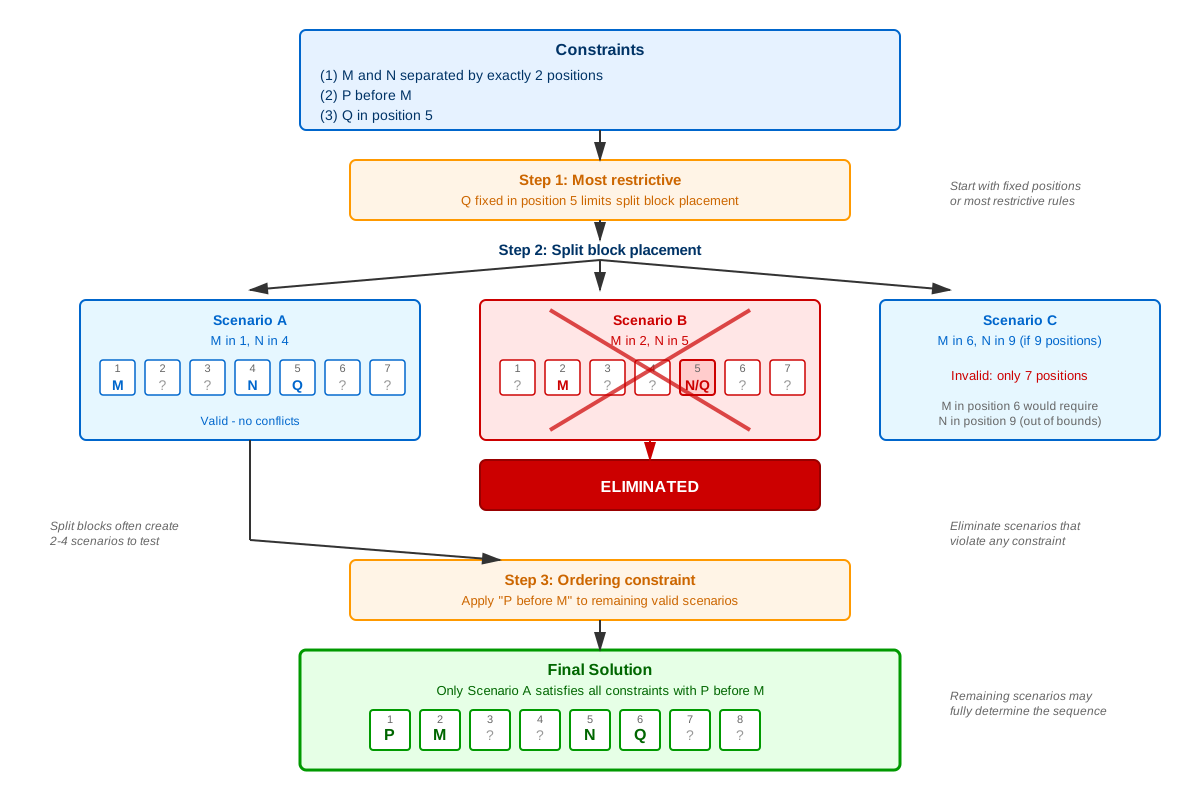
Split block rules frequently necessitate scenario-based approaches where test-takers enumerate all possible configurations. When a split block rule significantly constrains the game (occupying many positions or interacting with other rules), creating separate scenarios for each valid placement often proves most efficient.
For instance, in a 6-position game with the rule "P and Q are separated by exactly two positions," there are only 4 possible configurations:
- P - _ - _ - Q in positions 1-4
- P - _ - _ - Q in positions 2-5
- P - _ - _ - Q in positions 3-6
- Q - _ - _ - P in positions 1-4
- Q - _ - _ - P in positions 2-5
- Q - _ - _ - P in positions 3-6
Creating mini-boards for each scenario allows systematic exploration of how other rules apply in each case.
Concept Relationships
Split block rules exist within a hierarchy of sequencing constraints. At the foundation lie basic ordering rules (A before B), which establish relative position without specifying distance. Split block rules add precision by mandating exact spacing, making them more restrictive than simple ordering. They are closely related to block rules (adjacent elements), which can be understood as split blocks with zero separation—essentially a special case where the separation distance equals zero.
The relationship flows: Basic Ordering → Split Block Rules → Complete Determination. As constraints become more specific, the solution space narrows. Split block rules often serve as the bridge between under-constrained games (many possible solutions) and highly constrained games (few or one solution).
Within a single game, split block rules interact with fixed position rules to create forced placements, combine with conditional rules to trigger cascading deductions, and work alongside distribution rules to eliminate impossible configurations. The conceptual map looks like:
Fixed Positions + Split Blocks → Forced Placements → Limited Scenarios → Complete or Near-Complete Solutions
Multiple Split Blocks (sharing elements) → Chain Formations → Extended Sequences → Reduced Flexibility
Split Blocks + Ordering Rules → Intervening Element Identification → Position Determination
Understanding these relationships allows test-takers to recognize high-value deductions quickly and prioritize which rules to combine first during game setup.
Quick check — test yourself on Split block rules so far.
Try Flashcards →High-Yield Facts
⭐ Split block rules specify exact distance, not minimum or maximum separation—"separated by two" means exactly two, not "at least two"
⭐ If elements are separated by N positions, they are N+1 spaces apart in absolute distance
⭐ Non-directional split blocks allow either order (A_B or B_A); directional split blocks specify order
⭐ In an N-position sequence, a split block occupying K total positions can be placed in N-K+1 different starting positions (for directional rules)
⭐ Split blocks sharing a common element often create chain formations that severely limit possible arrangements
- Split block rules appear most frequently in sequencing games involving scheduling, ranking, or ordering scenarios
- When a split block rule involves elements near the beginning or end of a sequence, boundary constraints eliminate many configurations
- The intervening positions between split block elements are often key to solving the game—determining what can or must fill those spaces
- Split blocks combined with "not adjacent" rules create compound constraints that are highly restrictive
- Questions asking "which could be true" often test whether proposed positions satisfy split block distance requirements
Common Misconceptions
Misconception: "Separated by two positions" means the elements are two spaces apart in the sequence.
Correction: "Separated by two positions" means there are exactly two positions between the elements, making them three spaces apart. If A is in position 1 and B is in position 4, they are separated by two positions (positions 2 and 3 are between them).
Misconception: Split block rules are the same as block rules, just with more space between elements.
Correction: While conceptually related, split block rules and block rules function differently in deductions. Block rules create units that move together through the sequence, while split blocks maintain fixed internal distance but don't necessarily move as a unit when other constraints apply.
Misconception: If "X and Y are separated by one position," they could be separated by more than one position in some scenarios.
Correction: Split block rules specify exact distance. "Separated by one position" means exactly one position, never zero and never two or more. This precision is what distinguishes split blocks from relative ordering rules.
Misconception: In a non-directional split block, both orderings are always possible in every game state.
Correction: While non-directional split blocks don't inherently specify order, other rules in the game may force one particular ordering. The non-directionality means the split block rule itself doesn't determine order, but other constraints might.
Misconception: Split blocks can "wrap around" in circular sequences.
Correction: Unless explicitly stated that the sequence is circular, split blocks operate in standard linear sequences. In a 6-position linear sequence, position 6 and position 1 are not adjacent or separated by any countable distance—they're at opposite ends.
Misconception: When counting positions for split blocks, you should count the positions the elements occupy.
Correction: "Separated by N positions" counts only the intervening spaces, not the positions occupied by the elements themselves. A - _ - B has one intervening position (the underscore), even though A and B occupy positions themselves.
Worked Examples
Example 1: Basic Split Block Application
Game Setup: Seven books (F, G, H, J, K, L, M) are arranged on a shelf from left to right, positions 1-7.
Rules:
- F and G are separated by exactly two positions
- H is in position 4
- K comes before L
Question: If F is in position 2, which of the following must be true?
Solution Process:
Step 1: Apply the split block rule. If F is in position 2 and F and G are separated by exactly two positions, then G must be exactly two positions away from F.
Step 2: Calculate possible positions for G. Two positions separate F and G means three spaces apart in absolute distance. From position 2, counting three spaces gives us position 5 (forward) or position -1 (backward, impossible). Therefore, G must be in position 5.
Step 3: Record what we know:
- Position 2: F
- Position 4: H (given)
- Position 5: G (deduced)
Step 4: Apply remaining rules. K comes before L, but this doesn't immediately force any positions given our current constraints.
Step 5: Identify what must be true. G must be in position 5 (this would be the correct answer if it appeared in the choices). Also, positions 2, 4, and 5 are occupied, leaving positions 1, 3, 6, and 7 for J, K, L, and M.
Key Insight: The split block rule combined with a fixed position for one element completely determines the position of the other element. This is a high-value deduction that should be made immediately.
Example 2: Multiple Split Blocks with Shared Elements
Game Setup: Six presentations (A, B, C, D, E, F) are scheduled in time slots 1-6.
Rules:
- B and C are separated by exactly one position
- C and D are separated by exactly one position
- A comes before E
Question: What is the minimum number of consecutive positions that must contain B, C, and D?
Solution Process:
Step 1: Diagram the split block rules:
- B - _ - C (or C - _ - B)
- C - _ - D (or D - _ - C)
Step 2: Recognize that C appears in both split blocks. This creates a chain formation.
Step 3: Determine possible configurations. Since C is separated by one position from both B and D, we need to consider whether B and D are on the same side of C or opposite sides.
Configuration 1: B and D on opposite sides of C
- B - _ - C - _ - D (occupies 5 consecutive positions)
- D - _ - C - _ - B (occupies 5 consecutive positions)
Configuration 2: B and D on the same side of C?
- This is impossible. If B - _ - C and C - _ - D, then B and D cannot both be on the same side of C while maintaining the one-position separation for each.
Step 4: Verify the minimum span. Both valid configurations occupy exactly 5 consecutive positions.
Answer: 5 consecutive positions
Key Insight: When split blocks share a common element, they create extended chains. The shared element acts as a pivot, and determining the possible arrangements of the non-shared elements relative to the pivot is crucial. This type of constraint interaction frequently appears in medium-to-difficult LSAT games.
Exam Strategy
When approaching LSAT questions involving split block rules, implement this systematic process:
Initial Recognition: Watch for trigger phrases including "separated by exactly," "exactly N positions apart," "N spaces between," or "is the third/fourth/etc. after." These phrases signal split block constraints. Immediately diagram these rules using the dash notation (A - _ - B) to visualize the spatial relationship.
Immediate Deductions: Before moving to questions, check whether split block rules combine with fixed positions or other split blocks. If any element in a split block has a determined position, immediately calculate the position(s) of its paired element. If multiple split blocks share elements, diagram the chain formation to see the extended sequence.
Question Approach by Type:
For "must be true" questions: Focus on forced placements created by split blocks. If the question stem provides additional information (e.g., "If X is in position 3..."), immediately apply split block rules to determine what positions are forced.
For "could be true" questions: Verify that proposed arrangements satisfy the exact distance requirement. Count the intervening positions carefully—this is where errors commonly occur under time pressure.
For "complete and accurate list" questions: Systematically test each position for the element in question, checking whether placing it there allows the split block rule to be satisfied given the remaining available positions.
Time Management: Split block rules often enable scenario-based approaches. If a split block significantly constrains the game (occupying 4+ positions in a 6-7 position sequence), invest 60-90 seconds creating scenarios upfront. This investment typically saves 2-3 minutes across all questions by eliminating repeated calculations.
Process of Elimination: When evaluating answer choices, eliminate options that violate split block distance requirements first, as these are objective and quick to verify. Use your fingers or pencil to count intervening positions if needed—accuracy matters more than speed on these mechanical checks.
Exam Tip: If you're uncertain whether a rule means "separated by N" or "N apart," look for clarifying language elsewhere in the game setup or test both interpretations quickly to see which makes the game solvable. LSAT games always have consistent, logical solutions.
Memory Techniques
The "Dash Counting" Mnemonic: Remember "DASHES = DISTANCE" — count the dashes (underscores) in your notation to verify the separation distance. A - _ - B has one dash between, meaning one position of separation.
The "Plus One" Rule: When converting between "separated by" and "positions apart," remember S.O.P.A. — "Separated? One Plus Apart!" If separated by N, they're N+1 apart.
Visual Anchoring: Create a mental image of a bookshelf or parking spaces. "Separated by two positions" means two empty spaces between the books/cars. This concrete visualization prevents abstract counting errors.
The Chain Link Acronym: For multiple split blocks sharing elements, remember L.I.N.K. — "Linked Intervals Need Kombining" (intentional misspelling for the acronym). This reminds you to diagram how shared elements create extended chains.
Boundary Awareness: Remember E.N.D.S. — "Edges Narrow Down Scenarios." Split blocks near sequence boundaries have fewer possible placements, making them high-value starting points for deductions.
Summary
Split block rules are precise distance constraints that specify exactly how many positions must separate elements in a sequence, making them among the most powerful and frequently tested rules in LSAT Analytical Reasoning Legacy sequencing games. Unlike relative ordering rules that allow flexible spacing, split blocks mandate exact distances, dramatically narrowing the solution space and often enabling complete or near-complete determination of sequences. The key distinction between "separated by N positions" (N intervening spaces) and "N positions apart" (absolute distance of N) is fundamental to accurate application. Split blocks appear in both directional forms (specifying order) and non-directional forms (allowing either order), with directional rules being more restrictive. When combined with fixed positions, other split blocks, or ordering rules, these constraints generate high-value deductions that unlock entire games. Mastery requires facility with standard notation, ability to calculate valid placements systematically, recognition of chain formations when split blocks share elements, and strategic use of scenario-based approaches when constraints significantly limit possibilities.
Key Takeaways
- Split block rules specify exact distance between elements—"separated by N" means exactly N intervening positions, making elements N+1 spaces apart
- Directional split blocks (A is two after B) are more restrictive than non-directional split blocks (A and B separated by two)
- Split blocks combined with fixed positions immediately determine the location of the paired element
- Multiple split blocks sharing a common element create chain formations that occupy extended consecutive positions
- In an N-position sequence, a K-position split block can be placed in N-K+1 different configurations
- Boundary constraints near the beginning or end of sequences eliminate many split block placements
- Scenario-based approaches are often optimal when split blocks occupy a large portion of the available sequence
Related Topics
Block Rules (Adjacent Elements): Understanding standard block rules where elements must be adjacent provides the foundation for split blocks, which can be conceptualized as blocks with mandatory intervening spaces. Mastering split blocks makes advanced block variations more intuitive.
Conditional Sequencing Rules: Split blocks often appear in conditional statements ("If A is third, then B and C are separated by exactly one position"). Combining conditional reasoning with split block constraints represents an advanced skill tested on difficult games.
Numerical Distribution in Sequencing: When split blocks interact with rules about how many elements can occupy certain regions of a sequence, distribution analysis becomes necessary. This combination appears in the most challenging LSAT games.
Circular Sequencing Games: While standard split blocks operate in linear sequences, circular arrangements require modified distance calculations. Understanding linear split blocks is prerequisite to tackling circular variations.
Practice CTA
Now that you've mastered the conceptual framework of split block rules, it's time to cement your understanding through active practice. Attempt the practice questions associated with this topic, focusing on applying the systematic approaches outlined in the Exam Strategy section. Pay particular attention to questions that combine split blocks with other constraint types, as these represent the highest-yield question patterns on test day. Use the flashcards to drill the key distinctions between "separated by" and "apart from," and practice diagramming split blocks until the notation becomes automatic. Remember: split block rules appear in approximately 15-20% of Analytical Reasoning games, making them one of the highest-value topics for your study time investment. Consistent practice with these constraints will build the pattern recognition and spatial reasoning skills that separate good LSAT scores from great ones.
Sign up free to keep reading
Create a free AnvayaPrep account to finish this LSAT guide on Split block rules — plus flashcards and practice questions.