Overview
Conclusion strength is a fundamental concept in LSAT logical reasoning that examines the degree of support an argument's premises provide for its conclusion. Understanding conclusion strength is essential because the LSAT frequently tests whether test-takers can distinguish between conclusions that are strongly supported, moderately supported, or weakly supported by the evidence presented. This skill appears across multiple question types, including Strengthen, Weaken, Flaw, Assumption, and Evaluate questions.
The concept of lsat conclusion strength sits at the heart of critical reasoning assessment. When an argument presents evidence leading to a conclusion, that conclusion can range from being virtually certain (strong) to merely possible (weak). The LSAT rewards students who can precisely calibrate this relationship—recognizing when an author has overreached beyond what the evidence supports or when a conclusion appropriately reflects the strength of its premises. This calibration skill directly impacts performance on approximately 40-50% of Logical Reasoning questions.
Within argument fundamentals, conclusion strength connects intimately with other core concepts including premise identification, assumption detection, and argument structure analysis. Mastering conclusion strength enables students to evaluate whether an argument's reasoning is sound, identify logical gaps, and predict what additional information would strengthen or weaken the argument's persuasiveness. This foundational skill serves as a gateway to advanced logical reasoning competencies tested throughout the LSAT.
Learning Objectives
- [ ] Identify how Conclusion strength appears in LSAT questions
- [ ] Explain the reasoning pattern behind Conclusion strength
- [ ] Apply Conclusion strength to solve LSAT-style problems accurately
- [ ] Distinguish between strong, moderate, and weak conclusions based on premise support
- [ ] Evaluate whether an argument's conclusion is appropriately qualified given its evidence
- [ ] Recognize language markers that signal conclusion strength (e.g., "must be," "probably," "might be")
- [ ] Predict how additional evidence would affect conclusion strength in a given argument
Prerequisites
- Basic argument structure: Understanding the distinction between premises and conclusions is essential because conclusion strength specifically measures the relationship between these components.
- Conditional reasoning fundamentals: Recognizing sufficient and necessary conditions helps evaluate whether premises guarantee or merely suggest a conclusion.
- Quantifier interpretation: Understanding terms like "all," "some," "most," and "none" is necessary because these directly impact how strongly premises support conclusions.
- Inference basics: The ability to draw valid inferences from stated information provides the foundation for assessing whether a conclusion follows logically from its premises.
Why This Topic Matters
In real-world contexts, conclusion strength assessment is fundamental to critical thinking across professional fields. Attorneys must evaluate whether evidence strongly supports legal claims, medical professionals must determine whether symptoms definitively indicate a diagnosis or merely suggest possibilities, and business leaders must assess whether data robustly supports strategic decisions. The ability to calibrate confidence appropriately—neither overstating nor understating what evidence demonstrates—is a hallmark of sophisticated reasoning.
On the LSAT, conclusion strength appears with remarkable frequency and versatility. Approximately 45-55% of Logical Reasoning questions directly test this concept, making it one of the highest-yield topics for score improvement. The concept appears explicitly in Strengthen and Weaken questions, where students must identify what would increase or decrease support for a conclusion. It appears implicitly in Flaw questions, where overstatement (claiming more than the evidence supports) represents one of the most common logical errors. Assumption questions test conclusion strength by asking what must be true for a conclusion to follow from its premises. Even Inference questions require understanding conclusion strength, as correct answers must be conclusions that are strongly (often definitively) supported by the passage.
Common manifestations in LSAT passages include arguments that conclude something "must be true" based on evidence that only suggests it "might be true," arguments that draw universal conclusions from limited samples, and arguments that present correlational evidence but conclude causation. Recognizing these patterns enables rapid question analysis and accurate answer selection.
Core Concepts
Defining Conclusion Strength
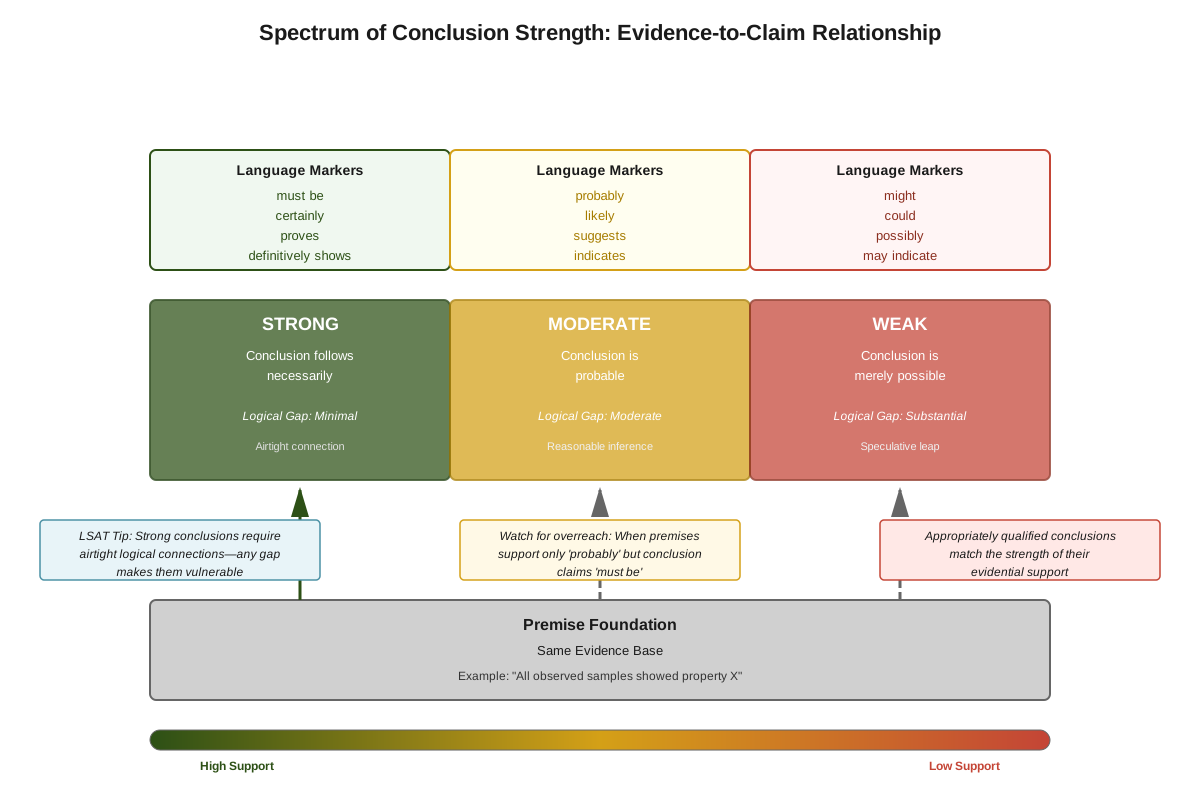
Conclusion strength refers to the degree to which an argument's premises support its conclusion. This relationship exists on a spectrum rather than as a binary (valid/invalid) distinction. A conclusion can be:
- Strongly supported: The premises make the conclusion highly probable or virtually certain
- Moderately supported: The premises provide reasonable but not definitive support
- Weakly supported: The premises provide minimal support, leaving the conclusion speculative
- Unsupported: The premises provide no meaningful support for the conclusion
The LSAT primarily focuses on identifying when conclusions are inappropriately strong given their premises—a common logical flaw where authors claim more certainty than their evidence warrants.
Strength Indicators in Language
Conclusion strength is often signaled through specific linguistic markers. Understanding these markers enables rapid assessment of whether a conclusion matches its evidentiary support:
| Strength Level | Language Markers | Example Phrases |
|---|---|---|
| Absolute/Definitive | Must, certainly, definitely, proves, establishes | "This proves that X is true" |
| Very Strong | Clearly, obviously, undoubtedly, shows that | "The evidence clearly shows X" |
| Moderate | Probably, likely, suggests, indicates, supports | "This suggests that X is probable" |
| Weak | Possibly, might, could, may indicate | "This might indicate X" |
| Speculative | Perhaps, conceivably, potentially | "Perhaps X is the case" |
When premises support only a moderate conclusion but the argument states a definitive conclusion, a strength mismatch occurs—a primary target of LSAT questions.
The Strength Calibration Principle
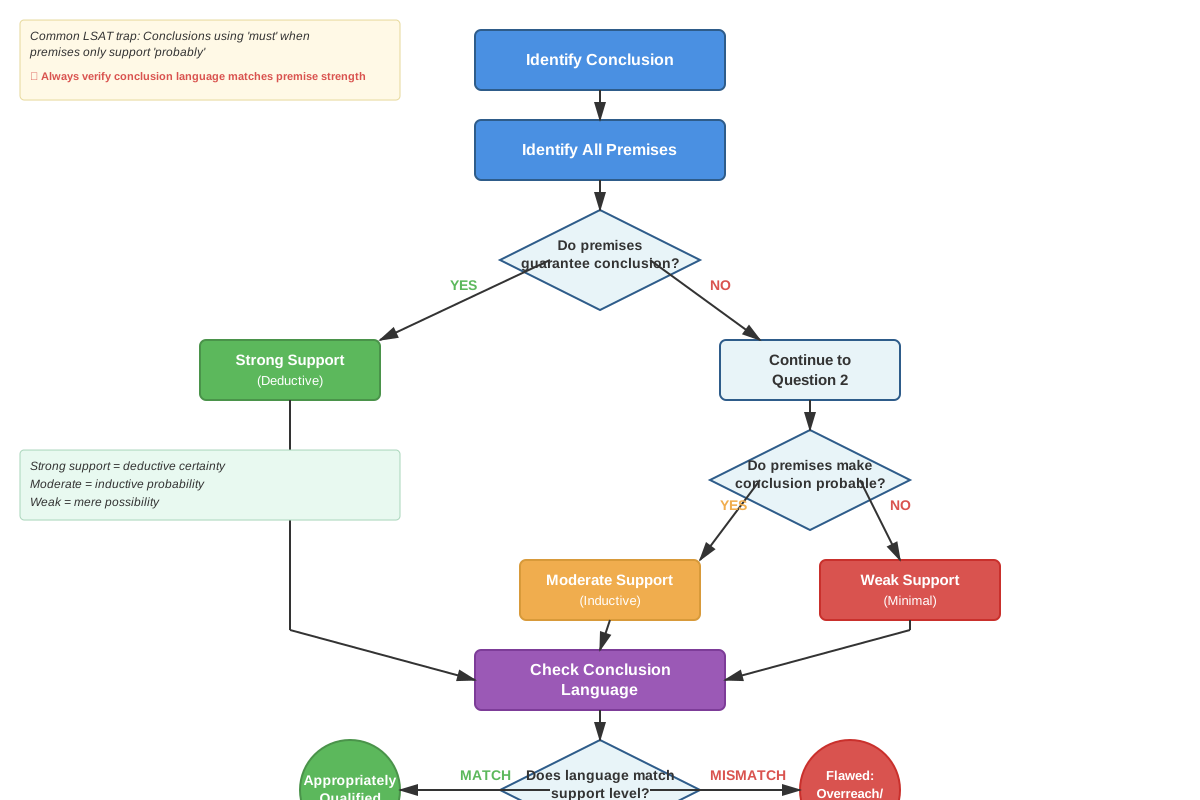
The strength calibration principle states that a sound argument's conclusion should not claim more certainty than its premises provide. This principle operates as follows:
- Assess premise strength: Determine whether premises are definitive facts, statistical probabilities, expert opinions, anecdotal evidence, or mere possibilities
- Identify conclusion language: Note the strength indicators in the conclusion
- Compare alignment: Evaluate whether the conclusion's claimed certainty matches the premise strength
- Identify gaps: Recognize what additional support would be needed to justify a stronger conclusion
For example, if premises establish that "most doctors recommend treatment X," a properly calibrated conclusion would be "treatment X is probably effective," not "treatment X is definitely effective." The universal quantifier "most" supports probability, not certainty.
Types of Strength Mismatches
Several common patterns of strength mismatch appear repeatedly on the LSAT:
Overgeneralization: Drawing a universal conclusion from limited evidence. Example: "The three restaurants we visited had poor service; therefore, all restaurants in this city have poor service." The premises support only "some restaurants in this city have poor service."
Causal overreach: Concluding definitive causation from correlational evidence. Example: "Ice cream sales and drowning deaths both increase in summer; therefore, ice cream consumption causes drowning." The correlation supports only "there might be a relationship," not definitive causation.
Necessity claims from sufficiency: Concluding something is necessary when evidence shows only sufficiency. Example: "Every successful athlete we studied practiced daily; therefore, daily practice is necessary for athletic success." The evidence shows daily practice is sufficient in observed cases, not that it's necessary in all cases.
Certainty from probability: Treating probable outcomes as certain. Example: "This treatment works in 90% of cases; therefore, it will definitely work for this patient." The 90% success rate supports "it will probably work," not certainty.
Evaluating Premise Quality
The strength of premises themselves directly impacts how strongly they can support conclusions:
- Empirical facts: Provide strong support (e.g., "Water boils at 100°C at sea level")
- Statistical data: Support strength proportional to sample size and methodology (e.g., "In a study of 10,000 participants...")
- Expert testimony: Moderate to strong support depending on expertise relevance and consensus
- Anecdotal evidence: Weak support (e.g., "My friend experienced...")
- Hypothetical scenarios: Very weak support for factual conclusions
An argument with strong premises can support a strong conclusion; an argument with weak premises cannot, regardless of how confidently the conclusion is stated.
Conditional Reasoning and Conclusion Strength
Conditional statements create specific strength relationships. When premises establish "If A, then B" and "A is true," the conclusion "B is true" is maximally strong—it follows with logical necessity. However, common errors weaken conclusions:
- Affirming the consequent: "If A, then B; B is true; therefore A is true" creates a weak conclusion (B could result from other causes)
- Denying the antecedent: "If A, then B; A is false; therefore B is false" creates a weak conclusion (B might still occur through other means)
Understanding these patterns helps identify when conditional reasoning inappropriately strengthens or weakens conclusions.
Quantifier Impact on Strength
Quantifiers directly determine conclusion strength:
- All/Every/None: Support universal conclusions
- Most/Majority: Support "probably" conclusions about individuals, definitive conclusions about groups
- Some/Many: Support only "possibly" conclusions about individuals
- Few/Rarely: Support weak positive conclusions or moderate negative conclusions
Mismatching quantifiers between premises and conclusions creates strength errors. For instance, premises about "some" members of a group cannot support conclusions about "all" members.
Concept Relationships
Conclusion strength serves as a central hub connecting multiple logical reasoning concepts. The relationship map flows as follows:
Argument Structure → Conclusion Strength: Identifying premises and conclusions (argument structure) is the prerequisite for assessing how well premises support conclusions (conclusion strength).
Conclusion Strength → Assumptions: When a conclusion is stronger than its explicit premises warrant, unstated assumptions must bridge the gap. Recognizing strength mismatches reveals what assumptions an argument requires.
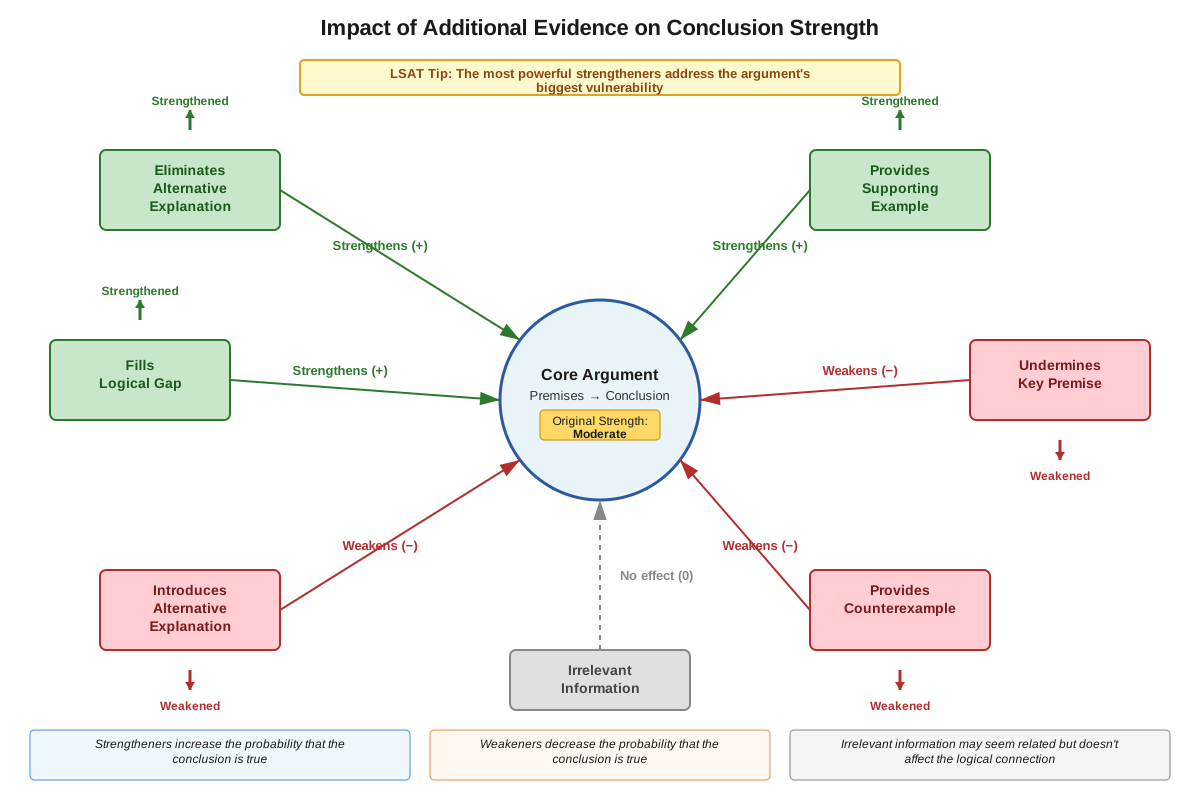
Conclusion Strength → Strengthen/Weaken Questions: These question types directly manipulate conclusion strength by adding information that increases or decreases premise support for the conclusion.
Conclusion Strength → Flaw Questions: Overstatement (claiming excessive certainty) is among the most common flaws, making conclusion strength assessment essential for flaw identification.
Quantifiers → Conclusion Strength: The scope indicated by quantifiers (all, some, most) directly determines how strongly premises support conclusions.
Conditional Reasoning → Conclusion Strength: Valid conditional inferences produce maximally strong conclusions, while invalid patterns (affirming consequent, denying antecedent) produce weak conclusions.
Conclusion Strength → Inference Questions: Correct inference answers must be strongly supported by the passage, requiring precise conclusion strength assessment.
This interconnected web means that mastering conclusion strength enhances performance across virtually all Logical Reasoning question types.
High-Yield Facts
⭐ Conclusion strength measures the degree to which premises support a conclusion, ranging from definitive to speculative.
⭐ Language markers like "must," "proves," and "definitely" signal strong conclusions, while "might," "could," and "possibly" signal weak conclusions.
⭐ The most common logical flaw on the LSAT is claiming more certainty than the evidence supports—overstating conclusion strength.
⭐ Premises about "most" or "majority" can support "probably" conclusions but not "definitely" conclusions about individuals.
⭐ Correlational evidence supports only weak causal conclusions unless additional evidence rules out alternative explanations.
- Universal conclusions ("all," "every," "none") require universal premise support; limited samples cannot justify them.
- Anecdotal evidence (personal experiences, isolated examples) provides weak support and cannot justify strong conclusions.
- Statistical evidence strength depends on sample size, methodology, and representativeness—not just the percentage reported.
- Valid conditional reasoning (modus ponens, modus tollens) produces maximally strong conclusions; invalid patterns produce weak conclusions.
- When an argument's conclusion is stronger than its premises warrant, the argument relies on unstated assumptions to bridge the gap.
⭐ Strengthen questions ask what would increase premise support for the conclusion; Weaken questions ask what would decrease it.
- Necessary assumptions are those without which the conclusion would be unsupported; sufficient assumptions are those that, if true, would guarantee the conclusion.
- Overgeneralization occurs when limited evidence supports a broad conclusion—a frequent LSAT trap.
- Expert testimony provides strong support only when the expert's field directly relates to the conclusion topic.
- Absence of evidence is not strong evidence of absence—a common reasoning error tested on the LSAT.
Quick check — test yourself on Conclusion strength so far.
Try Flashcards →Common Misconceptions
Misconception: If premises are true, the conclusion must be true.
Correction: Premises can be true while providing only weak support for a conclusion. Truth of premises is separate from strength of support. For example, "It rained yesterday" (true premise) provides no support for "It will rain tomorrow" (conclusion).
Misconception: Any evidence supporting a conclusion makes that conclusion strong.
Correction: Evidence can support a conclusion weakly, moderately, or strongly. A single anecdote might technically support a conclusion but does so weakly, insufficient to justify a definitive conclusion.
Misconception: "Most" and "all" are interchangeable in logical reasoning.
Correction: "Most" means more than half but not necessarily all, while "all" means 100%. Premises about "most" cannot support conclusions about "all." If most doctors recommend treatment X, we cannot conclude all doctors do.
Misconception: Correlation between two factors means one causes the other.
Correction: Correlation indicates only that two factors vary together, not that one causes the other. Both might be caused by a third factor, or the correlation might be coincidental. Correlational evidence provides only weak support for causal conclusions without additional evidence.
Misconception: If an argument has a flaw, its conclusion must be false.
Correction: A flawed argument means the conclusion is inadequately supported, not that the conclusion is false. The conclusion might still be true; the argument simply fails to prove it. Weak support doesn't equal disproof.
Misconception: Longer arguments with more premises automatically have stronger conclusions.
Correction: Conclusion strength depends on premise quality and relevance, not quantity. Ten irrelevant premises provide no support, while one highly relevant premise might provide strong support.
Misconception: Expert opinion always provides strong support for a conclusion.
Correction: Expert opinion provides strong support only when the expert's expertise directly relates to the conclusion topic and when expert consensus exists. A physicist's opinion on economics provides weak support.
Worked Examples
Example 1: Evaluating Conclusion Strength
Argument: "A recent survey of 50 college students found that 40 of them prefer studying in the library rather than in their dorm rooms. Therefore, college students definitely learn more effectively in libraries than in dorm rooms."
Analysis:
Step 1 - Identify the conclusion: "College students definitely learn more effectively in libraries than in dorm rooms." Note the strength indicator "definitely," which signals a strong, certain conclusion.
Step 2 - Identify the premises: A survey of 50 students found that 40 (80%) prefer studying in the library.
Step 3 - Assess premise strength: The premise provides information about student preferences, not about learning effectiveness. Additionally, the sample size is relatively small (50 students), and we don't know if it's representative of all college students.
Step 4 - Evaluate the match: The conclusion claims certainty ("definitely") about learning effectiveness, but the premise only establishes preference among a limited sample. This is a severe strength mismatch.
Step 5 - Identify the gaps:
- Preference doesn't equal effectiveness (students might prefer libraries for social reasons, not learning outcomes)
- The sample is small and potentially unrepresentative
- No actual learning outcome data is provided
Properly calibrated conclusion: "Some college students prefer studying in libraries, which might indicate that libraries provide a more effective learning environment for at least some students."
LSAT application: This argument would be vulnerable to Weaken questions (showing that preference doesn't correlate with effectiveness), Flaw questions (identifying the overgeneralization and the preference/effectiveness confusion), and Assumption questions (asking what must be true for the conclusion to follow—such as "student preferences accurately reflect learning effectiveness").
Example 2: Conditional Reasoning and Conclusion Strength
Argument: "Every successful entrepreneur in our study demonstrated strong networking skills. Maria is a successful entrepreneur. Therefore, Maria must have strong networking skills."
Analysis:
Step 1 - Identify the logical structure: This is a conditional argument. Premise 1 establishes: "If successful entrepreneur (in our study), then strong networking skills." Premise 2 states: "Maria is a successful entrepreneur."
Step 2 - Evaluate the conditional reasoning: This follows the valid pattern of modus ponens (If A then B; A; therefore B). When the conditional reasoning is valid, the conclusion strength matches the premise strength.
Step 3 - Assess premise limitations: The first premise applies only to entrepreneurs "in our study." If Maria was in the study, the conclusion follows strongly. If Maria wasn't in the study, we're generalizing from the study sample to all successful entrepreneurs, which weakens the conclusion.
Step 4 - Evaluate conclusion language: "Must have" indicates maximum certainty, which is appropriate only if Maria was part of the study or if we can assume the study sample represents all successful entrepreneurs.
Step 5 - Identify assumptions: The argument assumes either (a) Maria was in the study, or (b) the study sample is representative of all successful entrepreneurs, or (c) the pattern observed in the study applies universally.
Properly calibrated conclusion (if Maria wasn't in the study): "Maria probably has strong networking skills, given that all successful entrepreneurs in the study demonstrated such skills."
LSAT application: This argument demonstrates how valid conditional reasoning can still produce conclusions that are inappropriately strong if the premises contain limitations (like "in our study"). Assumption questions might ask what must be true for the conclusion to follow (that the study is representative), while Weaken questions might introduce evidence that the study sample was atypical.
Exam Strategy
Rapid Strength Assessment Protocol
When approaching LSAT questions involving conclusion strength, follow this systematic process:
- Locate and underline the conclusion (typically signaled by "therefore," "thus," "so," "consequently")
- Circle strength indicators in the conclusion ("must," "proves," "definitely" vs. "probably," "suggests," "might")
- Identify all premises and note their scope (all, most, some) and type (fact, opinion, anecdote)
- Ask: "Does the evidence justify this level of certainty?"
- Predict the gap: What's missing for the conclusion to be as strong as claimed?
Trigger Words and Phrases
High-alert words indicating potential overstatement:
- "Proves," "establishes," "demonstrates conclusively"
- "Must be," "has to be," "cannot be otherwise"
- "Clearly," "obviously," "undoubtedly"
- "All," "every," "none," "never" (in conclusions drawn from limited evidence)
Words suggesting appropriately qualified conclusions:
- "Suggests," "indicates," "supports the view"
- "Probably," "likely," "tends to"
- "May," "might," "could"
When you see strong language in a conclusion, immediately verify that the premises justify that strength level.
Question Type-Specific Strategies
For Strengthen Questions: Look for answers that either (a) provide additional evidence supporting the conclusion, (b) rule out alternative explanations, or (c) establish that a key assumption is true. The correct answer will increase the probability that the conclusion follows from the premises.
For Weaken Questions: Look for answers that either (a) provide counterevidence, (b) introduce alternative explanations, or (c) show that a key assumption is false. The correct answer will decrease the probability that the conclusion follows from the premises.
For Flaw Questions: When you see strong conclusion language paired with limited evidence, predict "overgeneralization" or "claims more than the evidence supports" as the flaw. Approximately 30-40% of flaw questions involve conclusion strength mismatches.
For Assumption Questions: The gap between premise strength and conclusion strength reveals the assumption. If premises support only "probably" but the conclusion claims "definitely," the assumption bridges that gap (e.g., "no other factors are relevant").
Process of Elimination Tips
Eliminate answers that:
- Discuss irrelevant topics not connected to the premise-conclusion relationship
- Would strengthen when you need to weaken (or vice versa)
- Address a different gap than the one between the stated premises and conclusion
- Introduce new terms not present in the argument
Keep answers that:
- Directly address the relationship between the evidence provided and the conclusion drawn
- Match the scope of the argument (don't eliminate answers for being "too narrow" if the argument itself is narrow)
- Fill the specific gap you identified in your prediction
Time Allocation
For questions involving conclusion strength:
- Spend 15-20 seconds identifying the conclusion and assessing its strength indicators
- Spend 20-25 seconds evaluating whether premises justify that strength level
- Spend 10-15 seconds predicting what the question will target (the gap)
- Spend 30-40 seconds evaluating answer choices
Total time per question: 75-100 seconds. Conclusion strength assessment is time well-invested because it enables rapid, confident answer selection.
Memory Techniques
The SCALE Mnemonic
Remember to assess conclusion SCALE:
- Strength indicators (must, probably, might)
- Calibration (does conclusion match evidence?)
- Assumptions (what bridges the gap?)
- Limitations (what restricts premise scope?)
- Evidence type (fact, statistic, anecdote?)
The Certainty Spectrum Visualization
Visualize conclusion strength as a thermometer:
BOILING (100°) ─── Must be, Proves, Definitely
HOT (75°) ────────── Clearly, Very likely
WARM (50°) ───────── Probably, Suggests
COOL (25°) ───────── Might, Could, Possibly
FREEZING (0°) ────── Pure speculation
When reading an argument, mentally place the conclusion and the premise support on this thermometer. If they're at different temperatures, there's a strength mismatch.
The "Prove It!" Challenge
When you see strong conclusion language, mentally challenge the argument: "Prove it! Does your evidence really establish this with certainty?" This automatic skepticism helps identify overstatement.
The Quantifier Ladder
Remember the support strength of different quantifiers:
ALL/EVERY/NONE (top rung) → supports universal conclusions
MOST/MAJORITY (middle rung) → supports "probably" for individuals, definitive for groups
SOME/MANY (lower rung) → supports only "possibly" for individuals
FEW/RARELY (bottom rung) → supports weak conclusions
You can't climb up the ladder in your conclusion—premises about "some" can't support conclusions about "all."
Summary
Conclusion strength represents the degree to which an argument's premises support its conclusion, ranging from definitive certainty to mere speculation. This concept is central to LSAT Logical Reasoning, appearing in approximately 45-55% of questions across multiple question types. The key principle is calibration: sound arguments match conclusion strength to premise support, while flawed arguments claim more certainty than their evidence warrants. Language markers signal strength levels—"must," "proves," and "definitely" indicate strong conclusions, while "probably," "suggests," and "might" indicate weaker conclusions. Common strength mismatches include overgeneralization (universal conclusions from limited evidence), causal overreach (definitive causation from correlation), and certainty claims from probabilistic evidence. Mastering conclusion strength requires systematically assessing premise quality, identifying conclusion strength indicators, evaluating whether they align, and recognizing what assumptions would bridge any gaps. This skill directly enhances performance on Strengthen, Weaken, Flaw, Assumption, and Inference questions, making it one of the highest-yield topics for LSAT score improvement.
Key Takeaways
- Conclusion strength measures how well premises support a conclusion—the core relationship tested across multiple LSAT question types
- Language markers reveal strength levels: "must/proves" signals strong conclusions, "probably/suggests" signals moderate conclusions, "might/could" signals weak conclusions
- The most common LSAT flaw is overstating conclusion strength—claiming more certainty than evidence supports
- Proper calibration matches conclusion strength to premise support—universal premises support universal conclusions, probabilistic premises support probabilistic conclusions
- Quantifiers directly determine conclusion strength: "all" supports definitive conclusions, "most" supports probable conclusions, "some" supports only possible conclusions
- Identifying strength mismatches reveals assumptions—the gap between premise support and conclusion certainty shows what the argument assumes
- Valid conditional reasoning produces strong conclusions, but premise limitations can still weaken them—always check whether conditional statements apply universally or only to specific cases
Related Topics
Necessary vs. Sufficient Assumptions: Understanding conclusion strength enables distinguishing between assumptions that are merely sufficient to support a conclusion and those that are necessary for the conclusion to follow at all. Necessary assumptions fill the minimum gap between premise strength and conclusion strength.
Causation vs. Correlation: This topic extends conclusion strength principles specifically to causal reasoning, examining when evidence supports definitive causal claims versus merely suggesting possible causal relationships.
Formal Logic and Validity: While conclusion strength operates on a spectrum, formal logic examines arguments where conclusions follow with absolute necessity from premises—the strongest possible conclusion strength.
Argument Evaluation Questions: These questions explicitly ask students to identify what information would help determine whether a conclusion is appropriately supported, directly testing conclusion strength assessment skills.
Parallel Reasoning: Recognizing conclusion strength patterns helps identify arguments with parallel structure, as matching strength relationships between premises and conclusions is a key component of structural similarity.
Practice CTA
Now that you understand conclusion strength—one of the most high-yield topics on the LSAT—it's time to apply these concepts to actual practice questions. Work through the practice problems to reinforce your ability to identify strength indicators, evaluate premise-conclusion alignment, and predict how arguments can be strengthened or weakened. Use the flashcards to drill the key distinctions between strength levels and common strength mismatch patterns. Remember: conclusion strength appears in nearly half of all Logical Reasoning questions, so mastering this topic will directly translate to significant score improvements. Your investment in understanding these principles will pay dividends across multiple question types. Start practicing now to build the automatic recognition skills that separate top scorers from the rest!
Sign up free to keep reading
Create a free AnvayaPrep account to finish this LSAT guide on Conclusion strength — plus flashcards and practice questions.