Overview
Context statements are foundational elements in logical reasoning that appear in nearly every LSAT Logical Reasoning section. These statements provide background information, set the stage for an argument, or establish the circumstances under which a claim is made. Unlike premises that directly support a conclusion or conclusions that represent the main point being argued, context statements serve a preparatory function—they orient the reader to the situation, define terms, or provide necessary background without themselves functioning as evidence or claims requiring support.
Understanding context statements is crucial for LSAT success because they help test-takers parse complex arguments efficiently. When students can quickly identify which parts of a stimulus are merely setting the scene versus which parts constitute the actual argumentative structure, they can focus their analytical energy on evaluating the logical relationships that matter most. Context statements often appear at the beginning of argument stimuli, but they can also be interspersed throughout or even appear at the end. Recognizing them prevents common errors such as mistaking background information for a premise or attempting to attack contextual setup as if it were a vulnerable assumption.
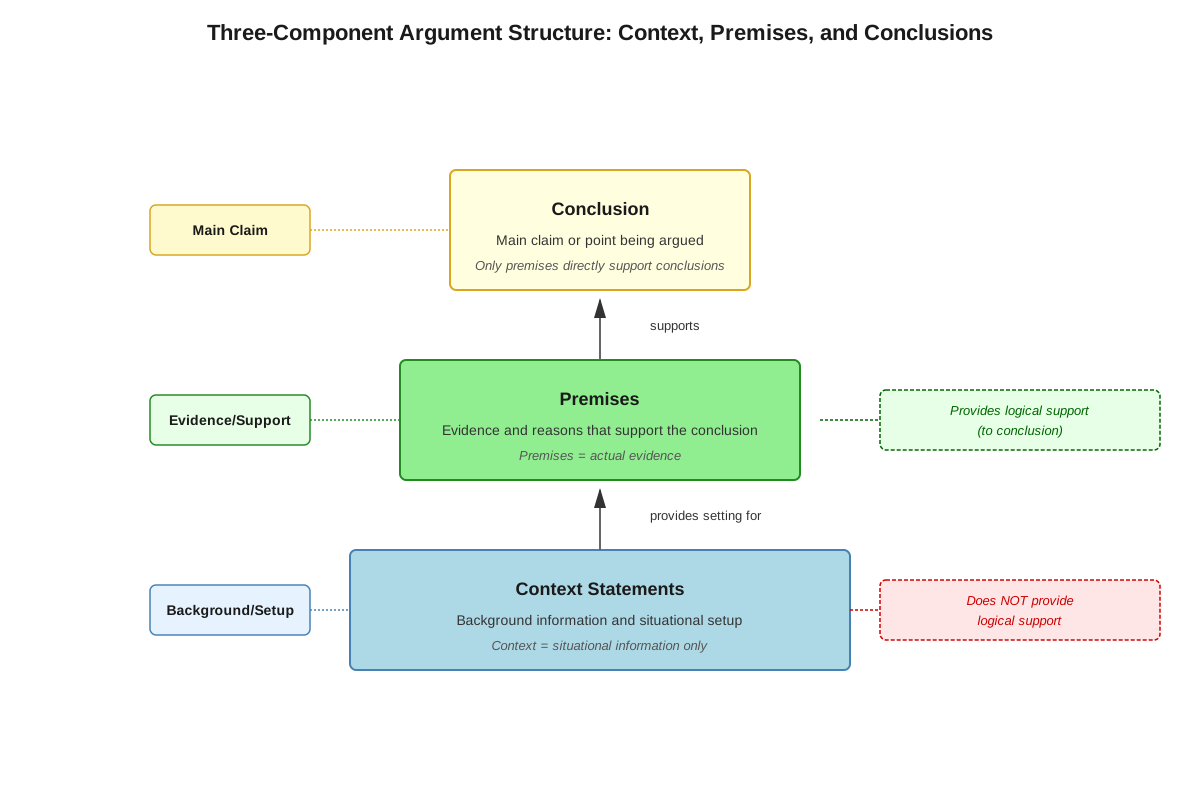
Within the broader framework of argument fundamentals, context statements represent one of the three primary building blocks alongside premises and conclusions. While premises and conclusions form the logical skeleton of an argument, context statements provide the flesh—the situational details that make the argument comprehensible and relevant. Mastering the identification and proper treatment of context statements enables students to construct accurate argument diagrams, identify assumptions more precisely, and avoid being distracted by irrelevant information when answering questions about argument structure, flaws, or strengthening/weakening factors.
Learning Objectives
- [ ] Identify how Context statements appears in LSAT questions
- [ ] Explain the reasoning pattern behind Context statements
- [ ] Apply Context statements to solve LSAT-style problems accurately
- [ ] Distinguish context statements from premises and conclusions in complex argument stimuli
- [ ] Recognize the strategic placement of context statements and their function in misdirection
- [ ] Evaluate whether information presented as context actually plays an argumentative role
- [ ] Construct accurate argument diagrams that properly categorize contextual versus evidential information
Prerequisites
- Basic argument structure: Understanding the fundamental components of arguments (premises and conclusions) is essential because context statements are defined in relation to these core elements
- Indicator words: Familiarity with conclusion and premise indicators helps distinguish when a statement is providing evidence versus merely setting up the discussion
- Reading comprehension fundamentals: The ability to parse complex sentences and identify main ideas versus supporting details transfers directly to recognizing context versus argument
- Logical relationships: Understanding how statements can support, oppose, or remain neutral to claims helps identify when information is contextual rather than argumentative
Why This Topic Matters
In real-world reasoning and professional contexts, distinguishing between background information and actual arguments is critical for effective communication and analysis. Lawyers must separate case facts from legal arguments, business analysts must distinguish market conditions from strategic recommendations, and researchers must differentiate experimental setup from conclusions. The skill of identifying lsat context statements trains this essential analytical capability.
On the LSAT, context statements appear in approximately 80-90% of Logical Reasoning stimuli, making them one of the most frequently encountered elements. They are particularly prevalent in:
- Argument structure questions (Method of Reasoning, Role of Statement): These questions explicitly test whether students can identify what function a particular statement serves
- Assumption questions: Context statements often contain information that seems relevant but doesn't actually bridge logical gaps, serving as attractive wrong answers
- Strengthen/Weaken questions: Understanding what is context versus what is being argued helps identify which new information would actually affect the argument's validity
- Flaw questions: Students must recognize that attacking or questioning context statements is typically not a valid criticism of an argument's reasoning
- Main Point questions: Context statements are frequently confused with conclusions by test-takers who don't carefully distinguish setup from claim
The LSAT deliberately uses context statements to increase stimulus complexity and create wrong answer choices. Test-makers know that students under time pressure may treat all information as equally relevant to the argument's logical structure, leading to predictable errors. Questions may ask about the role of a context statement, or answer choices may incorrectly characterize contextual information as a premise or conclusion.
Core Concepts
Definition and Function of Context Statements
A context statement is any sentence or clause in an LSAT stimulus that provides background information, establishes a scenario, defines terms, or sets up the circumstances for an argument without itself serving as evidence for a conclusion or representing a claim that requires support. Context statements answer questions like "What is the situation?" or "What are we talking about?" rather than "Why should we believe this?" or "What is being claimed?"
The primary functions of context statements include:
- Establishing the domain of discourse: Identifying the subject matter, time period, or field being discussed
- Defining key terms: Clarifying what specific words or concepts mean within the argument
- Providing factual background: Offering generally accepted or stipulated information that frames the discussion
- Setting temporal or spatial parameters: Indicating when or where the argument applies
- Introducing stakeholders or entities: Identifying who is involved in the situation being discussed
Distinguishing Context from Premises
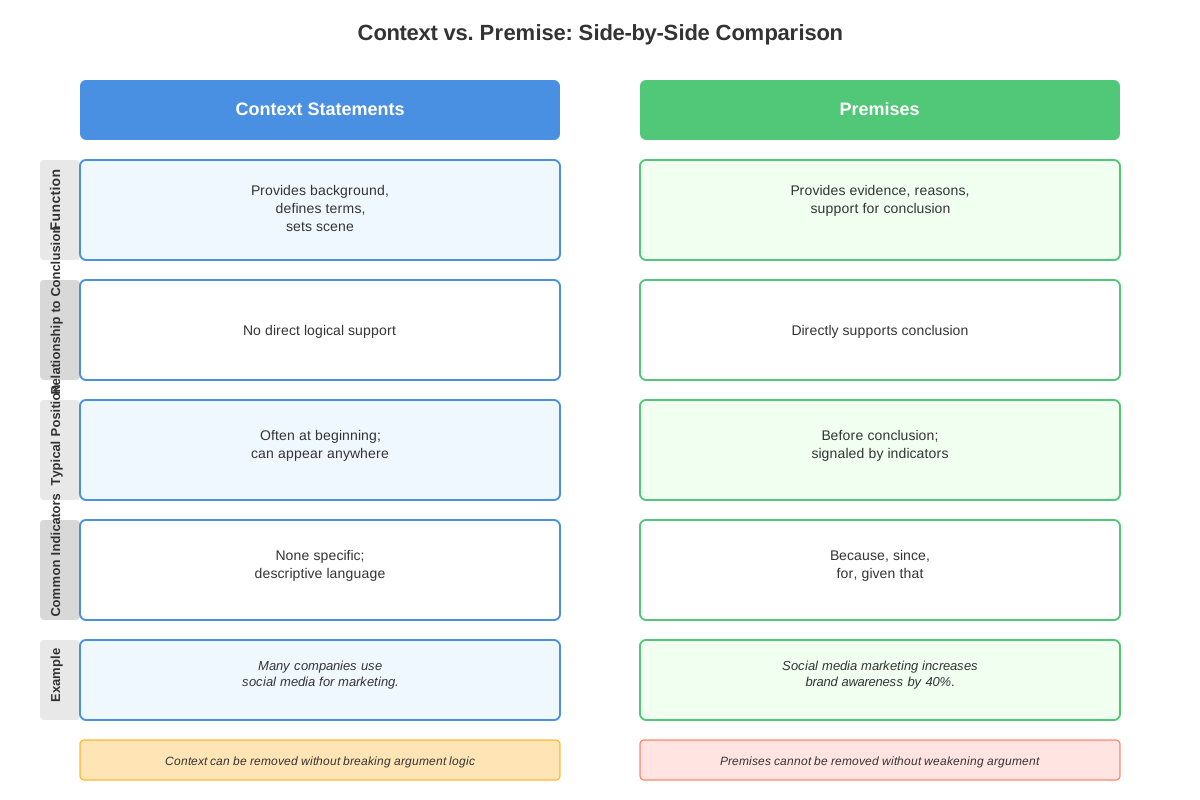
The critical distinction between context statements and premises lies in their relationship to the conclusion. Premises are statements offered as reasons to believe the conclusion—they provide evidential support and are intended to make the conclusion more likely to be true. Context statements, by contrast, merely describe the situation in which the argument takes place without providing logical support.
| Feature | Context Statement | Premise |
|---|---|---|
| Function | Provides background/setup | Offers evidence/support |
| Relationship to conclusion | Neutral; doesn't support | Directly supports conclusion |
| Argumentative role | Non-argumentative | Argumentative |
| Can be questioned | Typically accepted as given | Can be evaluated for truth/relevance |
| Removal effect | Argument becomes harder to understand | Argument becomes weaker |
Consider this example:
"The city of Riverside has experienced significant population growth over the past decade. This growth has strained the city's water infrastructure. Therefore, the city should invest in expanding its water treatment facilities."
- Context statement: "The city of Riverside has experienced significant population growth over the past decade."
- Premise: "This growth has strained the city's water infrastructure."
- Conclusion: "Therefore, the city should invest in expanding its water treatment facilities."
The first sentence provides background about population growth. While this information helps us understand why infrastructure might be strained, it doesn't directly support the conclusion. The second sentence, however, provides a reason (strained infrastructure) for why the city should invest in treatment facilities.
Positional Patterns and Placement
While context statements frequently appear at the beginning of LSAT stimuli, their placement varies strategically:
Opening context (most common): The stimulus begins with one or more context statements before introducing the argument proper. This pattern mirrors natural communication where speakers establish common ground before making claims.
Embedded context: Context statements appear mid-argument, often after a conclusion indicator but before the actual conclusion. This placement tests whether students are relying too heavily on positional cues rather than analyzing logical function.
Closing context: Less common but particularly tricky, some stimuli end with contextual information that might be mistaken for a conclusion due to its position.
Interspersed context: Multiple context statements appear throughout the stimulus, woven between premises and conclusions, requiring careful parsing of each statement's role.
Context Statements vs. Descriptive Premises
A sophisticated challenge involves distinguishing context statements from descriptive premises—factual statements that do serve as evidence. The key question is: "Does this statement provide a reason to accept the conclusion, or does it merely describe the situation?"
Consider: "Most teenagers use social media daily. Social media use correlates with increased anxiety. Therefore, we should be concerned about teenage mental health."
Both the first and second sentences are factual descriptions, but the second functions as a premise (providing evidence for concern) while the first could be interpreted as either context or premise depending on the argument's structure. If the argument is specifically about why we should be concerned about teenagers (as opposed to other groups), then the first statement provides evidential support. If the argument would work equally well without specifying teenagers (if it's really about social media users generally), then it's more contextual.
Implicit Context
Not all context is explicitly stated. The LSAT assumes certain implicit context—shared background knowledge that doesn't need to be articulated. For example, arguments about "businesses" assume readers understand what businesses are and that they generally seek profit. Arguments about "scientific studies" assume basic understanding of empirical research. Recognizing implicit context helps students avoid bringing in outside assumptions while still understanding the argument's framework.
Context in Conditional Reasoning
In conditional logic arguments, context statements often establish the domain or circumstances under which conditional relationships apply. For example: "In countries with mandatory voting laws, voter turnout exceeds 90%. If a country wants high voter turnout, it should implement mandatory voting."
The first sentence provides contextual information about countries with mandatory voting laws. While this information is related to the argument, it doesn't directly support the conditional claim in the conclusion—it merely establishes an empirical observation that the argument draws upon.
Concept Relationships
The relationship between context statements and other argument components forms a hierarchical structure:
Context statements → establish framework for → Premises and Conclusions
Context provides the situational foundation upon which the logical structure is built. Without context, arguments may be incomprehensible, but without premises and conclusions, there is no argument at all—only description.
Context statements ← distinguished from → Premises through the support test: Does this statement provide a reason to believe the conclusion? If yes, it's a premise; if no, it's context.
Context statements ← distinguished from → Conclusions through the claim test: Is this statement asserting something that requires support, or is it establishing accepted background? Conclusions are claims requiring justification; context is typically stipulated or accepted.
Within the broader framework of argument fundamentals, the progression is:
- Identify context (what's the situation?)
- Locate conclusion (what's being claimed?)
- Find premises (what reasons support the claim?)
- Analyze logical relationships (how do premises support the conclusion?)
- Identify assumptions (what unstated connections are necessary?)
This sequence shows that recognizing context is the essential first step in argument analysis. Students who skip this step often misidentify the argument's structure, leading to errors in subsequent analysis.
Context statements also relate to scope in logical reasoning. The context often defines the scope of the argument—what domain, time period, or set of circumstances the argument addresses. Understanding this relationship helps students evaluate whether answer choices are relevant to the argument's actual scope or whether they introduce out-of-scope considerations.
High-Yield Facts
⭐ Context statements provide background information but do not offer evidential support for the conclusion
⭐ Approximately 80-90% of LSAT Logical Reasoning stimuli contain at least one context statement
⭐ Context statements can appear at any position in a stimulus, not just at the beginning
⭐ Removing a context statement makes an argument harder to understand but does not make it logically weaker
⭐ The LSAT frequently uses context statements to create wrong answers that seem relevant but don't address the argument's logical structure
- Context statements often establish the domain, define terms, or set temporal/spatial parameters for an argument
- Distinguishing context from premises requires asking whether the statement provides a reason to believe the conclusion
- In Role of Statement questions, "provides background" or "establishes context" are common correct answer descriptions for context statements
- Context statements are typically accepted as given and are not the target of criticism in Flaw questions
- Multiple context statements can appear in a single stimulus, especially in longer, more complex arguments
- Context statements may contain factual information that seems important but plays no role in the argument's logical structure
- Understanding what is context versus what is argument helps eliminate wrong answers that address irrelevant aspects of the stimulus
- Context statements can be conditional in form but still serve a non-argumentative function
- The presence of indicator words does not automatically mean a statement is not context—function matters more than form
- Recognizing context helps students focus their analysis on the actual logical relationships being tested
Quick check — test yourself on Context statements so far.
Try Flashcards →Common Misconceptions
Misconception: All statements at the beginning of a stimulus are context statements → Correction: While context statements frequently appear at the beginning, opening statements can also be premises or even conclusions. Position is a clue, not a definitive indicator. Always analyze the statement's function in relation to the conclusion.
Misconception: Context statements are unimportant and can be ignored → Correction: Context statements are essential for understanding what the argument is about and what scope it addresses. Ignoring context can lead to misunderstanding the argument's domain or mistaking the conclusion. Context matters for comprehension even though it doesn't provide logical support.
Misconception: If a statement contains facts or data, it must be a premise → Correction: Factual statements can serve as context, premises, or even conclusions depending on their role. A statement like "The company was founded in 1995" might be pure context, or it might be a premise if the argument is about the company's longevity. Function, not content type, determines the role.
Misconception: Context statements never appear in the conclusion of a stimulus → Correction: While less common, context statements can appear at the end of a stimulus, especially when they provide clarifying information or define the scope of a preceding claim. Don't rely solely on position to identify context.
Misconception: In Strengthen/Weaken questions, information that relates to context statements can strengthen or weaken the argument → Correction: Since context statements don't provide logical support, information that merely elaborates on or contradicts the context typically doesn't affect the argument's logical strength. The argument's validity depends on the relationship between premises and conclusion, not on the accuracy or completeness of contextual background.
Misconception: Every sentence must be classified as either context, premise, or conclusion → Correction: Some sentences contain multiple clauses that serve different functions. A single sentence might include both context and a premise, or context and a conclusion. Analyze each meaningful unit of information separately.
Misconception: Context statements are always neutral and objective → Correction: While context statements don't provide argumentative support, they can contain evaluative language or present information in a particular light. The key is whether they're offered as reasons to believe the conclusion, not whether they're purely factual or neutral in tone.
Worked Examples
Example 1: Identifying Context in a Complex Stimulus
Stimulus: "Urban beekeeping has become increasingly popular in major cities over the past five years. Proponents argue that urban bees help pollinate city gardens and green spaces. However, a recent study found that urban bee colonies often outcompete native pollinator species for resources. City planners should therefore restrict the number of beehive permits issued in urban areas."
Analysis:
Step 1: Identify the conclusion by looking for conclusion indicators and asking "What is the main claim?"
- The word "therefore" signals the conclusion: "City planners should restrict the number of beehive permits issued in urban areas."
Step 2: Identify premises by asking "What reasons are given to support this conclusion?"
- "A recent study found that urban bee colonies often outcompete native pollinator species for resources" → This provides a reason (harm to native species) for restricting permits.
Step 3: Identify context by asking "What information provides background but doesn't support the conclusion?"
- "Urban beekeeping has become increasingly popular in major cities over the past five years" → This establishes the situation but doesn't provide a reason for restriction.
- "Proponents argue that urban bees help pollinate city gardens and green spaces" → This presents a view but isn't offered as support for the conclusion; it's background on the debate.
Step 4: Verify by testing removal
- If we remove "Urban beekeeping has become increasingly popular," the argument still works logically, though we understand less about why this issue matters now.
- If we remove the premise about outcompeting native species, the argument loses its logical support.
Connection to Learning Objectives: This example demonstrates how context statements appear in LSAT questions (Learning Objective 1) by showing their typical placement and function. It also applies the reasoning pattern (Learning Objective 2) of distinguishing context from argumentative elements through functional analysis.
Example 2: Context Statement in a Role Question
Stimulus: "Historically, economic recessions have led to decreased consumer spending on luxury goods. The current economic downturn has been particularly severe, with unemployment reaching levels not seen in decades. Despite this, sales of luxury automobiles have remained stable. This suggests that the current recession is affecting different economic classes in fundamentally different ways than previous recessions."
Question: "The statement that historically, economic recessions have led to decreased consumer spending on luxury goods plays which of the following roles in the argument?"
Analysis:
Step 1: Identify the conclusion
- "This suggests that..." indicates the conclusion: "the current recession is affecting different economic classes in fundamentally different ways than previous recessions."
Step 2: Determine what supports this conclusion
- The premise is the contrast: previous recessions led to decreased luxury spending, but current luxury auto sales remain stable despite severe economic conditions.
Step 3: Analyze the role of the statement in question
- "Historically, economic recessions have led to decreased consumer spending on luxury goods" establishes what typically happens—it provides the baseline against which the current situation is compared.
- This is contextual information that sets up the contrast but doesn't itself argue for the conclusion.
- However, it's part of the evidential structure because the argument depends on comparing current patterns to historical patterns.
Step 4: Refine the classification
- This is a sophisticated case: the statement provides background about historical patterns, but this background is essential to the comparative premise. It's best understood as contextual information that forms part of a premise structure.
- In a Role question, the correct answer might say something like: "provides background information about typical patterns that the argument contrasts with current observations" or "establishes a historical baseline against which current data is compared."
Step 5: Eliminate wrong answers
- Wrong: "States the main conclusion" (it's not what's being argued)
- Wrong: "Provides evidence that directly supports the conclusion" (it doesn't directly support; it sets up a contrast)
- Wrong: "Presents a view that the argument challenges" (the argument doesn't challenge this historical pattern)
- Correct: "Provides background information that contextualizes the evidence presented" or similar
Connection to Learning Objectives: This example shows how to apply context statement analysis to solve LSAT-style problems accurately (Learning Objective 3) and demonstrates the reasoning pattern (Learning Objective 2) of analyzing statement function in relation to the argument's structure. It also illustrates the sophisticated distinction between pure context and contextual information that plays a role in the evidential structure.
Exam Strategy
Systematic Approach to Context Identification
When approaching any Logical Reasoning stimulus, follow this sequence:
- Read the entire stimulus first without marking anything—get the overall sense of what's being discussed
- Identify the conclusion using indicator words and the "therefore test" (what is the author trying to convince you of?)
- Identify premises by asking what reasons support that conclusion
- Label remaining statements as context by process of elimination and functional analysis
- Verify by asking: "If I removed this statement, would the argument be less logically strong, or just less clear?"
Trigger Words and Phrases for Context
While no words guarantee a statement is context, certain phrases frequently introduce contextual information:
- "Historically..." / "Traditionally..." / "In the past..."
- "It is generally accepted that..." / "It is well known that..."
- "In [specific domain/field]..." (e.g., "In modern democracies...")
- "Recently..." / "Over the past [time period]..."
- "[Group] has/have..." (when describing a situation rather than providing evidence)
- "The [entity] is/was..." (when defining or describing)
Caution: These phrases can also introduce premises, so always verify function, not just form.
Process of Elimination Tips
In questions asking about argument structure or the role of a statement:
Eliminate answers that:
- Describe context statements as "providing support" or "offering evidence" when they merely set up the situation
- Describe premises as "providing background" when they actually support the conclusion
- Confuse the position of a statement with its function (e.g., assuming the first statement must be context)
Select answers that:
- Accurately describe the logical relationship between the statement and the conclusion
- Use language like "establishes the context," "provides background," "sets up the situation," or "describes the circumstances" for context statements
- Distinguish between information that makes the argument comprehensible versus information that makes it logically stronger
Time Allocation
- Initial read: 20-30 seconds for most stimuli
- Argument analysis (including context identification): 10-15 seconds
- Question and answer choice evaluation: 30-45 seconds
Don't spend excessive time debating whether a statement is context or premise unless the question specifically asks about it. For most question types, the key is recognizing what the conclusion is and what supports it—context identification is a means to that end, not an end in itself.
Question-Type Specific Strategies
For Assumption questions: Context statements often appear in wrong answers. If an answer choice merely elaborates on or clarifies the context without bridging a logical gap between premise and conclusion, eliminate it.
For Strengthen/Weaken questions: Information that only relates to context statements typically doesn't affect argument strength. Focus on answer choices that address the relationship between premises and conclusion.
For Role/Method questions: Carefully distinguish "provides background context" from "offers supporting evidence." The correct answer must precisely describe the statement's function.
For Main Point questions: Context statements are never the main point. If you're torn between two answer choices, ask which one represents a claim requiring support (conclusion) versus which one provides setup information (context).
Memory Techniques
The "SETUP" Mnemonic for Context Functions
Situation description
Establishes domain
Temporal/spatial parameters
Underlying background
Preparatory information
When you encounter a statement and wonder if it's context, ask: "Is this doing any of the SETUP functions?"
The Support Test Visualization
Visualize the argument as a building:
- Context = the ground/foundation (necessary for the building to make sense, but not part of the structure itself)
- Premises = the support beams (holding up the conclusion)
- Conclusion = the roof (what's being supported)
Ask: "Is this statement part of the ground, a support beam, or the roof?"
The "Remove and Test" Technique
Create a mental habit: When you identify a potential context statement, imagine removing it from the stimulus. Ask:
- Does the argument become unclear (suggests context)? OR
- Does the argument become weaker (suggests premise)?
Acronym: CONTEXT
Circumstances described
Orienting information
Not providing support
Tells us the situation
Establishes background
X-out as evidence (doesn't count as evidence)
Typically at the beginning (but not always)
Summary
Context statements are essential components of LSAT Logical Reasoning stimuli that provide background information, establish circumstances, and orient readers to the situation being discussed without themselves offering evidential support for conclusions. Mastering the identification and proper treatment of context statements enables test-takers to accurately parse argument structure, focus analytical energy on genuine logical relationships, and avoid common traps in answer choices. The key distinction is functional: context statements answer "What's the situation?" while premises answer "Why believe the conclusion?" and conclusions answer "What's being claimed?" Context statements appear in the vast majority of LSAT stimuli and are strategically used by test-makers to increase complexity and create attractive wrong answers. Success requires systematic analysis of each statement's role in relation to the conclusion, not reliance on positional cues or surface features. By applying the support test (Does this provide a reason to believe the conclusion?), the removal test (Does removing this weaken the argument or just make it less clear?), and careful attention to logical function over form, students can consistently distinguish context from argumentative elements and apply this skill across all Logical Reasoning question types.
Key Takeaways
- Context statements provide background and setup but never offer direct evidential support for the conclusion
- Approximately 80-90% of LSAT Logical Reasoning stimuli contain context statements, making their identification a high-frequency skill
- Position is a clue but not definitive—context statements can appear anywhere in a stimulus, though they're most common at the beginning
- The support test is the most reliable method: if a statement doesn't provide a reason to believe the conclusion, it's likely context
- Removing a context statement makes an argument less clear but not logically weaker; removing a premise weakens the argument
- The LSAT uses context statements strategically to create wrong answers that seem relevant but don't address the argument's logical structure
- Mastering context identification is the essential first step in accurate argument analysis and enables success across all Logical Reasoning question types
Related Topics
Premises and Conclusions: After mastering context statements, deepening understanding of how premises provide evidential support and how to identify conclusions with certainty builds on the foundational skill of distinguishing argumentative from non-argumentative elements.
Argument Structure and Diagramming: Context identification enables accurate argument mapping, where students visually represent the logical relationships between components—a critical skill for complex stimuli.
Assumption Identification: Understanding what is context versus what is argument helps identify logical gaps more precisely, as assumptions bridge premises to conclusions, not context to conclusions.
Scope and Domain: Context statements often define an argument's scope, making this a natural next topic for understanding how arguments can be properly strengthened, weakened, or evaluated.
Role of Statement Questions: This question type explicitly tests the skills developed in this topic, requiring precise identification of whether statements serve contextual, evidential, or conclusory functions.
Practice CTA
Now that you understand the critical role of context statements in LSAT Logical Reasoning, it's time to put this knowledge into practice. Attempt the practice questions and flashcards to reinforce your ability to quickly and accurately identify context statements in complex stimuli. Remember: every expert test-taker started exactly where you are now. The difference between average and exceptional performance is deliberate practice of these fundamental skills. Each practice question you complete strengthens your analytical reflexes and builds the confidence you need to excel on test day. You've built the foundation—now construct your success through consistent application.
Sign up free to keep reading
Create a free AnvayaPrep account to finish this LSAT guide on Context statements — plus flashcards and practice questions.