Overview
Premises form the foundational building blocks of every argument encountered in LSAT Logical Reasoning sections. Understanding premises is not merely an academic exercise—it is the essential first step in analyzing, evaluating, and ultimately mastering the arguments that appear throughout the exam. A premise is a statement offered as evidence or support for a conclusion; it represents the "why" behind an argument's claim. On the LSAT, the ability to quickly and accurately identify premises separates high scorers from those who struggle, as nearly every Logical Reasoning question type requires this fundamental skill.
The relationship between premises and other argument fundamentals is hierarchical and interdependent. While premises provide the evidentiary foundation, conclusions represent the claims being supported, and assumptions fill the logical gaps between them. Without a firm grasp of how to identify and evaluate premises, students cannot effectively tackle assumption questions, strengthen/weaken questions, flaw questions, or any of the other question types that dominate the Logical Reasoning sections. Premises are the raw material from which all logical analysis flows.
Mastering LSAT premises requires more than simple identification—it demands understanding their function within arguments, recognizing how they interact with conclusions, and evaluating their sufficiency as support. This topic appears in approximately 50-60% of all Logical Reasoning questions either directly or as a necessary component of analysis. The investment in thoroughly understanding premises yields returns across the entire LSAT, making this one of the highest-yield topics in the entire curriculum.
Learning Objectives
- [ ] Identify how Premises appears in LSAT questions
- [ ] Explain the reasoning pattern behind Premises
- [ ] Apply Premises to solve LSAT-style problems accurately
- [ ] Distinguish between premises and conclusions in complex arguments
- [ ] Evaluate the relevance and strength of premises in supporting conclusions
- [ ] Recognize premise indicators and structural markers in LSAT passages
- [ ] Analyze multi-premise arguments and determine their logical relationships
Prerequisites
- Basic sentence comprehension: Understanding grammatical structure is essential for parsing complex LSAT arguments and identifying where one claim ends and another begins.
- Familiarity with argument structure: Recognizing that arguments consist of claims with supporting evidence provides the framework for identifying premises specifically.
- Logical connectives: Understanding words like "and," "or," "if-then," and "because" helps identify how premises relate to each other and to conclusions.
Why This Topic Matters
In real-world contexts, the ability to identify and evaluate premises underlies critical thinking in law, business, medicine, and everyday decision-making. Lawyers must assess the evidentiary support for claims, doctors must evaluate the diagnostic evidence supporting a diagnosis, and business leaders must weigh the data supporting strategic decisions. The LSAT tests this fundamental skill because it predicts success in legal reasoning, where attorneys constantly evaluate whether the evidence (premises) adequately supports legal claims (conclusions).
On the LSAT itself, premises appear in virtually every Logical Reasoning question. Approximately 25-26 of the 50-51 scored questions on each LSAT are Logical Reasoning questions, and nearly all of them require premise identification as a foundational skill. Specific question types that heavily rely on premise identification include:
- Assumption questions (Must Be True/Sufficient Assumption/Necessary Assumption): Require identifying the gap between premises and conclusion
- Strengthen/Weaken questions: Demand understanding which premises support the conclusion and how additional evidence would affect that support
- Flaw questions: Require recognizing when premises fail to adequately support conclusions
- Method of Reasoning questions: Ask students to describe how premises function within an argument
- Parallel Reasoning questions: Require matching the premise-conclusion structure of arguments
Common manifestations in LSAT passages include single-premise arguments, multi-premise arguments where multiple pieces of evidence converge to support one conclusion, premise chains where one premise supports another which then supports the main conclusion, and complex arguments with sub-conclusions that serve as premises for main conclusions.
Core Concepts
Definition and Function of Premises
A premise is a statement offered as evidence, support, or justification for a conclusion. Premises answer the question "Why should I believe the conclusion?" and provide the rational basis for accepting an argument's main claim. In formal logic, premises are the propositions from which a conclusion is drawn through inference. On the LSAT, premises are typically factual claims, observations, data points, expert testimony, or general principles that the argument treats as given or established.
The primary function of premises is to provide logical support for conclusions. This support can be deductive (where premises, if true, guarantee the conclusion) or inductive (where premises make the conclusion more probable but don't guarantee it). Most LSAT arguments employ inductive reasoning, meaning the premises increase the likelihood of the conclusion without providing absolute certainty. Understanding this distinction helps students evaluate argument strength and identify logical vulnerabilities.
Identifying Premises: Indicator Words
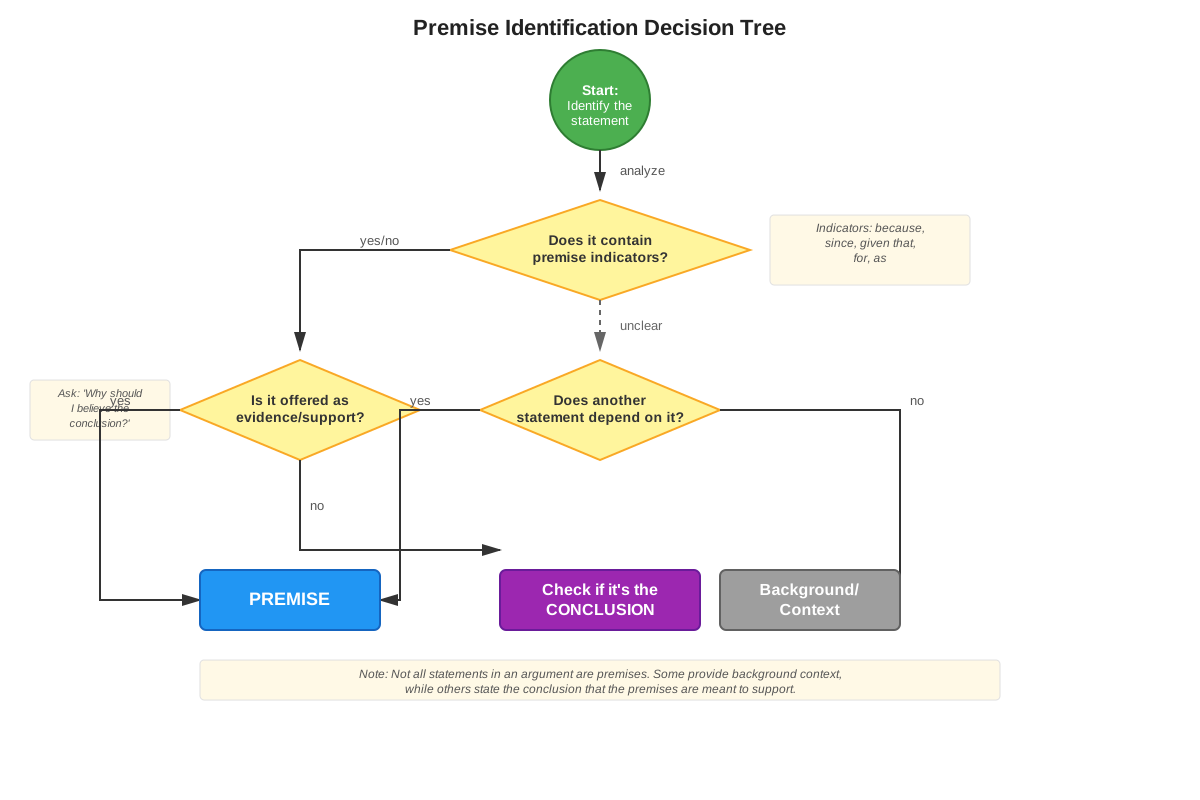
Premise indicators are linguistic markers that signal a statement is being offered as evidence. Recognizing these indicators accelerates premise identification and improves accuracy under time pressure. Common premise indicators include:
| Premise Indicator | Example Usage | Notes |
|---|---|---|
| Because | "The policy will fail because it lacks funding." | Most common indicator |
| Since | "Since enrollment has declined, revenue will decrease." | Can also indicate time; context matters |
| For | "We should expand, for demand is increasing." | Formal usage |
| As | "As studies show benefits, we should proceed." | Can be ambiguous |
| Given that | "Given that costs are rising, prices must increase." | Explicitly marks evidence |
| The reason is that | "The reason is that competitors have entered the market." | Unambiguous marker |
| After all | "We should invest; after all, returns are strong." | Often follows conclusion |
| For the reason that | "Sales dropped for the reason that quality declined." | Explicit causal premise |
Exam Tip: Not all premises are preceded by indicators. Many LSAT arguments present premises without explicit markers, requiring students to identify them through structural analysis and understanding of argument flow.
Premises vs. Conclusions: The Critical Distinction
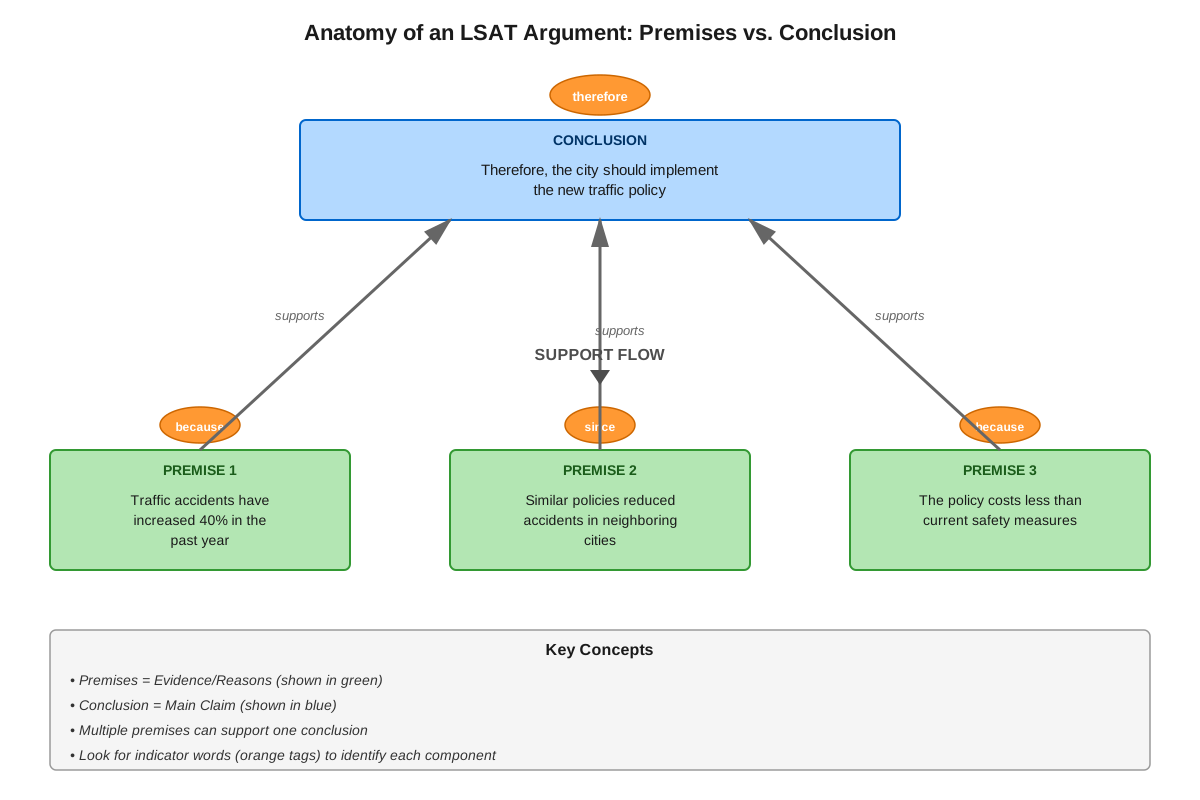
The most fundamental skill in argument analysis is distinguishing premises from conclusions. While premises provide support, conclusions are the claims being supported. This distinction is functional, not inherent—the same statement could serve as a premise in one argument and a conclusion in another, depending on its role.
The conclusion test helps identify which is which: Ask "What is this argument trying to convince me of?" The answer is the conclusion. Then ask "What reasons are given for believing this?" The answers are the premises. Additionally, conclusion indicators (therefore, thus, consequently, so, hence) signal conclusions, while premise indicators signal premises.
Consider this example: "Because the defendant was seen at the crime scene and his fingerprints were found on the weapon, he is guilty." The conclusion is "he is guilty" (what we're meant to believe), while the premises are "the defendant was seen at the crime scene" and "his fingerprints were found on the weapon" (the reasons given).
Types of Premises
Factual premises present observable or verifiable information: "The company's revenue increased by 15% last quarter." These premises are treated as given on the LSAT—students should not question their truth but rather evaluate whether they adequately support the conclusion.
Principle premises state general rules or standards: "Any policy that reduces inequality should be implemented." These premises establish criteria or frameworks that the argument then applies to specific situations.
Comparative premises establish relationships between entities: "Method A is more effective than Method B." These premises often appear in arguments recommending one option over another.
Causal premises assert cause-and-effect relationships: "Increased advertising leads to higher sales." These premises are particularly important in strengthen/weaken questions, where students must evaluate whether additional evidence affects the causal claim.
Multiple Premises and Logical Structure
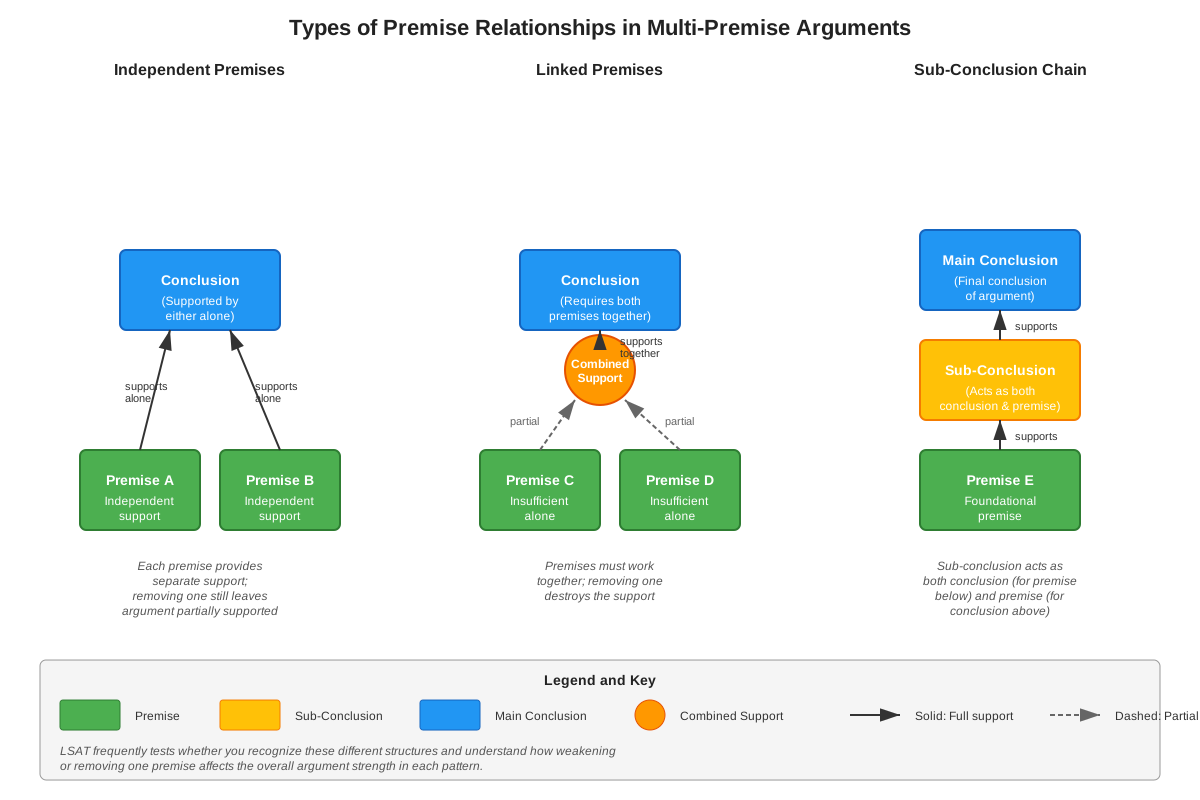
Many LSAT arguments contain multiple premises that work together to support a conclusion. Understanding how these premises interact is crucial for complete argument analysis.
Independent premises each provide separate support for the conclusion. If one premise were removed, the others would still provide some support. Example: "We should hire Sarah because (1) she has extensive experience, and (2) she has excellent references." Each premise independently supports hiring Sarah.
Dependent premises work together as a unit—removing one premise eliminates the support provided by the others. Example: "All managers must have MBAs. Sarah has an MBA. Therefore, Sarah could be a manager." The two premises must work together; neither alone supports the conclusion.
Premise chains occur when one premise supports an intermediate conclusion, which then serves as a premise for the main conclusion. Example: "Sales have increased (premise) → therefore profits will rise (intermediate conclusion/sub-premise) → therefore we should expand (main conclusion)." Recognizing these chains prevents confusion about argument structure.
Evaluating Premise Relevance and Sufficiency
Not all premises provide equal support. Relevance refers to whether a premise has any logical connection to the conclusion. An irrelevant premise might be true but fails to support the conclusion. Example: "The restaurant should expand because the chef graduated from a prestigious culinary school." The chef's education, while potentially positive, doesn't directly support expansion.
Sufficiency refers to whether premises provide adequate support for the conclusion. Premises can be relevant but insufficient. Example: "One customer complained, so the product is defective." The complaint is relevant to product quality but insufficient to establish defectiveness—one complaint doesn't prove a systemic problem.
LSAT questions frequently test whether students recognize when premises are insufficient, requiring additional assumptions to bridge the gap to the conclusion. This understanding is foundational for assumption, flaw, and strengthen/weaken questions.
Concept Relationships
Premises connect directly to conclusions in a support relationship: premises → support → conclusions. This is the most fundamental relationship in argument analysis. Without premises, conclusions are unsupported assertions; without conclusions, premises are merely disconnected facts.
Premises relate to assumptions as explicit versus implicit support. Premises are stated support, while assumptions are unstated but necessary support. Together, premises + assumptions → complete support → conclusion. Identifying premises helps reveal what assumptions must be true for the argument to work.
The relationship to argument structure is hierarchical: premises occupy the foundational level, providing the evidentiary base upon which the entire argument rests. Understanding premises enables analysis of structure, as students can map how multiple premises relate to each other and to intermediate and main conclusions.
Premises connect to inference questions through a reversal of the typical relationship. In standard arguments, premises support conclusions. In inference questions, the premises are given as facts, and students must identify what conclusion they support or what must be true based on them. This tests whether students truly understand how premises function as evidentiary support.
The connection to strengthen/weaken questions is direct: these questions ask students to identify additional premises that would increase or decrease support for the conclusion. Understanding the original premises is essential for determining what additional evidence would be relevant and impactful.
High-Yield Facts
⭐ Premises are statements offered as evidence or support for a conclusion, answering "why should I believe this claim?"
⭐ Premise indicators include "because," "since," "for," "given that," and "after all," though many premises appear without explicit indicators.
⭐ The same statement can function as a premise in one argument and a conclusion in another—the role is determined by function, not content.
⭐ Most LSAT arguments contain 1-3 premises supporting a single main conclusion, though complex arguments may have more.
⭐ Independent premises each provide separate support; dependent premises must work together to provide support.
- Premises on the LSAT should be treated as true—the test evaluates reasoning, not factual accuracy of premises.
- Identifying premises is the first step in analyzing any argument and is required for virtually all Logical Reasoning question types.
- Premise chains create intermediate conclusions that serve as premises for main conclusions, requiring careful structural analysis.
- Relevance and sufficiency are distinct qualities—a premise can be relevant but insufficient to support a conclusion.
- Factual premises present data or observations, while principle premises establish general rules or standards.
- Multiple premises can converge on a single conclusion from different angles, providing cumulative support.
- The absence of premise indicators requires students to identify premises through structural analysis and understanding of argument flow.
Quick check — test yourself on Premises so far.
Try Flashcards →Common Misconceptions
Misconception: All premises are preceded by indicator words like "because" or "since."
Correction: Many LSAT premises appear without explicit indicators. Students must identify them through structural analysis, recognizing which statements provide support versus which state the conclusion. Context and argument flow are essential for identification.
Misconception: Longer statements are more likely to be premises than shorter ones.
Correction: Length has no relationship to whether a statement is a premise or conclusion. A premise can be a single word ("Inflation") in context, while a conclusion might be a complex sentence. Function, not length, determines the role.
Misconception: Premises must be factually true in the real world.
Correction: On the LSAT, premises should be treated as given, regardless of their real-world accuracy. The test evaluates logical reasoning, not factual knowledge. Even if a premise seems dubious, students should accept it as true for purposes of analyzing the argument's logic.
Misconception: The first statement in an argument is always a premise.
Correction: Arguments can begin with conclusions, background information, or context before presenting premises. Some arguments state the conclusion first, then provide supporting premises. Students must analyze the logical relationship between statements, not rely on position.
Misconception: If a statement contains data or statistics, it must be a premise.
Correction: While data often appears in premises, conclusions can also contain data. The key is whether the statement is being supported by other statements (making it a conclusion) or providing support (making it a premise). A statement like "Therefore, sales increased by 15%" is a conclusion despite containing data.
Misconception: All premises in an argument provide equal support for the conclusion.
Correction: Premises vary in strength, relevance, and importance. Some premises provide strong, direct support, while others offer weak or tangential support. Evaluating the relative strength of premises is crucial for strengthen/weaken and flaw questions.
Misconception: Background information and context are premises.
Correction: Not all statements in an LSAT passage are premises. Background information provides context but doesn't directly support the conclusion. Only statements that function as evidence or reasons for the conclusion qualify as premises.
Worked Examples
Example 1: Identifying Premises in a Standard Argument
Argument: "The city should invest in public transportation. After all, traffic congestion has increased by 30% over the past five years, and studies show that improved public transit reduces congestion. Moreover, public transportation is more environmentally sustainable than private vehicles."
Analysis:
Step 1: Identify the conclusion by asking "What is this argument trying to convince me of?"
- The conclusion is: "The city should invest in public transportation."
- This is signaled by the recommendation ("should invest") and is the claim being supported by other statements.
Step 2: Identify premise indicators.
- "After all" signals that what follows is a premise.
- "Moreover" indicates an additional premise.
Step 3: List the premises:
- Premise 1: "Traffic congestion has increased by 30% over the past five years" (factual premise providing data)
- Premise 2: "Studies show that improved public transit reduces congestion" (factual premise establishing a causal relationship)
- Premise 3: "Public transportation is more environmentally sustainable than private vehicles" (comparative premise)
Step 4: Evaluate the premise structure.
- These are independent premises—each provides separate support for investing in public transportation.
- Premise 1 establishes a problem (congestion).
- Premise 2 establishes that the proposed solution addresses the problem.
- Premise 3 provides an additional benefit of the solution.
- Together, they create cumulative support for the conclusion.
Connection to Learning Objectives: This example demonstrates how to identify premises using both indicator words and structural analysis, explaining the reasoning pattern of multiple independent premises converging on a single conclusion.
Example 2: Distinguishing Premises from Background Information
Argument: "Urban areas have experienced significant population growth over the last decade. This growth has strained existing infrastructure. Because the water treatment facility is operating at 95% capacity and population projections indicate continued growth, the city must build a new treatment facility."
Analysis:
Step 1: Identify all statements in the passage.
- Statement 1: "Urban areas have experienced significant population growth over the last decade."
- Statement 2: "This growth has strained existing infrastructure."
- Statement 3: "The water treatment facility is operating at 95% capacity."
- Statement 4: "Population projections indicate continued growth."
- Statement 5: "The city must build a new treatment facility."
Step 2: Identify the conclusion.
- Statement 5 is the conclusion—it's the recommendation being supported.
- "Must build" indicates a strong claim requiring justification.
Step 3: Distinguish premises from background information.
- Statements 1 and 2 provide background context—they set the scene but don't directly support the specific conclusion about building a water treatment facility.
- Statement 3 is a premise—it provides specific evidence about the current facility's capacity, directly supporting the need for a new facility.
- Statement 4 is a premise—it provides evidence that the problem will worsen, supporting the need for action.
- The premise indicator "because" explicitly marks statements 3 and 4 as premises.
Step 4: Analyze the premise relationship.
- These are dependent premises working together: the facility is near capacity (current problem) AND population will grow (future problem) → therefore, a new facility is needed.
- Neither premise alone would strongly support the conclusion—both are needed to establish urgency.
Step 5: Recognize what's missing.
- The argument assumes that building a new facility is the best solution (rather than reducing water usage, upgrading the existing facility, etc.).
- This gap between premises and conclusion represents an assumption—unstated but necessary support.
Connection to Learning Objectives: This example demonstrates the critical skill of distinguishing premises from background information and recognizing dependent premise structures, both essential for accurately analyzing LST arguments.
Exam Strategy
When approaching LSAT questions involving premises, employ a systematic process to maximize accuracy and efficiency:
Step 1: Read the question stem first. Knowing what the question asks helps focus attention on relevant argument components. If the question asks about assumptions or flaws, pay special attention to whether the premises sufficiently support the conclusion.
Step 2: Identify the conclusion immediately. Use conclusion indicators (therefore, thus, so, consequently) or ask "What is this trying to convince me of?" Marking the conclusion (mentally or with notation) prevents confusion when analyzing premises.
Step 3: Locate and bracket premises. Look for premise indicators (because, since, for, given that) and identify all statements that provide support for the conclusion. Distinguish premises from background information, which provides context but not direct support.
Step 4: Evaluate premise relationships. Determine whether premises are independent (each provides separate support) or dependent (must work together). This understanding is crucial for strengthen/weaken questions, where you need to know which premises are most vulnerable or important.
Step 5: Assess sufficiency. Ask whether the premises, even if true, adequately support the conclusion. Identifying gaps between premises and conclusion reveals assumptions and helps predict correct answers for assumption, flaw, and strengthen/weaken questions.
Trigger Words to Watch For: "Because," "since," "for," "given that," "after all," "for the reason that," "as indicated by," "in light of," and "seeing that" all signal premises. However, remain alert for premises without indicators.
Process of Elimination Tips:
- Eliminate answer choices that confuse premises with conclusions
- Eliminate choices that introduce information not present in the original premises
- For strengthen/weaken questions, eliminate choices that address irrelevant premises or ignore the main premise-conclusion gap
- Eliminate choices that treat background information as if it were a premise
Time Allocation: Spend 15-20 seconds identifying the argument structure (conclusion and premises) before attempting to answer the question. This upfront investment prevents costly errors and often makes the correct answer immediately apparent. For complex arguments with multiple premises or premise chains, allocate an additional 10 seconds to map the relationships.
Memory Techniques
PREMISE Acronym for identifying premises:
- Provides support
- Reasons given
- Evidence offered
- Makes the conclusion believable
- Indicators present (often)
- Supporting statements
- Explains "why"
The Foundation Visualization: Picture an argument as a building. The conclusion is the roof—the visible claim. The premises are the foundation and support beams—they hold up the conclusion. If the foundation (premises) is weak or incomplete, the roof (conclusion) will collapse. This mental image helps remember that premises provide structural support.
The "Because Test": When uncertain whether a statement is a premise, try inserting "because" before it and see if it logically supports the conclusion. If "Conclusion, because [statement]" makes logical sense, the statement is likely a premise.
Indicator Word Grouping: Remember premise indicators in categories:
- Causation: because, since, for
- Evidence: given that, as indicated by, in light of
- Justification: for the reason that, after all, seeing that
The Support Arrow: When reading arguments, mentally draw arrows from premises to conclusions (Premise → Conclusion). This kinesthetic/visual technique reinforces the support relationship and helps identify argument structure quickly.
Summary
Premises are the foundational elements of logical reasoning on the LSAT, representing statements offered as evidence or support for conclusions. Mastering premise identification requires recognizing indicator words (because, since, for, given that), understanding the functional distinction between premises and conclusions, and evaluating how multiple premises interact to support claims. Premises can be independent (each providing separate support) or dependent (working together as a unit), and they vary in type (factual, principle, comparative, causal) and strength (relevance and sufficiency). The ability to quickly and accurately identify premises is essential for virtually all Logical Reasoning question types, including assumption, strengthen/weaken, flaw, and method of reasoning questions. Students must distinguish premises from background information, recognize premise chains where intermediate conclusions serve as premises for main conclusions, and evaluate whether stated premises adequately support conclusions or require additional assumptions. Success on the LSAT demands treating premises as given (regardless of real-world accuracy) and focusing on the logical relationships between premises and conclusions rather than the factual content of individual statements.
Key Takeaways
- Premises are statements offered as evidence supporting a conclusion; they answer "why should I believe this claim?"
- Premise indicators (because, since, for, given that) signal support statements, though many premises appear without explicit markers
- The distinction between premises and conclusions is functional, not inherent—the same statement can serve different roles in different arguments
- Multiple premises can be independent (each providing separate support) or dependent (must work together), affecting how arguments can be strengthened or weakened
- Identifying premises is the essential first step for analyzing any LSAT argument and is required for virtually all Logical Reasoning question types
- Premises should be treated as true on the LSAT; the test evaluates reasoning quality, not factual accuracy
- Evaluating premise sufficiency—whether stated premises adequately support the conclusion—reveals assumptions and logical gaps that are frequently tested
Related Topics
Conclusions: Understanding how to identify the main claim being supported by premises is the natural complement to premise identification. Mastering both enables complete argument analysis and is essential for all Logical Reasoning question types.
Assumptions: Once premises are identified, recognizing unstated but necessary support (assumptions) becomes possible. Assumptions fill the logical gap between premises and conclusions, making this a critical next step in argument analysis.
Argument Structure: Building on premise identification, this topic explores how complex arguments organize multiple premises, intermediate conclusions, and main conclusions into coherent logical structures.
Strengthen and Weaken Questions: These question types directly test the ability to identify premises and evaluate what additional evidence would increase or decrease their support for the conclusion.
Flaw Questions: Understanding premises enables recognition of common logical flaws, such as insufficient evidence, irrelevant premises, or unwarranted causal claims.
Practice CTA
Now that you understand the fundamental role of premises in LSAT arguments, it's time to apply this knowledge. Attempt the practice questions to test your ability to identify premises, distinguish them from conclusions and background information, and evaluate their sufficiency in supporting claims. Use the flashcards to reinforce premise indicators and key concepts until recognition becomes automatic. Remember: premise identification is a skill that improves dramatically with deliberate practice. Every argument you analyze strengthens your ability to quickly and accurately identify the evidentiary foundation of logical reasoning. Your investment in mastering this foundational topic will pay dividends across every Logical Reasoning question you encounter on test day.
Sign up free to keep reading
Create a free AnvayaPrep account to finish this LSAT guide on Premises — plus flashcards and practice questions.