Overview
Intermediate conclusions represent one of the most sophisticated and frequently tested elements of argument fundamentals in LSAT Logical Reasoning. Unlike simple arguments that move directly from premises to a main conclusion, many LSAT arguments contain layered reasoning structures where one claim serves as both a conclusion (supported by earlier premises) and a premise (supporting a later conclusion). These intermediate steps form the logical scaffolding that connects foundational evidence to ultimate claims, and recognizing them is essential for understanding how arguments actually work.
The ability to identify and analyze intermediate conclusions is critical for success on the LSAT because these structural elements appear across virtually every question type in Logical Reasoning. Whether evaluating an argument's assumptions, identifying its flaws, strengthening or weakening its reasoning, or simply describing its structure, students must first understand the argument's architecture. Intermediate conclusions function as the joints and beams of this architecture—they reveal how an argument builds from basic observations to complex claims. Missing an intermediate conclusion often means misunderstanding the entire argument, leading to incorrect answers even when the student grasps the general topic.
Within the broader landscape of LSAT intermediate conclusions and argument analysis, this topic connects directly to premise identification, conclusion recognition, and argument structure mapping. Mastering intermediate conclusions enables students to see arguments not as flat collections of statements but as dynamic, hierarchical reasoning chains. This skill becomes the foundation for more advanced tasks like identifying sufficient and necessary assumptions, recognizing reasoning patterns, and evaluating logical validity. The 20 minutes invested in mastering this concept will yield returns across hundreds of LSAT questions.
Learning Objectives
- [ ] Identify how intermediate conclusions appear in LSAT questions
- [ ] Explain the reasoning pattern behind intermediate conclusions
- [ ] Apply intermediate conclusions to solve LSAT-style problems accurately
- [ ] Distinguish intermediate conclusions from main conclusions and basic premises
- [ ] Recognize indicator words and structural patterns that signal intermediate conclusions
- [ ] Diagram argument structures that contain multiple levels of reasoning
- [ ] Evaluate how intermediate conclusions affect argument validity and strength
Prerequisites
- Basic premise identification: Understanding what constitutes evidence or support in an argument is necessary because intermediate conclusions are supported by premises before they support other claims
- Main conclusion recognition: Students must be able to identify the ultimate point of an argument to distinguish it from intermediate steps
- Indicator word familiarity: Knowledge of conclusion indicators (therefore, thus, so) and premise indicators (because, since, for) helps track the logical flow that creates intermediate conclusions
- Argument structure basics: Understanding that arguments contain claims in support relationships provides the framework within which intermediate conclusions operate
Why This Topic Matters
In real-world reasoning, intermediate conclusions mirror how complex thinking actually unfolds. Scientists don't jump directly from raw data to groundbreaking theories; they establish intermediate findings that build toward larger discoveries. Legal arguments don't leap from evidence to verdicts; they establish intermediate legal points that support ultimate conclusions. Business cases don't move straight from market data to strategic recommendations; they establish intermediate insights about trends and opportunities. Recognizing intermediate conclusions trains students to follow sophisticated reasoning chains in professional and academic contexts.
On the LSAT specifically, intermediate conclusions appear with remarkable frequency. Research on released LSAT exams indicates that approximately 40-50% of Logical Reasoning arguments contain at least one intermediate conclusion. This structural element appears across all major question types: Method of Reasoning questions explicitly ask students to identify the role of intermediate conclusions; Flaw questions often hinge on problems in the reasoning between premises and intermediate conclusions or between intermediate and main conclusions; Assumption questions frequently target gaps at either level of reasoning; and Parallel Reasoning questions require matching the multi-level structure that intermediate conclusions create.
Common manifestations include arguments where statistical evidence supports an intermediate claim about correlation, which then supports a main conclusion about causation; arguments where expert testimony establishes an intermediate conclusion about what is likely true, which then supports a recommendation; and arguments where definitional premises establish an intermediate conclusion about category membership, which then supports a prediction about behavior or properties.
Core Concepts
Definition and Function of Intermediate Conclusions
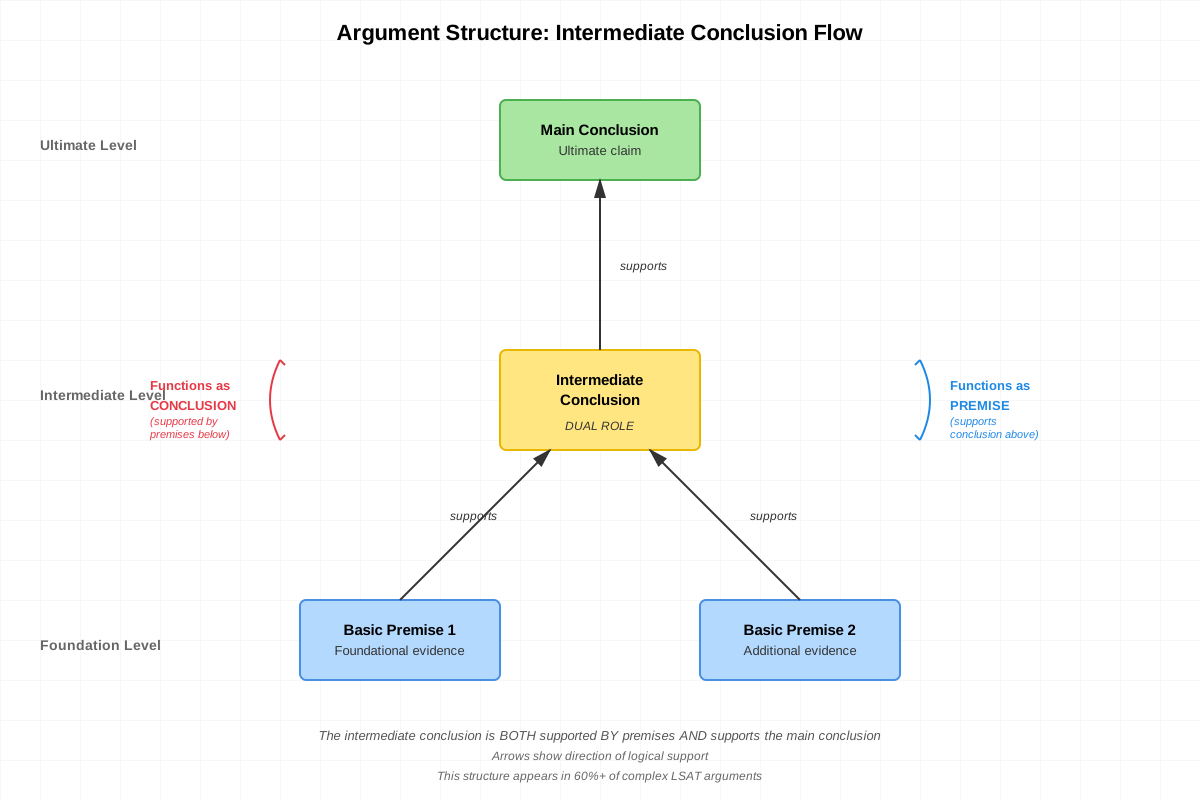
An intermediate conclusion is a claim within an argument that serves a dual role: it functions as a conclusion because it is supported by one or more premises, and it simultaneously functions as a premise because it provides support for another conclusion (typically the main conclusion). This dual nature makes intermediate conclusions the "middle layer" of multi-tiered arguments. They represent reasoning checkpoints where the argument pauses to establish a subsidiary point before moving toward its ultimate claim.
The functional purpose of intermediate conclusions is to break complex reasoning into manageable steps. Rather than asking readers to accept a large logical leap from basic evidence to a sophisticated claim, arguments with intermediate conclusions build their case incrementally. Each intermediate conclusion represents a smaller, more defensible inference that then enables the next step in reasoning.
Structural Position in Arguments
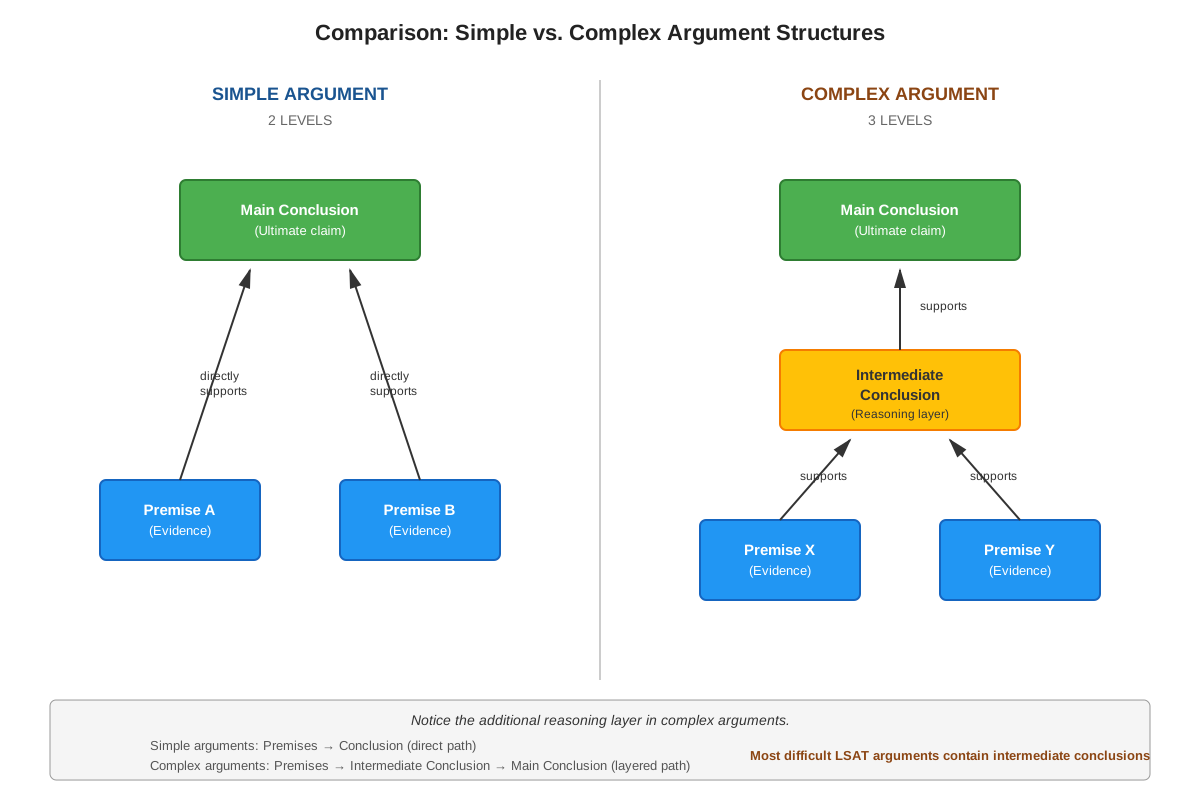
Intermediate conclusions occupy a specific structural position in argument architecture. They appear "downstream" from at least one premise (which supports them) and "upstream" from at least one conclusion (which they support). This creates a reasoning chain that can be represented as:
Premise(s) → Intermediate Conclusion → Main Conclusion
However, arguments can contain multiple intermediate conclusions at different levels, creating more complex structures:
Premise(s) → Intermediate Conclusion 1 → Intermediate Conclusion 2 → Main Conclusion
Or branching structures where multiple premises support different intermediate conclusions that converge to support a single main conclusion:
Premise A → Intermediate Conclusion X ↘
                                        → Main Conclusion
Premise B → Intermediate Conclusion Y ↗
Indicator Words and Recognition Patterns
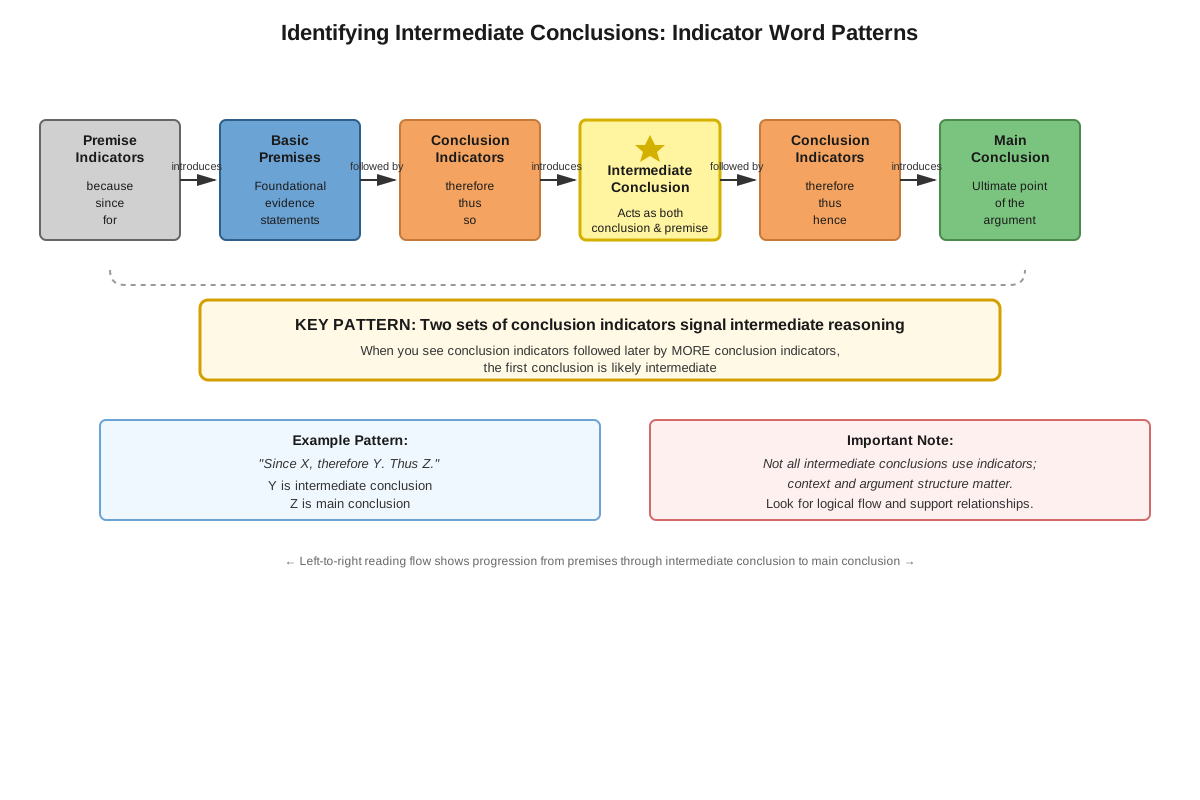
While intermediate conclusions can appear without explicit indicators, certain linguistic patterns frequently signal their presence. Conclusion indicators like "therefore," "thus," "so," "hence," "consequently," and "it follows that" often precede intermediate conclusions, just as they precede main conclusions. The key to distinguishing them lies in what follows: if additional reasoning builds upon the indicated conclusion, it's intermediate rather than main.
Premise indicators appearing after a claim suggest that claim is a conclusion (possibly intermediate) being supported. For example: "The company will likely expand [intermediate conclusion], since market research shows strong demand [premise]. Therefore, investors should buy the stock now [main conclusion]."
Certain structural phrases particularly suggest intermediate conclusions:
- "This means that..." (often introduces an intermediate conclusion drawn from preceding evidence)
- "From this we can infer..." (signals a conclusion that may support further reasoning)
- "This suggests..." (indicates a tentative conclusion that often supports a stronger main claim)
The Dual Nature: Conclusion and Premise
Understanding the dual nature of intermediate conclusions is crucial for LSAT success. When analyzing whether a statement is an intermediate conclusion, apply two tests:
- The Conclusion Test: Is this claim supported by other statements in the argument? If yes, it functions as a conclusion.
- The Premise Test: Does this claim support other statements in the argument? If yes, it functions as a premise.
If both tests return "yes," the statement is an intermediate conclusion. This dual nature means that questions about the "role" or "function" of a statement in an argument may correctly describe an intermediate conclusion as either "a conclusion supported by evidence" or "a premise supporting the main point"—both descriptions are accurate.
Distinguishing Intermediate from Main Conclusions
The main conclusion represents the argument's ultimate point—the primary claim the author wants the audience to accept. Every other element of the argument exists to support this claim, either directly or indirectly. Intermediate conclusions support the main conclusion but are not themselves the argument's ultimate purpose.
Several strategies help distinguish them:
| Feature | Main Conclusion | Intermediate Conclusion |
|---|---|---|
| Support relationship | Supported by everything else; supports nothing | Supported by some claims; supports other claims |
| Author's primary purpose | What the author most wants to prove | A step toward what the author wants to prove |
| Structural position | Typically appears at end or beginning | Typically appears in the middle |
| Removal test | Removing it eliminates the argument's point | Removing it weakens the reasoning chain but may leave the main point identifiable |
Common Argument Patterns with Intermediate Conclusions
Certain reasoning patterns frequently employ intermediate conclusions:
Causal Chain Arguments: Evidence → Intermediate conclusion about correlation → Main conclusion about causation
Definitional Arguments: Definitional premise → Intermediate conclusion about category membership → Main conclusion about properties or predictions
Expert Opinion Arguments: Expert testimony → Intermediate conclusion about what is likely true → Main conclusion with recommendation or prediction
Analogical Arguments: Similarity premises → Intermediate conclusion about relevant similarity → Main conclusion about shared properties
Statistical Arguments: Statistical data → Intermediate conclusion about trends or patterns → Main conclusion about future outcomes or policy recommendations
Concept Relationships
The concept of intermediate conclusions sits at the nexus of multiple argument analysis skills. Understanding premises is prerequisite because intermediate conclusions are built upon them—one cannot identify what supports an intermediate conclusion without recognizing premises. Similarly, recognizing main conclusions is essential because intermediate conclusions are distinguished by their relationship to the ultimate claim.
Intermediate conclusions connect directly to argument structure analysis. Mapping an argument's structure requires identifying not just what claims exist but how they relate hierarchically. Intermediate conclusions create the multi-level architecture that distinguishes sophisticated arguments from simple ones.
The concept flows into assumption identification because assumptions can exist at multiple levels. An argument might have an assumption between premises and an intermediate conclusion, and a separate assumption between the intermediate conclusion and the main conclusion. Missing the intermediate conclusion means missing half the potential assumptions.
Flaw identification similarly depends on recognizing intermediate conclusions. A flaw might occur in the reasoning leading to the intermediate conclusion, or in the reasoning from the intermediate conclusion to the main conclusion. The argument structure determines where to look for logical problems.
The relationship map flows as follows:
Premise Recognition → enables → Intermediate Conclusion Identification → enables → Complete Argument Structure Mapping → enables → Assumption Identification and Flaw Recognition → enables → Argument Evaluation and Question Answering
High-Yield Facts
⭐ Intermediate conclusions serve dual roles: they are conclusions supported by premises AND premises supporting other conclusions
⭐ Approximately 40-50% of LSAT Logical Reasoning arguments contain at least one intermediate conclusion, making this a high-frequency structural element
⭐ Conclusion indicators (therefore, thus, so, hence) can precede either intermediate or main conclusions; the distinction lies in whether further reasoning follows
⭐ The main conclusion is the argument's ultimate point; intermediate conclusions are stepping stones toward that point
⭐ Method of Reasoning questions frequently ask about the role of intermediate conclusions, often using phrases like "serves as a conclusion for which evidence is provided and as evidence for the argument's main conclusion"
- Intermediate conclusions typically appear in the middle of arguments, though their position can vary
- Arguments can contain multiple intermediate conclusions at different levels or in parallel structures
- Removing an intermediate conclusion disrupts the reasoning chain but may leave the main conclusion identifiable
- Premise indicators (because, since, for) appearing after a claim suggest that claim is a conclusion being supported
- The "why" test helps identify conclusions: if you can ask "why should I believe this?" and the argument provides an answer, the claim is a conclusion (possibly intermediate)
Quick check — test yourself on Intermediate conclusions so far.
Try Flashcards →Common Misconceptions
Misconception: Intermediate conclusions always appear in the middle of an argument physically → Correction: While intermediate conclusions often appear mid-argument, their position is determined by logical structure, not physical location. An intermediate conclusion can appear early in an argument if the main conclusion appears first, or late if premises are front-loaded.
Misconception: A statement can only be either a premise or a conclusion, never both → Correction: This binary thinking misses the essence of intermediate conclusions. A single statement can simultaneously be a conclusion (relative to what supports it) and a premise (relative to what it supports). The roles are not mutually exclusive but depend on the statement's relationships within the argument structure.
Misconception: Conclusion indicators always signal the main conclusion → Correction: Words like "therefore" and "thus" indicate that a conclusion follows, but they don't specify whether it's intermediate or main. An argument might say "therefore X" (intermediate conclusion) followed by "which means Y" (main conclusion). The indicator tells you a conclusion is present, not which type.
Misconception: Every argument has an intermediate conclusion → Correction: Many LSAT arguments are simple two-level structures: premises directly supporting a main conclusion with no intermediate steps. Intermediate conclusions appear frequently but not universally. Assuming they're always present can lead to misidentifying simple premises as intermediate conclusions.
Misconception: The longest or most complex sentence in an argument is the intermediate conclusion → Correction: Complexity and length don't determine logical function. A simple, short claim can be an intermediate conclusion if it's supported by some statements and supports others. Conversely, a complex sentence might be a basic premise or the main conclusion.
Misconception: Intermediate conclusions are less important than main conclusions → Correction: For LSAT purposes, intermediate conclusions are equally important. Questions frequently focus on them specifically, and understanding them is essential for grasping the argument's complete structure. Many wrong answers exploit confusion about intermediate versus main conclusions.
Worked Examples
Example 1: Identifying and Analyzing an Intermediate Conclusion
Argument: "Recent studies show that employees who work from home are 15% more productive than office workers. This increased productivity means companies can achieve better results with the same workforce. Therefore, businesses should implement remote work policies to maximize profitability."
Analysis:
Step 1: Identify all claims
- Claim 1: "Recent studies show that employees who work from home are 15% more productive than office workers"
- Claim 2: "This increased productivity means companies can achieve better results with the same workforce"
- Claim 3: "Businesses should implement remote work policies to maximize profitability"
Step 2: Determine support relationships
- Does anything support Claim 1? No—it's presented as evidence from studies
- Does anything support Claim 2? Yes—Claim 1 supports it (the word "means" indicates Claim 2 is a conclusion drawn from Claim 1)
- Does anything support Claim 3? Yes—Claim 2 supports it (the word "therefore" indicates Claim 3 is a conclusion drawn from Claim 2)
Step 3: Determine what each claim supports
- Does Claim 1 support anything? Yes—it supports Claim 2
- Does Claim 2 support anything? Yes—it supports Claim 3
- Does Claim 3 support anything? No—it's the final claim
Step 4: Classify each claim
- Claim 1: Basic premise (supports but is not supported)
- Claim 2: Intermediate conclusion (supported by Claim 1, supports Claim 3)
- Claim 3: Main conclusion (supported but does not support)
Structure diagram:
Premise: Remote workers are 15% more productive
         ↓
Intermediate Conclusion: Companies can achieve better results with same workforce
         ↓
Main Conclusion: Businesses should implement remote work policies
Connection to learning objectives: This example demonstrates how to identify intermediate conclusions by analyzing support relationships, explains the reasoning pattern (evidence → intermediate inference → recommendation), and shows how to apply this analysis to solve structure-based questions.
Example 2: Complex Argument with Multiple Levels
Argument: "Archaeological evidence indicates that the ancient city was abandoned suddenly. When cities are abandoned suddenly, valuable items are typically left behind. Indeed, excavations have uncovered numerous gold artifacts in residential areas. This suggests the abandonment was unexpected rather than planned. Unexpected abandonments in this region historically resulted from natural disasters. We can conclude that a natural disaster likely caused the city's abandonment."
Analysis:
Step 1: Identify all claims
- Archaeological evidence indicates sudden abandonment
- Sudden abandonments typically leave valuable items behind
- Excavations uncovered numerous gold artifacts
- The abandonment was unexpected rather than planned
- Unexpected abandonments in this region historically resulted from natural disasters
- A natural disaster likely caused the city's abandonment
Step 2: Map support relationships
Claims 1, 2, and 3 are basic premises—they provide evidence but aren't themselves supported by other claims in the argument.
Claim 4 ("This suggests the abandonment was unexpected") is supported by claims 1, 2, and 3. The word "suggests" indicates this is a conclusion drawn from the evidence about sudden abandonment, typical patterns, and discovered artifacts. This is an intermediate conclusion.
Claim 5 is presented as a general historical fact—a basic premise.
Claim 6 ("We can conclude that...") is the main conclusion, supported by claim 4 (the intermediate conclusion about unexpected abandonment) and claim 5 (the premise about historical causes).
Structure diagram:
Premise 1: Sudden abandonment (archaeological evidence)
Premise 2: Sudden abandonments leave valuables
Premise 3: Gold artifacts found
         ↓
Intermediate Conclusion: Abandonment was unexpected
         ↓ (combined with)
Premise 4: Unexpected abandonments in region caused by natural disasters
         ↓
Main Conclusion: Natural disaster likely caused abandonment
Key insight: This argument contains reasoning at two levels. The first level establishes that the abandonment was unexpected (intermediate conclusion). The second level uses that established point, combined with additional historical information, to reach the ultimate conclusion about causation. A question asking "What role does the claim that the abandonment was unexpected play in the argument?" would be correctly answered with something like: "It is a conclusion supported by archaeological evidence that in turn supports the argument's main conclusion about the cause of abandonment."
Exam Strategy
Approaching Questions About Intermediate Conclusions
When facing LSAT questions that involve intermediate conclusions, employ this systematic approach:
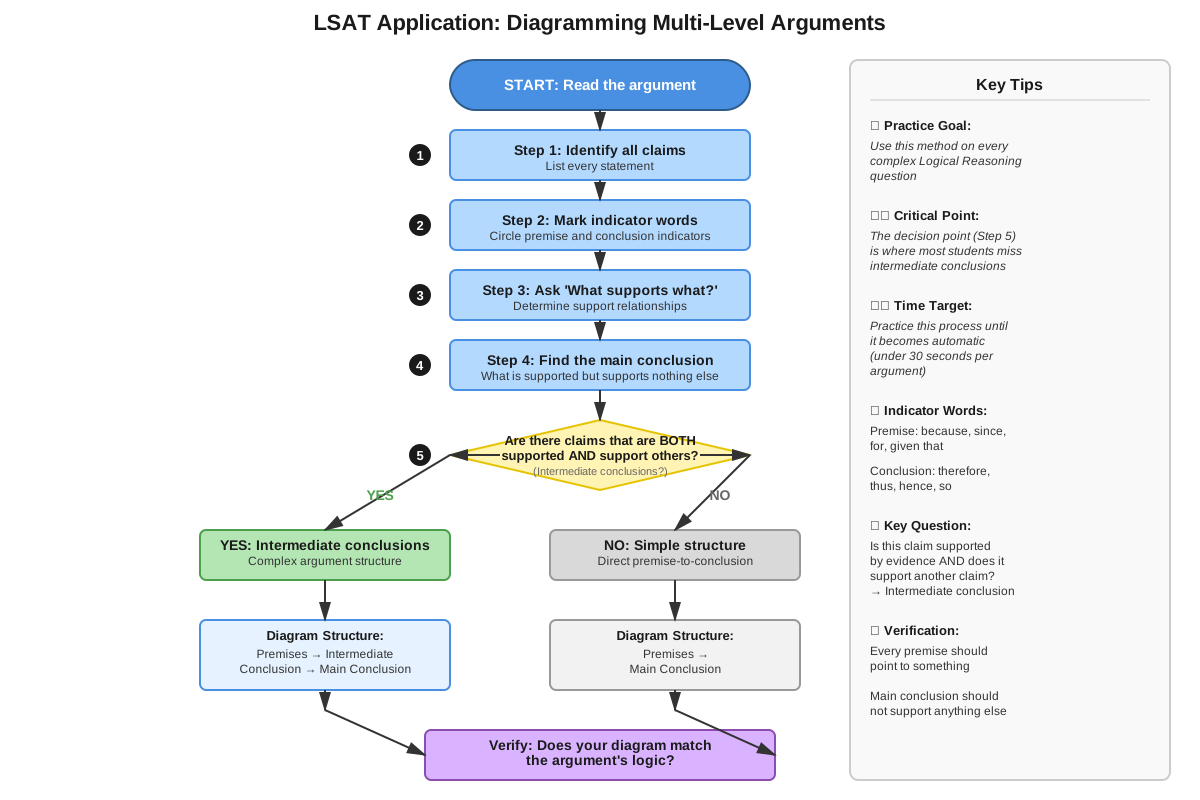
Step 1: Read the argument carefully and identify all claims. Don't rush to judgment about which is which—simply note every statement that makes a claim.
Step 2: Look for conclusion indicators (therefore, thus, so, hence, consequently, it follows that) and premise indicators (because, since, for, given that). Mark them but remember that conclusion indicators might precede either intermediate or main conclusions.
Step 3: Apply the support test to each claim. Ask: "What supports this claim?" and "What does this claim support?" Claims supported by some statements and supporting other statements are intermediate conclusions.
Step 4: Identify the main conclusion by finding the argument's ultimate point—the claim that everything else exists to support. This is often (but not always) the last sentence, and it's the claim that answers "What is the author's primary purpose?"
Step 5: Map the structure mentally or on scratch paper, showing the flow from premises through intermediate conclusions to the main conclusion.
Trigger Words and Phrases
Watch for these high-yield indicators:
Intermediate conclusion signals:
- "This means that..."
- "This suggests..."
- "From this we can infer..."
- "This indicates..."
- "It follows that..." (when additional reasoning follows)
Main conclusion signals:
- "Therefore..." (when it's the final inference)
- "The point is..."
- "The conclusion to draw is..."
- "We should conclude..."
- "Ultimately..."
Dual-role phrases (often connect intermediate to main conclusions):
- "...and therefore..." (the first conclusion is intermediate, the second main)
- "...which means that..." (often introduces main conclusion following intermediate)
Process of Elimination Tips
When answer choices describe the role of a statement:
Eliminate answers that:
- Describe the statement as "the main conclusion" if other claims depend on it for support
- Describe it as "a premise" if the argument provides support for it
- Claim it's "unsupported" if premises clearly back it up
- Say it "supports nothing" if it clearly leads to another conclusion
Keep answers that:
- Accurately describe the dual nature ("a conclusion that serves as a premise")
- Correctly identify what supports it and what it supports
- Match your structural map
Time Allocation
For questions explicitly about intermediate conclusions (typically Method of Reasoning or Argument Structure questions):
- Spend 15-20 seconds on initial argument reading
- Spend 10-15 seconds mapping the structure
- Spend 20-30 seconds evaluating answer choices
- Total: 45-65 seconds for these questions
The upfront investment in structure mapping pays dividends in answer choice evaluation, as you can quickly eliminate choices that mischaracterize relationships.
Memory Techniques
The "Stepping Stone" Visualization
Visualize arguments with intermediate conclusions as a path across a river. Premises are the riverbank where you start. The main conclusion is the opposite bank where you want to arrive. Intermediate conclusions are stepping stones in the river—you must step on them to reach the other side, but they're not your final destination. This image reinforces that intermediate conclusions are necessary steps in the reasoning journey but not the ultimate goal.
The "IC-DC" Mnemonic
Remember that Intermediate Conclusions have Dual Characteristics: they are both conclusions (supported by evidence) and premises (supporting other claims). IC-DC helps recall this essential dual nature.
The "Support Sandwich" Technique
Think of intermediate conclusions as the middle layer of a sandwich:
- Bottom bread: Basic premises (foundation)
- Filling: Intermediate conclusion (the middle layer)
- Top bread: Main conclusion (the final layer)
Just as the filling touches both pieces of bread, the intermediate conclusion connects to both premises below and conclusions above.
The "Therefore Test"
When you see "therefore" or similar indicators, ask: "Is there more reasoning after this?" If yes, what follows is likely the main conclusion, making the current claim intermediate. If no, it's likely the main conclusion. This quick test helps distinguish intermediate from main conclusions.
The "Why Chain" Method
For each claim, ask "Why should I believe this?" If the argument answers that question, the claim is a conclusion. Then ask "What does this help prove?" If the argument uses it to prove something else, it's intermediate. This creates a chain: Why? → Because [premises]. What does this prove? → It proves [main conclusion]. The claim in the middle is intermediate.
Summary
Intermediate conclusions represent a critical structural element in LSAT Logical Reasoning arguments, appearing in approximately 40-50% of arguments across all question types. These claims serve a dual function: they are conclusions because they are supported by premises, and they simultaneously function as premises because they support further conclusions, typically the main conclusion. Recognizing intermediate conclusions requires analyzing support relationships within arguments—identifying what supports each claim and what each claim supports. Arguments with intermediate conclusions build reasoning in layers, moving from basic evidence through intermediate inferences to ultimate claims. Success on LSAT questions involving intermediate conclusions depends on careful structure mapping, attention to indicator words, and understanding that a single statement can play multiple roles within an argument's architecture. The ability to identify and analyze intermediate conclusions is foundational for virtually all Logical Reasoning question types, from Method of Reasoning and Argument Structure questions that explicitly ask about them, to Assumption, Flaw, Strengthen, and Weaken questions that require understanding the complete reasoning chain.
Key Takeaways
- Intermediate conclusions have a dual nature: they are both conclusions (supported by premises) and premises (supporting other conclusions), distinguishing them from basic premises and main conclusions
- Structure mapping is essential: systematically identifying what supports each claim and what each claim supports reveals intermediate conclusions and prevents misidentification
- Conclusion indicators don't specify type: words like "therefore" and "thus" signal conclusions but don't distinguish intermediate from main conclusions—context and subsequent reasoning determine the type
- Approximately 40-50% of LSAT arguments contain intermediate conclusions, making this a high-frequency, high-value concept for test preparation
- Method of Reasoning questions frequently test intermediate conclusions by asking about the role or function of specific claims within arguments
- Multiple levels of reasoning are common: arguments may contain several intermediate conclusions at different levels, requiring careful analysis to map the complete structure
- The main conclusion is the argument's ultimate point: everything else, including intermediate conclusions, exists to support it directly or indirectly
Related Topics
Assumption Identification: Mastering intermediate conclusions enables more sophisticated assumption analysis because assumptions can exist at multiple levels—between premises and intermediate conclusions, or between intermediate and main conclusions. Understanding the complete argument structure reveals where assumptions might be hiding.
Argument Structure and Method of Reasoning: These question types explicitly test the ability to identify and describe the roles of different claims, including intermediate conclusions. The skills developed here directly apply to questions asking "which one of the following most accurately describes the argument's method of reasoning?"
Flaw Recognition: Many argument flaws occur in the reasoning between premises and intermediate conclusions or between intermediate and main conclusions. Recognizing the multi-level structure helps pinpoint where logical problems arise.
Parallel Reasoning: These challenging questions require matching not just the content but the structure of arguments. Arguments with intermediate conclusions create specific structural patterns that must be replicated in the correct answer choice.
Sufficient and Necessary Assumptions: Understanding intermediate conclusions helps identify assumptions at each level of reasoning, distinguishing between assumptions needed for the intermediate conclusion and those needed for the main conclusion.
Practice CTA
Now that you understand the structure and function of intermediate conclusions, it's time to apply this knowledge. Work through the practice questions to test your ability to identify intermediate conclusions in various argument structures, and use the flashcards to reinforce key concepts and recognition patterns. Remember that mastering this topic will improve your performance across virtually every Logical Reasoning question type—the investment in practice will yield returns throughout your LSAT preparation. Each practice question is an opportunity to strengthen your structure-mapping skills and build the confidence needed for test day success.
Sign up free to keep reading
Create a free AnvayaPrep account to finish this LSAT guide on Intermediate conclusions — plus flashcards and practice questions.