Overview
Qualifications represent one of the most subtle yet powerful tools in logical reasoning on the LSAT. In the context of argument fundamentals, qualifications are words, phrases, or clauses that limit, restrict, or modify the scope of a claim. They function as hedging devices that make statements more precise, defensible, and logically sound by acknowledging exceptions, limitations, or degrees of certainty. Understanding qualifications is essential because they fundamentally alter the strength and meaning of arguments—transforming absolute claims into conditional ones, universal statements into particular ones, and categorical assertions into probabilistic ones.
On the LSAT, the ability to recognize and properly interpret qualifications separates high-scoring test-takers from those who struggle with nuance. Test-makers deliberately craft arguments where the presence or absence of qualifications determines whether reasoning is valid or fallacious. A single qualifying word like "most," "some," "typically," or "generally" can completely change what an argument proves or fails to prove. Students who overlook these linguistic markers will consistently misidentify argument structures, select incorrect answer choices, and fail to spot logical gaps that hinge on scope mismatches.
Within the broader framework of Logical Reasoning, qualifications connect intimately with concepts like scope, degree of certainty, conditional reasoning, and the distinction between necessary and sufficient conditions. They appear across virtually every question type—from Strengthen and Weaken questions to Necessary Assumption and Flaw questions. Mastering LSAT qualifications provides the foundation for understanding how arguments can be made more or less vulnerable to criticism, how evidence relates to conclusions, and how to match the logical force of premises to claims.
Learning Objectives
- [ ] Identify how Qualifications appears in LSAT questions
- [ ] Explain the reasoning pattern behind Qualifications
- [ ] Apply Qualifications to solve LSAT-style problems accurately
- [ ] Distinguish between qualified and unqualified claims in argument structures
- [ ] Recognize scope shifts created by the presence or absence of qualifications
- [ ] Evaluate how qualifications affect argument strength and validity
- [ ] Predict correct answer choices by matching qualification levels between premises and conclusions
Prerequisites
- Basic argument structure: Understanding premises, conclusions, and how they relate is necessary because qualifications modify these fundamental components
- Scope concepts: Familiarity with how broad or narrow claims can be helps recognize when qualifications expand or restrict argument scope
- Quantifiers: Knowledge of terms like "all," "some," and "none" provides the foundation for understanding how qualifications create logical boundaries
- Conditional reasoning basics: Understanding if-then relationships helps because qualifications often introduce conditions that limit when claims apply
Why This Topic Matters
Qualifications appear in approximately 60-70% of all Logical Reasoning questions on the LSAT, making them one of the most frequently tested concepts. They are particularly prevalent in Flaw questions (where unqualified conclusions from qualified premises represent a common error pattern), Necessary Assumption questions (where the correct answer often adds a needed qualification), and Strengthen/Weaken questions (where answer choices introduce or remove qualifications to affect argument force).
In real-world legal reasoning, qualifications are essential for precise argumentation. Attorneys must carefully qualify their claims to avoid overstatement, judges must recognize the scope limitations of precedents, and legal scholars must distinguish between rules that apply universally versus those with exceptions. The LSAT tests this skill because legal practice demands the ability to work with nuanced, carefully bounded claims rather than sweeping generalizations.
Common manifestations in LSAT passages include: arguments that conclude something is "always" true based on evidence about what is "usually" true; claims about "all members" of a group based on data about "most members"; categorical recommendations based on probabilistic evidence; and absolute predictions based on conditional statements. Recognizing these patterns allows test-takers to immediately identify logical vulnerabilities and predict what correct answers must address.
Core Concepts
What Are Qualifications?
Qualifications are linguistic elements that specify the conditions, limitations, or degree of certainty associated with a claim. They answer questions like: Under what circumstances? To what extent? How often? With what level of confidence? In logical reasoning, qualifications function as scope restrictors that prevent claims from being interpreted more broadly than the evidence supports.
Qualifications can be categorized into several functional types:
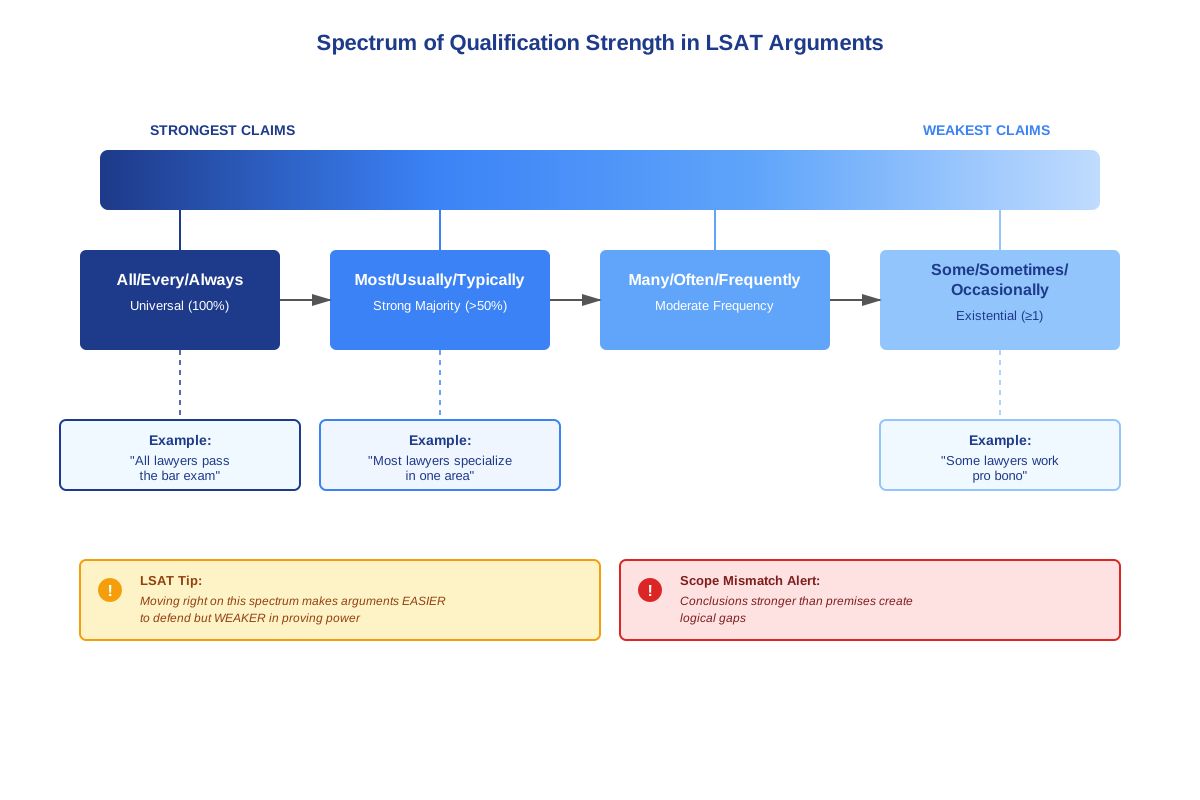
Frequency qualifications indicate how often something occurs: always, usually, often, sometimes, rarely, never. These create a spectrum from universal to particular claims.
Degree qualifications specify intensity or extent: completely, largely, somewhat, slightly, barely. These modify how much of a quality or characteristic applies.
Conditional qualifications establish circumstances under which claims hold: if, when, provided that, unless, except when. These create logical dependencies.
Epistemic qualifications express certainty levels: certainly, probably, possibly, might, could. These indicate the speaker's confidence in the claim.
Scope qualifications define the range of application: all, most, many, some, few. These specify what portion of a category the claim covers.
The Logic of Qualified vs. Unqualified Claims
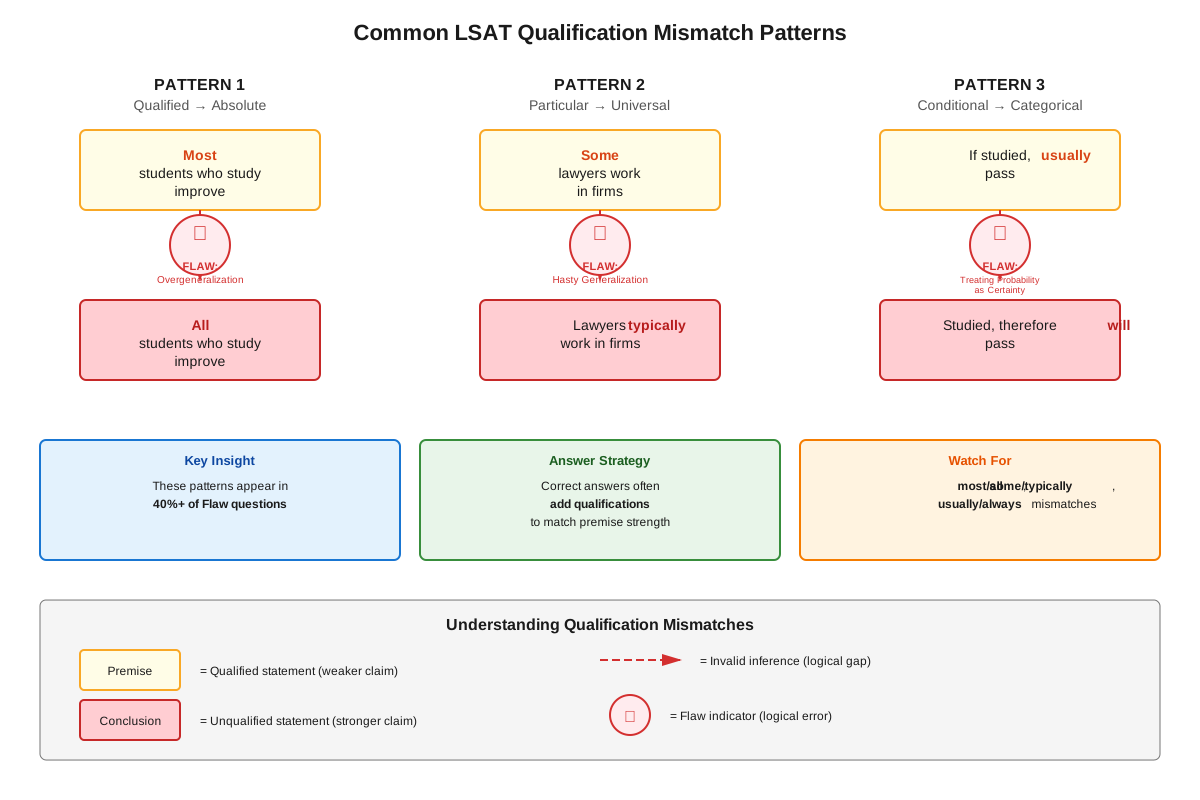
The fundamental logical principle governing qualifications is that evidence with qualifications cannot support conclusions without those qualifications unless additional justification bridges the gap. This represents a scope mismatch—one of the most common logical flaws on the LSAT.
Consider the logical difference:
| Unqualified Claim | Qualified Claim | Logical Strength |
|---|---|---|
| All X are Y | Most X are Y | Weaker (allows exceptions) |
| This will happen | This will probably happen | Weaker (acknowledges uncertainty) |
| Under all conditions | Under normal conditions | Weaker (limited applicability) |
| Experts agree | Some experts agree | Weaker (not consensus) |
When an argument moves from a qualified premise to an unqualified conclusion, it commits a scope shift error. The conclusion claims more than the evidence establishes. Conversely, when a conclusion is appropriately qualified to match the evidence, the argument is logically stronger and more defensible.
Qualifications and Argument Strength
The presence of qualifications affects argument strength in predictable ways:
- Qualified conclusions are easier to support: A claim that "most students benefit from tutoring" requires less evidence than "all students benefit from tutoring"
- Matching qualifications preserve validity: When premises and conclusions share the same qualifications, the argument avoids scope problems
- Removing qualifications creates vulnerability: An argument becomes attackable when it drops qualifications present in the evidence
- Adding appropriate qualifications strengthens arguments: Introducing realistic limitations makes claims more defensible
- Overly qualified conclusions may be too weak: Sometimes qualifications can make a conclusion so hedged that it fails to establish anything meaningful
Common Qualifying Terms on the LSAT
Test-takers must develop sensitivity to the following high-frequency qualifying terms:
Universal quantifiers (no exceptions): all, every, each, any, always, invariably, necessarily, must, cannot, none, never
Near-universal qualifiers (rare exceptions): almost all, nearly always, virtually every, typically, generally, normally, usually, regularly
Majority qualifiers (more than half): most, majority, more than half, predominantly, primarily
Substantial minority qualifiers: many, numerous, frequently, often, commonly
Existential qualifiers (at least one): some, several, certain, a few, occasionally, sometimes, can, may, might, could
Conditional markers: if, when, whenever, provided that, assuming that, given that, unless, except, only if
Qualifications in Argument Structure
In well-constructed arguments, qualifications should flow consistently from premises through to conclusions. Consider this structure:
Premise 1 (qualified): Most students who study consistently improve their LSAT scores.
Premise 2 (qualified): Sarah has been studying consistently.
Conclusion (appropriately qualified): Sarah will probably improve her LSAT score.
The conclusion's qualification ("probably") appropriately reflects the qualified nature of the first premise ("most"). Now contrast with a flawed version:
Premise 1 (qualified): Most students who study consistently improve their LSAT scores.
Premise 2 (qualified): Sarah has been studying consistently.
Conclusion (inappropriately unqualified): Sarah will improve her LSAT score.
The unqualified conclusion commits a scope error by claiming certainty when the evidence only supports probability.
Qualifications and Necessary Assumptions
Many Necessary Assumption questions hinge on qualifications. When an argument's conclusion is less qualified than its premises warrant, the argument assumes that the gap doesn't matter—that no relevant exceptions exist. The necessary assumption often takes the form of a negative qualification: "There are no factors that would prevent X" or "The exceptions to the general rule don't apply here."
For example, if an argument concludes that a policy will succeed based on evidence that similar policies usually succeed, it necessarily assumes that this case isn't one of the exceptions where such policies fail.
Concept Relationships
Qualifications serve as the foundation for understanding scope relationships in arguments. Scope → is defined by → Qualifications, meaning that the breadth or narrowness of a claim depends directly on its qualifying language.
Qualifications → determine → Argument Strength, as the degree of hedging affects how defensible a claim is against counterexamples.
Conditional Reasoning → relies on → Qualifications, since conditional statements are themselves a form of qualification that specifies when claims apply.
Flaw Recognition → requires identifying → Qualification Mismatches, particularly when conclusions drop qualifications present in premises.
Strengthen/Weaken Questions → often involve → Adding or Removing Qualifications, as answer choices that introduce exceptions weaken arguments while those that eliminate exceptions strengthen them.
The relationship map: Qualifications → Scope Definition → Argument Evaluation → Answer Choice Prediction → Correct Response Selection
High-Yield Facts
⭐ Arguments that move from qualified premises to unqualified conclusions commit a scope shift error—one of the most common flaws on the LSAT
⭐ The word "some" in logic means "at least one" and possibly "all"—it sets a minimum, not a maximum
⭐ "Most" means "more than half" and is the strongest claim you can make about a majority without claiming universality
⭐ Conditional qualifications ("if," "when") restrict claims to specific circumstances and cannot support unconditional conclusions
⭐ Epistemic qualifiers like "probably" and "likely" indicate uncertainty and cannot support conclusions stated as certainties
- Removing a qualification from a premise when forming a conclusion creates a logical gap that must be filled by an assumption
- The presence of "typically" or "generally" in a premise means exceptions exist, making absolute conclusions vulnerable
- "Can" and "may" indicate possibility, not actuality—they support much weaker conclusions than "does" or "will"
- Qualifications in correct answer choices often mirror the qualification level in the stimulus
- Overgeneralizing from qualified evidence is more common than undergeneralizing in LSAT wrong answers
- The phrase "in most cases" explicitly acknowledges exceptions, making it impossible to conclude what will happen in a specific case without additional information
Quick check — test yourself on Qualifications so far.
Try Flashcards →Common Misconceptions
Misconception: "Most" and "many" are interchangeable in logical reasoning.
Correction: "Most" means more than 50% and allows for definite logical inferences, while "many" is vague and could mean anywhere from a substantial minority to nearly all. Only "most" guarantees a majority.
Misconception: If something is true "generally" or "typically," then it's true in any specific case unless proven otherwise.
Correction: General rules acknowledge exceptions. Without evidence that a specific case follows the general pattern, you cannot conclude the rule applies. The burden is on the argument to show the case isn't an exception.
Misconception: Qualifications always weaken arguments.
Correction: Appropriate qualifications actually strengthen arguments by making them more defensible and accurate. Unqualified claims are often easier to attack because they're vulnerable to any counterexample.
Misconception: "Some" means "a few" or "not many."
Correction: In formal logic, "some" means "at least one and possibly all." It's the weakest existential claim and is compatible with any quantity from one to the entire set.
Misconception: If an argument's premises are qualified, the conclusion must use the exact same qualifying word.
Correction: The conclusion must be appropriately qualified to match the logical strength of the premises, but this doesn't require identical wording. "Probably," "likely," and "most likely" can all appropriately qualify a conclusion based on premises about what happens "usually" or "in most cases."
Misconception: Conditional qualifications ("if X, then Y") mean that Y only happens when X happens.
Correction: Conditional statements establish sufficiency (X is enough for Y) but not necessity (X isn't required for Y). Y could occur for other reasons. This confusion leads to errors in conditional reasoning questions.
Misconception: Adding qualifications to an answer choice always makes it more likely to be correct.
Correction: The qualification level must match the stimulus. Over-qualified answer choices that are too hedged or weak may fail to accomplish what the question asks (e.g., a Strengthen question needs a strong answer, not an overly cautious one).
Worked Examples
Example 1: Identifying Qualification Mismatches
Stimulus: "Studies show that people who exercise regularly tend to have lower rates of heart disease than those who don't exercise. Therefore, if you want to avoid heart disease, you should exercise regularly."
Question: Which of the following identifies a flaw in the reasoning?
Analysis:
Step 1: Identify the qualifications in the premise. The premise says people who exercise "tend to have lower rates"—this is a qualified, probabilistic claim indicating a correlation, not a guarantee.
Step 2: Identify the qualifications in the conclusion. The conclusion recommends exercise as a means to "avoid heart disease"—this is stated as a reliable method without qualification.
Step 3: Recognize the scope shift. The premise establishes a tendency (qualified), but the conclusion treats exercise as an effective preventive measure (less qualified). The argument moves from correlation to causation and from "tends to" to an implicit "will."
Step 4: The flaw is that the argument treats a tendency as a certainty and assumes that correlation implies causation. The evidence only supports a qualified conclusion like "exercise will probably reduce your risk" or "exercise may help prevent heart disease."
Correct answer pattern: "The argument treats evidence of a correlation as though it established a causal relationship" or "The argument fails to consider that the tendency described in the evidence may not apply in every individual case."
Connection to learning objectives: This example demonstrates how to identify qualifications in premises ("tend to"), recognize when conclusions lack appropriate qualifications, and explain the reasoning pattern (scope shift from qualified evidence to unqualified recommendation).
Example 2: Necessary Assumption with Qualifications
Stimulus: "Most successful entrepreneurs have strong networking skills. Jamal has strong networking skills, so he will probably succeed as an entrepreneur."
Question: Which of the following is an assumption required by the argument?
Analysis:
Step 1: Map the argument structure.
- Premise: Most successful entrepreneurs have strong networking skills
- Premise: Jamal has strong networking skills
- Conclusion: Jamal will probably succeed as an entrepreneur
Step 2: Identify the logical gap. The premise tells us that most successful entrepreneurs have networking skills, but this doesn't tell us that most people with networking skills become successful entrepreneurs. This is a classic reversal error combined with a qualification issue.
Step 3: Recognize what must be assumed. For the conclusion to follow, the argument must assume that having networking skills is a strong indicator of entrepreneurial success—not just that successful entrepreneurs tend to have this trait. The argument assumes the correlation works in both directions to some degree.
Step 4: Consider qualification matching. The conclusion is appropriately qualified ("probably"), which matches the qualified premise ("most"). However, the argument still assumes that Jamal doesn't have other characteristics that would prevent success despite his networking skills.
Correct answer pattern: "Jamal does not lack other characteristics that are essential for entrepreneurial success" or "Having strong networking skills is a reliable indicator of potential entrepreneurial success."
Connection to learning objectives: This example shows how to apply qualification analysis to identify assumptions, recognize that even appropriately qualified conclusions can rest on hidden assumptions, and solve LSAT-style problems by tracking how qualifications affect logical relationships.
Exam Strategy
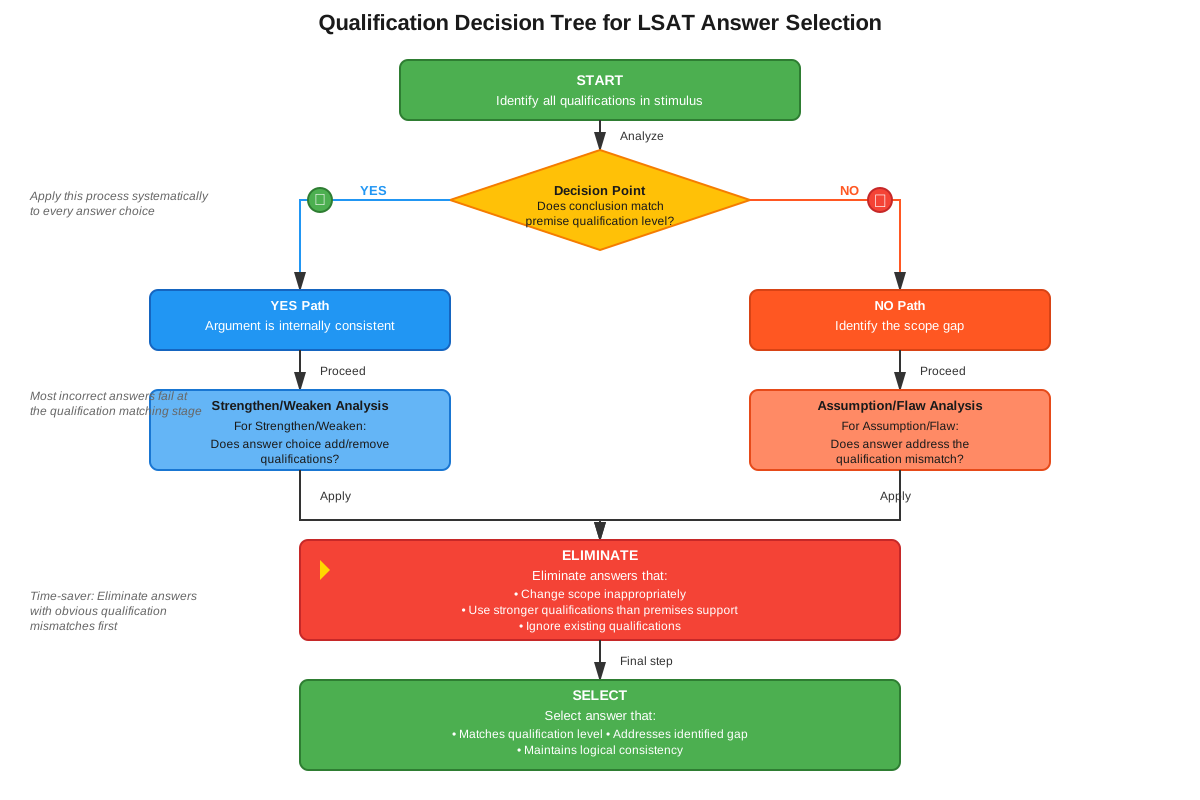
When approaching LSAT questions involving qualifications, follow this systematic process:
Step 1: Identify and mark all qualifying terms in both the stimulus and answer choices. Circle or underline words like "most," "some," "typically," "probably," "if," and "generally." This visual marking prevents overlooking crucial scope indicators.
Step 2: Check for qualification consistency between premises and conclusion. Ask: Does the conclusion claim more certainty, broader scope, or fewer conditions than the premises support? If yes, you've likely found a flaw or identified what an assumption must address.
Step 3: Watch for trigger phrases that signal qualification issues:
- "Studies show that X tends to..." followed by an unqualified recommendation
- "Most X are Y" followed by a conclusion about a specific X
- "This usually happens" followed by "This will happen"
- "Under normal conditions" followed by an unconditional prediction
Step 4: In Flaw questions, scope shifts involving qualifications are among the most common correct answers. If you see a qualification mismatch, strongly consider answer choices mentioning "treats a tendency as a certainty," "generalizes from atypical cases," or "assumes what is true in most cases is true in all cases."
Step 5: In Necessary Assumption questions, the correct answer often adds a qualification that was missing or rules out exceptions to a qualified premise. Test answer choices by negating them—if the negation destroys the argument, you've found the necessary assumption.
Step 6: In Strengthen/Weaken questions, answers that remove exceptions strengthen arguments, while those that introduce exceptions weaken them. An answer stating "In most cases, the exception doesn't apply" strengthens; one stating "Frequently, the exception does apply" weakens.
Exam Tip: When two answer choices seem close, compare their qualification levels. The correct answer typically matches the qualification level of the stimulus. If the stimulus is qualified, an overly strong answer is likely wrong; if the stimulus is strong, an overly hedged answer may be too weak.
Time allocation: Spend 5-10 seconds specifically checking qualifications in each stimulus. This small time investment prevents costly errors and often reveals the argument's logical structure immediately.
Memory Techniques
The SCOPE Acronym for checking qualifications:
- Strength: How strong is the claim? (Universal, majority, existential?)
- Conditions: Are there conditional qualifications? (If, when, unless?)
- Often: What frequency is indicated? (Always, usually, sometimes?)
- Probability: What certainty level? (Definitely, probably, possibly?)
- Exceptions: Does the language acknowledge exceptions? (Most, typically, generally?)
The Qualification Spectrum Visualization: Picture a horizontal line from "absolute" on the left to "minimal" on the right:
ABSOLUTE ←→ STRONG ←→ MODERATE ←→ WEAK ←→ MINIMAL
all/always   most/usually   many/often   some/sometimes   few/rarely
must/will    probably       may/might    could/can        possibly
When analyzing arguments, mentally place premises and conclusions on this spectrum. If the conclusion is further left (stronger) than the premises support, there's a scope problem.
The "Exception Test" Mnemonic: When you see "most," "typically," or "generally," immediately think "EXCEPT"—these words explicitly acknowledge exceptions exist. If the conclusion doesn't account for possible exceptions, the argument is vulnerable.
The Matching Game: Think of qualifications like matching puzzle pieces. The conclusion's qualification must "fit" with the premises' qualifications. If they don't match, something is missing (an assumption) or wrong (a flaw).
Summary
Qualifications are linguistic elements that limit, restrict, or specify the scope, certainty, frequency, or conditions of claims in logical reasoning. Mastering qualifications is essential for LSAT success because they appear in the majority of Logical Reasoning questions and fundamentally determine argument validity. The core principle is that conclusions cannot be less qualified than premises support without creating a logical gap. Arguments that move from qualified premises (most, usually, tends to) to unqualified conclusions (will, must, always) commit scope shift errors—one of the most frequently tested flaws. Conversely, appropriately qualified conclusions that match the strength of their evidence create sound arguments. Test-takers must develop sensitivity to qualifying terms across the spectrum from universal quantifiers (all, always) through majority qualifiers (most, typically) to existential qualifiers (some, sometimes). Success requires systematically identifying qualifications in stimuli, checking for consistency between premises and conclusions, and selecting answer choices that appropriately address qualification mismatches through assumptions, flaw identifications, or argument modifications.
Key Takeaways
- Qualifications define the scope, certainty, and conditions of claims—they are not mere stylistic choices but logical necessities
- Scope shifts from qualified premises to unqualified conclusions represent one of the most common argument flaws on the LSAT
- "Most" means more than 50% and allows logical inferences; "many" is vague and doesn't guarantee a majority
- Appropriately qualified conclusions are logically stronger and more defensible than overreaching unqualified ones
- Systematic identification of qualifying terms in both stimuli and answer choices prevents costly errors and reveals argument structure
- Necessary assumptions often involve ruling out exceptions to qualified premises or adding missing qualifications
- Matching the qualification level between stimulus and answer choice is a powerful elimination strategy
Related Topics
Conditional Reasoning: Qualifications and conditional statements are closely related, as conditionals represent a specific type of qualification that restricts when claims apply. Mastering qualifications provides the foundation for understanding sufficient and necessary conditions.
Formal Logic and Quantifiers: The relationship between qualifications and formal logic quantifiers (all, some, none) deepens understanding of how to diagram arguments and make valid inferences.
Scope and Degree: This topic explores how arguments can err by being too broad or too narrow, building directly on qualification concepts to address more complex scope problems.
Causation vs. Correlation: Many causation errors involve qualification issues, as arguments often move from qualified correlational evidence to unqualified causal conclusions.
Argument Evaluation: Understanding qualifications enables more sophisticated evaluation of argument strength, validity, and vulnerability to criticism across all question types.
Practice CTA
Now that you understand how qualifications function in logical reasoning, it's time to put this knowledge into practice. Work through the practice questions focusing specifically on identifying qualifying terms, checking for scope consistency, and predicting how qualifications affect argument strength. Use the flashcards to reinforce recognition of common qualifying terms and their logical implications. Remember: every hour spent mastering qualifications pays dividends across multiple question types. The ability to spot and analyze qualifications separates good LSAT scores from great ones—you're building a skill that will serve you throughout the exam and in legal reasoning beyond it.
Sign up free to keep reading
Create a free AnvayaPrep account to finish this LSAT guide on Qualifications — plus flashcards and practice questions.