Overview
Sufficient assumption with formal logic represents one of the most predictable and high-yield question types on the LSAT Logical Reasoning section. These questions present an argument with a logical gap and ask test-takers to identify the assumption that, if added, would make the argument's conclusion follow with absolute certainty. Unlike necessary assumption questions that ask for minimally required conditions, sufficient assumption questions demand an answer choice that completely bridges the logical gap—often requiring no additional premises to make the argument valid.
The formal logic component distinguishes these questions from standard sufficient assumption questions. When formal logic is involved, the argument typically contains conditional statements (if-then relationships), categorical claims (all, some, none), or other logical structures that can be represented symbolically. Success on these questions requires both recognizing the formal logical structure and understanding how to connect the premises to the conclusion through proper logical linkage. The LSAT tests this skill because legal reasoning frequently involves identifying what additional facts or rules would guarantee a particular legal conclusion.
Within the broader landscape of assumption questions and logical reasoning, sufficient assumption questions with formal logic occupy a critical position. They build upon understanding of conditional logic, contrapositive relationships, and argument structure while connecting to strengthen/weaken questions and inference questions. Mastering this topic provides a foundation for tackling complex logical reasoning passages and develops the analytical precision essential for law school success. These questions reward systematic thinking and pattern recognition, making them among the most learnable question types despite their initial complexity.
Learning Objectives
- [ ] Identify how Sufficient assumption with formal logic appears in LSAT questions
- [ ] Explain the reasoning pattern behind Sufficient assumption with formal logic
- [ ] Apply Sufficient assumption with formal logic to solve LSAT-style problems accurately
- [ ] Diagram formal logic statements from LSAT arguments using standard notation
- [ ] Recognize the specific logical gap between premises and conclusion in formal logic arguments
- [ ] Distinguish between sufficient and necessary assumptions in formal logic contexts
- [ ] Predict correct answer choices before reviewing options by identifying the missing logical link
Prerequisites
- Conditional logic fundamentals: Understanding if-then statements, sufficient and necessary conditions, and contrapositive formation is essential because sufficient assumption questions with formal logic rely heavily on these relationships.
- Basic argument structure: Recognizing premises, conclusions, and the distinction between stated and unstated elements enables identification of logical gaps that sufficient assumptions must fill.
- Logical indicators and keywords: Familiarity with words like "all," "some," "none," "only," "unless," and "if" allows proper interpretation of formal logical statements.
- Necessary assumption questions: Understanding the difference between what must be true (necessary) versus what guarantees the conclusion (sufficient) prevents confusion between these related question types.
Why This Topic Matters
Sufficient assumption questions with formal logic appear with remarkable consistency on every LSAT administration, typically comprising 2-4 questions per test across both Logical Reasoning sections. This frequency, combined with their predictable structure, makes them among the highest-yield topics for score improvement. Unlike reading comprehension passages that vary widely in content, these questions follow recognizable patterns that become increasingly manageable with practice.
In legal practice, attorneys constantly evaluate whether available evidence sufficiently supports a legal conclusion or whether additional facts are needed to guarantee a particular outcome. A prosecutor must determine what additional evidence would ensure a conviction; a contract attorney must identify what terms would guarantee enforceability. The reasoning skills tested in sufficient assumption questions with formal logic directly parallel this professional analytical work, making them particularly relevant to law school admissions committees.
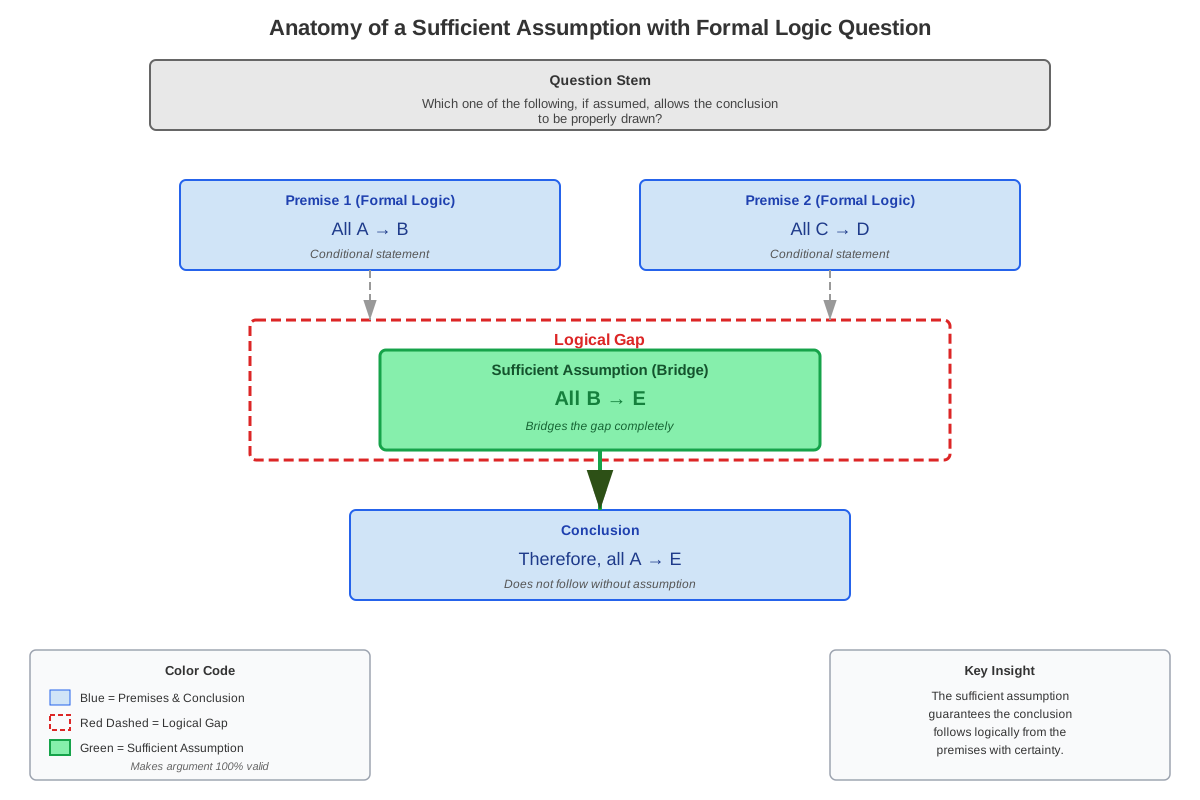
On the LSAT, these questions commonly appear with question stems like "Which one of the following, if assumed, allows the conclusion to be properly drawn?" or "The conclusion follows logically if which one of the following is assumed?" The arguments typically present formal logical statements in the premises (often using categorical language or conditional structures) and reach a conclusion that introduces new terms or makes a logical leap. The correct answer creates an airtight logical bridge, often by linking terms that appear in the conclusion but not the premises, or by completing a chain of conditional reasoning.
Core Concepts
The Nature of Sufficient Assumptions
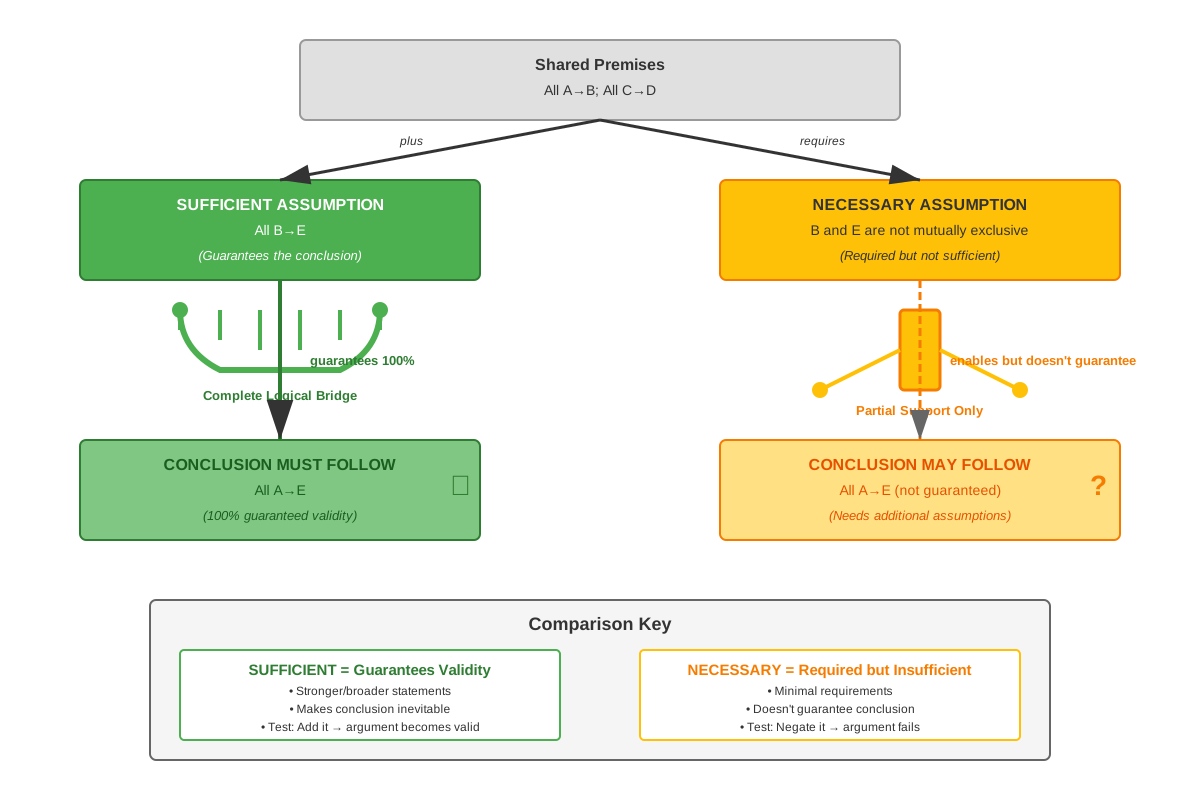
A sufficient assumption is a statement that, when added to an argument's existing premises, guarantees the truth of the conclusion. Unlike necessary assumptions (which must be true for the argument to work but might not be enough alone), sufficient assumptions provide everything needed to make the argument logically valid. Think of sufficient assumptions as "overkill"—they may provide more than the minimum required, but they definitively close all logical gaps.
In formal logic contexts, sufficient assumptions typically work by creating logical connections between terms or completing conditional chains. The argument presents premises that establish certain relationships, then jumps to a conclusion involving terms or relationships not fully established by those premises. The sufficient assumption supplies the missing link with mathematical precision.
Formal Logic Structures in LSAT Arguments
Formal logic on the LSAT involves arguments that can be represented using symbolic notation and follow strict logical rules. The most common structures include:
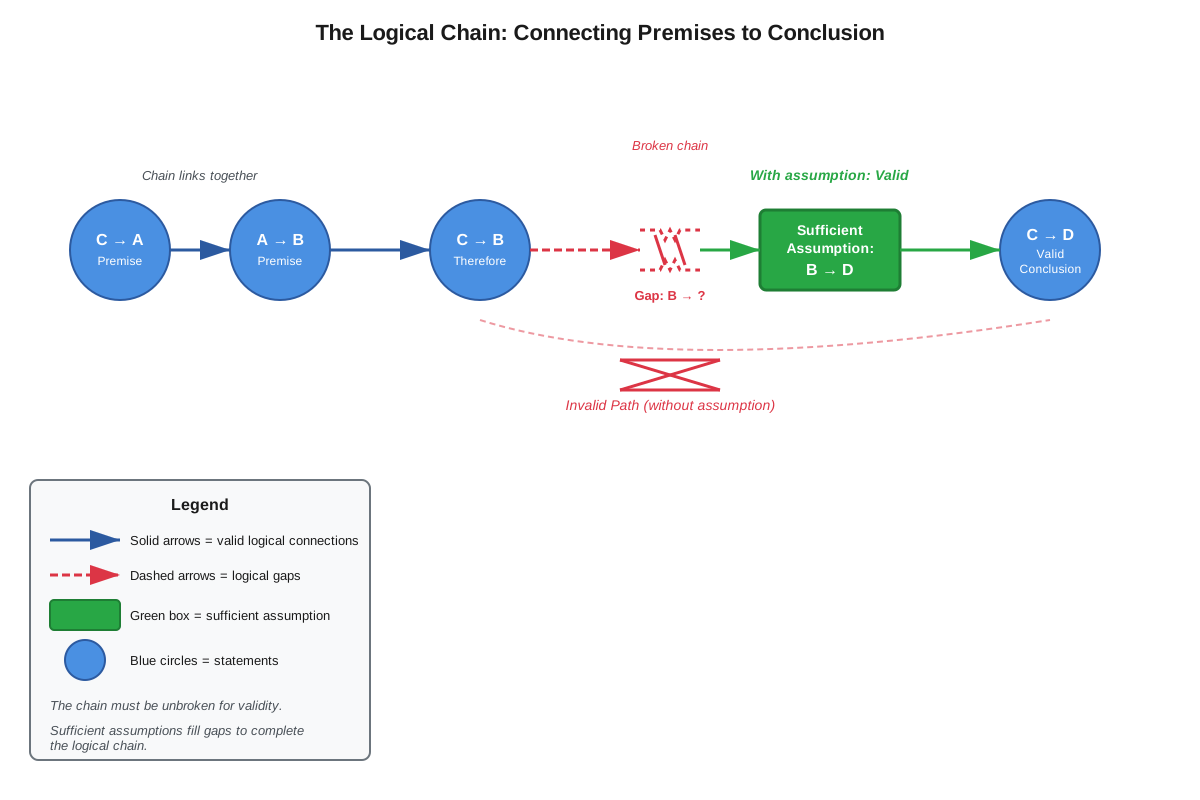
Conditional Statements: These take the form "If A, then B" (symbolized as A → B). The sufficient condition (A) guarantees the necessary condition (B). Arguments often chain these conditionals together, requiring assumptions that complete the chain.
Categorical Statements: These include universal claims ("All X are Y"), particular claims ("Some X are Y"), and negative claims ("No X are Y"). Sufficient assumptions often need to bridge categorical gaps, such as connecting two categories mentioned separately in premises and conclusion.
Contrapositive Relationships: Every conditional statement has a logically equivalent contrapositive (A → B is equivalent to ~B → ~A). Recognizing when arguments rely on contrapositive reasoning helps identify what assumptions are needed.
Identifying the Logical Gap
The critical skill in sufficient assumption questions is pinpointing exactly what's missing between premises and conclusion. This gap typically manifests in three ways:
- Term Shift: The conclusion introduces a term not present in the premises, or connects two terms never linked in the premises. For example, premises discuss "effective policies" while the conclusion references "popular policies"—the gap involves the relationship between effectiveness and popularity.
- Incomplete Conditional Chain: The premises establish A → B and the conclusion claims A → C, but no premise connects B to C. The sufficient assumption must provide B → C to complete the chain.
- Categorical Bridge: The premises make claims about one category while the conclusion makes claims about a different category, requiring an assumption that relates these categories.
The Mechanistic Approach to Solving
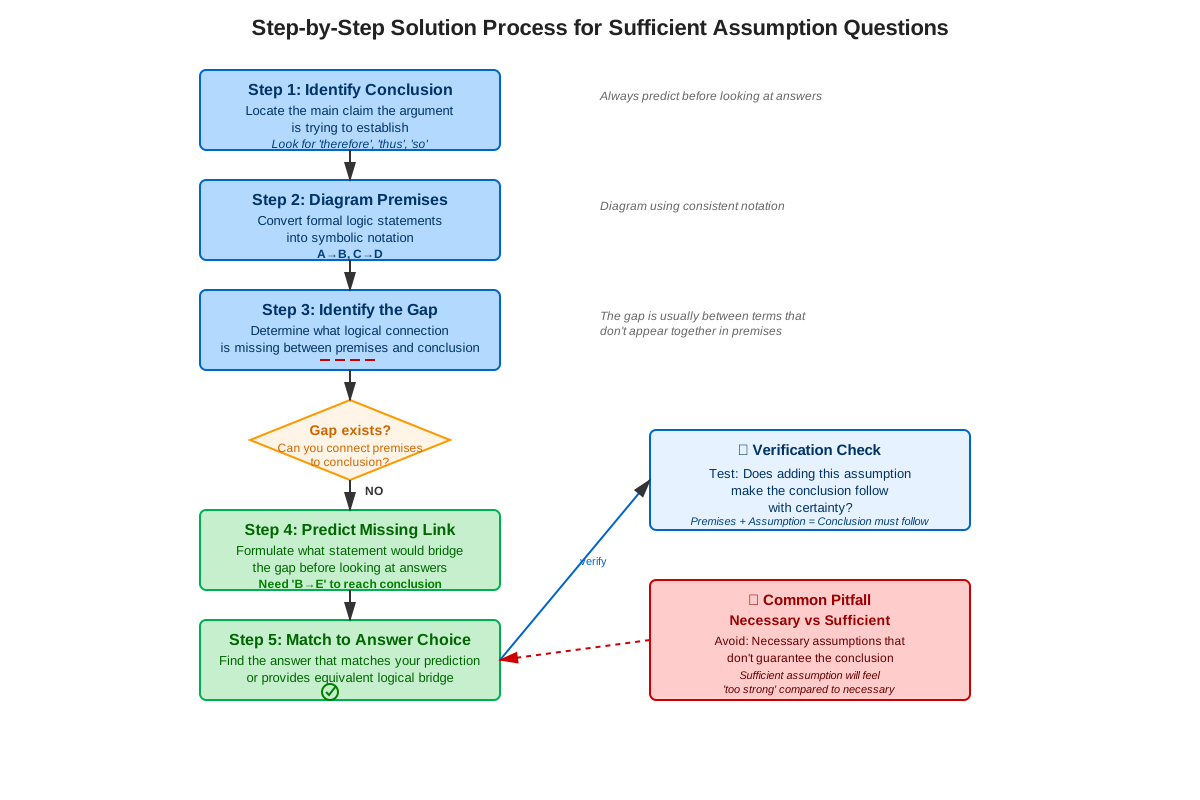
Successful test-takers employ a systematic process:
Step 1: Identify the Conclusion - Locate what the argument is trying to prove, often signaled by conclusion indicators like "therefore," "thus," or "consequently."
Step 2: Diagram the Formal Logic - Convert conditional and categorical statements into symbolic notation. Use arrows for conditionals, and clearly mark what terms appear where.
Step 3: Locate the Gap - Compare the conclusion's logical structure to what the premises establish. Identify new terms, missing links in conditional chains, or categorical jumps.
Step 4: Predict the Answer - Before looking at choices, articulate what statement would bridge the gap. This prediction prevents distraction from attractive wrong answers.
Step 5: Match and Verify - Find the answer choice matching your prediction, then verify it by adding it to the premises and confirming the conclusion now follows necessarily.
Common Formal Logic Patterns
| Pattern Type | Premise Structure | Conclusion Structure | Required Assumption |
|---|---|---|---|
| Chain Completion | A → B | A → C | B → C |
| Contrapositive Gap | A → B | ~C → ~A | B → C |
| Categorical Bridge | All X are Y | All Z are Y | All Z are X (or overlap claim) |
| Term Introduction | Discusses concept A | Claims about concept B | A and B relationship |
| Reversed Logic | If A, then B | If B, then A | Biconditional or separate B → A |
The Sufficiency Test
To verify an answer choice is truly sufficient, apply this test: Add the answer choice to the premises as if it were an additional premise, then determine whether the conclusion must be true. If any doubt remains about the conclusion's validity, the assumption is not sufficient. The correct answer will make the argument airtight—no exceptions, no additional information needed.
Concept Relationships
The concepts within sufficient assumption questions with formal logic form an interconnected system. Formal logic structures (conditionals and categoricals) provide the framework within which arguments operate. These structures create the possibility for logical gaps when premises don't fully connect to conclusions. Identifying the gap requires understanding both the formal logic structure and the specific term shifts or incomplete chains present in the argument. Once the gap is identified, the mechanistic approach guides test-takers through predicting the answer and applying the sufficiency test.
This topic connects to prerequisite knowledge of conditional logic by applying those foundational rules to argument analysis. The contrapositive relationships learned in basic conditional logic become tools for recognizing what assumptions complete logical chains. Understanding of necessary assumptions provides contrast—necessary assumptions ask "what must be true?" while sufficient assumptions ask "what would guarantee the conclusion?"
The relationship map flows as follows: Conditional Logic Fundamentals → enables recognition of → Formal Logic Structures in Arguments → which contain → Logical Gaps → identified through → Systematic Analysis → leading to → Predicted Sufficient Assumptions → verified by → Sufficiency Test → resulting in → Correct Answer Selection.
Sufficient assumption questions with formal logic also connect forward to strengthen questions (where the correct answer makes the conclusion more likely but not certain) and parallel reasoning questions (where recognizing logical structure helps match argument patterns). Mastery here builds the analytical precision needed throughout Logical Reasoning.
High-Yield Facts
⭐ Sufficient assumptions make the conclusion follow with absolute certainty, not just make it more likely or plausible.
⭐ The correct answer often connects a term in the conclusion to a term in the premises that were never previously linked.
⭐ When premises form a conditional chain with a gap (A → B and C → D, with conclusion A → D), the sufficient assumption completes the chain (B → C).
⭐ Sufficient assumptions can be "overkill"—they may establish more than minimally necessary, which distinguishes them from necessary assumptions.
⭐ If the conclusion introduces a new term not mentioned in any premise, the sufficient assumption must connect that new term to something in the premises.
- Contrapositive relationships are logically equivalent to their original conditionals, so an assumption might work by establishing a contrapositive connection.
- Categorical statements using "all" create one-directional relationships that may require assumptions to reverse or complete the logical direction.
- Wrong answers in sufficient assumption questions often provide necessary but not sufficient conditions, or address irrelevant aspects of the argument.
- The formal logic in these questions can usually be diagrammed symbolically, and doing so reveals the gap more clearly than reading alone.
- Sufficient assumption questions never require outside knowledge—the correct answer always follows from pure logical structure.
- When an argument moves from a conditional statement to a categorical conclusion (or vice versa), the assumption must bridge this logical type-shift.
- Multiple conditional statements in premises often signal a chain-completion pattern where the assumption links the chain's middle.
Quick check — test yourself on Sufficient assumption with formal logic so far.
Try Flashcards →Common Misconceptions
Misconception: Sufficient assumptions must be realistic or plausible in the real world. → Correction: Sufficient assumptions only need to be logically adequate to guarantee the conclusion. The LSAT tests logical sufficiency, not real-world plausibility. An assumption can be extreme, unlikely, or even absurd in reality while still being logically sufficient.
Misconception: The correct answer will always be the shortest or simplest statement. → Correction: Sufficient assumptions often need to be comprehensive enough to close all logical gaps, which may require complex or lengthy statements. The correct answer is determined by logical completeness, not brevity.
Misconception: If an assumption makes the argument stronger, it's the correct answer. → Correction: Sufficient assumption questions require an assumption that makes the conclusion certain, not merely stronger. An answer that improves the argument without guaranteeing the conclusion is incorrect, even though it might be correct for a strengthen question.
Misconception: The assumption must be something the author believes or intends. → Correction: Sufficient assumption questions ask what would make the conclusion follow logically, regardless of what the author actually believes. The correct answer is determined by logical structure, not authorial intent.
Misconception: Necessary and sufficient assumptions are interchangeable terms. → Correction: These are distinct logical concepts. A necessary assumption must be true for the argument to work but might not be enough alone. A sufficient assumption guarantees the conclusion but might include more than minimally necessary. Some assumptions can be both necessary and sufficient, but many are one or the other.
Misconception: The correct answer will always use the exact same terms as the premises and conclusion. → Correction: While the correct answer must connect to the argument's terms, it may use synonyms, broader categories, or related concepts. The logical relationship matters more than exact word matching.
Misconception: If you can think of a counterexample to the conclusion even with the assumption added, it's wrong. → Correction: The assumption only needs to make the conclusion follow from the premises as stated. If your counterexample requires changing or denying a premise, it doesn't invalidate the assumption's sufficiency.
Worked Examples
Example 1: Conditional Chain Completion
Argument: "All effective teachers are patient. Maria is an inspiring educator. Therefore, Maria is patient."
Analysis:
Step 1 - Identify the conclusion: "Maria is patient"
Step 2 - Diagram the formal logic:
- Premise: Effective teacher → Patient
- Premise: Maria is an inspiring educator
- Conclusion: Maria is patient
Step 3 - Locate the gap: The premises establish that effective teachers are patient, and that Maria is an inspiring educator. However, nothing connects "inspiring educator" to "effective teacher." To conclude Maria is patient, we need to establish that Maria is an effective teacher (which would trigger the conditional) or that inspiring educators are patient.
Step 4 - Predict the answer: We need either "All inspiring educators are effective teachers" or "All inspiring educators are patient." The first option creates a chain (Inspiring educator → Effective teacher → Patient), while the second directly establishes the conclusion.
Step 5 - Evaluate options:
- (A) "All inspiring educators are effective teachers" - This works! If Maria is an inspiring educator, and all inspiring educators are effective teachers, then Maria is an effective teacher. Since all effective teachers are patient, Maria must be patient. This is sufficient.
- (B) "Some effective teachers are inspiring educators" - This doesn't help. "Some" statements don't allow us to conclude anything definite about Maria specifically.
- (C) "Maria is patient with her students" - This might seem to give us the conclusion, but it doesn't connect to the premises logically. It's just restating the conclusion without showing why it follows from the premises.
- (D) "All patient people are inspiring educators" - This reverses the logic we need. We need to get from inspiring educator to patient, not from patient to inspiring educator.
Correct Answer: (A) - It completes the conditional chain, making the conclusion follow necessarily from the premises.
Example 2: Term Bridge with Categorical Logic
Argument: "No policies that harm economic growth should be implemented. The proposed regulation would significantly reduce industrial efficiency. Thus, the proposed regulation should not be implemented."
Analysis:
Step 1 - Identify the conclusion: "The proposed regulation should not be implemented"
Step 2 - Diagram the formal logic:
- Premise: Harm economic growth → Should NOT be implemented (or contrapositive: Should be implemented → Does NOT harm economic growth)
- Premise: Proposed regulation → Reduces industrial efficiency
- Conclusion: Proposed regulation → Should NOT be implemented
Step 3 - Locate the gap: The premises connect "harming economic growth" to "should not be implemented," and separately state that the regulation "reduces industrial efficiency." The conclusion claims the regulation should not be implemented. The gap is the connection between "reducing industrial efficiency" and "harming economic growth." These terms are never linked in the premises.
Step 4 - Predict the answer: We need something like "Anything that reduces industrial efficiency harms economic growth" or "Reducing industrial efficiency harms economic growth." This would create the chain: Proposed regulation → Reduces efficiency → Harms economic growth → Should not be implemented.
Step 5 - Evaluate options:
- (A) "Industrial efficiency is important for businesses" - This is too vague and doesn't establish the necessary connection to economic growth or implementation decisions.
- (B) "All policies that reduce industrial efficiency harm economic growth" - Perfect! This bridges the gap. If the regulation reduces industrial efficiency, and all such policies harm economic growth, then the regulation harms economic growth. Since policies that harm economic growth should not be implemented, the regulation should not be implemented.
- (C) "Economic growth is the most important policy consideration" - This doesn't establish the logical connection we need. Even if economic growth is most important, we still need to know that reducing efficiency harms it.
- (D) "The proposed regulation has no benefits that outweigh its costs" - This introduces new considerations (benefits and costs) not present in the logical structure of the argument.
Correct Answer: (B) - It provides the categorical bridge between the two key terms, making the conclusion logically necessary.
Exam Strategy
When approaching lsat sufficient assumption with formal logic questions, begin by reading the question stem first to confirm you're dealing with a sufficient assumption question. Look for phrases like "allows the conclusion to be properly drawn," "enables the conclusion to follow logically," or "if assumed, establishes the conclusion." These phrases signal that you need an answer providing complete logical sufficiency.
Trigger words and phrases to watch for in the argument include:
- Conditional indicators: "if," "when," "whenever," "only if," "unless," "provided that"
- Categorical indicators: "all," "every," "any," "each," "no," "none"
- Conclusion indicators: "therefore," "thus," "hence," "consequently," "it follows that"
- Premise indicators: "because," "since," "given that," "for"
As you read the argument, actively diagram formal logic statements. Use simple notation (arrows for conditionals, shorthand for categories) to visualize the logical structure. This external representation prevents mental errors and makes gaps obvious. When you spot a term in the conclusion that doesn't appear in the premises, or notice an incomplete conditional chain, you've found your gap.
Process-of-elimination strategy:
- Eliminate answers that introduce completely new concepts unrelated to the argument's logical structure
- Eliminate answers that provide necessary but not sufficient conditions (they help but don't guarantee)
- Eliminate answers that strengthen the argument without making it airtight
- Eliminate answers that reverse the needed logical direction
- Test remaining answers by adding them to premises and checking if the conclusion must follow
Time allocation: Spend 30-45 seconds reading and diagramming the argument, 15-20 seconds predicting the answer, and 30-45 seconds evaluating choices. If you've correctly identified the gap and predicted the answer, you should recognize the correct choice quickly. If you find yourself spending over 90 seconds total, make your best guess and move on—these questions reward pattern recognition that develops with practice.
Exam Tip: The correct answer will often feel "too strong" or "too broad" compared to wrong answers. This is because sufficient assumptions need to guarantee the conclusion, which requires comprehensive statements. Don't shy away from strong answer choices in sufficient assumption questions.
Memory Techniques
BRIDGE Acronym for the systematic approach:
- Break down the argument (identify conclusion and premises)
- Represent formally (diagram the logic)
- Identify the gap (find missing connections)
- Determine what's needed (predict the assumption)
- Guarantee test (verify sufficiency)
- Eliminate and select (choose the answer)
Visualization Strategy: Picture the argument as a bridge with the premises on one side and the conclusion on the other. The gap is the missing section of bridge. The sufficient assumption is a complete bridge span that allows you to walk from premises to conclusion without any leaps or gaps. Wrong answers are either incomplete spans, spans connecting the wrong points, or decorative elements that don't actually bridge the gap.
The Chain Mnemonic: For conditional chain problems, remember "Complete Chains Connect Conclusions" - if you see multiple conditionals, you're likely looking for the link that completes the chain from the first premise to the conclusion.
Term Tracking: Use the mnemonic "New Terms Need Ties" - when a New Term appears in the conclusion, it Needs a Tie back to the premises. The sufficient assumption provides that tie.
Summary
Sufficient assumption questions with formal logic test the ability to identify and fill logical gaps in arguments containing conditional statements, categorical claims, and other formal logical structures. These questions require recognizing that a sufficient assumption makes the conclusion follow with absolute certainty—not merely making it more plausible or likely. Success depends on systematically diagramming the argument's formal logic, identifying exactly what connection is missing between premises and conclusion, predicting what statement would bridge that gap, and verifying that the chosen answer makes the argument logically airtight. The most common patterns involve completing conditional chains, bridging term shifts between premises and conclusion, and connecting categorical statements. Unlike necessary assumptions that ask for minimum requirements, sufficient assumptions may be "overkill," providing more than minimally necessary to guarantee the conclusion. These questions appear consistently on every LSAT and reward methodical analysis over intuitive reading, making them among the most learnable and high-yield question types for score improvement.
Key Takeaways
- Sufficient assumptions guarantee the conclusion with certainty, distinguishing them from necessary assumptions that merely must be true for the argument to work
- Formal logic structures (conditionals and categoricals) can be diagrammed symbolically to reveal logical gaps more clearly than reading alone
- The correct answer typically bridges a term shift or completes a conditional chain between premises and conclusion
- Predicting the answer before reviewing choices prevents distraction from attractive but insufficient wrong answers
- The sufficiency test—adding the assumption to premises and verifying the conclusion must follow—confirms the correct answer
- These questions appear 2-4 times per LSAT and follow predictable patterns that become increasingly recognizable with practice
- Strong or broad answer choices should not be eliminated in sufficient assumption questions, as guaranteeing conclusions often requires comprehensive statements
Related Topics
Necessary Assumption Questions: Understanding the contrast between necessary and sufficient assumptions deepens comprehension of both question types. Necessary assumptions ask for minimum requirements, while sufficient assumptions ask for guarantee conditions. Mastering sufficient assumptions makes necessary assumption questions easier by clarifying what "must be true" means versus what "would be enough."
Conditional Logic and Contrapositives: Advanced work with conditional chains, multiple conditionals, and contrapositive reasoning builds on the formal logic foundation established here. These skills enable faster diagramming and gap identification in complex arguments.
Strengthen and Weaken Questions: Sufficient assumption questions connect to strengthen questions, where the correct answer makes the conclusion more likely but not certain. Understanding the difference between "makes stronger" and "makes certain" prevents confusion between these question types.
Formal Logic Games: The diagramming and logical reasoning skills developed through sufficient assumption questions transfer directly to Logic Games, particularly those involving conditional rules and categorical relationships.
Practice CTA
Now that you understand the systematic approach to sufficient assumption questions with formal logic, it's time to apply these concepts to actual LSAT questions. Work through the practice questions methodically, diagramming each argument and predicting answers before reviewing choices. Use the flashcards to reinforce pattern recognition for common logical structures and gap types. Remember that these questions reward systematic analysis—each practice problem strengthens your ability to spot patterns and predict correct answers quickly. The investment in mastering this high-yield topic will pay dividends across your entire LSAT performance. Start practicing now to transform these questions from challenging puzzles into reliable score-boosters!
Sign up free to keep reading
Create a free AnvayaPrep account to finish this LSAT guide on Sufficient assumption with formal logic — plus flashcards and practice questions.