Overview
Causal evidence forms one of the most frequently tested concepts in LSAT Logical Reasoning sections, appearing in approximately 15-20% of all questions. Understanding how arguments establish, support, or challenge causal relationships is fundamental to success on the LSAT. When test-makers present arguments claiming that one phenomenon causes another, they expect students to recognize the type of evidence being used, evaluate its strength, and identify potential weaknesses in the causal reasoning.
The LSAT tests causal reasoning because legal thinking constantly involves questions of cause and effect: Did the defendant's actions cause the plaintiff's injury? What factors caused a particular legal precedent to develop? Will a proposed policy cause its intended effects? Mastering causation and explanation allows students to dissect arguments methodically, distinguish correlation from causation, and recognize when evidence genuinely supports a causal claim versus when it merely shows an association. This skill extends beyond identifying causal arguments to understanding what types of evidence strengthen or weaken them.
Within the broader framework of Logical Reasoning, causal evidence connects intimately with argument structure, assumption identification, and flaw recognition. Many strengthen/weaken questions, flaw questions, and assumption questions revolve around causal claims. Understanding causal evidence also prepares students for more complex topics like necessary and sufficient conditions, alternative explanations, and statistical reasoning—all of which frequently intersect with causal arguments on the LSAT.
Learning Objectives
- [ ] Identify how Causal evidence appears in LSAT questions
- [ ] Explain the reasoning pattern behind Causal evidence
- [ ] Apply Causal evidence to solve LSAT-style problems accurately
- [ ] Distinguish between different types of causal evidence and evaluate their relative strength
- [ ] Recognize common flaws in causal reasoning and predict answer choices that exploit these flaws
- [ ] Generate alternative explanations that challenge causal claims
- [ ] Assess whether given evidence is sufficient to establish a causal relationship versus mere correlation
Prerequisites
- Basic argument structure: Understanding premises and conclusions is essential because causal claims typically appear as conclusions supported by correlational or experimental evidence
- Correlation versus causation distinction: Recognizing that two events occurring together does not automatically mean one causes the other forms the foundation for evaluating causal evidence
- Conditional reasoning fundamentals: Causal relationships often get confused with conditional statements, so distinguishing "X causes Y" from "if X, then Y" prevents analytical errors
- Strengthen and weaken question types: Most causal evidence questions ask students to strengthen or weaken causal arguments, requiring familiarity with these question formats
Why This Topic Matters
Causal reasoning pervades legal analysis, making it a natural focus for the LSAT. Attorneys must constantly evaluate whether evidence supports causal claims: in tort law, establishing that a defendant's negligence caused harm; in contract law, determining whether a breach caused damages; in criminal law, proving that an action caused a prohibited result. The ability to assess causal evidence critically distinguishes strong legal reasoning from weak speculation.
On the LSAT, causal evidence appears most frequently in:
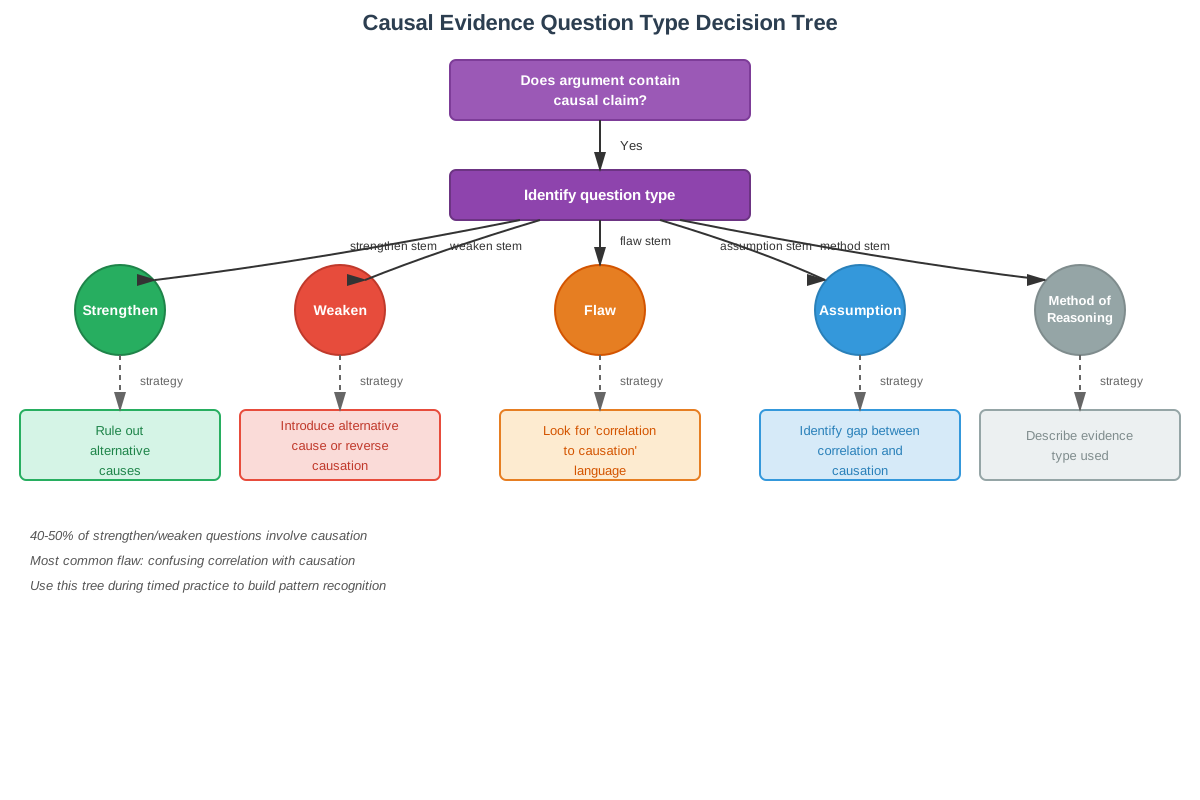
- Strengthen/Weaken questions (40-50% of these involve causal reasoning)
- Flaw questions (approximately 25% identify causal reasoning errors)
- Assumption questions (many causal arguments depend on unstated assumptions about alternative causes)
- Paradox/Resolve questions (often require identifying causal mechanisms)
- Method of Reasoning questions (may ask students to describe how causal evidence functions)
Test statistics show that students who master causal reasoning improve their Logical Reasoning scores by an average of 3-5 points. The predictability of causal reasoning patterns makes this a high-yield study area—once students internalize the common evidence types and vulnerabilities, they can quickly identify correct answers even under time pressure. Missing causal reasoning questions represents a significant opportunity cost because these questions follow recognizable patterns that, once learned, become consistently answerable.
Core Concepts
What Constitutes Causal Evidence
Causal evidence refers to information presented to support the claim that one phenomenon (the cause) brings about another phenomenon (the effect). On the LSAT causal evidence questions, arguments typically move from observational data to causal conclusions. The evidence itself usually takes one of several forms: correlational data, temporal sequences, experimental results, or mechanistic explanations.
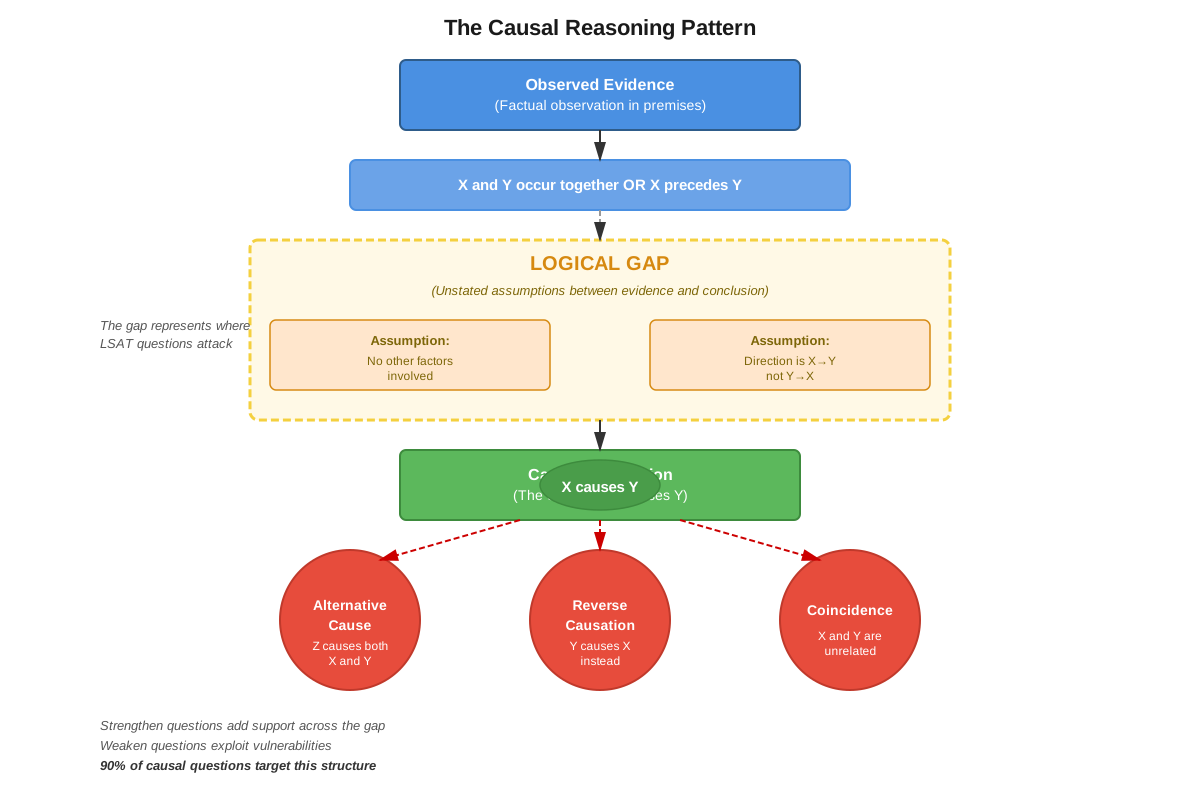
The fundamental structure of a causal argument follows this pattern:
- Evidence is presented (correlation, experiment, mechanism, etc.)
- A causal conclusion is drawn (X causes Y)
- The argument implicitly assumes no alternative explanations exist
Understanding this structure allows students to anticipate vulnerabilities and predict answer choices systematically.
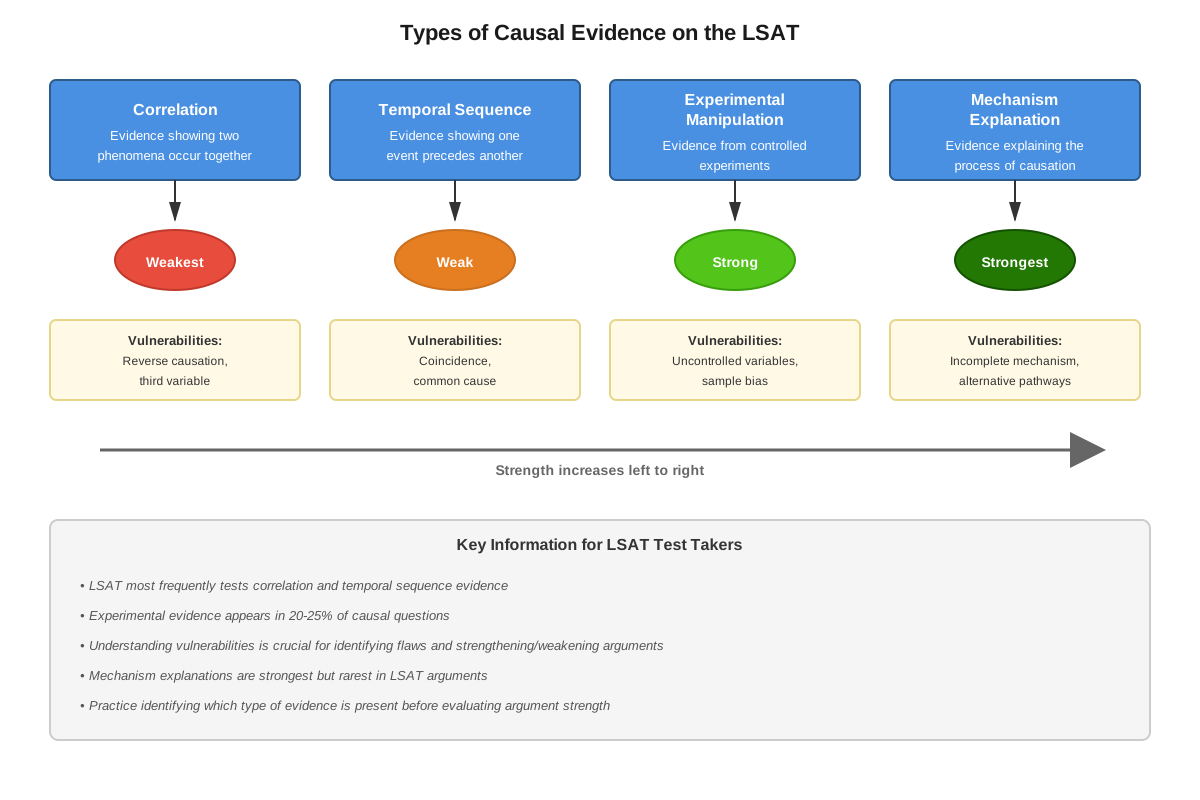
Types of Causal Evidence
Correlational Evidence
The most common type of causal evidence on the LSAT involves correlation—two phenomena occurring together with some regularity. For example: "Countries with higher chocolate consumption have more Nobel Prize winners per capita; therefore, eating chocolate causes increased cognitive ability leading to Nobel Prizes."
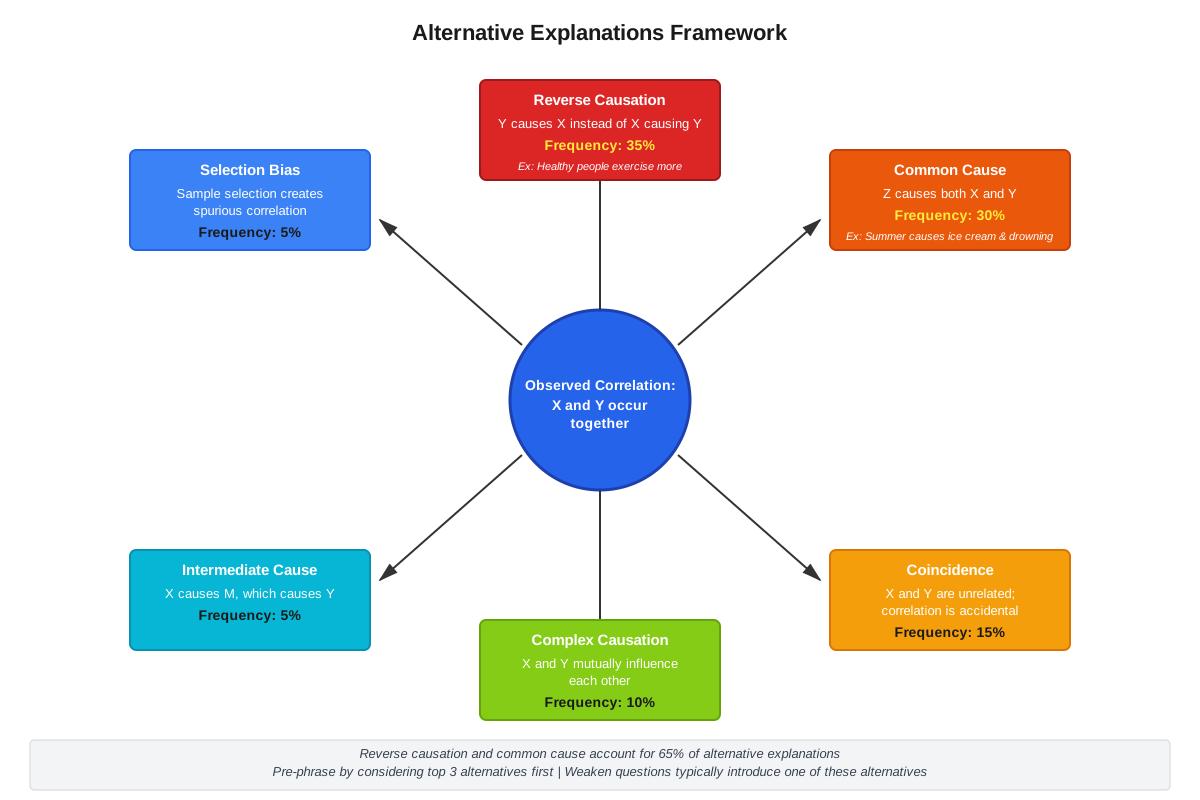
Correlational evidence is inherently weak for establishing causation because correlation can arise from:
- Causation in the claimed direction (X → Y)
- Reverse causation (Y → X)
- Common cause (Z → X and Z → Y)
- Coincidence (no causal relationship)
LSAT questions frequently exploit this weakness by presenting answer choices that introduce alternative explanations.
Temporal Sequence Evidence
Arguments sometimes cite temporal ordering as causal evidence: "Event X occurred before Event Y; therefore, X caused Y." While temporal priority is necessary for causation (causes must precede effects), it is not sufficient. The LSAT tests whether students recognize that "post hoc ergo propter hoc" (after this, therefore because of this) represents a logical fallacy.
Example: "After the new principal arrived, test scores improved; therefore, the new principal caused the improvement." This ignores that other factors might have changed simultaneously or that a pre-existing trend might have continued regardless of the principal's arrival.
Experimental Evidence
The strongest causal evidence involves controlled experiments where researchers manipulate one variable while holding others constant. LSAT arguments citing experimental evidence typically describe:
- A treatment group receiving the suspected cause
- A control group not receiving it
- A measured difference in outcomes
However, even experimental evidence has vulnerabilities that the LSAT exploits:
- Selection bias: Were groups truly comparable?
- Confounding variables: Were other factors truly controlled?
- Measurement issues: Were outcomes measured accurately?
- External validity: Do results generalize beyond the experimental setting?
Mechanistic Evidence
Some arguments provide a mechanism—an explanation of how the cause produces the effect. For example: "Caffeine blocks adenosine receptors in the brain, preventing drowsiness signals; therefore, caffeine causes increased alertness."
Mechanistic evidence strengthens causal claims by showing a plausible pathway from cause to effect. LSAT questions may ask students to identify answer choices that provide mechanisms or to recognize when a proposed mechanism has gaps.
Evaluating Causal Evidence Strength
| Evidence Type | Strength Level | Key Vulnerability | LSAT Exploitation |
|---|---|---|---|
| Simple correlation | Weak | Alternative explanations | Introduce reverse causation or common cause |
| Temporal sequence | Weak-Moderate | Post hoc fallacy | Show coincidental timing or pre-existing trends |
| Controlled experiment | Strong | Confounding variables | Identify uncontrolled factors or selection bias |
| Mechanism explanation | Moderate-Strong | Incomplete pathway | Reveal missing steps or blocking factors |
| Multiple converging lines | Very Strong | Individual line weaknesses | Attack the strongest individual line |
Common Causal Reasoning Patterns on the LSAT
The LSAT recycles several causal reasoning patterns:
- Correlation to causation leap: Evidence shows X and Y occur together; conclusion claims X causes Y
- Single study generalization: Evidence from one study or context; conclusion applies broadly
- Ignoring alternative causes: Evidence consistent with X causing Y; conclusion assumes no other explanation
- Confusing necessary and sufficient causes: Evidence shows X necessary for Y; conclusion treats X as sufficient
- Reverse causation oversight: Evidence compatible with Y causing X; argument assumes X causes Y
Strengthening Causal Arguments
Answer choices strengthen causal arguments by:
- Eliminating alternative explanations: "No other factor changed during the relevant period"
- Establishing temporal priority: "X always preceded Y in all observed cases"
- Showing dose-response relationships: "Greater amounts of X correlate with stronger Y effects"
- Demonstrating mechanism: "X operates through pathway Z to produce Y"
- Ruling out reverse causation: "Y cannot influence X due to temporal or physical constraints"
- Providing experimental confirmation: "Controlled studies show X manipulation changes Y"
Weakening Causal Arguments
Answer choices weaken causal arguments by:
- Introducing alternative causes: "Factor Z also changed and could explain Y"
- Suggesting reverse causation: "Y might actually cause X instead"
- Identifying common causes: "Factor Z causes both X and Y"
- Showing correlation without causation: "X and Y occur together but neither causes the other"
- Revealing confounding variables: "Groups differed in ways beyond X"
- Demonstrating mechanism impossibility: "X cannot physically affect Y"
Concept Relationships
The concepts within causal evidence form a hierarchical structure:
Causal Claims (top level) → require → Causal Evidence (supporting level) → which comes in types → Correlational, Temporal, Experimental, Mechanistic (evidence types) → each vulnerable to → Alternative Explanations (challenges) → specifically → Reverse Causation, Common Cause, Coincidence, Confounding Variables
This topic connects to prerequisite knowledge:
- Argument structure provides the framework for identifying where causal claims appear (typically as conclusions)
- Correlation vs. causation represents the foundational distinction that causal evidence questions exploit
- Conditional reasoning helps students avoid confusing "if X then Y" with "X causes Y"
Causal evidence also connects forward to advanced topics:
- Necessary and sufficient conditions (causes can be necessary, sufficient, both, or neither)
- Statistical reasoning (many causal arguments rely on statistical evidence)
- Scientific reasoning (experimental design principles apply to evaluating causal evidence)
- Alternative explanations (a dedicated topic that expands on challenging causal claims)
The relationship map: Correlation observed → Causal hypothesis proposed → Evidence evaluated → Alternative explanations considered → Causal conclusion accepted or rejected
High-Yield Facts
⭐ Correlation does not establish causation—the most fundamental principle; correlation can result from X causing Y, Y causing X, a common cause Z, or coincidence
⭐ Temporal priority is necessary but not sufficient for causation—causes must precede effects, but "after" does not mean "because of"
⭐ Alternative explanations are the primary weakness in causal arguments—most wrong answers in strengthen questions eliminate alternatives; most correct answers in weaken questions introduce alternatives
⭐ Controlled experiments provide stronger causal evidence than observational correlations—manipulation of variables while controlling others supports causal inference
⭐ Reverse causation is a specific type of alternative explanation—the effect might actually cause what the argument claims is the cause
- Dose-response relationships strengthen causal claims—if more of the cause produces more of the effect, causation becomes more plausible
- Mechanisms explain how causes produce effects—providing a mechanism strengthens causal arguments
- Confounding variables are factors that correlate with both the proposed cause and the effect—they create spurious correlations
- Common cause scenarios involve a third factor causing both the proposed cause and the effect—this explains correlation without direct causation
- Selection bias occurs when compared groups differ in ways beyond the proposed cause—this undermines experimental evidence
Quick check — test yourself on Causal evidence so far.
Try Flashcards →Common Misconceptions
Misconception: If X always occurs before Y, then X must cause Y.
Correction: Temporal sequence is necessary for causation but not sufficient. Night always precedes day, but night does not cause day. The LSAT frequently presents arguments that assume temporal priority establishes causation, and correct answers often exploit this flaw by showing that the temporal sequence could be coincidental or explained by other factors.
Misconception: Strong correlation means strong causation.
Correction: Correlation strength (how closely X and Y track together) does not determine whether a causal relationship exists. Ice cream sales and drowning deaths correlate strongly, but ice cream does not cause drowning—both are caused by warm weather. The LSAT tests whether students can distinguish correlation strength from causal validity.
Misconception: If eliminating X eliminates Y, then X causes Y.
Correction: This reasoning confuses necessary conditions with sufficient causes. X might be necessary for Y without being the cause. Oxygen is necessary for fires, but we do not say oxygen causes fires—we identify the spark or heat source as the cause. LSAT questions may present evidence that X is necessary for Y and ask whether this establishes that X causes Y.
Misconception: Experimental evidence always establishes causation definitively.
Correction: Even controlled experiments can have flaws: selection bias, confounding variables, measurement errors, or limited generalizability. The LSAT presents experimental evidence and asks students to identify remaining vulnerabilities or to recognize what additional information would strengthen the causal claim.
Misconception: If no alternative explanation is mentioned, none exists.
Correction: Arguments on the LSAT routinely fail to consider alternative explanations—this represents a common flaw. Students must actively generate possible alternatives even when the argument does not mention them. Many assumption questions ask students to identify what the argument assumes (that no alternative explanation exists), and many weaken questions provide alternative explanations.
Misconception: Providing a mechanism proves causation.
Correction: A plausible mechanism strengthens a causal claim but does not prove it. The mechanism itself might be incorrect, or other factors might prevent the mechanism from operating in practice. For example, an argument might explain how a drug should work biochemically, but clinical trials might show it does not actually produce the predicted effect in patients.
Worked Examples
Example 1: Identifying and Evaluating Causal Evidence
Argument: "A recent study found that people who drink green tea daily have lower rates of heart disease than those who do not drink green tea. Therefore, drinking green tea prevents heart disease."
Analysis:
Step 1: Identify the causal claim
The conclusion is "drinking green tea prevents heart disease"—a clear causal claim where green tea consumption (cause) leads to reduced heart disease (effect).
Step 2: Identify the evidence type
The evidence is correlational: green tea drinkers have lower heart disease rates. This is observational data, not experimental manipulation.
Step 3: Evaluate evidence strength
Correlational evidence is weak for establishing causation. The argument leaps from correlation to causation without ruling out alternatives.
Step 4: Generate alternative explanations
- Reverse causation: People with heart disease might avoid green tea (unlikely but possible)
- Common cause: Health-conscious people might both drink green tea AND engage in other heart-healthy behaviors (exercise, diet)
- Confounding variables: Green tea drinkers might differ from non-drinkers in income, education, or access to healthcare
- Selection bias: The study might have sampled from populations that differ in multiple ways
Step 5: Predict question types and answers
If this is a weaken question, correct answers might:
- Introduce a common cause: "People who drink green tea also exercise significantly more than those who do not"
- Identify a confounding variable: "Green tea drinkers in the study had higher incomes and better access to healthcare"
- Suggest reverse causation: "People diagnosed with heart disease often avoid caffeinated beverages including green tea"
If this is a strengthen question, correct answers might:
- Eliminate alternatives: "The study controlled for exercise, diet, income, and other health behaviors"
- Provide mechanism: "Green tea contains antioxidants that reduce arterial inflammation"
- Show dose-response: "People who drink more green tea have progressively lower heart disease rates"
If this is an assumption question, correct answers might:
- "No other factor that differs between green tea drinkers and non-drinkers explains the heart disease rate difference"
- "Green tea consumption preceded the lower heart disease rates rather than vice versa"
Connection to learning objectives: This example demonstrates how to identify causal evidence (correlational data), explain the reasoning pattern (correlation to causation leap), and apply this understanding to predict answer choices across multiple question types.
Example 2: Experimental Evidence with Vulnerabilities
Argument: "Researchers divided 100 volunteers into two groups. One group took a new memory supplement daily for six months, while the other group took nothing. At the end of the study, the supplement group scored 15% higher on memory tests. This proves the supplement improves memory."
Analysis:
Step 1: Identify the causal claim
The conclusion is "the supplement improves memory"—the supplement (cause) produces better memory test performance (effect).
Step 2: Identify the evidence type
This is experimental evidence: researchers manipulated the independent variable (supplement vs. no supplement) and measured the dependent variable (memory test scores). This is stronger than mere correlation.
Step 3: Evaluate evidence strength
Experimental evidence is generally strong, but this particular experiment has vulnerabilities:
- No placebo control: The control group took "nothing" rather than a placebo, so the effect might result from expectation/placebo effect rather than the supplement itself
- Possible selection bias: How were volunteers assigned to groups? Random assignment is not mentioned
- Confounding variables: Did groups differ in other ways? Did they know which group they were in?
- Measurement issues: Who administered the memory tests? Were they blind to group assignment?
Step 4: Generate specific vulnerabilities
The most significant flaw is the lack of a placebo control. The supplement group knew they were taking something intended to improve memory, which could create expectation effects. The control group knew they were taking nothing, which might reduce motivation or create negative expectations.
Step 5: Predict question types and answers
If this is a flaw question, the correct answer might:
- "The argument fails to consider that the improvement might result from participants' expectations rather than the supplement's chemical effects"
- "The argument overlooks the possibility that knowing one is receiving treatment affects performance"
If this is a strengthen question, correct answers might:
- "Neither the participants nor the test administrators knew who received the supplement"
- "The control group received placebo pills identical in appearance to the supplement"
- "Participants who took the supplement showed measurable changes in brain chemistry associated with memory formation"
If this is a weaken question, correct answers might:
- "Participants who believed they were receiving the supplement but actually received a placebo showed similar improvements"
- "The supplement group had higher average education levels than the control group"
- "Many participants in the supplement group also began using other memory-enhancement techniques during the study"
Connection to learning objectives: This example shows how to identify experimental causal evidence, recognize that even experiments can have flaws, and apply this understanding to predict how different question types will test these vulnerabilities.
Exam Strategy
Trigger Words and Phrases
When reading LSAT arguments, watch for causal language that signals causal reasoning:
- Direct causal claims: "causes," "produces," "brings about," "leads to," "results in," "is responsible for"
- Causal explanations: "because," "due to," "as a result of," "is explained by," "accounts for"
- Weaker causal language: "contributes to," "influences," "affects," "plays a role in"
- Correlation language that often precedes causal claims: "is associated with," "correlates with," "occurs together with," "is linked to"
Systematic Approach to Causal Evidence Questions
- Identify the causal claim (usually the conclusion): What is claimed to cause what?
- Identify the evidence type: Correlation? Temporal sequence? Experiment? Mechanism?
- Assess evidence strength: How strong is this evidence type for establishing causation?
- Generate alternative explanations (before looking at answer choices):
- Could reverse causation explain the evidence?
- Could a common cause explain both phenomena?
- What confounding variables might exist?
- Is the correlation possibly coincidental?
- Predict answer choice patterns:
- Strengthen: eliminates alternatives, provides mechanism, shows dose-response
- Weaken: introduces alternatives, suggests reverse causation, identifies confounds
- Assumption: states that alternatives do not exist
- Flaw: describes the logical gap between evidence and causal conclusion
Process of Elimination Tips
For Strengthen Questions:
- Eliminate answers that introduce new problems or alternative explanations
- Eliminate answers that address irrelevant aspects of the argument
- Keep answers that rule out specific alternative explanations you generated
- Keep answers that provide mechanisms or show dose-response relationships
For Weaken Questions:
- Eliminate answers that are consistent with the causal claim
- Eliminate answers that address irrelevant factors
- Keep answers that introduce plausible alternative explanations
- Keep answers that suggest reverse causation or common causes
For Assumption Questions:
- Eliminate answers that are already stated in the argument
- Eliminate answers that go beyond what the argument requires
- Keep answers that rule out alternative explanations
- Use the negation test: if negating the answer choice destroys the argument, it is a necessary assumption
Time Allocation
Causal reasoning questions typically require 1:15 to 1:30 to answer accurately:
- 20-30 seconds: Read and identify the causal claim
- 20-30 seconds: Identify evidence type and generate alternatives
- 20-30 seconds: Read and evaluate answer choices
- 10-15 seconds: Confirm and select
Do not rush the alternative explanation generation phase—investing 20-30 seconds to think of alternatives before reading answer choices dramatically improves accuracy and actually saves time by making answer choice evaluation faster and more confident.
Memory Techniques
The RACE Mnemonic for Alternative Explanations
When evaluating causal claims, remember RACE to generate the four main alternative explanations:
- Reverse causation: Could the effect actually cause the supposed cause?
- Alternative cause: Could a different factor cause the effect?
- Common cause: Could a third factor cause both phenomena?
- Error/coincidence: Could the correlation be spurious or coincidental?
The STEM Mnemonic for Strengthening Causal Arguments
Strong causal evidence follows STEM:
- Show mechanism: Explain how the cause produces the effect
- Temporal priority: Demonstrate the cause precedes the effect
- Eliminate alternatives: Rule out other possible explanations
- Measure dose-response: Show more cause produces more effect
Visualization Strategy
Picture causal arguments as a bridge:
- The cause is one side of the river
- The effect is the other side
- The evidence is the bridge connecting them
- Alternative explanations are other possible bridges or routes
Weak causal arguments have shaky bridges with many alternative routes. Strong causal arguments have solid bridges with no viable alternatives. When strengthening, you are reinforcing the bridge or blocking alternative routes. When weakening, you are revealing cracks in the bridge or showing alternative routes.
The Correlation Hierarchy
Remember this hierarchy from weakest to strongest evidence:
- Simple correlation (weakest)
- Temporal sequence
- Correlation + mechanism
- Controlled experiment
- Controlled experiment + mechanism (strongest)
Summary
Causal evidence represents one of the highest-yield topics in LSAT Logical Reasoning, appearing in 15-20% of questions across multiple question types. Success requires understanding that arguments typically present correlational, temporal, experimental, or mechanistic evidence to support causal conclusions, and that each evidence type has characteristic vulnerabilities. The fundamental principle is that correlation does not establish causation—alternative explanations including reverse causation, common causes, confounding variables, and coincidence can explain correlations without direct causal relationships. Strengthening causal arguments involves eliminating alternatives, providing mechanisms, or demonstrating dose-response relationships, while weakening them involves introducing alternatives or identifying confounds. Students must actively generate alternative explanations before evaluating answer choices, using systematic approaches like the RACE mnemonic. Mastering causal evidence patterns allows students to predict answer choices accurately and efficiently, converting these high-frequency questions into consistent points.
Key Takeaways
- Correlation never establishes causation alone—always consider alternative explanations including reverse causation, common causes, and confounding variables
- The four main alternative explanations (RACE) are reverse causation, alternative causes, common causes, and error/coincidence—generate these before reading answer choices
- Evidence strength hierarchy runs from simple correlation (weakest) through temporal sequence and mechanisms to controlled experiments (strongest)
- Strengthen answers eliminate alternatives or provide mechanisms; weaken answers introduce alternatives or identify confounds
- Temporal priority is necessary but not sufficient—causes must precede effects, but "after" does not mean "because of"
- Experimental evidence is stronger than correlational evidence but remains vulnerable to selection bias, confounding variables, and placebo effects
- Active alternative generation before reading answer choices dramatically improves accuracy and efficiency on causal reasoning questions
Related Topics
Necessary and Sufficient Conditions: Understanding the distinction between necessary and sufficient conditions helps clarify causal relationships, as causes can be necessary (required for the effect), sufficient (enough to produce the effect), both, or neither. Mastering causal evidence provides the foundation for analyzing these more nuanced relationships.
Flaw Question Types: Many flaw questions specifically test causal reasoning errors, including correlation-causation confusion, post hoc reasoning, and failure to consider alternatives. Strong causal evidence skills directly translate to identifying these flaws.
Statistical Reasoning: Causal arguments frequently rely on statistical evidence, including sample sizes, study designs, and data interpretation. Understanding causal evidence prepares students to evaluate whether statistical evidence supports causal conclusions.
Scientific Method and Experimental Design: Advanced LSAT questions may test understanding of control groups, randomization, blinding, and other experimental design principles. Causal evidence mastery provides the conceptual foundation for these more technical topics.
Alternative Explanations: This dedicated topic expands on generating and evaluating alternative explanations for observed phenomena, building directly on the causal evidence framework.
Practice CTA
Now that you have mastered the core concepts of causal evidence, it is time to apply this knowledge to actual LSAT questions. Complete the practice questions and flashcards for this topic, focusing on identifying causal claims, generating alternative explanations before reading answer choices, and predicting answer patterns based on question type. Remember that causal reasoning questions follow predictable patterns—consistent practice will transform these high-frequency questions into reliable points on test day. Each practice question you complete strengthens your pattern recognition and builds the confidence needed to approach causal evidence questions systematically and efficiently.
Sign up free to keep reading
Create a free AnvayaPrep account to finish this LSAT guide on Causal evidence — plus flashcards and practice questions.