Overview
Causal strengthener questions represent one of the most frequently tested patterns in LSAT Logical Reasoning sections. These questions assess a test-taker's ability to identify evidence that makes a causal claim more convincing or probable. In the context of causation and explanation, strengthening questions require students to recognize what additional information would bolster the argument that X causes Y, rather than merely correlating with Y or being caused by some alternative factor.
Understanding causal strengtheners is essential because the LSAT frequently presents arguments that conclude one phenomenon causes another based on limited evidence. The test-makers expect students to distinguish between correlation and causation, identify potential alternative explanations, and recognize what evidence would make the causal claim more defensible. This skill extends beyond simple memorization—it requires deep analytical thinking about the logical structure of causal arguments and the various ways they can be vulnerable to attack.
Mastery of lsat causal strengthener questions connects directly to other critical Logical Reasoning skills, including identifying assumptions, recognizing flaws in causal reasoning, and understanding how to weaken arguments. Students who excel at causal strengtheners typically perform well on assumption questions, necessary assumption questions, and sufficient assumption questions because all these question types require understanding the logical gaps in arguments. The ability to strengthen causal arguments also inversely relates to the ability to weaken them—understanding what makes a causal claim stronger automatically illuminates what would make it weaker.
Learning Objectives
- [ ] Identify how Causal strengthener appears in LSAT questions
- [ ] Explain the reasoning pattern behind Causal strengthener
- [ ] Apply Causal strengthener to solve LSAT-style problems accurately
- [ ] Distinguish between answer choices that strengthen causal claims versus those that merely provide additional information
- [ ] Recognize the five major categories of causal strengtheners and apply them to novel arguments
- [ ] Evaluate the relative strength of different strengthening answer choices
- [ ] Identify common trap answers in causal strengthener questions
Prerequisites
- Basic understanding of correlation versus causation: Essential for recognizing when an argument makes a causal leap from mere association between variables
- Familiarity with argument structure (premise, conclusion, assumption): Necessary to identify what the argument claims and what evidence it provides
- Knowledge of alternative explanations and confounding variables: Required to understand what vulnerabilities exist in causal arguments
- Experience with conditional reasoning: Helpful for understanding sufficient and necessary conditions in causal relationships
- Understanding of strengthen question stems: Needed to recognize when a question asks for strengthening versus other tasks
Why This Topic Matters
Causal strengthener questions appear with remarkable frequency on the LSAT, typically comprising 3-5 questions per Logical Reasoning section. This translates to approximately 6-10 questions per complete LSAT exam, making causal reasoning one of the highest-yield topics for test preparation. These questions appear in various forms, including "Which one of the following, if true, most strengthens the argument?" and "Which one of the following, if true, provides the most support for the conclusion?"
In real-world applications, the ability to evaluate causal claims is fundamental to legal reasoning. Attorneys must regularly assess whether evidence supports causal claims in tort cases (did the defendant's action cause the plaintiff's injury?), criminal cases (did the defendant's conduct cause the prohibited result?), and policy arguments (will this regulation cause the desired outcome?). Judges and lawyers constantly evaluate whether correlational evidence sufficiently establishes causation or whether alternative explanations remain plausible.
On the LSAT, causal strengthener questions commonly appear in arguments about scientific studies, policy recommendations, business decisions, and historical explanations. The test-makers favor scenarios where correlation is observed and causation is inferred, creating natural opportunities to test whether students can identify what would make the causal inference more justified. These questions also frequently appear in the more difficult questions (questions 15-25 in a section), making them particularly important for students aiming for top scores.
Core Concepts
The Structure of Causal Arguments
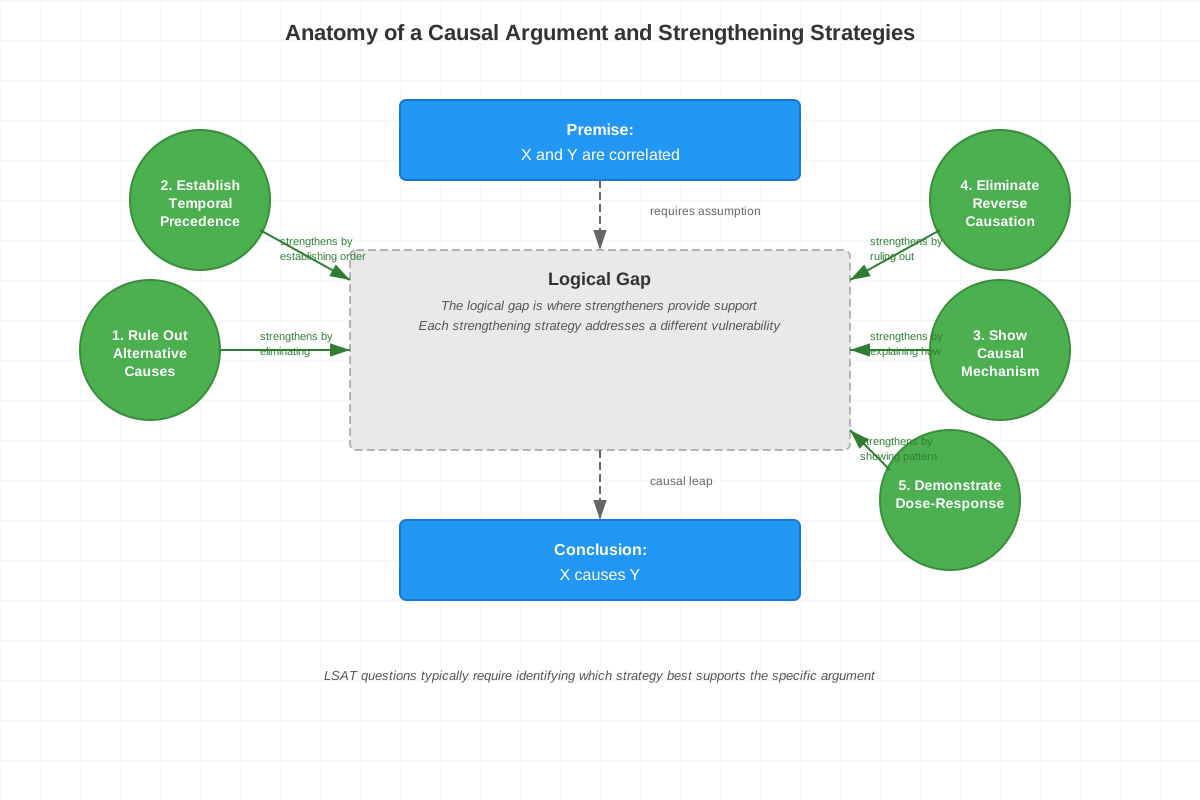
A causal argument on the LSAT typically follows this pattern: Evidence is presented showing that X and Y occur together or that Y follows X, and the conclusion asserts that X causes Y. The fundamental vulnerability in such arguments is that correlation does not establish causation. Multiple alternative explanations might account for the observed correlation: Y might cause X (reverse causation), Z might cause both X and Y (common cause), the correlation might be coincidental, or other confounding variables might be at play.
When approaching a causal strengthener question, the first step is identifying the causal claim. Look for language such as "causes," "leads to," "results in," "produces," "brings about," "is responsible for," or "explains why." The argument structure typically presents observational evidence (correlation, temporal sequence, or association) and concludes with a causal claim that goes beyond what the evidence strictly proves.
Five Major Categories of Causal Strengtheners
Understanding the five primary ways to strengthen a causal argument provides a systematic framework for evaluating answer choices:
1. Eliminating Alternative Explanations
The most common and powerful way to strengthen a causal claim is to rule out competing explanations for the observed correlation. If an argument claims X causes Y, showing that other potential causes of Y were absent or controlled for makes the causal claim more credible.
Example: If an argument claims that a new teaching method caused improved test scores, evidence showing that student demographics, teacher quality, and study time remained constant would eliminate alternative explanations for the improvement.
2. Establishing Temporal Precedence
Demonstrating that the alleged cause occurred before the alleged effect strengthens causal claims because causes must precede their effects. This is particularly important when the argument's evidence doesn't clearly establish the temporal sequence.
Example: If an argument claims that stress causes illness, evidence showing that stress levels increased before illness symptoms appeared would strengthen the claim by ruling out reverse causation (illness causing stress).
3. Showing Correlation Strength or Dose-Response Relationship
Evidence that the alleged cause and effect correlate more strongly than initially stated, or that increases in the cause correspond to increases in the effect, strengthens causal claims. This pattern suggests a genuine causal relationship rather than coincidence.
Example: If an argument claims that exercise causes improved mood, evidence showing that people who exercise more frequently report proportionally better moods would strengthen the causal claim.
4. Demonstrating Mechanism or Causal Pathway
Explaining how or why X causes Y strengthens the causal claim by making it more plausible. Evidence of an intermediate step or biological/physical mechanism connecting cause and effect adds credibility.
Example: If an argument claims that meditation reduces blood pressure, evidence explaining that meditation decreases stress hormone production, which in turn relaxes blood vessels, would strengthen the claim by providing a causal mechanism.
5. Providing Analogous Cases or Replication
Evidence that the same causal relationship has been observed in similar situations or that the finding has been replicated strengthens the claim by suggesting it's not an isolated coincidence.
Example: If an argument claims that a marketing campaign caused increased sales in one region, evidence that similar campaigns produced similar results in other regions would strengthen the causal claim.
Common Causal Argument Vulnerabilities
| Vulnerability | Description | How to Strengthen |
|---|---|---|
| Reverse Causation | Y might cause X instead of X causing Y | Show temporal precedence (X before Y) |
| Common Cause | Z might cause both X and Y | Eliminate potential common causes |
| Coincidence | X and Y might correlate by chance | Show consistent correlation or replication |
| Confounding Variables | Other factors might explain the relationship | Control for or eliminate confounders |
| Insufficient Sample | Evidence might be based on too few cases | Provide broader evidence or replication |
Recognizing Causal Language in Arguments
The LSAT uses various linguistic markers to signal causal claims. Recognizing these triggers helps identify when an argument is making a causal assertion:
- Direct causal verbs: causes, produces, creates, generates, brings about, leads to, results in
- Explanatory language: explains why, is responsible for, accounts for, is the reason that
- Effect language: effect of, consequence of, outcome of, due to, because of
- Conditional causal language: if X, then Y will result; X will lead to Y
The Assumption Gap in Causal Arguments
Every causal argument on the LSAT contains an assumption gap—unstated premises that must be true for the conclusion to follow from the evidence. In causal arguments, these assumptions typically include:
- No alternative explanation accounts for the observed correlation
- The direction of causation is as stated (not reversed)
- The correlation is not coincidental
- No confounding variables are responsible for the relationship
- The observed pattern is representative and replicable
Strengthening a causal argument means providing evidence that makes one or more of these assumptions more likely to be true. The correct answer to a causal strengthener question will address the most significant vulnerability in the argument's reasoning.
Concept Relationships
The concept of causal strengtheners exists within a network of related Logical Reasoning concepts. Understanding these relationships enhances overall performance:
Causal Strengthener → Inverse of → Causal Weakener: Every principle that strengthens a causal claim has an inverse that would weaken it. If eliminating alternative explanations strengthens an argument, introducing alternative explanations weakens it. Mastering strengtheners automatically improves performance on weakening questions.
Causal Strengthener → Depends on → Identifying Assumptions: Before strengthening a causal argument, one must identify its assumptions. The assumption gap reveals what evidence would make the argument stronger. This connection means that assumption identification skills directly support causal strengthener performance.
Causal Strengthener → Related to → Sufficient Assumption Questions: While sufficient assumption questions require answer choices that guarantee the conclusion, strengthener questions only require making the conclusion more likely. However, both question types involve filling logical gaps in arguments, and sufficient assumptions always strengthen arguments (though strengtheners don't always provide sufficiency).
Correlation vs. Causation → Foundational to → Causal Strengthener: The distinction between correlation and causation underlies all causal strengthener questions. Arguments present correlational evidence and conclude causation, creating the need for strengthening evidence.
Alternative Explanations → Primary Target of → Causal Strengthener: Most high-value strengthening answers eliminate or reduce the plausibility of alternative explanations, making this the central concept in causal strengthening.
Textual Relationship Map:
Correlation Evidence → Causal Conclusion (contains assumption gap)
                              ↓
                    Causal Strengthener fills gap by:
                              ↓
        ┌────────────────────┼────────────────────┐
        ↓                    ↓                    ↓
Eliminating          Establishing           Showing
Alternatives         Mechanism           Dose-Response
        ↓                    ↓                    ↓
    Makes causal claim more probable/defensible
High-Yield Facts
⭐ The most common correct answer in causal strengthener questions eliminates an alternative explanation for the observed correlation.
⭐ Causal strengthener questions appear 6-10 times per complete LSAT exam, making them one of the highest-yield question types.
⭐ Evidence showing temporal precedence (cause before effect) strengthens causal claims by ruling out reverse causation.
⭐ A dose-response relationship (more cause → more effect) strengthens causal claims by suggesting genuine causation rather than coincidence.
⭐ Providing a mechanism or explanation for how X causes Y strengthens the causal claim by making it more plausible.
- Causal strengthener questions typically appear in the medium-to-difficult range (questions 10-25) within Logical Reasoning sections.
- The correct answer makes the conclusion more likely but does not need to prove it with certainty.
- Evidence of replication or analogous cases strengthens causal claims by reducing the likelihood of coincidence.
- Controlling for confounding variables strengthens causal arguments by isolating the alleged cause-effect relationship.
- Answer choices that merely restate the premise or provide background information do not strengthen the argument.
- Strengthening answers often introduce new information not mentioned in the original argument.
- The strength of a strengthener is relative—the correct answer is the one that strengthens most among the options, not necessarily the one that makes the argument completely convincing.
- Causal arguments on the LSAT rarely involve complex scientific knowledge; the reasoning pattern matters more than domain expertise.
- Answer choices that strengthen a different conclusion than the one stated in the argument are incorrect, even if they provide relevant information.
- Recognizing the specific vulnerability in each causal argument is essential for predicting and identifying the correct strengthening answer.
Quick check — test yourself on Causal strengthener so far.
Try Flashcards →Common Misconceptions
Misconception: Any answer choice that provides additional supporting information strengthens the argument.
Correction: Only information that addresses the logical gap between premises and conclusion strengthens the argument. Additional facts that don't make the causal claim more probable are irrelevant, even if they seem related to the topic.
Misconception: The correct answer must prove the conclusion is true.
Correction: Strengthener questions ask what makes the conclusion more likely or more probable, not what proves it with certainty. The correct answer increases confidence in the conclusion but doesn't eliminate all doubt.
Misconception: If an answer choice is factually true or reasonable, it strengthens the argument.
Correction: The truth or reasonableness of an answer choice is irrelevant. What matters is whether it makes the specific conclusion in the argument more likely to follow from the premises. Always evaluate answers in relation to the argument's logical structure.
Misconception: Strengthening a causal claim requires showing that the correlation is strong.
Correction: While showing correlation strength can help, the most effective strengtheners typically eliminate alternative explanations or establish causal mechanisms. A strong correlation alone doesn't rule out common causes or reverse causation.
Misconception: Answer choices that introduce new variables or factors cannot strengthen the argument.
Correction: Strengthening answers frequently introduce new information. In fact, eliminating alternative explanations often requires introducing information about other potential causes and showing they weren't present.
Misconception: The correct answer will always directly address something mentioned in the argument.
Correction: Effective strengtheners often address unstated assumptions or potential objections that aren't explicitly mentioned in the original argument. The correct answer might eliminate an alternative explanation that the argument never discussed.
Misconception: Temporal sequence alone (X before Y) proves causation.
Correction: While temporal precedence is necessary for causation and does strengthen causal claims, it doesn't prove causation. Many events precede other events without causing them. Temporal precedence strengthens but doesn't prove causal claims.
Worked Examples
Example 1: Medical Study Argument
Argument:
"A recent study found that people who drink green tea daily have lower rates of heart disease than those who don't drink green tea. Therefore, drinking green tea reduces the risk of heart disease."
Question: Which one of the following, if true, most strengthens the argument?
Answer Choices:
(A) Green tea contains antioxidants that have been shown to improve cardiovascular function.
(B) The study included 10,000 participants from diverse demographic backgrounds.
(C) People who drink green tea daily were similar to non-tea drinkers in terms of exercise habits, diet, and other health behaviors.
(D) Heart disease is one of the leading causes of death worldwide.
(E) Some people who drink green tea daily still develop heart disease.
Analysis:
First, identify the causal claim: The argument concludes that drinking green tea (cause) reduces heart disease risk (effect) based on correlational evidence (tea drinkers have lower rates).
Second, identify the argument's vulnerabilities:
- Alternative explanation: Perhaps health-conscious people both drink green tea and engage in other healthy behaviors that reduce heart disease
- Reverse causation: Less plausible here, but theoretically people without heart disease might be more likely to drink tea
- Common cause: Perhaps some third factor causes both tea drinking and lower heart disease rates
- Coincidence: The correlation might be accidental
Third, evaluate each answer:
(A) Provides a mechanism (antioxidants improve cardiovascular function) explaining how green tea might cause reduced heart disease. This strengthens by making the causal claim more plausible. This is a strong contender.
(B) Addresses sample size and diversity, which relates to whether the finding is reliable and generalizable. However, this doesn't address the logical gap between correlation and causation. A large, diverse sample can still show correlation without causation.
(C) CORRECT ANSWER. This eliminates the most significant alternative explanation—that tea drinkers engage in other healthy behaviors that actually cause the reduced heart disease. By showing that tea drinkers and non-tea drinkers are similar in other health behaviors, this isolates green tea as the likely cause of the difference in heart disease rates.
(D) Provides background information about heart disease prevalence but doesn't address whether green tea causes reduced risk. This is irrelevant to the logical gap.
(E) Weakens rather than strengthens by showing the relationship isn't perfect. This suggests green tea might not be the cause or might not be the only factor.
Key Lesson: Answer choice (C) is superior to (A) because eliminating alternative explanations (especially confounding variables) typically provides stronger support than merely providing a plausible mechanism. Choice (A) makes the causal claim more plausible, but choice (C) more directly addresses why the observed correlation likely reflects genuine causation.
Example 2: Business Decision Argument
Argument:
"After Company X implemented a new employee training program, productivity increased by 15% over the following six months. The new training program must have caused the increase in productivity."
Question: Which one of the following, if true, most strengthens the argument?
Answer Choices:
(A) The training program cost significantly less than previous training programs.
(B) No other changes in company operations, technology, or workforce composition occurred during the six-month period.
(C) Other companies in the same industry also experienced productivity increases during this period.
(D) Employee satisfaction surveys showed that workers enjoyed the new training program.
(E) The training program focused on skills directly related to employees' job responsibilities.
Analysis:
Identify the causal claim: The new training program (cause) caused the 15% productivity increase (effect).
Identify vulnerabilities:
- Alternative explanations: Other changes in the company might have caused the increase
- Temporal coincidence: The productivity increase might have occurred for reasons unrelated to the training
- Industry-wide trends: Perhaps external factors affected productivity
- Reverse causation: Not applicable here (productivity can't cause past training)
Evaluate each answer:
(A) Addresses cost-effectiveness but not causation. The cost of the program doesn't make it more or less likely to have caused the productivity increase.
(B) CORRECT ANSWER. This eliminates alternative explanations by showing that no other changes occurred that could account for the productivity increase. By ruling out competing causes, this makes it more likely that the training program was responsible for the observed effect.
(C) Actually weakens the argument by suggesting that industry-wide factors (not the specific training program) might explain the productivity increase. If other companies without the training program also saw increases, the training program is less likely to be the cause.
(D) Employee satisfaction with the program doesn't establish that it caused productivity increases. People can enjoy programs that don't affect their productivity, and this doesn't eliminate alternative explanations.
(E) Makes the causal claim more plausible by suggesting a mechanism (relevant skills training → improved performance), but doesn't eliminate alternative explanations as effectively as choice (B).
Key Lesson: When an argument claims that a specific intervention caused an observed change, the strongest support typically comes from evidence that no other changes occurred during the relevant time period. This eliminates alternative explanations and isolates the alleged cause as the most likely explanation for the effect.
Exam Strategy
Systematic Approach to Causal Strengthener Questions
Step 1: Identify the Causal Claim (10-15 seconds)
Read the argument carefully and locate the conclusion. Look for causal language: "causes," "leads to," "results in," "explains," "is responsible for." Clearly identify what is claimed to cause what.
Step 2: Identify the Evidence (10-15 seconds)
Determine what evidence the argument provides. Usually, this is correlational evidence, temporal sequence, or observed association. Note that the evidence doesn't prove causation—it merely suggests it.
Step 3: Identify Vulnerabilities (15-20 seconds)
Before looking at answer choices, mentally note the argument's weaknesses:
- What alternative explanations might account for the correlation?
- Could the causation be reversed?
- Might a common cause explain both phenomena?
- Are there potential confounding variables?
Step 4: Predict the Strengthener (10 seconds)
Based on the most significant vulnerability, predict what type of evidence would strengthen the argument. This prediction helps you recognize the correct answer more quickly.
Step 5: Evaluate Answer Choices (40-50 seconds)
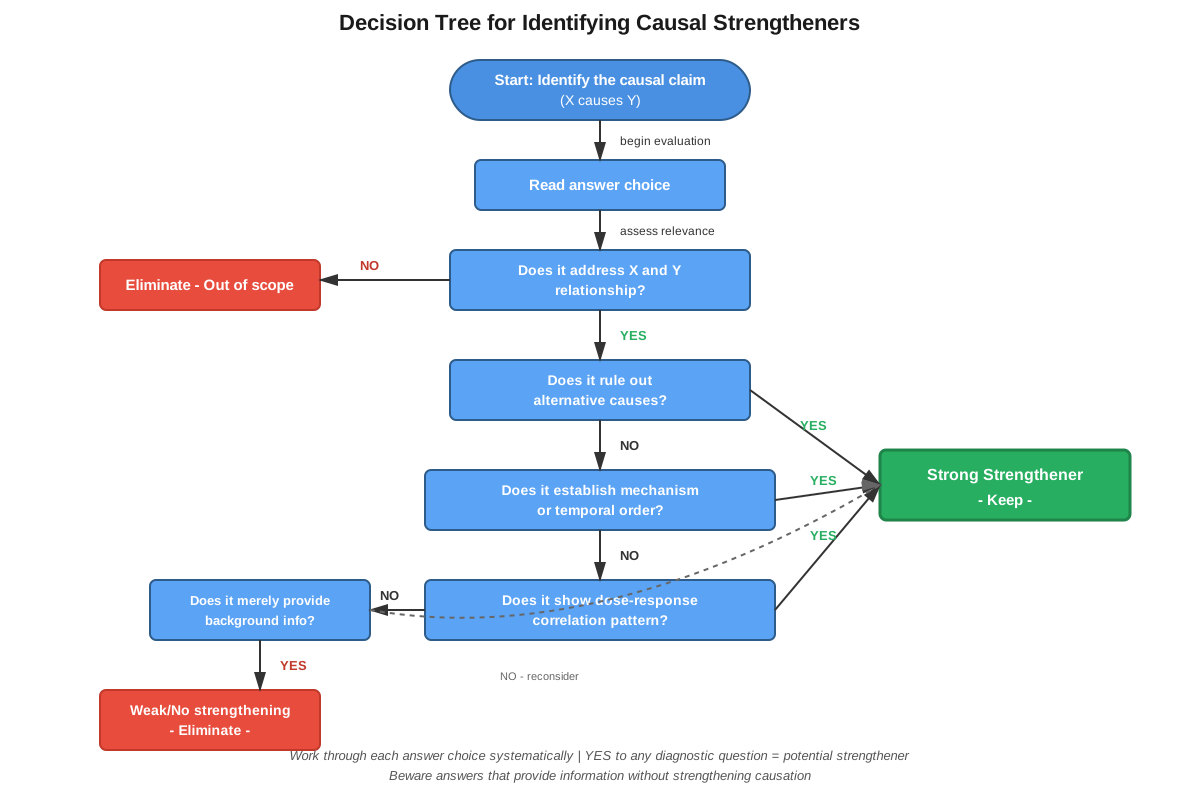
Systematically evaluate each choice:
- Does it address the logical gap between premises and conclusion?
- Does it eliminate an alternative explanation?
- Does it make the causal claim more probable?
- Does it address the argument's specific conclusion?
Trigger Words and Phrases
In Question Stems:
- "Most strengthens"
- "Provides the most support for"
- "Most justifies the conclusion"
- "If true, would provide the best reason for"
In Arguments (signaling causal claims):
- "Therefore, X causes Y"
- "This explains why"
- "X is responsible for Y"
- "X leads to Y"
- "As a result of X, Y occurred"
In Answer Choices (strong strengtheners):
- "No other factors changed"
- "Other potential causes were absent"
- "The same pattern was observed in"
- "X occurred before Y"
- "The more X, the more Y"
Process of Elimination Tips
Eliminate answers that:
- Merely restate the premise: If an answer just repeats information already in the argument, it doesn't strengthen.
- Provide irrelevant background: General information about the topic that doesn't address the causal gap should be eliminated.
- Address a different conclusion: If the answer strengthens a claim other than the stated conclusion, eliminate it.
- Actually weaken the argument: Some trap answers subtly undermine the causal claim.
- Introduce alternative explanations: Answers that suggest other causes typically weaken rather than strengthen.
Time Allocation
For a typical causal strengthener question, allocate approximately 1:20-1:30 (80-90 seconds):
- Reading and understanding the argument: 25-30 seconds
- Identifying the causal claim and vulnerabilities: 20-25 seconds
- Evaluating answer choices: 35-40 seconds
Exam Tip: If you're stuck between two answers, choose the one that more directly eliminates an alternative explanation rather than one that merely makes the causal mechanism more plausible. The LSAT tends to favor answers that address competing explanations.
Memory Techniques
The CAUSAL Acronym for Strengthener Categories
Common causes eliminated
Alternative explanations ruled out
Unidirectional (temporal precedence established)
Strength of correlation increased
Analogous cases provided
Link or mechanism explained
Visualization Strategy: The Causal Chain
Visualize causal arguments as a chain connecting cause to effect. The chain has weak links (assumptions). Strengthening means reinforcing the weak links:
[CAUSE] --?--> [EFFECT]
         ↑
    Weak link = assumption gap
         ↑
Strengthener reinforces this connection
When evaluating answers, visualize whether each choice reinforces the chain, adds support beneath it, or is irrelevant to the connection.
The "Rule Out" Mnemonic
Remember that the most common strengtheners RULE OUT problems:
Reverse causation ruled out
Uncontrolled variables eliminated
Lack of mechanism addressed
Extraneous explanations removed
Other causes shown absent
Unrelated factors controlled
Temporal sequence established
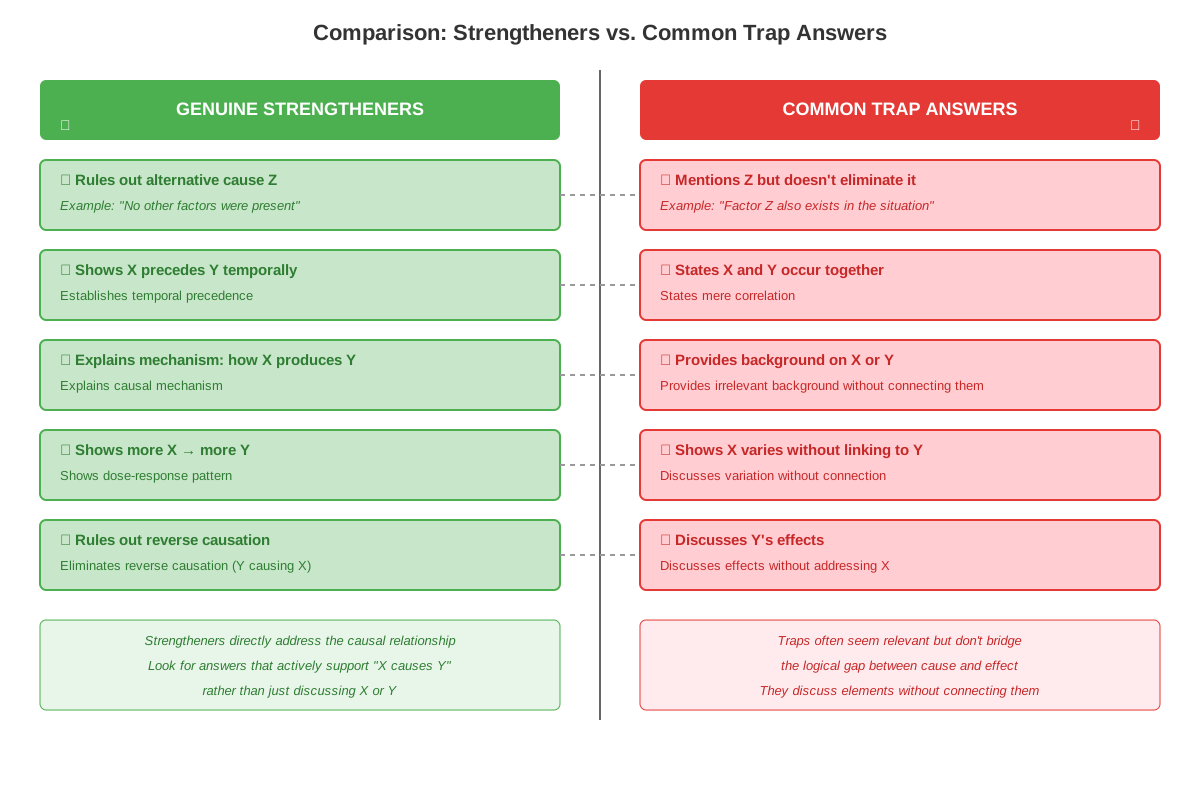
The Comparison Table Memory Aid
Memorize this comparison to quickly categorize answer choices:
| Strengthens | Doesn't Strengthen |
|---|---|
| Eliminates alternatives | Restates premise |
| Shows temporal order | Provides background |
| Demonstrates mechanism | Addresses different conclusion |
| Controls confounders | Introduces new problems |
| Provides replication | Merely describes correlation |
Summary
Causal strengthener questions test the ability to identify evidence that makes a causal claim more probable by addressing the logical gap between correlational evidence and causal conclusions. The fundamental pattern involves arguments that observe X and Y occurring together and conclude that X causes Y, creating vulnerabilities related to alternative explanations, reverse causation, common causes, and confounding variables. The five major categories of strengtheners—eliminating alternative explanations, establishing temporal precedence, showing dose-response relationships, demonstrating causal mechanisms, and providing analogous cases—offer systematic approaches to evaluating answer choices. The most effective strengtheners typically eliminate alternative explanations or control for confounding variables, making the alleged cause the most plausible explanation for the observed effect. Success on these questions requires identifying the specific causal claim, recognizing the argument's vulnerabilities, predicting what evidence would address those vulnerabilities, and systematically evaluating answer choices based on whether they make the conclusion more probable. Mastering causal strengtheners is essential for LSAT success, as these questions appear frequently and connect to broader skills in assumption identification, argument evaluation, and logical reasoning.
Key Takeaways
- Causal strengthener questions appear 6-10 times per LSAT exam and are among the highest-yield question types for focused preparation
- The most common and effective strengtheners eliminate alternative explanations for observed correlations, making the causal claim more defensible
- Strengthening requires making the conclusion more probable, not proving it with certainty—the correct answer is the best among the options, not necessarily perfect
- Five major strengthener categories provide a systematic framework: eliminating alternatives, establishing temporal precedence, showing dose-response, demonstrating mechanism, and providing replication
- Always identify the specific causal claim and the argument's vulnerabilities before evaluating answer choices—prediction improves accuracy and speed
- Answer choices that merely restate premises, provide background information, or address different conclusions do not strengthen the argument
- Understanding causal strengtheners automatically improves performance on related question types, including weakeners, assumptions, and flaws
Related Topics
Causal Weakeners: The inverse of strengtheners, these questions ask what evidence would make a causal claim less probable. Mastering strengtheners provides immediate insight into weakeners, as the same categories apply in reverse.
Necessary Assumptions in Causal Arguments: Understanding what assumptions causal arguments depend on reveals what evidence would strengthen them. These question types are closely related and mutually reinforcing.
Flaw Questions with Causal Reasoning: Many flaw questions identify errors in causal reasoning, such as confusing correlation with causation. Recognizing what strengthens causal arguments helps identify when arguments fail to establish causation.
Sufficient Assumption Questions: While sufficient assumptions guarantee conclusions, they also strengthen arguments. The skills for identifying what would make causal conclusions follow necessarily overlap with strengthening skills.
Method of Agreement and Difference: These formal logical principles from Mill's Methods underlie many causal strengthener questions, particularly those involving controlled comparisons and elimination of alternative explanations.
Practice CTA
Now that you've mastered the core concepts of causal strengtheners, it's time to apply this knowledge to actual LSAT-style questions. The practice questions and flashcards will reinforce your understanding of the five strengthener categories, help you recognize common trap answers, and build the speed and accuracy needed for test day. Remember that causal strengthener questions reward systematic thinking—identify the causal claim, spot the vulnerabilities, predict the strengthener, and methodically evaluate each answer choice. With focused practice, these questions will become some of your most reliable point-scorers on the LSAT. You've built a strong foundation; now strengthen it through application!
Sign up free to keep reading
Create a free AnvayaPrep account to finish this LSAT guide on Causal strengthener — plus flashcards and practice questions.