Overview
Causal weakener questions represent one of the most frequently tested question types in LSAT Logical Reasoning sections. These questions challenge test-takers to identify flaws in causal arguments or to recognize information that undermines a proposed cause-and-effect relationship. Understanding how to weaken causal claims is fundamental to success on the LSAT, as approximately 15-20% of Logical Reasoning questions involve causation and explanation in some form.
In LSAT arguments, authors frequently conclude that one phenomenon causes another based on observed correlations or temporal sequences. However, correlation does not equal causation, and the LSAT exploits this logical gap extensively. A lsat causal weakener question asks test-takers to identify which answer choice most effectively challenges the causal relationship proposed in the stimulus. This requires recognizing the specific vulnerabilities in causal reasoning and understanding the various ways such arguments can be undermined.
Mastering causal weakener questions connects directly to broader Logical Reasoning skills, including identifying assumptions, recognizing argument structure, and evaluating evidence. These questions also relate closely to strengthen questions (the inverse operation), necessary assumption questions (which often involve causal links), and flaw questions (which may identify causal reasoning errors). The ability to deconstruct causal claims and recognize their weaknesses is not merely a test-taking skill—it represents critical thinking applicable to legal reasoning, policy analysis, and everyday decision-making.
Learning Objectives
- [ ] Identify how Causal weakener appears in LSAT questions
- [ ] Explain the reasoning pattern behind Causal weakener
- [ ] Apply Causal weakener to solve LSAT-style problems accurately
- [ ] Distinguish between the five primary methods of weakening causal arguments
- [ ] Recognize the difference between weakening a causal claim and disproving it entirely
- [ ] Evaluate answer choices to determine which provides the strongest challenge to a causal relationship
- [ ] Identify common causal reasoning patterns and their specific vulnerabilities
Prerequisites
- Basic argument structure: Understanding premises, conclusions, and how evidence supports claims is essential because causal weakener questions require identifying which part of the argument to target
- Correlation vs. causation distinction: Recognizing that two events occurring together does not prove one causes the other provides the foundation for understanding why causal arguments are vulnerable
- Conditional reasoning fundamentals: Many causal arguments involve necessary or sufficient conditions, and understanding these relationships helps identify logical gaps
- Argument evaluation skills: The ability to assess whether evidence adequately supports a conclusion is necessary for determining what would weaken that support
Why This Topic Matters
Causal reasoning pervades legal thinking, policy debates, and everyday decision-making. Attorneys must evaluate whether evidence truly supports causal claims about liability, damages, or criminal responsibility. Legislators must assess whether proposed policies will actually cause desired outcomes. The LSAT tests this reasoning pattern extensively because it reflects core analytical skills required for legal practice.
On the LSAT, causal weakener questions appear in approximately 3-5 questions per test across both Logical Reasoning sections. These questions typically appear as "Weaken" questions but may also surface in "Flaw," "Evaluate," or "Assumption" questions where causal reasoning is central. The question stems often include phrases like "most seriously weakens," "casts the most doubt on," or "calls into question."
Common manifestations include: scientific studies claiming one variable causes another; business scenarios where management attributes outcomes to specific decisions; social science arguments linking policies to societal changes; and historical analyses claiming certain events caused particular outcomes. The LSAT favors scenarios where correlation is mistaken for causation, alternative explanations exist, or the causal mechanism is questionable.
Core Concepts
Understanding Causal Arguments
A causal argument claims that one phenomenon (the cause) brings about another phenomenon (the effect). In LSAT stimuli, these arguments typically follow a pattern: evidence is presented showing that X and Y occur together or in sequence, and the conclusion asserts that X causes Y. The fundamental vulnerability of such arguments lies in the logical gap between observing a relationship and proving causation.
Causal claims on the LSAT generally take three forms:
- Direct causation: X directly causes Y
- Causal contribution: X is one factor that causes Y
- Causal prevention: X prevents Y from occurring
Each form has specific vulnerabilities that test-takers must recognize to select effective weakening answer choices.
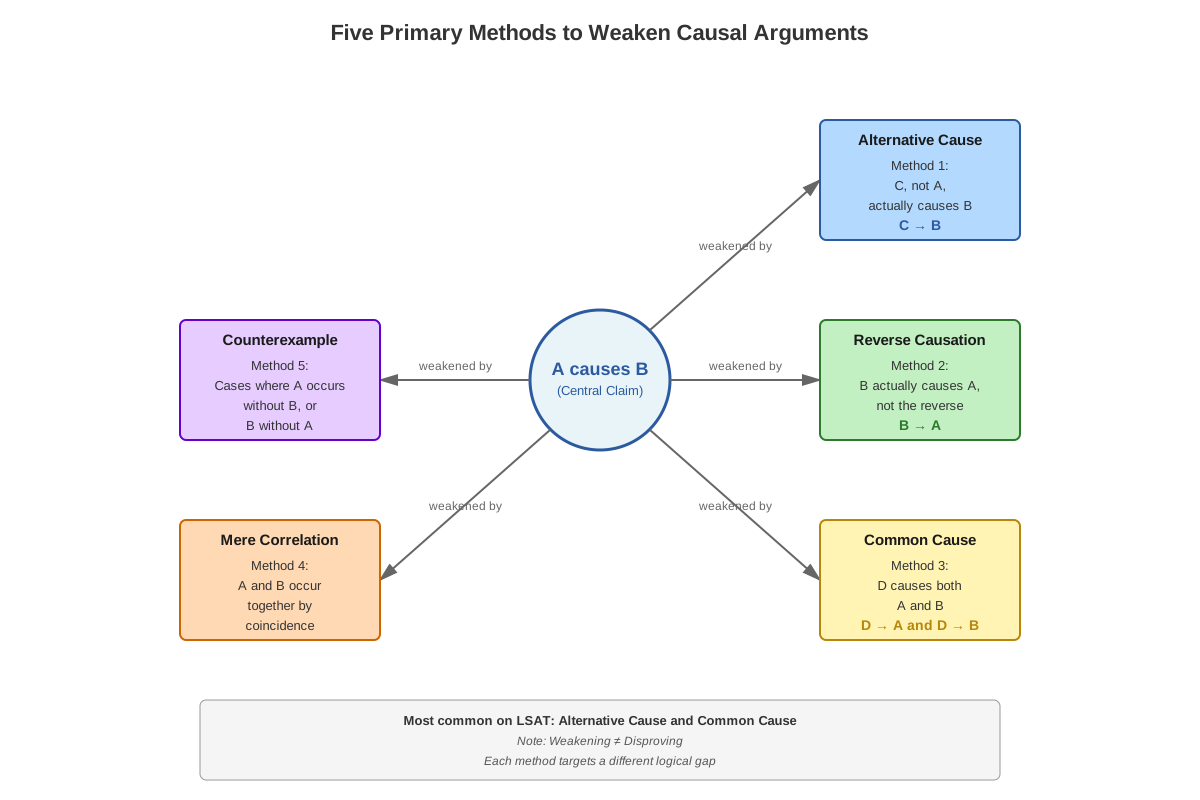
The Five Primary Weakening Strategies
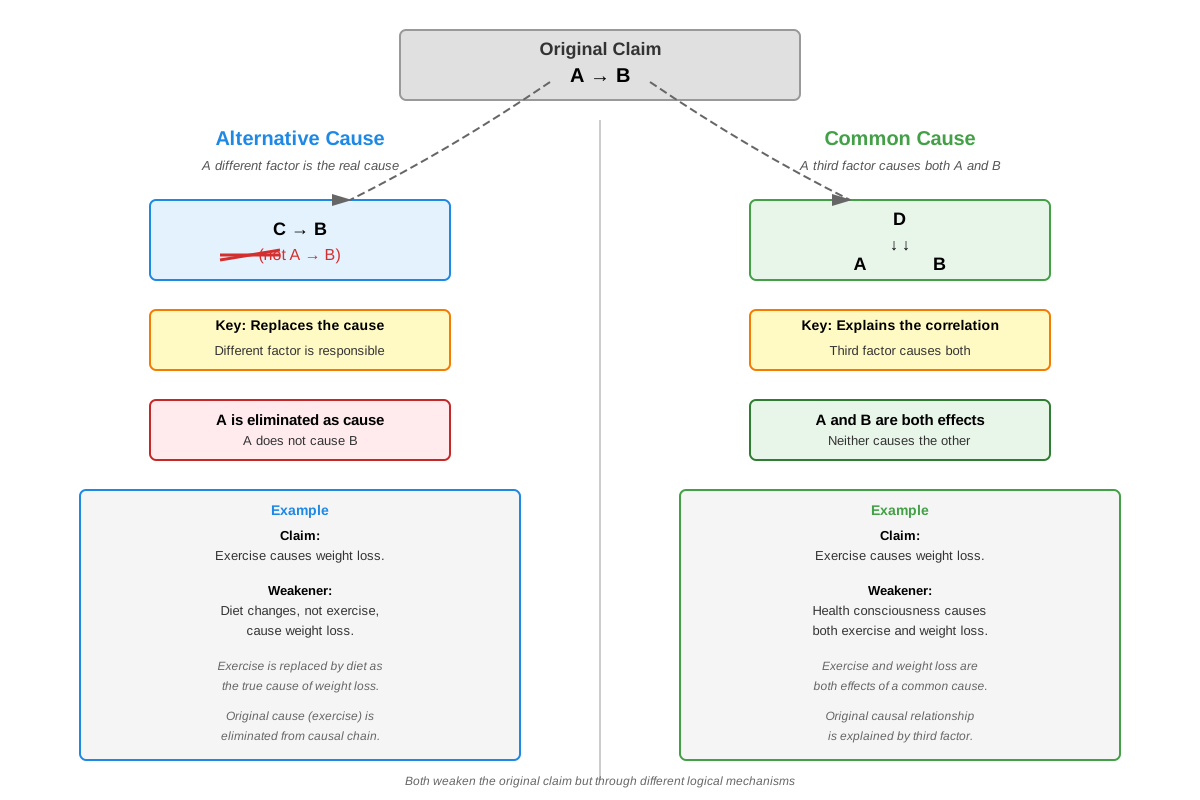
1. Alternative Cause
The most common method of weakening a causal argument involves presenting an alternative cause—a different factor that could explain the observed effect. If the argument claims "X causes Y," showing that Z could also cause Y (and may be the actual cause) undermines confidence in the original causal claim.
For example, if an argument concludes that a new teaching method caused improved test scores, an alternative cause might be that the school simultaneously reduced class sizes, hired more experienced teachers, or attracted more motivated students.
2. Reverse Causation
Reverse causation challenges a causal claim by suggesting the proposed effect actually causes the proposed cause, rather than vice versa. If the argument claims "X causes Y," reverse causation proposes "Y causes X."
Consider an argument claiming that drinking coffee causes people to wake up early. Reverse causation would suggest that waking up early causes people to drink coffee (they need caffeine because they're awake early), rather than coffee causing the early waking.
3. Common Cause (Third Factor)
A common cause or third factor explanation proposes that both the alleged cause and effect are actually results of some other underlying factor. If the argument claims "X causes Y," a common cause shows that Z causes both X and Y, making their correlation spurious.
For instance, if an argument claims that ice cream sales cause drowning deaths (because both increase together), a common cause explanation would identify that hot weather causes both increased ice cream sales and more swimming, which leads to more drownings.
4. Coincidence (No Causal Relationship)
This strategy suggests the correlation between the proposed cause and effect is merely coincidental—a random occurrence without any causal connection. This approach is less common on the LSAT because it's harder to prove definitively, but it appears when the correlation is weak or the sample size is small.
5. Breaking the Causal Chain
This method shows that the proposed cause does not actually produce the proposed effect by demonstrating that the causal mechanism is implausible, impossible, or interrupted. This might involve showing that:
- The alleged cause occurred after the effect (temporal problem)
- The cause is insufficient to produce the effect
- An intervening factor prevents the cause from producing the effect
- The causal mechanism described is scientifically impossible
Recognizing Causal Indicators
LSAT stimuli signal causal claims through specific language patterns. Recognizing these causal indicators helps identify when an argument is vulnerable to causal weakeners:
| Causal Language | Example Usage | Implication |
|---|---|---|
| "causes," "caused by" | "Stress causes illness" | Direct causal claim |
| "leads to," "results in" | "Exercise leads to weight loss" | Causal sequence |
| "because of," "due to" | "Sales increased due to advertising" | Causal explanation |
| "responsible for" | "The policy is responsible for the decline" | Causal attribution |
| "explains why" | "This explains why profits rose" | Causal reasoning |
| "the reason for" | "The reason for success was innovation" | Causal identification |
The Correlation-Causation Gap
The fundamental logical gap in causal arguments is the leap from correlation (two things occurring together) to causation (one thing causing the other). The LSAT exploits this gap relentlessly. Test-takers must recognize that even strong correlations do not prove causation without additional evidence about the causal mechanism, temporal sequence, and elimination of alternative explanations.
Three conditions must be met for a strong causal claim:
- Correlation: The cause and effect must occur together with regularity
- Temporal precedence: The cause must occur before the effect
- No plausible alternative explanations: Other potential causes must be ruled out
Most LSAT causal arguments satisfy the first two conditions but fail the third, creating the vulnerability that weakener questions exploit.
Degrees of Weakening
Not all weakening answer choices are equally strong. The LSAT often includes answer choices that weaken an argument slightly versus those that weaken it significantly. Understanding degrees of weakening helps select the best answer:
- Strong weakening: Provides a highly plausible alternative explanation or directly contradicts a key assumption
- Moderate weakening: Raises doubt about the causal claim but doesn't provide a complete alternative
- Weak weakening: Suggests a minor complication but doesn't seriously challenge the core causal claim
The correct answer typically provides the strongest weakening among the options, not necessarily a complete refutation of the argument.
Concept Relationships
The concepts within causal weakener questions form an interconnected system. Understanding causal arguments is the foundation, which leads to recognizing causal indicators in LSAT stimuli. Once a causal claim is identified, the correlation-causation gap becomes the primary vulnerability to exploit. This gap can be attacked through the five primary weakening strategies: alternative cause, reverse causation, common cause, coincidence, or breaking the causal chain.
These strategies connect to prerequisite knowledge: correlation vs. causation understanding enables recognition of the logical gap; argument structure knowledge helps identify which element to attack; and conditional reasoning skills assist in evaluating whether the cause is necessary or sufficient for the effect.
Causal weakener questions also relate to other LSAT question types. They are the inverse of strengthen questions (which support causal claims), closely related to flaw questions (which identify causal reasoning errors), and connected to assumption questions (which often involve unstated causal links). Mastering causal weakeners thus enhances performance across multiple question types.
Relationship map: Causal Argument Recognition → Identify Causal Indicators → Locate Correlation-Causation Gap → Select Appropriate Weakening Strategy → Evaluate Degree of Weakening → Choose Strongest Answer
High-Yield Facts
⭐ The most common causal weakener on the LSAT is presenting an alternative cause that could explain the observed effect.
⭐ Correlation between two variables never proves causation without additional evidence about mechanism and alternative explanations.
⭐ Reverse causation is particularly effective when the temporal sequence in the argument is ambiguous or unstated.
⭐ A common cause (third factor) explanation is strongest when both the alleged cause and effect increase or decrease together.
⭐ The correct weakening answer does not need to disprove the argument—it only needs to cast reasonable doubt on the causal claim.
- Causal arguments on the LSAT typically move from observed correlation to causal conclusion without adequate justification.
- Temporal precedence (cause before effect) is necessary but not sufficient for proving causation.
- Answer choices that merely show the cause doesn't always produce the effect do not significantly weaken arguments claiming the cause sometimes produces the effect.
- Strengthening the correlation between cause and effect does not weaken the argument—it may actually strengthen it.
- The phrase "most seriously weakens" indicates that multiple answers may weaken the argument, but one does so most effectively.
- Causal weakeners often exploit the assumption that no other factors are relevant to the outcome.
- An effective weakener must be relevant to the specific causal relationship claimed, not just generally related to the topic.
- Sample size and representativeness issues can weaken causal claims based on statistical evidence.
- Showing that the effect occurs without the cause present strongly suggests the cause is not necessary for the effect.
- Demonstrating that the cause is present without the effect occurring suggests the cause is not sufficient for the effect.
Quick check — test yourself on Causal weakener so far.
Try Flashcards →Common Misconceptions
Misconception: Any information that contradicts the conclusion weakens the argument. → Correction: Only information that undermines the connection between premises and conclusion weakens the argument. Information that contradicts a premise or introduces irrelevant facts does not weaken the reasoning.
Misconception: To weaken a causal argument, you must prove the cause definitely does not produce the effect. → Correction: Weakening only requires casting doubt on the causal relationship. Showing that alternative explanations are plausible or that the causal mechanism is questionable is sufficient—complete disproof is not necessary.
Misconception: If the cause and effect are strongly correlated, the causal argument cannot be weakened. → Correction: Even perfect correlation does not prove causation. Strong correlation can result from reverse causation, common causes, or coincidence. The strength of correlation is separate from the validity of the causal inference.
Misconception: Showing that the cause sometimes fails to produce the effect weakens an argument claiming the cause generally produces the effect. → Correction: Causal claims typically allow for exceptions or probabilistic relationships. Showing occasional failures does not significantly weaken claims about general tendencies unless the failures are frequent or systematic.
Misconception: Alternative causes only weaken an argument if they completely explain the effect without the original cause. → Correction: An alternative cause weakens the argument by showing that the original cause may not be responsible, even if the alternative doesn't fully explain everything. Multiple factors can contribute to an effect, and showing another plausible contributor undermines confidence in the original causal claim.
Misconception: Reverse causation and common cause are the same weakening strategy. → Correction: Reverse causation proposes that Y causes X (flipping the direction), while common cause proposes that Z causes both X and Y (introducing a third factor). These are distinct logical structures with different implications.
Misconception: The correct answer to a weaken question must directly address the conclusion. → Correction: The correct answer may attack an assumption linking premises to conclusion rather than directly contradicting the conclusion itself. Undermining the logical connection is often more effective than contradicting the conclusion.
Worked Examples
Example 1: Alternative Cause
Stimulus: "A recent study found that employees who work from home are 20% more productive than those who work in the office. The study concludes that the flexibility of working from home causes increased productivity."
Question: Which of the following, if true, most weakens the argument?
Answer Choices:
(A) Some employees who work from home report feeling isolated
(B) The study only included employees who volunteered to work from home
(C) Working from home has become increasingly common in recent years
(D) Productivity is difficult to measure accurately across different job types
(E) Office environments often include distracting conversations
Analysis:
First, identify the causal claim: The argument concludes that working from home (cause) leads to increased productivity (effect), based on the correlation between these two factors.
Next, consider what would weaken this causal relationship. We need to find an alternative explanation for the increased productivity or challenge the causal mechanism.
Evaluating each choice:
(A) Feeling isolated is a negative aspect of working from home, but it doesn't explain why productivity is higher or provide an alternative cause. This doesn't weaken the causal claim.
(B) This is the correct answer. If only employees who volunteered to work from home were studied, there's a selection bias. These employees might be more self-motivated, better at time management, or have home situations conducive to work—factors that could explain their higher productivity. The alternative cause is the pre-existing characteristics of employees who choose to work from home, not the working-from-home arrangement itself. This represents a common cause scenario: certain employee traits cause both the choice to work from home and higher productivity.
(C) The increasing prevalence of working from home doesn't address whether it causes productivity. This is irrelevant to the causal claim.
(D) While measurement difficulties might affect the study's reliability, this doesn't provide an alternative explanation for the observed productivity difference.
(E) This actually strengthens the argument by suggesting a mechanism (fewer distractions at home) through which working from home could cause increased productivity.
Key Takeaway: This example demonstrates how selection bias creates an alternative cause. The employees' pre-existing characteristics, not the work location itself, may explain the productivity difference.
Example 2: Reverse Causation
Stimulus: "Researchers observed that cities with higher rates of bicycle infrastructure development also have higher rates of cycling. They concluded that building bicycle infrastructure causes more people to cycle."
Question: Which of the following, if true, most seriously weakens the researchers' conclusion?
Answer Choices:
(A) Some cities with bicycle infrastructure have seen no increase in cycling
(B) Bicycle infrastructure is expensive to build and maintain
(C) Cities typically build bicycle infrastructure in response to growing numbers of cyclists demanding safer routes
(D) Cycling has health benefits that are well-documented
(E) Automobile traffic has decreased in cities with more bicycle infrastructure
Analysis:
The causal claim is: bicycle infrastructure (cause) leads to increased cycling (effect).
Examining the answer choices:
(A) This shows the cause doesn't always produce the effect, but it doesn't strongly weaken an argument about general tendencies. The argument allows for exceptions.
(B) The cost of infrastructure is irrelevant to whether it causes increased cycling. This addresses feasibility, not causation.
(C) This is the correct answer. This presents reverse causation: instead of infrastructure causing cycling, increased cycling causes infrastructure development. Cities observe growing cyclist populations and respond by building infrastructure to accommodate them. This completely reverses the causal arrow, suggesting the researchers have the relationship backward. The effect (cycling) actually precedes and causes what was identified as the cause (infrastructure).
(D) Health benefits of cycling don't address the relationship between infrastructure and cycling rates. This is off-topic.
(E) This could be seen as an additional effect of bicycle infrastructure, but it doesn't weaken the claim that infrastructure causes cycling. If anything, it suggests infrastructure has multiple effects.
Key Takeaway: Reverse causation is particularly powerful when the temporal sequence is ambiguous. This example shows how what appears to be cause-and-effect may actually be effect-and-cause, with cities responding to existing demand rather than creating new demand.
Exam Strategy
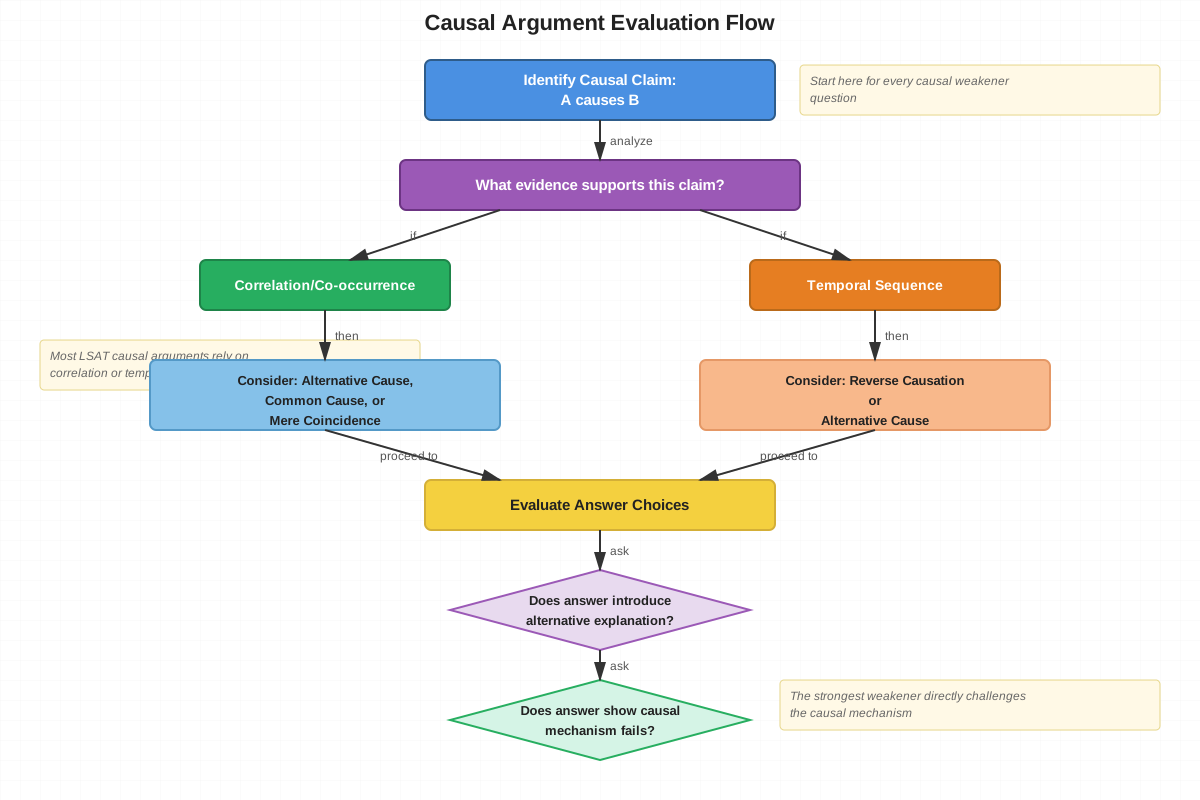
When approaching causal weakener questions on the LSAT, follow this systematic process:
Step 1: Identify the Causal Claim (15-20 seconds)
Look for causal language indicators: "causes," "leads to," "results in," "because of," "responsible for," or "explains why." Clearly identify what is claimed to be the cause and what is claimed to be the effect. Write "C → E" in your scratch work if helpful.
Step 2: Recognize the Evidence Type (10 seconds)
Determine whether the argument is based on correlation, temporal sequence, or analogy. Most LSAT causal arguments rely on correlation or temporal sequence without establishing a true causal mechanism.
Step 3: Anticipate Vulnerabilities (15-20 seconds)
Before reading answer choices, quickly consider: Could there be an alternative cause? Could the causation be reversed? Could a third factor explain both? Is the causal mechanism plausible? This pre-thinking prevents you from being swayed by attractive wrong answers.
Step 4: Evaluate Answer Choices Systematically (60-90 seconds)
For each answer choice, ask:
- Does this provide an alternative explanation for the effect?
- Does this suggest reverse causation?
- Does this introduce a common cause?
- Does this break the causal chain or mechanism?
- Is this relevant to the specific causal claim, or just generally related to the topic?
Trigger Words to Watch For:
In question stems:
- "most seriously weakens"
- "casts the most doubt on"
- "calls into question"
- "undermines"
- "challenges"
In answer choices that often indicate correct answers:
- "actually" (suggesting alternative explanation)
- "instead" (suggesting reverse causation or alternative)
- "both... and..." (suggesting common cause)
- "before" or "after" (suggesting temporal problems)
Process of Elimination Tips:
Eliminate answers that:
- Strengthen the argument by supporting the causal mechanism
- Are irrelevant to the specific causal relationship claimed
- Address a different part of the argument than the causal claim
- Merely show exceptions without undermining the general causal pattern
- Introduce new information that doesn't connect to the cause-effect relationship
Time Allocation:
Spend approximately 1:20-1:30 on causal weakener questions. They require careful analysis but shouldn't consume excessive time. If you're stuck between two answers, choose the one that more directly challenges the causal mechanism or provides a more plausible alternative explanation.
Exam Tip: The correct answer often feels like it "explains away" the correlation by showing why the cause and effect might occur together without a causal relationship. If an answer makes you think "Oh, that's why they're correlated!" it's likely correct.
Memory Techniques
ARCBC Mnemonic for the five weakening strategies:
- Alternative cause
- Reverse causation
- Common cause
- Break the chain
- Coincidence
The "Three C's" for evaluating causal arguments:
- Correlation (Is there one?)
- Chronology (Does cause precede effect?)
- Competing explanations (Have alternatives been ruled out?)
Visualization Strategy: Picture the causal argument as an arrow from cause to effect. Each weakening strategy does something different to that arrow:
- Alternative cause: draws a new arrow from a different source to the effect
- Reverse causation: flips the arrow direction
- Common cause: draws arrows from a third factor to both cause and effect
- Break the chain: cuts the arrow in the middle
- Coincidence: makes the arrow dotted/dashed (weak connection)
The "WEAK" acronym for what makes causal arguments vulnerable:
- Without mechanism (no explanation of how cause produces effect)
- Evidence is correlational (not experimental or controlled)
- Alternatives not eliminated (other explanations possible)
- Kronology unclear (temporal sequence ambiguous)
Summary
Causal weakener questions test the ability to identify and challenge cause-and-effect claims that appear in LSAT Logical Reasoning sections. These questions exploit the fundamental logical gap between correlation and causation, requiring test-takers to recognize that observed relationships do not prove causal connections. The five primary weakening strategies—alternative cause, reverse causation, common cause, breaking the causal chain, and coincidence—provide systematic approaches to undermining causal arguments. Success requires identifying causal indicators in the stimulus, recognizing the specific vulnerability in the reasoning, and selecting the answer choice that most effectively challenges the causal claim. The correct answer need not disprove the argument entirely; it must only cast reasonable doubt on the causal relationship by suggesting plausible alternatives or revealing flaws in the causal reasoning. Mastering this question type enhances performance across multiple Logical Reasoning question types and develops critical thinking skills essential for legal reasoning.
Key Takeaways
- Causal weakener questions appear frequently on the LSAT and test the ability to challenge cause-and-effect claims based on correlational evidence
- The five primary weakening strategies are alternative cause, reverse causation, common cause, breaking the causal chain, and coincidence
- Alternative cause is the most common and effective weakening strategy, providing a different explanation for the observed effect
- Correlation never proves causation without additional evidence about mechanism, temporal sequence, and elimination of alternatives
- The correct answer must be relevant to the specific causal relationship claimed and typically provides the strongest challenge among the options
- Recognizing causal indicators ("causes," "leads to," "results in," "because of") helps identify when arguments are vulnerable to causal weakeners
- Effective weakening requires only casting reasonable doubt on the causal claim, not completely disproving it
Related Topics
Causal Strengtheners: Understanding how to weaken causal arguments naturally leads to understanding how to strengthen them. Strengthening strategies include eliminating alternative causes, establishing temporal precedence, demonstrating the causal mechanism, and showing the effect doesn't occur without the cause.
Necessary vs. Sufficient Assumptions in Causal Arguments: Many causal arguments rely on unstated assumptions about whether the cause is necessary, sufficient, or both for producing the effect. Mastering causal weakeners enables better recognition of these assumption types.
Flaw Questions with Causal Reasoning: Approximately 30% of flaw questions involve causal reasoning errors. Understanding causal weakeners helps identify and articulate these flaws, such as "confuses correlation with causation" or "fails to consider alternative explanations."
Experimental Design and Causation: Advanced LSAT questions may involve scientific studies or experiments. Understanding how controlled experiments establish causation (versus observational studies that only show correlation) builds on causal reasoning fundamentals.
Method of Agreement and Difference: These formal logical methods for establishing causation appear occasionally in complex LSAT arguments. Mastering basic causal weakeners provides the foundation for understanding these more sophisticated approaches.
Practice CTA
Now that you understand the core concepts and strategies for causal weakener questions, it's time to apply this knowledge. Work through the practice questions to reinforce your ability to identify causal claims, recognize their vulnerabilities, and select the most effective weakening answer choices. Use the flashcards to memorize the five weakening strategies and common causal indicators. Remember: causal reasoning appears in approximately 15-20% of Logical Reasoning questions, making this one of the highest-yield topics for LSAT preparation. Each practice question you complete strengthens your pattern recognition and builds the confidence needed to tackle these questions efficiently on test day. Your investment in mastering causal weakeners will pay dividends across multiple question types and significantly improve your Logical Reasoning score.
Sign up free to keep reading
Create a free AnvayaPrep account to finish this LSAT guide on Causal weakener — plus flashcards and practice questions.