Overview
The distinction between cause versus condition represents one of the most sophisticated and frequently tested concepts in LSAT Logical Reasoning. This topic challenges test-takers to differentiate between factors that actively produce an outcome (causes) and factors that merely enable or allow an outcome to occur (conditions). Understanding this distinction is critical because LSAT questions routinely present arguments that conflate these two concepts, and recognizing this error is essential for identifying flawed reasoning patterns.
On the LSAT, causation and explanation questions require precise analytical thinking. Many arguments incorrectly treat necessary conditions as if they were sufficient causes, or they assume that because something must be present for an outcome to occur, it must be what brought about that outcome. This confusion appears across multiple question types, including Flaw questions, Strengthen/Weaken questions, Necessary Assumption questions, and Sufficient Assumption questions. Mastering the cause versus condition distinction enables test-takers to quickly identify logical gaps and predict correct answer choices.
This topic sits at the intersection of conditional reasoning and causal reasoning within the broader LSAT cause versus condition framework. While conditional logic deals with "if-then" relationships and their formal structures, causal reasoning examines what produces or brings about effects in the real world. The cause versus condition distinction bridges these domains by requiring students to recognize that necessary conditions (from conditional logic) are not automatically causal agents. This conceptual sophistication makes the topic both challenging and high-yield for exam preparation.
Learning Objectives
- [ ] Identify how Cause versus condition appears in LSAT questions
- [ ] Explain the reasoning pattern behind Cause versus condition
- [ ] Apply Cause versus condition to solve LST-style problems accurately
- [ ] Distinguish between necessary conditions and sufficient causes in argument structures
- [ ] Recognize when arguments improperly conflate conditions with causes
- [ ] Evaluate whether proposed explanations identify genuine causes or merely enabling conditions
- [ ] Predict answer choices that exploit the cause-condition distinction
Prerequisites
- Basic conditional logic: Understanding "if-then" statements, necessary and sufficient conditions is essential because conditions in causal contexts often mirror necessary conditions in formal logic
- Argument structure identification: Recognizing premises, conclusions, and assumptions allows students to locate where cause-condition confusion occurs within arguments
- Common logical fallacies: Familiarity with correlation-causation errors provides foundation for understanding the more nuanced cause-condition distinction
- Strengthen and Weaken question types: These question formats frequently test the cause versus condition concept through answer choices that address causal mechanisms
Why This Topic Matters
The cause versus condition distinction appears in real-world reasoning constantly. Medical professionals must distinguish between risk factors (conditions) and actual disease causes. Legal professionals differentiate between "but-for" causation (necessary conditions) and proximate causes (actual causal agents). Policy makers must identify which factors genuinely produce social outcomes versus which factors merely enable them. This reasoning skill extends far beyond the LSAT into professional and everyday decision-making.
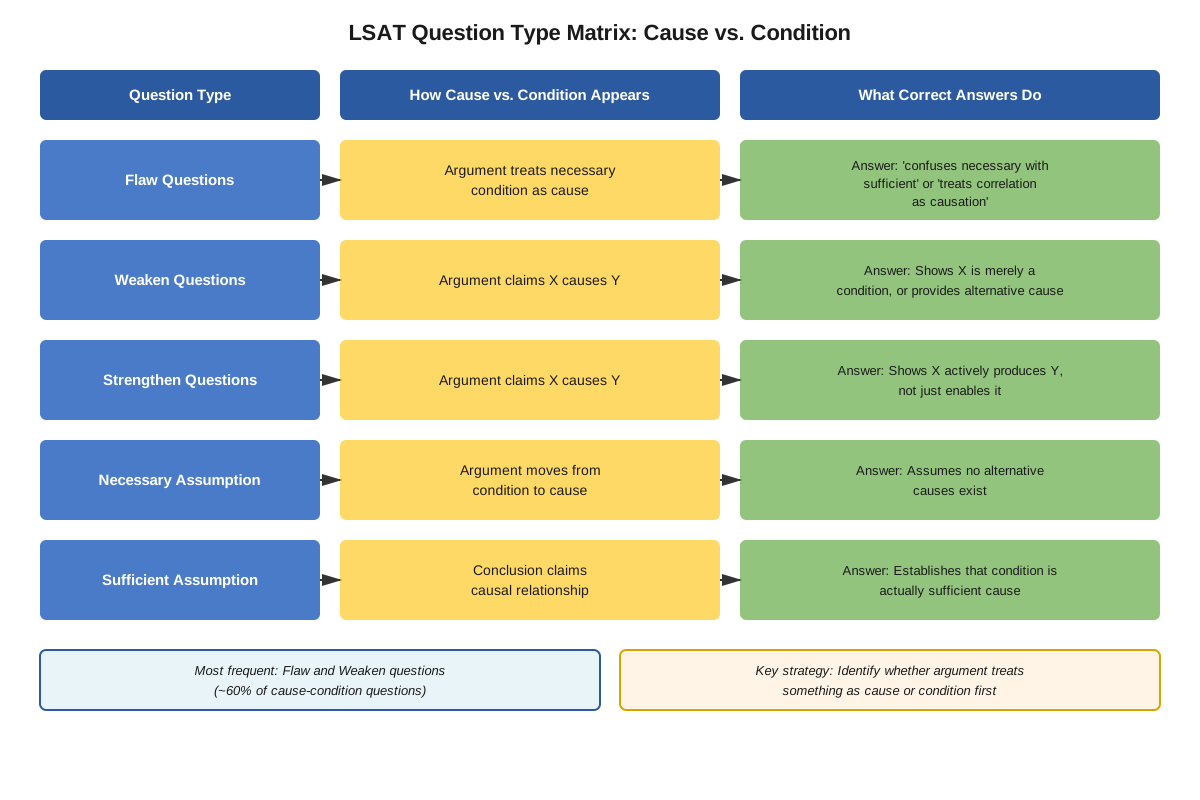
On the LSAT specifically, cause versus condition concepts appear in approximately 15-20% of Logical Reasoning questions across various question types. The distinction most frequently appears in:
- Flaw questions where arguments treat conditions as causes
- Weaken questions requiring identification of alternative causes or recognition that cited factors are merely conditions
- Strengthen questions where correct answers establish that a condition is actually a cause
- Necessary Assumption questions where the argument assumes a condition functions as a cause
The LSAT tests this concept because it reveals sophisticated analytical thinking. Test-takers who master this distinction demonstrate the ability to parse complex arguments with precision—exactly the skill required for legal reasoning. Questions exploiting the cause-condition gap often separate high scorers from average performers because they require moving beyond surface-level analysis to examine the logical structure of causal claims.
Core Concepts
Defining Causes
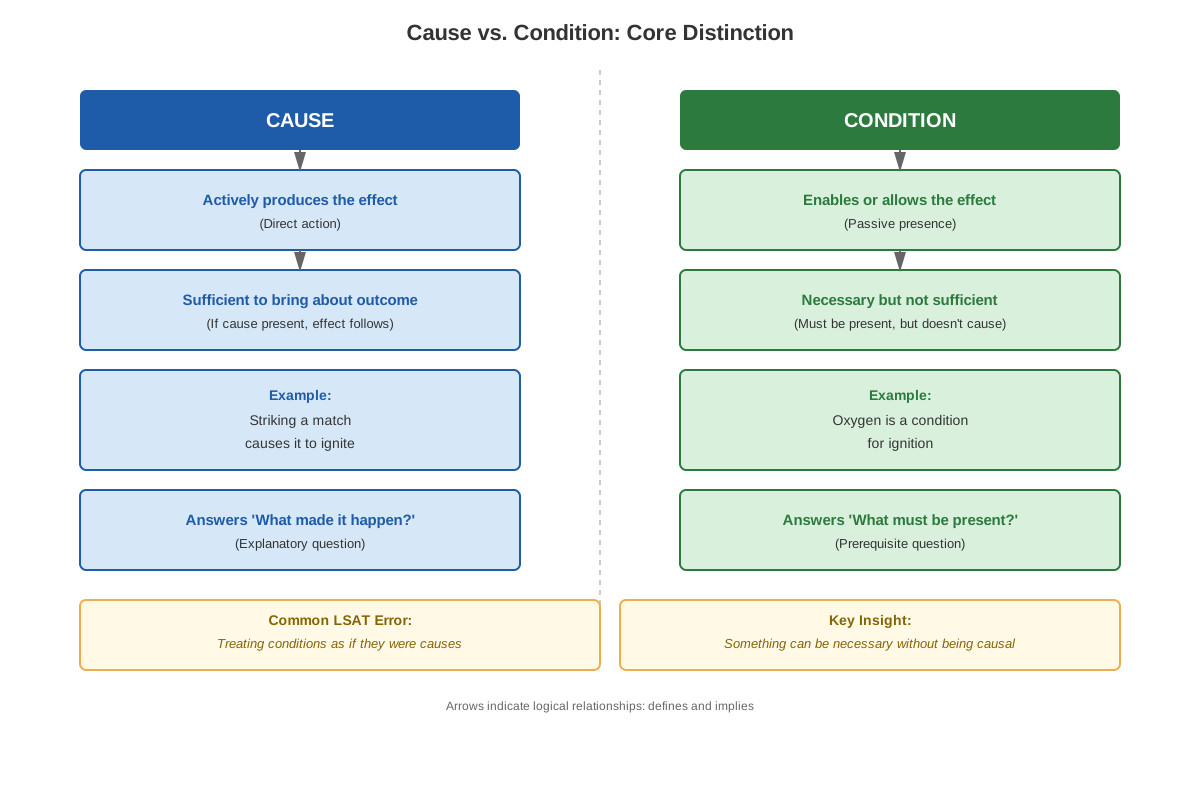
A cause is a factor that actively produces, generates, or brings about an effect. Causes have productive power—they make things happen. When we identify something as a cause, we claim it has the capacity to generate the outcome in question. For example, striking a match causes it to ignite; the friction and heat actively produce the flame. Causes answer the question "What made this happen?" or "What brought this about?"
In LSAT arguments, genuine causes possess several characteristics:
- They have a mechanism or process through which they produce the effect
- They are typically sufficient (or contribute to sufficiency) for producing the outcome
- They explain why the effect occurred rather than merely describing circumstances under which it occurred
- They involve some form of active influence or productive relationship
Defining Conditions
A condition is a factor that must be present for an outcome to occur but does not itself produce that outcome. Conditions are enabling factors—they allow or permit something to happen without causing it. Oxygen is a condition for fire, but oxygen does not cause fire; it merely enables combustion to occur when an ignition source is present. Conditions answer the question "What had to be in place?" rather than "What made this happen?"
Conditions in LSAT arguments typically exhibit these features:
- They are necessary for the outcome (the outcome cannot occur without them)
- They lack productive or generative power
- They are part of the background circumstances rather than active agents
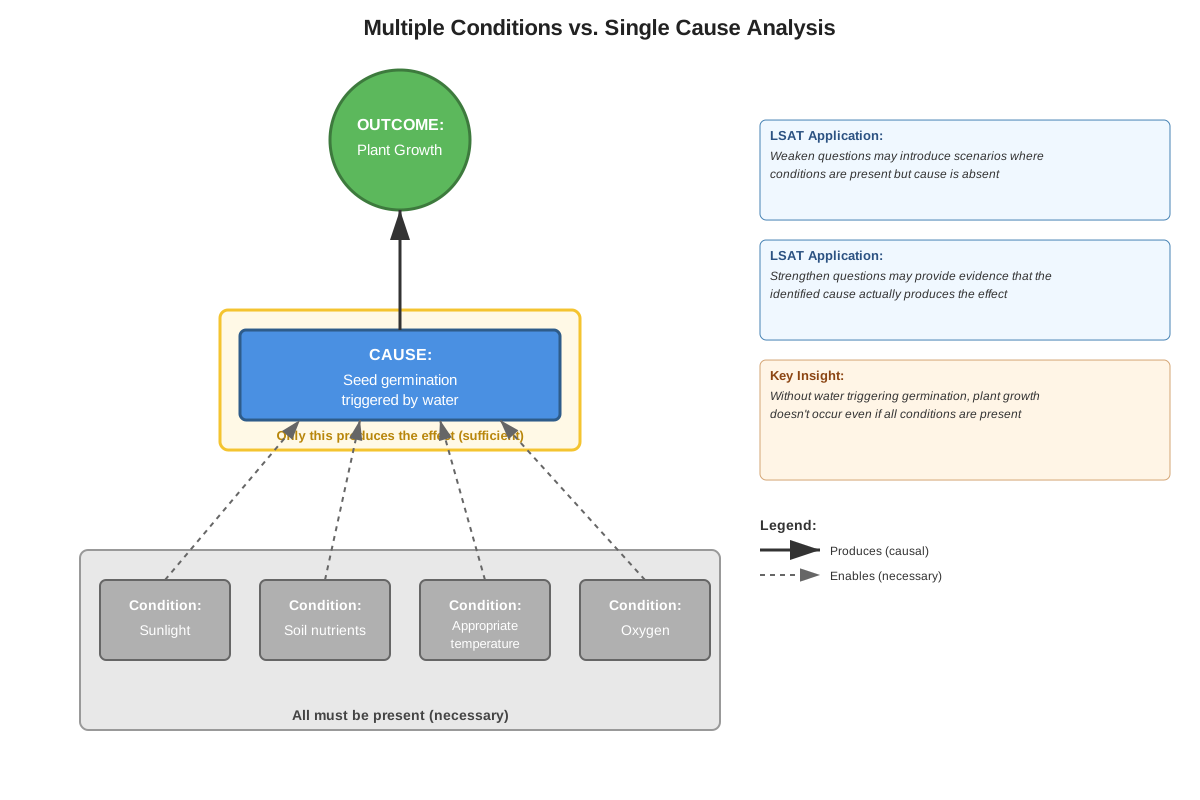
- Multiple conditions may all be necessary while none alone is the cause
The Critical Distinction
| Aspect | Cause | Condition |
|---|---|---|
| Relationship to effect | Produces or generates | Enables or permits |
| Logical status | Often sufficient (or contributory) | Typically necessary |
| Active vs. passive | Active agent | Passive requirement |
| Explanatory power | Explains why it happened | Explains what had to be present |
| Mechanism | Has causal mechanism | No causal mechanism |
The LSAT exploits this distinction by presenting arguments that treat necessary conditions as if they were causes. For example: "The company's profits increased after hiring a new CEO. Therefore, the new CEO caused the profit increase." This argument treats the CEO's presence (potentially a necessary condition for this particular increase) as if it were the cause, ignoring that the CEO might have merely been present while other factors (market conditions, product innovations, etc.) actually produced the increase.
Necessary Conditions vs. Causes
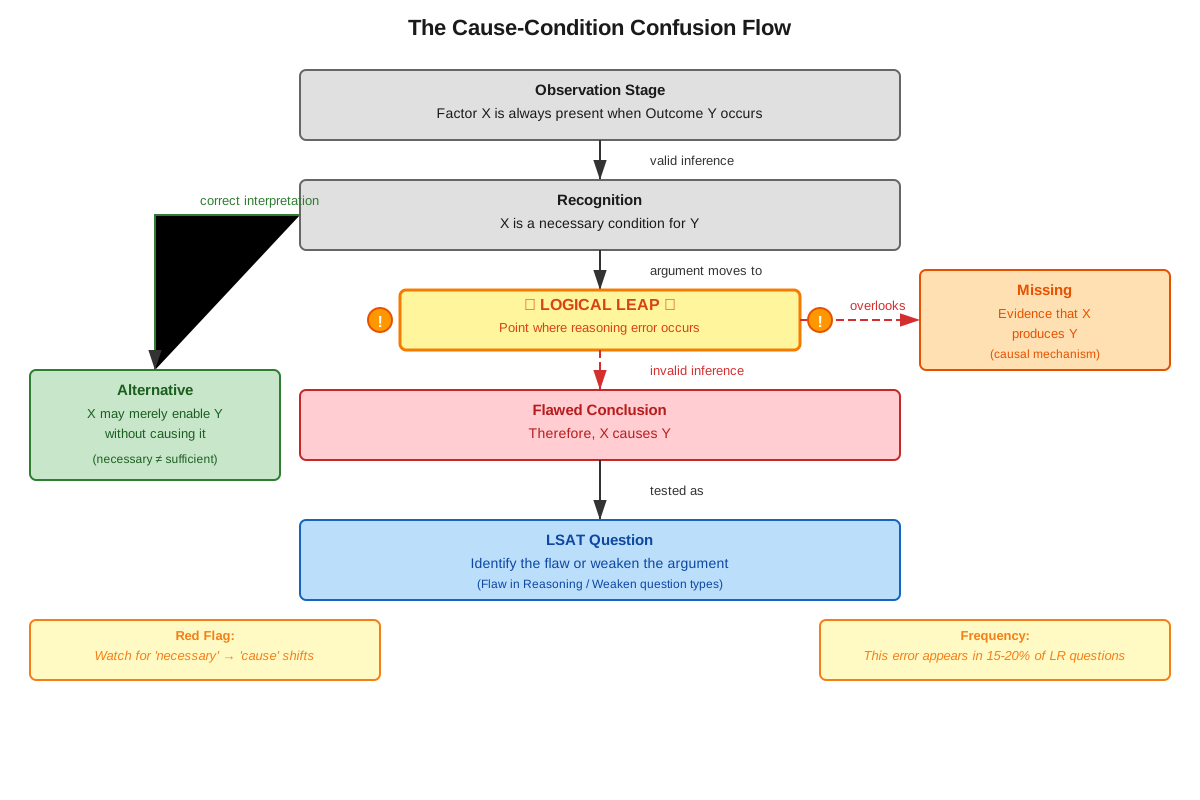
This confusion is particularly common because necessary conditions and causes can appear similar. Consider: "Without oxygen, the fire would not have occurred." This statement identifies oxygen as necessary, but it would be fallacious to conclude "Therefore, oxygen caused the fire." The match strike or electrical spark caused the fire; oxygen was merely a necessary background condition.
The LSAT frequently presents arguments with this structure:
- X was present when Y occurred
- Without X, Y would not have occurred
- Therefore, X caused Y
This reasoning is flawed because premises 1 and 2 establish X as a necessary condition, but they do not establish X as a cause. The argument assumes that being necessary is equivalent to being causal—a logical error the LSAT tests repeatedly.
Multiple Conditions and Causal Complexity
Real-world causation typically involves multiple necessary conditions but only certain factors function as causes. For a car to start, you need: (1) fuel, (2) a battery, (3) an ignition system, (4) turning the key, and (5) proper mechanical assembly. All are necessary conditions, but we typically identify turning the key as the cause of the car starting in that moment. Why? Because turning the key is the active intervention that triggers the process, while the other factors are standing background conditions.
LSAT arguments often exploit this by:
- Identifying one necessary condition and treating it as the sole cause
- Confusing background conditions with triggering causes
- Assuming that because something is necessary, it must be what brought about the effect
Temporal Sequence and Causation
The LST also tests whether students confuse temporal sequence with causation. Just because A preceded B does not mean A caused B—A might merely be a condition that happened to occur first. For example: "Every successful startup had office space before becoming profitable. Therefore, obtaining office space causes startup success." Office space might be a necessary condition (you need somewhere to work), but it clearly does not cause success—it merely enables the work that might lead to success.
Contributory Causes vs. Enabling Conditions
Some factors contribute to causing an outcome without being sufficient by themselves. These contributory causes differ from mere conditions because they have genuine productive power, even if they require other factors to be present. For example, smoking contributes to causing lung cancer—it has a causal mechanism even though not all smokers develop cancer. In contrast, having lungs is a condition for lung cancer but does not contribute to causing it.
The LSAT tests whether students can distinguish:
- Contributory causes (partial productive power)
- Necessary conditions (no productive power, just enabling)
- Sufficient causes (full productive power)
Concept Relationships
The cause versus condition distinction builds directly on conditional logic foundations. In conditional logic, students learn that necessary conditions (the consequent in "if A then B") must be present for the sufficient condition to guarantee the outcome. The cause-condition distinction adds a layer: just because something is necessary does not mean it has causal power. Thus: Conditional Logic (necessary/sufficient) → Causal Reasoning (cause/condition) → Argument Evaluation.
This topic also connects intimately with correlation versus causation. While correlation-causation errors involve mistaking mere association for causal relationships, cause-condition errors involve mistaking necessary enabling factors for productive causes. Both represent failures to establish genuine causal relationships, but cause-condition confusion is more subtle: Correlation ≠ Causation → Condition ≠ Cause → Proper Causal Analysis.
Within causation and explanation questions, the cause-condition distinction enables analysis of alternative explanations. When an argument claims X caused Y, recognizing that X might merely be a condition opens the possibility that Z actually caused Y while X was just necessarily present. This relationship flows: Identify Condition (not cause) → Recognize Explanatory Gap → Consider Alternative Causes.
The concept also relates to sufficient assumptions and necessary assumptions. Arguments that confuse conditions with causes have a necessary assumption: that the condition actually functions as a cause. Recognizing this gap allows prediction of both assumption questions and strengthen/weaken questions: Identify Cause-Condition Gap → Predict Necessary Assumption → Anticipate Strengthen/Weaken Answers.
High-Yield Facts
⭐ A necessary condition is not automatically a cause—necessity means the outcome cannot occur without it, but this does not mean it produces the outcome
⭐ Causes have productive or generative power—they actively bring about effects through some mechanism
⭐ Conditions enable or permit outcomes—they are part of the background circumstances that must be in place
⭐ Temporal precedence does not establish causation—just because A came before B does not mean A caused B; A might merely be a condition that happened first
⭐ Multiple necessary conditions can exist while only some are causes—all causes are conditions, but not all conditions are causes
- Arguments that move from "X was present when Y occurred" to "X caused Y" commit a cause-condition error
- The LSAT frequently presents arguments treating necessary conditions as sufficient causes
- Oxygen, while necessary for fire, is a condition not a cause—the ignition source is the cause
- Background conditions (standing factors) differ from triggering causes (active interventions)
- Contributory causes have partial productive power; mere conditions have no productive power
- Flaw questions often describe the error as "treats a factor necessary for bringing about a result as if it were sufficient"
- Weaken questions may present alternative causes or show the cited factor is merely a condition
- Strengthen questions may establish that a condition actually has causal power
- The phrase "without which it would not have occurred" identifies a necessary condition, not necessarily a cause
- Causal mechanisms distinguish causes from conditions—causes have explanatory mechanisms for how they produce effects
Quick check — test yourself on Cause versus condition so far.
Try Flashcards →Common Misconceptions
Misconception: If something is necessary for an outcome, it must have caused that outcome.
Correction: Necessary conditions enable outcomes but do not necessarily produce them. Many necessary conditions lack causal power—they are merely required background circumstances. Oxygen is necessary for human life but does not cause any particular human action.
Misconception: Whatever happened immediately before an effect must be its cause.
Correction: Temporal precedence alone does not establish causation. The preceding factor might be a condition, a correlate, or entirely unrelated. Turning on a light before making coffee does not cause the coffee to brew, even though it happened first.
Misconception: All conditions are equally important in causal analysis.
Correction: While all necessary conditions are logically required, causes have special status because they have productive power. In practical reasoning and on the LSAT, distinguishing active causes from passive conditions is essential for proper explanation and prediction.
Misconception: If removing a factor prevents an outcome, that factor must be the cause.
Correction: Removing any necessary condition prevents the outcome, but this does not make every necessary condition a cause. Removing oxygen prevents fire, but oxygen is not the cause of fire—it is an enabling condition.
Misconception: The cause-condition distinction is just semantic—it does not matter for LSAT purposes.
Correction: The LSAT explicitly tests this distinction across multiple question types. Arguments that conflate conditions with causes contain logical flaws that appear in Flaw questions, create gaps that appear in Assumption questions, and present vulnerabilities that appear in Weaken questions.
Misconception: Something cannot be both a condition and a cause.
Correction: All causes are conditions (necessary for the specific outcome they produce), but not all conditions are causes. The relationship is hierarchical: causes are a special subset of conditions—those with productive power.
Misconception: If multiple factors are present, they must all be causes.
Correction: When multiple factors are present, some may be causes (with productive power) while others are merely conditions (enabling factors). The LSAT tests whether students can distinguish which factors actively produced the outcome versus which merely had to be present.
Worked Examples
Example 1: Flaw Question
Stimulus: "The city's crime rate decreased significantly after the new police chief was appointed. Clearly, the new police chief's leadership caused the reduction in crime."
Question: Which of the following describes a flaw in the argument's reasoning?
Analysis:
- Identify the conclusion: The new police chief's leadership caused the crime reduction
- Identify the evidence: Crime decreased after the chief was appointed
- Recognize the logical structure: The argument observes temporal sequence (chief appointed → crime decreased) and infers causation
- Apply cause versus condition: The argument treats the chief's presence as a cause, but the evidence only establishes temporal correlation. The chief's appointment might be a condition (present when crime decreased) without being the cause
- Identify the gap: The argument assumes that because the chief was present when crime decreased, the chief caused the decrease. This confuses a potentially necessary condition (or mere temporal correlate) with a productive cause
- Predict the answer: The correct answer will describe treating a factor that was merely present as if it caused the outcome, or treating correlation/temporal sequence as causation
Correct Answer Pattern: "The argument treats a factor that was present when a change occurred as though that factor brought about the change" or "The argument mistakes a necessary condition for a sufficient cause."
Connection to Learning Objectives: This example demonstrates how to identify cause versus condition in LSAT questions (Objective 1), explains the reasoning pattern of conflating conditions with causes (Objective 2), and shows how to apply this distinction to solve problems (Objective 3).
Example 2: Weaken Question
Stimulus: "Studies show that successful entrepreneurs consistently wake up early. Therefore, waking up early causes entrepreneurial success. Aspiring entrepreneurs should adopt this habit to increase their chances of success."
Question: Which of the following, if true, most weakens the argument?
Analysis:
- Identify the causal claim: Waking up early causes entrepreneurial success
- Identify the evidence: Successful entrepreneurs wake up early (correlation)
- Recognize the logical structure: The argument moves from correlation to causation
- Apply cause versus condition: Waking up early might be a condition present among successful entrepreneurs without being what causes their success. The argument treats this condition as if it has productive power
- Consider alternative explanations: What might actually cause entrepreneurial success? Perhaps drive, intelligence, opportunity, or work ethic. Waking up early might be a byproduct of these factors or merely a common habit without causal significance
- Predict weakening strategies:
- Show waking up early is a condition, not a cause
- Provide an alternative cause
- Show the correlation exists for non-causal reasons
- Demonstrate that the condition can be present without the effect
Strong Weakening Answer: "Successful entrepreneurs tend to be highly driven individuals, and highly driven individuals naturally require less sleep and wake earlier than average, regardless of their profession."
Why this weakens: This answer shows that waking up early is a byproduct of drive (the actual cause) rather than a cause itself. It reveals that the cited factor is a condition or correlate without productive power—drive causes both early waking and success.
Alternative Strong Answer: "Many successful entrepreneurs report that they achieved their initial success while working late nights and sleeping late, only adopting early waking habits after becoming successful."
Why this weakens: This reverses the temporal sequence, suggesting that success might cause early waking (perhaps through changed schedules or habits) rather than early waking causing success. It shows the cited factor is a condition that follows rather than produces the outcome.
Connection to Learning Objectives: This example shows how cause versus condition appears in Weaken questions (Objective 1), demonstrates the reasoning pattern of treating conditions as causes (Objective 2), requires distinguishing necessary conditions from causes (Objective 4), and applies the distinction to solve LSAT problems (Objective 3).
Exam Strategy
Recognition Triggers
Watch for these phrases that signal cause-condition issues:
- "X was present when Y occurred, therefore X caused Y"
- "Without X, Y would not have happened, so X caused Y"
- "Every time X is present, Y follows, proving X causes Y"
- "After X occurred, Y occurred, showing X caused Y"
- "X is necessary for Y, therefore X produces Y"
These constructions typically treat conditions (or correlates) as causes without establishing productive power.
Question Type Strategies
For Flaw Questions:
- Identify whether the argument moves from presence/necessity to causation
- Ask: "Does the evidence show this factor produces the outcome, or just that it was present?"
- Look for answers describing "treats a necessary condition as sufficient" or "mistakes correlation for causation"
- Eliminate answers about other logical errors (sampling, equivocation, etc.)
For Weaken Questions:
- Identify the causal claim in the conclusion
- Recognize if the evidence only establishes the factor as a condition
- Predict answers that: (a) provide alternative causes, (b) show the factor is merely a condition, or (c) break the causal mechanism
- Strong weakeners often show the cited factor is a byproduct of the real cause
For Strengthen Questions:
- Identify the gap between condition and cause
- Look for answers that establish a causal mechanism
- Correct answers often show the factor has productive power, not just presence
- Eliminate answers that only establish correlation or necessity
For Assumption Questions:
- Recognize that arguments treating conditions as causes assume the condition has productive power
- The necessary assumption bridges the gap: "The condition actually functions as a cause"
- Use the negation test: if the factor is merely a condition without causal power, does the argument fall apart? If yes, you have found the assumption
Time Management
- Spend 10-15 seconds identifying whether an argument makes a causal claim
- If causal, immediately ask: "Does the evidence show production or just presence?"
- This quick analysis often allows you to predict the answer before reading choices
- On difficult questions, eliminate answers that do not address the cause-condition distinction if you have identified it as the central issue
Process of Elimination
Eliminate answers that:
- Address different logical issues when cause-condition is the central flaw
- Strengthen the causal claim when you need to weaken it
- Merely restate the correlation without addressing causation
- Confuse the direction of causation without addressing the condition-cause gap
Memory Techniques
The POWER Mnemonic
Remember that CAUSES have POWER:
- Productive capacity (they generate effects)
- Operative mechanism (they work through a process)
- Why-explaining (they answer "why did this happen?")
- Effect-generating (they bring about outcomes)
- Real influence (they actively affect the world)
CONDITIONS lack this POWER—they merely enable.
The Oxygen Analogy
Whenever you see a cause-condition question, think: "Is this like oxygen?" Oxygen is necessary for fire but does not cause fire. This simple analogy helps distinguish necessary enabling factors from productive causes. Ask: "Is the cited factor like oxygen (necessary but not causal) or like the match strike (actually productive)?"
The Background vs. Trigger Visualization
Visualize a stage with background scenery and an actor. Conditions are the background—they must be present, but they do not make the action happen. Causes are the actor—they perform the action that produces the outcome. When an argument treats background as actor, it commits a cause-condition error.
The "But For" vs. "Brought About" Test
- "But for" language ("Without X, Y would not have occurred") identifies necessary conditions
- "Brought about" language ("X produced Y" or "X generated Y") identifies causes
- If an argument uses "but for" evidence to support a "brought about" conclusion, it likely confuses conditions with causes
Acronym: CENT
Remember CENT for evaluating causal claims:
- Condition or Cause? (Does it enable or produce?)
- Evidence sufficient? (Does it show productive power?)
- Necessary vs. Sufficient? (Required vs. generative?)
- Temporal sequence? (Presence before ≠ causation)
Summary
The cause versus condition distinction is fundamental to LSAT Logical Reasoning success. Causes actively produce or generate outcomes through mechanisms that have productive power, while conditions merely enable outcomes by being necessary background factors without generative capacity. The LSAT repeatedly tests whether students can recognize when arguments improperly treat necessary conditions as if they were sufficient causes, or when arguments assume that temporal precedence or mere presence establishes causation. This confusion appears across multiple question types—Flaw, Weaken, Strengthen, and Assumption questions all exploit the gap between establishing that something was present or necessary and establishing that it actually produced the outcome. Mastering this distinction requires recognizing that all causes are conditions (they must be present for the effects they produce), but not all conditions are causes (many necessary factors lack productive power). Success on LSAT cause versus condition questions depends on quickly identifying causal claims, evaluating whether evidence establishes productive power or merely presence, and predicting how answer choices will address the condition-cause gap.
Key Takeaways
- Causes produce effects through active mechanisms; conditions merely enable effects by being necessarily present—this is the fundamental distinction the LSAT tests
- Necessary conditions are not automatically causes—the most common error is treating "necessary for" as equivalent to "brings about"
- Temporal sequence does not establish causation—"after" does not mean "because of"; the preceding factor might be a condition or correlate
- Look for productive power—causes have mechanisms that generate outcomes; conditions lack this generative capacity
- Multiple necessary conditions typically exist, but only some are causes—distinguish background enabling factors from active productive agents
- The LSAT tests this distinction across question types—Flaw, Weaken, Strengthen, and Assumption questions all exploit cause-condition confusion
- Quick recognition saves time—identifying cause-condition issues immediately allows prediction of correct answers before reading all choices
Related Topics
Correlation versus Causation: While cause versus condition distinguishes productive factors from enabling factors, correlation versus causation distinguishes genuine causal relationships from mere associations. Mastering cause-condition enables more sophisticated analysis of when correlations might reflect causal relationships.
Sufficient and Necessary Conditions in Formal Logic: The cause-condition distinction builds on formal conditional logic by adding the dimension of productive power. Understanding how necessary conditions function in formal logic provides the foundation for recognizing when arguments improperly treat them as causes.
Alternative Explanations and Causal Reasoning: Recognizing that a cited factor might be a condition rather than a cause opens the possibility of alternative explanations. This topic extends cause-condition analysis into evaluating competing causal accounts.
Causal Chains and Complex Causation: After mastering the basic cause-condition distinction, students can analyze more complex scenarios involving multiple causes, intermediate causes, and causal chains where some factors are both effects of prior causes and causes of subsequent effects.
Practice CTA
Now that you understand the critical distinction between causes and conditions, you are ready to apply this knowledge to actual LST questions. The practice questions and flashcards will reinforce your ability to quickly identify cause-condition confusion, predict correct answers, and avoid the traps that catch unprepared test-takers. This is a high-yield topic that appears frequently on the LSAT—mastering it will directly improve your score. Approach the practice materials with confidence, knowing that you now possess the analytical framework to dissect even the most sophisticated causal reasoning questions. Your investment in understanding this distinction will pay dividends across multiple question types and throughout the Logical Reasoning sections.
Sign up free to keep reading
Create a free AnvayaPrep account to finish this LSAT guide on Cause versus condition — plus flashcards and practice questions.