Overview
The correlation versus causation fallacy represents one of the most frequently tested reasoning errors on the LSAT Logical Reasoning section. This flaw occurs when an argument observes that two phenomena occur together (correlation) and incorrectly concludes that one must cause the other (causation). Understanding this distinction is fundamental to success on flaw questions, as test-makers consistently exploit students' tendency to accept correlational evidence as proof of causal relationships.
On the LSAT, arguments committing this error typically present statistical data, observational studies, or temporal relationships between variables, then leap to an unwarranted causal conclusion. For instance, an argument might note that ice cream sales and drowning deaths both increase during summer months, then conclude that ice cream consumption causes drowning. The flaw lies in ignoring alternative explanations: both phenomena might be caused by a third factor (warm weather), the causal direction might be reversed, or the correlation might be entirely coincidental.
Mastering LSAT correlation versus causation reasoning is essential because this flaw appears across multiple question types beyond just Flaw questions, including Weaken, Strengthen, Assumption, and Evaluate questions. The ability to recognize when an argument has made an unjustified causal leap—and to articulate precisely why that leap is problematic—forms a cornerstone of logical reasoning skills tested throughout the exam. This topic connects directly to broader concepts of sufficient versus necessary conditions, alternative explanations, and the standards of evidence required for sound argumentation.
Learning Objectives
- [ ] Identify how correlation versus causation appears in LSAT questions
- [ ] Explain the reasoning pattern behind correlation versus causation
- [ ] Apply correlation versus causation to solve LSAT-style problems accurately
- [ ] Distinguish between legitimate causal arguments and those that merely establish correlation
- [ ] Generate alternative explanations for observed correlations without assuming causation
- [ ] Recognize the specific language patterns that signal causal versus correlational claims
- [ ] Evaluate answer choices that correctly describe the correlation-causation flaw
Prerequisites
- Basic understanding of argument structure: Recognizing premises and conclusions is essential because the correlation-causation flaw specifically concerns the logical gap between evidence (correlation) and conclusion (causation).
- Familiarity with conditional reasoning: Understanding sufficient and necessary conditions helps distinguish between "X causes Y" (a causal claim) and "When X occurs, Y occurs" (a correlational observation).
- Knowledge of what constitutes a logical flaw: Students must understand that flaws are gaps in reasoning that make an argument's conclusion not necessarily follow from its premises.
- Ability to identify conclusion indicators: Recognizing words like "therefore," "thus," and "consequently" helps locate where the causal claim is being made.
Why This Topic Matters
The correlation versus causation distinction appears in approximately 15-20% of all Logical Reasoning questions on the LSAT, making it one of the highest-yield topics for test preparation. This flaw appears most frequently in Flaw questions (where students must identify the reasoning error), Weaken questions (where correct answers often provide alternative explanations), and Strengthen questions (where correct answers rule out alternative causes). Understanding this concept is not merely academic—it represents a practical critical thinking skill that law schools value highly, as legal reasoning frequently requires distinguishing between coincidental associations and genuine causal relationships.
In real-world applications, the ability to distinguish correlation from causation prevents flawed policy decisions, faulty medical conclusions, and unsound legal arguments. Attorneys must regularly evaluate whether evidence demonstrates actual causation or merely shows that two events occurred together. For example, in tort law, establishing that a defendant's action caused a plaintiff's injury requires more than showing the two events were correlated in time.
On the LSAT, this topic appears in various disguises: scientific studies claiming causal relationships, business arguments about what drives success, social policy debates about what causes societal problems, and historical arguments about what led to particular outcomes. The test-makers particularly favor scenarios involving temporal relationships (one event precedes another), statistical correlations (two variables move together), and comparative data (differences between groups). Recognizing these patterns allows students to anticipate the flaw before even reading the answer choices.
Core Concepts
The Fundamental Distinction
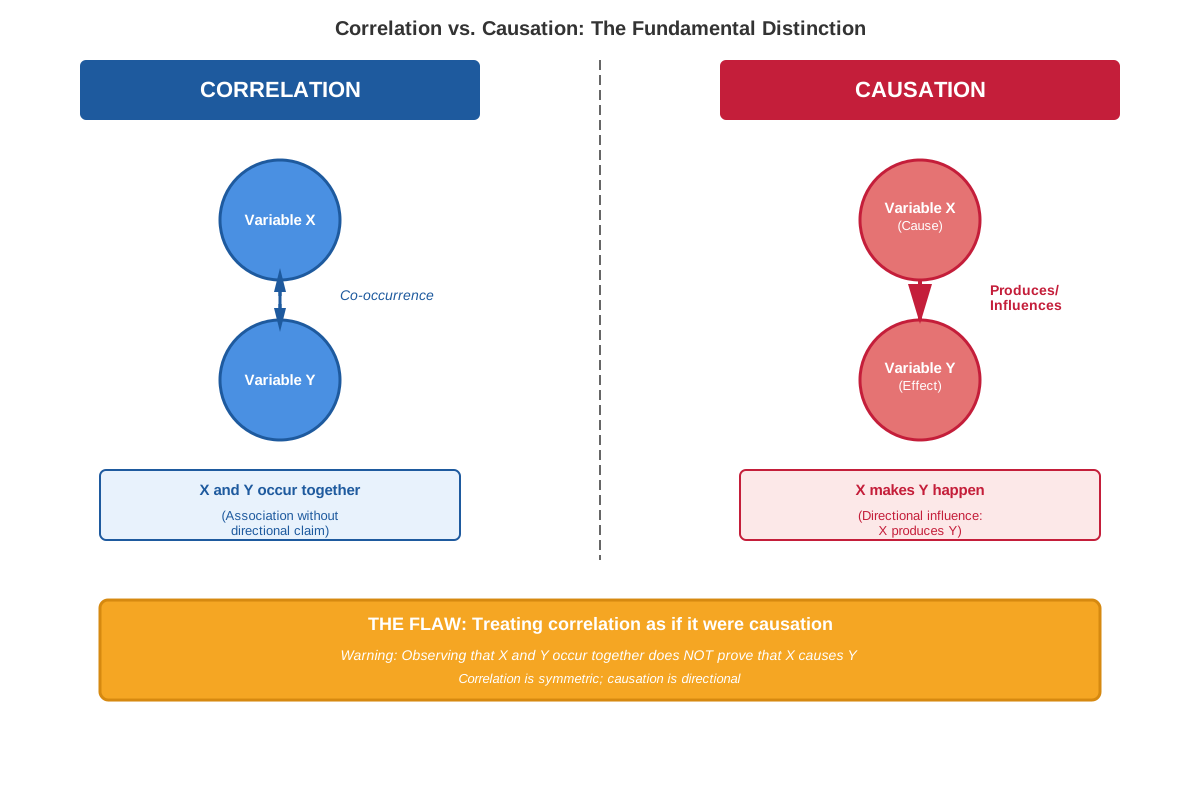
Correlation describes a relationship where two variables or phenomena occur together with some regularity. When X and Y are correlated, observing X makes Y more likely to be observed as well, or changes in X correspond to changes in Y. Crucially, correlation is a purely observational or statistical relationship that makes no claims about why the relationship exists.
Causation, by contrast, asserts that one phenomenon directly brings about or produces another. When X causes Y, X is not merely associated with Y but actually makes Y happen through some mechanism. Causal relationships imply that manipulating X will change Y, that X is sufficient or necessary for Y, and that there exists some explanatory connection between them.
The correlation versus causation fallacy occurs when an argument treats evidence of correlation as if it were evidence of causation. This represents a logical leap because correlation alone cannot establish the direction of causation, rule out common causes, or eliminate the possibility of coincidence.
Four Alternative Explanations for Correlation
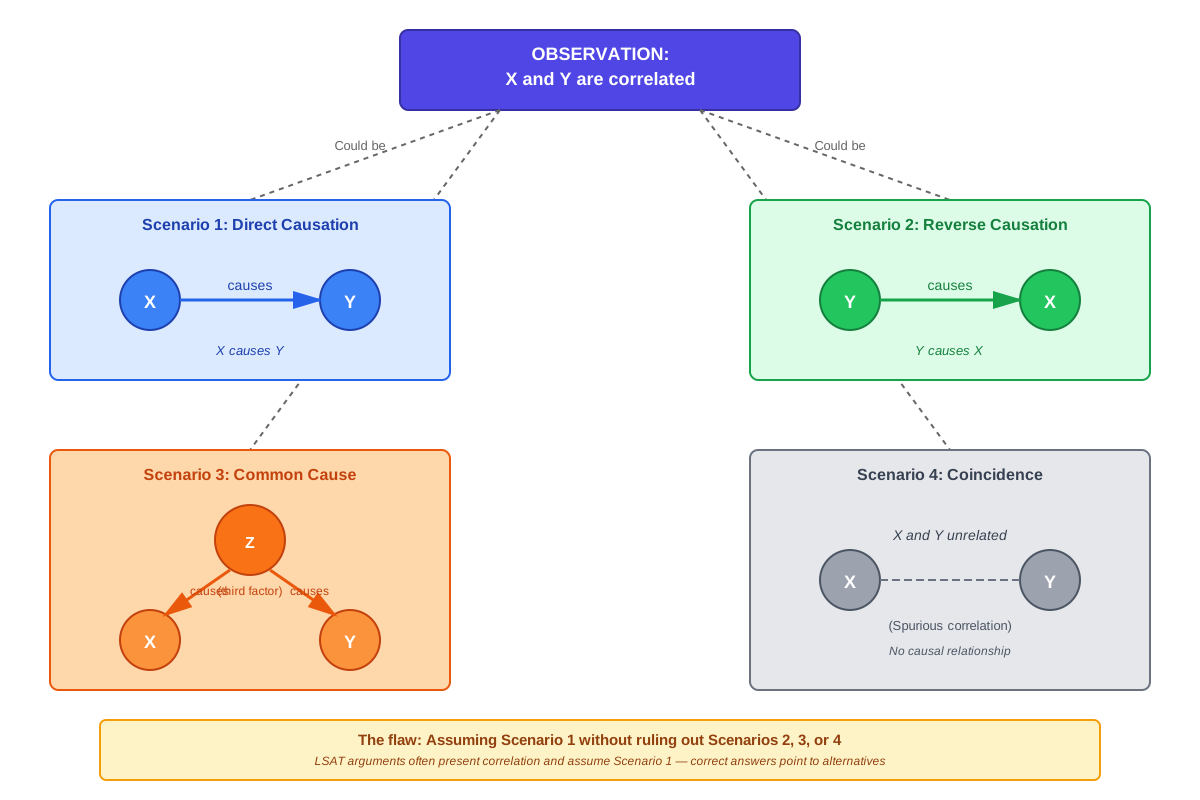
When two phenomena are correlated, several explanations exist beyond direct causation:
- Reverse Causation: Y might actually cause X, rather than X causing Y. An argument observing that successful companies have confident CEOs might conclude that confidence causes success, when actually success might cause confidence.
- Common Cause (Confounding Variable): A third factor Z might cause both X and Y, creating a correlation between them without any direct causal link. The ice cream and drowning example illustrates this: warm weather causes both increased ice cream sales and more swimming, which leads to more drownings.
- Coincidence: The correlation might be entirely accidental, especially with small sample sizes or when examining many variables simultaneously. Some correlations are simply statistical flukes.
- Complex Causal Chain: X and Y might both be parts of a larger causal network where their correlation results from indirect pathways rather than direct causation.
Temporal Relationships and Causation
A particularly common variant of the correlation-causation flaw involves temporal correlation—observing that X precedes Y and concluding that X caused Y. This reasoning pattern, sometimes called "post hoc ergo propter hoc" (after this, therefore because of this), is fallacious because temporal sequence alone does not establish causation.
For example: "After the new principal arrived, test scores improved. Therefore, the new principal caused the improvement." This argument ignores that many other factors might have changed simultaneously (new curriculum, demographic shifts, increased funding), that the improvement might have been part of an existing trend, or that the timing might be coincidental.
Necessary Conditions for Causal Claims
Legitimate causal arguments typically provide evidence beyond mere correlation:
| Evidence Type | What It Shows | Strength for Causation |
|---|---|---|
| Mere correlation | X and Y occur together | Weak—many alternative explanations |
| Temporal precedence | X occurs before Y | Weak—necessary but not sufficient |
| Mechanism explanation | How X produces Y | Moderate—strengthens plausibility |
| Controlled experiment | Manipulating X changes Y | Strong—rules out confounders |
| Dose-response relationship | More X produces more Y | Moderate—supports causation |
| Elimination of alternatives | Other explanations ruled out | Strong—increases confidence |
Recognizing Causal Language
LSAT arguments signal causal claims through specific language patterns:
Strong causal language: "causes," "produces," "brings about," "leads to," "results in," "is responsible for," "explains why," "accounts for"
Weaker causal language: "contributes to," "influences," "affects," "plays a role in," "is a factor in"
Correlational language: "is associated with," "correlates with," "occurs alongside," "is found together with," "accompanies," "coincides with"
Arguments committing the correlation-causation flaw typically present evidence using correlational or temporal language, then draw conclusions using causal language. This shift in language type signals the logical gap.
The Role of Alternative Explanations
Understanding the correlation-causation distinction requires facility with generating alternative explanations. When an LSAT argument claims X causes Y based on correlational evidence, the critical thinker immediately asks: "What else might explain this correlation?"
For example, if an argument states that countries with higher chocolate consumption have more Nobel Prize winners and concludes that chocolate consumption enhances cognitive ability, alternative explanations include: wealthier countries can afford both chocolate and better education systems (common cause), or Nobel Prize winners celebrate with chocolate (reverse causation).
Concept Relationships
The correlation versus causation concept sits at the intersection of several fundamental logical reasoning principles. It directly builds upon argument structure analysis, as identifying this flaw requires first recognizing the argument's conclusion (typically a causal claim) and premises (typically correlational evidence). The gap between these elements constitutes the flaw.
This concept connects intimately with sufficient and necessary conditions. A causal relationship (X causes Y) implies that X is sufficient for Y, or necessary for Y, or both. However, correlation alone establishes neither sufficiency nor necessity—it merely shows association. Understanding this distinction helps students recognize why correlational evidence cannot support causal conclusions without additional premises.
The relationship map flows as follows:
Argument Structure → enables identification of → Premises (correlation) vs. Conclusion (causation) → reveals → Logical Gap → which can be exploited in → Weaken Questions (by providing alternative explanations) or Strengthen Questions (by ruling out alternatives) or Assumption Questions (by identifying what must be true to bridge the gap) or Flaw Questions (by describing the error).
The correlation-causation distinction also relates to sampling and generalization issues. Many LSAT arguments present correlational data from a specific sample and make causal claims about a broader population, compounding the logical problems. Additionally, this concept connects to conditional reasoning errors, as students sometimes confuse "X is correlated with Y" with conditional statements like "If X, then Y."
High-Yield Facts
⭐ Correlation alone never proves causation—additional evidence is always required to establish a causal relationship.
⭐ Temporal precedence (X before Y) does not establish that X caused Y—this is the post hoc fallacy.
⭐ The correlation-causation flaw appears in approximately 15-20% of Logical Reasoning questions, making it one of the most frequently tested concepts.
⭐ Three main alternatives to direct causation are: reverse causation, common cause, and coincidence—generating these alternatives is key to Weaken questions.
⭐ Arguments shift from correlational language in premises to causal language in conclusions—this language shift signals the flaw.
- Controlled experiments provide stronger evidence for causation than observational studies because they can isolate variables and rule out confounders.
- The correlation-causation flaw can appear in any Logical Reasoning question type, not just Flaw questions.
- Correct answer choices describing this flaw often use phrases like "treats a correlation as evidence of causation" or "fails to consider alternative explanations."
- Eliminating alternative explanations strengthens causal arguments; introducing alternative explanations weakens them.
- Multiple correlations do not add up to causation—even if X correlates with Y in many contexts, this still does not prove X causes Y.
- The strength of a correlation (how closely X and Y track together) does not determine whether the relationship is causal.
- Arguments can commit the correlation-causation fallacy even when the causal claim is true—the flaw is in the reasoning, not necessarily the conclusion.
Quick check — test yourself on Correlation versus causation so far.
Try Flashcards →Common Misconceptions
Misconception: If X always occurs before Y, then X must cause Y.
Correction: Temporal precedence is necessary but not sufficient for causation. Night always precedes day, but night does not cause day. Many events occur in sequence without causal relationships. The argument must also rule out alternative explanations and provide a plausible mechanism.
Misconception: Strong correlations are more likely to be causal than weak correlations.
Correction: The strength of a correlation (how closely two variables track together) is independent of whether the relationship is causal. A weak correlation might reflect genuine causation with many confounding factors, while a strong correlation might result from a common cause or coincidence. Correlation strength is a statistical property; causation is a logical relationship.
Misconception: If an argument provides a mechanism explaining how X could cause Y, the correlation-causation flaw is eliminated.
Correction: While providing a mechanism strengthens a causal argument, it does not eliminate the flaw if the argument still relies primarily on correlational evidence. The mechanism shows plausibility, but alternative explanations must still be ruled out. A plausible story about how X causes Y does not prove that X actually does cause Y.
Misconception: The correlation-causation flaw only appears in Flaw questions.
Correction: This reasoning error appears across all Logical Reasoning question types. In Weaken questions, correct answers often provide alternative explanations for correlations. In Strengthen questions, correct answers rule out alternatives. In Assumption questions, correct answers state that no alternative explanation exists. Recognizing the underlying correlation-causation structure is essential regardless of question type.
Misconception: If an argument acknowledges that correlation does not prove causation but still draws a causal conclusion, the flaw is avoided.
Correction: Merely acknowledging the limitation does not fix the logical gap. If the argument's only evidence remains correlational, the conclusion is still inadequately supported regardless of whether the author admits the evidence is imperfect. The flaw exists in the logical structure, not in the author's awareness of potential problems.
Misconception: Reverse causation and common cause are the same thing.
Correction: These are distinct alternative explanations. Reverse causation means Y causes X (the opposite direction from what the argument claims). Common cause means a third factor Z causes both X and Y, with no direct causal link between them. Distinguishing these alternatives is crucial for answering Weaken and Strengthen questions correctly.
Worked Examples
Example 1: Classic Correlation-Causation Flaw
Argument: "A recent study found that children who attend preschool score higher on reading tests in third grade than children who do not attend preschool. Therefore, attending preschool causes improved reading ability."
Analysis:
Step 1: Identify the conclusion
The conclusion is a causal claim: "attending preschool causes improved reading ability."
Step 2: Identify the evidence
The evidence is correlational: children who attend preschool are associated with higher reading scores. This is an observational relationship, not experimental evidence.
Step 3: Identify the logical gap
The argument moves from "preschool attendance correlates with higher scores" to "preschool causes higher scores" without ruling out alternative explanations.
Step 4: Generate alternative explanations
- Common cause: Families who can afford preschool might also provide more books at home, read to children more frequently, or live in better school districts. Socioeconomic factors might cause both preschool attendance and higher reading scores.
- Reverse causation: Children with better pre-existing cognitive abilities might be more likely to be enrolled in preschool by parents who recognize their potential.
- Selection bias: Parents who prioritize education might both send children to preschool and engage in other educational activities at home.
Step 5: Connect to question types
- In a Flaw question, the correct answer might state: "treats evidence that two phenomena are correlated as proof that one causes the other."
- In a Weaken question, the correct answer might provide: "Most children who attend preschool come from families with higher incomes and more books in the home."
- In a Strengthen question, the correct answer might state: "The study controlled for family income, parental education, and home literacy environment."
This example demonstrates the core learning objective of identifying and explaining the correlation-causation reasoning pattern.
Example 2: Temporal Correlation Variant
Argument: "In the year following the implementation of a new traffic safety campaign, traffic fatalities decreased by 15%. This demonstrates that the safety campaign was effective in reducing traffic deaths."
Analysis:
Step 1: Identify the conclusion
The conclusion makes a causal claim: the safety campaign "was effective in reducing" (caused the reduction in) traffic deaths.
Step 2: Identify the evidence
The evidence establishes temporal correlation: the campaign was implemented, then fatalities decreased. The argument relies on the temporal sequence (post hoc reasoning).
Step 3: Identify the logical gap
The argument assumes that because the decrease followed the campaign, the campaign caused the decrease. This commits the post hoc fallacy, a specific type of correlation-causation error.
Step 4: Generate alternative explanations
- Existing trend: Traffic fatalities might have been decreasing for several years due to safer vehicle technology, and the campaign coincidentally occurred during this ongoing trend.
- Other simultaneous changes: New traffic laws, improved road conditions, or economic changes affecting driving patterns might have occurred at the same time.
- Weather or seasonal factors: The year following the campaign might have had unusually mild weather, reducing dangerous driving conditions.
- Regression to the mean: If the campaign was implemented after an unusually high-fatality year, the decrease might simply reflect a return to normal levels.
Step 5: Apply to LSAT strategy
This example shows why temporal language ("following," "after," "subsequently") should trigger careful scrutiny. The argument would be strengthened by evidence that: (1) no other relevant factors changed, (2) the decrease was greater than the existing trend, (3) the decrease occurred specifically in behaviors targeted by the campaign, or (4) similar campaigns in other locations produced similar results.
Step 6: Answer choice prediction
For a Flaw question, the correct answer might state: "fails to consider that the decrease might have resulted from factors other than the campaign" or "treats temporal succession as sufficient evidence of causal connection."
This example illustrates how to apply correlation-causation analysis to solve LSAT-style problems accurately, addressing the third learning objective.
Exam Strategy
Trigger Words and Phrases
When reading LSAT arguments, immediately heighten scrutiny when encountering these patterns:
In premises: "is associated with," "correlates with," "studies show that," "occurs alongside," "is found in," "after X occurred, Y occurred," "X and Y both increased"
In conclusions: "causes," "is responsible for," "explains," "leads to," "results in," "produces," "brings about"
The shift from correlational language to causal language signals a potential correlation-causation flaw.
Systematic Approach for Flaw Questions
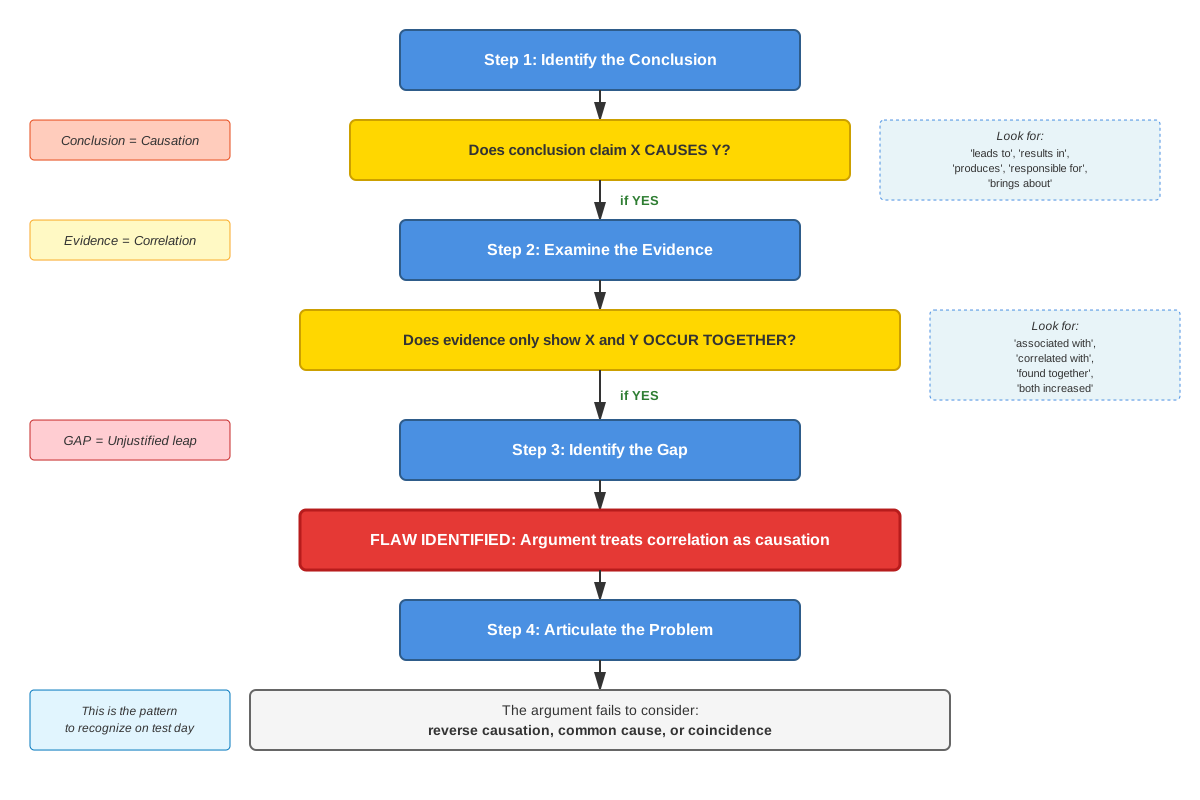
- Read the conclusion first to determine if it makes a causal claim
- Examine the premises to see if they provide only correlational or temporal evidence
- Ask: "What else could explain this correlation?"
- Generate at least two alternative explanations before looking at answer choices
- Predict the answer: "The argument treats correlation as causation" or "fails to rule out alternative explanations"
- Eliminate answers that describe different flaws or mischaracterize the argument
Process of Elimination Tips
Eliminate answer choices that:
- Describe the argument as confusing correlation with causation when the argument actually provides experimental evidence or rules out alternatives
- Claim the argument reverses cause and effect when it actually commits a different error
- Are too vague (e.g., "relies on insufficient evidence") when more specific answers about causation are available
- Describe flaws the argument does not commit (e.g., circular reasoning, equivocation)
Keep answer choices that:
- Explicitly mention treating correlation as causation
- Reference failing to consider alternative explanations
- Describe assuming no other factors are relevant
- Mention overlooking the possibility of reverse causation or common cause
Time Allocation
For correlation-causation questions:
- Flaw questions: 1:00-1:15 minutes (these are often straightforward once you recognize the pattern)
- Weaken questions: 1:15-1:30 minutes (requires generating and evaluating alternative explanations)
- Strengthen questions: 1:15-1:30 minutes (requires identifying which alternatives need to be ruled out)
The correlation-causation pattern is one of the most recognizable on the LSAT. Once identified, these questions should be answered efficiently, allowing more time for complex formal logic or parallel reasoning questions.
Question Type Variations
Flaw Questions: Look for answers describing the logical gap between correlational evidence and causal conclusion.
Weaken Questions: Correct answers typically provide alternative explanations (common cause, reverse causation) or show the correlation is coincidental.
Strengthen Questions: Correct answers rule out alternative explanations, provide mechanism evidence, or show the correlation holds across varied contexts.
Assumption Questions: Correct answers state that no alternative explanation exists or that the causal direction is as claimed.
Evaluate Questions: Correct answers ask whether alternative explanations exist or whether the correlation persists when confounding factors are controlled.
Memory Techniques
The "CRAC" Acronym
When you spot a correlation in an LSAT argument, remember CRAC to generate alternative explanations:
- Common cause (third factor causes both)
- Reverse causation (Y causes X, not X causes Y)
- Accidental/coincidental correlation
- Complex causal chain (indirect relationship)
The Traffic Light Visualization
Imagine a traffic light for causal claims:
- Red light (stop and question): Correlation or temporal evidence only
- Yellow light (proceed with caution): Mechanism provided but alternatives not ruled out
- Green light (accept): Controlled experiment or alternatives systematically eliminated
When an argument shows a red or yellow light but draws a strong causal conclusion, a flaw exists.
The "Before/After" Trap Reminder
Create a mental image of dominoes falling: Just because one domino falls before another doesn't mean the first caused the second to fall—someone might have pushed both, or they might have fallen independently. This visualization helps remember that temporal sequence alone does not establish causation.
The Three Questions Mantra
Memorize these three questions to ask whenever you see correlation:
- "Could it be backwards?" (reverse causation)
- "Could something else cause both?" (common cause)
- "Could it be coincidence?" (accidental correlation)
Rehearsing these questions makes generating alternatives automatic during the exam.
Summary
The correlation versus causation distinction represents a fundamental logical principle that appears throughout LSAT Logical Reasoning sections. This flaw occurs when arguments observe that two phenomena occur together—either simultaneously or in temporal sequence—and conclude without adequate justification that one causes the other. Correlation describes mere association or co-occurrence; causation asserts that one phenomenon produces or brings about another. The logical gap between these concepts creates one of the most commonly tested reasoning errors on the LSAT. Successful students recognize this flaw by noting the shift from correlational language in premises to causal language in conclusions, then systematically generate alternative explanations including reverse causation, common cause, and coincidence. This pattern appears across all Logical Reasoning question types: in Flaw questions where the error must be identified, in Weaken questions where alternative explanations undermine the argument, in Strengthen questions where ruling out alternatives supports the argument, and in Assumption questions where the absence of alternatives must be assumed. Mastering this concept requires both pattern recognition—spotting the telltale language shifts and evidence types—and active critical thinking—generating plausible alternatives that explain the observed correlation without accepting the causal claim.
Key Takeaways
- Correlation never proves causation—observing that X and Y occur together does not establish that X causes Y without additional evidence ruling out alternatives
- The three main alternative explanations are reverse causation, common cause, and coincidence—generate these systematically when evaluating causal arguments
- Temporal precedence alone is insufficient—"X before Y" does not prove "X caused Y" (the post hoc fallacy)
- Language shifts signal the flaw—watch for correlational language in premises ("associated with," "occurs alongside") shifting to causal language in conclusions ("causes," "produces," "explains")
- This flaw appears in 15-20% of Logical Reasoning questions across multiple question types, making it one of the highest-yield patterns to master
- Controlled experiments provide stronger causal evidence than observational studies—arguments citing experiments are less likely to commit this flaw
- Recognizing the pattern enables efficient question-solving—once identified, correlation-causation questions should be answered quickly and confidently
Related Topics
Necessary and Sufficient Conditions: Understanding the logical relationships between conditions deepens comprehension of causation, as causal relationships often involve sufficiency or necessity. Mastering correlation versus causation provides a foundation for analyzing more complex conditional arguments.
Sampling and Generalization Flaws: Many correlation-causation arguments also involve generalizing from samples to populations. Understanding both flaws together enables recognition of arguments with multiple logical gaps.
Weaken and Strengthen Question Strategies: The correlation-causation pattern appears most frequently in these question types. Mastering this topic directly improves performance on approximately 25-30% of all Weaken and Strengthen questions.
Alternative Explanation Reasoning: The skill of generating alternative explanations extends beyond correlation-causation to many other argument types. This topic builds the critical thinking foundation for advanced Logical Reasoning performance.
Formal Logic and Conditional Reasoning: Understanding the difference between "X is correlated with Y" and "If X, then Y" prevents confusion between statistical relationships and logical relationships, a distinction tested throughout the LSAT.
Practice CTA
Now that you understand the correlation versus causation distinction, you are prepared to tackle practice questions that test this high-yield concept. The pattern recognition and alternative-explanation skills developed through this guide will serve you across multiple question types and significantly improve your Logical Reasoning score. Approach the practice questions systematically: identify whether conclusions make causal claims, examine whether premises provide only correlational evidence, generate alternative explanations, and predict answers before evaluating choices. Remember that mastering this single concept can improve your performance on 15-20% of all Logical Reasoning questions—making it one of the most efficient uses of your study time. Challenge yourself to recognize the correlation-causation pattern within the first 15 seconds of reading an argument, and watch your speed and accuracy improve dramatically. You have the tools; now apply them with confidence!
Sign up free to keep reading
Create a free AnvayaPrep account to finish this LSAT guide on Correlation versus causation — plus flashcards and practice questions.