Overview
Contributing cause is a fundamental concept in LSAT Logical Reasoning that appears frequently across multiple question types, particularly in Strengthen, Weaken, Assumption, and Flaw questions. Unlike simple causal relationships where one factor alone produces an outcome, a contributing cause is one of multiple factors that work together to bring about an effect. Understanding this nuanced form of causation and explanation is essential for distinguishing between necessary causes, sufficient causes, and factors that merely contribute to an outcome without being solely responsible for it.
The LSAT tests contributing cause reasoning because it mirrors the complexity of real-world causal relationships. In legal reasoning, policy analysis, and everyday decision-making, outcomes rarely result from a single factor. A lawyer must understand that multiple factors may contribute to a client's situation, that correlation doesn't imply sole causation, and that identifying one contributing factor doesn't exclude others. The test-makers design questions that require students to recognize when an argument incorrectly treats a contributing cause as the only cause, when additional contributing factors strengthen or weaken a conclusion, or when an argument fails to consider alternative contributing causes.
This topic sits at the heart of the Causation and Explanation unit and connects directly to other causal reasoning patterns including correlation versus causation, necessary versus sufficient conditions, and alternative explanations. Mastering contributing cause reasoning enables students to navigate complex argument structures where multiple factors interact, to identify logical gaps in causal claims, and to evaluate evidence that either supports or undermines causal conclusions. This foundational understanding proves essential for achieving high scores on the LSAT's Logical Reasoning sections.
Learning Objectives
- [ ] Identify how Contributing cause appears in LSAT questions
- [ ] Explain the reasoning pattern behind Contributing cause
- [ ] Apply Contributing cause to solve LSAT-style problems accurately
- [ ] Distinguish between contributing causes, necessary causes, and sufficient causes in argument structures
- [ ] Recognize when arguments improperly eliminate or ignore contributing factors
- [ ] Evaluate answer choices that introduce new contributing causes to strengthen or weaken arguments
- [ ] Identify flawed reasoning that treats a contributing cause as the sole or primary cause
Prerequisites
- Basic causal reasoning: Understanding that causes produce effects and that arguments often claim causal relationships—this forms the foundation for recognizing more complex causal patterns like contributing causes.
- Correlation versus causation: Recognizing that two things occurring together doesn't mean one causes the other—essential for evaluating whether identified factors truly contribute to outcomes.
- Argument structure analysis: Ability to identify premises, conclusions, and logical gaps—necessary for spotting where contributing cause reasoning appears and where it breaks down.
- Necessary and sufficient conditions: Understanding these logical relationships helps distinguish contributing causes (which are neither necessary nor sufficient alone) from other causal factors.
Why This Topic Matters
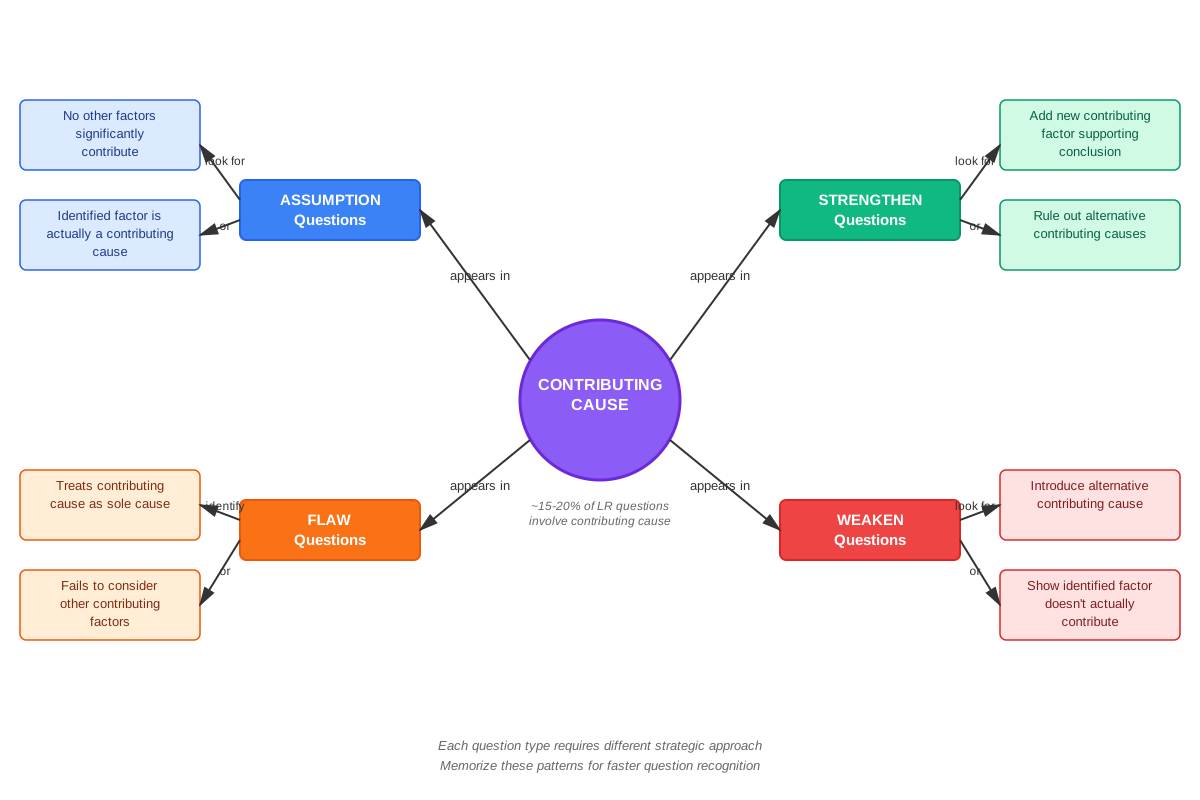
Contributing cause reasoning appears in approximately 15-20% of all Logical Reasoning questions on the LSAT, making it one of the highest-yield topics for test preparation. This concept appears most frequently in Strengthen questions (where adding a contributing factor supports a conclusion), Weaken questions (where eliminating a contributing factor or introducing an alternative undermines an argument), Flaw questions (where arguments incorrectly treat contributing causes), and Assumption questions (where the argument depends on assumptions about contributing factors).
In real-world applications, contributing cause reasoning is essential for legal practice, policy analysis, medical diagnosis, and scientific research. Attorneys must understand that multiple factors contribute to legal outcomes—a contract dispute might result from ambiguous language, changed circumstances, and bad faith, all contributing simultaneously. Judges and juries must weigh multiple contributing factors when determining liability or damages. Policy makers must recognize that social outcomes result from numerous contributing causes, not single interventions.
On the LSAT, contributing cause appears in passages discussing public health (multiple factors contributing to disease), economics (various factors affecting market outcomes), environmental issues (multiple causes of ecological problems), social phenomena (various contributors to behavioral patterns), and scientific explanations (multiple factors producing experimental results). The test consistently rewards students who can identify when arguments oversimplify causal relationships by ignoring contributing factors or who can recognize when additional contributing causes strengthen or weaken conclusions.
Core Concepts
Definition of Contributing Cause
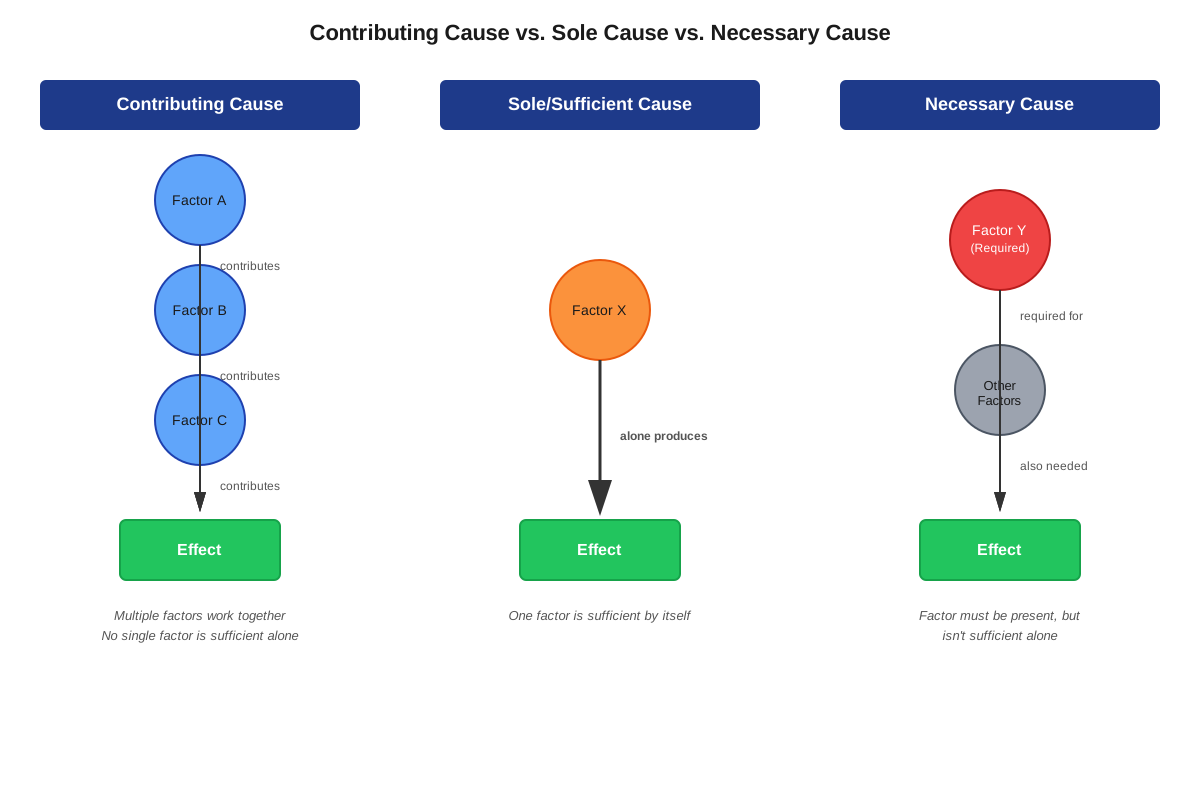
A contributing cause is a factor that plays a role in bringing about an effect but is neither necessary nor sufficient by itself to produce that effect. Unlike a sole cause (which alone produces the outcome) or a necessary cause (without which the outcome cannot occur), a contributing cause works alongside other factors to produce a result. Multiple contributing causes can combine to create an effect, and removing one contributing cause may reduce but not eliminate the outcome.
The key characteristics of contributing causes include: (1) they increase the likelihood or magnitude of an effect, (2) they work in conjunction with other factors, (3) the effect can still occur without any single contributing cause if other factors are present, and (4) the presence of one contributing cause doesn't exclude the relevance of others. Understanding these characteristics helps distinguish contributing causes from other causal relationships that appear on the LSAT.
Contributing Cause vs. Other Causal Relationships
| Causal Relationship | Definition | Example | LSAT Relevance |
|---|---|---|---|
| Contributing Cause | One of multiple factors that helps produce an effect | Lack of exercise contributes to heart disease (along with diet, genetics, stress) | Most common; arguments often oversimplify by ignoring other contributors |
| Necessary Cause | Must be present for effect to occur | Oxygen is necessary for fire | Arguments may confuse contributing with necessary causes |
| Sufficient Cause | Alone guarantees the effect | Decapitation is sufficient for death | Rare on LSAT; helps contrast with contributing causes |
| Sole Cause | The only factor producing the effect | Pressing the button is the sole cause of the bell ringing | Arguments often incorrectly treat contributing causes as sole causes |
How Contributing Cause Appears in LSAT Arguments
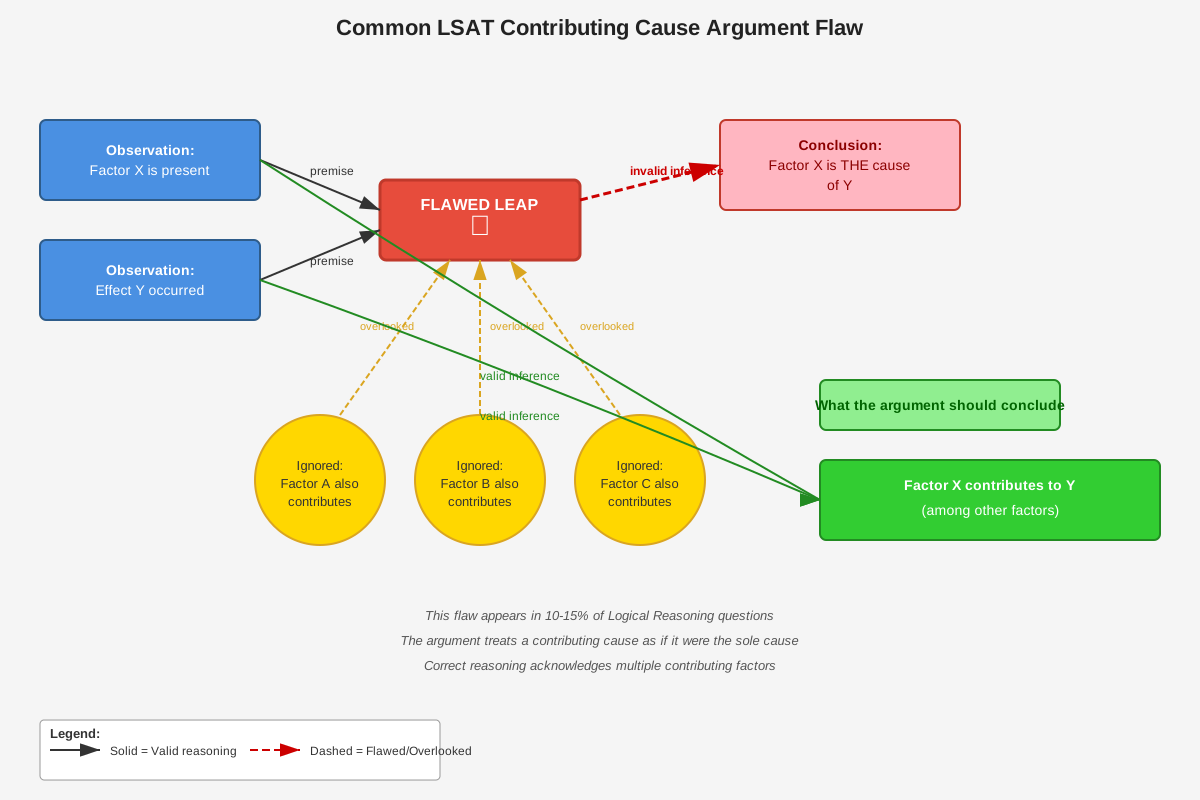
LSAT contributing cause reasoning typically appears in three patterns. First, arguments may identify one contributing cause and incorrectly conclude it's the primary or only cause, ignoring other factors. For example: "Since the introduction of speed cameras, traffic accidents have decreased. Therefore, speed cameras are responsible for the reduction in accidents." This argument treats speed cameras as the sole cause while ignoring other potential contributing factors like improved road design, better vehicle safety features, or demographic changes.
Second, arguments may acknowledge multiple contributing causes but fail to weigh their relative importance or interaction effects. An argument might note that both advertising and product quality affect sales but then draw conclusions as if only one factor matters. Third, arguments may use evidence about one contributing cause to make claims about overall causation without considering whether other contributing factors might be more significant.
The Logical Structure of Contributing Cause Arguments
Contributing cause arguments follow a recognizable pattern:
- Observation: An effect or outcome is identified (e.g., "Crime rates have decreased")
- Correlation: A factor is noted that correlates with or precedes the effect (e.g., "Police presence increased")
- Causal Claim: The argument concludes the factor causes or contributes to the effect (e.g., "Increased police presence reduced crime")
- Logical Gap: The argument fails to adequately address alternative or additional contributing causes
The strength of a contributing cause argument depends on: (1) the strength of correlation between the proposed cause and effect, (2) the plausibility of the causal mechanism, (3) whether alternative contributing causes have been ruled out or acknowledged, (4) whether the temporal sequence supports causation (cause precedes effect), and (5) whether confounding variables have been controlled.
Common Flaws in Contributing Cause Reasoning
Arguments involving contributing causes frequently commit several logical errors. The single-cause fallacy occurs when an argument treats one contributing cause as if it were the sole cause, ignoring other relevant factors. For example: "Students who eat breakfast perform better academically. Therefore, providing free breakfast will solve our school's academic performance problems." This ignores other contributing factors like teaching quality, class size, home environment, and student motivation.
The post hoc fallacy (post hoc ergo propter hoc—"after this, therefore because of this") occurs when arguments assume that because one event preceded another, it must have contributed to causing it, without establishing a genuine causal connection. The reverse causation error mistakes which factor is the cause and which is the effect. The confounding variable error fails to recognize that a third factor might be causing both the proposed cause and the effect, creating a spurious correlation.
Strengthening and Weakening Contributing Cause Arguments
On the LSAT, answer choices strengthen contributing cause arguments by: (1) providing evidence that the proposed contributing cause actually preceded the effect, (2) showing a mechanism by which the cause could produce the effect, (3) demonstrating that the correlation holds across different contexts, (4) ruling out alternative contributing causes, or (5) showing that when the proposed cause is absent, the effect diminishes even when other factors remain constant.
Answer choices weaken contributing cause arguments by: (1) introducing alternative contributing causes that better explain the effect, (2) showing the proposed cause occurred after the effect (reversing temporal sequence), (3) demonstrating that the effect occurs without the proposed cause, (4) revealing confounding variables, or (5) showing that the correlation disappears when other factors are controlled. Understanding these patterns enables rapid evaluation of answer choices in Strengthen and Weaken questions.
Concept Relationships
Contributing cause reasoning connects to multiple other concepts within Logical Reasoning. The relationship flows as follows: Basic causal reasoning (understanding that causes produce effects) → Correlation versus causation (recognizing that co-occurrence doesn't prove causation) → Contributing cause (understanding that multiple factors can work together to produce effects) → Complex causal analysis (evaluating arguments with multiple interacting causes).
Contributing cause also relates to necessary and sufficient conditions. A necessary cause must be present for an effect (if no cause, then no effect), while a sufficient cause guarantees an effect (if cause, then effect). Contributing causes are neither necessary nor sufficient—they increase the likelihood or magnitude of an effect but don't guarantee it and aren't required for it. This distinction helps students avoid confusing these different causal relationships on the LSAT.
The concept connects to assumption questions because arguments about contributing causes often assume: (1) that other contributing factors aren't more important, (2) that the identified factor actually contributes rather than merely correlating, (3) that the causal direction is correct, and (4) that no confounding variables explain the relationship. Identifying these assumptions is essential for Assumption and Necessary Assumption questions.
Contributing cause reasoning also underlies many Flaw questions, where arguments commit errors like treating a contributing cause as a sole cause, ignoring alternative contributing factors, or failing to establish that correlation indicates contribution. The concept extends to Paradox questions, where apparent contradictions often resolve by recognizing that multiple contributing causes can produce unexpected patterns.
High-Yield Facts
⭐ A contributing cause is one of multiple factors that helps produce an effect but is neither necessary nor sufficient alone to cause that effect.
⭐ The most common flaw in contributing cause arguments is treating one contributing factor as if it were the sole or primary cause while ignoring other relevant factors.
⭐ Strengthening a contributing cause argument often involves ruling out alternative contributing causes or demonstrating the proposed cause's mechanism of action.
⭐ Weakening a contributing cause argument typically involves introducing alternative contributing causes that better explain the effect or showing the proposed cause doesn't actually precede the effect.
⭐ Arguments that move from "X contributes to Y" to "X is responsible for Y" or "X is the main cause of Y" commit a logical error by overstating the role of one contributing factor.
- Contributing causes can work additively (each adds to the effect) or synergistically (they interact to produce effects greater than their sum).
- The presence of one contributing cause doesn't exclude the relevance of other contributing causes—multiple factors can simultaneously contribute to the same effect.
- Temporal sequence is necessary but not sufficient for establishing contributing causation—the proposed cause must precede the effect, but precedence alone doesn't prove contribution.
- Confounding variables can create the appearance of contributing causation when a third factor actually causes both the proposed cause and the observed effect.
- The relative importance of different contributing causes matters—an argument can be weakened by showing that other contributing factors are more significant than the one identified.
- Contributing cause reasoning appears most frequently in Strengthen, Weaken, Flaw, and Assumption question types on the LSAT.
- Arguments about public policy, health outcomes, economic effects, and social phenomena almost always involve multiple contributing causes rather than single causes.
Quick check — test yourself on Contributing cause so far.
Try Flashcards →Common Misconceptions
Misconception: If a factor contributes to an effect, it must be necessary for that effect to occur.
Correction: Contributing causes are not necessary—the effect can still occur through other contributing factors even if one particular contributing cause is absent. Multiple different combinations of contributing causes can produce the same effect.
Misconception: Identifying one contributing cause means other factors are irrelevant or less important.
Correction: Multiple contributing causes can be equally important or even more important than the identified factor. Finding one contributing cause doesn't diminish the relevance of others, and other factors may actually be more significant in producing the effect.
Misconception: If two things are correlated and one precedes the other, the first must contribute to causing the second.
Correction: Temporal precedence and correlation are necessary but not sufficient for establishing contributing causation. A third factor might cause both, the correlation might be coincidental, or the relationship might not be causal despite the temporal sequence.
Misconception: Weakening a contributing cause argument requires proving the proposed cause has no effect whatsoever.
Correction: To weaken a contributing cause argument, you need only show that other factors are more important, that the proposed cause's contribution is minimal, or that alternative explanations better account for the effect. Complete elimination of the proposed cause's contribution isn't necessary.
Misconception: If removing a contributing cause doesn't eliminate the effect entirely, the cause wasn't really contributing.
Correction: By definition, contributing causes work alongside other factors, so removing one contributing cause typically reduces but doesn't eliminate the effect. The persistence of the effect after removing one factor doesn't prove that factor wasn't contributing—it simply confirms that other contributing factors remain.
Misconception: Strengthening a contributing cause argument requires proving it's the most important or primary cause.
Correction: To strengthen a contributing cause argument, you need only provide evidence that the factor genuinely contributes to the effect, not that it's the most important factor. Showing a plausible mechanism, ruling out some alternatives, or demonstrating consistent correlation across contexts all strengthen the argument without proving primacy.
Worked Examples
Example 1: Identifying Contributing Cause in a Weaken Question
Stimulus: "Over the past decade, the city of Riverside has experienced a significant decrease in residential burglaries. During this same period, the city implemented a neighborhood watch program that now covers 60% of residential areas. Clearly, the neighborhood watch program has been effective in reducing burglaries."
Question: Which of the following, if true, most weakens the argument?
Answer Choices:
(A) Some neighborhoods with active watch programs still experience occasional burglaries.
(B) During the same decade, Riverside experienced significant demographic changes, with younger residents moving to suburbs and an aging population remaining in the city.
(C) Neighborhood watch programs in other cities have also been associated with reduced crime rates.
(D) The neighborhood watch program has been most active in areas that historically had low burglary rates.
(E) Residents in neighborhoods with watch programs report feeling safer than those without such programs.
Analysis:
The argument commits a classic contributing cause error: it observes a correlation between the neighborhood watch program and decreased burglaries, then concludes the program caused the decrease. The logical gap is that the argument ignores alternative contributing causes for the reduction in burglaries.
Let's evaluate each answer:
(A) This doesn't weaken the argument. The argument claims the program is effective (contributes to reduction), not that it eliminates all burglaries. Contributing causes don't need to completely eliminate effects.
(B) This significantly weakens the argument by introducing an alternative contributing cause. Demographic changes (aging population) could explain reduced burglaries because younger people commit most burglaries. This suggests the demographic shift, not the watch program, might be the primary contributing cause.
(C) This actually strengthens the argument by showing the correlation holds in other contexts, making it more likely the program genuinely contributes to reduced crime.
(D) This weakens the argument somewhat by suggesting reverse causation or selection bias—the program was implemented where burglaries were already low, so the program might not be causing the low rates.
(E) This is irrelevant to whether the program actually reduces burglaries. Feeling safer doesn't mean burglaries actually decreased due to the program.
Answer: (B)
This example demonstrates how LSAT questions test contributing cause reasoning by presenting an argument that identifies one potential cause and asking students to recognize alternative contributing causes that weaken the causal claim.
Example 2: Contributing Cause in a Strengthen Question
Stimulus: "Researchers found that students who regularly participate in music programs demonstrate higher mathematical aptitude than students who don't participate in music programs. The researchers concluded that music education contributes to the development of mathematical skills."
Question: Which of the following, if true, most strengthens the researchers' conclusion?
Answer Choices:
(A) Students with higher mathematical aptitude are more likely to choose to participate in music programs.
(B) The correlation between music participation and mathematical aptitude holds even when controlling for factors such as family income, parental education, and overall academic motivation.
(C) Some students who don't participate in music programs still demonstrate high mathematical aptitude.
(D) Music programs teach rhythm and pattern recognition, which are unrelated to mathematical thinking.
(E) Schools with strong music programs also tend to have well-funded mathematics departments.
Analysis:
The argument claims that music education contributes to mathematical skills based on correlation. To strengthen this contributing cause claim, we need evidence that: (1) rules out alternative explanations, (2) establishes a plausible mechanism, (3) shows the causal direction is correct, or (4) demonstrates the correlation isn't due to confounding variables.
(A) This actually weakens the argument by suggesting reverse causation—mathematical aptitude might cause music participation rather than music participation contributing to mathematical aptitude.
(B) This strongly strengthens the argument by ruling out confounding variables. If the correlation persists even when controlling for income, parental education, and motivation (all potential alternative contributing causes), it's more likely that music education genuinely contributes to mathematical skills rather than these other factors explaining both.
(C) This doesn't weaken or strengthen the argument. The claim is that music contributes to mathematical skills, not that it's necessary for them. Contributing causes don't need to be present in every case of the effect.
(D) This weakens the argument by undermining the plausible mechanism—if music skills are unrelated to mathematical thinking, it's less likely music education contributes to mathematical aptitude.
(E) This introduces a confounding variable (well-funded math departments) that could explain the correlation, thus weakening rather than strengthening the argument.
Answer: (B)
This example shows how strengthening contributing cause arguments often involves ruling out alternative contributing causes or confounding variables, making it more likely the proposed factor genuinely contributes to the effect.
Exam Strategy
When approaching LSAT contributing cause questions, begin by identifying the argument's causal claim. Look for language indicating causation: "contributes to," "leads to," "results in," "causes," "is responsible for," "explains," or "accounts for." Once you've identified the causal claim, determine whether the argument treats the cause as sole, necessary, sufficient, or contributing.
Trigger words and phrases that signal contributing cause reasoning include: "one factor," "contributes to," "plays a role in," "helps explain," "partly responsible for," "among the causes," "a reason for," and "influences." These phrases suggest the argument acknowledges or should acknowledge multiple factors. Conversely, watch for language that overstates causation: "the cause," "entirely responsible," "the only factor," "completely explains," or "the reason"—these often indicate the argument is treating a contributing cause as more than it is.
For Weaken questions involving contributing causes, prioritize answer choices that: (1) introduce alternative contributing causes that better explain the effect, (2) show the proposed cause occurred after the effect, (3) reveal confounding variables, or (4) demonstrate that when the proposed cause varies, the effect doesn't vary correspondingly. Eliminate answers that merely show the proposed cause isn't necessary or sufficient—contributing causes are neither by definition.
For Strengthen questions, prioritize answers that: (1) rule out alternative contributing causes, (2) establish temporal precedence (cause before effect), (3) provide a plausible mechanism, (4) show the correlation holds across different contexts, or (5) demonstrate that controlling for other variables doesn't eliminate the correlation. Avoid answers that merely restate the correlation or that show the cause is sometimes present without the effect (which doesn't undermine contributing causation).
Exam Tip: In Flaw questions, the most common contributing cause flaw is "treats a factor that contributes to an effect as if it were the only factor" or "fails to consider alternative explanations." Learn to recognize this pattern quickly.
Time allocation: Spend 15-20 seconds identifying the causal claim and the logical gap (what alternative causes are ignored), then 30-40 seconds evaluating answer choices. Don't get stuck trying to prove an answer is perfect—eliminate clearly wrong answers and choose the best remaining option. Contributing cause questions reward systematic elimination more than perfect certainty.
For process of elimination, immediately eliminate answers that: (1) are irrelevant to the causal relationship, (2) address a different cause-effect relationship than the one in the argument, (3) in Weaken questions, merely show the cause isn't necessary or sufficient, or (4) in Strengthen questions, introduce new problems or alternative causes. Focus on answers that directly address whether the proposed factor genuinely contributes to the stated effect.
Memory Techniques
Mnemonic for Contributing Cause Characteristics: MINI helps remember that contributing causes are:
- Multiple factors work together
- Increases likelihood but doesn't guarantee
- Not necessary (effect can occur without it)
- Insufficient alone (needs other factors)
Visualization strategy: Picture contributing causes as multiple streams flowing into a river. Each stream (contributing cause) adds water (contributes to the effect), but no single stream is the river (sole cause). The river (effect) could exist with different combinations of streams, and removing one stream reduces but doesn't eliminate the river. This image helps remember that contributing causes work together and that multiple combinations can produce the same effect.
Acronym for Weakening Contributing Cause Arguments: REACT
- Reverse causation (effect actually causes the proposed cause)
- Eliminate temporal precedence (cause didn't come first)
- Alternative causes (other factors better explain the effect)
- Confounding variables (third factor causes both)
- Time-based analysis (correlation doesn't persist over time)
Acronym for Strengthening Contributing Cause Arguments: PRIME
- Precedence established (cause clearly before effect)
- Rule out alternatives (eliminate other explanations)
- Identify mechanism (show how cause produces effect)
- Multiple contexts (correlation holds across situations)
- Eliminate confounds (control for other variables)
Summary
Contributing cause reasoning represents one of the most frequently tested concepts in LSAT Logical Reasoning, appearing in approximately 15-20% of questions across Strengthen, Weaken, Flaw, and Assumption question types. A contributing cause is a factor that helps produce an effect while working alongside other factors, but is neither necessary nor sufficient alone to cause that effect. The LSAT tests this concept because real-world outcomes—whether legal, social, economic, or scientific—typically result from multiple contributing factors rather than single causes. Arguments frequently commit errors by treating contributing causes as sole causes, ignoring alternative contributing factors, or failing to establish that correlation indicates genuine contribution. Strengthening contributing cause arguments involves ruling out alternatives, establishing plausible mechanisms, and demonstrating that correlations persist when controlling for confounding variables. Weakening such arguments requires introducing alternative contributing causes, revealing confounding variables, or showing that temporal sequence or correlation doesn't support the causal claim. Mastering contributing cause reasoning enables students to navigate complex causal arguments, identify logical gaps, and systematically evaluate answer choices that address multiple-factor causation.
Key Takeaways
- Contributing causes are factors that help produce effects while working with other factors, but are neither necessary nor sufficient alone—multiple contributing causes typically combine to produce outcomes.
- The most common flaw in contributing cause arguments is treating one contributing factor as if it were the sole or primary cause while ignoring other relevant contributing factors.
- Strengthen contributing cause arguments by ruling out alternative causes, establishing temporal precedence, providing plausible mechanisms, or showing correlations persist when controlling for confounding variables.
- Weaken contributing cause arguments by introducing alternative contributing causes, revealing confounding variables, demonstrating reverse causation, or showing the proposed cause doesn't precede the effect.
- Contributing cause questions appear most frequently in Strengthen, Weaken, Flaw, and Assumption question types, making this one of the highest-yield topics for LSAT preparation.
- Recognize trigger language: "contributes to," "one factor," "plays a role" suggest contributing causes, while "the cause," "solely responsible," "the only factor" indicate arguments overstating causation.
- The presence of one contributing cause doesn't exclude others—multiple factors can simultaneously contribute to the same effect with varying degrees of importance.
Related Topics
Necessary and Sufficient Conditions: Understanding the distinction between necessary causes (must be present for effect), sufficient causes (alone guarantee effect), and contributing causes (help produce effect with other factors) is essential for advanced causal reasoning on the LSAT. Mastering contributing causes provides the foundation for analyzing these more specific causal relationships.
Correlation versus Causation: This prerequisite topic extends naturally into contributing cause reasoning. While correlation versus causation addresses whether any causal relationship exists, contributing cause reasoning addresses the complexity of causal relationships when they do exist, particularly when multiple factors contribute.
Alternative Explanations: Contributing cause reasoning connects directly to evaluating alternative explanations. Many Weaken and Strengthen questions involving contributing causes essentially ask whether alternative contributing factors better explain observed effects.
Confounding Variables: This advanced topic builds on contributing cause reasoning by examining how third factors can create spurious correlations between proposed causes and effects. Understanding contributing causes enables more sophisticated analysis of confounding variables.
Causal Chains and Complex Causation: After mastering contributing causes, students can progress to analyzing arguments involving multiple causal steps, feedback loops, and interactive effects where contributing causes influence each other as well as the final outcome.
Practice CTA
Now that you've mastered the core concepts of contributing cause reasoning, it's time to apply this knowledge to actual LSAT questions. Work through the practice questions and flashcards to reinforce your understanding and develop the pattern recognition skills essential for quickly identifying contributing cause reasoning on test day. Remember that contributing cause appears in 15-20% of Logical Reasoning questions—mastering this topic will directly improve your score. Focus on identifying the causal claims in arguments, recognizing when arguments oversimplify by ignoring contributing factors, and systematically evaluating answer choices that introduce or eliminate contributing causes. Your investment in practicing this high-yield topic will pay dividends across multiple question types on the LSAT.
Sign up free to keep reading
Create a free AnvayaPrep account to finish this LSAT guide on Contributing cause — plus flashcards and practice questions.