Overview
Controlled studies represent one of the most frequently tested concepts in LSAT Logical Reasoning, appearing in questions that assess a test-taker's ability to evaluate scientific evidence, identify flaws in experimental design, and distinguish between correlation and causation. These studies form the backbone of empirical reasoning in the causation and explanation unit, providing a structured methodology for establishing causal relationships while eliminating alternative explanations.
On the LSAT, controlled studies appear in various question types including Strengthen/Weaken questions, Flaw questions, Method of Reasoning questions, and Assumption questions. Understanding how proper experimental controls work—and recognizing when they're absent or inadequate—is essential for scoring in the upper percentiles. The test frequently presents arguments that draw causal conclusions from observational data or poorly designed experiments, requiring test-takers to identify what's missing or what would make the reasoning more sound.
The concept of controlled studies connects directly to broader logical reasoning principles including causal reasoning, necessary and sufficient conditions, and the evaluation of evidence quality. Mastering this topic enables students to critically assess any argument that claims one factor causes another, making it foundational not only for the Logical Reasoning section but also for Reading Comprehension passages that discuss scientific studies or policy recommendations based on empirical research.
Learning Objectives
- [ ] Identify how Controlled studies appears in LSAT questions
- [ ] Explain the reasoning pattern behind Controlled studies
- [ ] Apply Controlled studies to solve LSAT-style problems accurately
- [ ] Distinguish between properly controlled experiments and flawed study designs
- [ ] Recognize the role of control groups in establishing causation
- [ ] Evaluate whether alternative explanations have been adequately ruled out
- [ ] Identify confounding variables that undermine causal claims
Prerequisites
- Basic understanding of causation vs. correlation: Necessary to distinguish between mere association and genuine causal relationships that controlled studies aim to establish
- Familiarity with argument structure: Required to identify conclusions, premises, and gaps in reasoning within passages describing studies
- Knowledge of necessary and sufficient conditions: Helps understand what conditions must be present or absent to establish causation
- Understanding of alternative explanations: Essential for recognizing why control groups are needed to rule out competing hypotheses
Why This Topic Matters
Controlled studies appear in approximately 15-20% of Logical Reasoning questions across both LR sections, making this one of the highest-yield topics for LSAT preparation. Questions involving experimental design, study methodology, and causal reasoning consistently appear on every administration of the test. Understanding controlled studies is particularly crucial because these questions often separate high scorers from mid-range performers—they require nuanced thinking about what makes evidence strong or weak.
In real-world applications, controlled studies form the foundation of scientific research, medical trials, policy evaluation, and evidence-based decision-making. Legal professionals regularly encounter expert testimony based on studies, making the ability to evaluate research methodology directly relevant to legal practice. The LSAT tests this skill because lawyers must assess the strength of empirical claims in litigation, regulatory matters, and policy advocacy.
On the exam, controlled studies most commonly appear in:
- Strengthen/Weaken questions asking what would make a causal claim more or less convincing
- Flaw questions identifying problems with how a study was conducted or interpreted
- Assumption questions requiring identification of what must be true for a study's conclusion to follow
- Method of Reasoning questions describing how an argument uses experimental evidence
- Parallel Reasoning questions matching the structure of arguments involving studies
Core Concepts
What Are Controlled Studies?
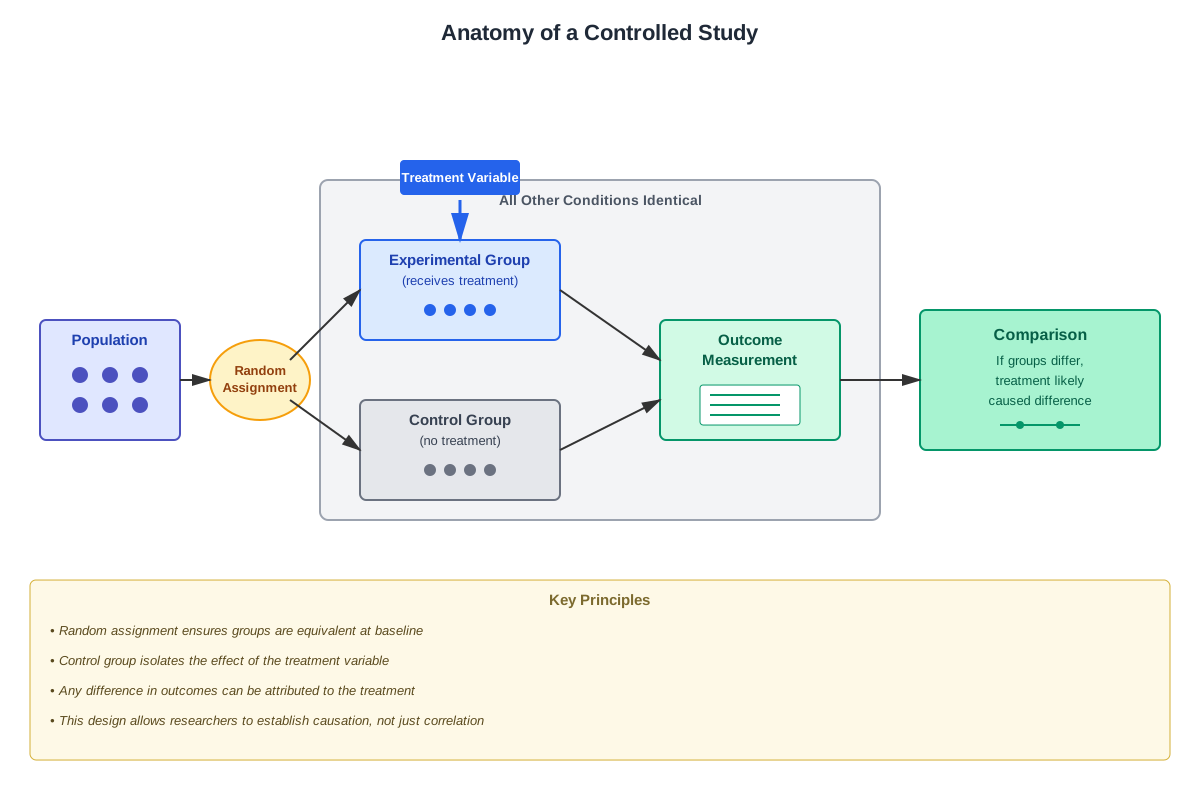
A controlled study is an experimental design that attempts to establish causation by systematically comparing two or more groups that differ only in the variable being tested. The fundamental principle is isolation: by keeping all factors constant except the one under investigation, researchers can attribute any observed differences in outcomes to that single variable rather than to confounding factors.
The essential components of a properly controlled study include:
- Experimental group: Receives the treatment or intervention being tested
- Control group: Does not receive the treatment, providing a baseline for comparison
- Random assignment: Participants are randomly allocated to groups to prevent selection bias
- Controlled variables: All other potentially relevant factors are kept constant or accounted for
The Logic of Control Groups
The control group serves as the counterfactual—it shows what would have happened to the experimental group if they had not received the treatment. Without this comparison, it's impossible to know whether observed changes resulted from the treatment or from other factors like time passage, natural variation, or the placebo effect.
Consider this reasoning pattern:
- Group A receives treatment X and shows outcome Y
- Group B (identical to Group A in all relevant ways) does not receive treatment X and does not show outcome Y
- Therefore, treatment X likely caused outcome Y
The strength of this inference depends entirely on whether the groups are truly "identical in all relevant ways." This is where most LSAT questions focus: identifying what factors might differ between groups and thus provide alternative explanations.
Types of Variables in Controlled Studies
| Variable Type | Definition | Example | LSAT Relevance |
|---|---|---|---|
| Independent variable | The factor manipulated by researchers | Type of medication given | What the study is testing |
| Dependent variable | The outcome being measured | Patient recovery rate | What the study concludes about |
| Controlled variable | Factors kept constant across groups | Patient age, dosage timing | What must be equal for valid comparison |
| Confounding variable | Uncontrolled factors that might affect results | Patients' exercise habits | What weakens the study's conclusion |
Common Flaws in Study Design
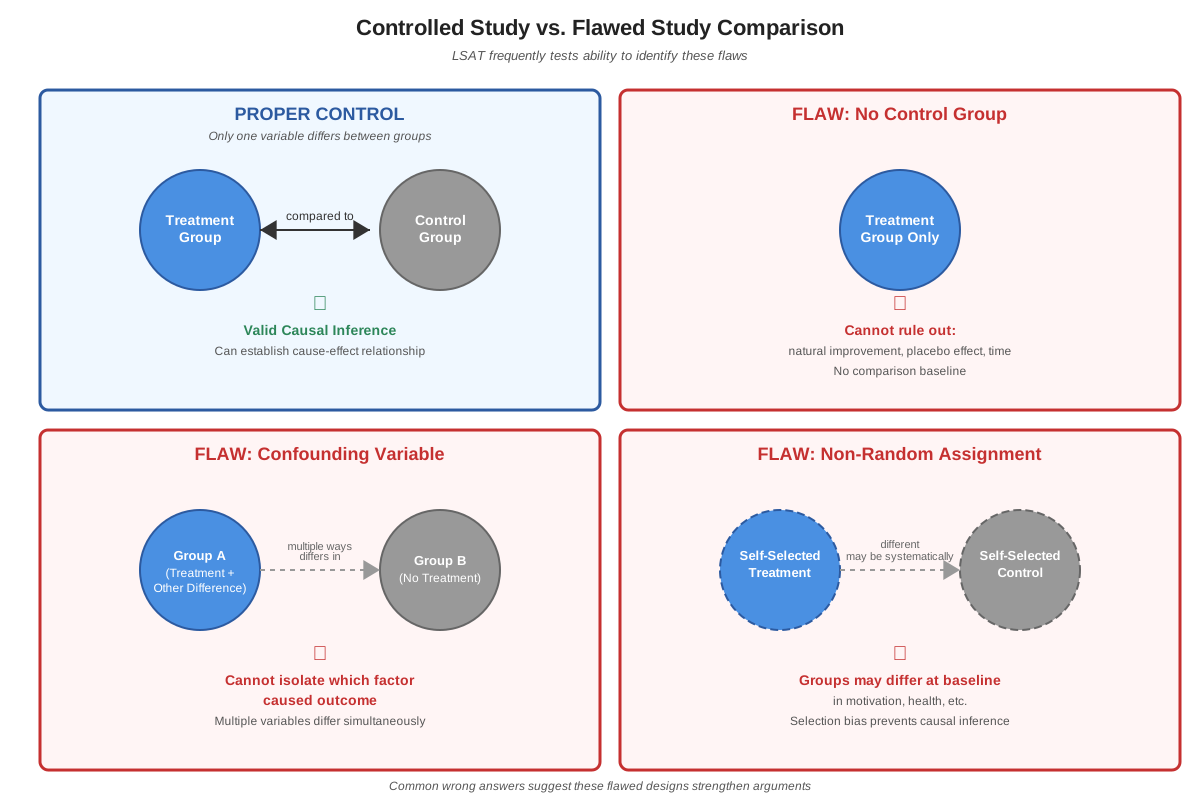
The LSAT frequently presents studies with methodological problems. Recognizing these flaws is crucial:
Lack of Control Group: The study only observes the experimental group without comparison. This makes it impossible to determine whether changes would have occurred anyway.
Non-Random Assignment: Participants self-select into groups or are assigned based on characteristics that might correlate with outcomes. For example, if healthier patients choose to take a medication, their better outcomes might reflect their initial health rather than the medication's effectiveness.
Uncontrolled Variables: Factors other than the independent variable differ between groups. If the experimental group receives both a new drug and extra medical attention while the control group receives neither, any improvement could result from either factor.
Inadequate Sample Size: Too few participants make results unreliable and susceptible to random variation.
Measurement Problems: The dependent variable is poorly defined, subjectively assessed, or measured differently across groups.
Establishing Causation Through Control
For a controlled study to establish that X causes Y, it must demonstrate:
- Correlation: X and Y occur together (or X's presence correlates with Y's presence)
- Temporal precedence: X occurs before Y
- Elimination of alternative explanations: No other factor plausibly explains the X-Y relationship
The third criterion is where control becomes essential. A properly controlled study systematically rules out alternative explanations by ensuring that only the hypothesized cause differs between groups. When the LSAT asks what would "strengthen" or "weaken" a causal argument based on a study, the correct answer typically addresses whether alternative explanations have been adequately eliminated.
The Placebo Effect and Blinding
Advanced controlled studies use blinding to prevent expectations from influencing results:
- Single-blind: Participants don't know which group they're in
- Double-blind: Neither participants nor researchers assessing outcomes know group assignments
The LSAT occasionally tests understanding of why blinding matters: if participants know they're receiving treatment, their expectations might produce psychological or behavioral changes that affect outcomes independently of the treatment's direct effects.
Observational Studies vs. Controlled Experiments
The LSAT often contrasts these approaches:
Observational studies simply observe existing differences without manipulating variables. These can identify correlations but struggle to establish causation because groups may differ in multiple unmeasured ways.
Controlled experiments actively manipulate the independent variable and use random assignment to create comparable groups. These provide stronger evidence for causation.
A common LSAT pattern presents an observational finding (e.g., "People who drink coffee have lower rates of disease X") and asks what would strengthen the causal interpretation. The answer often involves describing a controlled experiment or ruling out confounding variables.
Concept Relationships
The concept of controlled studies sits at the intersection of several logical reasoning principles:
Causation and Explanation → Controlled Studies → Evaluation of Evidence Quality
Controlled studies provide the methodological framework for moving from mere correlation to justified causal claims. They operationalize the abstract principle that "correlation doesn't imply causation" by showing what additional evidence is needed.
Alternative Explanations ← Controlled Studies → Sufficient Evidence
The purpose of experimental controls is to eliminate alternative explanations. Each controlled variable represents a potential alternative explanation that has been ruled out. When controls are inadequate, alternative explanations remain viable, weakening the argument.
Necessary Assumptions → Controlled Studies → Strengthen/Weaken Reasoning
Arguments based on studies assume that relevant variables have been controlled. Identifying these assumptions (what must be true about the study design) is key to both Assumption questions and to knowing what information would strengthen or weaken the conclusion.
Sample Representativeness → Controlled Studies → Generalizability
Even well-controlled studies may have limited applicability if the sample isn't representative of the broader population. This connects controlled studies to scope issues in logical reasoning.
High-Yield Facts
⭐ A control group provides the baseline showing what would happen without the treatment, making it essential for establishing causation.
⭐ Random assignment to experimental and control groups prevents selection bias and ensures groups are comparable.
⭐ Confounding variables are uncontrolled factors that provide alternative explanations for observed results.
⭐ Correlation alone cannot establish causation; controlled studies are needed to rule out alternative explanations.
⭐ For a study to support a causal claim, the experimental and control groups must be identical in all relevant ways except the variable being tested.
- The independent variable is what researchers manipulate; the dependent variable is what they measure.
- Observational studies can identify correlations but provide weaker evidence for causation than controlled experiments.
- Blinding prevents participants' or researchers' expectations from influencing results.
- Sample size affects reliability; small samples are more susceptible to random variation.
- The placebo effect demonstrates that receiving any treatment (even inactive) can produce psychological or physiological changes.
- A study's conclusion is only as strong as its weakest methodological element.
- Temporal precedence (cause before effect) is necessary but not sufficient for establishing causation.
Quick check — test yourself on Controlled studies so far.
Try Flashcards →Common Misconceptions
Misconception: A control group must receive no treatment at all.
Correction: A control group must differ from the experimental group only in the variable being tested. Sometimes the control group receives a standard treatment while the experimental group receives a new treatment. The key is that they differ in only one relevant way.
Misconception: Random assignment means the groups will be perfectly identical.
Correction: Random assignment makes it probable that groups are similar on average and ensures that any differences are due to chance rather than systematic bias. It doesn't guarantee perfect matching, especially with small samples.
Misconception: If a study shows correlation, there must be some causal relationship (even if the direction is unclear).
Correction: Correlation can result from coincidence, from both variables being caused by a third factor, or from complex indirect relationships. No causal relationship at all might exist.
Misconception: Controlling for one or two major variables is sufficient to establish causation.
Correction: Uncontrolled variables can always provide alternative explanations. The strength of causal inference depends on how comprehensively alternative explanations have been ruled out. The LSAT often tests whether a seemingly minor uncontrolled variable could explain results.
Misconception: A larger sample size automatically makes a study's methodology sound.
Correction: Sample size affects statistical reliability but doesn't fix fundamental design flaws like lack of a control group, non-random assignment, or confounding variables. A large but poorly designed study remains weak evidence.
Misconception: If the experimental group improves, the treatment must have worked.
Correction: Without a control group, improvement could result from natural recovery, regression to the mean, placebo effects, or other time-related factors. The control group shows whether improvement would have occurred anyway.
Worked Examples
Example 1: Identifying a Methodological Flaw
Passage: "A study found that students who took vitamin supplements scored higher on standardized tests than students who did not. The researchers concluded that vitamin supplements improve academic performance."
Question: Which of the following, if true, most weakens the argument?
Analysis:
This argument draws a causal conclusion (vitamins → better test scores) from an observational correlation. The study lacks key features of a controlled experiment:
- No random assignment: Students chose whether to take vitamins
- Potential confounding variables: Students who take vitamins might differ systematically from those who don't
Step-by-step reasoning:
- Identify the conclusion: Vitamin supplements cause improved test performance
- Identify the evidence: Correlation between vitamin use and higher scores
- Recognize the gap: Alternative explanations haven't been ruled out
- Consider what could explain the correlation without vitamins causing improvement
Strong weakener: "Students who take vitamin supplements are more likely to come from families that emphasize academic achievement and provide other educational resources."
This introduces a confounding variable (family emphasis on education) that could explain both vitamin use and test performance, providing an alternative explanation for the correlation.
Why this works: It identifies a factor that:
- Differs between the groups (vitamin users vs. non-users)
- Could plausibly cause the observed outcome (better test scores)
- Wasn't controlled for in the study design
Connection to learning objectives: This demonstrates how to identify missing controls in study design and recognize alternative explanations that undermine causal claims.
Example 2: Strengthening a Causal Argument
Passage: "Researchers randomly assigned 200 patients with chronic pain to two groups. One group received acupuncture treatment while the other received no treatment. After six weeks, the acupuncture group reported significantly less pain. The researchers concluded that acupuncture reduces chronic pain."
Question: Which of the following, if true, most strengthens the argument?
Analysis:
This study has several strengths:
- Random assignment (eliminates selection bias)
- Control group (provides baseline comparison)
- Clear outcome measure (pain levels)
However, potential weaknesses remain:
- No placebo control (patients knew whether they received treatment)
- Subjective outcome measure (self-reported pain)
- Possible placebo effect
Step-by-step reasoning:
- Identify what's already controlled: Random assignment, comparison group
- Identify remaining alternative explanations: Placebo effect, expectation effects
- Consider what would rule out these alternatives
Strong strengthener: "The control group received sham acupuncture treatments that appeared identical to real acupuncture but used needles that didn't penetrate the skin, and neither group knew which treatment they received."
This adds:
- Placebo control (both groups receive apparent treatment)
- Double-blinding (eliminates expectation effects)
- Isolation of the specific mechanism (needle penetration)
Why this works: It eliminates the most plausible alternative explanation—that improvement resulted from patients' expectations rather than acupuncture's direct physiological effects.
Connection to learning objectives: This demonstrates understanding of how proper controls strengthen causal inferences and how to evaluate what additional information would make a study more convincing.
Exam Strategy
Trigger Words and Phrases
When you see these phrases, immediately think about controlled studies:
- "A study found/showed/demonstrated"
- "Researchers concluded"
- "This proves/establishes that"
- "The evidence shows"
- "Compared to a control group"
- "Randomly assigned"
- "Participants who received"
These signal that the argument relies on empirical evidence and may have methodological strengths or weaknesses.
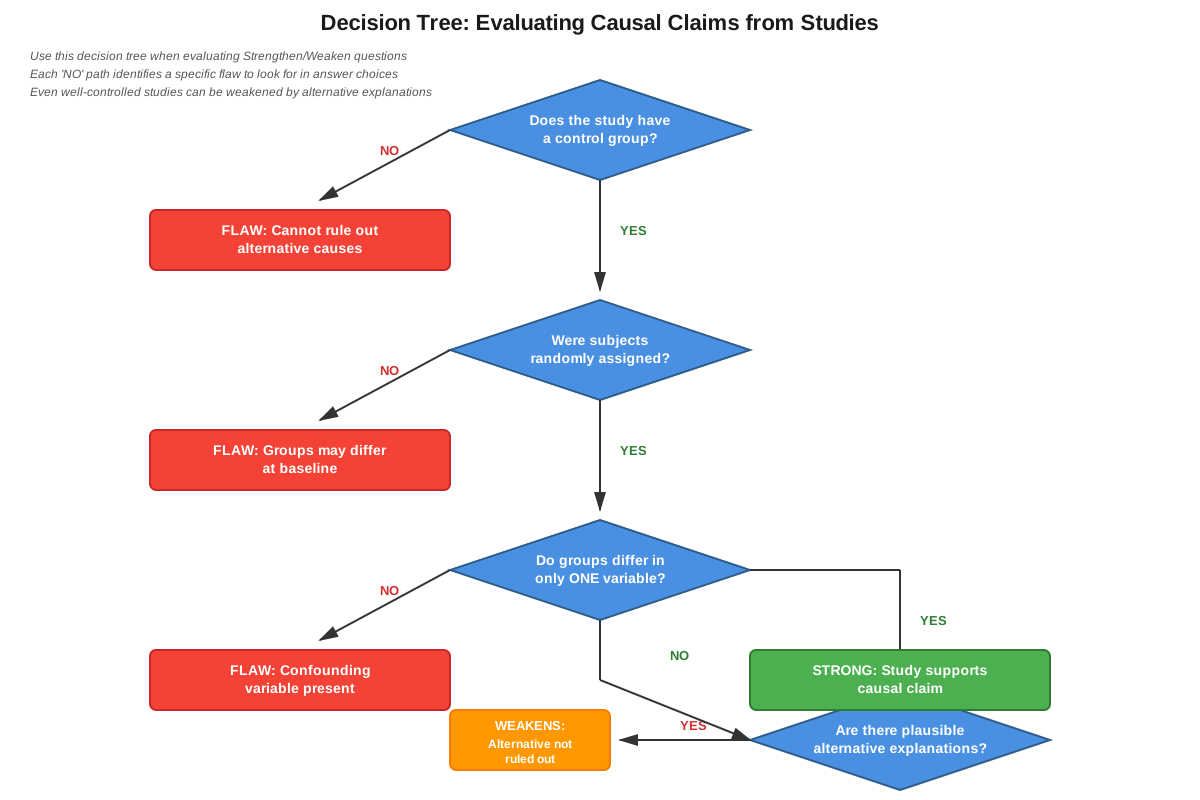
Systematic Approach to Study-Based Questions
Step 1: Identify the study's conclusion (What causal claim is being made?)
Step 2: Map the study design
- Is there a control group?
- Was assignment random or self-selected?
- What variables were controlled?
- What was measured and how?
Step 3: Identify potential confounding variables
- What factors might differ between groups?
- What alternative explanations could account for results?
Step 4: Match your analysis to the question type
- Weaken: Look for uncontrolled variables or alternative explanations
- Strengthen: Look for evidence that rules out alternatives or improves methodology
- Flaw: Identify the specific methodological problem
- Assumption: Identify what must be true about the study design for the conclusion to follow
Process of Elimination Tips
Eliminate answers that:
- Introduce irrelevant information that doesn't affect the causal relationship
- Address the wrong variable (dependent instead of independent, or vice versa)
- Strengthen when you need to weaken, or vice versa
- Discuss the study's practical implications rather than its methodology
- Mention factors that were already controlled for in the study design
Keep answers that:
- Identify or rule out confounding variables
- Address whether groups were truly comparable
- Discuss factors that could provide alternative explanations
- Relate to the specific mechanism by which the cause supposedly produces the effect
Time Allocation
Spend 15-20 seconds identifying the study design and potential flaws before looking at answer choices. This upfront investment prevents you from being swayed by attractive but incorrect answers. For controlled studies questions:
- Weaken/Strengthen: 1:15-1:30 (slightly longer due to complexity)
- Flaw: 1:00-1:15
- Assumption: 1:15-1:30
If you're stuck, ask: "What's the most obvious alternative explanation for these results?" The correct answer often addresses that explanation.
Memory Techniques
The RICE Mnemonic for Study Evaluation
Random assignment (Were groups created fairly?)
Isolation of variables (Does only one thing differ between groups?)
Control group (Is there a baseline for comparison?)
Elimination of alternatives (Have other explanations been ruled out?)
Visualization Strategy
Picture a controlled study as a balance scale:
- Both sides must be equal except for the one weight (variable) you're testing
- If the scale tips, you know that weight caused the change
- If other weights differ between sides, you can't tell what caused the tipping
The "What Else?" Question
When evaluating any study, automatically ask: "What else could explain these results?" This single question captures the essence of identifying confounding variables and alternative explanations.
Acronym for Common Confounds
SHAPES - Common confounding variables to consider:
Selection bias (non-random assignment)
History (external events during the study)
Attention (experimental group receives more attention)
Placebo effects (expectations influencing outcomes)
Existing differences (groups differed before treatment)
Sample size (too small for reliable conclusions)
Summary
Controlled studies represent the gold standard for establishing causal relationships by systematically comparing groups that differ only in the variable being tested. The LSAT extensively tests understanding of what makes studies methodologically sound: random assignment to prevent selection bias, control groups to provide baseline comparisons, and careful control of variables to eliminate alternative explanations. Questions typically present studies with methodological flaws—missing control groups, confounding variables, or non-random assignment—and ask test-takers to identify these problems or determine what information would strengthen or weaken the causal conclusion. Success requires recognizing that correlation alone cannot establish causation and that the strength of a causal inference depends entirely on how thoroughly alternative explanations have been ruled out. Mastering this topic means automatically asking "What else could explain these results?" and systematically evaluating whether the study design adequately addresses that question.
Key Takeaways
- Control groups are essential for establishing causation because they show what would have happened without the treatment, ruling out alternative explanations like natural improvement or time-related factors
- Random assignment prevents selection bias by ensuring experimental and control groups are comparable, eliminating systematic pre-existing differences as alternative explanations
- Confounding variables are uncontrolled factors that provide alternative explanations for results; identifying these is key to weakening arguments based on studies
- The LSAT tests methodology, not results—focus on how the study was conducted, not whether its findings seem plausible or important
- Correlation never establishes causation alone; additional evidence ruling out alternative explanations is always required
- Every uncontrolled variable is a potential alternative explanation that weakens the causal inference
- Strengthen/weaken questions about studies typically hinge on whether alternative explanations have been adequately ruled out or whether new confounding variables are introduced
Related Topics
Causal Reasoning: Controlled studies provide the empirical foundation for causal claims; mastering this topic enables deeper understanding of how causation is established and challenged in logical arguments.
Necessary and Sufficient Conditions: Understanding these logical relationships helps clarify what must be true for a study to validly support its conclusion and what conditions are merely correlated vs. causally related.
Sampling and Generalization: Even well-controlled studies may have limited applicability; this topic addresses when findings from a sample can be extended to broader populations.
Correlation vs. Causation: This fundamental distinction underlies all controlled study questions; mastering controlled studies provides concrete examples of how to move from correlation to justified causal claims.
Alternative Explanations: The primary purpose of experimental controls is to eliminate alternative explanations; this topic explores how to systematically identify and evaluate competing hypotheses.
Practice CTA
Now that you understand the principles of controlled studies and how they appear on the LSAT, it's time to apply this knowledge. Work through the practice questions to reinforce your ability to identify methodological flaws, evaluate study designs, and determine what would strengthen or weaken causal arguments. Use the flashcards to memorize key concepts like the components of proper experimental design and common confounding variables. Remember: controlled studies questions separate high scorers from the rest because they require careful, systematic thinking about evidence quality. With practice, you'll develop the instinct to automatically spot missing controls and alternative explanations, making these questions some of your most reliable points on test day.
Sign up free to keep reading
Create a free AnvayaPrep account to finish this LSAT guide on Controlled studies — plus flashcards and practice questions.