Overview
Correlation evidence is one of the most frequently tested concepts in LSAT Logical Reasoning sections, appearing in approximately 15-20% of all questions. This topic sits at the heart of causation and explanation reasoning, requiring test-takers to understand the critical distinction between events that occur together (correlation) and events where one causes the other (causation). The LSAT consistently tests whether students can recognize when an argument inappropriately jumps from observing a correlation to concluding a causal relationship, or conversely, when correlation evidence legitimately supports or weakens a causal claim.
Understanding lsat correlation evidence is essential because it forms the foundation for evaluating arguments across multiple question types, including Strengthen, Weaken, Flaw, Assumption, and Evaluate questions. The test-makers design questions that exploit common reasoning errors people make when interpreting statistical relationships and observational data. Students who master this topic gain a significant competitive advantage, as they can quickly identify the logical structure of arguments involving correlational data and predict what information would strengthen or weaken such arguments.
This topic connects intimately with other Logical Reasoning concepts including necessary and sufficient conditions, alternative explanations, and statistical reasoning. Mastery of correlation evidence enables students to tackle more complex argument structures and prepares them for the sophisticated reasoning required in the most difficult LSAT questions, particularly those involving scientific studies, policy recommendations, and causal chains.
Learning Objectives
- [ ] Identify how Correlation evidence appears in LSAT questions
- [ ] Explain the reasoning pattern behind Correlation evidence
- [ ] Apply Correlation evidence to solve LSAT-style problems accurately
- [ ] Distinguish between correlation and causation in argument structures
- [ ] Recognize the three primary alternative explanations for any observed correlation
- [ ] Evaluate whether additional evidence strengthens or weakens a causal claim based on correlational data
- [ ] Predict common wrong answer choices in correlation-based questions
Prerequisites
- Basic argument structure: Understanding premises and conclusions is essential because correlation evidence typically appears as a premise supporting a causal conclusion
- Conditional reasoning fundamentals: Recognizing the difference between "if-then" relationships and causal relationships helps distinguish correlation from causation
- Statistical reasoning basics: Familiarity with concepts like sample size and representativeness aids in evaluating the strength of correlational evidence
- Argument evaluation skills: The ability to identify assumptions and gaps in reasoning is necessary to spot the leap from correlation to causation
Why This Topic Matters
In real-world contexts, the ability to distinguish correlation from causation is crucial for evaluating scientific claims, policy proposals, medical advice, and business decisions. Professionals across fields—from medicine to public policy to business analytics—must regularly assess whether observed relationships represent genuine causal connections or merely coincidental patterns. The reasoning skills developed through mastering this LSAT topic transfer directly to critical thinking in professional and personal contexts.
On the LSAT, correlation evidence appears with remarkable frequency and predictability. Approximately 15-20% of Logical Reasoning questions involve correlational reasoning, making it one of the highest-yield topics for focused study. These questions appear most commonly as:
- Flaw questions where the error involves assuming causation from correlation
- Weaken questions requiring identification of alternative explanations
- Strengthen questions asking for evidence that rules out alternative explanations
- Assumption questions testing understanding of what must be true for a causal conclusion to follow from correlational premises
- Evaluate questions seeking information that would help determine whether correlation indicates causation
The LSAT tests this concept because it represents a fundamental reasoning skill that law students and lawyers must possess. Legal arguments frequently involve interpreting statistical evidence, evaluating expert testimony about causal relationships, and distinguishing between coincidental associations and genuine causal connections in case law and statutory interpretation.
Core Concepts
Understanding Correlation Evidence
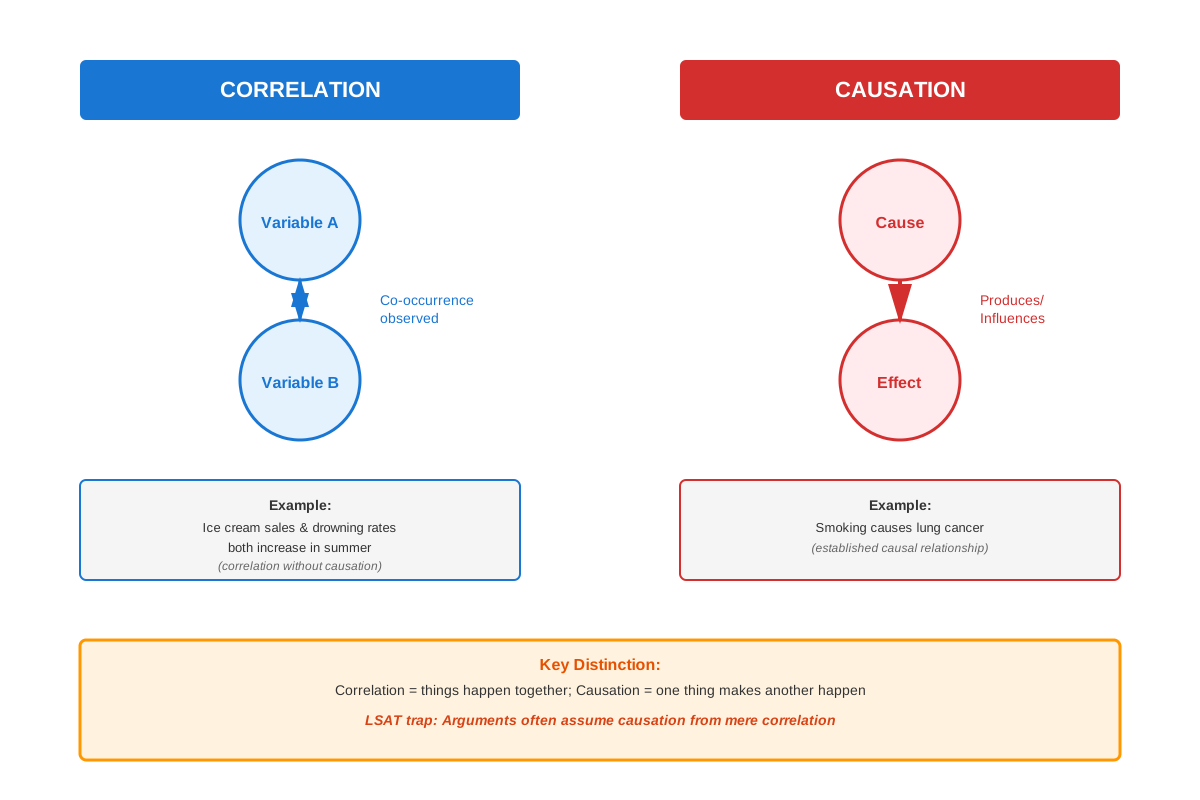
Correlation evidence refers to observational data showing that two or more phenomena occur together with some degree of regularity. When two variables are correlated, changes in one variable are associated with changes in another variable. For example, ice cream sales and drowning deaths are positively correlated—they both increase during the same time periods. However, this correlation does not mean ice cream consumption causes drowning.
Correlations can be positive (both variables increase together), negative (one increases as the other decreases), or zero (no systematic relationship). The LSAT focuses primarily on positive correlations, though negative correlations occasionally appear. The strength of a correlation can vary from weak to strong, though the LSAT typically presents clear correlational patterns rather than ambiguous statistical relationships.
The Correlation-Causation Distinction
The fundamental principle underlying all lsat correlation evidence questions is this: correlation does not imply causation. Just because two events occur together does not mean one causes the other. This principle is so important that it appears in various forms across dozens of LSAT questions each year.
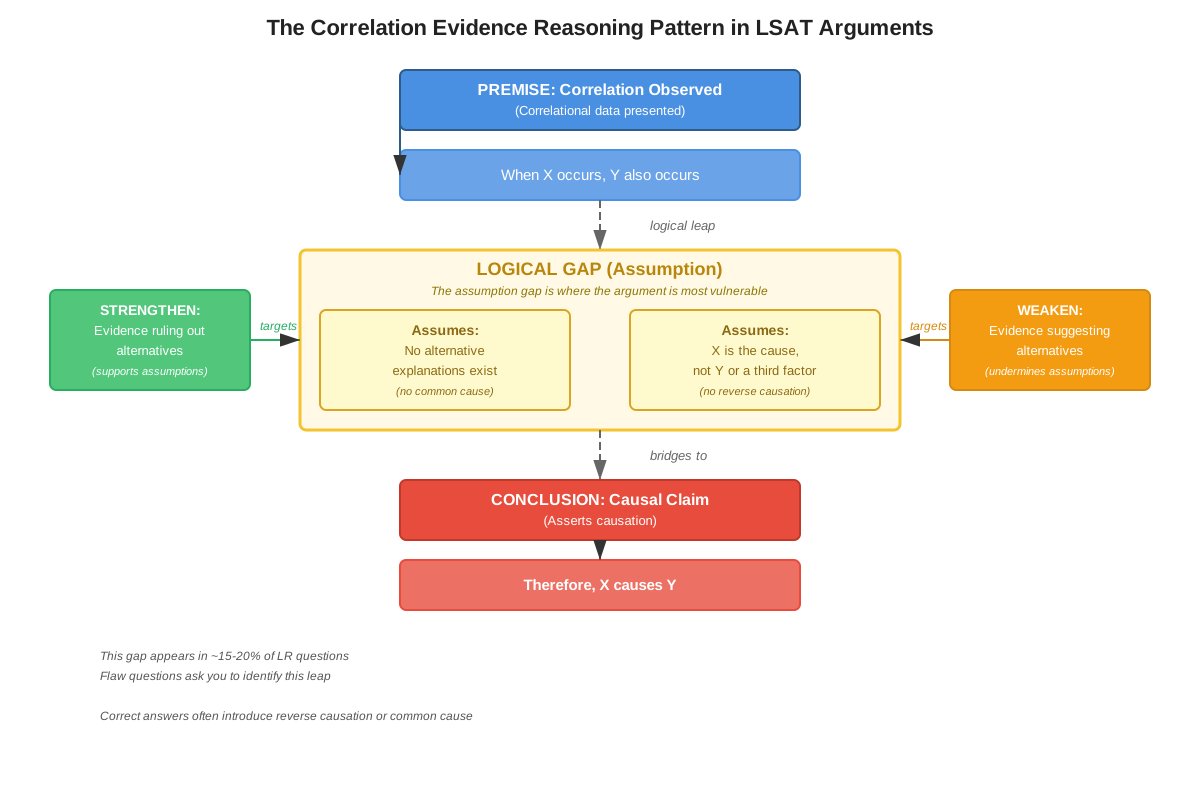
When an argument moves from observing a correlation to concluding a causal relationship, it commits a logical error unless additional evidence rules out alternative explanations. The LSAT tests whether students recognize this gap in reasoning and understand what additional information would be needed to bridge it.
The Three Alternative Explanations
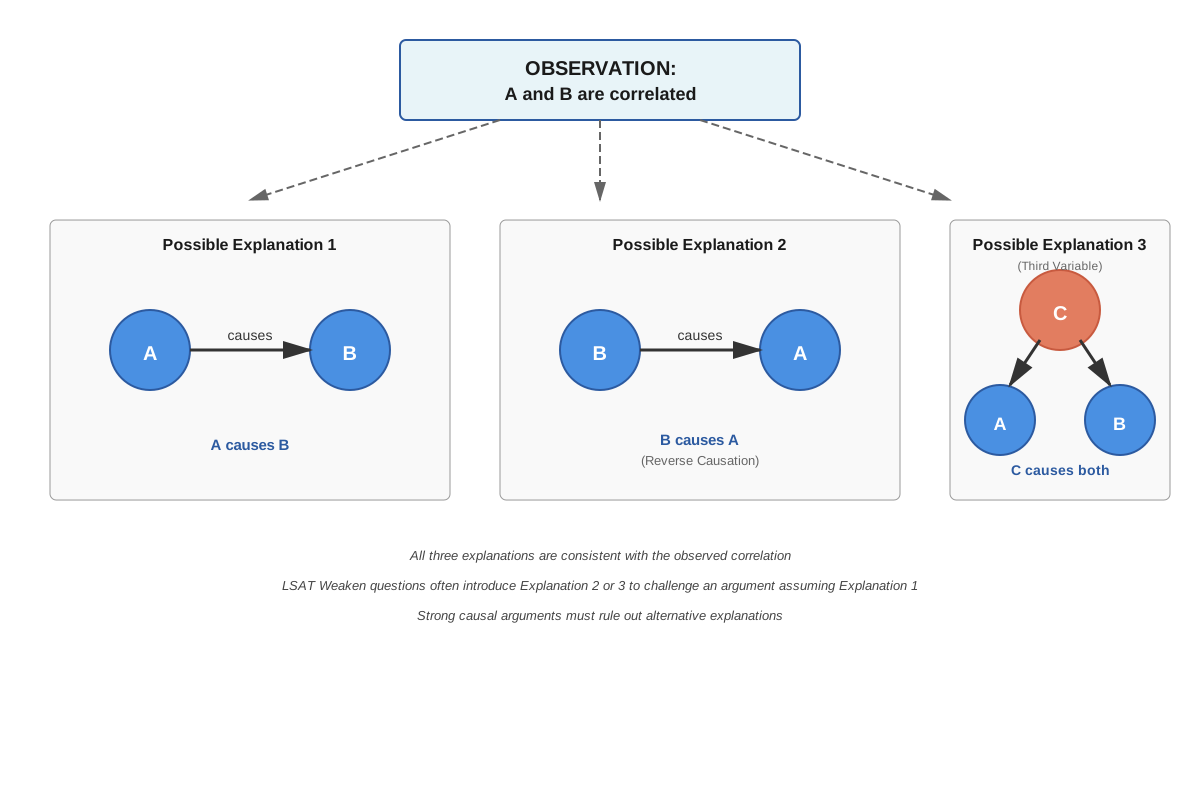
For any observed correlation between variables A and B, there are exactly three possible explanations:
- A causes B: The first variable genuinely causes the second
- B causes A: The causal direction is reversed from what the argument claims
- C causes both A and B: A third factor (common cause) produces both observed phenomena
Understanding these three alternatives is crucial for logical reasoning success. Every correlation question on the LSAT involves one or more of these possibilities.
| Explanation Type | Description | Example |
|---|---|---|
| Direct Causation | A → B | Exercise causes improved mood |
| Reverse Causation | B → A | Improved mood causes more exercise |
| Common Cause | C → A and C → B | Warm weather causes both more exercise and improved mood |
Identifying Correlation Evidence in Arguments
Correlation evidence typically appears in LSAT arguments through specific linguistic markers:
- Statistical associations: "Studies show that X is associated with Y"
- Temporal co-occurrence: "X and Y occur together"
- Comparative observations: "People who do X are more likely to experience Y"
- Survey results: "Surveys reveal that X correlates with Y"
- Trend data: "As X increases, Y also increases"
The conclusion following such evidence often uses causal language:
- "X causes Y"
- "X is responsible for Y"
- "X leads to Y"
- "X produces Y"
- "X results in Y"
- "Y is due to X"
Strengthening Causal Arguments from Correlation
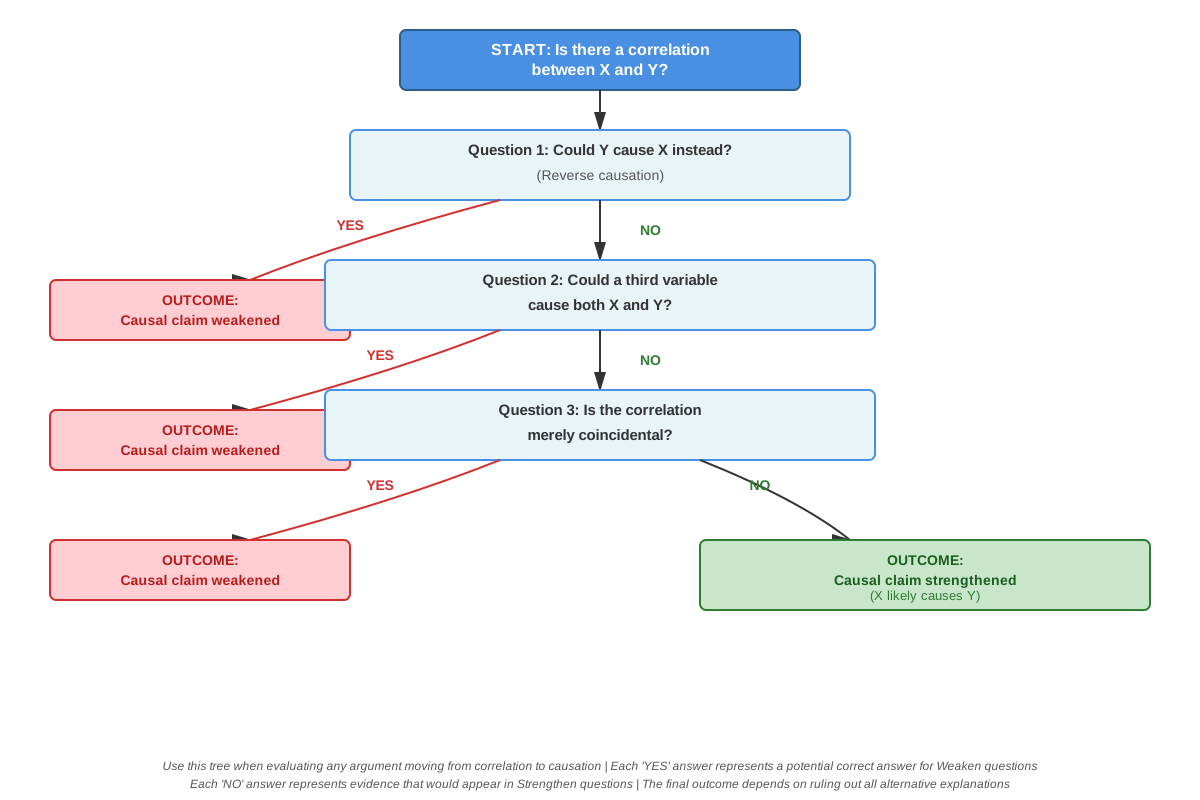
To strengthen an argument that concludes causation from correlation, evidence must rule out alternative explanations. The most effective strengthening evidence:
- Rules out reverse causation: Shows that B cannot cause A (perhaps B occurs after A, or B lacks the mechanism to produce A)
- Rules out common causes: Demonstrates that no third factor could explain both phenomena
- Shows mechanism: Explains how A could plausibly cause B
- Demonstrates temporal priority: Establishes that A occurs before B
- Controls for confounding variables: Shows the correlation persists even when other factors are held constant
Weakening Causal Arguments from Correlation
To weaken an argument concluding causation from correlation, evidence should:
- Suggest reverse causation: Provide reason to think B might cause A instead
- Introduce a common cause: Identify a plausible third factor that could cause both A and B
- Show the correlation is spurious: Demonstrate that the relationship disappears under certain conditions
- Identify a confounding variable: Point to another factor that better explains the observed relationship
- Challenge the mechanism: Show that A lacks the capacity to produce B
The Role of Temporal Sequence
Temporal sequence—the order in which events occur—plays a critical role in evaluating causal claims based on correlation. A fundamental principle of causation is that causes must precede their effects. Therefore, evidence showing that the alleged cause occurs before the alleged effect strengthens a causal argument, while evidence showing the reverse weakens it.
However, temporal priority alone is insufficient to establish causation. Many events occur in sequence without causal connection. The LSAT tests whether students recognize that temporal sequence is necessary but not sufficient for causation.
Controlled Experiments vs. Observational Studies
The LSAT occasionally distinguishes between controlled experiments (where researchers manipulate variables) and observational studies (where researchers merely observe naturally occurring patterns). Controlled experiments provide stronger evidence for causation because they can rule out confounding variables and establish temporal priority. Observational studies typically provide only correlational evidence.
When an argument cites an observational study showing correlation and concludes causation, it is more vulnerable to alternative explanations than an argument citing a controlled experiment.
Concept Relationships
The concepts within correlation evidence form a logical hierarchy. At the foundation lies the basic correlation-causation distinction—understanding that association does not imply causation. This fundamental principle generates the three alternative explanations (direct causation, reverse causation, common cause), which in turn determine how arguments can be strengthened (by ruling out alternatives) or weakened (by introducing plausible alternatives).
Temporal sequence connects to the three alternatives by helping rule out reverse causation—if A occurs before B, then B cannot cause A. Controlled experiments relate to the strengthening concept because they systematically rule out common causes and confounding variables.
The relationship map flows as follows:
Correlation Evidence → generates → Causal Claims → which require → Ruling Out Alternatives → specifically → Reverse Causation, Common Cause, Spurious Correlation → accomplished through → Temporal Evidence, Mechanistic Evidence, Controlled Studies → resulting in → Stronger or Weaker Arguments
This topic connects to prerequisite knowledge of argument structure because correlation evidence typically appears as premises supporting causal conclusions. It relates to conditional reasoning by contrast—conditional statements express logical relationships, while causal statements express real-world cause-and-effect relationships. Understanding this distinction prevents confusion between "if-then" logic and causal reasoning.
Correlation evidence also connects forward to more advanced topics in causation and explanation, including causal chains, necessary and sufficient conditions for causation, and complex multi-factor causal explanations.
High-Yield Facts
⭐ Correlation does not imply causation—this is the single most important principle for correlation evidence questions
⭐ Every correlation has exactly three possible explanations: A causes B, B causes A, or C causes both A and B
⭐ Temporal priority is necessary but not sufficient for causation—the cause must precede the effect, but occurring first does not prove causation
⭐ To strengthen a causal argument from correlation, rule out alternative explanations—especially reverse causation and common causes
⭐ To weaken a causal argument from correlation, introduce plausible alternative explanations—particularly common causes
- Controlled experiments provide stronger evidence for causation than observational studies because they can isolate variables
- The presence of a correlation between A and B does not tell us the direction of causation
- Multiple correlations can exist simultaneously without any causal relationships being present
- A strong correlation is not stronger evidence for causation than a weak correlation unless alternative explanations are ruled out
- Confounding variables are third factors that create spurious correlations between variables that are not causally related
- The LSAT rarely requires statistical knowledge beyond understanding what correlation means
- Arguments that move from correlation to causation without addressing alternatives commit a logical flaw
- Evidence showing a mechanism by which A could cause B strengthens but does not prove a causal relationship
Quick check — test yourself on Correlation evidence so far.
Try Flashcards →Common Misconceptions
Misconception: If two things are strongly correlated, one must cause the other → Correction: Strong correlation indicates a reliable association but provides no information about causation without additional evidence ruling out alternative explanations. Ice cream sales and drowning deaths are strongly correlated, but neither causes the other—both are caused by warm weather.
Misconception: Temporal sequence proves causation—if A happens before B, then A causes B → Correction: Temporal priority is necessary for causation but not sufficient. Night always precedes day, but night does not cause day. Many sequential events have no causal relationship.
Misconception: If we can't think of an alternative explanation, the correlation must indicate causation → Correction: The inability to immediately identify an alternative explanation does not mean none exists. The LSAT specifically tests whether students can recognize that unidentified confounding variables might exist.
Misconception: Reverse causation and common cause are the same thing → Correction: Reverse causation means B causes A (opposite of the claimed direction), while common cause means C causes both A and B. These are distinct alternative explanations requiring different types of evidence to rule out.
Misconception: Correlation evidence is weak evidence that should be dismissed → Correction: Correlation evidence is valuable and often the starting point for establishing causation. The issue is not that correlation is worthless, but that it requires additional evidence (ruling out alternatives) before supporting a causal conclusion.
Misconception: If A causes B, there must be a correlation between A and B → Correction: While causation typically produces correlation, causal relationships can exist without observable correlation if confounding factors mask the relationship or if the causal effect is weak relative to other influences.
Misconception: Statistical significance means causation → Correction: Statistical significance indicates that a correlation is unlikely to be due to random chance, but it says nothing about whether the correlation represents a causal relationship. A statistically significant correlation still requires additional evidence to support a causal conclusion.
Worked Examples
Example 1: Identifying the Flaw
Question: "A recent study found that people who drink coffee daily are less likely to develop Parkinson's disease than people who do not drink coffee. Therefore, drinking coffee prevents Parkinson's disease."
Analysis:
Step 1: Identify the evidence type. The premise presents correlation evidence—an observed association between coffee drinking and lower rates of Parkinson's disease.
Step 2: Identify the conclusion type. The conclusion makes a causal claim—that coffee drinking prevents (causes the absence of) Parkinson's disease.
Step 3: Recognize the logical gap. The argument moves from correlation to causation without ruling out alternative explanations.
Step 4: Consider the three alternatives:
- Could reverse causation apply? Could early Parkinson's symptoms cause people to avoid coffee? Possibly—early symptoms might include sensitivity to stimulants.
- Could a common cause apply? Could a third factor cause both coffee drinking and lower Parkinson's rates? Possibly—genetic factors might influence both beverage preferences and disease susceptibility.
Step 5: Identify the flaw. The argument assumes that correlation implies causation without considering alternative explanations.
Answer approach: For a Flaw question, the correct answer would describe the correlation-causation error. For a Weaken question, look for an answer introducing reverse causation or a common cause. For a Strengthen question, look for an answer ruling out these alternatives.
Example 2: Strengthening a Causal Argument
Question: "Studies show that children who read frequently perform better academically than children who read infrequently. Which of the following, if true, most strengthens the conclusion that frequent reading causes improved academic performance?"
Analysis:
Step 1: Identify what needs strengthening. The argument concludes that reading causes academic improvement based on correlational evidence.
Step 2: Determine what would strengthen this. Evidence that rules out alternative explanations, particularly:
- Reverse causation: Maybe academically strong students choose to read more
- Common cause: Maybe family education level causes both reading frequency and academic success
Step 3: Evaluate answer choices (hypothetical examples):
(A) "Children from educated families both read more and perform better academically"
- This weakens by introducing a common cause
(B) "When schools implement mandatory reading programs, academic performance improves even among students who previously performed poorly"
- This strengthens by suggesting reading causes improvement (not just that good students read more) and by showing improvement occurs after increased reading
(C) "Students who perform well academically report enjoying reading"
- This is neutral or slightly weakens by suggesting reverse causation
(D) "Reading frequency correlates with performance across all subjects"
- This neither strengthens nor weakens—it just provides more correlation
(E) "Students who read frequently also tend to watch less television"
- This neither strengthens nor weakens the specific causal claim
Step 4: Select the answer that best rules out alternatives. Answer (B) is strongest because it addresses both reverse causation (poor performers improve when they read more) and establishes temporal sequence (reading increase precedes performance improvement).
Key takeaway: This example demonstrates that strengthening a causal argument from correlation requires evidence that rules out alternative explanations, particularly reverse causation and common causes.
Exam Strategy
Recognizing Correlation Questions
Watch for these trigger phrases that signal correlation evidence:
- "Studies show that X is associated with Y"
- "People who X are more likely to Y"
- "X and Y occur together"
- "As X increases, Y increases"
- "X correlates with Y"
- "Surveys reveal that X and Y co-occur"
When you see these phrases followed by causal language in the conclusion ("causes," "leads to," "produces," "results in"), you're dealing with a correlation-causation question.
Question Type Strategies
For Flaw Questions:
- Immediately check whether the argument moves from correlation to causation
- The correct answer will describe this logical gap, often using language like "takes a correlation as evidence of causation" or "fails to consider alternative explanations"
- Eliminate answers that describe flaws not present in the argument
For Weaken Questions:
- Look for answers that introduce reverse causation or common causes
- Prioritize answers that provide plausible alternative explanations
- Be wary of answers that merely show the correlation is weak—this doesn't address the causation claim
For Strengthen Questions:
- Look for answers that rule out reverse causation or common causes
- Temporal evidence (cause precedes effect) is often correct
- Evidence of a mechanism (how A could cause B) strengthens moderately
- Controlled experiment results strengthen more than additional correlational data
For Assumption Questions:
- The assumption will typically be that no alternative explanation exists
- Look for answers stating that reverse causation doesn't apply or that no common cause exists
- Use the negation test: if the assumption is false, the argument should fall apart
Time Management
Correlation questions are typically medium difficulty and should take 1:15-1:30 minutes. Don't overthink them:
- Identify correlation evidence (15 seconds)
- Identify causal conclusion (10 seconds)
- Consider the three alternatives (20 seconds)
- Evaluate answer choices (30-45 seconds)
If you're stuck, remember that common cause alternatives are more frequently correct than reverse causation alternatives in weaken questions, though both appear regularly.
Process of Elimination
Eliminate answers that:
- Provide additional correlation without addressing causation
- Are irrelevant to the specific correlation discussed
- Strengthen when you need to weaken (or vice versa)
- Address a different logical flaw than correlation-causation
Keep answers that:
- Directly address alternative explanations
- Provide temporal or mechanistic information
- Rule out or introduce confounding variables
Memory Techniques
The "ABC" Mnemonic
For remembering the three alternative explanations for any correlation:
A→B: A causes B (direct causation)
B→A: B causes A (reverse causation)
C→AB: C causes both A and B (common cause)
The "CRIME" Framework
For evaluating causal arguments from correlation, check whether the argument addresses:
Common causes (ruled out?)
Reverse causation (ruled out?)
Independent verification (mechanism explained?)
Mechanism (how could A cause B?)
Earlier occurrence (does A precede B?)
Visualization Strategy
Picture correlation as two lines moving together on a graph—they rise and fall in parallel. Now picture causation as an arrow from one to the other. The key insight: seeing the lines move together doesn't tell you whether an arrow exists or which direction it points.
The Ice Cream Reminder
Whenever you see correlation evidence, think: "Ice cream and drowning"—the classic example of correlation without causation. This instant reminder helps you avoid the correlation-causation trap.
Summary
Correlation evidence represents one of the highest-yield topics in LSAT Logical Reasoning, appearing in 15-20% of questions across multiple question types. The fundamental principle is that correlation does not imply causation—observing that two phenomena occur together does not establish that one causes the other. Every correlation has exactly three possible explanations: A causes B, B causes A, or C causes both A and B. Successful LSAT performance requires recognizing when arguments inappropriately leap from correlational premises to causal conclusions, understanding what evidence would strengthen such arguments (ruling out alternative explanations), and identifying what would weaken them (introducing plausible alternatives). Temporal priority—establishing that the alleged cause precedes the alleged effect—is necessary but not sufficient for causation. Controlled experiments provide stronger evidence than observational studies because they can isolate variables and rule out confounding factors. Mastering this topic requires practice identifying correlation evidence through linguistic markers, systematically considering the three alternative explanations, and selecting answers that appropriately address these alternatives based on question type.
Key Takeaways
- Correlation does not imply causation—this principle underlies 15-20% of all Logical Reasoning questions
- Every observed correlation has exactly three possible explanations: direct causation, reverse causation, or common cause
- Strengthening a causal argument from correlation requires ruling out alternative explanations, particularly reverse causation and common causes
- Weakening such arguments requires introducing plausible alternative explanations
- Temporal sequence (cause before effect) is necessary but not sufficient for establishing causation
- Watch for trigger phrases like "associated with," "correlated with," and "occur together" followed by causal language in conclusions
- The three-alternative framework (A→B, B→A, C→AB) provides a systematic approach to every correlation question
Related Topics
Causal Chains and Complex Causation: Building on basic correlation-causation reasoning, this topic explores arguments involving multiple causal steps (A causes B, which causes C) and how to strengthen or weaken such chains. Mastering correlation evidence provides the foundation for understanding these more complex causal structures.
Necessary and Sufficient Conditions for Causation: This advanced topic examines what conditions must be present for causation to occur and what conditions guarantee causation, connecting logical reasoning about conditionals to causal reasoning.
Statistical Reasoning and Sampling: This related topic covers how to evaluate statistical evidence more broadly, including sample representativeness, sample size, and statistical significance—concepts that often appear alongside correlation evidence in LSAT questions.
Alternative Explanations and Confounding Variables: This topic deepens understanding of how to identify and evaluate alternative explanations for observed phenomena, a skill directly built on correlation evidence mastery.
Practice CTA
Now that you understand the principles of correlation evidence, it's time to apply this knowledge to actual LSAT questions. The practice questions and flashcards will help solidify your ability to quickly identify correlation evidence, systematically consider alternative explanations, and select correct answers across all question types. Remember: correlation evidence questions are highly predictable and follow consistent patterns. With focused practice, you can master this high-yield topic and significantly improve your Logical Reasoning score. Start with the practice questions to test your understanding, then use the flashcards to reinforce the key principles until they become automatic. Your investment in mastering this topic will pay dividends across 15-20% of all Logical Reasoning questions you encounter.
Sign up free to keep reading
Create a free AnvayaPrep account to finish this LSAT guide on Correlation evidence — plus flashcards and practice questions.