Overview
Explaining a result is a fundamental reasoning pattern that appears frequently throughout the LSAT Logical Reasoning section. This question type presents students with an observed phenomenon, surprising outcome, or puzzling fact, then asks them to identify which answer choice best accounts for or explains why that result occurred. Unlike pure causal reasoning questions that focus on establishing cause-and-effect relationships, explaining a result questions require test-takers to work backward from an effect to identify its most plausible cause or contributing factors. These questions test the ability to evaluate competing explanations, distinguish between sufficient and necessary conditions, and recognize which factors genuinely account for an observed outcome versus those that are merely correlated or irrelevant.
The importance of mastering this topic cannot be overstated for LSAT success. Logical reasoning questions involving causation and explanation constitute a significant portion of the exam, and "explain the result" questions represent one of the most common question stems within this category. These questions assess critical thinking skills that law schools value highly: the ability to analyze complex situations, evaluate evidence, identify relevant factors, and distinguish strong explanations from weak ones. Students who can quickly recognize the structure of these arguments and systematically evaluate answer choices gain a substantial advantage in both accuracy and timing.
Within the broader landscape of Logical Reasoning concepts, explaining a result sits at the intersection of causal reasoning, argument analysis, and evidence evaluation. It shares conceptual territory with strengthen/weaken questions, assumption questions, and paradox resolution questions, but maintains its own distinct logical structure. While strengthen questions ask what would make an argument more convincing and assumption questions identify unstated premises, explaining a result questions specifically require identifying what accounts for a particular outcome. This topic builds directly on foundational understanding of argument structure, evidence types, and causal relationships while preparing students for more advanced reasoning tasks involving complex multi-factor explanations and competing hypotheses.
Learning Objectives
- [ ] Identify how Explaining a result appears in LSAT questions
- [ ] Explain the reasoning pattern behind Explaining a result
- [ ] Apply Explaining a result to solve LSAT-style problems accurately
- [ ] Distinguish between genuine explanations and mere correlations or coincidences
- [ ] Evaluate multiple competing explanations to determine which best accounts for a given result
- [ ] Recognize common wrong answer patterns in explaining a result questions
- [ ] Apply the principle of parsimony (simplest sufficient explanation) when multiple explanations seem plausible
Prerequisites
- Basic argument structure: Understanding premises, conclusions, and how evidence supports claims is essential because explaining a result questions require analyzing how explanatory factors relate to outcomes
- Causal reasoning fundamentals: Familiarity with cause-and-effect relationships provides the foundation for distinguishing genuine explanations from spurious correlations
- Conditional logic: Knowledge of sufficient and necessary conditions helps evaluate whether proposed explanations actually account for the observed results
- Evidence evaluation: The ability to assess the strength and relevance of evidence enables students to determine which explanations are best supported
Why This Topic Matters
In real-world contexts, the ability to explain results is fundamental to scientific reasoning, legal argumentation, business analysis, and everyday decision-making. Lawyers must regularly construct and evaluate explanations for events—why a contract was breached, what caused an accident, or why a witness behaved in a particular way. Scientists develop hypotheses to explain experimental results. Business analysts explain market trends and consumer behavior. This reasoning pattern reflects how humans naturally make sense of the world by identifying causes and explanatory factors for observed phenomena.
On the LSAT, explaining a result questions appear with remarkable frequency, typically comprising 8-12% of all Logical Reasoning questions across both sections. This translates to approximately 4-6 questions per test, making it one of the highest-yield question types to master. These questions appear in various forms: some present surprising statistical findings that need explanation, others describe unexpected outcomes from experiments or policies, and still others present puzzling discrepancies between expectations and reality. The question stems are usually straightforward, containing phrases like "Which one of the following, if true, most helps to explain...?" or "Which one of the following best accounts for the results described above?"
The exam frequently embeds these questions within passages discussing scientific studies, business scenarios, historical events, or social phenomena. Common contexts include medical research results, economic trends, behavioral patterns, technological outcomes, and policy effects. The LSAT tests not just whether students can identify an explanation, but whether they can identify the best explanation among several plausible options—a skill that requires nuanced understanding of explanatory power, relevance, and sufficiency.
Core Concepts
The Structure of Explaining a Result Questions
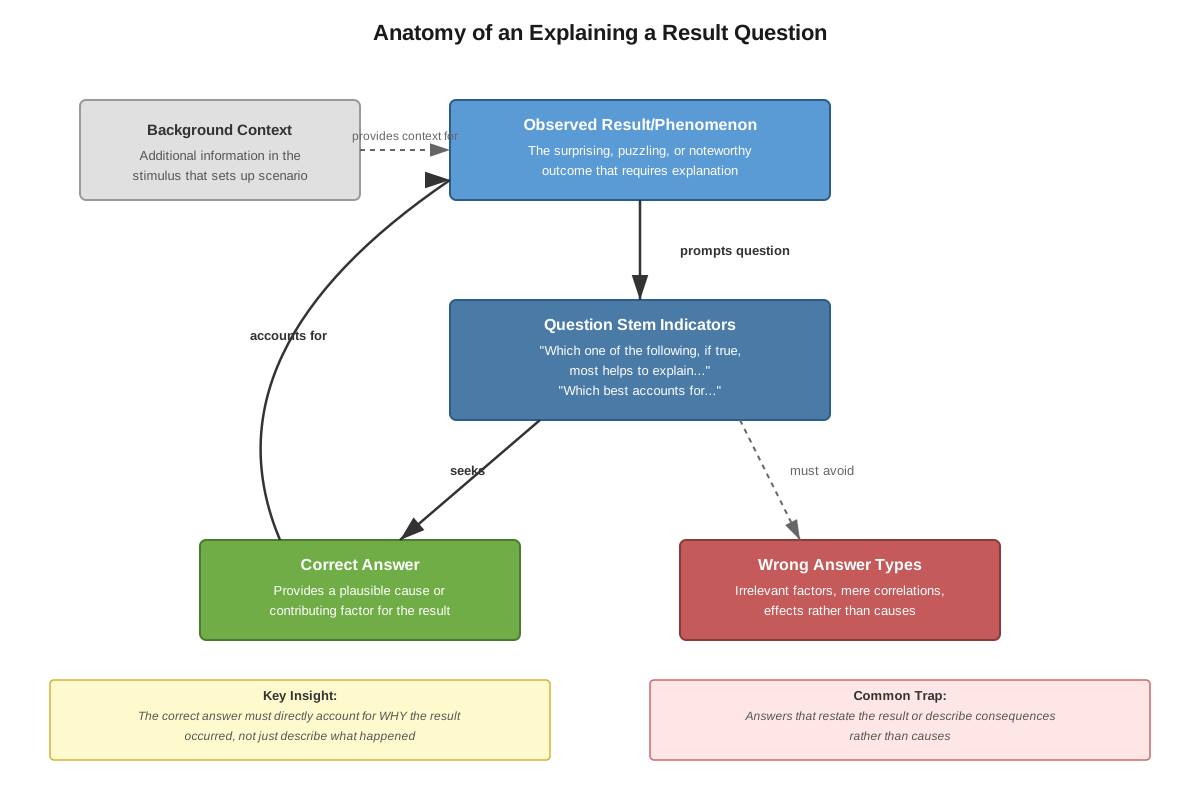
Explaining a result questions follow a predictable logical structure that students must recognize instantly. The stimulus presents an observed outcome, phenomenon, or result that requires explanation. This result is typically surprising, counterintuitive, or seemingly paradoxical—something that demands an account of why it occurred. The question stem then asks which answer choice best explains, accounts for, or resolves this result. Unlike strengthen questions where the conclusion is already stated and needs support, explaining a result questions present only the phenomenon itself, leaving the explanation to be identified among the answer choices.
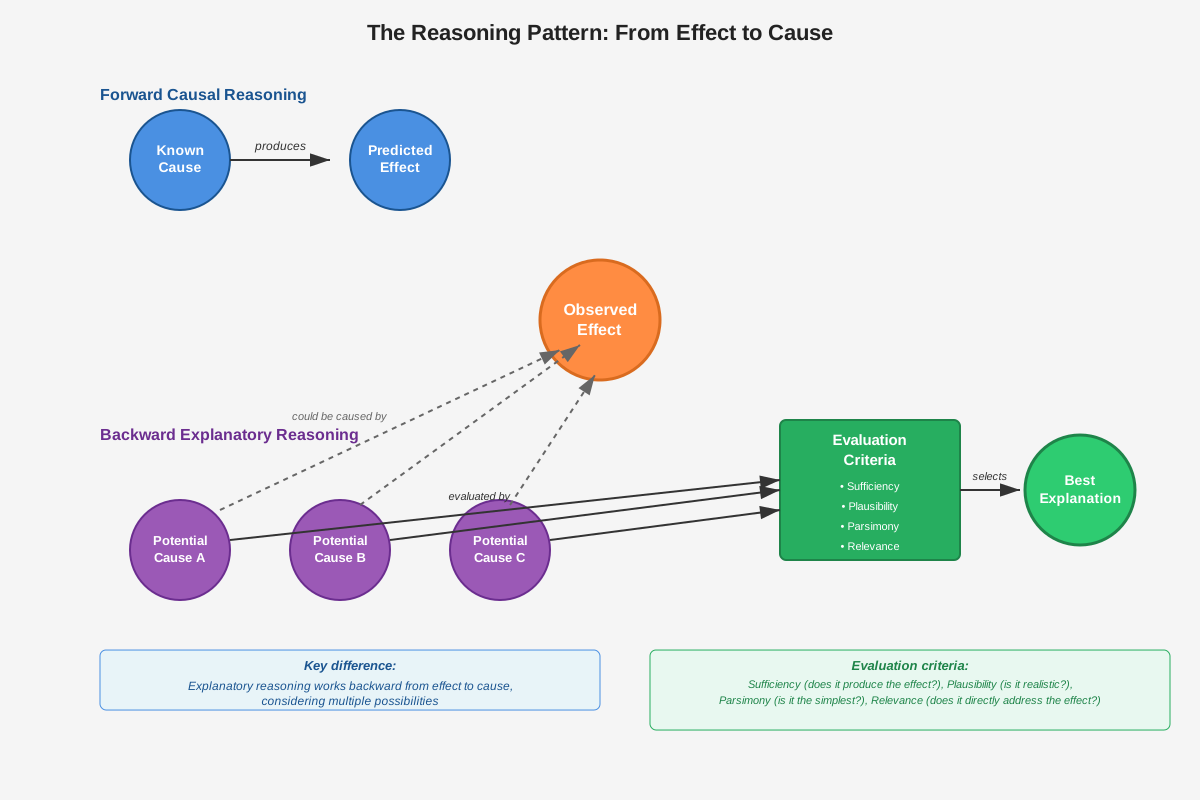
The key distinction lies in the direction of reasoning. In a standard argument, premises lead to a conclusion. In explaining a result questions, the "conclusion" (the observed result) is given, and the task is to identify what would serve as the best "premise" (explanatory factor) to account for it. This reverse-engineering of arguments requires understanding what makes an explanation adequate: it must be relevant to the specific result, sufficient to account for the outcome, and more plausible than competing explanations.
Characteristics of Strong Explanations
A strong explanation in LSAT explaining a result questions possesses several critical features. First, it must be directly relevant to the specific result described—it should address the particular phenomenon rather than tangential issues. Second, it must be sufficient to account for the result, meaning that if the explanation is true, the result becomes understandable or expected rather than surprising. Third, it should be parsimonious, meaning it explains the result without introducing unnecessary complexity or additional puzzling elements. Fourth, it should be complete in addressing all aspects of the result that need explanation, not just part of the phenomenon.
Consider the difference between these two scenarios:
| Feature | Weak Explanation | Strong Explanation |
|---|---|---|
| Relevance | Addresses a different outcome | Directly addresses the specific result |
| Sufficiency | Makes result slightly less surprising | Makes result fully expected |
| Parsimony | Introduces new puzzling elements | Uses straightforward causal mechanisms |
| Completeness | Explains only part of the phenomenon | Accounts for all aspects requiring explanation |
The Role of Background Assumptions
Explaining a result questions often rely on unstated background knowledge or common-sense assumptions about how the world works. The correct answer typically activates these assumptions to bridge the gap between the explanatory factor and the observed result. For example, if a question asks why sales increased after a price increase, the correct explanation might involve the product being a luxury good where higher prices signal quality—this relies on background knowledge about consumer psychology and market dynamics.
Students must distinguish between assumptions that are reasonable to make (based on common knowledge or information provided in the stimulus) and those that would constitute unwarranted leaps. The LSAT expects test-takers to bring general knowledge about human behavior, basic science, economics, and social dynamics, but not specialized expertise in any field.
Competing Explanations and Explanatory Power
Many explaining a result questions present multiple answer choices that could potentially account for the result to some degree. The task becomes identifying which explanation has the greatest explanatory power—which one best accounts for the result with the fewest additional assumptions and the most direct causal connection. Explanatory power involves both the strength of the causal connection and the scope of what is explained.
A complete explanation accounts for all surprising aspects of the result. If a phenomenon has multiple puzzling features, the best explanation addresses all of them rather than just one. For instance, if a study shows that people who drink coffee live longer and have lower rates of heart disease, an explanation that accounts for both findings is superior to one that explains only longevity.
Distinguishing Explanation from Correlation
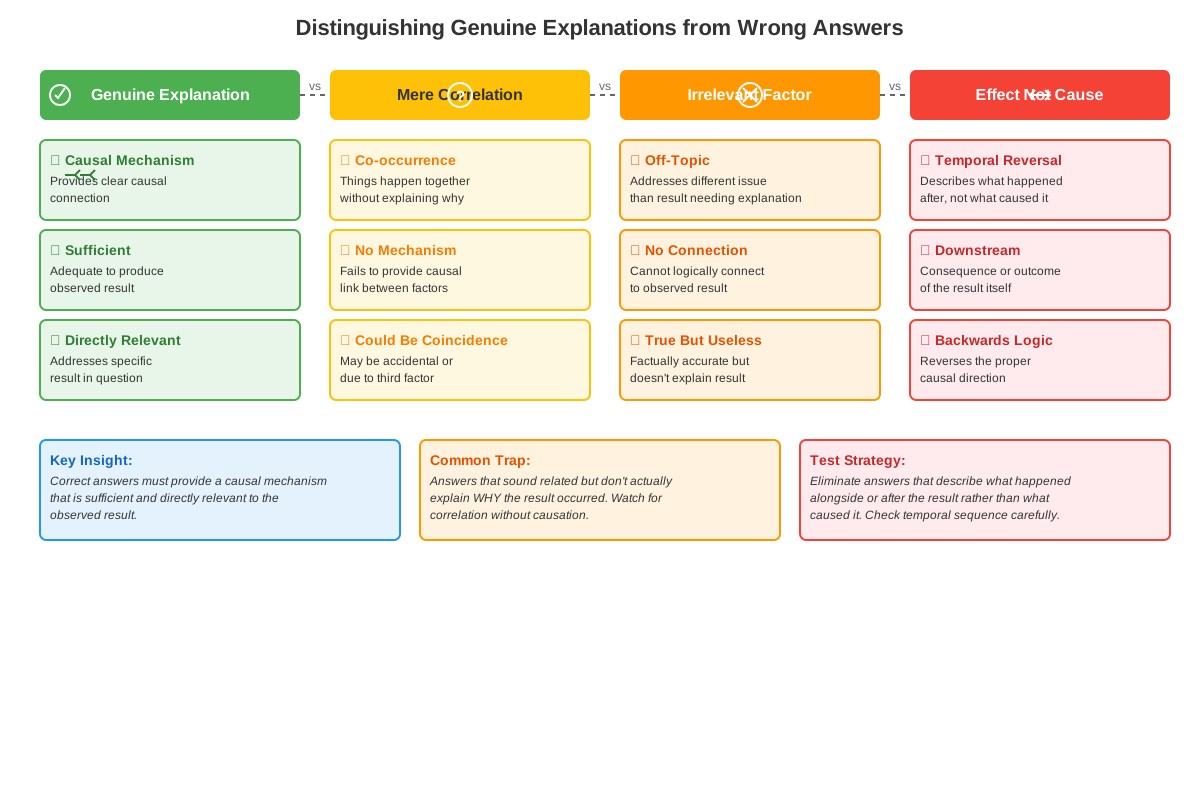
A critical skill in causation and explanation questions is distinguishing genuine explanatory factors from mere correlations. Just because two things occur together does not mean one explains the other. The correct answer in an explaining a result question must provide a plausible causal mechanism or identify a common cause that accounts for both observed phenomena.
For example, if ice cream sales and drowning deaths both increase in summer, ice cream sales don't explain drowning deaths—rather, warm weather explains both. The LSAT frequently includes wrong answers that present correlations without explanatory power, testing whether students can identify the difference.
The Principle of No Alternative Explanation Needed
Unlike paradox resolution questions where the correct answer must reconcile seemingly contradictory facts, explaining a result questions simply require an answer that makes the result understandable. The explanation doesn't need to be the only possible explanation or to rule out all alternatives—it just needs to be sufficient to account for the result. This is an important distinction because students sometimes eliminate correct answers thinking they need to prove the explanation is the sole cause, when in fact they only need to show it adequately accounts for the outcome.
Concept Relationships
The concepts within explaining a result questions form an interconnected logical framework. The observed result serves as the starting point, creating the need for explanation. This result's characteristics—whether it's surprising, counterintuitive, or seemingly paradoxical—determine what kind of explanation is needed. The explanatory factors presented in answer choices must connect to this result through plausible causal mechanisms or by identifying common causes that account for multiple aspects of the phenomenon.
The relationship flows as follows: Observed Result → Requires Explanation → Evaluate Proposed Explanatory Factors → Assess Causal Mechanisms → Determine Sufficiency and Relevance → Identify Best Explanation. Each step depends on the previous one, and weakness at any point undermines the entire reasoning chain.
This topic connects to prerequisite knowledge of causal reasoning by applying those principles in reverse—working from effect to cause rather than cause to effect. It relates to conditional logic because explanations often involve sufficient conditions: if the explanation is true, then the result becomes expected. The topic also connects forward to more complex reasoning tasks like paradox resolution (which requires explaining how two seemingly contradictory facts can both be true) and hypothesis evaluation (which involves comparing multiple explanations systematically).
Understanding explaining a result questions also enhances performance on strengthen and weaken questions because the same skills apply: identifying what factors make an outcome more or less likely. The key difference is that strengthen/weaken questions have an explicit conclusion being argued for, while explaining a result questions present only the phenomenon itself.
High-Yield Facts
⭐ Explaining a result questions present an observed outcome and ask which answer choice best accounts for why that outcome occurred
⭐ The correct answer must be sufficient to make the result expected or understandable, not merely possible
⭐ Strong explanations are directly relevant, sufficient, parsimonious, and complete in addressing all aspects of the result
⭐ The correct answer does not need to be the only possible explanation—it just needs to adequately account for the result
⭐ Correlation does not equal explanation; the correct answer must provide a plausible causal mechanism
- Explaining a result questions typically comprise 8-12% of LSAT Logical Reasoning questions
- Common question stems include "most helps to explain," "best accounts for," and "which of the following, if true, explains"
- Wrong answers often present factors that are correlated with the result but don't actually explain it
- The principle of parsimony favors simpler explanations over complex ones when both are sufficient
- Background assumptions and common-sense knowledge play a legitimate role in evaluating explanations
- An explanation that accounts for multiple puzzling aspects of a result is stronger than one that explains only part
- The observed result in the stimulus is always treated as factually true—never question whether it actually occurred
- Temporal sequence matters: the explanatory factor must occur before or simultaneously with the result, not after
- Wrong answers sometimes explain a different result than the one actually described in the stimulus
- The best explanation often involves identifying a previously unmentioned factor that bridges the gap between circumstances and outcome
Quick check — test yourself on Explaining a result so far.
Try Flashcards →Common Misconceptions
Misconception: The correct answer must be the only possible explanation for the result → Correction: The correct answer only needs to be sufficient to account for the result; multiple explanations could theoretically work, but the credited response will be the one that best explains the specific result described with the fewest additional assumptions.
Misconception: If an answer choice is correlated with the result, it explains the result → Correction: Correlation alone does not constitute explanation; the correct answer must provide a plausible causal mechanism connecting the explanatory factor to the observed outcome, not merely show that two things occur together.
Misconception: The explanation must address every possible aspect of the situation described → Correction: The explanation only needs to address the specific result that requires explanation, not every detail mentioned in the stimulus; focus on what makes the outcome surprising or puzzling.
Misconception: More complex explanations are more sophisticated and therefore better → Correction: The principle of parsimony favors simpler explanations when they adequately account for the result; introducing unnecessary complexity or additional puzzling elements weakens rather than strengthens an explanation.
Misconception: The correct answer must prove the explanation is definitely true → Correction: The question asks which answer choice, if true, best explains the result; you should assume the answer choice is true and evaluate whether it adequately accounts for the outcome, not whether the answer choice itself is proven.
Misconception: Explaining a result questions are the same as paradox resolution questions → Correction: While related, these question types differ: paradox questions present two seemingly contradictory facts and ask how both can be true, while explaining a result questions present a single outcome and ask what accounts for it occurring.
Worked Examples
Example 1: Medical Research Result
Stimulus: A recent study found that patients who received a new medication for anxiety reported significantly greater improvement than those who received a placebo. However, objective measurements of stress hormones showed no difference between the two groups. Which of the following, if true, best explains this result?
Answer Choices:
(A) The placebo used in the study was designed to look identical to the actual medication
(B) Patients' subjective reports of anxiety improvement often correlate poorly with objective physiological measurements
(C) The new medication reduces patients' awareness of their anxiety symptoms without actually reducing the underlying physiological stress response
(D) Stress hormone levels naturally fluctuate throughout the day regardless of medication
(E) The study included both patients with mild anxiety and those with severe anxiety
Analysis: The result requiring explanation has two components: (1) patients reported greater improvement with the medication, but (2) objective measurements showed no difference. We need an explanation that accounts for this discrepancy—why subjective and objective measures diverged.
- (A) is irrelevant to explaining the discrepancy; it explains why the study was properly blinded but doesn't account for the divergent results.
- (B) merely restates that subjective and objective measures often don't match, but doesn't explain why they diverged in this specific case. It describes the phenomenon rather than explaining it.
- (C) provides a specific causal mechanism: the medication affects symptom awareness without changing underlying physiology. This directly explains why patients felt better (reduced awareness of symptoms) while stress hormones remained unchanged (no actual physiological effect). This is the correct answer.
- (D) would affect both groups equally and doesn't explain why the medication group reported different subjective experiences.
- (E) doesn't explain the discrepancy between subjective reports and objective measurements; it just describes the study population.
Key Reasoning: The correct answer must explain both aspects of the puzzling result—why subjective reports improved AND why objective measures didn't. Answer (C) provides a mechanism that accounts for both, making it the best explanation.
Example 2: Economic Phenomenon
Stimulus: After a major retailer increased the price of its premium coffee brand by 20%, sales of that brand increased by 15% over the following quarter. Sales of the retailer's lower-priced coffee brands remained stable during the same period. Which of the following best accounts for this result?
Answer Choices:
(A) The retailer's advertising budget for all coffee products increased during that quarter
(B) Many consumers perceive higher-priced coffee as being of higher quality
(C) The costs of coffee beans increased significantly during that period
(D) The retailer's competitors did not change their coffee prices during that quarter
(E) Coffee consumption generally increases during the quarter in question due to seasonal factors
Analysis: The surprising result is that sales increased after a price increase, which contradicts normal economic expectations. We need an explanation for why higher prices led to higher sales specifically for the premium brand.
- (A) would likely affect all coffee brands equally, but the stimulus tells us lower-priced brands remained stable. This doesn't explain why only the premium brand saw increased sales.
- (B) provides a psychological mechanism: consumers use price as a quality signal, especially for premium products. When the price increased, consumers perceived the coffee as even higher quality, increasing demand. This directly explains the counterintuitive result and is the correct answer.
- (C) might explain why the retailer raised prices, but doesn't explain why consumers bought more at the higher price. This confuses the retailer's motivation with consumer behavior.
- (D) might make the retailer's coffee relatively more expensive, which would typically decrease sales, not increase them. This doesn't explain the result.
- (E) would affect all coffee brands and doesn't explain why specifically the premium brand that raised prices saw increased sales while lower-priced brands remained stable.
Key Reasoning: The explanation must account for the specific pattern: premium brand sales increased after a price increase, while other brands remained stable. Answer (B) provides a mechanism (price-quality perception) that explains why the premium brand specifically would see increased sales from a price increase.
Exam Strategy
When approaching explaining a result questions on the LSAT, begin by carefully identifying exactly what result requires explanation. Underline or mentally note the specific outcome, paying attention to any surprising, counterintuitive, or puzzling aspects. Ask yourself: "What about this result is unexpected or needs accounting for?" This focus prevents you from selecting answers that explain the wrong thing or address tangential issues.
Exam Tip: The phrase "if true" in the question stem is crucial—assume each answer choice is factually correct and evaluate whether it explains the result, rather than questioning whether the answer choice itself is plausible.
Watch for trigger words and phrases that signal explaining a result questions: "most helps to explain," "best accounts for," "which of the following explains why," "most helps to resolve the apparent discrepancy," and "best explains the results described above." These stems indicate you should focus on explanatory power rather than argument strength or logical validity.
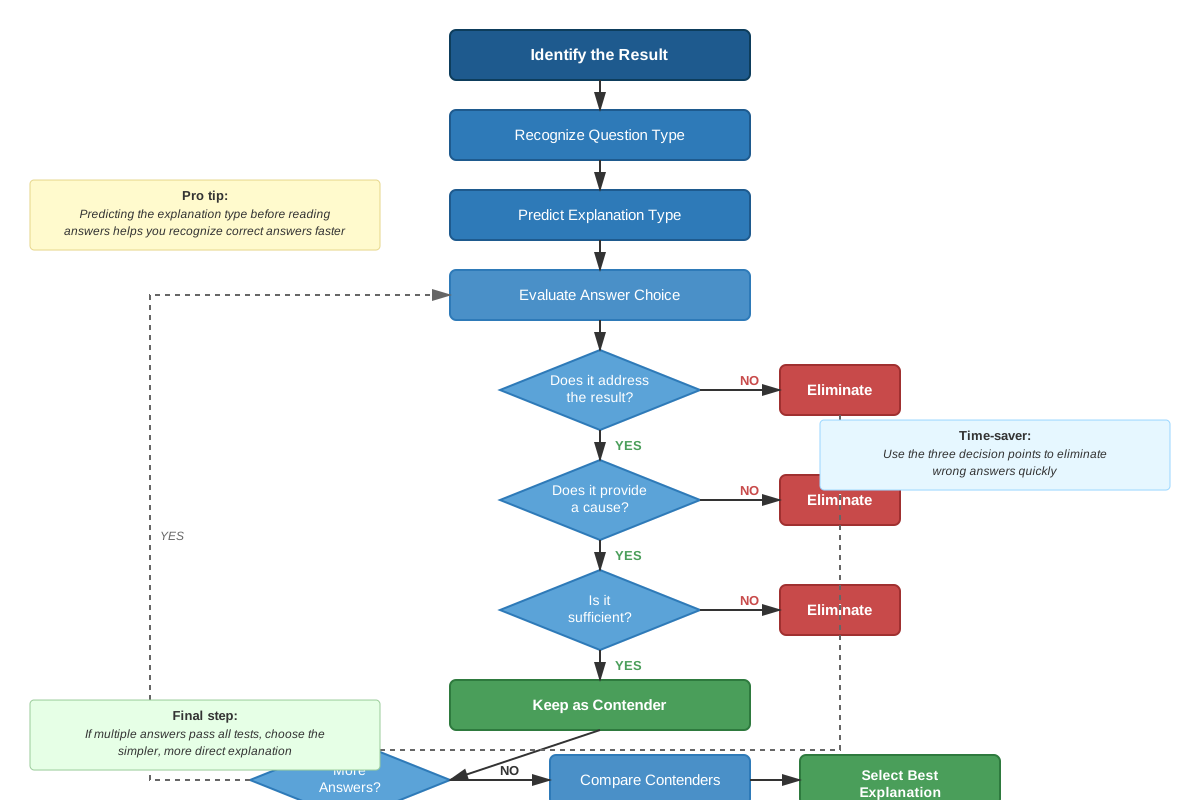
Apply a systematic process of elimination:
- Relevance check: Eliminate answers that address a different result or phenomenon than the one described
- Sufficiency check: Eliminate answers that make the result only slightly less surprising rather than fully explicable
- Causal mechanism check: Eliminate answers that present mere correlations without explaining why the result occurred
- Completeness check: If the result has multiple puzzling aspects, favor answers that address all of them
Time allocation for these questions should be approximately 1:15-1:30 per question. They typically require more careful reading of the stimulus than some other question types because you must fully understand the result before evaluating explanations. However, once you've identified what needs explaining, the answer choices can often be evaluated relatively quickly.
Common wrong answer patterns to watch for include: (1) answers that restate the result without explaining it, (2) answers that explain why the study was conducted but not why the result occurred, (3) answers that provide background information without explanatory power, (4) answers that explain part but not all of the puzzling result, and (5) answers that confuse correlation with causation.
When two answers seem close, apply the parsimony principle: favor the simpler, more direct explanation that requires fewer additional assumptions. Also consider scope—the answer that explains more aspects of the result is generally superior to one with narrower explanatory power.
Memory Techniques
Use the acronym RSCP to remember what makes a strong explanation:
- Relevant to the specific result
- Sufficient to account for the outcome
- Causal mechanism (not just correlation)
- Parsimonious (simple and direct)
Visualize explaining a result questions as detective work: you're given the crime scene (the result) and must identify which piece of evidence (answer choice) best explains what happened. Just as a detective needs evidence that directly connects to the specific crime, you need an explanation that directly connects to the specific result.
For remembering the difference between explanation and correlation, use the mnemonic "ICE CREAM doesn't DROWN people"—reminding you that ice cream sales and drowning deaths correlate but one doesn't explain the other; both are explained by a third factor (warm weather).
Create a mental checklist using the phrase "Does it MAKE SENSE?":
- Mechanism: Is there a plausible causal mechanism?
- All aspects: Does it address all puzzling aspects?
- Known facts: Is it consistent with information given?
- Expected: Does it make the result expected rather than surprising?
- Sufficient: Is it adequate to account for the result?
- Extraneous: Does it avoid introducing new puzzles?
- Not just correlation: Does it provide genuine explanation?
- Specific: Does it address this particular result?
- Economical: Is it parsimonious?
Summary
Explaining a result questions constitute a high-yield LSAT question type that tests the ability to work backward from an observed outcome to identify its most plausible cause or explanatory factors. These questions present a phenomenon—typically surprising or counterintuitive—and ask which answer choice best accounts for why it occurred. Success requires understanding that strong explanations must be directly relevant to the specific result, sufficient to make the outcome expected rather than surprising, and based on plausible causal mechanisms rather than mere correlation. The correct answer need not be the only possible explanation, but it must adequately account for the result with minimal additional assumptions. Students must distinguish between answers that genuinely explain the result and those that merely restate it, provide tangential information, or present correlations without explanatory power. Mastering this question type requires systematic evaluation of answer choices for relevance, sufficiency, causal connection, and completeness, while applying the principle of parsimony when multiple explanations seem plausible. The skills developed through explaining a result questions—identifying causal mechanisms, evaluating competing hypotheses, and distinguishing correlation from causation—are fundamental to legal reasoning and appear throughout the LSAT in various forms.
Key Takeaways
- Explaining a result questions present an observed outcome and require identifying which answer choice best accounts for why it occurred
- Strong explanations are relevant, sufficient, causally connected (not merely correlated), and parsimonious
- The correct answer must make the result expected or understandable, not just possible
- Focus on identifying exactly what aspect of the result is surprising or requires explanation before evaluating answer choices
- Correlation does not equal explanation—the correct answer must provide a plausible causal mechanism
- Apply systematic elimination: check relevance, sufficiency, causal mechanism, and completeness
- These questions appear frequently on the LSAT (8-12% of Logical Reasoning questions) and are highly testable
Related Topics
Paradox Resolution: While explaining a result questions ask what accounts for a single outcome, paradox resolution questions present two seemingly contradictory facts and ask how both can be true simultaneously. Mastering explaining a result provides the foundation for paradox questions.
Strengthen and Weaken Questions: These question types use similar reasoning skills but in different directions—strengthen questions ask what makes a conclusion more likely, while explaining a result questions identify what makes an observed outcome understandable. The causal reasoning skills transfer directly.
Causal Reasoning and Causation Flaws: Understanding how to identify genuine causal relationships versus spurious correlations is essential for both explaining results and identifying flawed causal arguments. These topics are deeply interconnected.
Assumption Questions: Both question types require identifying unstated elements that connect evidence to conclusions, though assumption questions focus on necessary conditions while explaining a result questions focus on sufficient explanations.
Practice CTA
Now that you've mastered the core concepts of explaining a result questions, it's time to put your knowledge into practice. Work through the practice questions to reinforce your understanding and develop the pattern recognition skills that lead to quick, accurate performance on test day. Each practice question you complete strengthens your ability to identify what makes an explanation strong and builds the systematic evaluation process that separates top scorers from average performers. The flashcards will help cement the key distinctions and principles in your memory. Remember: understanding the theory is just the beginning—consistent practice transforms knowledge into the automatic, confident performance that yields your target score.
Sign up free to keep reading
Create a free AnvayaPrep account to finish this LSAT guide on Explaining a result — plus flashcards and practice questions.